Root Rot on Philodendron Ring of Fire: Causes, Checks &
Quick answer
Root rot on Philodendron Ring of Fire usually starts with overwatered, airless mix: lower leaves yellow then brown and drop, growth stalls, and the stem base softens. First step: unpot the plant and inspect the roots — firm white to tan roots mean a watering reset, while brown mushy roots with a sour smell mean trim, sterilize, and repot into fresh chunky aroid mix.
Root Rot on Philodendron Ring of Fire: Causes, Checks & Fixes
This guide covers root rot on Philodendron Ring of Fire. See also the general Root Rot guide, watering, and light pages for this plant.
Root Rot on Philodendron Ring of Fire: Causes, Checks & Fixes
Quick answer
Root rot on Philodendron Ring of Fire almost always traces back to mix that stays wet and airless too long. Lower leaves turn yellow, then brown, and drop from the bottom up, new growth stalls, and in advanced cases the stem base goes soft. First step: unpot the plant and inspect the roots. Firm white-to-tan roots mean you caught it early and a watering reset will do; brown, mushy, foul-smelling roots mean trim back to healthy tissue with sterilized shears and repot into fresh, sterile, chunky aroid mix.
For how soggy mix damages roots in general, see our root-rot guide. On Ring of Fire, the pattern shows up in a very plant-specific way, described below.
What root rot looks like on Ring of Fire
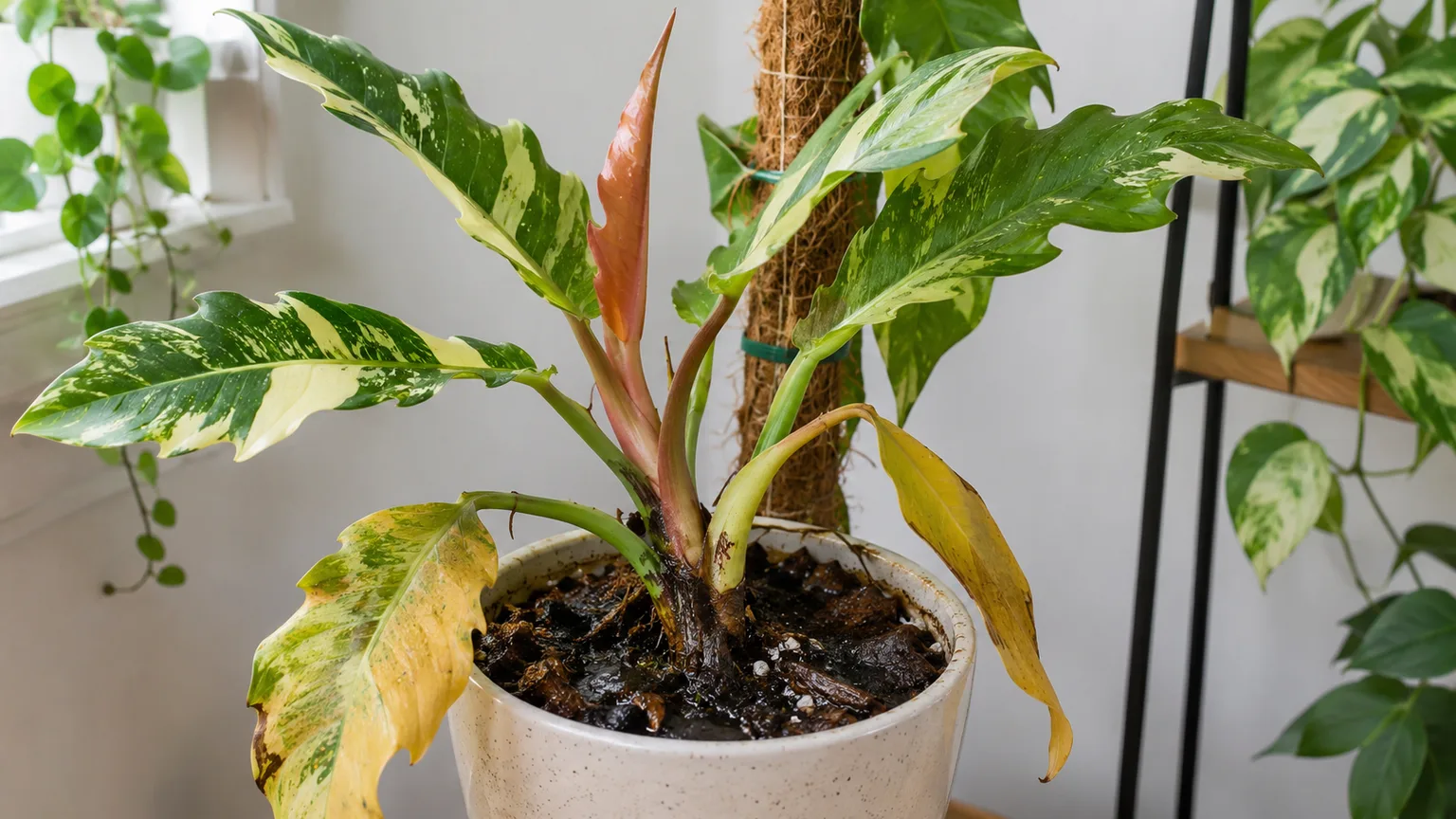
Because Ring of Fire is a climbing philodendron with thick stems and big serrated leaves, the above-ground pattern is distinctive. Yellowing starts on the lowest, oldest leaves and climbs upward, with leaves browning at the edges, wilting despite wet soil, and dropping. New leaves are the tell: a healthy plant pushes reddish spears that harden into variegated blades, but a rotting root system produces spears that stall, emerge small and pale, or collapse before unfurling.
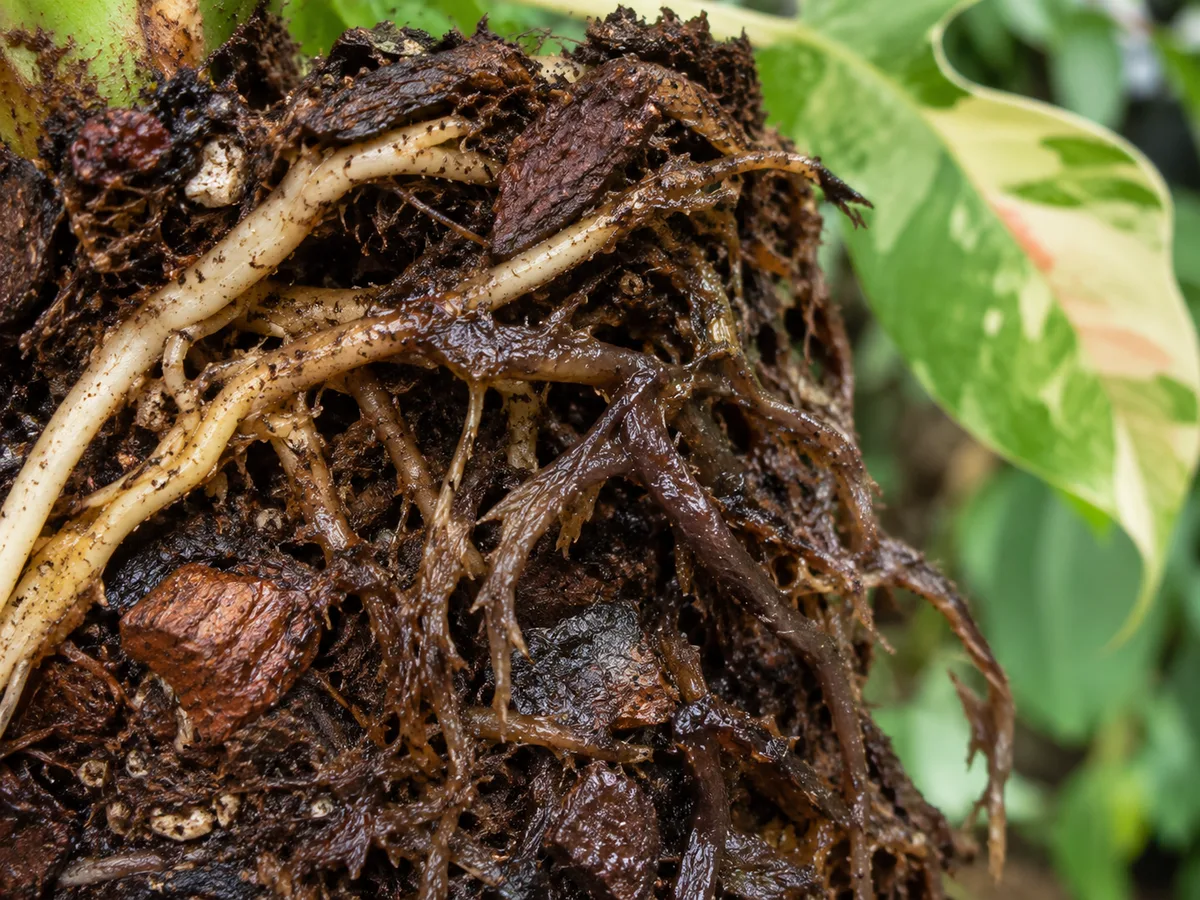
Root rot turns roots brown and soft, unlike firm white-to-tan healthy roots.
The pale variegated sectors deserve special attention. Cream and yellow patches hold less chlorophyll and scorch or brown first under any stress, so variegation browning alone is not a rot diagnosis. Suspect true root rot when variegation browning comes together with lower-leaf yellowing, a pot that stays heavy for days, and slowed or halted new growth.
Below the soil line, rotted roots are brown or black, soft and stringy, and often smell sour or swampy — in contrast to the firm’s healthy white-to-tan roots. If the stem base near the soil feels soft or looks darkened and translucent, rot has moved from roots into stem tissue, which is the escalation point on this thick-stemmed plant.
Why Ring of Fire gets root rot
Ring of Fire wants a chunky, airy aroid mix of potting mix plus perlite and orchid bark, watered only once the top 3–5 cm dry out. Most cases start when one of three things breaks that contract: the plant sits in dense peat-heavy nursery mix that never dries, the pot has no drainage hole or the nursery pot sits in a cachepot of standing water, or watering follows a calendar instead of the pot’s actual dry-down.
Light drives the timing. In the bright indirect light this cultivar needs for strong variegation, it drinks steadily and a 7–10 day summer rhythm works. In dim light the plant barely drinks, green oversized leaves replace colorful ones, and the same watering schedule keeps the mix waterlogged for weeks. Connecticut’s philodendron handbook describes exactly this failure mode: leaves gradually turn yellow, brown, and drop starting low on the plant when roots sit wet, with Rhizoctonia-type root rot as the named disease.
Two Ring of Fire–specific traps complete the picture. First, the moss pole: constantly soaked poles keep the stem base and aerial-root zone wet, and rot entering at a buried node can travel invisibly up the thick stem. Second, the nursery peat plug around the stem base, which holds water long after the surrounding chunky mix has dried. NC State Extension notes that on climbing philodendrons, overwatering leads directly to root rot, and this cultivar’s fast growth in good light makes owners overconfident about how much water it wants in winter.
The first fix: unpot and inspect the roots
Do this within a day or two if stems are soft or yellowing is spreading. Slide the plant out, shake and rinse the mix gently from the roots, and assess:
- Firm, white-to-tan roots, no smell: early stage. No surgery needed — repot into the same-size or one-size-smaller clean pot with fresh chunky mix, water lightly once, then resume watering only when the top 3–5 cm dry.
- Some brown mushy roots, firm stem base: moderate rot. Trim every soft root back to firm white tissue with sterilized scissors, rinse, and repot into fresh sterile mix in a cleaned pot.
- Mostly mush with a sour smell and a soft, dark stem base: severe. Cut back to the highest firm stem with a healthy node and propagate it as a cutting (see below), because the handbook is blunt that heavily symptomatic plants rarely recover.
Sterilize shears with rubbing alcohol or a 1:9 bleach dip between cuts, and work over newspaper you can throw away — sanitation matters because these pathogens persist in old mix and on dirty pots, which is why extension guidance stresses sterile mix and clean pots as the core control.
Step-by-step rescue repot
- Trim. Remove all mushy roots and any soft, dark stem tissue until every cut surface is firm and pale. Also remove fully yellow or collapsed leaves; they will not recover and they hide the stem base.
- Clean. Wash the pot with hot soapy water, disinfect it, and rinse well. Never reuse the old mix.
- Repot into chunky sterile mix. Potting mix plus perlite plus orchid bark, in a pot just big enough for the remaining healthy roots — oversized pots stay wet longest. Plant the stem base at the same depth, not deeper.
- Water once, lightly. Settle the mix with a modest watering, then empty the saucer so the plant never sits in standing water.
- Park it warm and bright. Bright indirect light and 18–29°C keep the remaining roots working; NC State cites 65–85°F as the indoor comfort range for these climbers. Hold the moss pole watering until the plant is clearly recovering.
For the ongoing rhythm after rescue, follow the plant’s own watering guide — finger-test the top 3–5 cm and lift the pot before every soak.
When the base is gone: node-cutting rescue
Ring of Fire’s climbing anatomy is your backup plan. Stem cuttings with nodes root readily on healthy philodendron tissue, so if the base is soft through, cut the highest firm stem section carrying at least one node and one leaf, let the cut callus for an hour, and root it in water or damp perlite in bright indirect warmth. Because variegation must be present on the cutting’s newest leaves — not just one old colorful blade — pick a section whose recent growth already shows the pattern. This is the honest endgame: one rooted node cutting beats months of nursing a stem that is rotting from the inside.
Mistakes to avoid
- Fertilizing a rotting plant. Salts stress damaged roots further; extension guidance specifically warns against overfertilizing struggling philodendrons. Resume feeding only after two or three healthy new leaves.
- Reaching for fungicide first. Drainage, sanitation, and tissue removal decide the outcome; chemical drenches cannot resurrect dead roots and can injure what remains.
- Repotting into a bigger pot “for room.” Extra wet mix around a reduced root system is the fastest route to relapse.
- Watering the moss pole and crown daily. Wet crowns invite exactly the pathogens named on philodendron; water the mix, not the stem.
- Stacking surgery, repot, misting, and feed on the same day. One intervention, then watch.
Recovery timeline
Weeks 1–2: no further yellowing, remaining leaves feel firm, mix dries on a normal rhythm. Weeks 3–6: a new spear emerges and hardens without collapsing — the only trustworthy all-clear. Damaged leaves never un-yellow or un-brown; prune them once new growth proves the plant has turned the corner. If instead yellowing keeps climbing or the stem base softens further after the repot, go back to the node-cutting rescue rather than repotting a second time.
How to prevent it next time
Prevention is the plant’s normal care done consistently. Keep it in chunky soil that drains freely, in a pot with holes, watering by finger test rather than schedule — the RHS advises letting philodendron compost dry out slightly between waterings. Always empty saucers and cachepots; the drainage remedy for waterlogged roots is the same across root-rot pathogens. Give it genuine bright indirect light so it drinks, refresh compacted mix every year or two in spring at repot time, and discard any plant whose entire root system and stem base have gone soft — Penn State’s ornamental root-rot guidance likewise treats severely rotted plants as unsalvageable and focuses on protecting the rest of the collection. Practical growers echo the same sequence of unpot, trim, and fresh airy mix for philodendron rescue.
Related tool
Use the Root Rot Risk Checker to score your watering, drainage, and light setup for root rot on this plant before changing multiple variables at once.
Related Philodendron Ring of Fire guides
- Watering guide — the finger-test and pot-weight rhythm that prevents relapse.
- Soil guide — building the chunky aroid mix this cultivar needs.
- Repotting guide — when and how to refresh compacted mix in spring.
- Philodendron Ring of Fire overview — light, humidity, and support for the whole plant.