Not Enough Light on Philodendron Splendid: Dull Leaves
Quick answer
Not enough light on Philodendron Splendid shows as smaller duller velvet leaves, longer gaps between new leaves, and a vine leaning toward the window. First step: move it into bright indirect light — near an east window or a few feet back from a south/west window behind a sheer curtain — and change nothing else for two weeks so new growth confirms the fix.
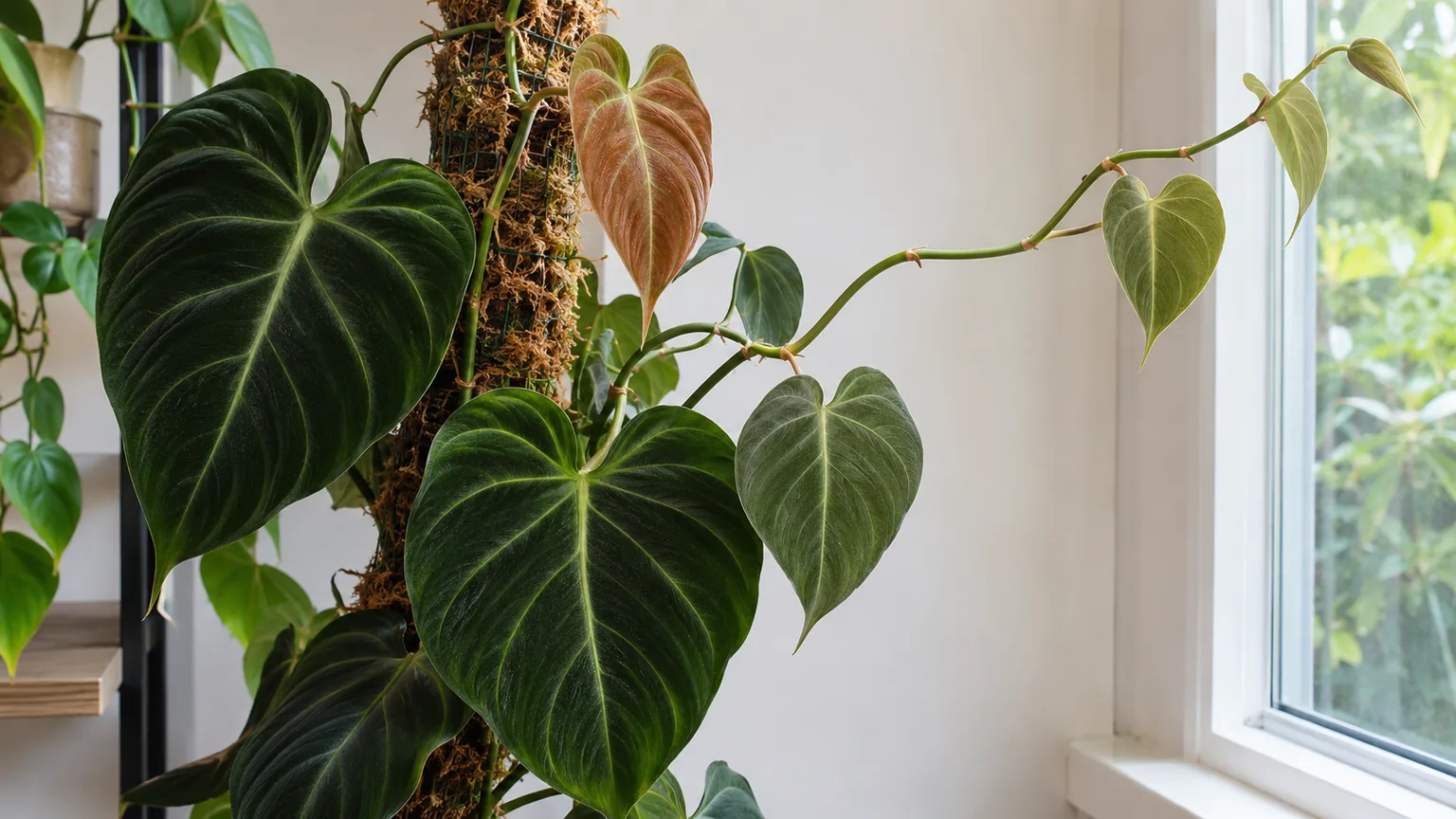
Not Enough Light on Philodendron Splendid: Dull Leaves, Stretch & Fixes
This guide covers not enough light on Philodendron Splendid. See also the general Not Enough Light guide, watering, and light pages for this plant.
Not Enough Light on Philodendron Splendid: Dull Leaves, Stretch & Fixes
Quick answer
Not enough light on Philodendron Splendid shows as smaller, duller velvet leaves, longer bare gaps between new leaf joints, and a vine that leans sideways toward the brightest window. Growth slows or stalls entirely, and the pot stays wet much longer than it should because a dim plant barely drinks.
First fix: move the plant into bright but indirect light — at an east or northeast window, or a meter or two back from a south- or west-facing window with a sheer curtain — and change nothing else for two weeks. New growth that comes in larger and darker confirms light was the limiter.
For how dim conditions weaken houseplants in general, see our not enough light hub. On Splendid, the story is always about a velvet climbing hybrid rationing leaf size to fund stem stretch — not a generic plant going pale.
When to use this page vs general care checks
Use this page when new growth is shrinking, dulling, or spacing out: smaller velvet leaves, longer internodes, sideways leaning. If leaves yellow with mushy stems and sour mix, suspect overwatering or root trouble first. If growth is simply slow with normal leaf size and spacing, review season and warmth in the Philodendron Splendid light guide before diagnosing a light shortage.
What not enough light looks like on Philodendron Splendid
Splendid is a verrucosum × melanochrysum hybrid grown for large velvety dark leaves with pale veins and coppery new growth. Low light rewrites that signature in a predictable order, and RHS describes the genus-level pattern plainly: without enough light, philodendrons become leggy and produce fewer, smaller leaves.
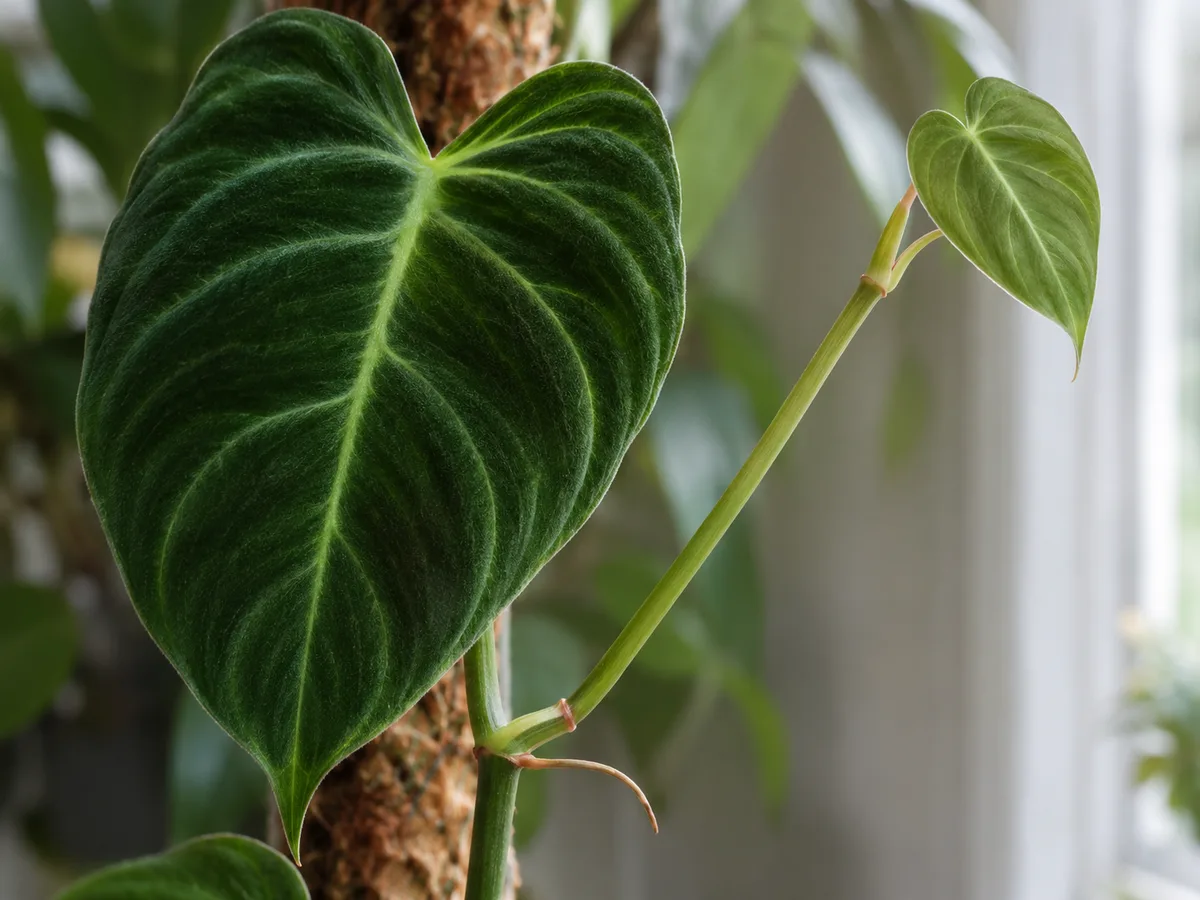
Low light can shrink new leaves, mute velvet texture, and stretch the gaps between nodes.
On Splendid specifically, watch for:
- Smaller, flatter, duller new leaves: Fresh foliage unfurls undersized and loses velvet depth and iridescence — Splendid survives dim corners but turns slow, leggy growth with fading luster there. New leaves may also emerge greener, missing the coppery-bronze flush of well-lit growth.
- Longer gaps between new leaves: The vine stretches bare internodes as it hunts photons while older growth stays compact — compare the last four joints against older ones to confirm the change is recent.
- Sideways leaning: The tip bends toward one window and aerial roots wave in air instead of gripping support, the classic one-sided reach.
- Stalled crown: No new leaf for weeks in spring or summer despite warmth and water. Light is the energy input for growth, and plants starved of it show weak, pale, spindly growth because photosynthesis cannot fund new tissue.
- A pot that never dries: Dim leaves transpire slowly, so the mix stays heavy days after watering. This is how a light problem quietly becomes a root problem.
Why Splendid suffers first: velvet leaves on a climbing budget
This is the section that separates Splendid from generic low-light advice. Velvet leaf surfaces scatter incoming light rather than reflecting it, so a velvet philodendron needs more ambient brightness than a glossy-leaved one to fix the same amount of carbon — yet its matte surface scorches fast under direct midday sun because it cannot shed heat like a waxy leaf. Splendid therefore lives in a narrower band than most houseplants: bright, but never harsh.
Add the climbing habit and the penalty doubles. Splendid is an obligate climber that expects a vertical surface; NC State describes climbing philodendrons grown on a moss pole or trellis indoors, and Splendid follows the same script. In dim light the plant spends its limited energy on stem length to reach brightness instead of leaf size, so you get a racing bare vine with shrinking foliage — etiolation wearing a climber’s costume.
Warmth without matching light makes it worse. Splendid grows best in steady indoor warmth around 65 to 85 degrees Fahrenheit, and warmth keeps the vine extending even when light cannot support dense growth. A warm dark corner is the fastest route to a stretched, floppy vine.
The dust factor: velvet traps what glossy leaves shed
A second Splendid-only wrinkle: the velvety texture that makes this plant collectible also traps household dust, and dust films measurably cut the light reaching the leaf. RHS advises growers to wipe the leaves to remove dust so plants absorb sufficient light — on glossy plants that is occasional housekeeping, but on Splendid it is part of light management.
Wipe gently with a soft damp microfiber cloth, supporting each leaf from below so the stem does not crack. Never use leaf-shine products on velvet; they clog the surface texture. If leaves look grayish despite a good window, dust — not the window — may be the missing light.
How to confirm the cause
Work through these checks in order before moving furniture or buying a grow light:
- Compare new vs old growth. Smaller duller leaves with suddenly longer gaps on the newest vine only means conditions changed recently — a move, a season shift, a taller neighbor stealing sun.
- Map light at vine-tip height. Crouch so your eyes sit where the newest leaf sits. Can you see open sky through glass from there, or only room walls? A sky-visible east window beats a “bright room” corner every time.
- Check the dust layer. Run a fingertip lightly across a mature leaf. Visible gray transfer means the plant has been breathing through a curtain for weeks.
- Check one-sidedness. If every new leaf angles one way and the far side is bare, the shortage is directional — rotation and repositioning matter as much as intensity.
- Weigh the pot and feel the stem base. Firm tissue with a heavy slow-drying pot confirms an idling dim plant — water less often until light improves. Mushy bases or sour-smelling mix point to root trouble instead, which needs a different page.
- Rule out cold and drought. Stalled tips can also follow cold drafts or a pot gone bone-dry; confirm the plant is warm and watered before blaming light alone.
The first fix to try
Move the plant into stronger indirect light — one action, nothing else that day.
Set it at an east or northeast window, or 1–2 meters back from an unobstructed south/west window with a sheer curtain against midday scorch. Clemson notes most philodendrons prefer indirect or curtain-filtered sunlight while tolerating low light — Splendid survives dim tolerance, but survival looks exactly like the symptoms above. Keep the pot, pole, watering rhythm, and fertilizer exactly as they were for two weeks so the newest unfurling leaf can report back: darker, larger, and closer-spaced means the diagnosis was right.
If the only available spot is much brighter, step up exposure over several days rather than jumping straight in — shade-softened velvet scorches easily, and tender growth acclimates best with the same gradual approach RHS hardening off practice recommends for plants facing stronger exposure.
Step-by-step recovery
Only act further once corrected light produces at least one healthier new leaf:
- Wipe every leaf with a damp microfiber cloth so the improved light actually reaches the surface.
- Reset watering to the brighter rhythm. A better-lit Splendid drinks faster — recheck the top few centimeters before each soak instead of keeping the dim-season schedule, and always empty the saucer.
- Rotate a quarter turn weekly so internodes stay even; one-sided stretching is directional, and rotation is part of the cure.
- Add or refresh the moss pole. Mist the pole when you water so aerial roots grip — a supported vine sizes leaves up instead of reaching, and Clemson confirms vining philodendrons are managed by support plus training and pruning.
- Prune only bare, spent stretches back to a healthy node once compact growth resumes, and root the tip as a node cutting. Stretched stem never shortens; recovery means growing a better vine.
- Hold fertilizer until two consecutive compact leaves appear — nitrogen on a recovering vine pushes soft elongated tissue. Under lamps, run full-spectrum light 12 to 14 hours per day hung above the crown, not from a distant desk lamp.
Recovery timeline
Judge everything by new nodes, never by old foliage:
- Days 1–14: Reaching slows; the tip straightens slightly toward overhead brightness. Water use may stay slow — do not compensate with extra drinks.
- Weeks 2–4: New leaves unfurl darker with visibly shorter gaps and a hint of the coppery flush. This is your pruning green light.
- Weeks 4–8: Pruned bases bud; the trained tip grips the pole and leaves regain velvet texture. Watering cadence visibly quickens.
- Beyond 2 months: A supported vine carries progressively larger leaves. Bare unpruned sections stay bare — schedule the cutback rather than waiting for backfilling that never comes.
Mistakes to avoid
- Fertilizing a dim vine first. Feed cannot replace photons; excess salts on a slow-growing plant push weaker tissue and can burn leaf edges.
- Jumping to harsh direct sun. Velvet leaves burn fast and scorched patches never heal — bright indirect first, then gradual exposure.
- Repotting on day one. Fresh mix and root disturbance add stress without adding light. Repot only if the pot is root-bound or the mix stays soggy for days.
- Ignoring the dust. Rearranging the room while leaves wear a gray film wastes half the upgrade.
- Pruning before fixing light. Cutting a starved vine forces replacement growth from the same dim budget — thin, pale, and floppier than before.
How to prevent it next time
- Park Splendid where the vine tip sees open sky through glass daily — east windows first choice, sheer-filtered south/west second.
- Wipe velvet leaves monthly so dust never becomes a light problem again.
- Rotate the pot a quarter turn weekly to keep growth even on all sides.
- Pot with a moss pole from the start and extend it before the tip outgrows it.
- In dark winters, add an overhead full-spectrum grow light on a 12–14 hour timer and raise it as the vine climbs.
- Recheck dry-down as light improves — brighter vines drink faster, so let the pot, not the calendar, set the schedule.
When to worry
Escalate when:
- The stem turns soft, dark, or foul-smelling at the soil line — that is rot, not light hunger.
- New leaves emerge deformed, sticky, or stippled silver — inspect velvet undersides for spider mites and thrips before assuming light.
- After six weeks of genuinely bright indirect light plus pole support, new growth still spaces wide and pale — check roots for circling or decay, since a failing root zone mimics light hunger.
A dull but firm vine with healthy roots almost always rebuilds handsome velvet growth within one growing season once light is corrected.
Related tool
Use the Light Requirement Calculator to check whether your window direction and distance give Splendid enough usable light before rearranging the whole room around it.