Root Rot on Philodendron White Princess: Causes, Checks
Quick answer
Root rot on Philodendron White Princess usually starts when chunky aroid mix stays wet too long, often in the dense moss cup the plant was sold in. Stop watering and unpot the same day, trim every mushy root back to firm tissue, repot into dry airy mix, and wait about a week before watering again.
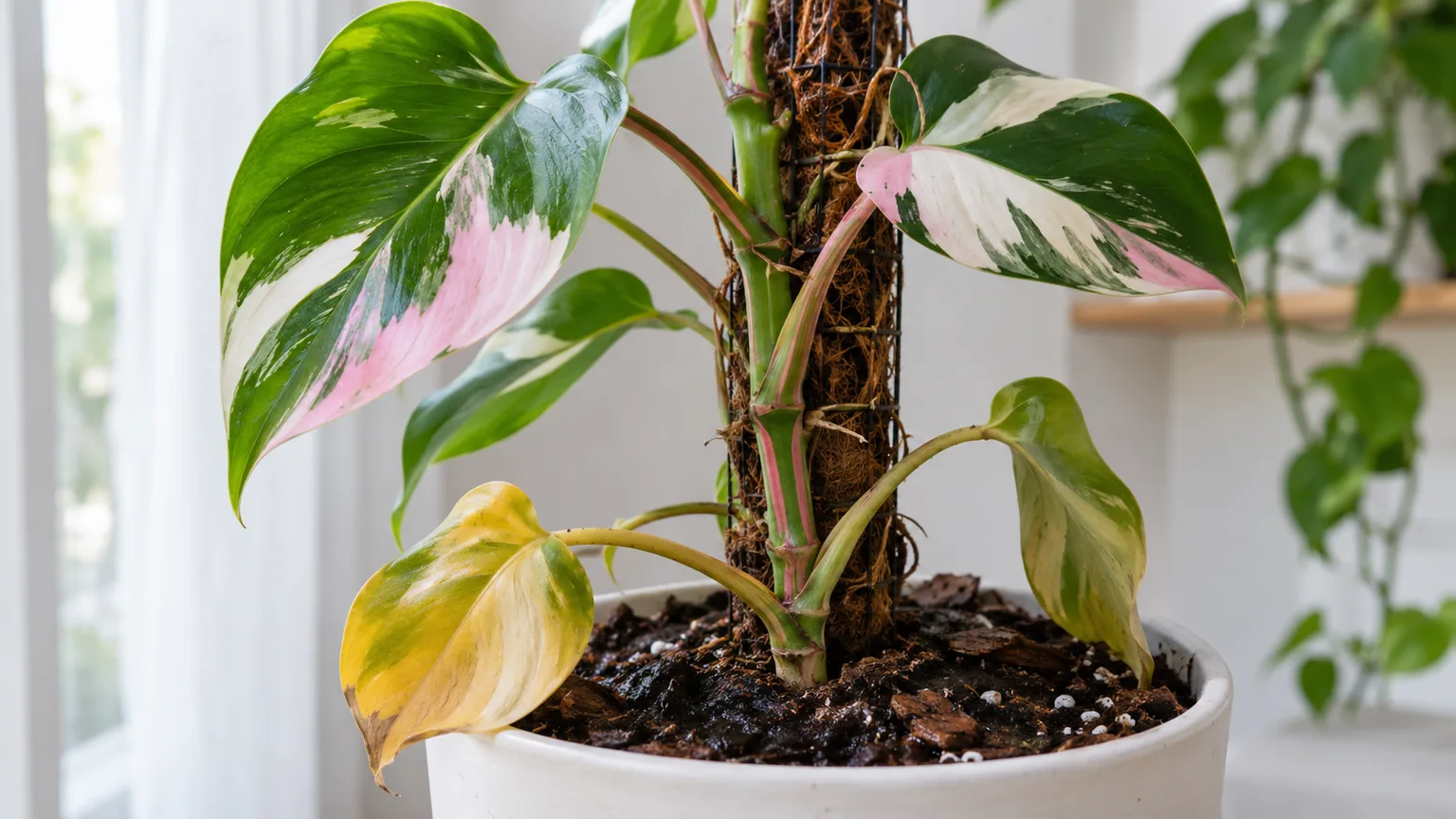
Root Rot on Philodendron White Princess: Causes, Checks and Fixes
This guide covers root rot on Philodendron White Princess. See also the general Root Rot guide, watering, and light pages for this plant.
Root Rot on Philodendron White Princess: Causes, Checks and Fixes
Quick answer
Root rot on Philodendron White Princess almost always starts below the soil line, when the mix stays wet long after watering. This plant is frequently sold still rooted in a dense moss or peat plug tucked inside a decorative pot, and that plug can stay sodden for weeks while the surface looks dry. For how waterlogged mix damages roots in general, see our root rot guide. On White Princess, the pattern usually shows up as yellowing lower leaves on a heavy pot, a sour smell at the drainage hole, and softening where the green-and-pink stem meets the soil.
What root rot looks like on Philodendron White Princess
Early rot is easy to misread because the upper leaves may still show crisp white-and-green variegation. Look for this combination instead of judging one leaf:
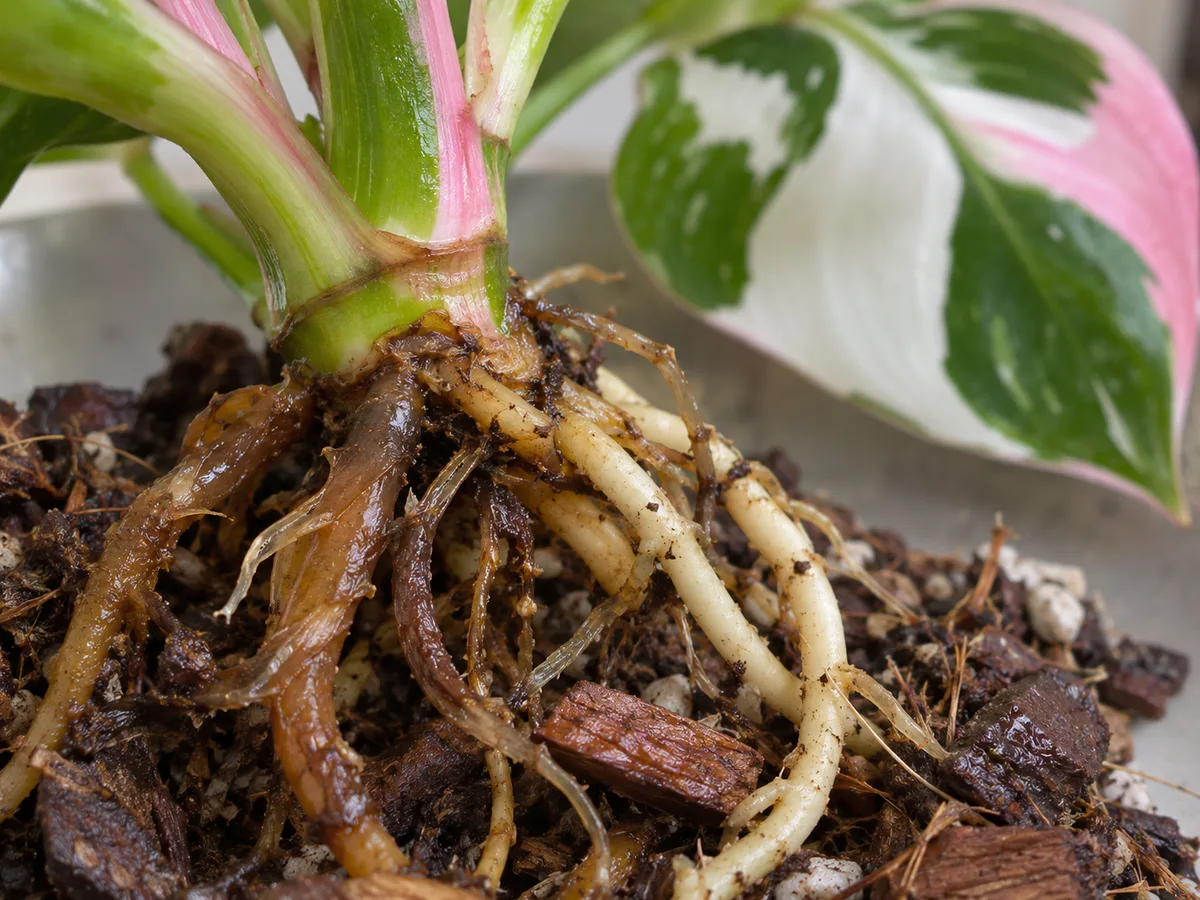
Rotted roots turn brown and soft beside firm pale roots; this is more reliable than leaf color alone.
- Mix that stays damp on the surface several days after watering, with a pot that feels heavy when lifted
- A sour or swampy smell when you sniff near the drainage hole
- Lower leaves yellowing and going limp while the mix is clearly moist, not dry
- New spears stalling, emerging small, or unfurling already pale and weak
- Softness or a wet, collapsing feel at the stem base where it enters the soil
- Brown, slippery, hollow roots that fall apart when touched after unpotting
White Princess adds one confusing twist. Its white leaf sectors brown easily from strong sun or dry air, and that cosmetic damage looks alarming but has nothing to do with roots. Trust the stem base and the root texture over leaf spots. Firm stem, firm pale roots, and dry browning only on white patches point to light or humidity stress, while a soft stem base on a wet pot points to rot.
Why White Princess is vulnerable to rot
Three traits of this specific plant stack the odds. First, the white variegated tissue photosynthesizes poorly, so a heavily white White Princess grows slowly, drinks slowly, and recovers slowly. A watering rhythm that suits a vigorous green philodendron keeps a white-heavy Princess wet too long, especially in autumn when growth eases off.
Second, many White Princess plants arrive in tight moss propagation cups sold as established plants. That medium was designed to root a cutting under greenhouse warmth and airflow, not to sustain a potted plant on a dim shelf. Water collects in the plug core while the outer bark layer dries, so finger-testing the surface lies to you.
Third, this is a climbing erubescens that wants moist, well-drained soil rich in organic matter, not a moisture-holding houseplant mix. Standard peat-heavy compost plus an oversized pot plus a cool room is the classic failure: roots sit in stale, airless mix, oxygen drops out, and decay-causing organisms move in. Root rot on philodendrons usually results from a soil mix that does not drain quickly or overly frequent watering, and White Princess punishes both mistakes faster than its green cousins.
How to confirm the cause
Work through these checks in order rather than guessing from one yellow leaf:
- Pot weight. Lift the pot three to four days after watering. Still heavy means the core is saturated.
- Drainage test. Water lightly and watch the hole. If nothing flows within a minute, the hole is blocked or the plug has sealed shut.
- Smell. A sour, swampy odor at the drainage hole signals decaying root tissue in airless mix.
- Stem base press. Gently squeeze the green stem with its pink striping right at soil level. Firm is reassuring. Soft, wet, or collapsing tissue means rot has reached the crown.
- Unpot and rinse. Shake off the wet mix and rinse roots under lukewarm water so color and texture show clearly. Turning the plant out of the pot and examining the roots is the confirmation step that settles lookalikes.
Healthy White Princess roots are pale, firm, and hold together when tugged. Rotted ones are brown to black, slippery or hollow, and strip away easily. Compare against drought before treating: a light pot with firm roots and crispy leaf edges means underwatering, while a heavy pot with mushy roots means rot even if the leaves droop identically.
Rule out the common lookalikes. Fungus gnats hovering over the surface warn of chronic wetness but are not themselves the diagnosis. Normal old-leaf aging drops the lowest leaf one at a time while new spears stay clean. If your routine Philodendron White Princess watering checks were skipped for weeks, calendar watering in low light is the likely trigger rather than disease.
The first fix to try
Stop watering immediately and unpot the plant the same day you confirm soft roots or a soft stem base. This is the one first action. Waiting lets decay travel from roots into the node, and once the node is gone the main plant cannot be saved.
Wear gloves or wash your hands after handling cut tissue, since philodendrons contain calcium oxalate crystals that irritate skin and mouths, and keep the work area away from pets. Then inspect before you cut so every removal is deliberate.
Step-by-step rescue
Once the plant is out of the pot:
- Tease away all wet, degraded medium, especially the dense nursery plug packed around the stem base and nodes.
- Cut every mushy, brown, or black root back to firm pale tissue with clean, sharp scissors. Firm white roots stay, and everything soft goes, even if little is left.
- Sterilize the blades between cuts when large sections are affected.
- Let the trimmed root system air-dry for several hours in gentle indirect light so cut surfaces callus.
- Repot into a clean pot with a working drainage hole, only slightly larger than the remaining root mass, using dry chunky aroid mix of potting soil, perlite, and orchid bark as described in the Philodendron White Princess soil guidance.
- Do not water for about a week after repotting.
If the stem base itself is soft but a higher node with an aerial root still feels firm, take insurance at the same time. Cut the healthy top section with at least one node and visible stem variegation, and root it separately in water or damp perlite. Philodendron cuttings produce roots in water within a couple of weeks when kept in conditions matching the Philodendron White Princess light guidance, so a backup plant is realistic even while the mother plant fights for recovery. Details for the clean-pot move are covered in the Philodendron White Princess repotting guidance.
After the dry week, soak only when the new mix is dry through the top 3 to 5 cm, let water run from the drainage hole, and empty the saucer. Resume the check-before-you-water rhythm from the Philodendron White Princess overview rather than a fixed schedule. Remove leaves only once they collapse fully, and leave mostly green foliage in place since the plant needs every working leaf to fund new roots.
Recovery timeline
Mild cases with a firm stem base and mostly pale roots usually stabilize within two to four weeks: the sour smell fades, remaining leaves stop yellowing, and the pot starts drying on schedule. Confident new growth typically follows in six to eight weeks, slower on heavily white plants because pale tissue contributes little energy.
Moderate cases where a third or more of the roots were removed need the full two months before you can call it a recovery. Severe cases with a collapsed stem base and no firm node rarely come back; honest progress there means the backup cutting roots and holds variegation, not the mother plant reviving. Old yellowed leaves and browned white patches never revert to perfect form, so judge success by firm new spears and a neutral-smelling pot.
What not to do
- Do not keep watering because the leaves look limp while the pot is still heavy. Limp on wet mix is the signature of dead roots, not thirst.
- Do not repot into a much larger pot. Extra wet mix volume dries slowly and restarts the cycle.
- Do not fertilize until new growth appears and watering is back on a stable dry-down rhythm. Salts on damaged roots burn what little function remains.
- Do not leave the nursery pot sitting in a full cachepot or saucer after watering.
- Do not rely on a fungicide drench alone without removing mushy tissue and fixing drainage.
- Do not hard-prune all variegated growth on day one. The plant needs its remaining green tissue to recover.
How to prevent it next time
Prevention for White Princess is mostly about the pot drying predictably. Water only when the top 3 to 5 cm is dry, roughly every 7 to 10 days in summer and every 10 to 14 days in winter, and let the compost dry out slightly between waterings rather than keeping it constantly moist. Saturated compost left standing in water eventually causes root rot, so the saucer-emptying habit matters as much as the schedule.
Repot new purchases out of the moss plug early, before the first winter, into airy mix. Give bright indirect light so the plant actually uses its water, refreshing compacted mix every one to two years in spring. A weekly glance at pot weight, drainage flow, and stem-base firmness catches the next episode while rescue is still a trim rather than an amputation.
When to worry
Treat confirmed rot as high severity on this plant. Escalate the same day if the stem base softens, black tissue climbs the green stem, more than a third of the roots are mushy, or the plant keeps declining for a week after you stopped watering. If the stem pulls free with no resistance, stop treating the base and put all effort into the firmest top cutting.
Conclusion
Root rot on Philodendron White Princess is nearly always wet, airless mix around a slow-drinking variegated climber, often starting in the nursery plug it arrived in. Confirm with a heavy pot, sour smell, and mushy roots, then act the same day: unpot, prune to firm tissue, repot dry into chunky mix, and hold water for a week. Keep a node cutting as backup when the stem base is soft. Prevent repeats with dry-down watering, free-draining mix, and bright indirect light, and judge recovery by firm new growth rather than old leaves healing.
Related Philodendron White Princess guides
- Philodendron White Princess overview — full care profile for this variegated climber.
- Philodendron White Princess watering — dry-down checks to use before assuming rot.
- Philodendron White Princess light — bright indirect levels that keep the pot drying on schedule.
- Philodendron White Princess soil — chunky aroid mix recipe that resists compaction.
- Philodendron White Princess repotting — clean-pot technique for rescue repots.
Related tool
Use the Root Rot Risk Checker to narrow causes for root rot on this plant before changing multiple variables at once.