Fungus Gnats on Pomegranate: Causes, Checks & Fixes
Quick answer
Clouds of tiny black flies over a pomegranate pot mean the compost-rich surface mix is staying wet enough for fungus gnat larvae. First step: stop scheduled watering and let the top 3–5 cm dry completely, then resume deep, infrequent soaks. Add yellow sticky traps and a Bti soil drench only if flies persist past two dry-down cycles.
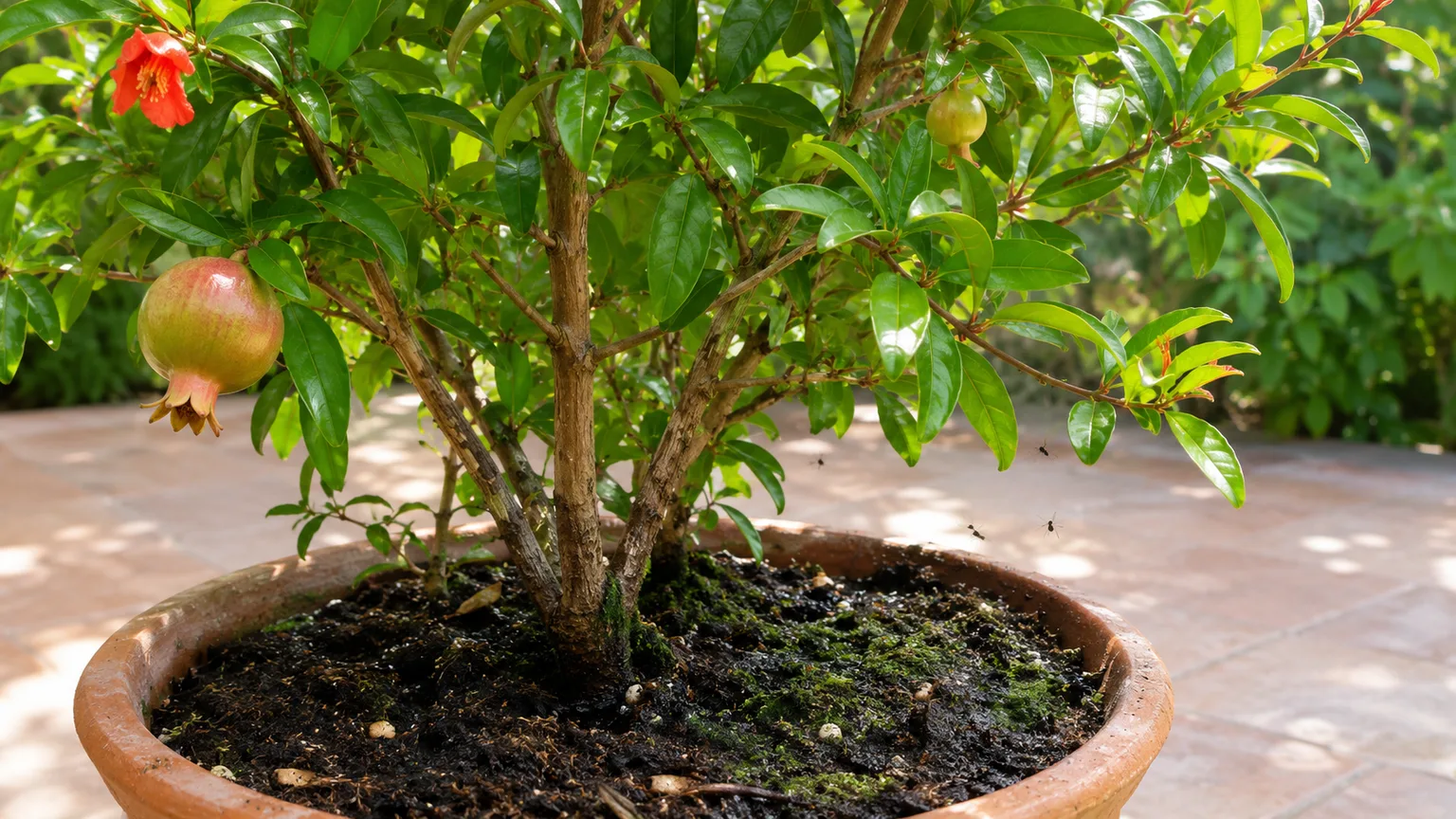
Fungus Gnats on Pomegranate: Causes, Checks & Fixes
This guide covers fungus gnats on Pomegranate. See also the general Fungus Gnats guide, watering, and light pages for this plant.
Fungus Gnats on Pomegranate: Causes, Checks & Fixes
Quick answer
If tiny black flies puff up every time you brush past your pomegranate pot, the larvae are almost certainly breeding in a surface layer that never dries. Pomegranate wants deep, infrequent soaks in a free-draining mix, so persistent gnats are your signal that watering, drainage, or saucer habits have drifted toward constant dampness.
First step: stop watering on a schedule and let the top 3–5 cm of mix dry completely before the next deep soak. That single change removes egg-laying sites and starves larvae of the fungi they feed on. Only if adults are still rising after two full dry-down cycles, add yellow sticky traps plus a Bti soil drench.
What fungus gnats look like on pomegranate
Adult gnats are delicate dark flies about 1/8 inch long that hover just above the pot surface, walk across damp mix, and collect on nearby windows. They do not bite people and do not chew leaves, so leaf damage is never their direct work. Their larvae live in the top few centimetres of mix: translucent thread-like maggots with shiny black heads, reaching about 1/4 inch when mature.
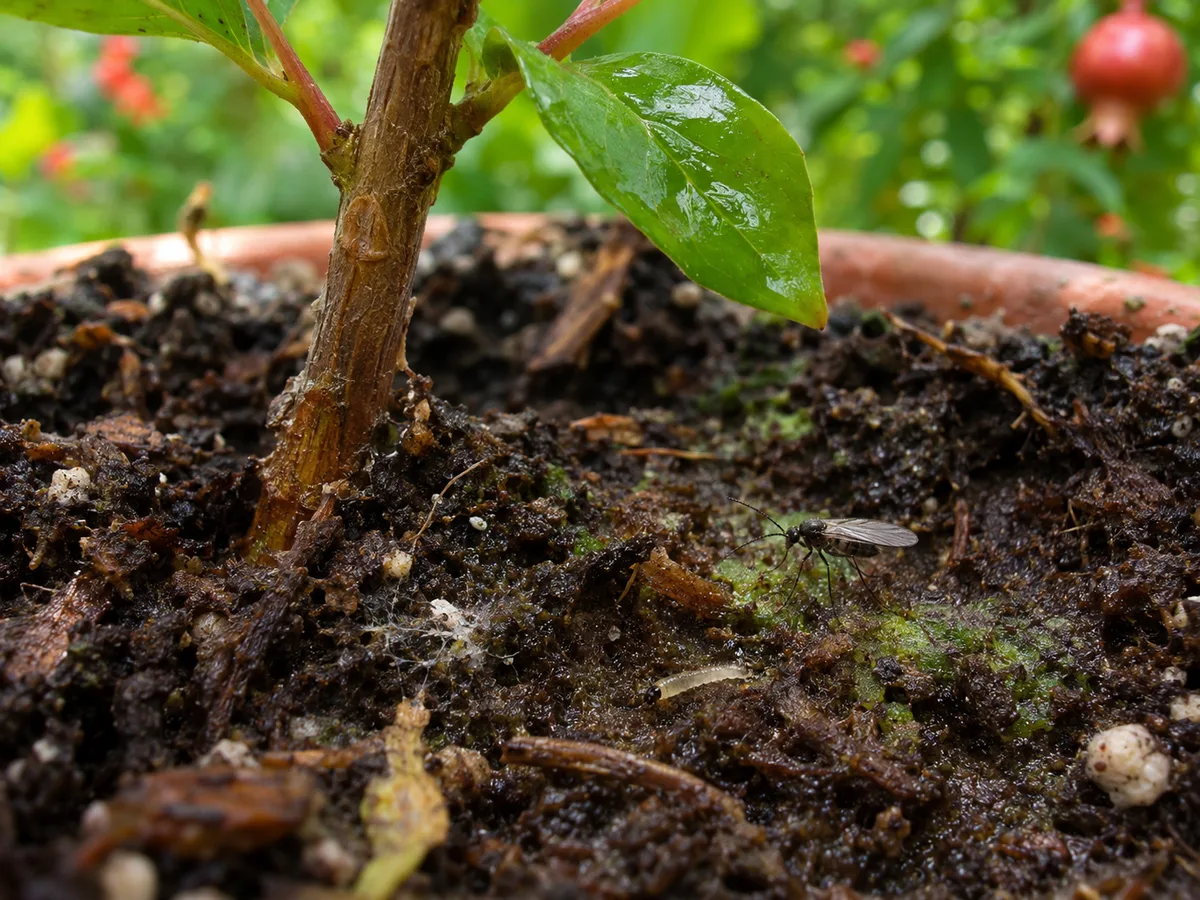
Adults hover above persistently damp mix, where their translucent, black-headed larvae develop.
For the general biology of these flies in potting mix, see our fungus gnats guide. On pomegranate, the pattern usually shows up as flies over the pot plus a surface that stays dark and moist for days, while the shrub itself looks otherwise normal until the wetness causes secondary trouble.
Because pomegranate is typically grown outdoors in sun and air movement, a thriving indoor-style gnat colony on it is diagnostic in itself: something is keeping the root zone wetter than this drought-tolerant species wants.
Why a compost-rich pomegranate mix breeds gnats
A good pomegranate container blend is roughly half loam or potting mix, a quarter mature compost, and a quarter coarse sand, pumice, or perlite. That compost fraction is excellent for fruiting but also a pantry for gnat larvae, which feed on fungi and decaying organic matter in the mix and chew roots when populations run high. Every heavy watering re-wets the organic surface and restarts the fungal bloom the larvae graze on.
Outdoor sun and breeze normally keep the surface in check. Problems start when a potted pomegranate sits in a saucer of standing water, gets daily splashes from a lawn sprinkler, or is moved into a sheltered, humid corner during monsoon weather. The plant hub describes a sun-lover that tolerates drought once established; a mix wet enough for gnats is wetter than its roots prefer, and the flies are simply the first visible symptom.
Cuttings and young container trees: the highest-risk stage
Fresh hardwood cuttings and first-year potted pomegranates live exactly where gnats hunt. Propagators keep cutting mix evenly moist for weeks while roots form, and that unbroken dampness lets females lay continuously. A mature shrub shrugs off moderate larval nibbling, but a cutting pushing its first white root hairs can lose the entire flush to larvae grazing in the same zone.
If you root one-year-old hardwood cuttings in late winter, use a grittier, lower-compost strike mix than the fruiting blend, water from below or sparingly from the top, and keep only as much humidity cover as the cuttings truly need. Ventilate daily so the surface firms between mistings. One infested cutting tray can seed every pot on the bench, so isolate new nursery stock for two weeks and check its surface before grouping plants together.
Dormancy and monsoon traps: when pomegranate stays wettest
Pomegranate is deciduous, and a leafless plant in cool weather drinks almost nothing. Yet many growers keep the winter watering rhythm unchanged, leaving a bare shrub in cold, wet mix for months. Females exploit exactly that: cool damp organic mix with no root uptake to dry it. A winter gnat bloom over a dormant pomegranate is a watering error, not a pest invasion. Cut back sharply after leaf fall and let winter rain plus minimal supplement do the work.
The second trap is monsoon season on a terrace. Driving rain saturates large containers, saucers overflow and rewick, and humid air slows evaporation for days. Tilt saucers to drain after storms, move vulnerable young pots under an eave during the wettest spells, and confirm drainage holes run freely before the rains arrive. Reset the watering rhythm each season rather than running one schedule all year.
How to confirm gnats, not fruit flies or shore flies
Work this short checklist before treating:
- Watch where they gather. Gnats hover over soil and run across the mix; fruit flies orbit fallen fruit, arils, compost, or drains instead.
- Set a yellow sticky card. Push one card just above the soil for 48 hours. A catch of small dark long-legged flies points to gnats, and the count gives you a baseline to judge progress.
- Lift a raw potato chunk. Lay cut-side-down pieces on the surface for three to four days, then inspect the underside for tiny translucent larvae with black heads. Finding larvae under the potato slices confirms breeding in the mix rather than flies wandering in from elsewhere.
- Smell and squeeze the surface. Sour odor plus mix that stays soggy days after watering means the gnat problem rides on drainage failure, and drying alone may not suffice.
- Note the calendar. A generation runs about 17 days at 75°F, with eggs hatching in roughly three days and larvae feeding for about ten, and indoor pots hold overlapping generations — so expect at least a month of steadily falling trap counts rather than an overnight cure.
Vinegar jars and other fruit-fly baits will not settle the question, since gnats ignore them and breed in soil, not on fermenting fruit.
First fix for pomegranate
First action: let the top 3–5 cm of mix dry completely, then water deeply until excess drains freely.
Test depth with a finger, not the calendar: on a fruiting container tree in hot weather that may mean watering every few days, while a dormant or shaded plant may need a week or more. Empty the saucer within half an hour so the base never rewick moisture. This dry surface eliminates egg-laying sites, which extension guidance calls the single most important management step, and it matches what pomegranate roots want anyway: letting the growing medium dry between waterings rather than hovering at constant dampness.
Do not fertilize, repot, prune, and spray in the same weekend. Change the moisture first, watch one full cycle, then escalate only if trap counts stay high.
Step-by-step recovery
- Days 1–3: dry and trap. Start the dry-down and place one yellow sticky card per pot. Cards both monitor and reduce the flying adults, so you can see whether numbers fall as the surface dries.
- Days 4–7: check larvae. Run the potato-chunk test. If larvae are abundant and flies persist into the second dry cycle, the infestation has depth and needs a larval treatment.
- Week 2: drench with Bti. Soak the mix with Bacillus thuringiensis israelensis (products such as Mosquito Bits or Gnatrol) mixed per label, wetting thoroughly so the bacteria reach feeding larvae. Because Bti does not persist indoors, plan repeat applications five to seven days apart until emergence stops.
- Weeks 2–4: fix the container. If any pot still smells sour or holds water for days, unpot, trim black mushy roots, and rebuild with the coarse mineral fraction from the soil blend. A half-inch top dressing of coarse sand or fine gravel can keep the surface drier and less inviting for egg-laying.
- Weeks 4–6: judge by new activity. Falling trap counts, no larvae under fresh potato chunks, and clean new shoot growth mean success. Old adult flies die within about a week, so late stragglers on cards are normal tail-off, not failure.
Reserve pyrethrin sprays for severe adult clouds, applied to the soil surface and resting spots per label, never fogged through the air. Sprays knock down fliers temporarily but never replace drying and larval control.
Lookalike symptoms
| Pattern | Distinguishing clue | More likely cause |
|---|---|---|
| Flies over fruit bowl or fallen split fruit, not soil | Ignores potato chunk and sticky cards at pot | Fruit flies feeding on ripe or split pomegranates |
| Stocky flies on algae-green mix that hop when disturbed | Short antennae, runs more than flies | Shore flies on algae, a drainage signal with different control |
| Wilting despite wet soil, sour mix, black soft roots | Gnats present but secondary | Root rot from chronic waterlogging |
| Yellowing older leaves with wet mix | Whole-canopy decline, no larvae | Simple overwatering |
| Fine stippling on leaf undersides, webbing in dry heat | Dry dusty foliage, few soil flies | Spider mites, a dry-weather pest |
When the pattern does not fit gnats cleanly, work through the pomegranate problems hub to route to the right diagnosis instead of treating blindly.
Mistakes to avoid
- Watering through the problem. Daily light sprinkles keep the exact top layer larvae need permanently moist. Always soak deeply, then wait for the 3–5 cm check.
- Sealing the surface with fine sand. A thin cosmetic sand cap over dense organic mix traps moisture underneath and makes things worse. Only a genuinely coarse, deep mineral layer over a free-draining blend helps.
- Hydrogen peroxide drenches. They can damage fine roots and soil life on a stressed young tree while missing eggs and pupae, so the colony rebounds.
- Spraying adults and declaring victory. Fliers are the shortest-lived stage; killing them without drying the mix or treating larvae guarantees a second wave in about two to three weeks.
- Repotting a healthy-rooted plant on day one. Tearing apart a sound root ball shocks a fruiting shrub for no gain when moisture correction plus Bti would have worked.
Recovery timeline
| Phase | Timing | Good signs | Bad signs |
|---|---|---|---|
| Surface drying | Days 1–7 | Top 3–5 cm firms up; fewer flies rising when tapped | Surface still dark and wet after a week of no water — suspect blocked drainage |
| Adult decline | Weeks 1–3 | Sticky-card counts fall by half or more each week | Counts flat despite dry surface — larvae deep in a soggy core |
| Larval clearance | Weeks 2–5 | Clean potato chunks; no larvae after second Bti round | Fresh larvae under every chunk — repeat Bti and reassess the mix |
| Full reset | Weeks 4–6 | New shoots firm and glossy; no flies for ten days | Wilting with wet soil or spreading dieback — inspect roots for rot |
Judge recovery by falling trap counts and vigorous new growth, not by repairing old leaves. Existing foliage never improves from gnat control; it simply stops declining once the root zone breathes again.
How to prevent it next time
Keep the watering rhythm tied to the finger test at 3–5 cm, and empty every saucer after watering and storms. Refresh tired container mix on the repotting cycle so compost does not collapse into a soggy sludge, and keep the coarse mineral fraction generous in pots that live through humid months. Quarantine new nursery plants for two weeks with their own sticky card before placing them beside clean stock, and start cuttings in grittier mix than the fruiting blend. After harvest and at leaf fall, step watering down deliberately: a pomegranate resting dry and leafless through winter offers gnats nothing to breed in.
When to use this page vs other Pomegranate guides
Use this page when small dark flies rise from the pot surface and the top of the mix stays damp. If the shrub wilts in wet soil with a sour smell and few or no flies, the moisture problem has progressed past gnats and the watering and soil guides take priority. If fruit splits after erratic watering or growth stalls in shade, those are separate pomegranate issues; browse the problems hub to pick the matching guide.
Related Pomegranate guides
- Pomegranate plant hub — sun, placement, and seasonal rhythm overview
- Pomegranate watering — the 3–5 cm check and fruiting-season consistency that prevents repeat blooms
- Pomegranate soil — compost-mineral blend and drainage that denies larvae their habitat
- Pomegranate repotting — when and how to rebuild a collapsed or sour mix
- Pomegranate problems hub — route lookalike symptoms to the right guide
Related tool
Use the Plant Problem Diagnosis Tool to narrow causes for fungus gnats on this plant before changing multiple variables at once.