Pomegranate Care Guide: Grow Anar in Pots
Punica granatum
Grow Pomegranate in full sun and free-draining soil. Learn when to water Punica granatum, prevent fruit splitting, repot containers, and support flowering and fruit.
Pomegranate Care Guide: Grow Anar in Pots
Start with wateringThe most common care mistake for PomegranateWatering guide →Pomegranate care essentials
Light
Water
Water deeply when the top 3–5 cm of soil is dry. Keep young plants and fruiting container trees evenly moist, but never waterlogged. Established trees tolerate drought, although irregular watering can split developing fruit.
Soil
Well-draining loam or sandy loam with compost. Pomegranate tolerates clay and alkaline conditions better than many fruit trees, but not stagnant, waterlogged soil.
Humidity
Temperature
Fertilizer
About Pomegranate
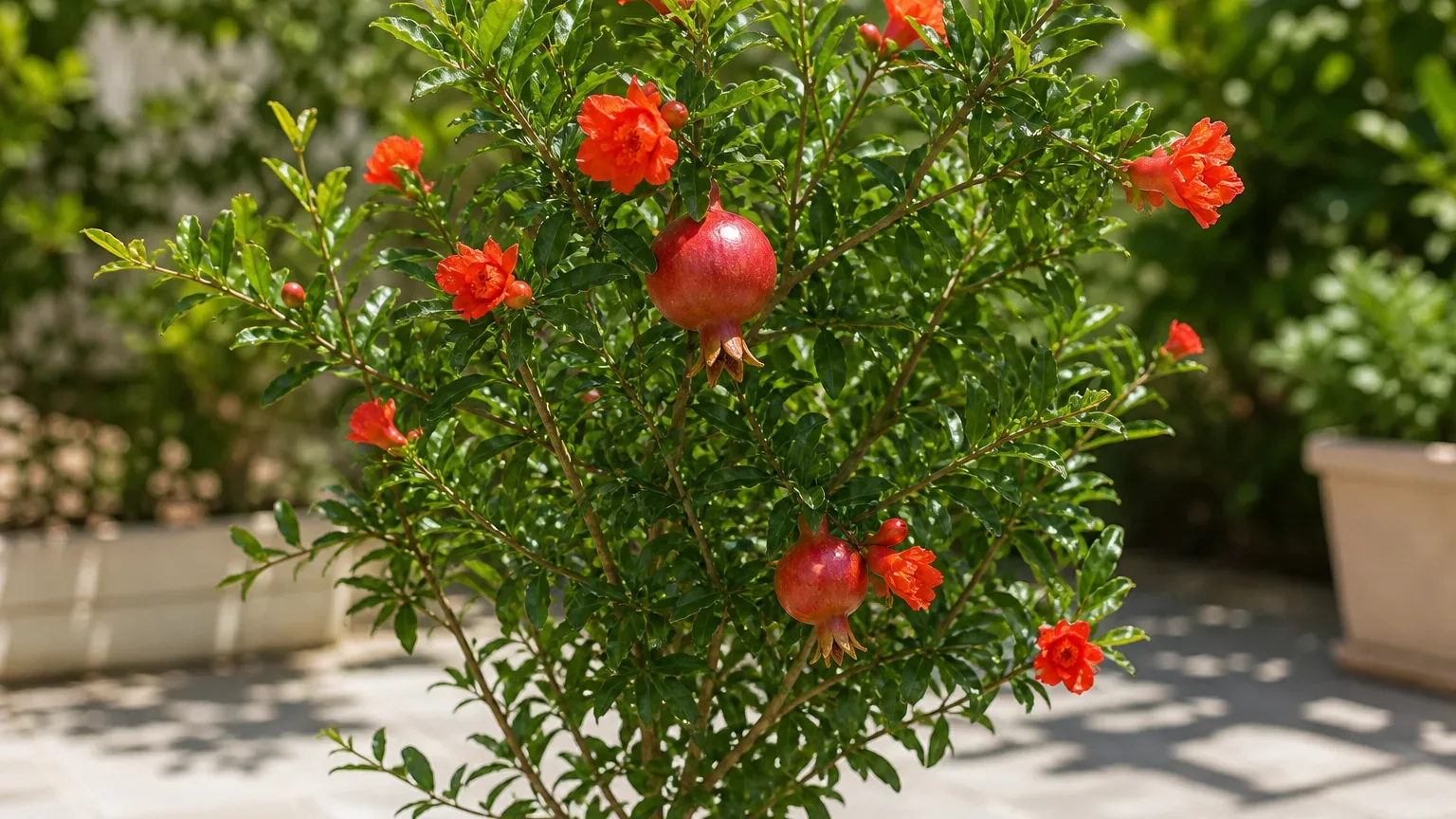
Pomegranate is native to From northeastern Turkey and Iran through Afghanistan to northern India, typically reaches 3–4.5 m tall as a shrub or small tree; smaller when pruned in a large container indoors, with moderate growth. Pomegranate has a tree like growth habit and part of the Lythraceae family. It is also known as Anar, Dalim, Granada, and Seeded Apple.
| Detail | Information |
|---|---|
| Also known as | Anar, Dalim, Granada, Seeded Apple |
| Native region | From northeastern Turkey and Iran through Afghanistan to northern India |
| Mature size | 3–4.5 m tall as a shrub or small tree; smaller when pruned in a large container |
| Growth rate | Moderate |
| Growth habit | Tree Like |
| Scientific name | Punica granatum |
| Family | Lythraceae |
Pomegranate Care Guide: Grow Anar in Pots
Pomegranate is a sun-loving deciduous fruit shrub, not a permanent indoor foliage plant. Punica granatum—called anar or dalim in many Indian homes—needs strong outdoor light, free-draining roots, and steadier moisture once flowers set fruit. Get those basics right and a named cultivar can thrive on a hot terrace or in a garden bed; keep it in a dim room or a closed pot and you will mostly grow thin wood and disappointment.
For home growers in India and similar warm climates, the practical challenge is rarely “keeping anar alive.” Established plants tolerate heat and short dry spells. The harder jobs are preventing monsoon waterlogging, avoiding a drought-to-deluge cycle that splits fruit, and pruning without removing the two- to three-year-old wood that carries the crop.
Quick pomegranate care at a glance
- Light: Full outdoor sun—at least six hours of direct light; more helps flowering, colour, and sweetness.
- Habit: Multi-stemmed deciduous shrub or small tree; expect leaf drop in the cool season.
- Water: Soak when the top 3–5 cm is dry; keep moisture even from flowering through ripening; reduce after harvest and in dormancy.
- Soil: Well-draining loam or sandy loam with compost; wide pH tolerance if drainage is good.
- Pot: Heavy container with open drainage holes; enlarge gradually; never leave the pot sitting in runoff.
- Feeding: Modest nitrogen during active growth; stop while bare or stressed.
- Pruning: Preserve short fruiting spurs on two- to three-year-old wood; decide early between shrub and single-trunk form.
If the plant declines, check the root zone before buying a tonic. Wet, sour mix needs drainage correction; bone-dry mix and a light pot need a thorough soak. The Pomegranate watering guide and Pomegranate soil guide separate those problems in more detail.
What kind of plant is a pomegranate?
Punica granatum is a woody perennial in the henna family (Lythraceae). NC State Extension describes it as a deciduous shrub or small tree native from northeast Turkey to Afghanistan and widely grown across Mediterranean and Middle Eastern climates. Utah State University Extension places its origin from Iran through northern India and notes a preference for semi-arid to subtropical conditions with hot summers and mild winters.
The edible part is the aril: juicy seed coats packed inside a leathery rind. Flowers are typically orange-red, and the plant is largely self-fruitful, though insects and hummingbirds can improve pollen transfer. This biology matters for care: you are managing a fruiting woody shrub that seasons with leaf fall, not a tropical evergreen houseplant that wants constant indoor humidity.
Growth habit and realistic mature size
Pomegranate naturally grows as a dense, bushy, multi-stemmed shrub. University of Georgia Extension reports typical heights of about 10–12 feet (roughly 3–3.7 m), while USU Extension notes training into a small tree about 12–15 feet high. Julia Morton’s warm-climate fruit account records larger specimens of 20–30 feet in ideal sites, with a strong tendency to sucker from the base and a lifespan measured in decades.
Container culture and annual pruning can keep a plant smaller, but they do not rewrite the species. A terrace anar will still want a woody root system, a stable pot, and enough canopy room for airflow. Compact ornamental forms such as ‘Nana’ stay much smaller—NC State notes roughly 3 feet—and should not be confused with a full-size fruiting orchard cultivar when harvest quality is the goal.
Choose a named fruiting cultivar, not a seedling guess
Choose a labelled fruiting cultivar when fruit flavour, seed hardness, and bearing habit matter. Seedlings germinate easily, but USU Extension reminds growers they will not come true to type. Hardwood cuttings of one-year-old wood are the standard vegetative route for predictable plants.
Inspect nursery stock for a firm multi-stemmed base or a clear trained trunk, clean glossy leaves, and no scale, mealybugs, cracked bark, or sour potting mix. Confirm whether the label describes a fruiting type or a dwarf ornamental. A plant sold only for flowers and patio display may never match market anar fruit.
Best placement in India and other warm climates
Give pomegranate an open terrace, courtyard, balcony, or garden bed with strong sun and moving air. Hot summers suit the crop; UGA notes exceptional heat tolerance and best performance when temperatures stay high for long stretches of the year. Humid monsoon weather is the harder Indian season: flowers can set poorly in stagnant humidity, and roots dry slowly in closed pots.
Protect young container plants from unusual cold snaps. USU Extension reports damage risk as temperatures drop toward about 12°F (−11°C). In most Indian plains and coastal cities, hard freeze is uncommon, but a leafless dormant plant in a windy balcony still benefits from a sheltered corner and reduced watering rather than constant wet mix.
Growing pomegranate in a large container
Yes—pomegranate can grow and fruit in a large outdoor pot if drainage and sun are excellent. Use a heavy container with several open drainage holes, start only one size wider than the root ball, and step up gradually as roots fill the mix. An oversized tub around a small root system stays wet too long; a severely rootbound pot can dry within a day in terrace heat and shed flowers or young fruit.
Rotate the pot periodically for balanced growth, but do not keep moving it between deep shade and harsh sun. Plan for Pomegranate repotting every two to three years, or sooner if roots circle densely, water runs off the root ball, or the mix smells sour. Indoor winter display is a short-term emergency option in cold climates, not a year-round culture plan for fruit.
Light: treat pomegranate as a full-sun fruit shrub
Pomegranate needs full sun. NC State lists full sun as six or more hours of direct light, and UGA recommends at least six hours for fruit colour and productivity. Partial shade may keep a plant alive, but USU Extension notes that sun is needed to build sugars and reach full flavour.
Acclimate nursery foliage over several days when moving from shade net to a concrete terrace. Soft leaves grown under cover can scorch before the plant hardens. Once established, strong tropical light is normal; pale, stretchy growth and sparse flowering usually mean the site is too dim. For window choice, intensity, and sunburn signs, use the Pomegranate light guide.
Watering through heat, fruit swell, and dormancy
Water by the root zone, not a fixed calendar. Check 3–5 cm into the mix; when that layer is dry, soak thoroughly until excess drains, then empty any saucer. Young plants and fruiting containers need closer checks than established in-ground trees. USU Extension suggests deep irrigation about every 7–10 days for established plants in dry conditions—useful context, not a rigid pot schedule.
Established pomegranate is drought-tolerant, but fruit quality is not. UGA stresses supplemental irrigation during establishment and for commercial fruiting, and warns that irregular moisture through drought followed by rain encourages fruit splitting. Keep moisture even from flowering through ripening; avoid flooding a severely dry, fruit-laden plant. After harvest and while deciduous plants are bare, reduce watering because a leafless shrub uses moisture more slowly.
During monsoon, pause irrigation when rain is already wetting the root zone, and move pots out of roof runoff. Saturated mix excludes oxygen and damages roots; drainage is a care requirement, not an optional pot feature. Seasonal examples and over/underwatering diagnostics live in the Pomegranate watering guide.
Soil and drainage for gardens and pots
Use well-draining loam or sandy loam enriched with compost. NC State notes tolerance of clay, loam, and sand when drainage and moisture are adequate, with a wide soil pH range from acid to alkaline. UGA prefers deep loam, cites a practical pH band around 5.5–7.2 for best growth, and still warns that extended waterlogging harms trees. Morton likewise records success on both calcareous alkaline soil and deep acidic loam.
A practical container blend is about 50% quality potting mix or loam, 25% mature compost, and 25% coarse sand, pumice, or perlite. The goal is even wetting and prompt drainage—especially important in humid weather. Tolerance of clay in the landscape does not make a closed decorative pot safe. Mix recipes and warning signs are covered in the Pomegranate soil guide.
Feeding without forcing soft leafy growth
Feed only while the plant is actively growing. USU Extension suggests modest annual nitrogen to maintain vigor and notes that phosphorus and potassium are often unnecessary unless a deficiency is confirmed. UGA warns that excess nitrogen late in the season can hurt fruit colour and size and may leave plants more vulnerable as weather cools.
Correct poor sun, waterlogged soil, or a root-bound pot before adding fertilizer. Compost or a light balanced feed during warm growth is usually enough for a home container plant. Stop feeding during dormancy and after severe stress. Rates, dilution, and deficiency signs belong in the Pomegranate fertilizer guide.
Flowering, fruiting wood, and pruning basics
Pomegranate commonly fruits on short spurs of two- to three-year-old wood. USU and UGA both emphasize that severe annual pruning removes productive wood and reduces yield, while light annual pruning renews fruiting spurs. Decide early whether you want a natural multi-stemmed shrub or a single-trunk tree, then remove unwanted basal suckers accordingly.
UGA Extension notes that multi-trunk training is often safer where frost can kill tops, because damaged stems can be removed without losing the whole plant. Major structural cuts belong in the cool dormant window; mid-season work is mostly sucker and deadwood cleanup. For step-by-step cuts and timing, use the Pomegranate pruning guide. To multiply a favourite cultivar, see Pomegranate propagation.
Pet cautions around pomegranate
Ripe arils are a familiar human food, but that does not verify every plant part as safe for pets. ASPCA’s toxic and non-toxic plant catalogue does not provide a dedicated Punica granatum entry confirming whole-plant safety. Keep dogs, cats, and other animals from chewing leaves, bark, roots, flowers, and rind, and contact a veterinarian if a substantial amount of plant material is eaten or digestive symptoms appear. Human edibility of the juice sacs is not a substitute for species-specific pet guidance.
Common mistakes and the first corrective action
The most common failures share one pattern: treating pomegranate like a low-light houseplant or watering it like a desert cactus during fruit swell. Too little sun stalls flowering. Irregular watering near harvest splits fruit. Closed pots and monsoon runoff smother roots. Hard shearing every year removes the wood that would have carried next season’s crop. Confusing ‘Nana’ ornamentals with orchard types sets false fruit expectations.
First action when unsure: put the plant in the brightest outdoor spot you have, check whether the mix is soggy or bone dry, and correct drainage or moisture before adding fertilizer or making large pruning cuts. If fruit is forming, prioritize even watering over heroic “dry stress.” If leaves fall in cool weather while stems stay firm, treat it as normal dormancy rather than a crisis.
When to use this page vs other Pomegranate guides
Use this overview to decide whether pomegranate fits your site, pot, and climate, and to set the right expectations for size, sun, and fruiting wood. Switch to sibling guides when you need depth on one task:
- Pomegranate light — window and terrace intensity, low-light limits, sunburn.
- Pomegranate watering — dryness checks, monsoon pauses, fruit-split prevention.
- Pomegranate soil — mix recipes, drainage fixes, pH context.
- Pomegranate fertilizer — timing, nitrogen caution, deficiency signs.
- Pomegranate repotting — pot size, root checks, post-repot care.
- Pomegranate propagation — hardwood cuttings and aftercare.
- Pomegranate pruning — shrub vs tree form and fruiting spurs.
Return to the Pomegranate plant hub for the species profile and cluster navigation.
Related Pomegranate guides
- Pomegranate overview — this page: identity, placement, and care map.
- Pomegranate light — full-sun requirements and warning signs.
- Pomegranate watering — even moisture through fruit development.
- Pomegranate soil — free-draining mixes for humid seasons.
- Pomegranate fertilizer — modest feeding in active growth.
- Pomegranate repotting — container refresh without drowning roots.
- Pomegranate propagation — vegetative methods for named cultivars.
- Pomegranate pruning — protect two- to three-year fruiting wood.
Conclusion
Pomegranate rewards growers who treat it as a hot-climate fruit shrub: full sun, open drainage, even watering while fruit develops, and pruning that keeps fruiting wood. In India and other warm regions it thrives on terraces and in gardens when monsoon sogginess and drought-to-deluge swings are controlled. Start with a named cultivar, give it outdoor light, and use the sibling guides when one care topic needs a deeper fix.
How to care for Pomegranate?
When should you water Pomegranate?
Water deeply when the top 3–5 cm of soil is dry. Keep young plants and fruiting container trees evenly moist, but never waterlogged. Established trees tolerate drought, although irregular watering can split developing fruit.
- Test 3–5 cm below the surface - Water deeply when the top 3–5 cm of soil is dry.
- then water thoroughly until excess drains from the pot - Water deeply when the top 3–5 cm of soil is dry.
- Drain excess water - Water deeply when the top 3–5 cm of soil is dry.
What soil works best for Pomegranate?
Well-draining loam or sandy loam with compost. Pomegranate tolerates clay and alkaline conditions better than many fruit trees, but not stagnant, waterlogged soil.
- 50% quality potting mix or loam - Well-draining loam or sandy loam with compost.
- 25% mature compost - Well-draining loam or sandy loam with compost.
- 25% coarse sand, pumice, or perlite - Well-draining loam or sandy loam with compost.
Grower notes for Pomegranate
What matters most with Pomegranate
Pomegranate is a sun-loving deciduous fruit shrub, not a permanent indoor foliage plant. Give it at least 6 hours of direct sun—more is better for sweet fruit—and a free-draining root zone. Established plants tolerate drought, but fruit quality depends on steady moisture. A dry spell followed by a large drink can make the rind split, so consistency matters most from flowering through ripening.
Best placement in a real home
Use a sunny terrace, courtyard, balcony, or garden bed with good airflow. In a container, choose a heavy pot with open drainage holes and enough room for a woody root system. Hot summers suit Pomegranate; warm, humid monsoon weather demands extra attention to drainage and leaf disease. Rotate a potted plant for balanced growth, but do not keep moving it between deep shade and harsh sun.
Before you buy this plant
Choose a named fruiting cultivar if harvest quality matters; seedlings do not reliably reproduce the parent fruit. Look for a firm multi-stemmed base, clean glossy leaves, and no scale, mealybugs, cracked bark, or sour potting mix. Confirm whether the label describes a full-size fruiting cultivar or the compact ornamental 'Nana', which stays much smaller and is not equivalent to a standard orchard Pomegranate.
First month after bringing it home
Place the plant in full sun gradually if it was displayed under nursery shade. Learn how quickly its pot dries before imposing a calendar, and do not repot, fertilize heavily, and prune at the same time. Some leaf drop after a move can be stress; complete leaf fall in the cool season is normal dormancy. Persistent yellowing while the mix stays wet points to a root-zone problem.
Fruiting without avoidable splits
Pomegranate flowers can self-pollinate, while visiting insects may improve pollen transfer. Keep moisture even as fruit expands and avoid a drought-to-deluge cycle near harvest. Fruit is generally carried on short spurs of two- to three-year-old wood, so severe annual pruning removes productive growth. Remove basal suckers only according to whether you want a single-trunk tree or a naturally multi-stemmed shrub.
Pet-aware note for Pomegranate
The juicy arils are a familiar human food, but that does not verify the whole plant as safe for every pet. ASPCA does not provide a dedicated Punica granatum entry in its toxic and non-toxic plant catalogue. Keep pets from chewing leaves, bark, roots, flowers, and rind, and ask a veterinarian if more than a small amount of any plant material is eaten.
Is Pomegranate safe for pets?
Ripe arils are eaten by people, but ASPCA has no dedicated listing that verifies Punica granatum as pet-safe. Prevent pets from chewing the leaves, bark, roots, flowers, or rind.
Punica granatum is not individually classified in the ASPCA toxic and non-toxic plant catalogue reviewed for this hub. Human edibility of the arils does not establish animal safety for every plant part. Treat the whole plant as unverified around pets, limit access, and contact a veterinarian after substantial ingestion or if symptoms develop.
Watering Pomegranate
For Pomegranate, test 3–5 cm below the surface, then water thoroughly until excess drains from the pot and water check twice weekly in hot weather and water when the top 3–5 cm dries; established in-ground trees may need a deep soak every 7–10 days during dry fruit development. Water consistently from flowering through fruit ripening; reduce after harvest and while the deciduous plant is dormant.
| Detail | Information |
|---|---|
| How often | Check twice weekly in hot weather and water when the top 3–5 cm dries; established in-ground trees may need a deep soak every 7–10 days during dry fruit development |
| How to check | Test 3–5 cm below the surface, then water thoroughly until excess drains from the pot |
| Seasonal changes | Water consistently from flowering through fruit ripening; reduce after harvest and while the deciduous plant is dormant |
Signs of overwatering
- persistent yellowing
- sour-smelling or constantly wet mix
- weak new growth
- root rot
Signs of underwatering
- wilting or curled leaves
- dry, crisp leaf edges
- flower or young-fruit drop
- fruit splitting after a sudden heavy watering
Soil & potting for Pomegranate
Use a mix of 50% quality potting mix or loam, 25% mature compost, 25% coarse sand, pumice, or perlite for Pomegranate. Good drainage is essential, especially in humid climates and containers. Target soil pH around 5.5–8.0. Repot every 2–3 years for container plants, or sooner if roots crowd the pot or drainage slows, ideally in late winter or early spring, before vigorous new growth.
| Detail | Information |
|---|---|
| Recommended mix | 50% quality potting mix or loam, 25% mature compost, 25% coarse sand, pumice, or perlite |
| Drainage | Good drainage is essential, especially in humid climates and containers |
| Soil pH | 5.5–8.0 |
| Repotting frequency | Every 2–3 years for container plants, or sooner if roots crowd the pot or drainage slows |
| Best season to repot | Late winter or early spring, before vigorous new growth |
Signs it needs repotting
- roots circling densely or leaving drainage holes
- water runs off without soaking the root ball
- pot dries within a day during warm weather
- growth stalls despite full sun and appropriate feeding
Humidity & temperature for Pomegranate
Fertilizer & pruning for Pomegranate
Common problems on Pomegranate
Yellow Leaves
MediumLikely cause: Common on this plant type; confirm with recent watering, light, and root checks.
Quick fix: Inspect the plant and correct the most likely care stressor before stacking treatments.
Full fix guide →Brown Tips
MediumLikely cause: Common on this plant type; confirm with recent watering, light, and root checks.
Quick fix: Inspect the plant and correct the most likely care stressor before stacking treatments.
Full fix guide →Root Rot
MediumLikely cause: Common on this plant type; confirm with recent watering, light, and root checks.
Quick fix: Inspect the plant and correct the most likely care stressor before stacking treatments.
Full fix guide →Overwatering
MediumLikely cause: Common on this plant type; confirm with recent watering, light, and root checks.
Quick fix: Inspect the plant and correct the most likely care stressor before stacking treatments.
Full fix guide →Underwatering
MediumLikely cause: Common on this plant type; confirm with recent watering, light, and root checks.
Quick fix: Inspect the plant and correct the most likely care stressor before stacking treatments.
Full fix guide →Spider Mites
MediumLikely cause: Common on this plant type; confirm with recent watering, light, and root checks.
Quick fix: Inspect the plant and correct the most likely care stressor before stacking treatments.
Full fix guide →Mealybugs
MediumLikely cause: Common on this plant type; confirm with recent watering, light, and root checks.
Quick fix: Inspect the plant and correct the most likely care stressor before stacking treatments.
Full fix guide →Aphids
MediumLikely cause: Common on this plant type; confirm with recent watering, light, and root checks.
Quick fix: Inspect the plant and correct the most likely care stressor before stacking treatments.
Full fix guide →Leggy Growth
MediumLikely cause: Common on this plant type; confirm with recent watering, light, and root checks.
Quick fix: Inspect the plant and correct the most likely care stressor before stacking treatments.
Full fix guide →Slow Growth
MediumLikely cause: Common on this plant type; confirm with recent watering, light, and root checks.
Quick fix: Inspect the plant and correct the most likely care stressor before stacking treatments.
Full fix guide →Wilting
MediumLikely cause: Common on this plant type; confirm with recent watering, light, and root checks.
Quick fix: Inspect the plant and correct the most likely care stressor before stacking treatments.
Full fix guide →Drooping Leaves
MediumLikely cause: Common on this plant type; confirm with recent watering, light, and root checks.
Quick fix: Inspect the plant and correct the most likely care stressor before stacking treatments.
Full fix guide →Low Humidity
MediumLikely cause: Common on this plant type; confirm with recent watering, light, and root checks.
Quick fix: Inspect the plant and correct the most likely care stressor before stacking treatments.
Full fix guide →Not Enough Light
MediumLikely cause: Common on this plant type; confirm with recent watering, light, and root checks.
Quick fix: Inspect the plant and correct the most likely care stressor before stacking treatments.
Full fix guide →Fungus Gnats
MediumLikely cause: Common on this plant type; confirm with recent watering, light, and root checks.
Quick fix: Inspect the plant and correct the most likely care stressor before stacking treatments.
Full fix guide →Mold on Soil
MediumLikely cause: Common on this plant type; confirm with recent watering, light, and root checks.
Quick fix: Inspect the plant and correct the most likely care stressor before stacking treatments.
Full fix guide →