Mealybugs on Pomegranate: Causes, Checks & Fixes
Quick answer
Mealybugs on pomegranate pack into bark crevices, leaf axils, root suckers, and the calyx crown of developing fruit, leaving white cottony wax, sticky honeydew, and black sooty mold. First step: dab every visible cluster with an alcohol-dipped cotton swab, then keep ants off the tree so predators can finish the job. Follow up with water blasts for crawlers and thin any touching fruit before honeydew collects.
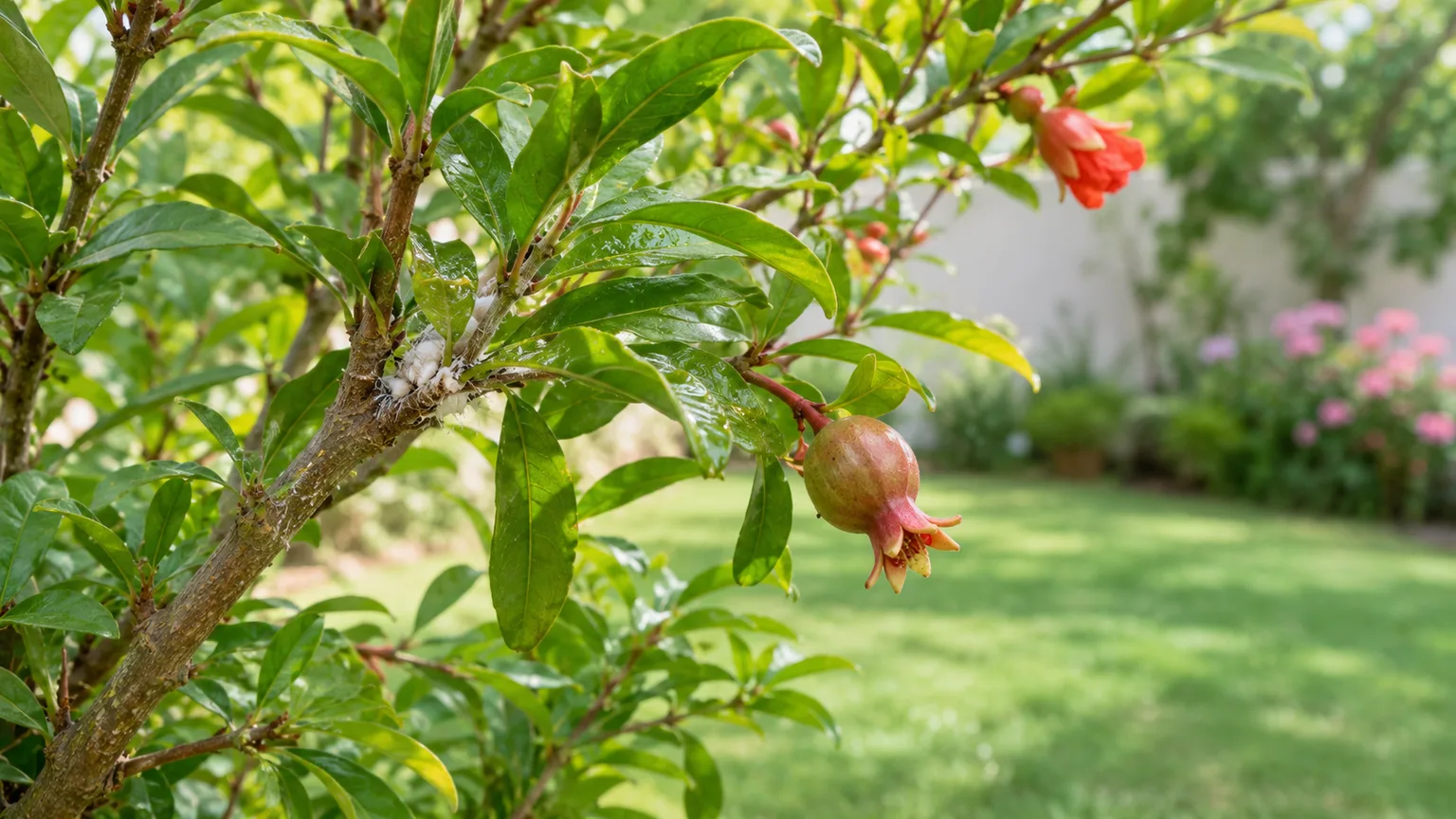
Mealybugs on Pomegranate: Causes, Checks & Fixes
This guide covers mealybugs on Pomegranate. See also the general Mealybugs guide, watering, and light pages for this plant.
Mealybugs on Pomegranate: Causes, Checks & Fixes
Quick answer
Pomegranate (Punica granatum) is a deciduous fruit shrub that wants full sun and free-draining roots — read the pomegranate overview if its basic rhythm is new to you. Mealybugs find it through its peeling bark, tight leaf axils, and endless sucker growth: white cottony colonies settle into crevices the eye skips over, then coat everything below with sticky honeydew and black sooty mold. For how mealybugs feed and multiply in general, see our mealybug pest guide. On pomegranate, the pattern is unmistakable: cottony wax in bark cracks and sucker bases in spring, honeydew-spotted fruit clusters by late summer.
First step: dab every visible cluster with an alcohol-dipped cotton swab. Work shoot by shoot in the cool of the morning, pressing the swab into bark crevices, leaf axils, and the calyx crown of young fruit until no white wax remains. That single direct kill comes before any spray, because it removes the wax-protected adults that water and soap struggle to reach.
What mealybugs look like on pomegranate
The main culprit is the grape mealybug, a flat oval insect about 0.2 inch (5 mm) long with a white waxy covering with wax filaments around its body and longer tail-like filaments at the rear. Newly hatched crawlers are yellow-orange-brown and wax-free at first, so the youngest generation looks like tiny amber dots rather than cotton. Females in general run 1/16 to 1/8 inch with a white waxy oval body, and males are small, winged, and seldom seen (Missouri Botanical Garden mealybug reference).
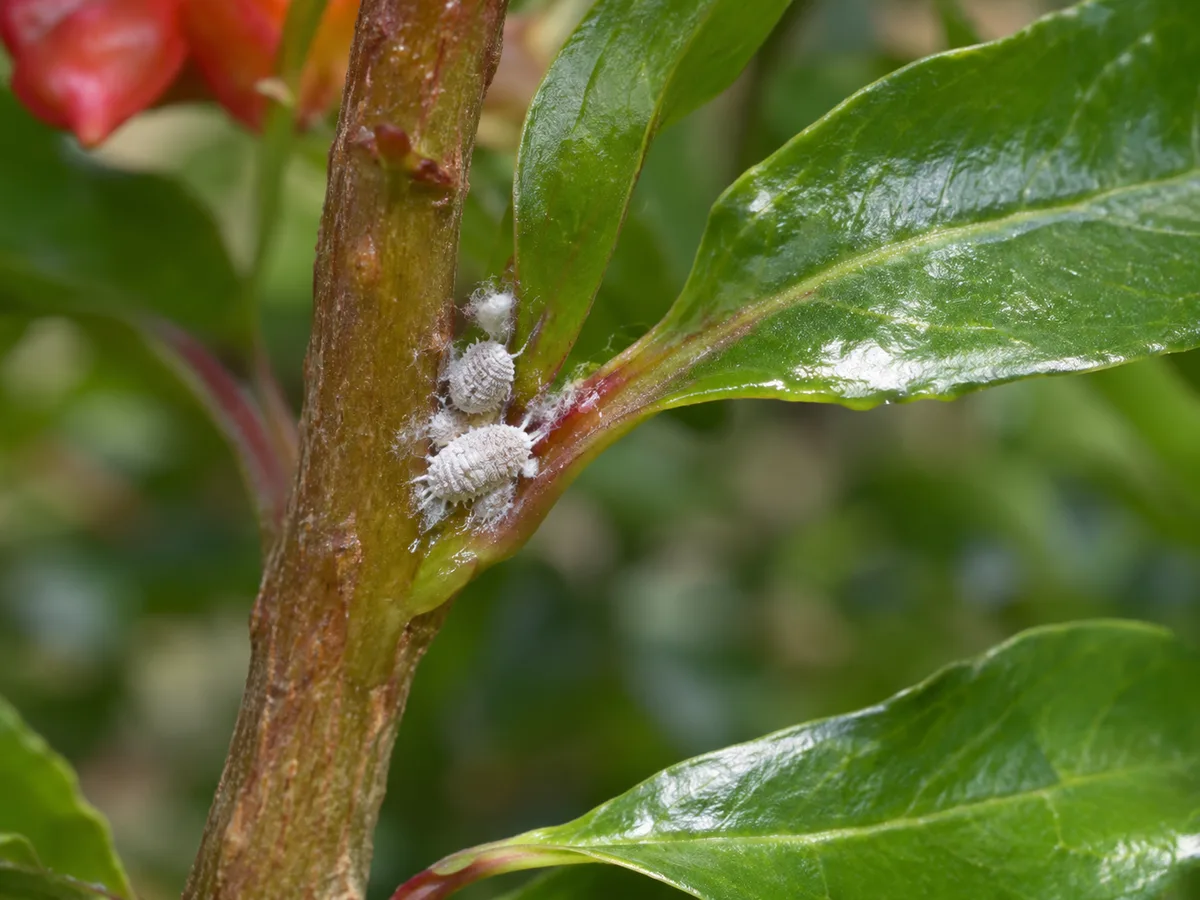
Cottony wax in leaf axils and bark crevices marks colonies that can be missed during a quick canopy check.
On pomegranate they settle in specific places. Check:
- Bark crevices and peeling plates on trunks and older limbs, where cottony egg masses overwinter under cover
- Leaf axils and the joints where petioles meet young shoots, the crawlers’ first spring address
- Root suckers and watersprouts at the base, which push the softest growth on the plant
- Flower ends and the calyx crown of developing fruit, where colonies hide deep in the folds
- Points where two fruitlets touch, the classic late-season damage site
Damage signs follow the colony. Everything below feeding turns shiny with sticky honeydew that grows a sooty-colored mold, giving leaves and rind a dirty black film. Heavily infested shoots stall, leaves yellow and drop, and fruit caught at contact points develops rot or discoloration. Cast white skins and loose cottony fluff on leaves are molted shells — proof mealybugs fed there even if the live insects have shifted deeper into cover.
Why pomegranate draws mealybugs into hiding
Grape mealybug is found in many pomegranate orchards yet only occasionally becomes a serious pest, because parasitic wasps, lacewings, and lady beetles usually hold it down. Outbreaks on a home tree almost always mean something tipped that balance — and pomegranate’s structure supplies the shelter.
Three amplifiers turn a few mealybugs into an outbreak:
- Peeling bark and tight axils. Mealybugs live together in clusters in inaccessible parts of plants such as leaf axils and under loose bark, and pomegranate’s exfoliating mature bark is purpose-built shelter. Sprays bead off wax and never reach these pockets, which is why colonies rebound after a careless treatment.
- Sucker growth. The second generation’s crawlers migrate outward in early summer and many can be found in the sucker growth at the base of trees. An unpruned skirt of suckers is a humid, tender nursery that reseeds the whole canopy — the pomegranate pruning guide shows how to keep it thinned.
- Heavy nitrogen feeding. Over-applied nitrogen combined with steady irrigation stimulates new plant growth where mealybugs prefer to lay eggs, so a big dose of quick-release fertilizer timed to the spring flush grows perfect mealybug food. Details in the pomegranate fertilizer guide.
Two more introduction routes matter. Ants may transport mealybugs from one plant to another while farming them for honeydew, so a busy ant highway up the trunk actively spreads the infestation. New nursery plants and crowded terrace groupings add carriers, so isolate newcomers for two to three weeks before parking them against an established anar.
How to confirm the cause
Work this order before treating:
- Find the wax. Part sucker clusters, peel back loose bark flakes gently, and look into leaf axils and fruit calyxes for white cottony masses. Females lay several hundred yellow-to-orange eggs in cottony egg masses typically located on the trunk under bark — that under-bark cotton is diagnostic.
- Read the residues. Shiny sticky honeydew plus black sooty film points to mealybugs, aphids, or scale — then the insect shape settles it. Mealybugs carry white cottony wax and visible legs; scale sits as immobile bumps; aphids are soft, exposed, and wax-free.
- Watch the ants. Steady ant traffic to one shoot or into the canopy almost always marks a tended honeydew colony worth treating at both ends.
- Check the calendar. Crawlers moving onto young shoots around March budbreak, a return to trunks in late May to early June, and a second crawler wave onto leaves and fruit from early June through July fits the documented rhythm of two generations a year with overwintering in the egg stage.
- Scan bare wood in winter. The larger instars, adults, and egg masses are easy to find under bark in late fall through late winter — pomegranate’s leafless dormancy hands you a free inspection window.
Do not confuse mealybug sooty film with drought stress (whole shoots flag at midday and recover by morning — a watering issue) or with normal winter leaf drop on this deciduous shrub, which is dormancy rather than decline. If leaves yellow broadly without wax, honeydew, or ants, browse the pomegranate problems hub for the right entry point instead.
The first fix to try
Dab every visible cluster with an alcohol-dipped cotton swab.
Soak the swab in isopropyl rubbing alcohol of 70% or less, press it directly onto each white cluster, and twist into bark cracks, leaf axils, and calyx folds so the alcohol wets the insects beneath the wax. Removing mealybugs with alcohol-dipped cotton swabs kills on contact without harming the predators working the rest of the tree. Test the alcohol on one leaf first and watch for burn before treating the whole canopy (alcohol phytotoxicity precaution).
Do this first and alone. One clear action lets you read the response: if clusters stay gone for a week, predators and weather are handling the survivors; if fresh cotton reappears within days, move to the follow-up sequence below.
Step-by-step follow-up
If dabbing does not hold:
- Blast crawlers with water every few days. A strong stream of water, repeated every few days as needed, knocks the wax-free crawler stage off shoots and suckers before they settle. Aim up into leaf undersides and sucker clusters in the morning so foliage dries by evening.
- Prune the worst wood. Snip the most heavily caked sucker clumps and unreachable shoot tips and bin or burn them; do not compost live colonies. Keep the plant’s fruiting wood in mind — the pomegranate pruning guide shows which growth to spare.
- Break the ant bridge. Sticky trunk bands, pruning branches off walls and soil, and clearing honeydew-soiled debris cut ant access so parasitic wasps, the mealybug destroyer lady beetle, and lacewings can feed freely.
- Target immatures with soap, oil, or neem. Insecticidal soaps, horticultural oils, and neem oil applied directly to immature mealybugs can reduce numbers, since crawlers lack the adults’ waterproof wax. The neem extract azadirachtin is effective on immature grape mealybugs. Coat colonies thoroughly in cool weather, never on water-stressed plants or above 90°F.
- Protect bloom-time pollinators. Avoid broad-spectrum insecticides, which reduce the natural enemies that control mealybug populations — pomegranate needs its bees more than it needs a spotless shoot tip.
Fruit-touch and calyx check: the late-season damage that matters most
This is the most pomegranate-specific damage mealybugs do. Colonies settle where two fruit touch, or inside the calyx of the fruit, and rot or discoloration can occur where the mealybugs deposit honeydew. Rot can even start inside the calyx and spread to the fruit interior, invisible until harvest. Mature mealybugs or egg masses hidden in the calyx also cause culling at packing.
From midsummer on, part every touching fruit pair weekly and peer into each calyx crown with a lens. Where you find cottony wax or sticky film, swab it out, wash honeydew off with plain water before mold sets, and thin the heaviest clusters so none are touching. That single thinning cut removes both the shelter and the honeydew trap in one move.
Dormancy: the winter bark check on bare stems
Because pomegranate drops its leaves, winter hands you a free inspection window no evergreen offers. On a mild day, walk the bare framework and lift loose bark flakes to look for cottony egg masses and sluggish overwintering adults. Also look for yellowed, parasitized mummies with tiny emergence holes — parasitized mealybugs called mummies are yellow — which tell you wasps are already working that limb.
Rub out small wax patches with an alcohol swab, prune out the twig sections carrying the heaviest deposits, and clear fallen leaves and weeds at the base that shelter alternate hosts. Ten minutes of dormant attention removes the generation that would otherwise colonize the first flush — the cheapest control of the year.
Recovery timeline
Expect knocked-back clusters within days of thorough dabbing and visibly cleaner shoot tips within one to two weeks if ants stay excluded. New leaves emerge unspotted; old sooty film weathers off slowly and can be rinsed with plain water.
Fruit shot through with rot spots will not heal — pick the worst affected fruitlets so the plant spends energy on clean ones. If fresh cotton rebuilds within days across shoots, suckers, and fruit despite repeat dabbing, blasting, and ant control, predators are losing and a soap, oil, or neem round on the crawler stage is justified. If shoots keep stalling after two full follow-up cycles, reassess water and roots rather than spraying harder.
What not to do
- Do not push quick nitrogen to force recovery while colonies are active — soft regrowth feeds the next wave. Resume the measured schedule in the pomegranate fertilizer guide only after shoots stay clean.
- Do not spray soap, oil, or neem on a drought-stressed tree or in hot sun; phytotoxicity burns follow.
- Do not spray open blossoms with anything broad-spectrum — bees set your crop.
- Do not strip the tree of suckers and shoots in one panic prune; you would remove fruiting wood and stress the plant into a weaker flush.
- Do not assume bare winter stems mean the mealybugs won — that is dormancy, and it is your scouting season.
Pomegranate care cross-check
Mealybug pressure tracks vigor and shelter, so confirm the basics while colonies are active:
- Light: at least six hours of direct outdoor sun; shade-grown flush is weak and slow to outgrow feeding. See the pomegranate light guide.
- Water: even moisture from flowering through ripening, never a swamp; drought-to-deluge swings stress the tree and split fruit. See the pomegranate watering guide.
- Soil: sharp drainage in loam or sandy loam; sour, airless mix keeps roots too weak to support clean growth.
- Feeding: modest slow-release nutrition during active growth, nothing while bare or stressed.
How to prevent it next time
- Scout peeling bark each winter for egg masses and rub out early sucker colonies in March before crawlers disperse.
- Keep nitrogen modest and slow-release so flushes harden faster than colonies build.
- Prune for airflow and sucker control per the pomegranate pruning guide, removing mealybug nurseries without sacrificing fruiting spurs.
- Examine and quarantine new plants for 2 or 3 weeks before placing them near a clean tree.
- Leave parasitic wasps, lady beetles, and lacewings alone — broad-spectrum sprays trade a week of clean bark for a season without guards.
- Water evenly and mulch sensibly so the tree never sits in the stressed state sucking pests exploit.
When to worry
Escalate when cottony wax sits inside fruit calyxes, honeydew coats clustered young fruit faster than you can wash it, or colonies spread across shoots, suckers, and fruit at once rather than one spur. Those mean the population is outpacing both predators and your swabbing.
Relax slightly when a small spring cluster on one shoot of a mature tree hosts visible lady beetle larvae or yellowed wasp mummies, or when predator activity is clearly rising. Keep watching, keep ants off, and let the tree’s own flush outrun the tail of the outbreak.
When to use this page vs other pomegranate guides
- White cottony wax in bark crevices, leaf axils, sucker bases, or fruit calyxes with honeydew — you are in the right place.
- Soft pear-shaped insects clustered on shoot tips with curled leaves but no cottony wax — that is the aphid pattern, not this page; start from the pomegranate problems hub.
- Yellow, wilting, or dropping leaves with no wax, honeydew, or ants — a water, light, or root issue; use the pomegranate watering guide first.
- General care, dormancy rhythm, and fruiting habit — the pomegranate overview.
Related Pomegranate guides
- Pomegranate overview — habit, sun, dormancy, and fruiting rhythm behind every pest decision.
- Pomegranate problems hub — browse every diagnosed issue on this species when the pest is uncertain.
- Pomegranate watering — even moisture that keeps trees vigorous enough to outgrow feeding.
- Pomegranate fertilizer — modest feeding that avoids soft nitrogen flushes pests love.
- Pomegranate pruning — sucker control and fruiting-wood care that remove mealybug nurseries safely.
- Pomegranate light — sun levels that harden growth against sucking pests.
Related tool
Use the Pest Identifier Tool to narrow causes for mealybugs on this plant before changing multiple variables at once.