Spider Mites on Pomegranate: Causes, Checks & Fixes
Quick answer
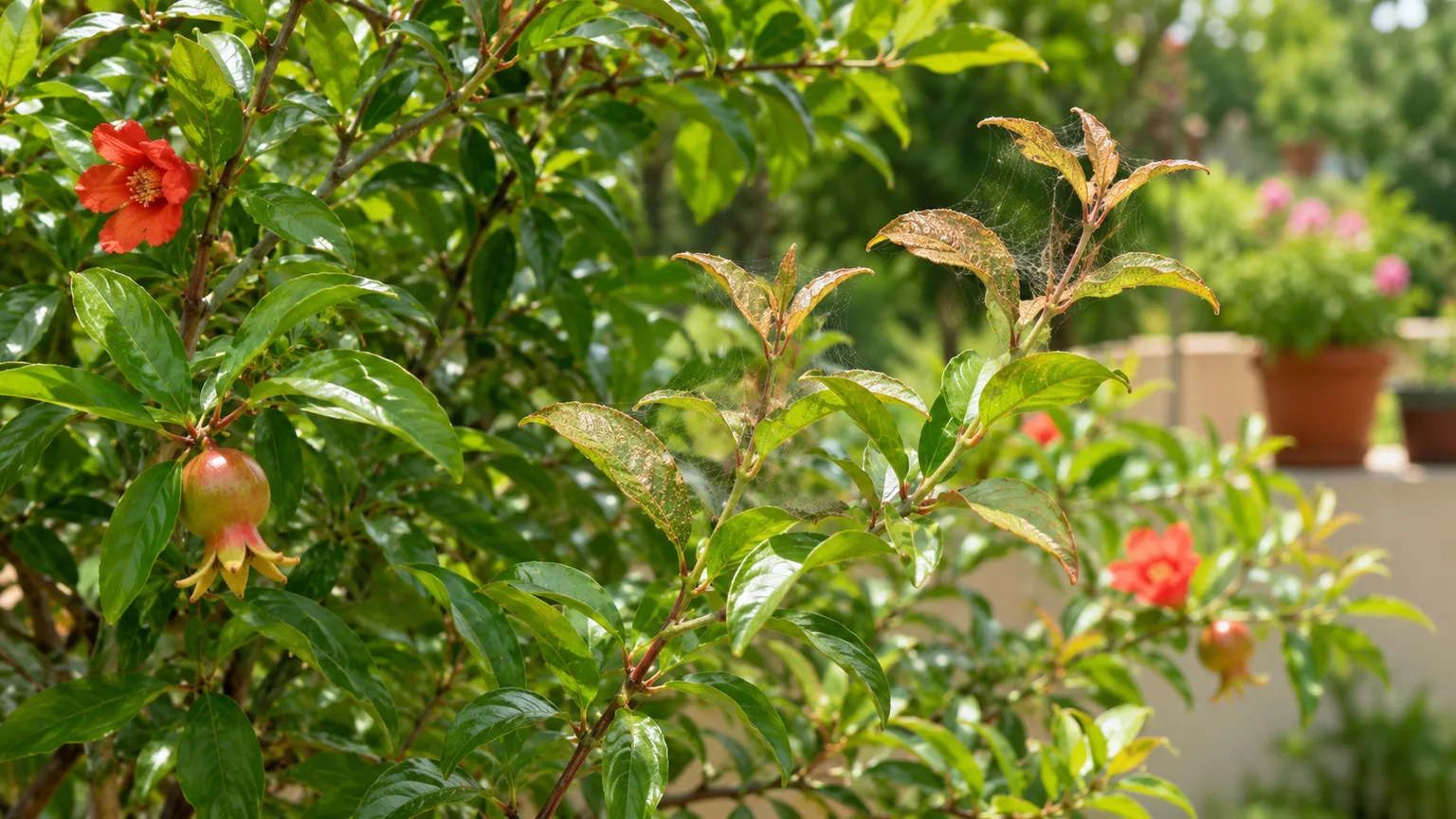
Spider mites on pomegranate show as pale stippling that turns small glossy leaves dusty bronze, with fine webbing under shoot-tip leaves in hot dry weather. First step: blast leaf undersides with a strong jet of water in the cool of the morning and repeat every few days. Confirm mites with a tap test before spraying anything, protect predators, and escalate to insecticidal soap or horticultural oil only if colonies persist.
Spider Mites on Pomegranate: Causes, Checks & Fixes
This guide covers spider mites on Pomegranate. See also the general Spider Mites guide, watering, and light pages for this plant.
Spider Mites on Pomegranate: Causes, Checks & Fixes
Quick answer
Pomegranate (Punica granatum) is a deciduous fruit shrub that wants full sun and free-draining roots — read the pomegranate hub if its seasonal rhythm is new to you. Spider mites find it in hot, dusty spells: colonies suck individual leaf cells dry on the undersides, leaving pale stippling that merges into a dusty bronze, plus faint webbing slung between shoot-tip leaves. For how webspinning mites feed and cycle in general, see our spider mite pest guide. On pomegranate, the pattern is unmistakable: bronze stippled shoot tips with dusty undersides in peak summer heat.
First step: blast the undersides of all affected leaves with a strong jet of water in the cool of the morning. That single physical knockdown comes before any spray, because predators often finish the job once dust and webbing are washed away.
What spider mites look like on pomegranate
To the naked eye you will never see the mite clearly — adults are less than 1/20 inch long, oval, eight-legged, and often carry two dark spots near the head. What you see instead is their feeding: hundreds of pinpoint pale dots where cell contents were sucked out, merging until the leaf looks bleached, then bronze. Heavily worked leaves yellow and drop, and the fine silk webbing strung along shoot tips and leaf undersides separates mites from every lookalike.
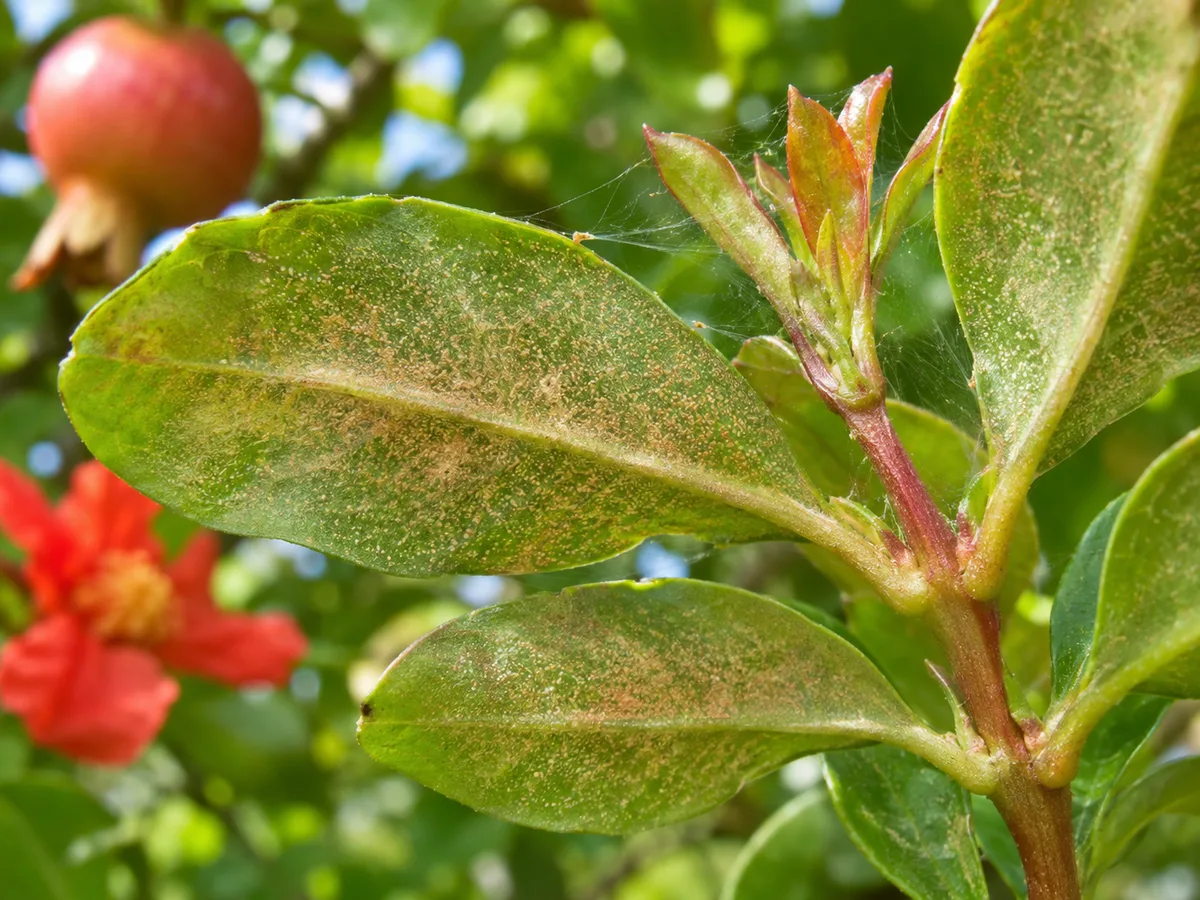
Spider mite feeding leaves tiny pale dots that merge into bronze patches, with fine webbing beneath the leaf.
On pomegranate, check these zones first:
- Sun-exposed shoot tips and expanding leaves, where the softest tissue and the most dust collect
- Leaf undersides along the midrib, the feeding and egg-laying surface — flip leaves, do not just glance at tops
- Root suckers and watersprouts at the base, whose crowded soft growth traps dust and hides early webbing
- Interior leaves touching dusty walls or paths, which stipple first on terrace trees
The glasshouse red spider mite behind most outbreaks is the two-spotted spider mite, active through the warm months and built to explode in number within a week or two of hot dry weather.
Why pomegranate draws mites in heat and dust
Pomegranate carries small, glossy, closely spaced leaves on stiff twiggy growth — a canopy that holds road and terrace dust the way a broad-leafed tree does not. Dust dulls the leaf, favors mite settling, and kills predatory mites faster than it kills the pest, so a dusty tree beside a path or construction edge is always the first to bronze.
Three amplifiers turn a few mites into an outbreak:
- Water stress. Damage is most severe in hot, dusty conditions and on plants short of water, so drought swings into a heatwave invite trouble — the pomegranate watering guide keeps moisture even without soggy spells.
- Broad-spectrum sprays for other pests. Insecticide treatments aimed at aphids or caterpillars frequently trigger mite outbreaks by wiping out predators, so mite webbing a week after a general spray is a familiar sequence.
- Heavy nitrogen flushes. Soft, fast growth is easy feeding, and a big dose of quick-release fertilizer timed to summer heat grows perfect mite food instead of hardened canopy. Details in the pomegranate fertilizer guide.
New nursery stock and crowded terrace groupings add introduction routes, so isolate newcomers for two to three weeks before parking them against an established tree.
How to confirm the cause
Work this order before treating:
- Tap-test the shoot tips. Hold a white sheet of paper under a suspect shoot, tap sharply, and watch with a hand lens — disturbed mites move around rapidly as tiny crawling dots.
- Read the leaf surface. Even stippling across the blade plus bronze cast and underside webbing points to mites; blotchy yellow between veins with no webbing leans nutrient or water instead.
- Check the calendar and dust. Stippling that appears or deepens during a hot dry spell on dusty outer canopy fits mites; sudden flagging at midday that recovers by morning is drought wilt, a watering issue.
- Scan for predator absence. A recent broad-spectrum spray followed by fast-spreading stippling strongly suggests predators were removed and mites released.
- Rule out dormancy. Normal winter leaf drop on this deciduous shrub is rest, not damage — mite stippling is a growing-season pattern on green leaves.
If leaves yellow broadly without stippling, webbing, or moving dots, browse the pomegranate problems hub for the right entry point instead.
The first fix to try
Blast leaf undersides with a strong stream of water.
Take a hose with a jet nozzle in the cool of the morning. Work shoot by shoot, aiming upward into the undersides and growing points until webbing and dust wash off every affected branch. Forceful water sprays knock colonies down without chemicals and leave predatory mites and insects alive to mop up survivors.
Do this first and alone. One clear action lets you read the response: if shoot tips stay clean and new leaves emerge unstippled for a week, washing plus predators are handling it; if stippling and webbing rebuild within days, move to the follow-up sequence below.
Step-by-step follow-up
If the blast does not hold:
- Repeat every three to five days for two weeks. Contact action only removes mites present that day, and eggs tucked in webbing keep hatching — persistence beats strength here.
- Even out the watering. Deep, steady irrigation through heat keeps the tree out of the stressed state where damage deepens fastest; the pomegranate watering guide sets the rhythm from flowering through ripening.
- Thin the worst clusters. Snip a few heavily bronzed, webbed shoot tips and sucker tufts and bin them; do not compost live colonies. Keep fruiting wood in mind — the pomegranate pruning guide shows which growth to spare.
- Escalate to soap or oil only if needed. Insecticidal soap or horticultural oil must contact mites to kill them, so coat undersides thoroughly in cool weather and re-treat after a week if live mites persist. Never spray water-stressed plants or in hot sun.
- Protect the predators. Mites have many natural predators that often limit numbers, so skip broad-spectrum insecticides entirely while mites are active — each general spray risks a bigger rebound.
Dusty-leaf syndrome: why small pomegranate leaves bronze first
This is the most pomegranate-specific part of the diagnosis. Pomegranate leaves are small, narrow, and glossy with a leathery cuticle, so early stippling shows as a pale dusting that is easy to dismiss as road dust — until the whole shoot tip turns bronze at once. On a broad-leafed fig the same feeding reads as obvious yellow patches; on pomegranate it reads as a dull gray-green cast that only reveals its pinpoint dots under a lens.
Use that trait. When terrace dust is visibly filming the canopy, stippling is probably already underway on the outermost sun leaves even if the interior still looks green. Wash dusty foliage on a schedule during heatwaves rather than waiting for bronze, and always compare an outer shoot tip against a shaded interior leaf — the gradient tells you whether mites or a whole-tree shortage is at work.
Dormancy: the bare-branch reset no evergreen offers
Because pomegranate drops its leaves, winter hands you a free break no evergreen grower gets. Leaf drop physically removes the mite population living on foliage, and bare stems let you wash trunks and framework clean of dust and old webbing where a few mites overwinter in bark crevices.
On a mild winter day, hose the bare framework, clear fallen leaves and weeds at the base that shelter alternate hosts, and prune out the twiggy interior clutter per the pomegranate pruning guide. Spring buds then break onto clean wood — the cheapest mite control of the year, and one that only a deciduous fruit shrub allows.
Suckers, spurs, and where webbing hides on this tree
Pomegranate grows as a multi-stemmed shrub that throws root suckers and watersprouts freely, and mites exploit exactly that architecture. Sucker tufts at the base push the softest leaves on the plant, sit lowest where dust settles, and tangle tightly enough to shelter webbing from a casual overhead spray.
Part every sucker clump and look inside rather than spraying the outside of the tuft. Remove the excess suckers you do not need for replacement stems — each one deleted is a mite nursery gone — and direct the water jet up through the remaining tufts from below. Fruiting spurs on older wood rarely carry the first colonies, so when webbing appears on spurs rather than shoot tips, the outbreak is already advanced and the full follow-up sequence is warranted.
Recovery timeline
Expect webbing gone and stippling halted within days of a thorough blast, with visibly cleaner shoot tips within one to two weeks if water stays even. New leaves emerge glossy and unstippled; old bronzed ones keep their color but stop accumulating damage.
Bronzed leaves will not re-green — if more than a third of the canopy yellows and drops in summer, fruit sizing that season suffers and the tree leans on stored reserves. If stippling rebuilds across multiple shoots despite repeat blasts and steady watering, predators are losing and a soap or oil round is justified. If shoots keep stalling after two full follow-up cycles, reassess roots and light rather than spraying harder.
What not to do
- Do not reach for a broad-spectrum insecticide at the first stippling — predator wipeout is the classic route to a worse outbreak.
- Do not spray soap or oil on a drought-stressed tree or in hot sun; burn damage follows on already taxed leaves.
- Do not fertilize to force recovery while colonies are active — soft regrowth feeds the next wave. Resume the measured schedule in the pomegranate fertilizer guide only after tips stay clean.
- Do not strip the shrub of suckers, spurs, and shoots in one panic prune; you would remove fruiting wood and stress the plant into a weaker flush.
- Do not assume bare winter stems mean the mites won — that is dormancy, and it is your cleanup season.
Pomegranate care cross-check
Mite pressure tracks heat, dust, and vigor, so confirm the basics while colonies are active — full details in the pomegranate hub:
- Light: at least six hours of direct outdoor sun; shade-grown growth is weak and slow to outgrow feeding. See the pomegranate light guide.
- Water: even moisture from flowering through ripening, never a swamp; drought-to-deluge swings stress the tree and deepen stippling. See the pomegranate watering guide.
- Soil: sharp drainage in loam or sandy loam; sour, airless mix keeps roots too weak to support clean growth.
- Feeding: modest slow-release nutrition during active growth, nothing while bare or stressed.
How to prevent it next time
- Hose dust off the canopy on a routine during heatwaves, aiming at undersides, not just a cosmetic top rinse.
- Water evenly and mulch sensibly so the tree never sits in the stressed state mites exploit.
- Keep nitrogen modest and slow-release so flushes harden faster than colonies build.
- Prune for airflow and sucker control each dormant season, removing mite nurseries without sacrificing fruiting spurs.
- Leave predatory mites, lady beetles, and lacewings alone — dusty conditions plus dead predators are the two preventable ingredients of every bad outbreak.
When to worry
Escalate when webbing mats across multiple shoot tips, young leaves yellow and drop through summer rather than autumn, or a sapling stalls with deepening bronze across the whole canopy. Those mean the colony is outpacing both predators and your blasts.
Relax slightly when stippling stays on a few outer leaves of a mature tree and tap tests come back clean after two wash rounds, or when cooling weather plus steady water halts spread on its own. Keep watching shoot tips weekly until new growth holds glossy and clean.
When to use this page vs other pomegranate guides
- Pinpoint stippling plus bronze cast with underside webbing and moving dots on a tap test — you are in the right place.
- Sticky shoot tips with visible soft insects and honeydew but no webbing — an aphid or scale issue instead; start from the pomegranate problems hub.
- Yellow, wilting, or dropping leaves with no stippling, webbing, or dots — a water, light, or root issue; use the pomegranate watering guide first.
- General care, dormancy rhythm, and fruiting habit — the pomegranate hub.
Related Pomegranate guides
- Pomegranate hub — habit, sun, dormancy, and fruiting rhythm behind every pest decision.
- Pomegranate problems hub — browse every diagnosed issue on this species when the pest is uncertain.
- Pomegranate watering — even moisture that keeps trees vigorous enough to outgrow feeding.
- Pomegranate fertilizer — modest feeding that avoids soft flushes sucking pests love.
- Pomegranate pruning — sucker control and fruiting-wood care that remove mite nurseries safely.
- Pomegranate light — sun levels that harden growth against heat-driven pests.
Related tool
Use the Pest Identifier Tool to narrow causes for spider mites on this plant before changing multiple variables at once.