Distorted Leaves on Spider Plant: Causes, Checks & Fixes
Quick answer
Distorted leaves on spider plant—twisted, rippled, or undersized narrow blades—usually trace to thrips or aphids on soft crown growth, or uneven watering while new leaves were forming. First step: inspect the newest blades emerging at the crown and shake them over white paper before repotting or fertilizing.
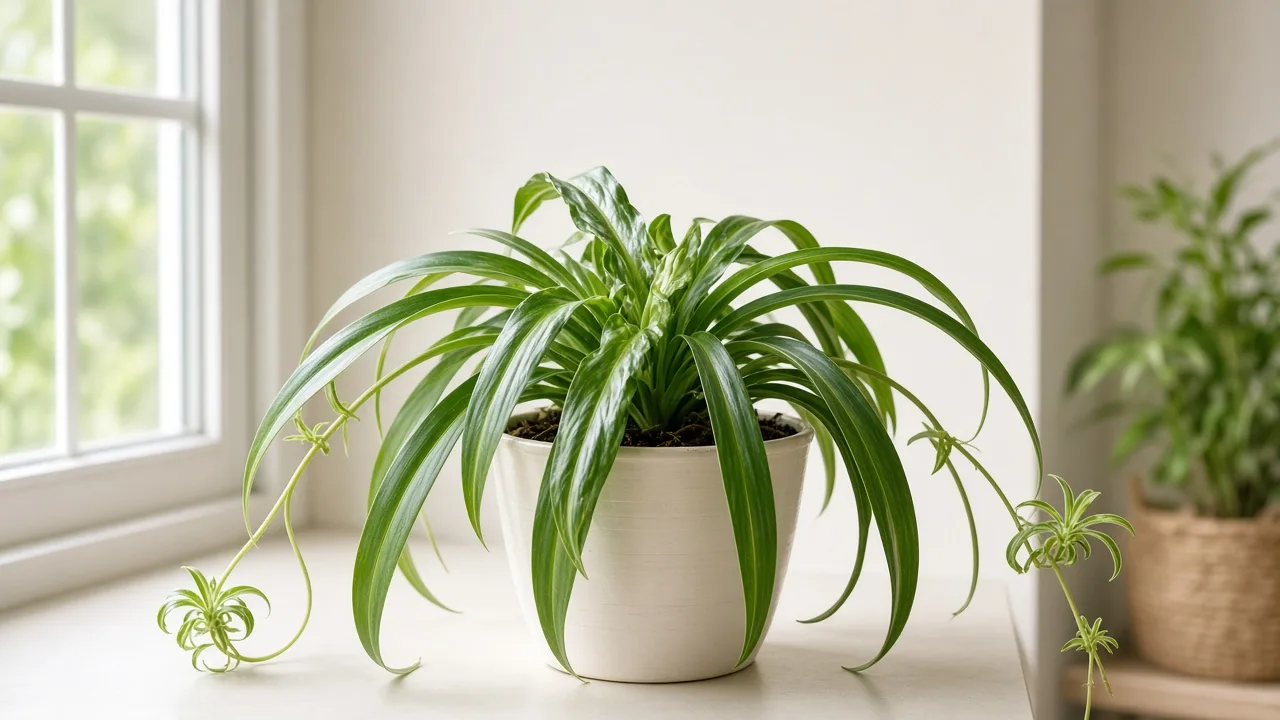
Distorted Leaves on Spider Plant: Causes, Checks & Fixes
This guide covers distorted leaves on Spider Plant. See also the general Distorted Leaves guide, watering, and light pages for this plant.
Distorted Leaves on Spider Plant: Causes, Checks & Fixes
Quick answer
Distorted leaves on spider plant (Chlorophytum comosum) break the plant’s usual look: narrow, arching, strap-shaped blades with a slight channel down the center, rising from a fountain crown and trailing stolons with baby plantlets. When new foliage emerges twisted, rippled, cupped, or noticeably narrower than neighbors, something interfered while that blade was forming—or sap feeders scarred soft tissue at the growing point.
For how crinkled and misshapen leaves develop on houseplants in general, see our distorted leaves hub. On spider plant, the diagnostic clue is almost always at the sheltered crown and along active stolon tips—the inner arching blades still pushing growth, the nodes bearing spiderettes, and whether distortion tracks only new tissue or older cascade leaves too.
First step: inspect the newest blades emerging at the crown and shake suspect leaves over white paper to confirm thrips before rinsing every leaf underside.
When to use this page vs other Spider Plant guides
| Pattern | Start here | Or route to… |
|---|---|---|
| Silvery streaks, black frass, scarred new tips | Thrips | This page when shape—not stippling alone—is the main issue |
| Inward roll on established blades without twist | Curling leaves | — |
| Sticky clumps in leaf axils at the crown | Mealybugs | Aphids if pear-shaped insects visible |
| Yellow lower leaves, heavy wet pot | Overwatering | Root rot if tubers feel soft |
| Uniform brown tips without ripple | Brown tips | Fluoride or dry air—not distortion |
| Fine webbing and yellow stippling | Spider mites | — |
What distorted leaves look like on Spider Plant
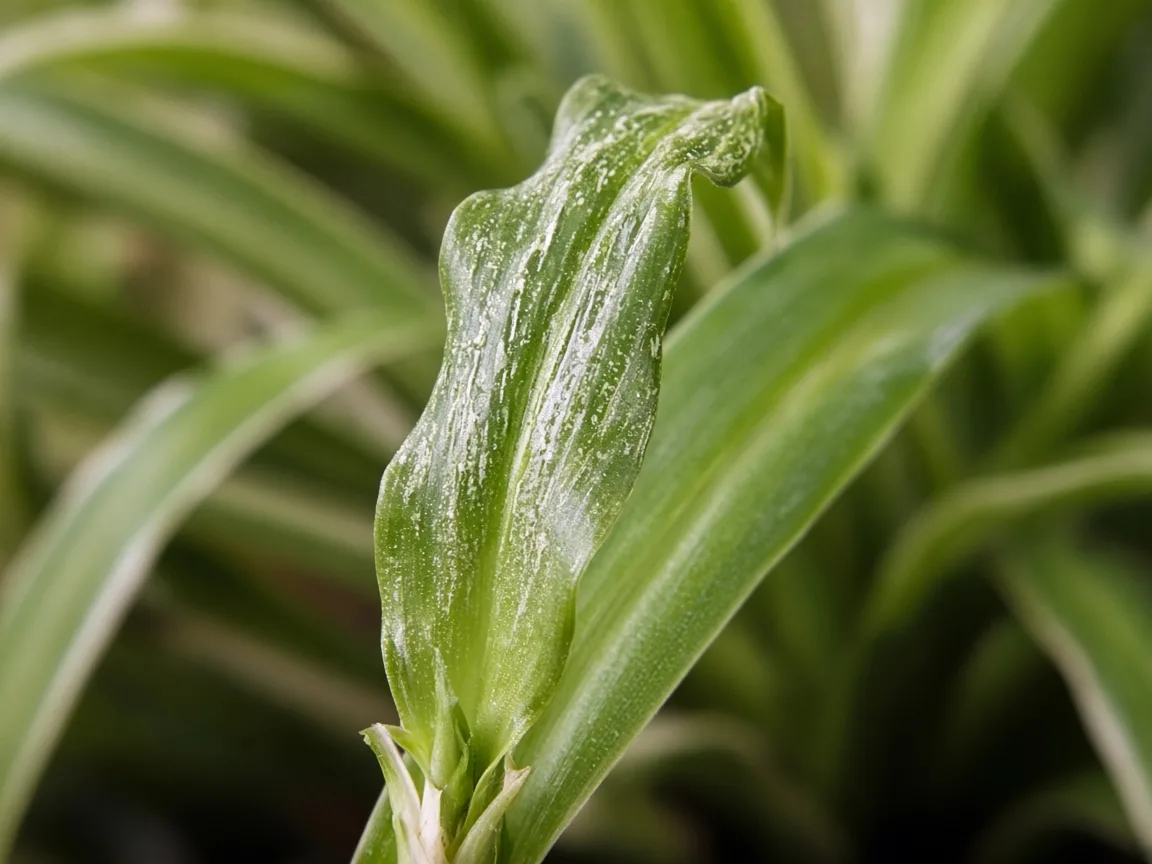
Twisted, undersized arching blade at the crown with silvery thrips scarring—compare with the flat strappy leaf below it on the same clump.
Healthy spider plant carries narrow strap-shaped leaves that arch outward from a central crown. Wisconsin Extension notes the blades are not flat but slightly channeled or folded down the middle, with solid green or white-striped variegation. Distortion means that symmetry fails:
Thrips scarring — Silvery or bronze streaks along the narrow blade, black varnish-like frass specks, and twisted or crinkled new leaves still emerging at the crown. UC IPM describes thrips rasping as stippling and scar formation that can distort plant parts; damage often shows before you spot the insects.
Aphid distortion — Clustered soft-bodied insects on new growth and stolon tips, sticky honeydew, and cupped or narrowed young blades at the crown. Aphids pierce tender tissue while leaves expand, leaving permanent warp on strappy foliage.
Mealybug stunting — White cottony clumps in crown axils and along stolons, sticky residue, and undersized or rippled new blades while older outer leaves look mostly normal. See mealybugs on spider plant.
Stop-start watering crinkle — Blades look creased or puckered along the central channel without silver streaks or insects, often after the pot dried completely and was flooded, or watering paused during active spring growth. RHS guidance on leaf deformation links crinkled leaves to irregular watering while new tissue develops.
Heavy fertilizer stress — Wisconsin Extension warns that heavily fertilized spider plants may produce fewer plantlets and show tip browning; severe salt buildup can leave new blades small and warped at the crown.
Heat or draft warp — Crispy distorted margins on blades facing a heating vent, air conditioner, or cold window glass; soil moisture may be normal. Distortion clusters on one side of the basket.
Crown-and-stolon distortion map (spider plant only)
Spider plant pushes new blades from a tight fountain crown and sends long stolons with plantlets when conditions suit offset production. Distortion clustered at the inner crown plus every active stolon tip—while lower cascade blades stay flat—points to pests or care stress at growing points, not a whole-pot root failure. Follow each runner: a clean mother crown with warped spiderettes only means the infestation or stress rode out along the stolon.
Narrow-blade thrips visibility (spider plant only)
Unlike broad-leaved houseplants where rasping shows as scattered dots, spider plant’s thin arching blades display thrips damage as long silvery streaks running lengthwise along the strap. That pattern is easy to confuse with mechanical creasing until you find black frass specks and a positive shake test on crown tissue.
Spiderette propagation risk (spider plant only)
Baby plantlets rooting on stolons share vascular tissue with the mother plant. Thrips or aphids scarring a spiderette tip can produce permanently twisted offsets that look healthy from across the room. Inspect every plantlet before pinning it into soil or rooting in water—otherwise you propagate distorted growth into a new pot.
Why Spider Plant gets distorted leaves
Commelinaceae family thrips pressure. Missouri Botanical Garden notes that plants in the spiderwort family (Commelinaceae), which includes spider plant, are prone to thrips attack. Heavily infested leaves appear brownish or silvery, and growing points may become contorted.
Constant tender shoots. Indoor spider plants push new crown blades year-round in good light and send out stolons with plantlets when offset production kicks in. Each emerging strap and stolon tip is easy feeding ground for thrips and aphids that reproduce quickly in warm rooms.
Sheltered crown and leaf bases. Arching leaves overlap at the center, creating pockets where thrips hide from rinses and sprays. Pest thrips often feed in buds and shoot tips before you notice insects on open foliage.
Hanging basket blind spots. Spider plants commonly hang where airflow is weaker than on an open bench. Damage builds on inner crown blades and stolon curves above eye level before ripples show on the outer cascade.
Irregular watering during active growth crinkles new leaves. Spider plant prefers the top 2 inches of mix to dry between drinks, but letting the whole pot go dust-dry and then soaking—or watering on a rigid calendar while growth speeds up—produces stop-start leaf development that looks like distortion rather than simple curling.
Dry stress in heated rooms. MBG notes plants kept too dry are more likely to be damaged by thrips. Warm, dry air near vents weakens leaf tissue without causing the uniform brown tips fluoride sensitivity produces.
How to confirm the cause
Work through these checks in order:
- New vs old — Distortion only on the last one or two blades per crown clump or stolon tip → pests, unfurl stress, or recent care change. Warped blades scattered on mature sections → past event or mechanical damage.
- Shake test — Hold white paper under a suspect crown leaf and tap the base. UC IPM recommends shaking foliage to dislodge thrips before treating.
- Surface scan — Silvery streaks and black frass → thrips. Sticky honeydew and clustered insects → aphids or mealybugs. No pest signs → watering or environment.
- Pot weight — Very light pot with limp arching blades and crinkled new growth → drought during growth. Heavy wet pot with yellow lower leaves → wet tuberous roots, not primary distortion.
- Fertilizer timeline — Distortion followed a recent full-strength feed or white salt crust on soil → hold feed and flush once if needed.
- Placement trace — Warped blades all face one window or vent → heat or draft. Random crown tips on a shaded plant → pests or watering.
- Spiderette check — Inspect every plantlet on stolons; shared scarring confirms a crown-level pest problem moving along runners.
First fix for Spider Plant
Photograph the worst distorted crown blade, then inspect every emerging tip and stolon node before you fertilize, repot, or spray.
| Confirmed pattern | First fix |
|---|---|
| Thrips signs (silver streaks, frass, shake test positive) | Isolate and rinse every leaf underside with lukewarm water; see thrips |
| Aphids on soft new growth | Isolate and wipe insects off with a damp cloth; see aphids |
| Mealybugs in crown axils | Dab visible clusters with 70% alcohol on a swab; see mealybugs |
| Crinkled blades after dry/wet swings, no pests | Water when top 2 inches dry; see watering guide |
| Tips burned after heavy feed | Flush soil once and skip fertilizer until new growth is clean |
| Warped blades on vent/window side | Move the basket or redirect arching leaves away from the heat or cold source |
Do not repot a spider plant with distorted crown tips on day one unless tuberous roots are mushy or soil smells sour. Do not stack repotting, pruning, and pesticide the same afternoon—you need to read which fix worked.
Step-by-step recovery
After the first targeted correction:
- Re-inspect crown tips every three to five days for two weeks—one missed thrips cohort can scar the next emerging blade.
- Hold isolation until no new distortion appears on crown or stolon growth.
- Stabilize watering using pot weight and the top 2-inch dry-down check from the watering guide rather than a fixed calendar.
- Prune only when needed — Remove blades more than half destroyed after pests are gone. Partial ripples on green strappy leaves still photosynthesize.
- Raise humidity toward 40–60% if unfurl tears accompany distortion in dry winter rooms; see low humidity.
- Resume diluted fertilizer only after two weeks of flat new growth during spring or summer active flush.
For a small basket with thrips on every crown tip, rooting a clean spiderette that emerged below the damage may be faster than fighting a long stolon infestation—Wisconsin Extension describes spiderettes as extremely easy to propagate once pest-free.
Recovery timeline
| Phase | Timing | Good sign | Bad sign |
|---|---|---|---|
| After first fix | Days 1–7 | No new twisted blades at crown | Fresh scarring on emerging leaves |
| New growth | Weeks 2–4 | Flat strappy blades at crown and stolon tips | Frass returns or crinkle spreads |
| Cosmetic | Ongoing | Old warped blades stable | Multiple crown clumps declining |
Distorted tissue does not flatten on existing blades. Judge recovery by clean new arching foliage, not by old puckered straps. Spider plant in bright indirect light with stable soil moisture often outgrows light distortion within one to three weeks once the cause is removed.
Lookalike symptoms to rule out
Inward roll on established blades without twist points to curling leaves from drought or low humidity—not the same as a misshapen strap blade.
Yellow lower leaves without shape change suggest overwatering or natural aging—not distortion.
Uniform brown tips without ripple routes to brown tips from fluoride, chlorine, or dry air.
Fine stippling with webbing points to spider mites, not thrips scarring.
Pale washed-out color without ripple routes to pale leaves or not enough light.
Mistakes to avoid
Do not spray insecticide before confirming live pests—stop-start watering crinkle does not need chemical treatment.
Do not assume one distorted blade means the problem is solved. Lift inner crown leaves and follow every stolon.
Do not fertilize a stressed spider plant to “push out” flat blades—extra nitrogen produces soft growth pests prefer.
Do not root spiderettes while crown distortion is still spreading—you will multiply the problem into new pots.
Spider plant is pet safe per ASPCA, but rinse-treated plants off countertops before pets investigate sticky residue from aphid honeydew.
How to prevent distorted leaves next time
- Quarantine new spider plants and spiderettes two to three weeks before mixing collections.
- Water when the top 2 inches of mix dry on a steady rhythm through spring growth spurts.
- Keep baskets in bright indirect light away from heating vents and cold window glass—see light guide.
- Feed monthly at half strength during active growth only; skip feed in winter slowdown.
- Scout crown tips and stolon nodes weekly during warm months when thrips enter through open windows.
- Rinse dusty arching leaves monthly in the shower to expose early scarring.
- Use well-draining mix so tuberous roots stay healthy—see soil guide.
When to worry
Escalate when:
- Fresh distortion appears on multiple crown clumps within a week
- New blades stop emerging or tear apart as they open
- Tuberous roots feel soft with sour-smelling mix
- Thrips or aphids show on several houseplants from one nursery batch
- Every stolon tip and spiderette is scarred despite repeated treatment
A single slightly rippled lower blade that has not changed in a month, with firm tubers and clean new crown growth elsewhere, is usually past stress—not an emergency. Discard and restart from a clean spiderette only when every growing point is scarred, roots have failed, and no clean crown section remains to salvage.
Conclusion
Distorted leaves on spider plant mean something interrupted normal strap-shaped blade development—usually sap feeders at the crown and stolon tips or uneven watering during a fast growth flush. Read the newest emerging blades, shake-test for thrips, and trace each stolon before you repot or feed. Spider plant recovers quickly once the cause stops; focus on flat, full-width new arching foliage at the growing points.
Related Spider Plant guides
- Spider Plant overview — placement, growth habit, and care baseline
- Spider Plant watering — dry-down checks for hanging baskets
- Spider Plant light — bright indirect light for steady new growth and spiderettes
- Spider Plant soil — drainage that keeps tuberous roots healthy
- Thrips on Spider Plant — silvery scarring at crown and stolon tips
- Aphids on Spider Plant — sticky cupping on soft new blades
- Curling leaves — roll without twist
- Brown tips — fluoride and dry-air tip burn
- Spider Plant problems hub — all common issues on this species
Related tool
Use the Plant Problem Diagnosis Tool to narrow causes for distorted leaves on this plant before changing multiple variables at once.