Fungus Gnats on String of Turtles: Identify and Control Them
Quick answer
Fungus gnats around String of Turtles usually indicate potting mix that stays moist long enough for larvae to develop. Confirm that the flies rise from this pot, let the mix reach the plant’s normal dry-down point before watering, and use a yellow sticky card to track adults.
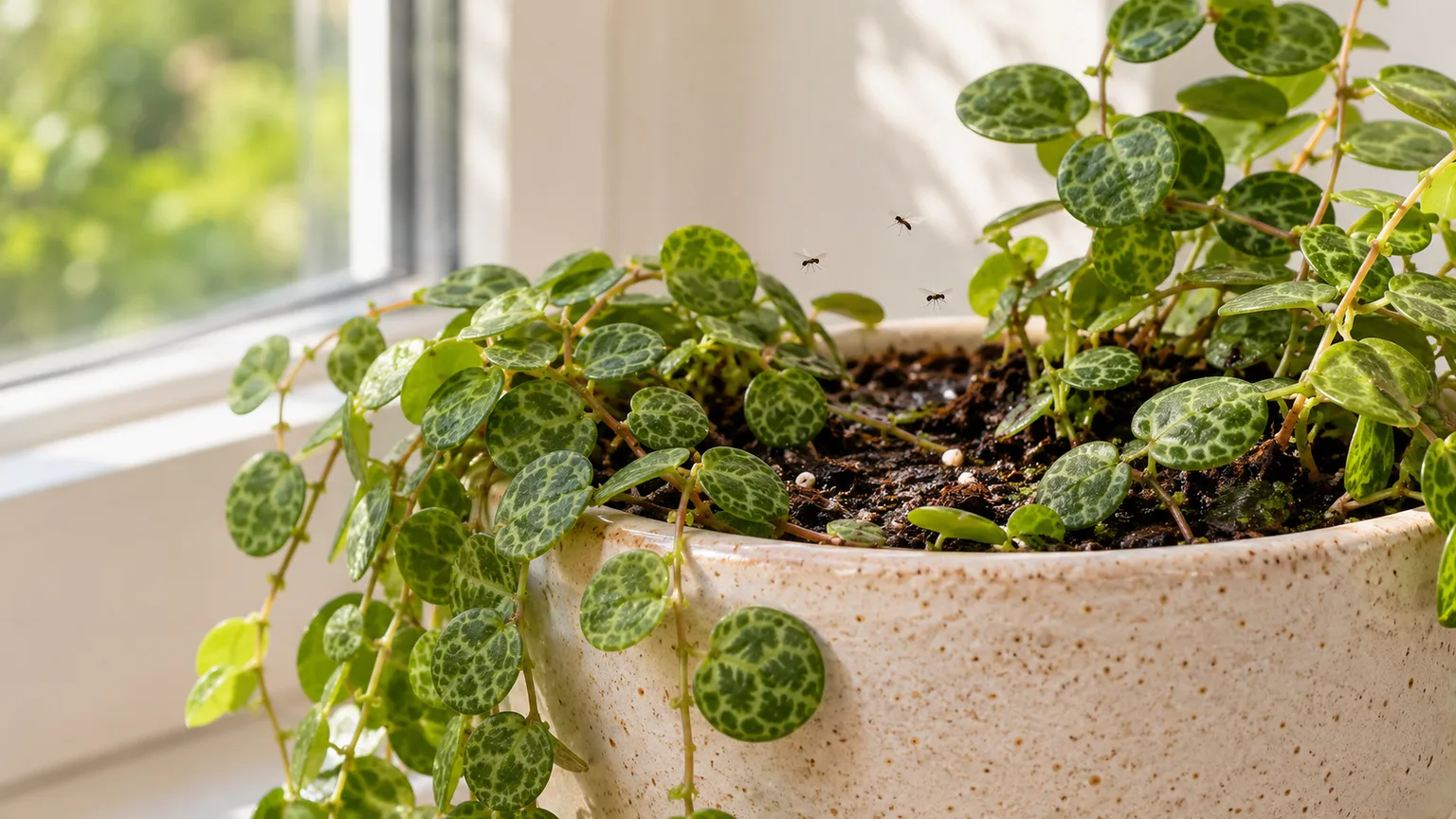
Fungus Gnats on String of Turtles: Identify and Control Them
This guide covers fungus gnats on String of Turtles. See also the general Fungus Gnats guide, watering, and light pages for this plant.
Fungus Gnats on String of Turtles: Identify and Control Them
Quick answer
Fungus gnats are tiny, dark flies that hover over or run across damp potting mix. Around String of Turtles, the first thing to check is whether the pot stays moist for too long. The flies do not mean this plant needs more water. Let the mix reach the plant’s usual dry-down point before watering again, empty any collected runoff, and place a yellow sticky card near the soil to monitor the adults.
This page focuses on the pot and its growing conditions. For other symptoms, compare the String of Turtles problem guides, or use the Plant Problem Diagnosis Tool. For general pest identification, see the fungus-gnat guide.
Why fungus gnats appear around String of Turtles
Fungus-gnat females lay eggs in moist potting media. Their larvae feed mainly on fungi and decaying organic matter, though they can also chew fine roots. UC IPM explains that damp, organic-rich soil supports the life stages that cause recurring indoor activity (UC IPM fungus-gnat guidance). Frequent small waterings, a slow-draining mix, a blocked drainage hole, or water left in a cachepot can all keep a pot moist longer than intended.
String of Turtles has small, fleshy leaves and is usually grown in a compact container. That makes it useful to check the moisture in the root zone, not just the visible soil surface: a dry-looking top can sit above wetter mix. The presence of gnats is a clue about moisture and organic material, not proof that the plant has root damage or that it needs a pesticide.
How to confirm the pest
Look for tiny, delicate, dark flies that rise from the pot when it is moved or hover close to the leaves and soil. Fungus gnats are often noticed resting on the pot, nearby windows, or other bright surfaces. Wisconsin Extension describes adults as small, dark flies and larvae as pale, wormlike bodies with dark heads (Wisconsin Extension identification notes).
To look for larvae, inspect the upper layer of damp mix and any fallen leaves on its surface. Larvae are translucent or whitish and have a shiny dark head. Avoid digging through the whole root ball just to identify a few flying adults; that can disturb this plant’s fine roots without establishing whether larvae are present.
Yellow sticky cards near the pot catch adults and make it easier to see whether their numbers are changing. A card is a monitoring aid, not a treatment for larvae. Wisconsin Extension also describes using a small potato slice on the soil surface as a short-term larval check; inspect it after several days and remove it afterward (Wisconsin Extension scouting methods).
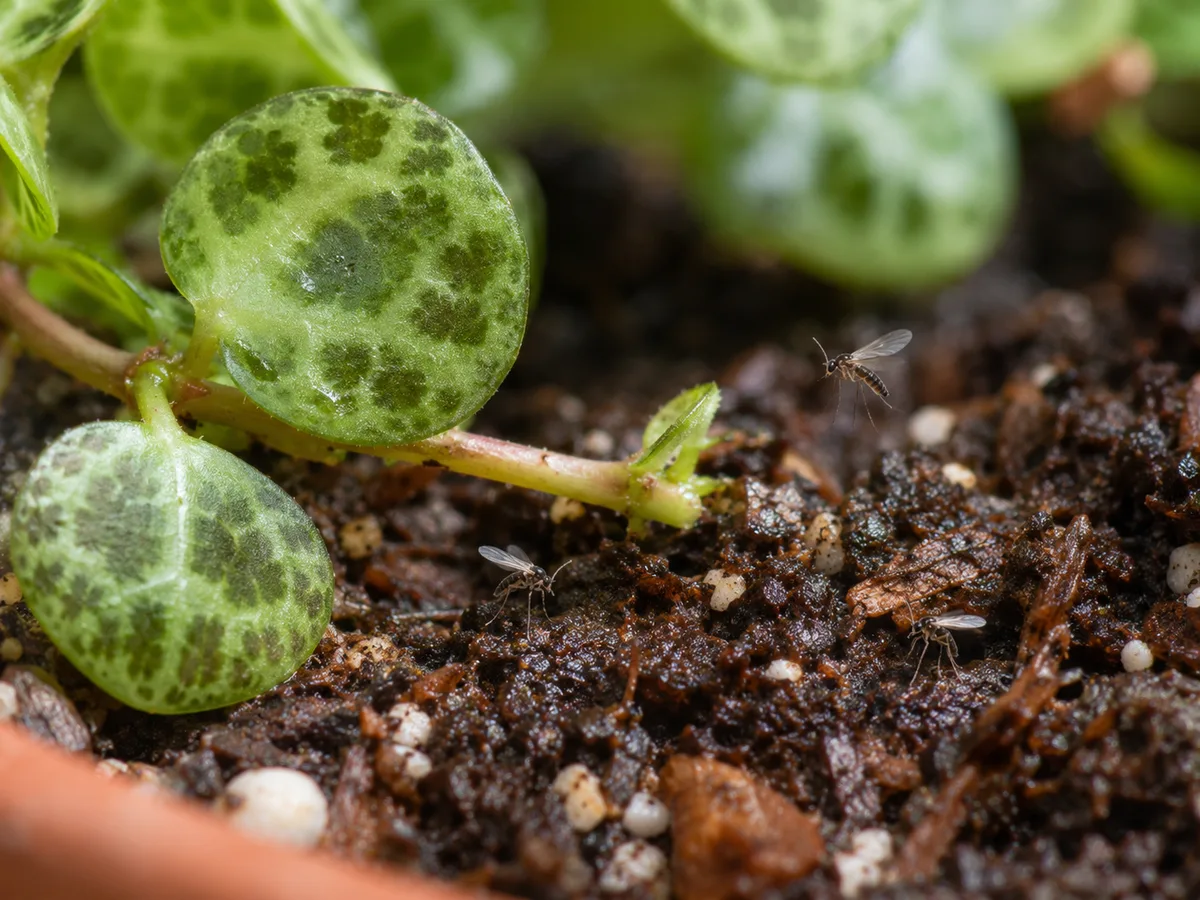
The image shows adult flies at the soil surface; larvae remain hidden in the mix and need a separate check.
If the flies do not rise from this pot, check other indoor plants, damp organic debris, and possible leaks. NC State Cooperative Extension recommends finding the moisture source and draining water from saucers rather than relying on sprays that leave the source in place (NC State Cooperative Extension moisture checks). Small flies around fruit or food waste may be fruit flies instead; compare the location and appearance before treating the plant.
First fix: restore the plant’s normal dry-down
Pause watering while the root zone is still damp. Check below the surface with a wooden skewer or compare the pot’s weight with how it feels after watering. Allow the mix to reach the point when String of Turtles normally needs water, then water evenly and let excess drain. Do not keep the plant bone-dry as a pest treatment; an extended drought can stress the plant and obscure the diagnosis.
UC IPM recommends avoiding overwatering, providing good drainage, and allowing the surface of container soil to dry between waterings (UC IPM moisture management). Wisconsin Extension likewise identifies a drier soil surface as a key cultural step and notes that improvement may take several weeks because eggs, larvae, pupae, and adults can overlap (Wisconsin Extension management guidance). Keep checking the mix rather than following a rigid number of days between waterings.
Empty runoff from saucers and outer pots, clear fallen leaves from the soil, and confirm the drainage opening is not blocked. If the mix remains wet well after watering, review the String of Turtles care overview and its watering guide. Consider repotting only if the current mix is compacted, degraded, or drains poorly; disturbing healthy roots is not the first response to a few gnats.
Monitoring and treatment options
Use a sticky card to follow adult activity, replacing it when covered or dusty. A gradual decline over the next few weeks is a more useful signal than whether every adult disappears immediately. Traps do not reach the soil-dwelling stage, so do not rely on them alone if the pot remains damp and new adults continue to emerge. Gardening Know How makes the same distinction between catching adults and addressing the soil conditions that support the pest (Gardening Know How monitoring advice); Oderings Garden Centres likewise notes that sticky traps reduce adult numbers but do not remove larvae in the mix (Oderings houseplant guidance).
If activity continues after you correct moisture and drainage, a biological product containing Bacillus thuringiensis subsp. israelensis (Bti) may be an option where its label permits indoor use on potting media. Follow the product label for preparation, watering, application interval, and plant compatibility. Wisconsin Extension notes that Bti products target larvae rather than eggs, pupae, or adults, so repeat applications may be needed according to the label (Wisconsin Extension Bti guidance). Avoid homemade chemical mixtures or treating the foliage for a pest whose immature stage is in the soil.
Read the plant’s symptoms carefully
Adults are mostly a nuisance; large larval populations can injure fine roots, but serious damage is uncommon in typical home settings. UC IPM cautions that wilt is more often caused by watering, root decay, or drainage problems than by fungus-gnat larvae (UC IPM damage and lookalikes). If String of Turtles wilts while the mix is wet, check for poor drainage and root decline instead of adding more water. If the mix is dry and leaves lose firmness, compare with the underwatering guide.
A few adults with firm leaves and no decline usually call for monitoring and moisture correction. Persistent wetness, soft stems, or continuing leaf loss deserve a closer root-zone check. Compare those signs with overwatering and root rot before repotting or removing healthy foliage.
Prevent another outbreak
Water according to how quickly the mix dries in the current light, temperature, and pot, not by a fixed calendar. Use a container with an open drainage hole and remove standing water. Discard fallen leaves and avoid leaving damp organic debris on the soil surface. NC State Extension recommends checking nearby areas for excess moisture too, since a leak or another damp source can keep indoor gnats appearing even after a single pot is corrected (NC State source checks).
When bringing plants indoors, inspect their pots and the soil surface for adults and larvae. If a new plant has active gnats, keep it apart from other plants while you correct the growing conditions and monitor it. A consistently appropriate dry-down is more useful for prevention than keeping the top layer wet and repeatedly treating the adults.
When to get more help
If gnats continue to appear from several pots after watering and drainage have been corrected, inspect the room for another damp source or ask a local extension service or qualified pest professional to identify the insect. Seek plant-care help if the plant continues to decline, the roots are soft or discolored, or the mix stays wet despite proper drainage. These signs can point to a separate root or watering problem that sticky cards cannot diagnose.
Related String of Turtles care and pest guides
Use the String of Turtles problem hub to compare symptoms. Check the plant’s watering guide and care overview as you adjust the dry-down, and visit the fungus-gnat guide for broader identification information.
FAQs
How can I tell fungus gnats from fruit flies?
Fungus gnats are small, slender, dark flies that stay near potting mix and may run over its surface. Fruit flies are usually more robust and gather near ripe produce or food waste. Check whether adults rise from the String of Turtles pot and look for larvae in damp mix.
Should I stop watering my String of Turtles completely?
No. Let the root-zone mix reach the plant’s usual dry-down point, then water normally and drain the pot. Do not leave the plant dry indefinitely; the goal is to stop keeping the mix continuously moist.
Will fungus gnats kill a String of Turtles?
A few adults are generally a nuisance. Large larval populations can injure fine roots, but root problems and watering stress are more common explanations for a declining houseplant. Check the roots and mix if the plant continues to wilt.
Do yellow sticky cards kill fungus-gnat larvae?
No. Sticky cards catch flying adults and help you track activity; they do not reach larvae in the potting mix. Pair monitoring with appropriate moisture management and, if needed, a product labeled for the intended indoor use.
When should I repot a gnat-infested String of Turtles?
Repot only if the mix stays wet unusually long, has broken down, or drains poorly despite corrected watering. Otherwise, first clear debris, let the mix dry to its normal watering point, and monitor the pot.