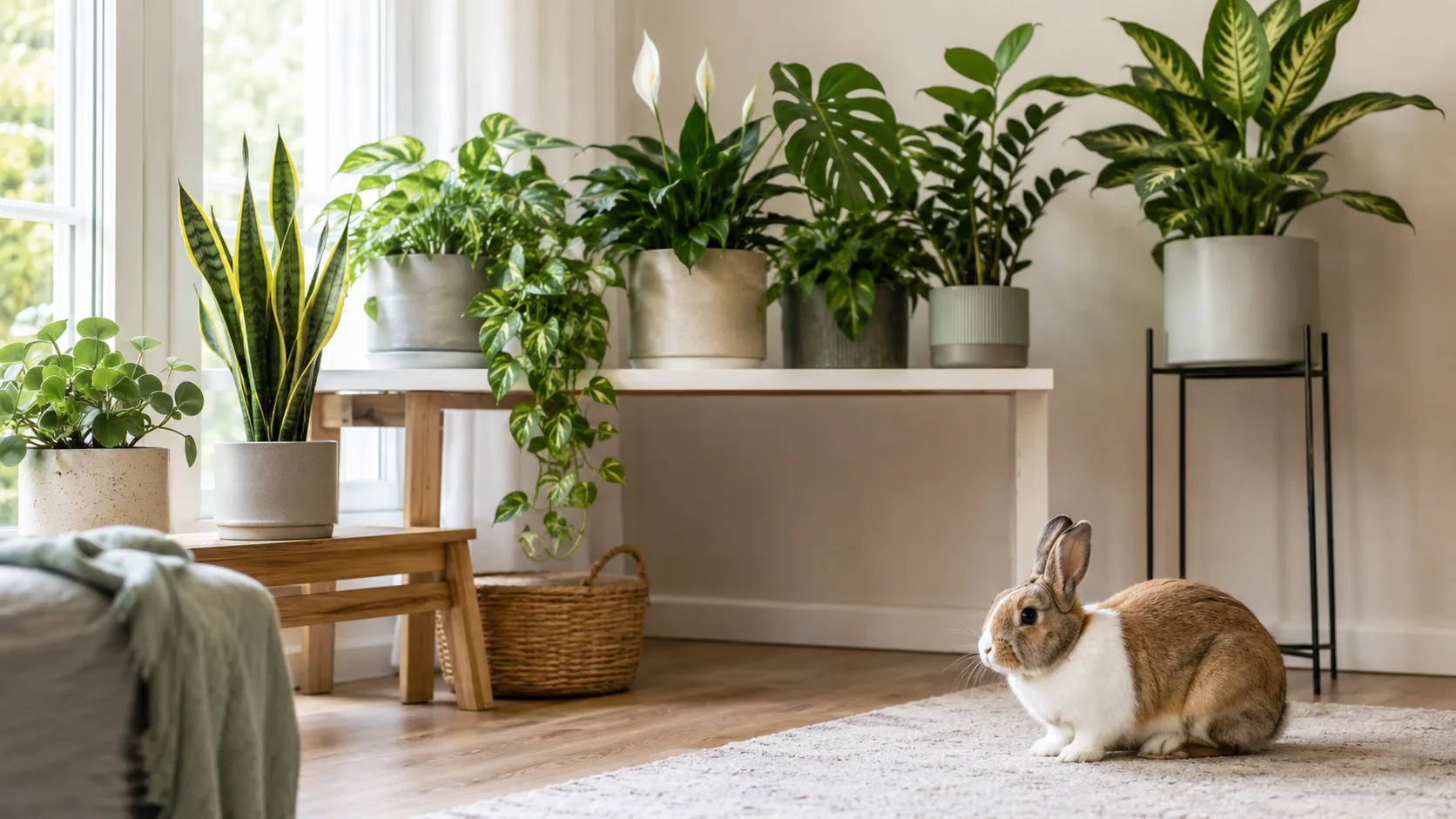
A toxic houseplant in a rabbit home is not a placement inconvenience—it is a grazing hazard. Rabbits explore with their teeth. Floor pots, trailing vines, low shelves, and dropped leaves that a cat might bat once become sustained sampling opportunities for a rabbit that treats every green thing as forage.
This guide ranks eight common indoor plants that the ASPCA lists as toxic to cats and/or dogs—compounds that make them unsafe in any rabbit-access zone. We order them by how often they appear in home décor and how easily a free-roam rabbit can reach them, not by how pretty they look on a windowsill. For verified safer options, see Plants Safer for Rabbits. For cat and dog lists, compare plants toxic to cats and plants toxic to dogs.
The eight houseplants to remove first in rabbit homes are pothos, philodendron, peace lily, dieffenbachia, ZZ plant, aloe vera, English ivy, and dracaena. All eight carry ASPCA toxic listings. None belong in a room where a rabbit roams unsupervised.
Why Rabbits Change the Risk Equation
Cats and dogs may chew a leaf and stop. Rabbits often graze repeatedly on whatever they can reach. That matters for two reasons.
First, dose adds up. A single nibble of an oxalate-rich aroid may cause oral pain; repeated ingestion over a day can worsen GI upset and reduce hay intake—and hay intake is the foundation of rabbit health. VCA Animal Hospitals notes that rabbits depend on continuous fiber intake for normal gut motility; anything that suppresses appetite or causes pain can escalate toward GI stasis, a veterinary emergency. (VCA Animal Hospitals - Feeding Your Rabbit)
Second, reach is wider than you think. Rabbits jump onto low furniture, pull trailing stems, and eat pruning debris before you sweep. A plant “on a shelf” is not safe if the shelf is rabbit-height or if leaves fall to the floor.
Editor note (free-roam setups): In typical rabbit households, trailing pothos and philodendron stems cause more exposures than upright floor plants—not because those species are more toxic, but because vines cross rabbit traffic lanes at nose height. Removing the vine matters more than moving the pot six inches.
When to Call a Rabbit-Savvy Veterinarian
Contact a veterinarian immediately if your rabbit chewed a known toxic plant and shows any of the following:
- Refusing hay or pellets for more than a few hours
- Smaller, misshapen, or absent droppings
- Lethargy, hunched posture, or grinding teeth
- Drooling, lip swelling, or repeated pawing at the mouth
- Diarrhea or straining
Save a leaf sample or clear photo for identification. Do not wait to see if symptoms “pass”—rabbits can deteriorate quickly when gut movement slows.
For any ingestion concern, ASPCA Animal Poison Control is available at 888-426-4435 (consultation fee may apply). Follow their guidance and your veterinarian’s instructions together.
Quick Pick: Remove These First
If you can only act on a few plants today, start with the Araceae cluster: pothos, philodendron, peace lily, and dieffenbachia. The ASPCA classifies all four as containing insoluble calcium oxalates, which cause immediate oral irritation and can trigger vomiting and reduced eating in companion mammals. (ASPCA insoluble oxalate plants)
Next, remove ZZ plant and aloe vera from floor-level and pen-adjacent zones. Both are common “easy care” plants that sit exactly where rabbits graze.
English ivy and dracaena round out the list—widely sold, often placed on low stands or windowsills, and ASPCA-listed toxic to cats and dogs.
How We Selected These Eight
These eight were chosen for ASPCA-verified toxicity, nursery availability, and realistic exposure in rabbit homes—not to be the longest possible toxic plant encyclopedia.
We required each species to have a verified ASPCA toxic listing and a full care hub in the LeafyPixels plant database. We then ranked by:
- Indoor prevalence — plants that appear in starter houseplant collections and apartment décor.
- Reach profile — trailing or low-growing habits that intersect rabbit traffic.
- Compound severity — oxalate aroids and saponin-containing species rank above obscure ornamentals.
- Identification clarity — common names that rabbit owners actually encounter at nurseries.
We left out plants without ASPCA listings or without LeafyPixels inventory pages. Pasture weeds and outdoor landscaping hazards are a separate topic.
Toxic Houseplant Comparison Table (Rabbit Homes)
Pothos
Safety status: Toxic — ASPCA lists golden pothos (Epipremnum aureum) as toxic to cats and dogs; treat as toxic to rabbits. (ASPCA golden pothos)
Best for: Nowhere a rabbit can reach — not a rabbit-home plant
Difficulty: Easy (which is why it is everywhere)
Light: Bright to medium indirect
Water: Moderate; forgiving
Pothos is the most common trailing houseplant in apartments—and one of the worst fits for free-roam rabbits. The ASPCA notes insoluble calcium oxalate crystals that cause oral irritation, excessive drooling, vomiting, and difficulty swallowing in cats and dogs. Rabbits that graze repeatedly may refuse hay afterward, which raises GI stasis concern.
Trailing stems cross rabbit lanes at perfect grazing height. Hanging baskets fail when a rabbit jumps onto furniture or when cuttings root in water on a low table.
Safety note: Assume every pothos cultivar (golden, marble queen, neon) is unsafe until verified—not all variegations have separate ASPCA pages, but all share the same genus compounds.
Placement tip: Remove from the rabbit zone entirely; do not rely on “higher shelf” placement.
If grazed: Stop access, offer hay, monitor droppings for 24 hours, call a rabbit-savvy vet if intake drops.
Useful care guides (for ID):
Philodendron
Safety status: Toxic — ASPCA lists philodendron as toxic to cats and dogs. (ASPCA philodendron)
Best for: Cat-free, rabbit-free rooms only
Difficulty: Easy
Light: Medium to bright indirect
Water: Moderate
Heartleaf philodendron (Philodendron hederaceum) and its cousins share the same Araceae oxalate profile as pothos. ASPCA clinical signs include oral pain, drooling, and vomiting. For rabbits, the bigger risk is sustained grazing suppressing normal hay consumption.
Philodendron is often sold in hanging pots or on low plant stands—exactly the geometry rabbits exploit. Moss poles and climbing stems also drop leaves when bumped.
Safety note: “Heartleaf” and “brasil” cultivars are still Philodendron—do not assume a prettier leaf is safer.
Placement tip: Keep in a closed room the rabbit never enters, not a shared living space.
If grazed: Same protocol as pothos; save a stem sample for the vet.
Useful care guides (for ID):
Peace Lily
Safety status: Toxic — ASPCA lists peace lily (Spathiphyllum) as toxic to cats and dogs despite the common name “lily.” (ASPCA peace lily)
Best for: Rabbit-free homes only
Difficulty: Medium
Light: Medium indirect
Water: Consistent moisture
Peace lily is not a true lily (Liliaceae)—but it is still an oxalate-containing aroid. The ASPCA reports oral irritation, drooling, vomiting, and difficulty swallowing. Peace lilies sit on floors and low tables because they tolerate medium light and look lush without much sun—placement rabbits reach easily.
White spathes and drooping leaves also fall and become floor forage.
Safety note: Do not confuse with true lilies, which are a separate severe cat toxin—peace lily is aroid-toxic, not lily-toxic, but still off-limits for rabbits.
Placement tip: If you keep one for aesthetics, it must live behind a closed door the rabbit cannot open.
If grazed: Watch for drooling and reduced hay intake within hours.
Useful care guides (for ID):
Dieffenbachia
Safety status: Toxic — ASPCA lists dumb cane (Dieffenbachia) as toxic to cats and dogs. (ASPCA dieffenbachia)
Best for: Display in rabbit-free zones only
Difficulty: Easy to medium
Light: Medium to bright indirect
Water: Moderate
Dieffenbachia carries insoluble calcium oxalates and can cause intense oral irritation—the common name “dumb cane” references swelling that interferes with speech in humans who chew stems. ASPCA lists similar oral signs in pets. Broad, upright leaves sit at rabbit eye level in floor pots.
Safety note: Sap can irritate human skin; wear gloves when pruning and dispose of cuttings in a sealed bin rabbits cannot reach.
Placement tip: Never use as “room divider” foliage in a shared rabbit space.
If grazed: Oral swelling and pain can stop eating immediately—treat as urgent.
Useful care guides (for ID):
ZZ Plant
Safety status: Toxic — ASPCA lists ZZ plant (Zamioculcas zamiifolia) as toxic to cats and dogs. (ASPCA ZZ plant)
Best for: Offices and rooms rabbits never enter
Difficulty: Easy
Light: Low to bright indirect
Water: Dry; infrequent
ZZ plant’s popularity comes from low-light tolerance and thick, glossy leaves—traits that also make it a staple in dim corners at rabbit height. The ASPCA classifies it among oxalate-containing houseplants. All parts should be considered harmful if ingested.
Safety note: ZZ plant is often recommended as “indestructible”—that indestructibility makes owners complacent about placement near pens.
Placement tip: Treat as toxic décor, not as enrichment near a rabbit exercise area.
If grazed: Monitor gut motility closely; any reduced droppings warrant a vet call.
Useful care guides (for ID):
Aloe Vera
Safety status: Toxic — ASPCA lists aloe as toxic to cats and dogs. (ASPCA aloe)
Best for: Sunny windows in rabbit-free rooms
Difficulty: Easy
Light: Bright indirect to some direct sun
Water: Dry between waterings
Aloe is confusing because humans use the gel topically—but the ASPCA lists the plant as toxic to cats and dogs, citing saponins and related compounds with potential vomiting and lethargy. Rabbits on sunny kitchen windowsills can reach pots while exploring counters or hopping from chairs.
Safety note: Do not assume “natural” or “medicinal” means safe for grazing herbivores.
Placement tip: Move aloe to a room the rabbit is never allowed in, or to a wall shelf with no jump path.
If grazed: Watch for diarrhea and appetite loss; aloe GI signs can appear within hours.
Useful care guides (for ID):
English Ivy
Safety status: Toxic — ASPCA lists English ivy (Hedera helix) as toxic to cats and dogs. (ASPCA English ivy)
Best for: Outdoor walls—not indoor rabbit zones
Difficulty: Medium
Light: Bright indirect
Water: Moderate
English ivy trails aggressively indoors. ASPCA notes toxic principles including triterpenoid saponins with vomiting, abdominal pain, hypersalivation, and diarrhea possible in dogs—and similar treatment applies to rabbits that ingest quantity.
Ivy leaves drop dry and remain tempting on the floor. Bouquet ivy in floral arrangements is an overlooked hazard in rabbit homes.
Safety note: Swedish ivy (Plectranthus) is a different species—verify botanical names on tags.
Placement tip: Skip ivy entirely in rabbit households; choose plants safer for rabbits for supervised herb treats.
If grazed: Remove fallen leaves daily; call vet if GI signs appear.
Useful care guides (for ID):
Dracaena
Safety status: Toxic — ASPCA lists dracaena as toxic to cats and dogs. (ASPCA dracaena)
Best for: Tall corners in rabbit-free rooms
Difficulty: Easy to medium
Light: Medium indirect
Water: Moderate dry-down
Dracaena (Dracaena spp., including corn plant and marginata) contains saponins. ASPCA clinical signs for cats include vomiting (sometimes with blood), depression, anorexia, and dilated pupils. Upright cane forms look out of reach until a rabbit pulls a lower leaf or knocks the pot.
Safety note: Lower leaves yellow and drop naturally—pick them up before they become floor snacks.
Placement tip: Heavy cachepot reduces tipping; still not a substitute for removing the plant from rabbit access.
If grazed: Monitor hay intake and droppings for 24 hours minimum.
Useful care guides (for ID):
Audit Your Rabbit Zones
Walk your home at rabbit height (floor to ~18 inches, plus furniture jump paths) and check:
- Floor pots and low baskets
- Trailing stems crossing pen boundaries
- Pruning debris and fallen leaves
- Water-propagation jars on coffee tables
- Bouquets and gift plants from visitors
The safest rabbit home treats unverified ornamentals as toxic by default. Verified edible herbs belong on the rabbit-safe list—not random décor foliage.
Common Mistakes in Rabbit Plant Safety
Assuming hanging baskets are enough. Rabbits jump. Trailing stems and dropped leaves defeat “out of reach” placement.
Keeping toxic plants “for now” in a pen the rabbit will eventually free-roam. Plan the final layout before expanding territory.
Trusting forum lists without ASPCA cross-check. Common names vary; ASPCA botanical listings reduce ID errors.
Ignoring GI stasis after a small nibble. Reduced hay intake matters more than visible drooling.
Offering “just a leaf” of an unverified houseplant. Decorative foliage is not rabbit food.
Conclusion
Rabbit-safe plant management starts with removing ASPCA-listed toxic ornamentals from every zone your rabbit can reach—not with better baskets. Pothos, philodendron, peace lily, and dieffenbachia are the highest-priority removals because they combine oxalate toxicity with trailing, reachable growth. ZZ plant, aloe vera, English ivy, and dracaena follow as common floor and sill plants that rabbits graze when given the chance.
None of these species belong in a free-roam rabbit home. Replace them with verified lower-risk options from our plants safer for rabbits guide, keep hay available at all times, and call a rabbit-savvy veterinarian or ASPCA Animal Poison Control at 888-426-4435 if grazing occurs and appetite or droppings change.
Start by removing one trailing vine today—the one your rabbit walks past every morning. That single change prevents more real-world exposures than rearranging every upright pot in the house.