Anacharis / Elodea Care Guide: Light, Water Parameters, Substrate & Common Problems
Practical Anacharis / Elodea care — moderate light, stable cool-mild water, melt fixes, Egeria vs Elodea ID, never release outdoors.
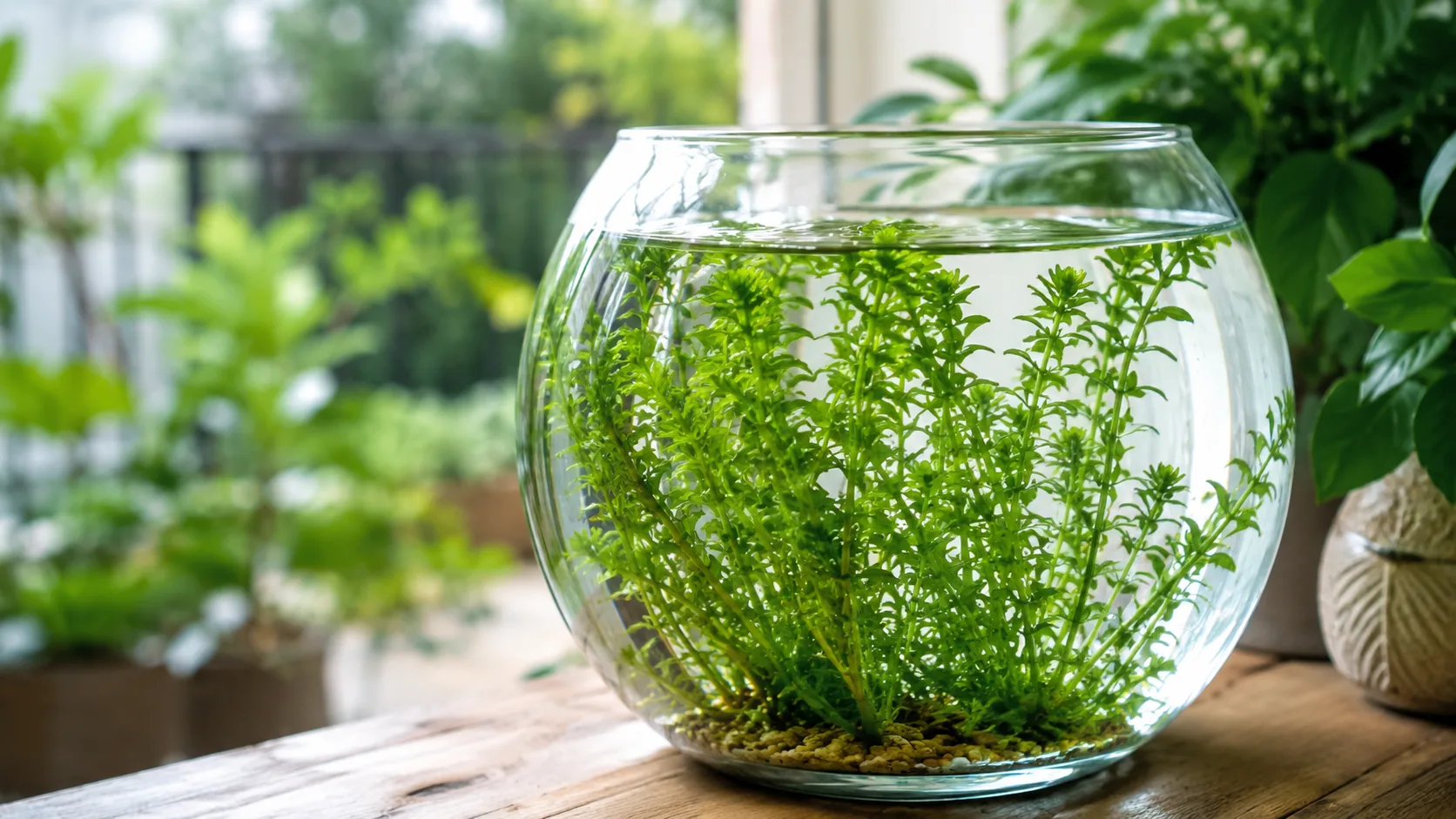
Anacharis is the pet-store name most aquarists use for Egeria densa, a fully submerged freshwater stem plant in the frogbit family (Hydrocharitaceae). Tags may also say Elodea, Brazilian waterweed, dense waterweed, or Brazilian elodea. Those labels are messy: true Elodea canadensis is a different, often native North American plant, while the dense, leafy bunches sold for aquariums are usually Egeria densa. The ITIS taxonomic record and USDA PLANTS profile both resolve the trade confusion to that species.
This guide is written for aquarium and pond keepers who want one practical on-ramp: stop melt after planting, grow bushy stems under moderate light, and keep the plant legal and contained. It was written by sai-ananth and reviewed by the LeafyPixels Review Board against botanical and invasive-species primary sources plus LeafyPixels Anacharis hub data. Recommendations below are aquarium care targets, not outdoor management prescriptions.
Anacharis earns its beginner reputation because it grows fast, pearls when healthy, and feeds from the water column. Survival and good growth are still different things. A bunch dropped into unstable, hot, copper-treated, or over-lit water can turn translucent within days. One kept under moderate light, in stable cool-to-mild water, and either floated or planted with bare stem bases usually fills in quickly and outcompetes algae.
Most Anacharis failures trace to transition shock after planting, parameter swings, copper or medication exposure, or light that is either too weak for bushy form or too strong without matching nutrients. These overlap. Warm tropical heaters thin growth and encourage melt. Long photoperiods without fertilizer invite algae on stems. Dense mats outdoors can draw oxygen overnight. By the time leaves look transparent, the failure often started with how the plant was acclimated or what was dosed into the tank.
How This Guide Relates to the Anacharis Hub
Use this page when you want one consolidated Anacharis / Elodea care framework. Use the canonical Anacharis / Elodea care hub when you need topic depth or symptom-first troubleshooting. Start with light, watering / water parameters, soil / substrate, propagation, and problem pages such as transparent leaves, yellow leaves, and chemical damage.
If Egeria densa is restricted where you live and you need a different easy submerged plant, compare attachment-style care in our Java fern care guide — different ecology, often legal where Brazilian waterweed is not.
What Anacharis Is: Trade Names, Biology, and Why It Melts
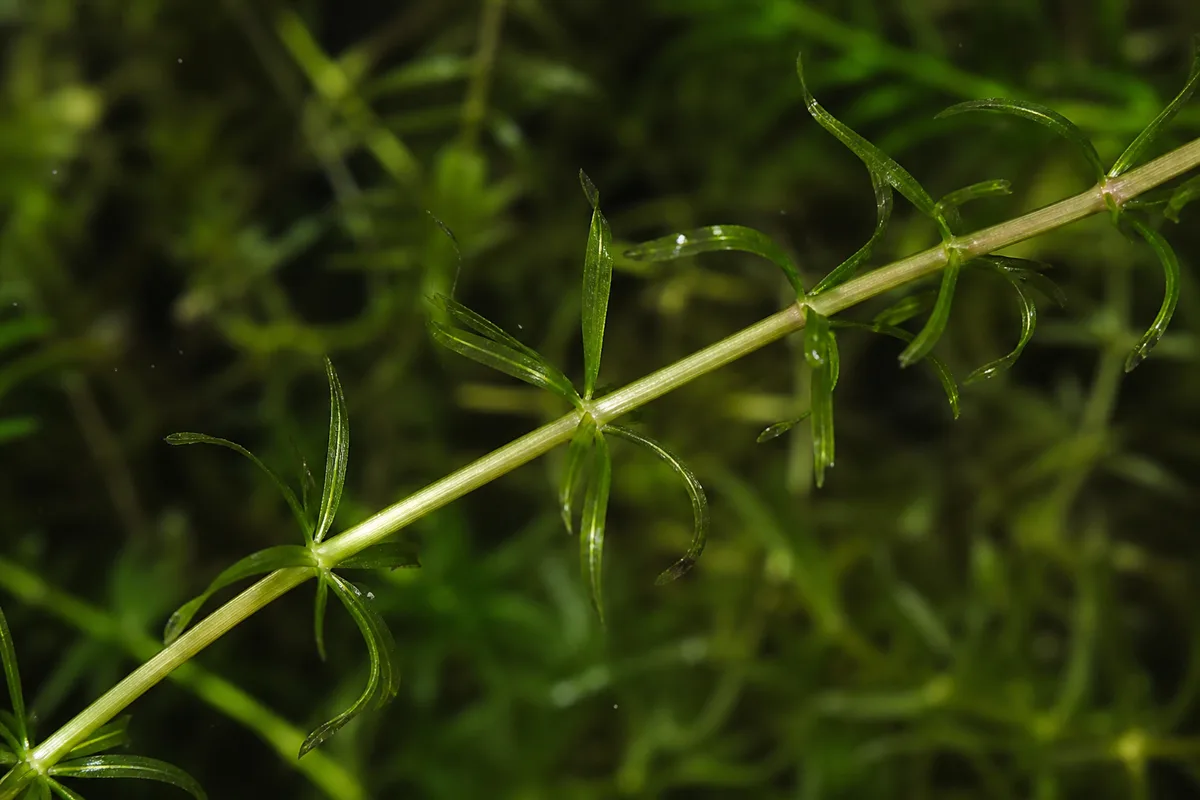
Egeria densa is a rooted, submersed perennial native to Argentina, Brazil, and Uruguay. UF/IFAS describes thin lance-shaped leaves with minute edge teeth arranged in whorls around the stem, and notes that the species is dioecious — outside South America, only male plants are generally known. The USGS Nonindigenous Aquatic Species fact sheet confirms U.S. populations are male-only and spread by vegetative fragmentation: stem pieces with a few nodes root or float and keep growing.
That biology explains the aquarium experience. Leaves are delicate and thin, so rough handling, rubber bands left on too long, or buried leafy tissue rot quickly. Adventitious roots form freely from stem nodes, which is why cuttings root without hormone and why floating stems thrive. Dense surface mats are useful cover for fry and shrimp, but they also shade lower growth and, in outdoor waterbodies, can crowd natives and alter oxygen cycles — which is why the same plant that “oxygenates” a tank is regulated as invasive in many places.
Tank outcome notes (practical patterns, not a personal diary): Banded shop stems planted with leafy tissue still buried often show translucent lower whorls within about two to five days. Floating healthy tops in matched, dechlorinated water usually holds color better through that window; white adventitious roots commonly appear within about a week once parameters stabilize. Stands kept near ~70°F (21°C) in unheated goldfish tanks typically look denser than the same genetics held at ~78–80°F (26–27°C) under tropical community heaters, where lower leaves thin and shed more readily.
Egeria densa vs Elodea canadensis (and Hydrilla)
Shop bags labeled “Elodea” or “Anacharis” are often Egeria densa. Native common waterweed (Elodea canadensis) looks similar but is usually smaller and less leafy. King County, Washington notes egeria stems look very leafy compared with native elodea, which has shorter leaves (about 0.5–1.5 cm) in whorls of three, while egeria has longer leaves commonly in whorls of four or six (often 4–8 on upper stems). The Washington State Noxious Weed Control Board likewise describes lower leaves in whorls of 3 and upper leaves in whorls of 4–8, and calls native elodea much smaller and less robust. USGS notes Egeria can be separated from Hydrilla verticillata by the absence of turions/tubers and by larger showy white male flowers.
| Trait | Egeria densa (Anacharis / Brazilian waterweed) | Elodea canadensis (common waterweed) | Hydrilla verticillata (lookalike) |
|---|---|---|---|
| Typical leaf whorls | Often 4–8 on mid/upper stems | Usually 3 | Often ~5; leaves spinier |
| Leaf length feel | Longer, denser “bushy” stems | Shorter, less robust | Variable; midrib teeth often visible |
| Special structures | No tubers/turions | No tubers | Tubers / turions present |
| U.S. aquarium trade | Common “Anacharis” / Brazilian elodea | Less often sold as dense bunches | High-priority invasive; not a beginner plant |
| Legal / invasive note | Widely regulated at state level | Often native / native-like | Strictly regulated Class A–type priority in many places |
When in doubt, photograph a whorl against a ruler and check local extension or weed-board ID before planting outdoors. UF/IFAS also flags confusion with both Hydrilla and Elodea and publishes comparison drawings for field workers.
Quick Anacharis Care Snapshot
For healthy Anacharis, keep the plant fully submerged in clean freshwater, give moderate aquarium light for about 7–10 hours, hold temperature roughly in the 60–77°F (15–25°C) comfort band, and either float stems or plant bare lower stems 1–2 inches deep in fine gravel or sand. Fertilizer is optional in stocked tanks; CO2 is optional but speeds growth. Never dump trimmings or tank water into local waterways.
| Care factor | Baseline target | Deeper guide |
|---|---|---|
| Light | Moderate; ~30–50 PAR at substrate; 7–10 h photoperiod | Anacharis light |
| Water | Stable temp/pH/GH; dechlorinated freshwater | Anacharis watering |
| Substrate | Fine gravel/sand as anchor; not potting soil | Anacharis soil |
| Feed | Light liquid fertilizer if water is barren | Anacharis fertilizer |
| Growth control | Top and replant; thin excess mats | Anacharis pruning |
A cool basement goldfish tank, a heated tropical community, and an outdoor tub will not behave the same. Good care is less about memorizing a calendar and more about keeping chemistry stable and reading leaf color and internode length each week.
Light for Bushy vs Leggy Growth
Anacharis is genuinely low-to-moderate demand for a stem plant. It survives dim water better than many aquarium plants, but bushy, short-internode growth needs enough usable light to reach the lower whorls. In practical low-tech tanks, aim for a full-spectrum planted LED that delivers roughly 30–50 PAR at the substrate, or classic fluorescent guidance around 2–3 watts per gallon of T5/T8 output in shallow tanks. Those numeric targets are practical grower guidance for display tanks, not values quoted as regulatory ecology optima.
The USGS NAS ecology notes describe a species that tolerates low light and low CO2 relative to many macrophytes, using bicarbonate and C4-like pathways, while also warning that very high light and UV can damage photosynthetic capacity. Translate that to a living room tank: moderate, consistent light wins. Sudden moves from a dim shop bag into intense LED without nutrient support bleach tips and invite hair algae on older leaves.
In low light, Anacharis usually lives but looks leggy: long gaps between whorls, pale leaves, and stems that race for the surface then flop. Move the bunch closer to the fixture, raise intensity slightly, or shorten the water-column path by floating some stems. For stretched growth patterns, see leggy growth on Anacharis and not enough light.
In moderate light, internodes shorten, color deepens to emerald, and pearling is more common during the photoperiod. If upper leaves bleach or brown while lower growth looks fine, the canopy may be too intense or the photoperiod too long — pull the fixture up, dim it, or trim tops so light reaches mid-stem. Direct outdoor sun on a shallow tub can cook leaves that were grown under indoor LEDs; acclimate gradually. Scorch-style damage is covered on sunburn / scorched leaves.
Photoperiod, PAR, and Algae Trade-offs
Run a 7–10 hour photoperiod on a timer. Stretching past 12 hours rarely improves Anacharis and usually feeds algae unless CO2 and nutrients keep pace. If green hair algae coats older leaves within two weeks of raising intensity, cut hours toward 7–9 before adding more fertilizer. Consistency beats weekend “catch-up” days that spike algae without thickening stems.
Water Parameters (Temperature, pH, Hardness, CO2)
Anacharis does not get “watered” like a pothos. It lives submerged and takes minerals through thin leaves and stems. For this plant, watering care means water quality: temperature stability, pH and hardness, chlorine/chloramine removal, and avoiding toxic treatments. The Smithsonian NEMESIS summary records broad environmental tolerances — roughly 1–32°C for survival and pH about 6.4–9.2 — which explains why the plant survives in many setups, not why every setup looks good.
Stability beats chasing perfect numbers. A plant acclimated to pH 7.4 can shed leaves if you crash it to 6.2 overnight after a large water change. Match new water within a couple of degrees Fahrenheit, dechlorinate every fill, and limit routine changes to about 25–30% unless you are correcting a crisis. Our Anacharis watering guide goes deeper on testing GH/KH and drip acclimation.
Temperature Comfort Band and Stability
For aquarium growth, the comfort band most keepers hit is 60–77°F (15–25°C), with denser, greener stems often in the cooler half of that range. Unheated goldfish tanks and mild-room setups suit Anacharis well. Standard tropical heaters near 78–80°F usually keep the plant alive but thinner, with more lower-leaf melt. Outdoor ponds may overwinter dormant shoots in mild climates; hard freezes kill exposed tissue. Cold damage and heat stress have dedicated pages if leaves collapse after a heater failure or summer spike: cold damage and heat stress.
Target pH about 6.5–7.5 as a practical comfort zone even though the plant tolerates wider swings. Aim for moderate hardness (roughly 3–8 dGH and 3–8 dKH as a workable middle) so stems are not brittle. Pure RO or distilled water without remineralization lacks calcium and magnesium the leaves need for structure — remineralize before using it for changes.
CO2, Bicarbonates, and Column Nutrients
Anacharis does not require injected CO2. It uses dissolved CO2 and bicarbonates from the water, which is part of why it succeeds in low-tech tanks. Optional injection around 15–25 ppm typically thickens stems and speeds growth; ramp slowly so you do not crash pH or starve the plant of other nutrients as growth accelerates. Liquid carbon (glutaraldehyde-based products) is a middle ground for some tanks, but sensitive stems can melt if dose is aggressive — treat it as optional, not mandatory.
Because Anacharis is a column feeder, barren tanks (fresh RO, heavy plant mass, light fish load) may need a comprehensive liquid fertilizer. Heavily stocked goldfish or turtle tanks often already supply enough nitrogen and phosphate; adding more can fuel algae. Watch tips and new growth: pale new leaves may suggest iron or nitrogen limits (see iron deficiency and nitrogen deficiency), while algae-coated stems after heavy dosing suggest cutting back.
Substrate and Planting: Float vs Anchor
“Soil” for Anacharis is mostly a language problem. Ordinary houseplant potting mix does not belong in a fish or turtle tank. The plant absorbs most nutrition from water; roots primarily anchor stems. Fine aquarium gravel (about 2–4 mm) or clean sand works. Cap any nutrient-rich aquasoil if you use it for neighboring root feeders, and keep fertilizer-rich terrestrial soils out of livestock water.
To plant: remove rubber bands and lead weights once stems can stay down, strip leaves from the bottom 1–2 inches, and insert only that bare section into substrate. Burying leafy tissue is a classic melt trigger — trapped leaves rot and the rot climbs. Space stems a few inches apart so light reaches lower whorls. Planting too shallow lets diggers uproot it; planting too deep buries healthy nodes. Full technique lives in the Anacharis soil / substrate guide.
Floating vs Planted Trade-offs
Floating is fully valid. Surface stems get the strongest light and atmospheric CO2 exchange, often root and elongate faster than buried ones, and work in bare-bottom quarantine tanks, breeding boxes, and shrimp tubs. The trade-off is cosmetics: floating Anacharis looks like a green tangle, not a tidy background. Many keepers float new arrivals for a day to acclimate, then plant healthy tops.
Anchored stems give a vertical background and keep filter intakes clearer if you trim regularly. In goldfish or turtle tanks, plant multiple perimeter clumps or use pots with gravel so digging livestock cannot erase the whole stand at once. Reposition and thin as needed rather than “repotting” on a houseplant schedule — see Anacharis repotting for overcrowding cues.
| Approach | Best for | Watch-outs |
|---|---|---|
| Floating | Quarantine, breeding boxes, fast recovery after melt | Tangled look; can shade lower plants |
| Planted bare bases | Display backgrounds, tidy midground walls | Buried leafy tissue melts; diggers uproot shallow plantings |
Fertilizer for a Column Feeder
Feed the water column, not the gravel, when Anacharis needs help. A lean comprehensive liquid fertilizer once or a few times weekly during strong light periods is enough in plant-heavy, lightly stocked tanks. Skip root tabs aimed only at Anacharis; save them for swords and crypts. In turtle tanks with leftover food and waste, extra fertilizer is usually unnecessary and can cloud water or fuel algae.
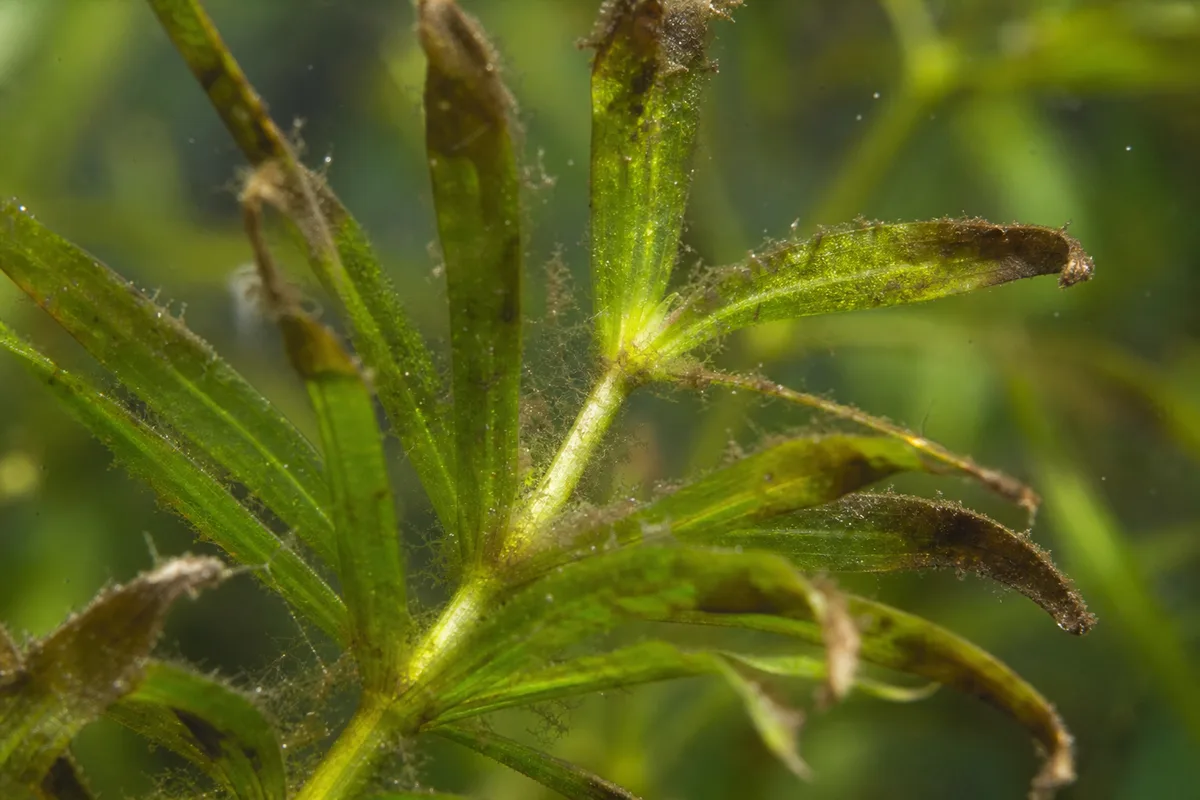
Overfertilization shows up as algae on leaves, excess pearling followed by decline, or tip burn after aggressive micro dosing. Dial back light hours and fertilizer together rather than chasing one variable. Details and dose logic are in the Anacharis fertilizer guide; symptom pages include overfertilization and fertilizer burn.
Propagation and Pruning Without Spreading Invasives
Propagation is stem cuttings only — no tubers, no plantlets. Cut a healthy 4–8 inch tip above a whorl, strip the lower inch of leaves, and float or plant the cutting. White roots often appear within a week in stable water. Topping a stem that reached the surface forces side shoots and thickens the stand; replant the tops as new stems. That cycle is how a few bunches become a wall of green.
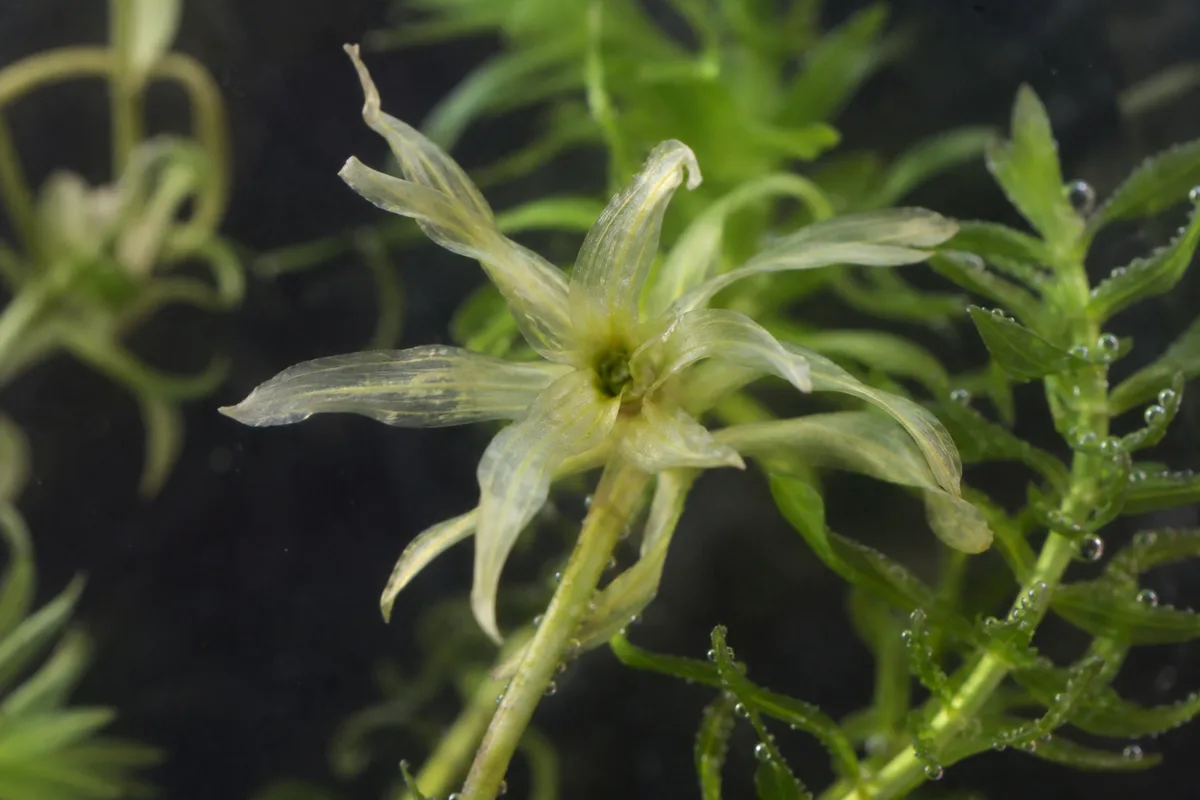
Prune before mats clog filters or shade everything below. Remove melting or brown sections promptly so decay does not spike ammonia. Compost or trash trimmings — never rinse them into a storm drain. Step-by-step cutting length and bushier-growth technique are in Anacharis propagation and Anacharis pruning. Transplant shock after aggressive replanting is covered under transplant shock.
Troubleshooting: Melt, Yellowing, Algae, Copper Damage
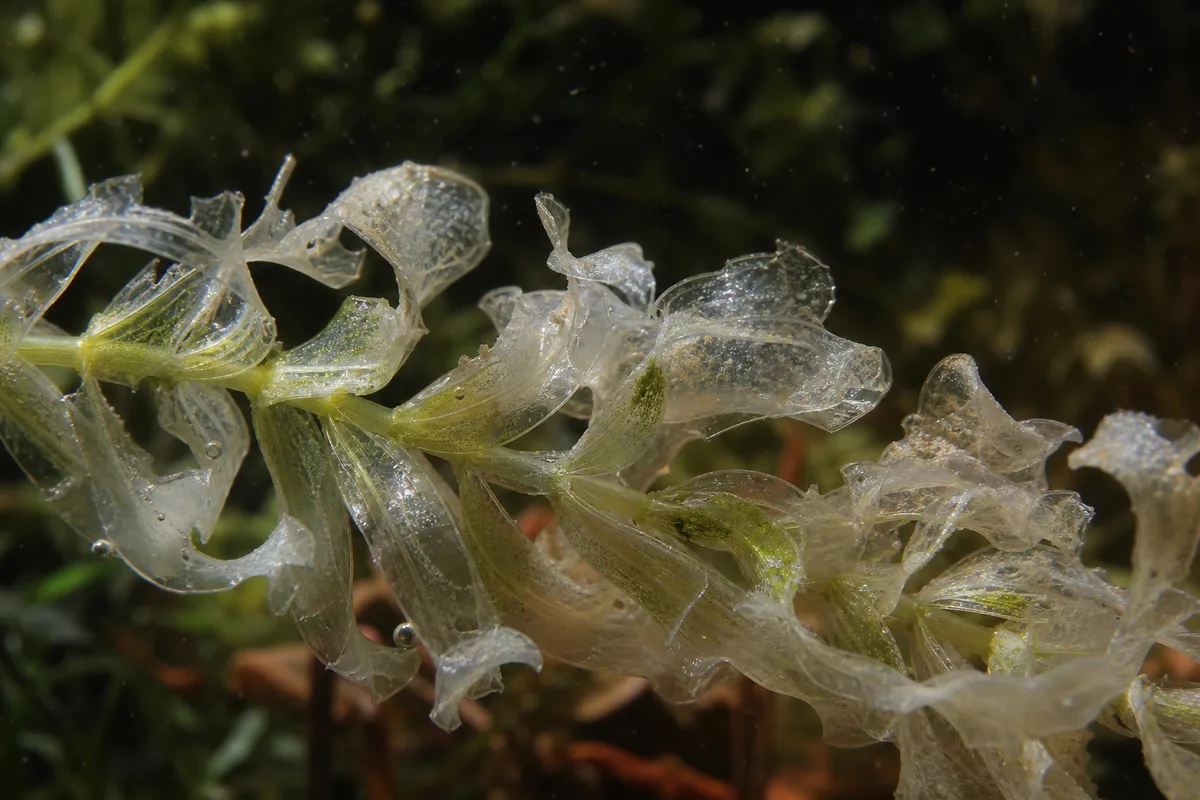
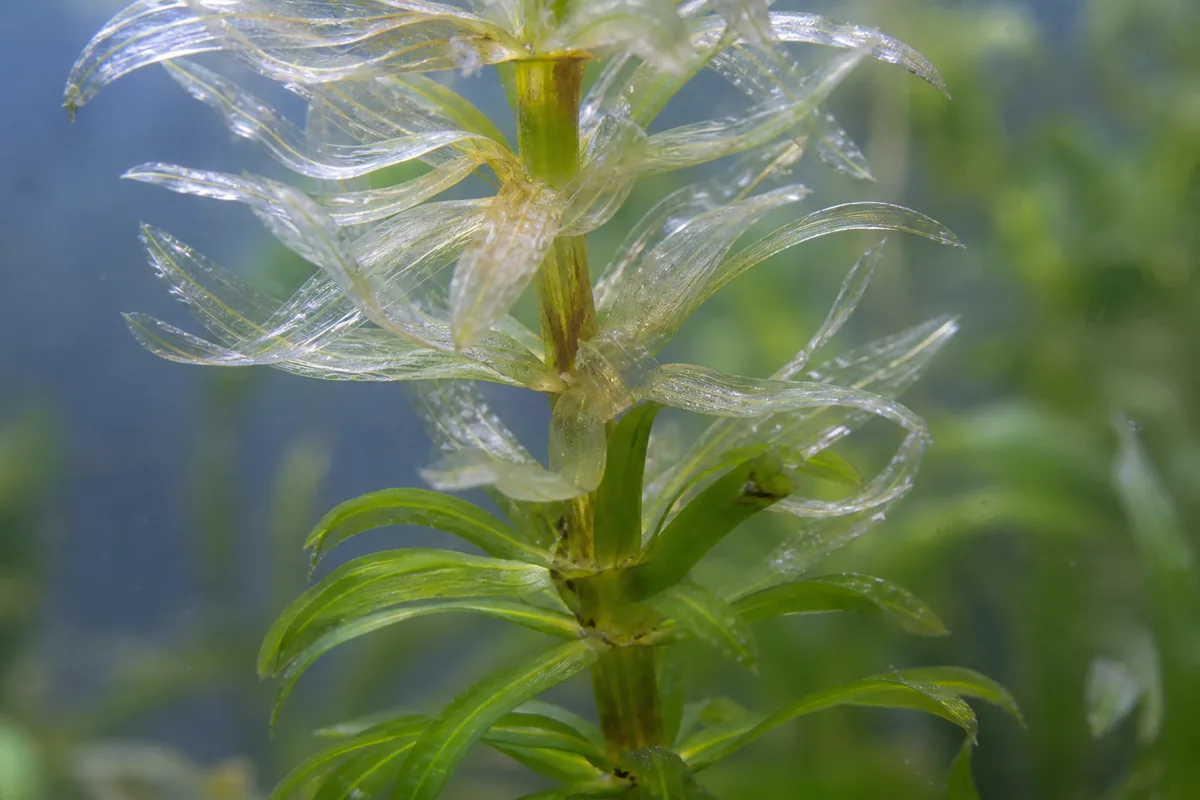
Melt — translucent, mushy leaves and collapsing stems — is the complaint beginners hit first. Often it is transition shock: farm-grown tissue adjusting to your temperature, pH, and hardness, sometimes after tightly banded shipping. Trim mush, float healthy tops, stabilize parameters, and wait for new growth rather than burying rotting bases deeper.

Practical melt recovery sequence: (1) remove rubber bands and discard fully mushy tissue, (2) float firm green tops for several days in dechlorinated, matched water, (3) strip 1–2 inches of lower leaves only when planting, (4) expect new tip growth within about one to two weeks if nodes stay firm. Transparent tissue troubleshooting continues on transparent leaves.
Yellow leaves need context. Lower yellowing under a dense canopy is often self-shading — trim and replant tops. Upper pale growth with long internodes points to low light. Widespread yellowing after a big water change points to chemistry shock. Broad diagnosis: yellow leaves on Anacharis and faded leaves.
Algae on stems means light, nutrients, and plant uptake are out of balance. Shorten photoperiod toward 7–9 hours, reduce iron-heavy dosing, and manually wipe leaves during water changes. Healthy Anacharis usually outcompetes hair algae once the surplus is cut. Black or mushy tips after medication are a different path — check copper next.
Copper Medications and Chemical Injury
Copper-based algaecides and many ich treatments that are “fish-safe” can still devastate Anacharis. UF/IFAS aquatic herbicide guidance lists copper among registered aquatic herbicides used against submerged weeds and describes it as a fast-acting, broad-spectrum contact herbicide — useful context for why aquarium copper doses can brown and kill stems quickly. Remove Anacharis to a separate tub of matched water before copper treatments, or choose plant-safe alternatives when the stand matters. Chemical injury patterns are documented on chemical damage.
Invasive Status, Legality, and Disposal
The traits that make Anacharis a great aquarium plant — fast vegetative growth, fragment survival, low light tolerance — also make it invasive outside cultivation. UF/IFAS notes global aquarium distribution and spread from discarded aquaria water. King County, Washington treats Egeria densa as a regulated Class B noxious weed, illegal to buy or sell in Washington, and warns never to dispose of unwanted aquatic plants in waterways. The Washington State Noxious Weed Control Board confirms Class B listing and quarantine prohibitions on transport, sale, and distribution. Snohomish County likewise links aquarium dumping to local infestations and emphasizes fragmentation.
Egeria densa is not on the U.S. federal noxious weed list, but many states restrict or prohibit it. Before you buy online, confirm the seller ships to your state and check current agriculture or natural-resources rules — legality changes and this page cannot certify your jurisdiction. Keep plants contained. Bag trimmings for trash. Never release fish, snails, plants, or tank water into ponds, lakes, or streams. Outdoors, dense mats can reduce recreation and overnight oxygen for fish — the same oxygen story hobbyists celebrate, scaled up without filtration.
Where Egeria is banned, choose legal alternatives such as Java fern (Microsorum pteropus) attached to hardscape, or other locally approved oxygenators — verify scientific names on the tag, not just “Anacharis.”
Goldfish, Koi, and Turtle Tank Notes
Anacharis is one of the better plants for goldfish and koi because it grows fast enough to tolerate grazing. Expect shorter, chewed stands rather than perfect aquascapes. Plant extras, use pots or weights, and accept that livestock will rearrange your work. Cooler water often suits both goldfish and Anacharis better than hot tropical setups.
For turtles, floating bunches can provide grazing and cover when sourced clean and pesticide-free. Match temperature to the turtle species, quarantine new plants, and thin debris so rotting greens do not foul water. Warm turtle tanks above the Anacharis comfort band produce thinner growth — compensate with more frequent replacement stems rather than heavy fertilizer. Always verify local legality before keeping the species in outdoor ponds turtles can escape from.
Weekly Check Checklist
- Leaves: emerald and firm, or translucent/mushy (trim and float tops)?
- Internodes: short and bushy, or stretched toward the light (raise intensity or float stems)?
- Temperature: still in the cool-to-mild comfort band after heater or weather changes?
- Medications: any copper or algaecide scheduled this week (move plants first)?
- Trimmings: bagged for trash, not rinsed outdoors or into drains?
Related guides
- Anacharis / Elodea care hub — topic and problem cluster for this species
- Anacharis light, watering / parameters, substrate, fertilizer, propagation, pruning — deeper how-tos
- Java fern care guide — easy submerged alternative when Egeria densa is restricted
- Indoor fern plant care guide — broader fern context if you pivot away from stem oxygenators
Conclusion
Anacharis care is aquatic care: moderate timed light, stable cool-to-mild water, clean chemistry, and either floating stems or carefully planted bare bases. Skip houseplant soil habits. Treat melt as acclimation or copper until proven otherwise. Feed the water column lightly only when growth stalls in barren tanks. Tell Egeria from Elodea before you plant outdoors, and dispose of every trimming as if it could start a new lake population — because fragments can.
If you remember one rule, make it this: keep parameters steady, keep copper away, and use the Anacharis / Elodea hub when symptoms outgrow a beginner summary. A healthy stand should look leafy, green, and actively elongating, pearling under the lights without dissolving into transparent mush.