Zebra Plant (Aphelandra) Care: Light, Water & Humidity
Zebra plant care for Aphelandra: bright light, even moisture, high humidity, leaf-drop fixes, and yellow bract flowering.
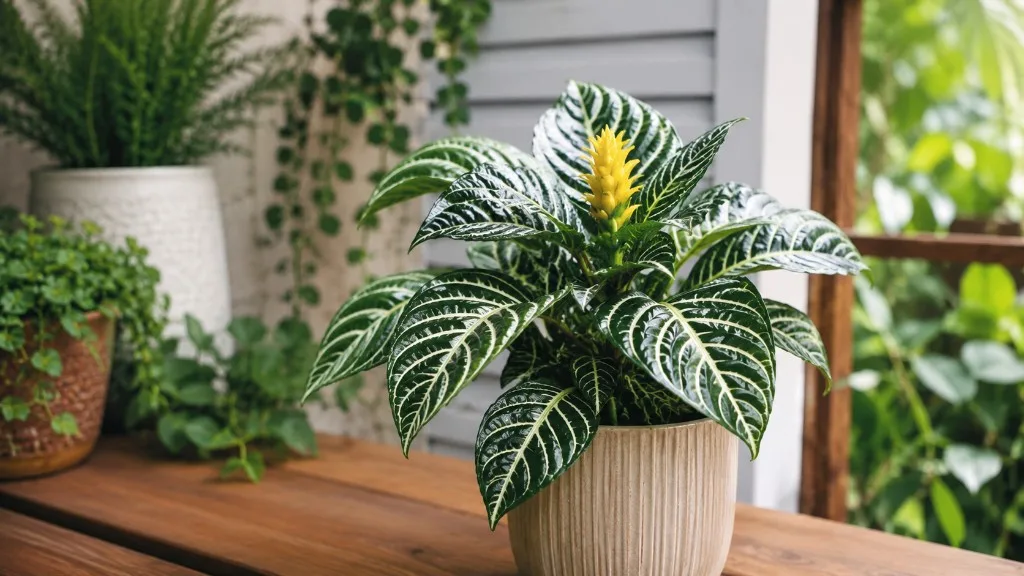
Zebra plant care succeeds when you treat Aphelandra squarrosa like a Brazilian understory shrub, not a cast-iron desk plant. It wants bright filtered light, evenly moist but well-drained soil, high humidity, and nights that stay near 65°F (18°C) or warmer. Miss that moisture-and-humidity pairing and you get bare stems, brown tips, aborted buds, or a plant that looks thirsty while sitting in wet peat.
Honest fit check: if your home runs dry in winter and you prefer plants that forgive missed waterings, choose something else. If you already keep calatheas or ferns happy — or you can run a small humidifier — zebra plant belongs in that same difficulty band, with an extra flowering cycle to manage.
Zebra Plant Care at a Glance
For a healthy indoor zebra plant, place it in bright indirect light, water when the top inch of mix feels dry while deeper soil stays slightly moist, use a peat-based or high-organic mix with strong drainage, keep humidity near 60–70%, and hold temperatures around 65–75°F (18–24°C). Feed lightly in active growth, cut stems back after the yellow bracts fade, and treat leaf drop as an environment signal before assuming pests.
| Care factor | Baseline target | Deeper guide |
|---|---|---|
| Light | Bright indirect; no hot midday sun | Zebra Plant light |
| Water | Top inch dry, then soak and drain | Zebra Plant watering |
| Soil | Acidic, organic, well-draining | Zebra Plant soil |
| Humidity | About 60–70% RH | Low humidity |
| Feed | Light feed in active growth | Zebra Plant fertilizer |
| After bloom | Cut back; root cuttings | Zebra Plant pruning |
Your room changes the calendar. A plant in a bright east bathroom may drink every five to seven days in summer. The same plant in a cool, dim living room may need longer gaps — and will rot if you ignore that slowdown. Check the pot, not the app reminder.
Confirm You Have Aphelandra squarrosa
Zebra plant in LeafyPixels care content means Aphelandra squarrosa, a tropical evergreen in the Acanthaceae family grown for glossy dark green leaves with bold white veins and golden-yellow flower bracts. North Carolina State Extension lists common names including Saffron Spike Zebra and Zebra Plant, notes a native range in northeast and southeast Brazil, and frames the plant as a broadleaf evergreen houseplant outside frost-free climates.
Indoors, expect a compact shrub usually kept around 1 to 2 feet in a standard pot — far smaller than the 4 to 6 feet outdoor height NC State lists for tropical plantings. Growth is slow, maintenance is medium, and the plant has a reputation for being short-lived as a houseplant unless you refresh it with stem cuttings after bloom. That is not a flaw in your care so much as a lifecycle pattern: the display plant flowers, stretches, then benefits from a hard cutback and a replacement rooted from the prunings.
Confirm the botanical name before you copy care advice. “Zebra plant” is shared by unrelated species, and mixing them up wrecks watering advice.
Lookalike Comparison: Aphelandra vs Calathea vs Haworthia
| Plant | Leaf cue | Moisture target | Humidity need |
|---|---|---|---|
| Aphelandra squarrosa | Glossy paddles, bold white longitudinal veins; yellow bract spike | Evenly moist, never bone-dry, never soggy | High (~60–70% RH) |
| Goeppertia zebrina (Calathea zebra) | Velvety leaves, horizontal light/dark bands; folds at night | Even moisture; hates drought and swamp | High |
| Haworthia fasciata (zebra haworthia) | Succulent rosette with white raised bumps | Dry-down between waterings | Low to moderate |
Aphelandra has large, glossy, paddle-shaped leaves with prominent white longitudinal veins, opposite leaf arrangement, and yellow bracted spikes. University of Arkansas Extension describes the cultivar ‘Louisae’ with creamy-white midribs and veins on waxy green blades, plus a four-sided yellow bract spike that stays showy for six to eight weeks while individual flowers last only a few days. Older references may list the synonym Justicia macrophylla; modern labels use Aphelandra squarrosa. For calathea-style humidity tactics that still help Aphelandra, see our calathea care guide.
First 30 Days After Purchase
Nursery zebra plants are often finished in high humidity and bright commercial light. The first month at home is when leaf drop, brown tips, and soft stems show up — usually from dry air and watering mistakes, not from a “bad plant.”
- Quarantine for 10–14 days away from your main collection. Check leaf undersides and stem axils for aphids, mealybugs, scale, and mites.
- Do not repot on day one unless the mix smells sour, stays glossy wet for days, or the pot has no drainage. Let the plant learn your room first.
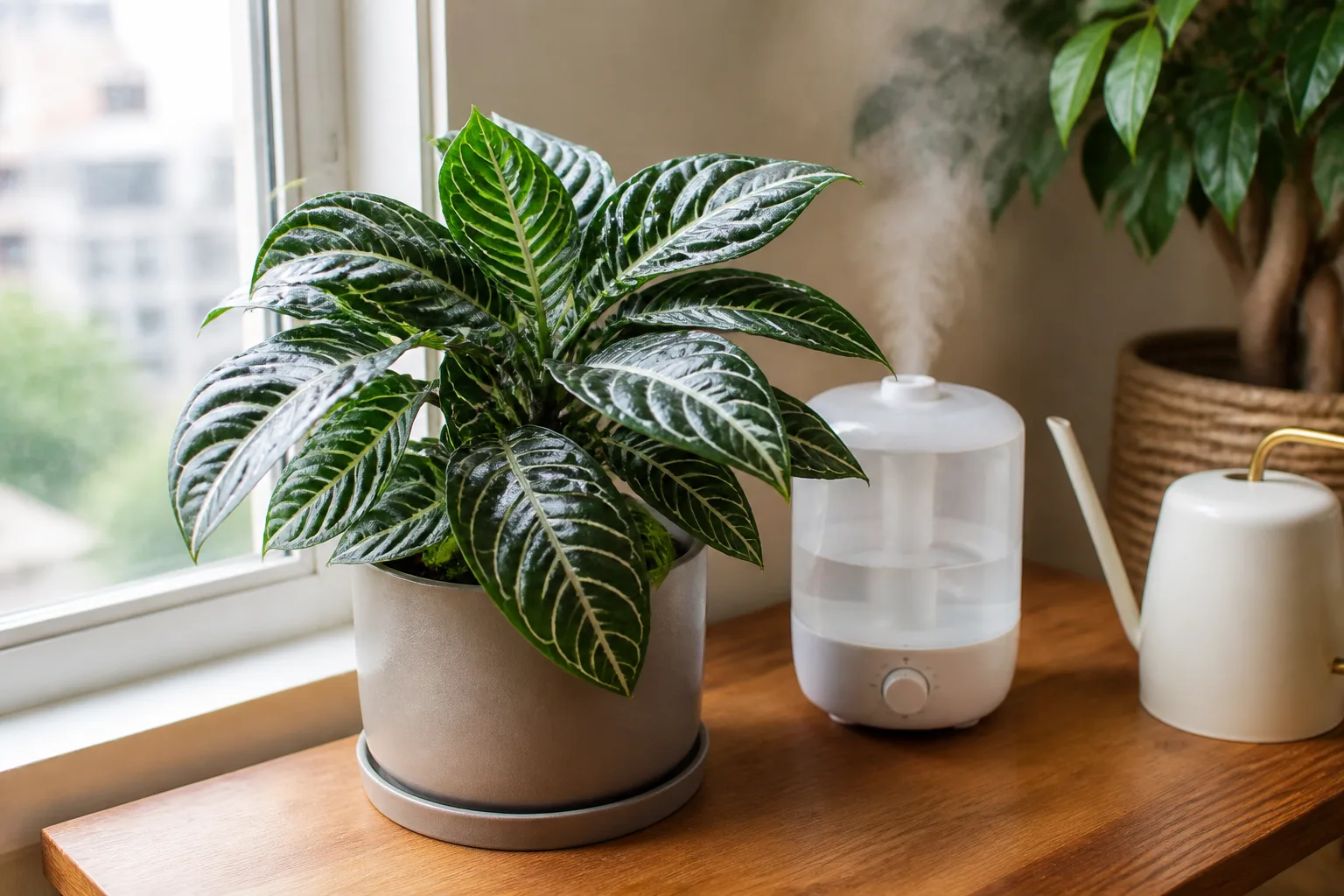
- Raise humidity immediately — a cool-mist humidifier near the plant beats misting. Aim toward the 60–70% band NC State associates with healthy culture and fewer brown leaf tips.
- Learn pot weight before you pour. Water when the top inch is dry; soak until a little runoff exits; empty the saucer. Clemson’s indoor watering guidance is the same container rule that protects Aphelandra roots: water thoroughly when needed, provide drainage, and avoid chronic wet feet.
- Hold fertilizer for two to four weeks while the plant settles. Stress plus salts browns tips that already struggle in dry apartments.
- Keep nights above about 65°F. Cold glass and AC drafts trigger sudden leaf and bud drop even when watering looks correct.
If lower leaves shed in week one while the pot is light and crispy at the surface, you are seeing adjustment plus drought — not a reason to drown the mix. Stabilize humidity and moisture first.
Light for White Veins and Yellow Bracts
Zebra plant is sold for two light-dependent features: high-contrast white veining and yellow bract spikes. Both fade when the plant sits in a dim corner “because tropical plants like shade.” Shade in a rainforest still means bright filtered daylight. Indoors, that translates to bright ambient light without hours of direct midday sun on the leaves.

NC State lists cultural light as dappled sunlight and partial shade, notes that prolonged periods of indirect light encourage blooming, and warns that scorching can follow too much sunlight. An east window is often the easiest home placement. A bright north window can work if new growth stays compact. South and west exposures usually need a sheer curtain or a few feet of setback so leaves stay out of hot beams.
Bright Indirect vs Direct Sun
Bright indirect light means you can read comfortably beside the plant for most of the day without the leaf surface heating under a sharp sun patch. Direct sun, especially afternoon sun through glass, bleaches glossy leaves, browns margins, and curls foliage. Morning sun through an east window is often tolerated on an acclimated plant; unfiltered west sun is the usual scorch culprit.
Low light is survivable for a while but produces leggy stems, smaller pale leaves, dull veining, and almost no chance of flowering. If that is your only spot, a full-spectrum grow light on a 10–12 hour timer a foot or so above the canopy is more honest than hoping a dark shelf will toughen it up. Rotate the pot weekly so stems do not permanently lean. For placement troubleshooting, use the Zebra Plant light guide and the not enough light problem page.
Photo-Accumulation and Flowering
Zebra plant is a photo-accumulator: it needs enough cumulative bright days before it initiates blooms. University of Arkansas Extension explains that plants must accumulate a prescribed period of bright light and good growing conditions; if light is too dim, you get foliage without flowers. Their practical greenhouse-style targets include night temperatures above 65°F and light around 650 footcandles for about 12 weeks before flowers form.
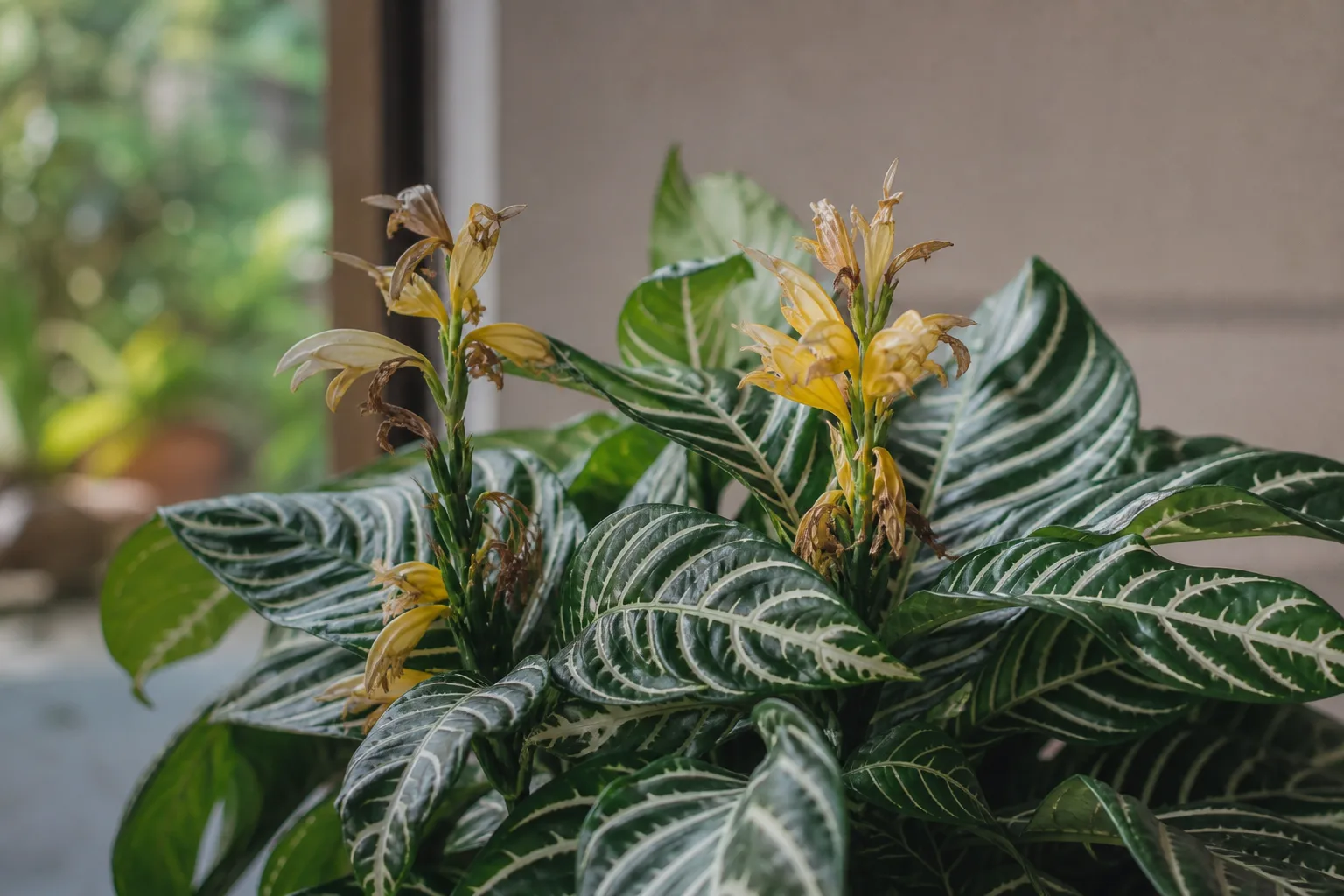
You do not need a light meter to use that idea. If the plant has not seen sustained bright indirect light for weeks, fertilizing harder will not force a spike. Stabilize light, warmth, moisture, and humidity first. Nursery plants often flower because they were finished under commercial light — then stop blooming at home until your placement catches up. The showy part of the display is the yellow bracts; small tubular flowers emerge from between them and are comparatively short-lived.
Watering Without Leaf Drop or Rot
The working rule is consistently moist, never soggy, never bone-dry. Water when the top inch feels dry, soak until a little runoff exits the drainage hole, then empty the saucer. Do not leave the pot standing in water.

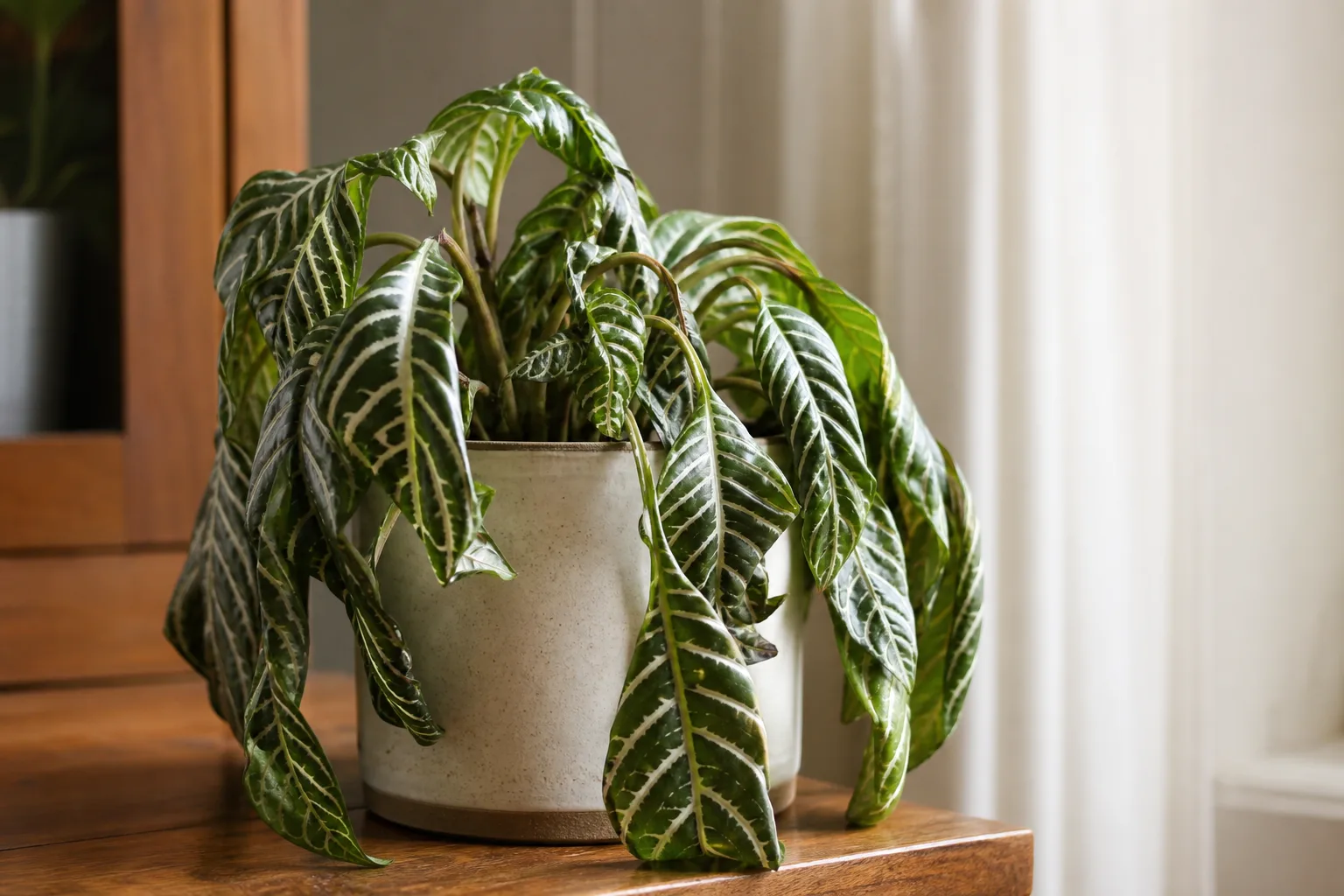
NC State warns against letting soil dry out completely and notes that both excessive water and extremely dry conditions brown and drop bottom leaves. It also flags that drooping can mean too much water. Arkansas Extension is blunt about drought cycles: plants allowed to wilt a time or two drop lower leaves and take on a miniature palm-tree look with a bare stem. That is why “succulent-style” dry-downs fail here.
Use room-temperature water. If tips brown despite decent humidity, trial filtered or distilled water for a month — mineral sensitivity is common in tropical foliage plants, though humidity is still the first suspect. For general moisture-check habits that transfer here, pair this with how to water indoor plants the right way.
The Top-Inch Test and Seasonal Rhythm
Finger-check the top inch before every watering. Dry and crumbly means water. Cool and damp means wait. A wooden skewer to the pot bottom helps in deep containers: damp wood means hold off. Learn pot weight so you can feel a halfway-dry plant without guessing from surface color alone — peat can look dry on top while staying wet underneath.
In winter, NC State describes a semi-dormancy: reduce watering but do not stop it, then resume weak fertilizer when new growth appears in late winter. The classic winter failure is summer watering frequency in lower light, which keeps the mix wet and invites yellow lower leaves, fungus gnats, and root rot. Stretch the interval, keep humidity up, and pause fertilizer until growth resumes. Deeper seasonal detail lives on the watering guide. Winter dry air plus overwatering traps are also covered in why houseplants struggle in winter.
Dry Wilt vs Wet Wilt
Leaf drop is zebra plant’s loudest distress signal. Causes overlap: dry soil, cool drafts, low humidity, sudden moves, and pest pressure. Always pair symptoms with a moisture check.

- Dry-soil wilt: light pot, mix pulling from the walls, crisp edges, recovery within hours after a thorough soak.
- Wet-soil wilt: heavy pot, sour smell, soft yellow leaves, decline after more water — roots are failing even though the mix is wet.
Do not “fix for thirst” by watering when the pot is already heavy. Unpot if soft stems and soggy mix persist: trim brown mushy roots, refresh into draining mix, and reset the top-inch rhythm. Symptom pages for wilting, underwatering, overwatering, and leaf drop walk those forks in more detail.
Soil, Pot, and Acidic Mix
Use a rich, well-draining, slightly acidic mix with high organic matter. NC State specifies acidic soil below pH 6.0, high organic loam texture, and good drainage while staying moist. A practical home blend is roughly two parts quality peat-based or peat-free houseplant mix, one part perlite, and one part orchid bark or coarse coco chips. The goal is a wrung-out sponge feel after watering — moisture retained, air pockets intact.
Always use a pot with a drainage hole. Decorative cachepots are fine only if you empty runoff every time. Oversized pots hold unused water around a small root system and raise rot risk. NC State recommends repotting annually up one pot size when roots need room; in practice, many home growers refresh every 1–2 years or when the mix collapses and stays wet for days. Tired peat that smells sour or stays glossy five days after watering is a soil problem, not a calendar problem. See the soil and repotting guides for mix recipes and timing.
Temperature and Humidity Indoors
Keep zebra plant in a stable 65–75°F (18–24°C) band. Treat 65°F as a practical floor. Cold window glass, AC vents, and entry drafts trigger sudden leaf and bud drop even when watering is correct. Move the plant before winter nights chill the panes.
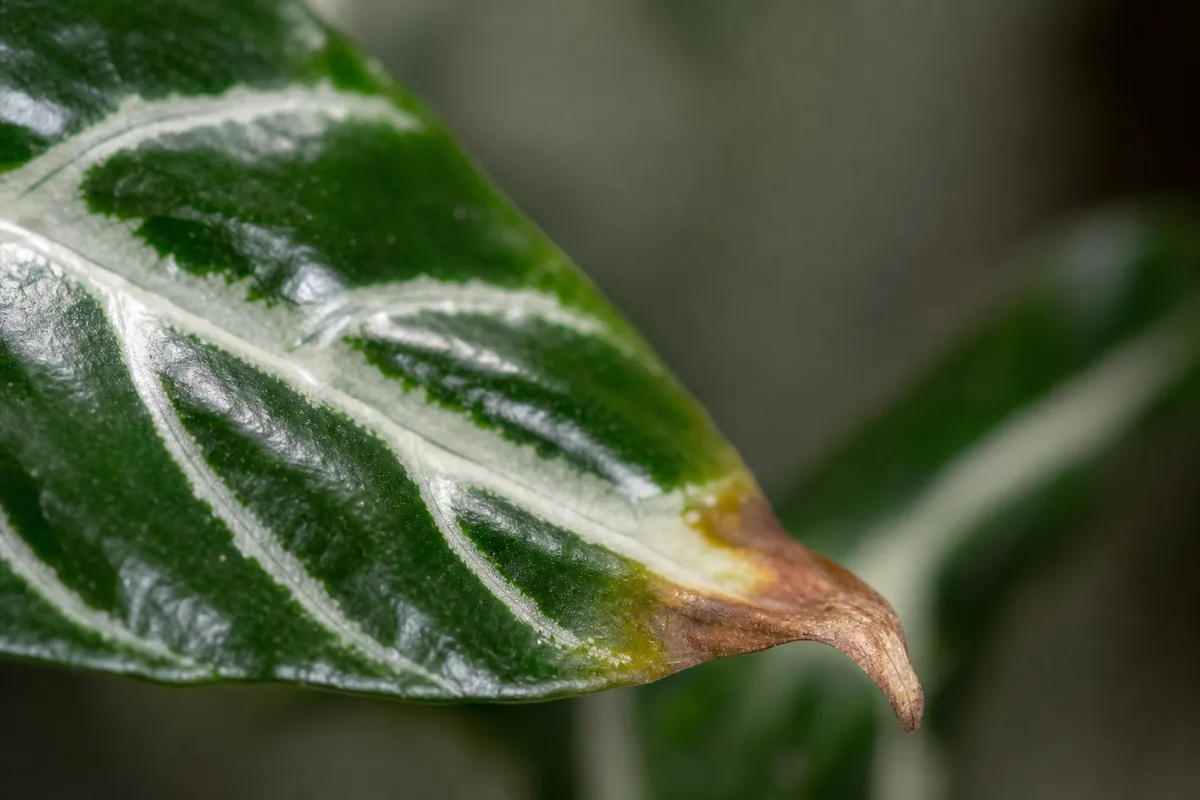
Humidity is a core requirement, not a finishing tip. Aim for roughly 60–70% relative humidity. NC State suggests pebble trays or bathrooms to help meet humidity needs and links brown tips to low humidity. Ranked by impact: a cool-mist humidifier near the plant, grouping tropicals, a pebble tray with the pot above the water line, and a bright bathroom with adequate light. Misting alone is a weak primary strategy — the boost lasts minutes, and wet foliage in stagnant air can encourage spotting. If tips crisp while soil moisture looks right, fix air moisture before changing fertilizer.
High humidity without airflow has a downside: stagnant damp air can favor mildew on soft growth. Keep gentle air movement without blasting the plant with a direct fan or vent. Use the low humidity and brown tips pages when edges keep browning.
Feed, Post-Bloom Cutback, and Propagation
Feed only after light, water, and humidity are stable. During active growth, use a dilute balanced liquid fertilizer (for example a half-strength 10-10-10 or similar houseplant formula) every few weeks — safer than weekly full-strength doses on a stress-prone tropical. NC State suggests a weak fertilizer every few weeks once late-winter growth resumes, and emphasizes moist soil in the growing season. Pause feeding for newly repotted, wilted, or winter-semi-dormant plants. Fertilizer cannot replace light for flowering and cannot repair roots sitting in wet peat. Season and product detail live on the fertilizer guide.
Cut Back to Two Rows of Leaves
After the yellow bracts fade, remove the spent spike and cut stems back, leaving about two rows of leaves. NC State notes this prevents the plant from going leafless and leggy, and that removed stems can propagate new plants. Arkansas Extension likewise says to remove the spike and relocate the plant to a warm, bright spot — summer shade outdoors can work in warm climates — then expect another fall bloom with routine care.
For propagation, take stem tip cuttings with at least two nodes during that post-bloom prune. Root in moist well-draining mix under warmth and high humidity, or start in water and move to mix once roots are a few centimeters long. Because the species is often short-lived as a single specimen, treating bloom-and-cutback as a renewal cycle keeps striped foliage in the house even when the original stem ages out. Step-by-step rooting lives on the propagation guide.
Common Problems: Quick Diagnosis Paths
Start diagnosis from roots and room conditions, not from leaf color alone.

Leaf drop and bare stems: usually drought cycles, cold drafts, or post-stress shed. Stabilize moisture and temperature; cut back and restart growth from lower nodes if the stem is bare. See leaf drop and draft stress.
Brown tips and crispy edges: low humidity first, then water quality or uneven watering. Raise RH; avoid compensating with constant soggy soil.
Yellow lower leaves on wet mix: overwatering or poor drainage; check root rot. Yellow crisp leaves on a light pot point the other way — underwatering.
No flowers: insufficient cumulative bright light, cool nights, or overall stress. Fix placement for weeks before changing fertilizer brands. See no flowers.
Bud drop on forming spikes: dry air, dry soil, or cold drafts aborting the display. Keep even moisture and humidity while bracts develop. See bud drop.
Pests: NC State lists aphids, scale, whiteflies, spider mites, and mealybugs as watch-outs. Dry air favors mites; inspect leaf undersides and axils. Treat early with mechanical removal and insecticidal soap where appropriate, and isolate the plant. Hub pages for spider mites, mealybugs, and scale insects cover species-specific treatment paths.
Pet Safety and Buying Notes
Aphelandra squarrosa (Saffron Spike Zebra) is listed by the ASPCA as non-toxic to dogs, cats, and horses. Non-toxic does not mean chew-proof — large amounts of any plant material can still upset a stomach. Confirm you bought Aphelandra, not a mislabeled calathea or haworthia sold under the same common name. If a pet eats a large quantity or shows persistent symptoms, contact your veterinarian or ASPCA Animal Poison Control at (888) 426-4435.
When buying, choose firm glossy leaves with crisp white veins, no soft stem base, and soil that does not smell sour. Nursery plants finished in high humidity often shed after a week in dry homes — quarantine, raise humidity immediately, and do not repot on day one unless the mix is failing.
First-Hand Notes From Growing Aphelandra
These notes come from keeping Aphelandra squarrosa in typical apartment conditions — bright rooms, winter heating, and the usual dry-air stretch — not from a greenhouse trial.
East bathroom vs dry living room. On an east sill in a steamy bathroom, our plants usually needed water every five to seven days in warm weather once the top inch dried. Moved three meters into a heated living room at roughly 35–40% RH without a humidifier, the same pot dried faster at the surface, tips browned within two weeks, and lower leaves shed after one missed watering. A small cool-mist humidifier within about a meter of the canopy reversed tip burn within a few weeks; misting alone did not.
Leaf drop after a dry-air move. A nursery plant with a forming bract spike dropped several lower leaves within ten days of coming home into heated air. The pot was still slightly moist mid-depth — not bone-dry — so the driver was humidity and draft near a sliding door, not underwatering. Moving the plant off the door path and raising RH stopped the shed; the bract continued for several more weeks.
Cutback and cuttings. After bracts faded, cutting stems back to about two leaf pairs and rooting the tips in a covered tray of moist bark-perlite mix produced rooted cuttings in roughly three to four weeks at warm room temperature. Leaving a bare, uncut stem looking like a miniature palm never recovered a full canopy as cleanly as a hard cutback plus a rooted replacement.
Bloom timing at home. Plants that sat in bright indirect light for many consecutive weeks produced new spikes more reliably than plants that lived in “pretty bright” mid-room spots. Fertilizer never forced a bloom in a dim corner. That tracks UAEX’s photo-accumulator framing even without a footcandle meter on the sill.
Mite pressure. On one dry winter stretch, fine webbing showed up on leaf undersides after humidity dipped. Raising RH and rinsing undersides cleared early mites before sprays were needed. Dry air is a pest problem as much as a tip-burn problem on this species.
Related Guides
- Zebra Plant care hub — topic list and symptom index for Aphelandra
- How to water indoor plants the right way — moisture-check habits that transfer here
- Calathea care guide — humidity tactics if you also grow striped prayer plants
- Why houseplants struggle in winter — dry air and overwatering traps
- Repotting houseplants — when and how to refresh any container plant
Conclusion
Treat zebra plant as a renewal crop: bright filtered light, warm nights, honest humidity, and soil that stays evenly moist without drowning the roots. After the yellow bracts fade, cut stems back to about two leaf rows and root the prunings so the striped foliage keeps circulating through the house. When symptoms outgrow this overview, open the matching topic on the Zebra Plant hub instead of stacking random fixes.