Black Magic Rose Care: Planting, Pruning & Blooming
Black Magic rose care starts with sun, soil, and drainage. Learn watering, pruning, feeding, container, winter, and leaf-problem basics for healthy blooms.
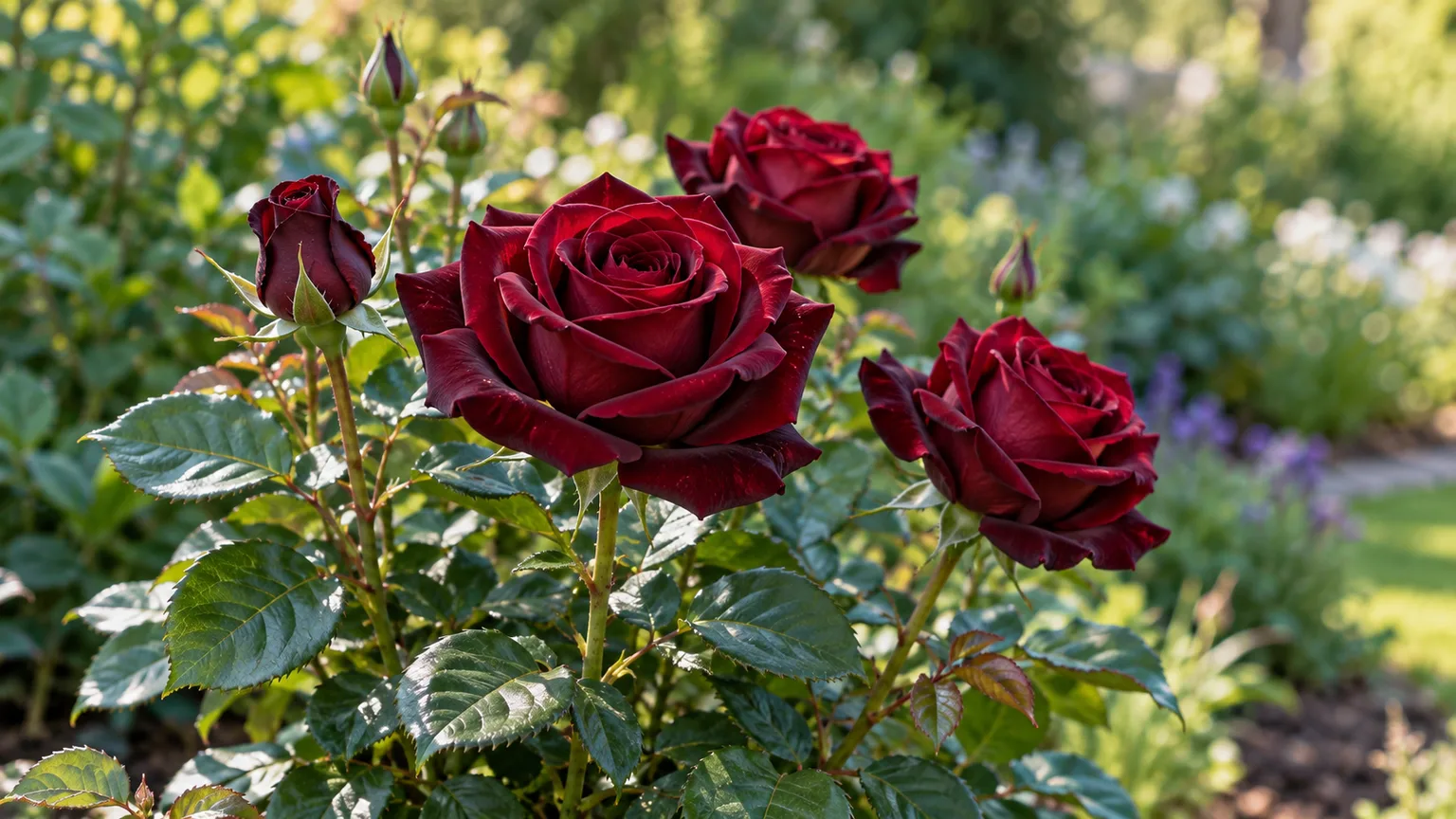
Black Magic is a hybrid tea rose grown for large, velvety blooms in very dark red. In deep shade the petals can look nearly black, but the flower is burgundy-red rather than truly black; a specialist rose nursery describes the blooms as dark red and slightly fragrant, with upright stems that suit cutting. Give the plant sun, fertile but freely draining soil, and room for air to move through the foliage, then water the root zone deeply instead of sprinkling leaves.
The details that need the most judgment are size, winter hardiness, and watering frequency. Cultivar listings and local growing conditions do not always line up, so use your nursery’s tag for the plant in front of you and adjust care to the soil and weather rather than copying a fixed calendar.
What makes Black Magic rose different?
‘Black Magic’ is a rose cultivar, not a botanical species or a black-flowered plant. Its dark color comes from dense red and burgundy tones that appear deeper in cool light or against dark foliage; direct sun makes the red easier to see. This distinction matters when choosing companions: pale roses, silver foliage, and chartreuse plants can make the petals look darker by contrast, while a black container or dark fence can swallow the flower’s detail.
As a hybrid tea, Black Magic is selected for strong, upright flowering stems and large individual blooms that work well in a vase. British Roses lists its particular plants at about 70–100 cm tall and notes slight fragrance, but that figure is a seller’s estimate rather than a universal maximum. Rootstock, local climate, growing season, and pruning all affect mature size, so check the tag and ask the nursery what its stock reaches locally instead of planting to one online height claim. British Roses’ Black Magic listing
Expect a rose that is grown primarily for flower form and color rather than perfume. If fragrance is a deciding factor, smell a blooming specimen before buying; descriptions such as “slight” can mean very little scent to a gardener who expects a classic, strongly perfumed rose.
Choose a site that supports flowers and healthy leaves
The best position is sunny, open, and not trapped between a wall and dense shrubs. A rose that receives too little light may keep growing leaves but produce fewer flowers, and crowded, slow-drying foliage makes disease management harder. The Royal Horticultural Society’s broad rose guide recommends a sunny site, free-draining soil, and enough space for the selected plant to mature; for a repeat-flowering hybrid tea, aim for around six hours of direct sun when your climate allows it. RHS guide to growing roses
Sun and airflow
Morning sun is especially helpful because it warms the plant and dries dew from the leaves. In a very hot region, a little late-afternoon shade may help reduce heat stress, but do not trade away most of the day’s light; if a rose in shade has long, soft shoots and sparse blooms, move it or open the canopy around it before increasing fertilizer.
Give the mature shrub open air on every side. Do not wedge it where a fence blocks wind and rain cannot dry the foliage, but avoid a harsh wind tunnel that repeatedly snaps flowering stems or dries the soil. Space it according to the plant’s mature width and neighboring plants, not its small size in the shipping pot; an open center makes it easier to prune, inspect, and harvest blooms.
Soil and spacing
Black Magic needs moisture at the roots without stagnant water around them. A deep, loamy bed with organic matter is useful, but “rich soil” does not mean a hole filled with potting mix or manure that is sharply different from the surrounding ground; that pocket can hold water or discourage roots from spreading. If water sits in the bed after rain, improve the site or use a raised bed before planting.
Work finished compost into a broad area of soil rather than making a small enriched pocket. Roses generally grow well in slightly acidic to near-neutral soil; a soil test is more reliable than adding lime or acidifiers by guess. Keep mulch a few inches away from the canes so the crown stays airy and you can see where new shoots emerge. BHG also emphasizes full sun, organic matter, and drainage for garden roses. Better Homes & Gardens rose-growing guide
Plant Black Magic rose without burying or drying the roots
Plant bare-root roses while dormant in the cool planting window for your region; plant a container-grown rose when the soil is workable and not waterlogged or baking hot. If you are buying rather than moving a plant, choose one with firm green canes, visible healthy buds, and no blackened or shriveled stems. A smaller, well-rooted plant is often a better start than a large specimen with dried roots.
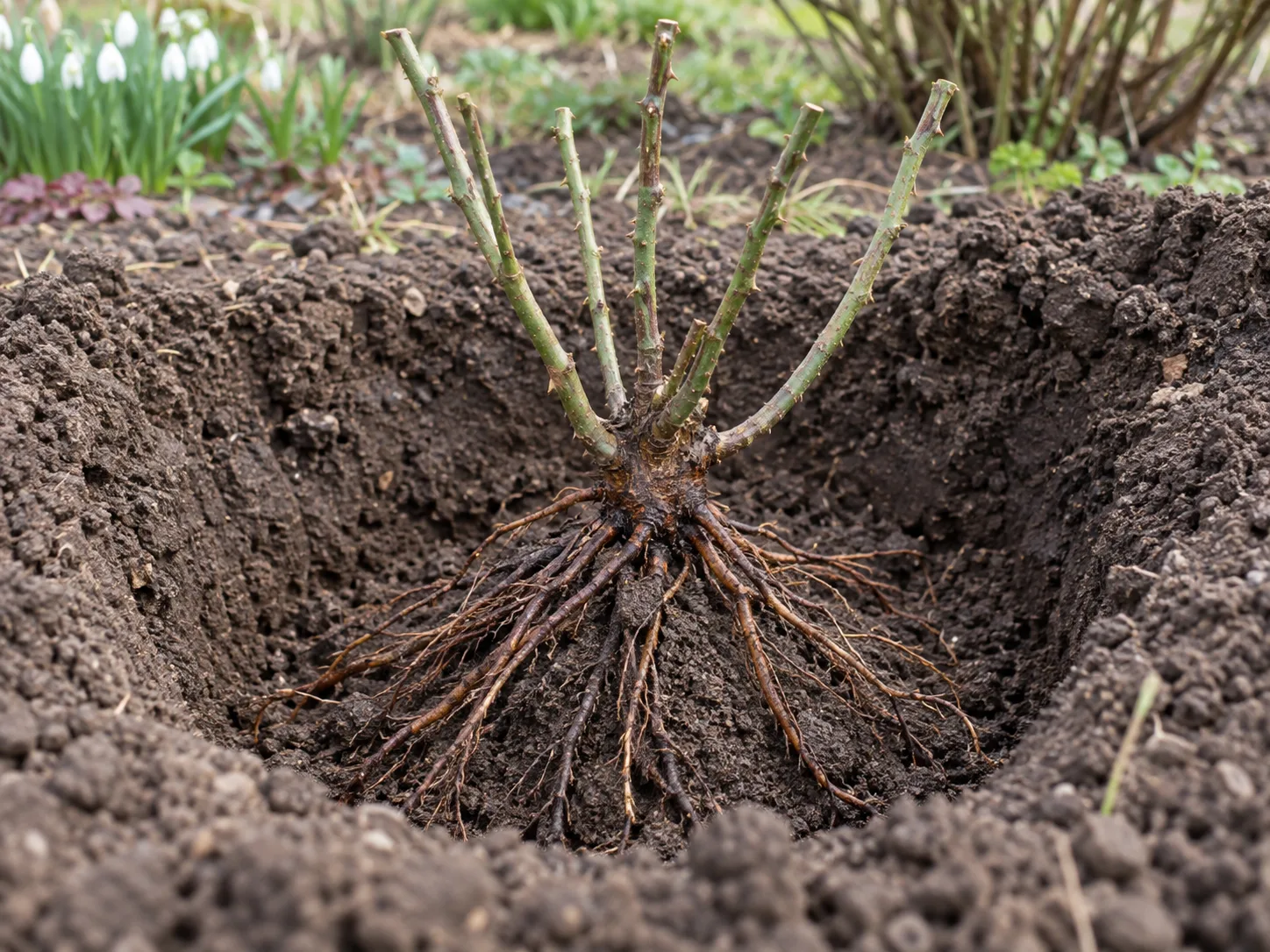
Before planting, water a potted rose so its root ball is evenly damp. Dig a hole wide enough to spread the roots without bending them sharply, and loosen compacted soil below and around the hole rather than making it deeper than necessary. For bare-root stock, build a low mound in the center and fan the roots over it; for a container plant, loosen circling roots gently and position the root ball at the level recommended for the plant’s graft and local winter conditions.
Refill with the excavated soil, firm it lightly, then water slowly so the soil settles around the roots. Do not pack the bed hard or bury the canes under a thick layer of compost. Mulch the root zone after planting, keeping a clear ring around the stem base, and water consistently while new roots establish. The RHS advises planting roses promptly and avoiding frozen or waterlogged ground; its guidance also distinguishes bare-root and container-grown planting windows. RHS rose planting guidance
Water deeply, then check before repeating
A weekly watering rule can be a starting point for an established rose during dry summer weather, not a requirement to water every week regardless of rain. The RHS suggests about 5–10 liters per established border rose during a dry, hot spell and recommends a deep soak over frequent light watering; it also notes that newly planted roses need regular water while establishing and pots may need water daily in hot conditions. These are useful reference points, but sandy soil, high heat, wind, shade, clay, and rainfall change how fast the root zone dries.
Check the soil several inches down before watering. If it is cool and damp, wait; if it is dry around the active root zone, water slowly at the base until moisture has moved beyond the surface layer. A shallow splash can leave the deeper roots dry while making the surface look wet, and repeatedly wetting the leaves increases the time they stay damp.
For a new rose, check more often than you water. The root ball can dry faster than the surrounding garden bed, especially in the first summer, so inspect it and nearby soil separately. For a container, lift or feel the potting mix and water when the upper layer begins to dry; let excess drain freely and never leave the pot sitting in a water-filled saucer. The aim is even moisture, not permanent saturation.
Feed for flowers without forcing late growth
Start with soil condition, not a heavy dose of rose food. A layer of mature compost or well-rotted organic mulch improves the surface over time, while a soil test can reveal whether pH or nutrients actually need correction. If the plant grows strongly and flowers normally, adding more fertilizer may only produce soft leafy growth.
For an established rose in the ground, a simple approach is to feed as active growth resumes in spring and again after the first strong flush of flowers, following the product label. The RHS gives spring and midsummer as its two general feeding windows for border roses. Stop routine feeding early enough for new stems to mature before cold weather; avoid high-nitrogen applications late in the season, especially if the plant already has dark, vigorous foliage but few buds.
Newly planted roses do not need fertilizer packed into the planting hole. Let roots establish first, then begin a modest routine once you see steady growth. If leaves yellow, flowers stay small, or canes grow weakly, check sunlight, drainage, water, and pests before assuming the plant is hungry; feeding a stressed root system can make the problem worse. RHS rose-feeding guidance
Prune to shape a strong hybrid tea rose
Pruning has two jobs: remove wood that cannot support healthy growth and keep the shrub open enough for light, air, and accessible flowers. It is not a haircut that has to happen on an exact date every year. For most temperate-climate gardeners, do the main work in late winter or early spring after the worst hard freezes have passed and buds begin swelling; adjust to local frost patterns rather than the calendar in another region.
Make the structural cuts in spring
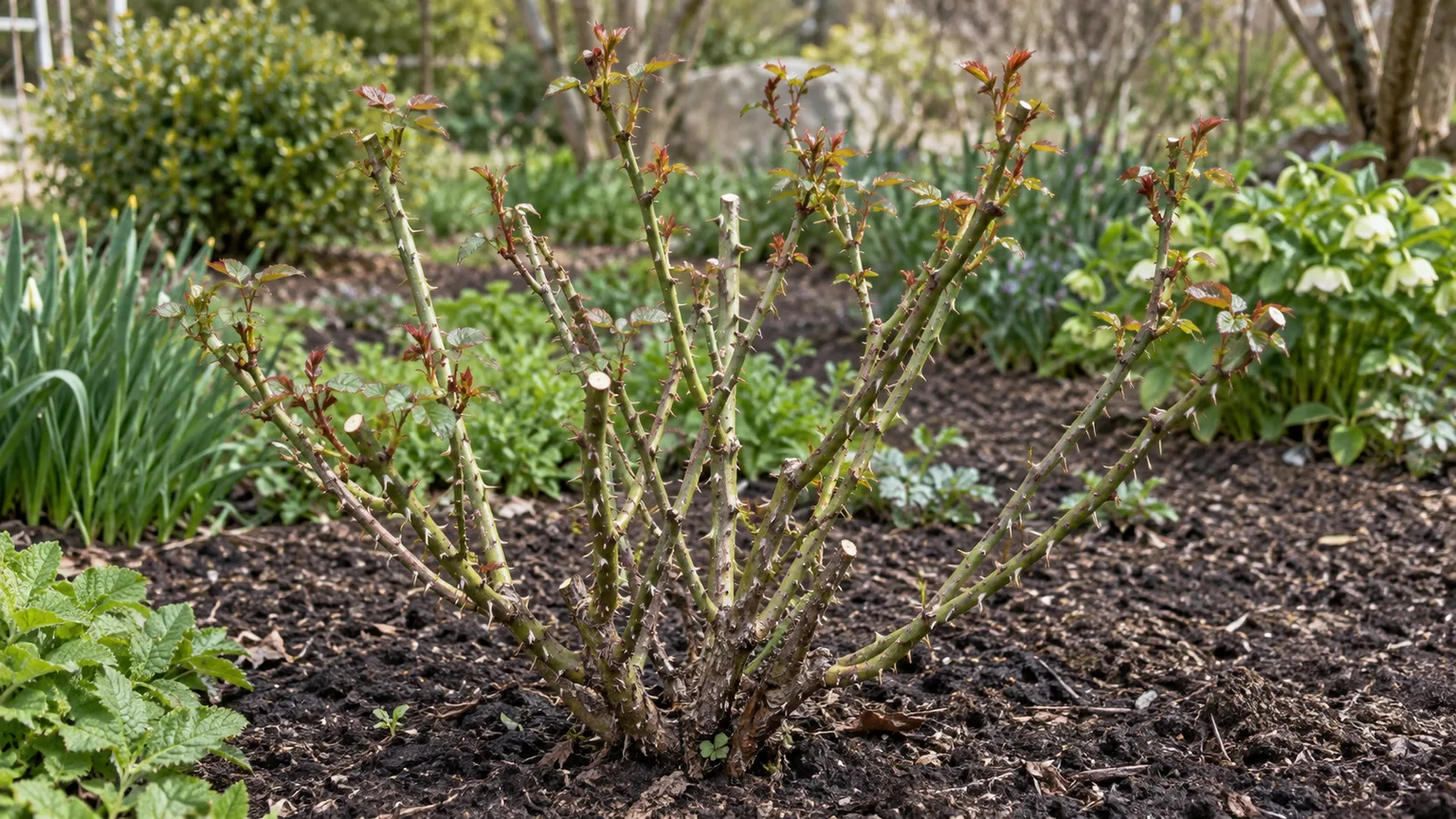
Wear sturdy gloves and use sharp bypass pruners. Begin by cutting out dead, diseased, broken, or very thin canes at their point of origin, then remove stems that rub across the center. Keep a handful of vigorous, well-spaced canes if the plant has enough; the goal is an open, vase-like framework, not a crowded tangle or a severe, bare stump.
Where each cane should be cut
Shorten the remaining canes to a sound outward-facing bud, making a clean sloping cut just above it so rain can drain away from the bud. Remove only as much healthy wood as needed to balance the plant’s vigor and the winter damage; a young or weak rose should not be cut back as hard as an established, vigorous one. When you are unsure how much survived winter, scratch a small spot of bark: green tissue under the bark is living, while dry brown tissue is not.
Do not seal ordinary pruning cuts with paint, and do not leave long stubs that die back. If you remove diseased material, bag it rather than composting it, then clean the pruners before moving to another rose. These small habits reduce accidental spread and keep later cuts easier to inspect.
Deadhead for repeat blooms and cut flowers
During the bloom season, remove spent flowers if you want the plant to put energy into another flowering cycle rather than forming hips. Follow the faded flower stem down to a strong leaf and outward-facing bud, then cut above it; do not strip most of the foliage from a long stem just to make a short bouquet. Keeping healthy leaves gives the rose the energy it needs to replace the bloom.
For a vase, cut in the cool morning when the buds have begun to open and carry clean, sharp pruners. Leave enough leafy stem on the shrub to support regrowth, and remove any leaves that would sit below the waterline in the vase. If you want hips or a more natural late-season look, stop deadheading the final flush instead of cutting every faded flower.
Grow Black Magic rose in a container only with enough root room
A pot can work on a sunny patio, but it makes this rose more demanding: the root zone dries faster, nutrients are limited, and winter cold reaches the roots more readily than it does in garden soil. If your space is small, a compact patio rose is usually an easier choice than a hybrid tea with tall flowering stems. If you still want Black Magic, choose a heavy container with generous volume and several drainage holes; Savvy Gardening’s container-rose guide places a standard rose in an 8–15-gallon range, so use the upper end for a vigorous plant and local size expectations. Savvy Gardening container-rose guide
Use a free-draining potting mix designed for outdoor containers, not garden soil alone. Set the plant at the appropriate depth for its rootstock, leave a little headroom for watering, and mulch the surface lightly without piling material against the stems. Put the container where it gets good sun and air movement, but secure it against tipping in strong wind.
Check container moisture often in hot weather, sometimes daily, and water until a little drains from the bottom. Feed modestly during active growth according to the fertilizer label, then flush the pot occasionally with plain water if salts have accumulated at the surface. Before winter, decide whether the pot can be moved to a sheltered, unheated spot or insulated in place; a heated living room is not a substitute for the rose’s outdoor seasonal cycle.
Protect the plant through winter
Do not cut a healthy Black Magic rose down hard in autumn. Late-season pruning can stimulate tender shoots that are more vulnerable to a freeze, while old stems also help protect the crown. Remove diseased leaves and broken wood, then wait until spring to make the main shape cuts.
In a cold-winter garden, protect the base and graft union after the soil has cooled, using loose soil or mulch appropriate to local rose practice. Avoid packing wet leaves tightly against the canes or burying the whole shrub in a sealed plastic wrap. In a mild climate, good drainage and clean-up may be enough; an extra-heavy mound can keep the base too damp.
A potted rose needs more protection than the same cultivar in the ground because its roots are exposed on all sides. Move the pot to a sheltered, unheated garage or shed if temperatures routinely fall below the plant’s local rating, or insulate the container and place it out of harsh wind. Check soil moisture occasionally over winter so the root ball does not become bone dry, but water sparingly while the plant is dormant.
Propagate from a cutting if you want the same cultivar
Seeds from a rose hip are not a reliable way to reproduce Black Magic. Roses cross-pollinate, and seedlings can differ in flower color, form, fragrance, vigor, and disease response; a seedling with dark flowers is not automatically the named cultivar. Use a stem cutting if your goal is a plant that matches the parent’s flowering wood.
Take a healthy, nonflowering or recently flowered shoot during a suitable mild period in your region. Cut a section with several nodes, remove the lower leaves, and place the bottom node in a clean, free-draining propagation mix; keep it evenly moist and sheltered from harsh sun while roots form. A clear cover can help retain humidity, but lift it to ventilate and remove it if condensation stays heavy or the cutting begins to rot.
A cutting-grown rose is on its own roots, so it will not have the same rootstock as a grafted nursery plant. It may therefore grow with a different vigor or winter response even though its flowers are the same cultivar. The RHS notes that some roses are protected from propagation for sale and that rootstock can affect plant performance; check local rules before selling propagated plants. RHS guide to rose propagation
Troubleshoot pests and rose diseases early
Inspect the new shoots and the undersides of leaves while you water. Catching a small problem early is easier than treating a defoliated rose, but do not spray just because a leaf looks imperfect; first check what is present and whether the damage is spreading. A healthy rose can tolerate some cosmetic feeding damage without losing its ability to flower.
Black spot and premature leaf drop
Black spot produces dark purple to black marks on leaves, often with yellowing around them and early leaf fall. The fungus can also leave dark lesions on young stems, and repeated defoliation weakens the plant; both the RHS and University of Arkansas Extension describe the disease as a recurring rose problem whose severity varies with conditions and cultivar. The RHS notes that resistance is not permanent because new fungal strains can overcome it, so do not treat any cultivar label as immunity. RHS black spot guidance · University of Arkansas Extension disease note
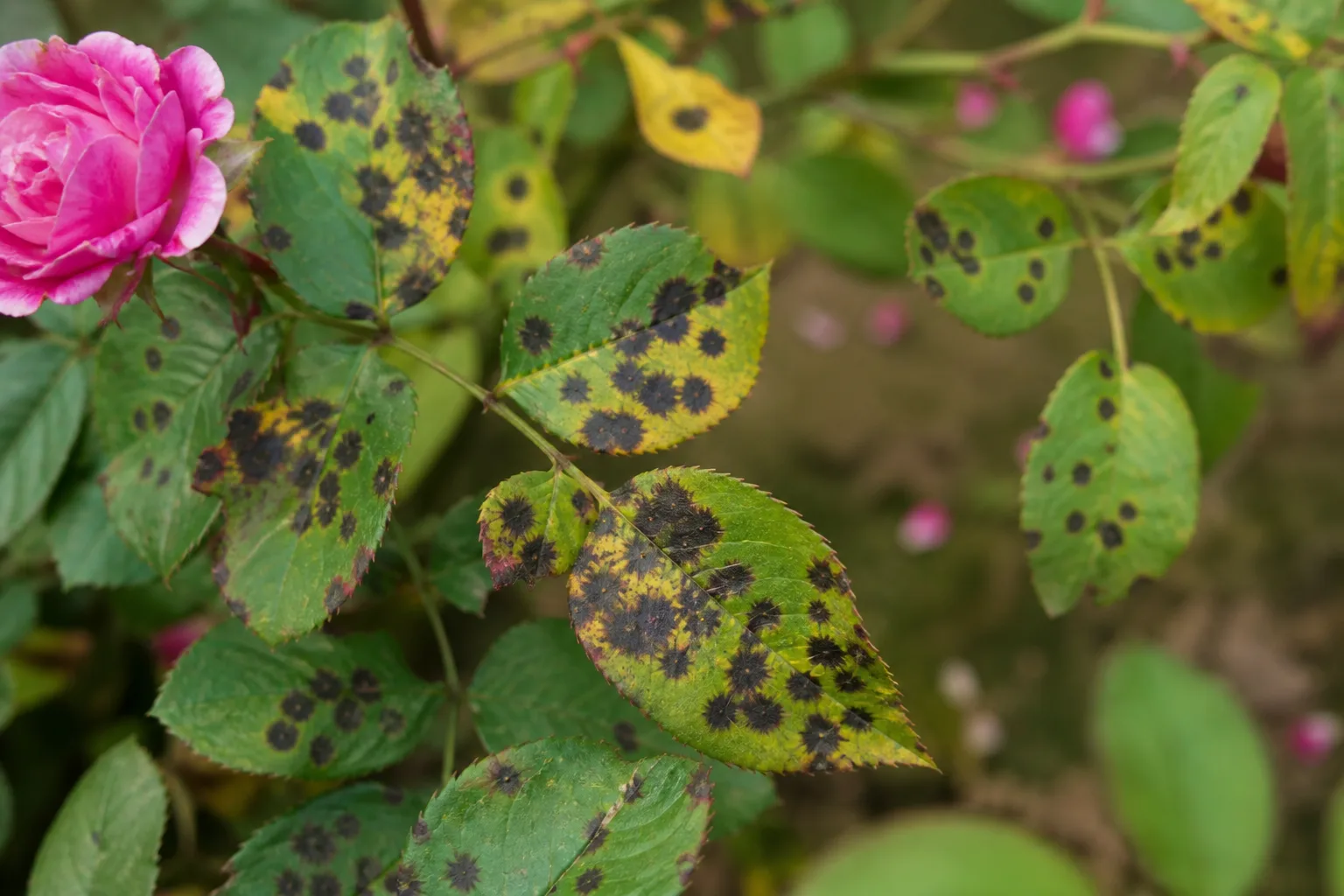
Keep the first response simple: remove fallen infected leaves, prune out clearly affected canes, water at the soil line, and give the shrub enough room to dry after rain. Do not compost diseased foliage if your compost pile does not reliably heat through. These steps reduce carryover but cannot prevent spores arriving on wind-driven rain, so keep checking after wet spells.
If the disease returns each year and repeatedly strips foliage, ask a local extension office or rose specialist about cultivars that perform better in your region. Fungicide decisions should be local and label-led: products differ by country and site, and the RHS advises against routine fungicide use in its guidance because of potential effects on biodiversity and soil health. Do not mix homemade sprays or assume an “organic” label makes a product harmless.
Aphids, leaf-chewing larvae, and powdery mildew
Aphids usually cluster on tender tips and flower buds. For a small infestation, rinse them off with a firm stream of water and recheck the new growth; avoid spraying open flowers or applying broad-spectrum insecticides that also hit pollinators and predators. If you consider a pesticide, use a product labeled for roses and the specific pest in your location, and follow its directions exactly.
Holes or scalloped edges call for a closer look before treatment. Check leaf undersides for rose sawfly larvae, inspect buds for caterpillars, and look for beetles at the time of day they feed; different insects need different responses, and not every missing piece of foliage requires a spray. Hand-pick visible larvae where practical and keep the shrub vigorous rather than removing healthy leaves indiscriminately.
Powdery mildew appears as pale, powdery growth and may distort young leaves or buds. Improve airflow, water the root zone, remove badly affected growth, and avoid keeping the rose crowded against a wall. If symptoms persist, compare them with a reliable local diagnosis before treating; black spot, mildew, and spray injury require different responses.
Diagnose a Black Magic rose that is not blooming
Start with light. A rose in fewer than about six hours of direct sun may survive but flower poorly, especially if nearby trees have leafed out since you first planted it. If the shrub is leggy and the flower count has declined over time, open the surrounding canopy or move the plant during dormancy rather than trying to correct shade with fertilizer.
Next check the previous pruning and feeding. Removing too much healthy cane, cutting at the wrong time for your climate, or leaving faded flowers through a long repeat-blooming season can reduce the next flush; too much nitrogen can produce glossy leaves at the expense of flowers. Correct one likely cause at a time so you can tell whether the change helps.
Then inspect water and roots. A dry plant may drop buds before opening, while saturated soil can damage roots and create weak shoots; neither problem is fixed by pruning harder. If growth is healthy but flowers are absent in the first season after planting, allow time for establishment and avoid forcing the rose with concentrated fertilizer.
If buds form but fail to open, look for botrytis-like gray decay after prolonged cool, wet weather, thrips inside the petals, or flowers that have simply been damaged by heat or rain. Remove only affected blooms and improve the conditions you can control. A useful diagnosis starts with the pattern—no buds, small buds, or buds that form and then fail—rather than treating every case of “no flowers” as the same problem.
Conclusion
Black Magic rose is a color-and-cutting rose that rewards a sunny, airy site, steady root-zone moisture, and deliberate spring pruning. Plant it in soil that drains, water according to what the root zone is doing, and deadhead selectively if you want another flush; keep a container large and insulated enough for the extra work it creates.
Use local nursery guidance for final size and hardiness, especially if your winters are severe or you are growing a grafted plant. If the rose struggles, check light, soil moisture, cane health, and leaf symptoms in that order before reaching for more fertilizer or a spray.



