Carnations: Plant Care and Growing Guide
Learn how to grow carnations from seed, cuttings, or transplants. Covers soil pH, heat limits, cut-flower harvest, and pet safety for Dianthus caryophyllus.
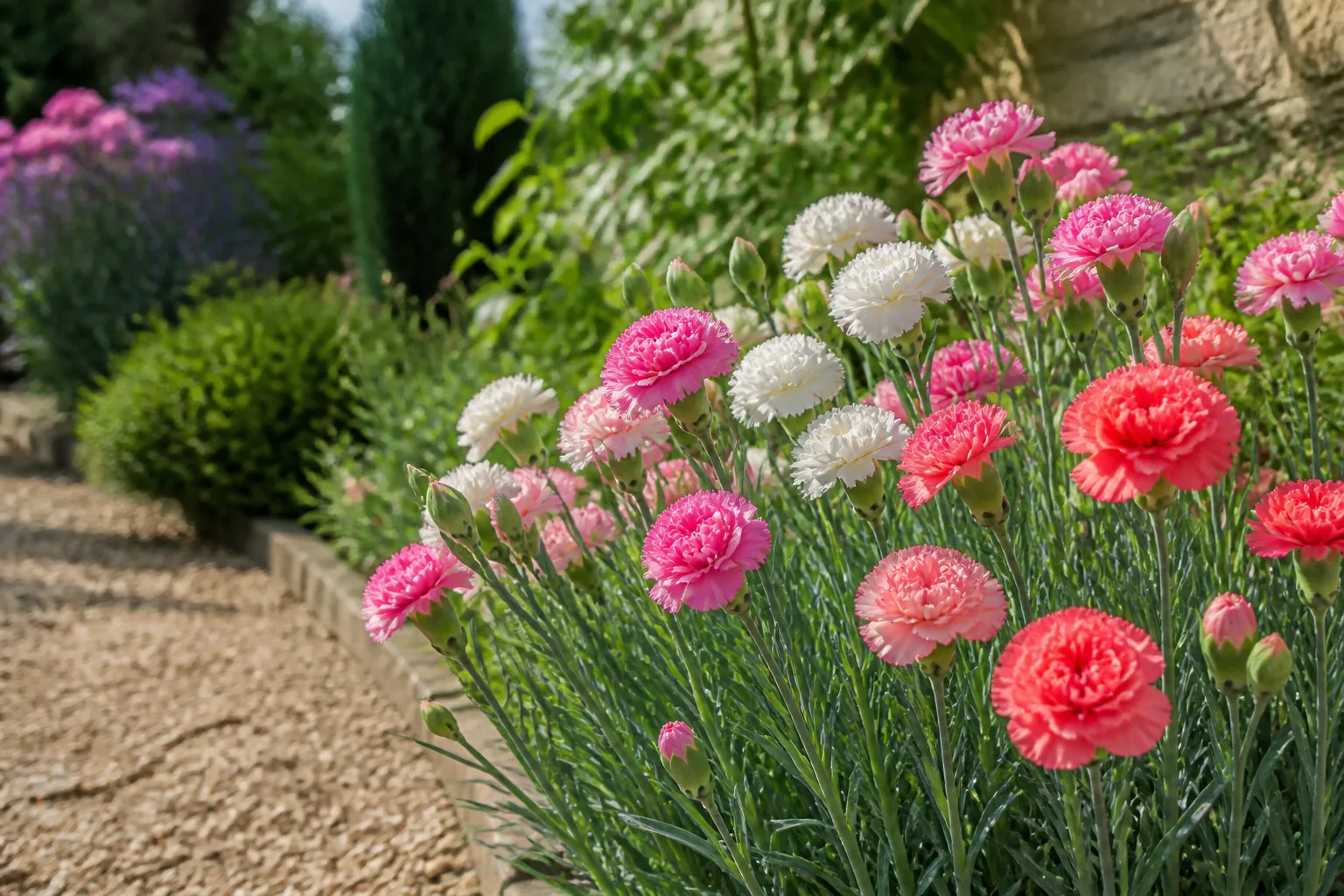
Carnations — Dianthus caryophyllus, also called clove pinks or gillyflowers — are the ruffled, spicy-scented flowers behind countless corsages, Mother’s Day bouquets, and cottage-garden borders. They are not fussy in the right climate, but they are picky about drainage, soil pH, and heat. Plant them where roots stay cool and air moves freely, and you get weeks of fragrant stems that outlast most garden annuals in a vase. Plant them in heavy clay or a steamy southern afternoon with wet foliage, and you get yellow leaves, gray mold, and a short-lived plant that never earns its bed space.
This guide covers which carnation type to buy, how to grow from seed or cuttings, container rules that matter, cut-flower harvest timing, and the troubleshooting steps that fix brown blooms when deadheading alone does not.
Why Carnations Belong in a Cutting Garden
Carnations have been cultivated for more than two thousand years — Greek texts reference dianthus (“divine flower”) and the Latin carnatio (“flesh-colored” or garland-related) that gave us the common name. Modern garden carnations combine fringed petals, clove-like fragrance, and stiff stems that hold up in arrangements without the price tag of long-stemmed roses.
NC State Extension notes that taller florist types reach 3 to 4 feet and are grown specifically for cut flowers and boutonnieres, while compact border forms stay under 18 inches and fit containers and edging. Both attract butterflies and moths, resist deer browsing, and produce edible flower petals (leaves and stems are not edible). Flowers have historical medicinal uses in European herbal traditions, though this guide focuses on ornamental growing — not medical advice.
The honest trade-off: carnations prefer cooler summer climates and alkaline, gritty soil. In hot, humid regions they often perform as short-lived perennials or cool-season annuals rather than permanent border fixtures. Knowing that upfront saves you from blaming yourself when a plant that thrived in Oregon struggles in Atlanta.
Carnations at a Glance
| Feature | Details |
|---|---|
| Common names | Carnation, clove pink, gillyflower, border carnation, wild carnation |
| Botanical name | Dianthus caryophyllus (Caryophyllaceae) |
| Plant type | Herbaceous perennial; often grown as annual in hot climates |
| Height | 6 in. to 4 ft. depending on type |
| Width | 6–14 in. |
| Sun | Full sun (6+ hours); morning sun ideal in hot regions |
| Soil | Well-drained, gritty loam high in organic matter |
| Soil pH | Neutral to alkaline (6.0–8.0+); lime if soil is acidic |
| Bloom time | Late spring through midsummer; rebloom possible with deadheading |
| Flower colors | White, pink, red, coral, purple, yellow, picotee bicolor |
| Hardiness | USDA zones 6a–9b per NC State; marginal in extreme heat |
| Native range | Mediterranean; exact wild range uncertain |
| Toxicity | Mildly toxic to dogs, cats, horses (ASPCA) |
| Deer/rabbit | Deer resistant; rabbits may nibble leaves |
One confusion worth clearing immediately: nursery flats labeled “carnations” may be Dianthus caryophyllus, D. chinensis (China pink, often treated as annual), or D. barbatus (Sweet William). Check the tag. Only D. caryophyllus is the classic florist carnation with the full double ruffled form most people picture.
Standard, Spray, and Border Types: Pick Before You Buy
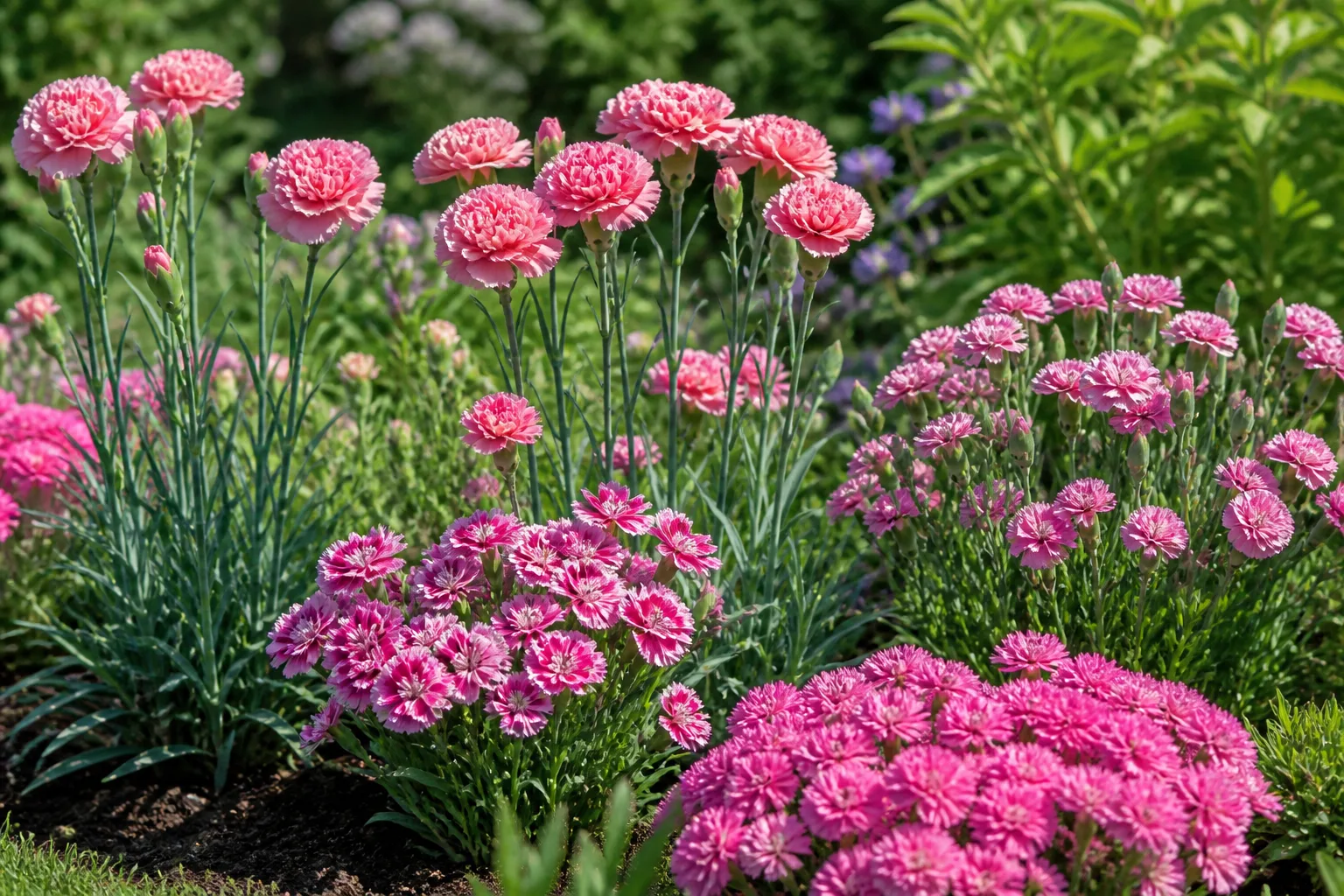
Before you grab the brightest flat at the garden center, decide what job the plant needs to do. Carnations sold to home gardeners fall into three broad groups, and mixing them up is the fastest way to end up with a floppy 3-foot stem where you wanted a 10-inch pot plant.
Large-Flowered Standard Carnations
Standard or Chabaud-type carnations produce single large blooms on long stems — the classic cut-flower form. Cultivars like ‘La France’ (pale pink), ‘Benigna’ (white picotee edged magenta), ‘Aurora’ (medium to dark pink range), and ‘Orange Sherbet’ (warm coral) belong here. These need staking in windy sites and spacing of 12 to 18 inches so air reaches each stem.
Choose standards when you want long stems for vases, a cutting row, or a cottage-garden backdrop behind lower edging plants. Expect heights of 18 inches to 4 feet depending on cultivar and fertility.
Spray and Miniature Carnations
Spray carnations (sometimes called multiflora types) branch heavily and carry clusters of smaller flowers per stem — ‘Elegance’ (pink with white edge), ‘Exquisite’ (purple picotee), and ‘Rony’ (deep scarlet) are common examples. Border doubles like ‘Appleblossom Burst’, ‘Double Bubble’, and ‘Rosy Cheeks’ stay compact with fully double heads under 2 inches across.
Choose spray or miniature types for containers, front-of-border color, and dense floral displays without staking. They read better in mixed beds than a row of lanky standards. For a single terminal bloom on a spray stem — the classic one-flower corsage look — pinch off all side buds and keep only the center bud.
Carnation Color Meaning for Bouquets and Beds
Floriography matters if you are giving carnations, not just growing them. Traditional color associations:
| Color | Common meaning |
|---|---|
| White | Purity, luck, innocence; honors deceased mothers on Mother’s Day |
| Light red / pink | Admiration, gratitude, maternal love |
| Dark red | Deep love and affection |
| Purple | Sorrow, apology, capriciousness |
| Yellow | Disappointment or rejection (handle carefully in gift bouquets) |
The pink carnation became an early-1900s symbol for Mother’s Day; white carnations honor mothers who have passed. Dyed carnations — common for holidays — start from white flowers. In the garden, choose colors for visual impact, not message. In a bouquet, match the color to the occasion so you do not accidentally send a yellow stem to someone you admire.
Light: Morning Sun Keeps Petals Bright
Carnations need at least six hours of direct sun daily for strong stems and full blooms. Less light produces weak, leggy growth and fewer flowers. NC State Extension lists both full sun and partial shade tolerance — meaning they accept light afternoon shade in hot climates, not deep shade.
In regions with intense afternoon sun, morning sun plus light afternoon shade keeps brightly colored petals from fading and reduces heat wilt. Position plants where east light hits first; a west-facing wall radiating heat late in the day is a common reason carnations look crisp by 3 p.m. even when soil is moist.
Soil, Drainage, and the Alkaline Sweet Spot
Carnations demand excellent drainage and soil that trends neutral to alkaline. NC State Extension specifies alkaline pH above 8.0 as acceptable alongside the neutral 6.0–8.0 band. Acidic soil — common in woodland gardens and peat-heavy mixes — produces stunted plants and pale foliage.
Before planting, test soil pH. If readings sit below 6.5, incorporate garden lime at label rates and retest in 60 to 90 days. Mix in compost for organic matter, but avoid heavy clay without amendment; carnations rot in wet winter soil. A gritty loam — think amended garden soil with coarse sand or fine gravel — mimics their Mediterranean origin better than rich, moisture-retentive potting mix alone.
Skip dyed mulch around carnations. Natural bark or gravel mulch is fine in cold zones for winter protection, but many experienced growers leave crowns unmulched in summer so soil dries faster at the surface — wet crowns invite crown rot and botrytis.
Watering Carnations Without Inviting Root Rot
Carnations are moderately drought tolerant once established, but they need consistent moisture when flower buds form in spring and during dry summer spells. Water at the base of the plant, not overhead. Wet petals and foliage fuel botrytis gray mold and rust in humid weather.
The failure pattern I see most: watering on a schedule instead of checking soil. Stick your finger 2 inches down — if dry, soak until water runs from drainage holes (containers) or penetrates 6 inches (beds). If wet, wait. Yellow leaves with soggy soil mean overwatering, not drought. Drooping with dry soil is straightforward underwatering. Drooping with moist soil on a 95°F afternoon is heat stress; the plant often recovers by evening without extra water.
Temperature, Humidity, and Southern Heat Limits
Carnations prefer cool roots and moderate air humidity. They tolerate warm days but wilt in extreme sustained heat — NC State Extension explicitly warns they may be a poor choice for southern gardens where summers stay hot and humid.
Container growers should keep daytime temperatures ideally between 60 and 65°F during peak development for best flower quality, according to container-growing guides from GardenGuides. That range is easier on a spring patio than a midsummer asphalt driveway. An occasional cool mist on extreme heat days can help outdoor plants briefly, but do not substitute misting for shade or proper watering — wet foliage overnight still invites disease.
If you garden in zones 8b–9b with humid summers, treat carnations as cool-season performers: plant in early spring, harvest through late spring and early summer, and accept that plants may go semi-dormant or decline in August. Replant in fall where mild winters allow, or choose heat-tolerant Dianthus species for summer color instead.
Fertilizing for Flowers, Not Foliage
New carnations benefit from a small amount of slow-release fertilizer mixed into planting soil at transplant time. Quick-release high-nitrogen feeds can burn roots and push leafy growth at the expense of buds. Overfertilizing shrinks roots and sets up root rot — a common outcome when gardeners “feed for blooms” weekly with the wrong high-nitrogen formula.
Use a balanced slow-release product at planting. Switch to a phosphorus-forward fertilizer (bloom booster) just before bud set, not during every watering. GardenersNet warns that excess nitrogen reduces flowering — if you see lush blue-green foliage and no buds, cut back feeding and check sun exposure before adding more nutrients.
Planting Carnations from Seed or Transplants
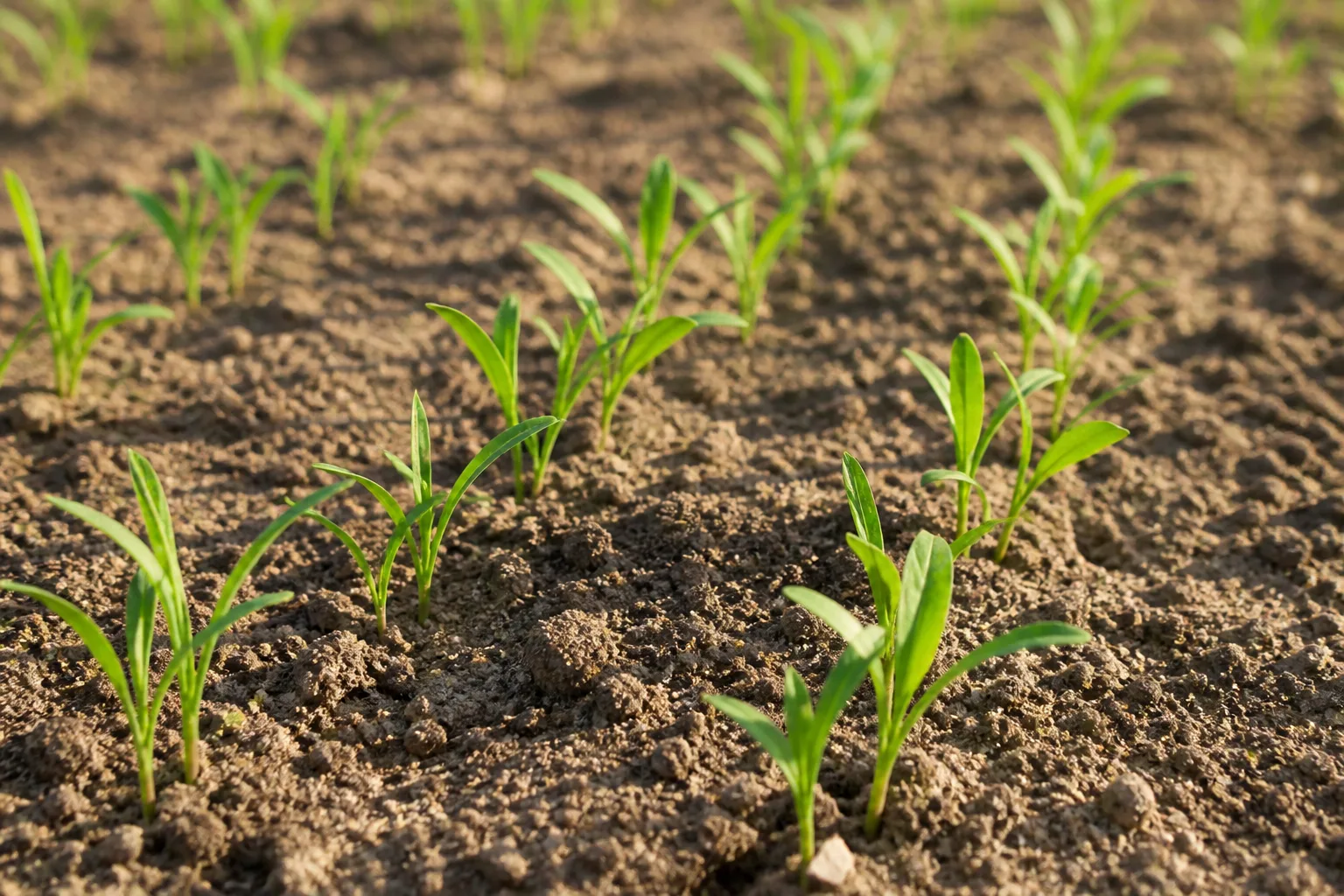
Timing: Start seeds indoors 6 to 8 weeks before your last frost date, or sow outdoors after frost danger passes in zones 6 and warmer. Outdoor spring sowing in cooler zones may not bloom until year two — plan accordingly.
Indoor seed method: Sprinkle seeds on moist seed-starting mix, cover very lightly (about 1/4 inch), and keep at 60 to 70°F. Germination takes 7 to 14 days with consistent moisture from a mist sprayer, not a heavy pour. Loosely cover trays with plastic for humidity until sprouts appear. Move seedlings to individual pots once they have two to three true leaves and reach 4 to 5 inches tall. Harden off for 7 to 10 days before transplanting outdoors after frost.
Outdoor transplant: Space plants 12 inches apart in beds, 12 to 18 inches for tall standards. Plant at the same depth they grew in pots — burying crowns too deep invites rot. Water in well; do not saturate.
First-year plants from seed often take longer to flower than nursery transplants — sometimes six weeks, sometimes a full season. Do not assume failure if buds are slow; check soil pH and sun first.
Propagating Carnations from Cuttings and Division
Professional growers propagate most florist carnations from terminal stem cuttings — tips taken from non-flowering shoots, not side nodes. Take 4- to 6-inch cuttings, strip lower leaves, and insert into moist sand or a sand-perlite mix. Roots form in 25 to 30 days at warm temperatures with bright indirect light. Transplant rooted cuttings to individual pots before setting out.
Division revives old, ragged clumps every 2 to 3 years. Dig the plant in early spring or fall, gently pull apart rooted sections with your hands, trim any black or mushy roots with sanitized pruners, and replant divisions 12 inches apart in full sun. Water well; hold fertilizer until new growth appears.
Seed propagation preserves named cultivars only if strains are stable — many hybrids do not come true from seed. For a specific picotee or Chabaud color, use cuttings or buy plants.
Growing Carnations in Containers and on Patios
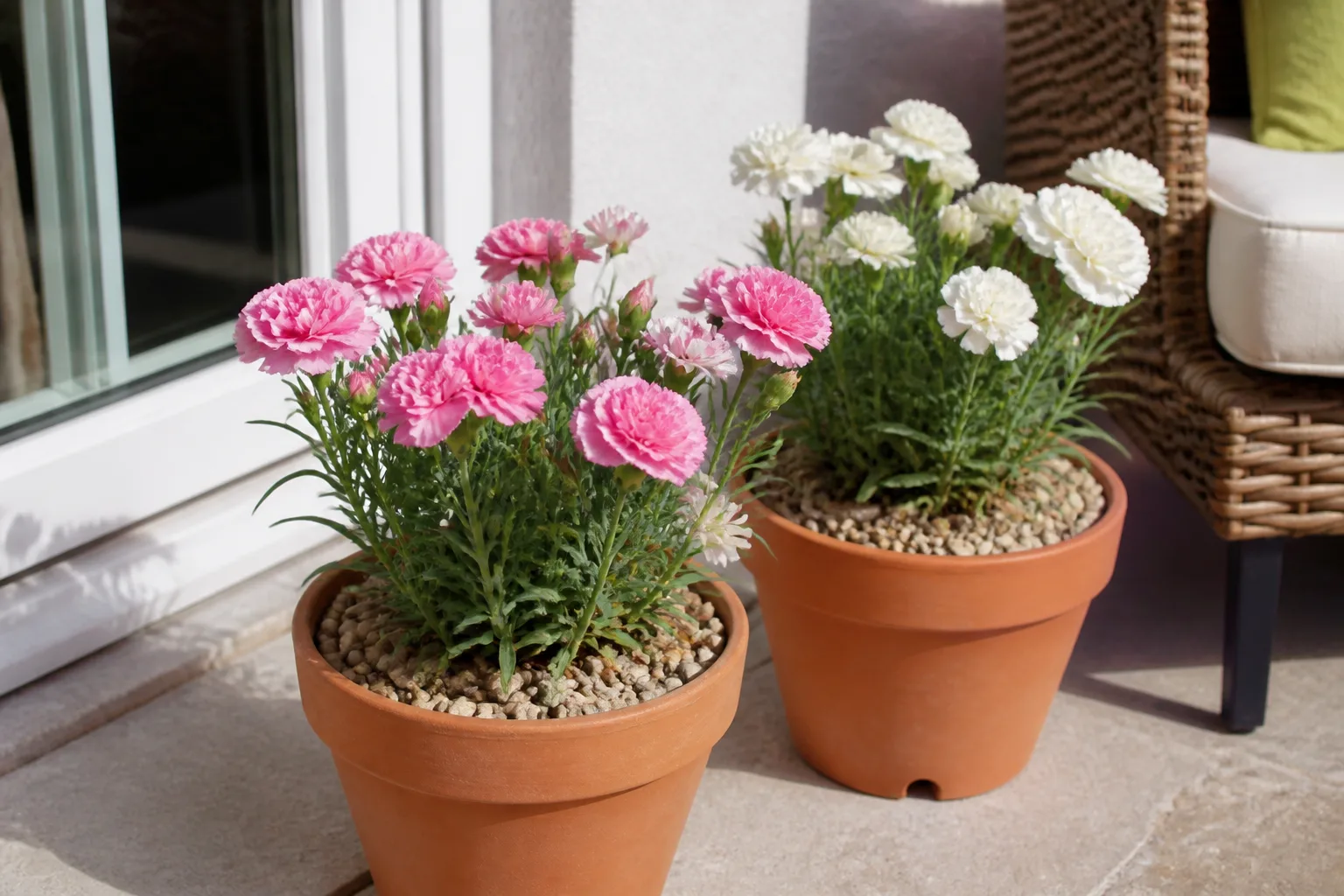
Carnations adapt well to pots when drainage and temperature stay in range. Choose a container at least 8 inches wide with drainage holes — one size up from the root ball when repotting. Use quality potting mix amended with perlite and a handful of lime if the mix is peat-heavy and acidic.
Repot every 2 to 3 years or when roots circle the pot. Knock off old soil, trim rotted roots, and move up 3 to 5 inches in pot diameter. After flowering ends, cut container plants back to about 1 inch above soil to rejuvenate for the next cycle, as recommended for container culture.
Place pots where they receive 4 to 6 hours of direct sun minimum — less triggers weak stems. Rotate pots weekly for even growth. In hot climates, move containers to morning-sun spots by midsummer.
Deadheading, Pinching, and Encouraging Rebloom
Remove spent flowers by cutting the stem several inches below the dead bloom, not just snapping the head. Deadheading redirects energy to side buds and can trigger a second flush in favorable climates. For spray types, regular deadheading is labor-intensive but worthwhile in a cutting garden.
Pinch center growth on young plants when they reach 6 inches to promote bushier side branching — especially for spray types. Stop pinching by midspring so buds can form.
If buds look tight and refuse to open on cut stems, florists sometimes brush the bud gently with an older open flower or squeeze the calyx base lightly — tricks that work for arrangements but are rarely needed on healthy garden plants with adequate sun and calcium in soil.
Overwintering Perennial Carnations
Hardy carnations survive frost when crowns drain well. In fall, cut stems to 2 to 3 inches above ground after flowering finishes. In zones 6 and 7, a light natural mulch protects against freeze-thaw heaving; pull mulch back in early spring so crowns dry quickly.
Avoid wet winter soil — carnations die from crown rot more often than from cold alone. Raised beds and gravel mulch help in heavy-rain climates. Potted carnations overwinter in an unheated garage or cold frame in zone 6 if pots stay barely moist and freeze-thaw cycles are moderated.
Plants decline after 3 to 5 years even with good care. Division or replacement keeps color strong; old, woody centers with few flowers signal time to propagate or replant.
Harvesting Carnations for Long-Lasting Cut Flowers
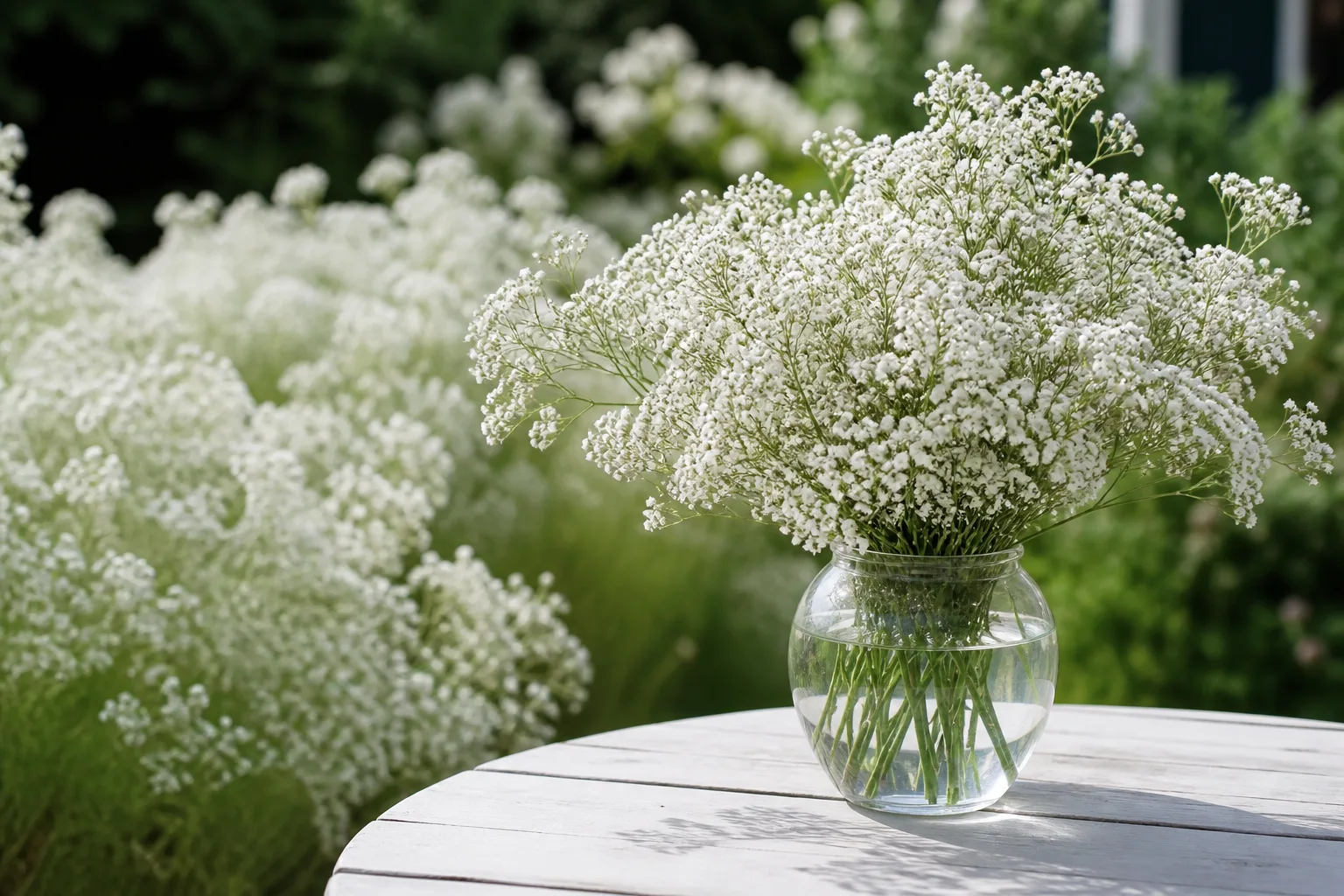
Cut carnations when petals show color but before they fully reflex (curl backward). Mid-afternoon harvest — when sugar content peaks — produces the longest vase life, per GardenGuides. Cut stems at an angle with clean pruners; strip leaves that would sit below the water line.
Condition cuts in lukewarm water for several hours before arranging. Change water every two days and recut stems slightly. Garden carnations lack the commercial post-harvest treatment of florist stems but still last 7 to 14 days in a clean vase — far longer than most garden annuals. For a single large bloom on a spray stem, remove all side buds early so energy concentrates in the terminal flower.
Pests, Diseases, and Troubleshooting
Aphids and spider mites cause distorted growth and yellowing leaves; fine webbing under leaves confirms mites. Insecticidal soap on a cool morning helps both — repeat weekly until clear. Cutworms chew holes in buds at soil level; hand-pick at dusk and use cardboard collars around stems.
Botrytis gray mold shows as brown, papery petals with gray fuzz — common in crowded, wet plantings. Remove affected flowers immediately, improve spacing, and stop overhead watering. Rust and leaf spot produce brown spots with yellow halos; remove infected foliage and avoid wetting leaves.
Bacterial wilt causes wilting, split stems, and sometimes oozing — more common on young plants. Remove infected plants entirely; sterilize tools between cuts. Root rot from overwatering pairs yellow lower leaves with mushy roots; reduce water, improve drainage, and discard plants that do not recover in two weeks.
| Symptom | Likely cause | First action |
|---|---|---|
| Brown papery blooms + gray fuzz | Botrytis | Remove blooms; increase air flow; water at base |
| Yellow leaves + fine webbing | Spider mites | Insecticidal soap; check undersides |
| Holes in buds | Cutworms | Collars; hand-pick at night |
| Wilting + split stems | Bacterial wilt | Remove plant; disinfect tools |
| Yellow leaves + wet soil | Overwatering / root rot | Let soil dry; check drainage |
Conclusion
Carnations reward gardeners who give them sun, alkaline well-drained soil, and cool roots — and who choose the right type for the job. Standards for long cutting stems; spray and border forms for pots and front edges. Start from seed in late winter if you have patience, from cuttings if you want a specific cultivar, and from nursery transplants if you want flowers this season. Deadhead faithfully, harvest in the afternoon, and plan for renewal every few years in hot or humid climates where they behave as short-lived treasures rather than permanent fixtures. Get those basics right and carnations deliver the clove-scented, ruffled blooms that made them a garland flower two millennia ago — still one of the most practical cut flowers you can grow at home.



