Christmas Cactus Care: Light, Water, Bloom Cues
Buds falling or no flowers? Christmas cactus care covers epiphytic watering, cool nights, 13–14h darkness, and bud-drop fixes.
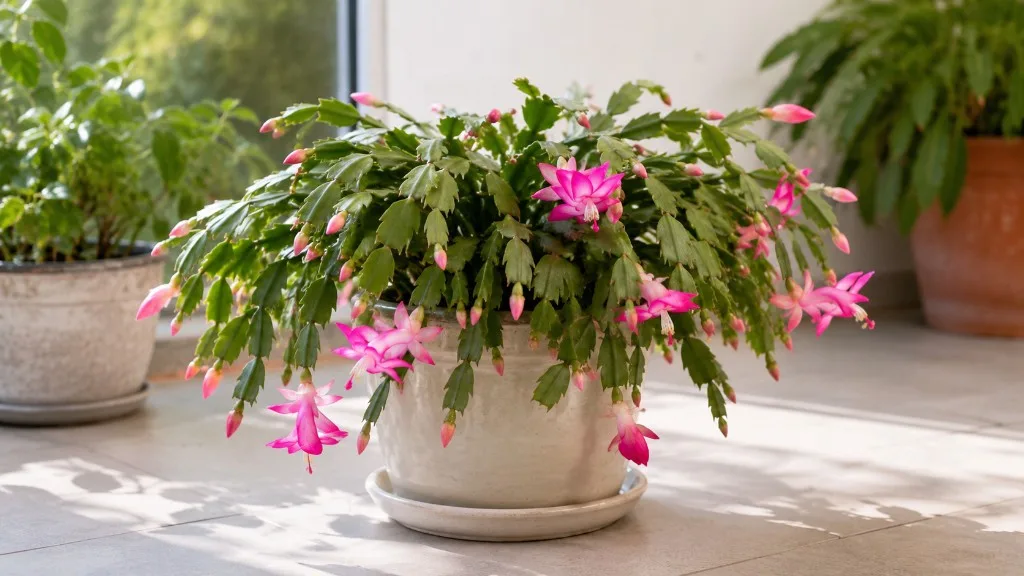
If your “Christmas cactus” stayed green for years, dropped every bud after a weekend trip, or got bone-dry “cactus soil” because the tag said cactus, you are fighting the wrong plant category. Christmas cactus care means treating Schlumbergera as a Brazilian rainforest epiphyte: bright filtered light, regular moisture in an airy mix, and a mid-September cue of cool nights plus long uninterrupted darkness before holiday blooms appear. Bloom color—pink, red, white, purple—does not change that routine.
Written by Sai Ananth (B.Pharmacy, Andhra University; LeafyPixels lead writer and indoor grower) and reviewed by Dr. Priya Menon (botanist and indoor plant specialist) on the LeafyPixels Review Board on 2026-08-02. Thresholds below were checked against Clemson HGIC, NC State Extension, Missouri Botanical Garden, Penn State Extension, RHS, UF/IFAS, and ASPCA listings. Dry-down intervals and cover-method notes reflect two editorial Schlumbergera plants in a north-central Ohio apartment (USDA zone 6a)—your windows and night lights will shift the numbers.
Healthy holiday cactus: firm scalloped segments and tip buds when cool nights and long dark periods hold in autumn. Editorial library photo — not a personal grow-log image.
Who This Guide Is For (and How We Grew These Notes)
Use this page if you need one year-round care system: identity, light, epiphytic watering, soil, bloom induction, bud-drop triage, pests, and pet safety. Prefer a single-symptom workflow when buds are already raining off or the plant never flowers—open the Christmas Cactus care hub, then jump to bud drop, no flowers, or watering.
How this rewrite was built: Crawl4AI pulls of the extension and garden sources listed above, cross-checks against LeafyPixels hub topic pages, and labeled practice notes from two Ohio pots (a 5-inch terracotta on an east sill; a 6-inch plastic nursery pot that lived near a living-room lamp until we moved it). We do not claim greenhouse trials. Where sources disagree on darkness hours, we state a single home rule you can actually run.
Quick Care Snapshot
| Care factor | Baseline target | Open when you need depth |
|---|---|---|
| Light | Bright filtered day light; protect from harsh summer sun | Christmas Cactus light |
| Water | Top dry → soak and drain; evenly moist after buds show | Christmas Cactus watering |
| Soil | Airy mix with perlite/bark; drainage hole; slightly pot-bound | Christmas Cactus soil |
| Bloom cue | Mid-September: cool nights + 13–14+ hours uninterrupted darkness for ~6 weeks | No flowers |
| Feed | Dilute monthly in growth; stop by late summer before bud set | Christmas Cactus fertilizer |
| Pets | ASPCA non-toxic to dogs, cats, horses — still not a snack | Hub safety notes |
A small terracotta on an east sill will not dry on the same clock as a large plastic pot under warm LEDs. Treat calendar ranges as check reminders.
Mid-September bloom checklist (print this):
- Stop fertilizer by late summer.
- From about mid-September, give cool nights (roughly 55–68°F / 13–20°C depending on protocol) and 13–14+ hours of continuous darkness nightly for at least six weeks.
- Keep daytime light bright but filtered—do not park the plant under a living-room lamp after dinner.
- Water a bit less until buds form; once buds show, keep the mix evenly moist (never a swampy saucer).
- Do not move, draft, or heat-spike the plant after buds appear.
What Schlumbergera × buckleyi Is — and Holiday Lookalikes
True Christmas cactus is commonly Schlumbergera × buckleyi, a nineteenth-century English nursery hybrid of S. russelliana × S. truncata, still sold for winter tubular blooms. NC State Extension describes it as an epiphytic hybrid about 6–12 inches tall and 12–24 inches wide with a pendulous habit. The green “leaves” are phylloclades—flattened, jointed stem segments that photosynthesize and store water.
Missouri Botanical Garden frames it as a frost-intolerant, winter-flowering epiphytic perennial for containers. Related Schlumbergera species cling to tree branches and rock crevices in humid Brazilian coastal forests—not arid deserts. Indoor success means dappled light, airy organic debris, and seasonal cool/short-day cues—not grit, blazing sun, and months of drought.
Penn State Extension notes holiday-cacti ancestors evolved above ground in southeast coastal Brazilian rainforests. The RHS is equally direct: these plants come from tropical rainforests in dappled light and warm humidity, so unlike desert cacti you keep them out of strong sunshine and give regular water. Treat “cactus” on the tag as taxonomy, not a watering schedule.
Thanksgiving vs Christmas vs Easter — Segment Margins and Bloom Windows
Retail labels are sloppy. Three plants get sold as “Christmas cactus”:
| Plant | Typical ID clue | Usual bloom window | Care delta |
|---|---|---|---|
| Thanksgiving cactus (S. truncata) | Sharper, claw-like teeth on segment margins; blooms often more horizontal | Often late fall / near Thanksgiving | Same Schlumbergera care; expect earlier show |
| Christmas cactus (S. × buckleyi and close hybrids) | More rounded, scalloped segment margins; drooping blooms | Closer to Christmas into winter | This guide’s default |
| Easter cactus (Hatiora / Rhipsalidopsis gaertneri) | Rounded segments; flatter, star-shaped flowers | Spring | Different genus; longer dark/cold needs |
Penn State Extension and Clemson HGIC emphasize that Thanksgiving and Christmas types are Schlumbergera, while Easter cactus is a different genus. If your “Christmas” plant flowers in November and has pointed teeth, keep this care system—just expect an earlier show. Cultivar bloom color (pink vs red vs white) does not change watering or darkness rules.
Light Year-Round vs Night Darkness for Buds
Christmas cactus needs two light strategies. From spring through early fall, it wants bright, filtered daylight for compact new segments. From mid-September into bud set, it also needs long, dark nights that room lamps often destroy. Daily light quality and fall photoperiod are related but not the same problem.
Bright Filtered Placement Indoors (and Summer Shade Outdoors)
RHS recommends bright light but not full sun, and calls an east-facing windowsill usually ideal. Clemson HGIC says holiday cacti grow best in light shade; full sun can help in fall and winter, but bright summer sun can make plants look pale and yellow. NC State Extension warns that full sun can bleach stems.
In home terms: place the pot where you can read by daylight without lamps, with soft shadows rather than hard noon glare. Set west or south exposures back from the glass or behind a sheer in hot months. North windows work only in bright rooms; weak light produces thin, widely spaced segments and fewer bloom tips later.
Summer outdoors can ripen growth if nights stay warm enough and the plant sits in shade. RHS suggests a warm, sheltered, shady spot, then bring the plant indoors before temperatures drop hard. Clemson warns against leaving plants outside if temperatures will drop below about 50°F (10°C). Acclimate gradually either direction so segments do not scorch or chill-shock. UF/IFAS Gardening Solutions notes outdoor growing is realistic in warmer Florida areas only with freeze protection.
Mid-September Bloom Checklist — Dark + Cool + Moisture
Holiday cacti are short-day plants. Flower buds form when nights lengthen and temperatures cool. This is the section that answers “why won’t it bloom?” for most healthy green plants.
Clemson’s protocol is the clearest home checklist. Starting about mid-September for at least six continuous weeks:
- Provide 14 or more hours of continuous darkness each night. As little as two hours of interrupted light—lamps, streetlights, car headlights—can block bud set.
- Keep fall growing temperatures roughly 60–68°F, near 68°F when possible for strong flower production.
- Alternatively, nights of about 50–59°F can set buds regardless of day length, though growth is slower and bud drop risk rises near 50°F.
- Once buds are set, photoperiod no longer controls flowering; keep conditions stable and do not let temperatures rise above about 90°F. (Clemson HGIC)
NC State Extension and Missouri Botanical Garden describe a closely related indoor recipe from mid-September: bright daytime light, night temperatures 55–65°F, and at least 13 hours of uninterrupted darkness (for example, cover the plant or move it to a dark room from about 6 pm to 7 am for 6–8 weeks). Missouri adds that if nights can stay near 45–55°F, buds may form without the strict darkness regimen—hard in many heated homes.
RHS frames the same biology as two cooler rest periods at about 12–15°C (55–59°F): from mid-September until buds appear, and again after flowering from late January to late March, with reduced watering during both rests. When buds show, return the plant to about 18–20°C (65–69°F) and resume regular watering.
Practical home version: from mid-September, move the plant to a cool spare room or closable space with bright day light and zero night light leaks, or cover it with a light-proof box/cloth each evening for six weeks. If you use a fabric cover near lamps, keep covers clear of hot bulbs—heat and fire risk matter more than perfect darkness theater. Do not rotate the pot through bright living rooms after dinner. Buds usually become visible in a few weeks when the routine holds. UF/IFAS stresses keeping plants away from artificial night light from October through December for holiday blooms.
LeafyPixels Home Rule for 13 vs 14 Hours of Darkness
Sources disagree by about an hour. Our editorial rule for apartments:
- Use ≥14 hours of continuous darkness if the plant sits near streetlight, hallway glow, TV light, or any night lamp risk (Clemson’s stricter bar).
- Use ≥13 hours only if you can put the plant in a truly dark spare room or closet with a bright daytime return—no door cracks of light at night (NC State / Missouri).
- Pair either darkness plan with cool nights in the 55–68°F band when you can; cool alone helps, but lamp leaks still cancel many living-room attempts.
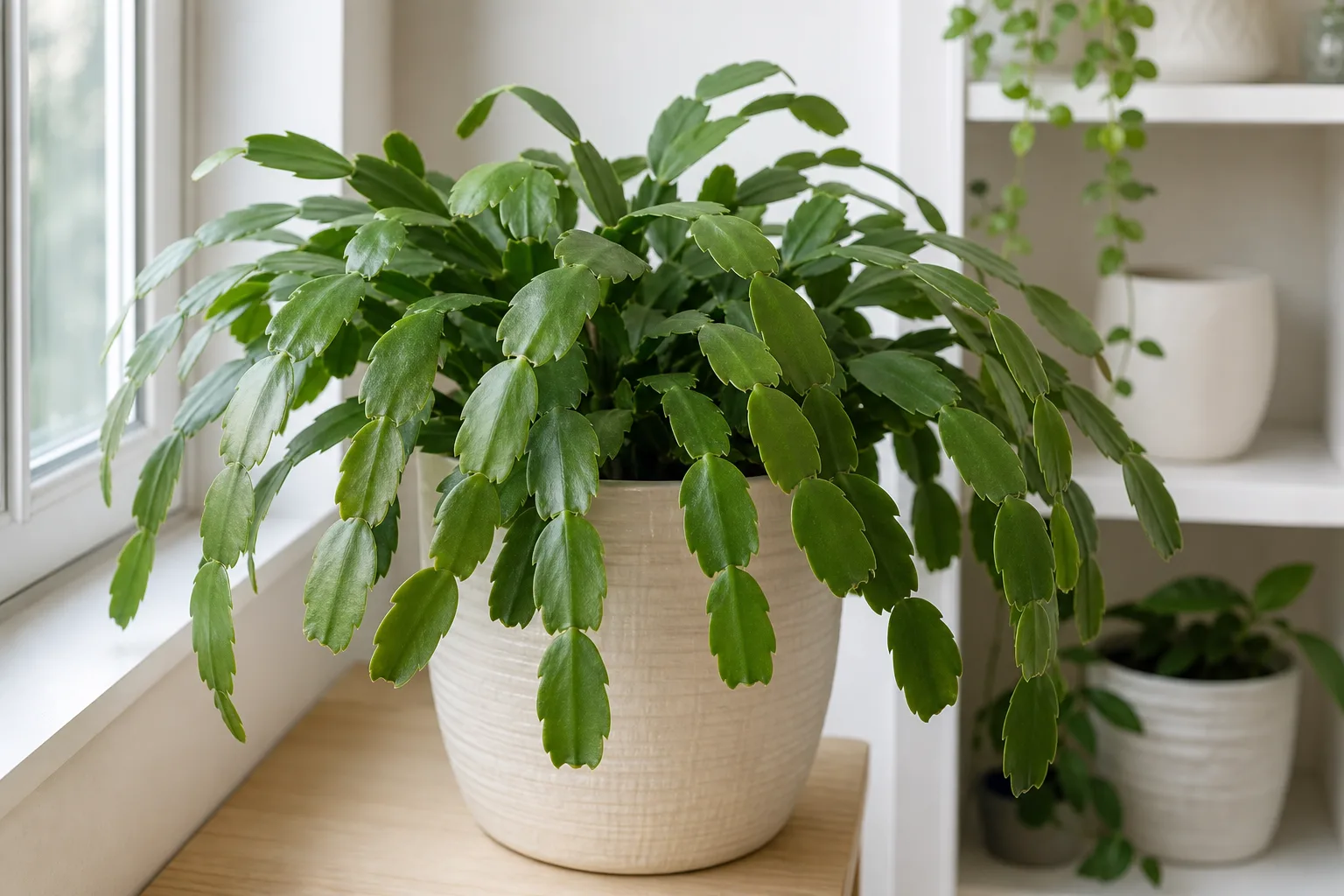
No-flower pattern on a green, otherwise healthy plant—the usual outcome when fall nights never stay dark or cool enough. Library diagnostic image.
Watering Like an Epiphyte
Epiphytic watering sits between desert drought and bog sogginess. Roots expect moisture pulses and oxygen. Stale, waterlogged peat kills them; weeks of bone-dry mix wrinkles segments and can drop buds once flowers are forming. Do not use desert cactus grit as the only mix.
Seasonal Rhythm, Rest Periods, and Bud-Stage Moisture
During active growth (roughly spring through early fall), keep the mix moist but never waterlogged. Water thoroughly from the top, let excess drain, and empty the saucer. NC State Extension says soil should be moist—not overly wet or overly dry—from spring to summer, with watering reduced in mid-September as buds develop and again after flowering. RHS says water regularly from April to September, keep compost moist but never waterlogged, then reduce during the autumn rest until buds form; once buds appear, resume watering carefully until flowers fade, then reduce again through late winter. During rests, let the top few centimeters dry between waterings but never let the pot dry out entirely.
Clemson HGIC’s moisture rule after bud set is especially important: water when the medium is dry to the touch in general culture, but once buds form keep the medium evenly moist to prevent bud abscission—still never leaving water standing in the saucer. UF/IFAS likewise warns against letting plants get too dry between waterings once buds are present.
In many homes that maps to roughly every 7–10 days in bright warm growth when the top inch feels dry (our east terracotta often landed here), stretching toward 10–14 days in the pre-bloom cool rest, then more frequent checks while buds swell. Your pot, light, and mix override any printed schedule. Depth checks and pot weight beat the calendar—the same habit as how to water indoor plants the right way, with a holiday-cactus twist once buds show. Full seasonal tables: Christmas Cactus watering.
Reading Segments: Thirst vs Rot vs Shock
Segment feel plus pot weight separates thirst from rot better than color alone.
| What you see / feel | Pot / soil context | Most likely cause | First move |
|---|---|---|---|
| Firm segments slightly soft or wrinkled | Light pot; mix dry at depth | Underwatering / dry rest gone too far | Thorough soak; empty saucer |
| Soft, yellow, or translucent segments | Heavy pot; mix still wet | Overwatering / early rot | Stop watering; check roots and drainage |
| Limp segments + sour wet mix | Waterlogged or compacted soil | Root rot | Unpot; trim mush; refresh airy mix |
| Healthy green plant, buds falling | Recent move, draft, dry bud-stage mix, or heat spike | Environmental shock | Stabilize place, moisture, and temperature |
RHS notes shrivelled stems can come from root damage caused by over- or underwatering, heat, or direct sun—not only “needs more water.” Always confirm moisture before you add another drink.
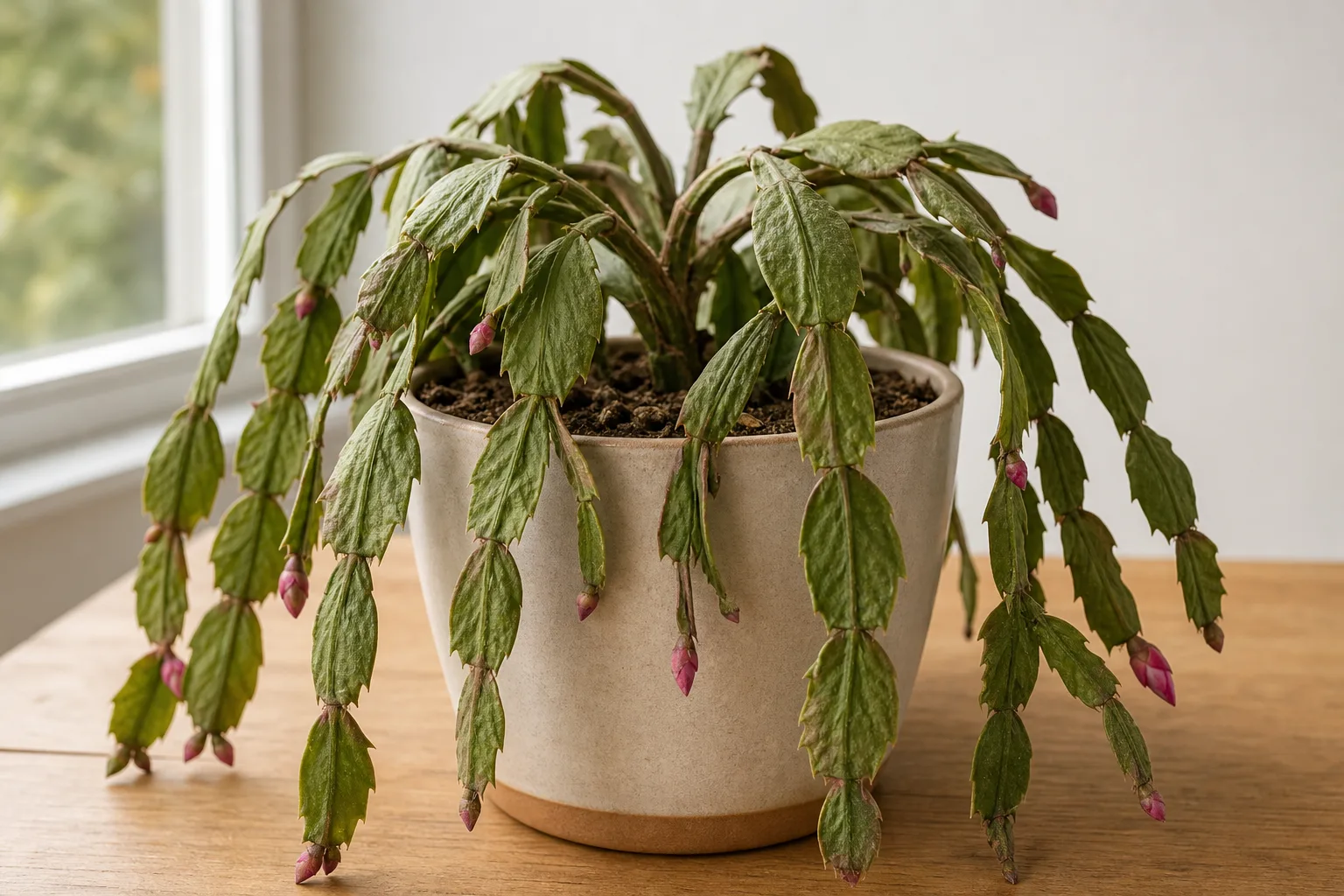
Wrinkled segments with a light, dry pot usually track underwatering—not a cue to switch to desert cactus grit.
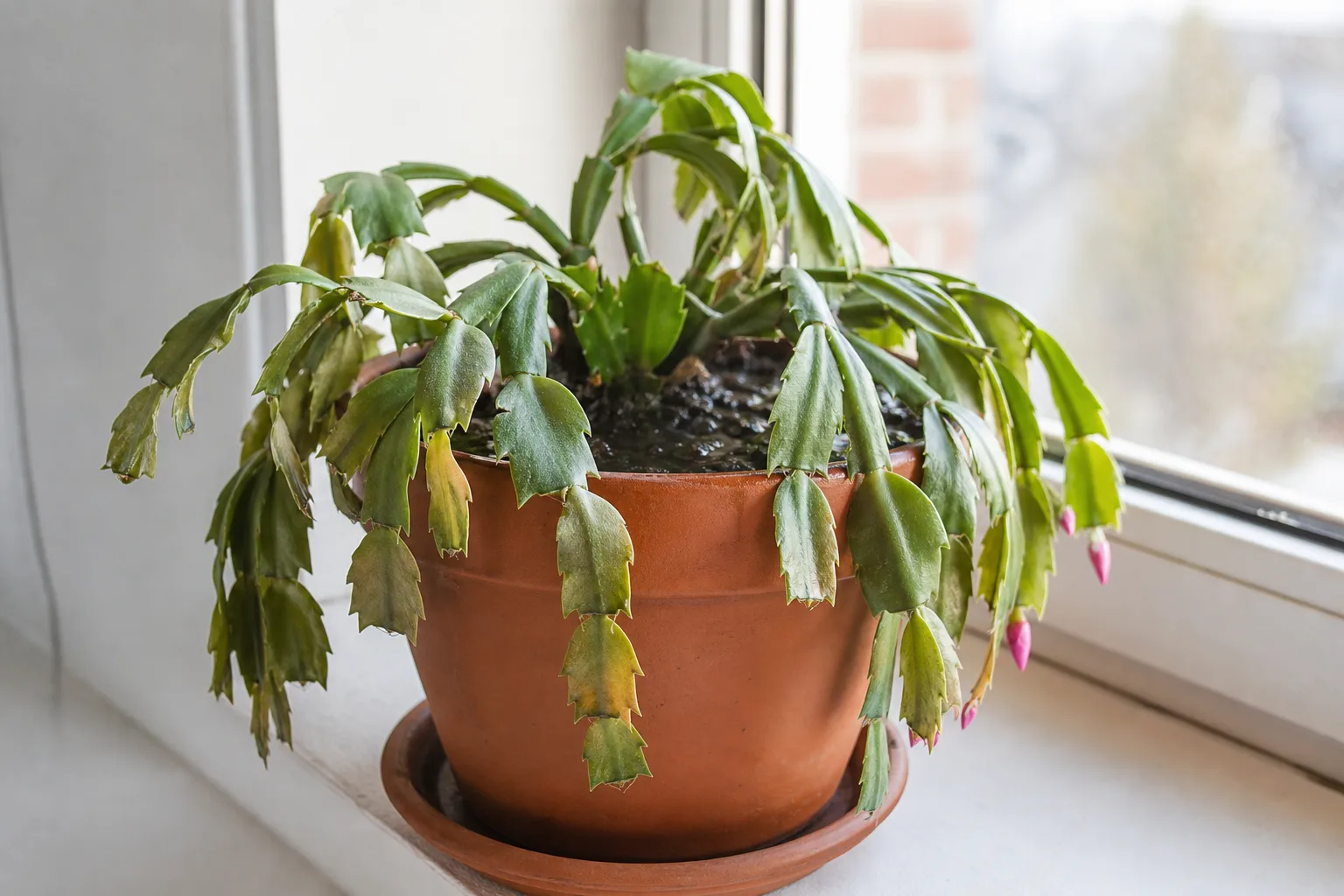
Soft or yellowing segments with a heavy, wet pot point to oxygen starvation and early rot risk.
Soil, Pot, and Repotting Without Killing Bloom
Epiphyte roots fail in heavy, wet houseplant mix. NC State Extension recommends a moist, well-drained, airy medium with peat moss, sand, and perlite. Missouri Botanical Garden suggests about one part potting soil, two parts peat moss, and one part sharp sand or perlite. Clemson HGIC’s practical mix is roughly 60–80% potting soil with 40–20% perlite, noting these epiphytic cacti do not grow well in heavy, wet mixes and flower best when somewhat pot-bound. UF/IFAS likewise prefers a well-drained medium and a pot that is not oversized.
Always use a pot with a drainage hole. A snug pot is better than a deep oversized cachepot full of unused wet mix. Penn State Extension and Clemson both point to repotting about every three to four years (Clemson: about every three years, ideally in spring after bloom), not annually. Do not repot while the plant is in active bloom. Move up only one pot size, set the root ball slightly below the rim, water moderately, and keep the plant shaded for a couple of days before returning to normal light.
Blend we actually used in the Ohio terracotta: quality peat-free potting base amended with roughly equal handfuls of perlite and medium orchid bark so water exits fast and air returns to the root zone. After one spring refresh (2025), that pot dried to a light finger-check in about a week on the east sill in warm weather—faster than the denser nursery peat the plant arrived in. If the surface stays wet for more than a week in ordinary indoor light, the mix is too dense, the pot is too large, or light is too low. Recipes: soil. Timing: repotting.
Temperature, Humidity, and When to Stop Fertilizing
Growing-season comfort is roughly 70–80°F for spring and summer growth (Clemson HGIC; NC State Extension; Missouri Botanical Garden). While in flower, RHS prefers a pleasantly warm 65–69°F. Penn State Extension cites about 68°F days / 60°F nights in winter culture. Protect plants from hot radiators, cold drafts, and freezing glass. Sudden swings are a classic bud-drop trigger.
Humidity matters more than for desert cacti. NC State Extension notes a preference for high humidity. RHS suggests regular misting and a tray of damp gravel with the pot above the water line. Penn State Extension mentions light daily misting. If heated winter air is very dry, a pebble tray or nearby humidifier helps more than soaking the mix. For tray technique without drowning roots, see can you use a pebble tray for succulents and cacti.
Fertilizer is a light seasonal tool. Clemson HGIC recommends monthly half-strength soluble fertilizer from late winter or early spring through summer, plus monthly Epsom salts (1 teaspoon per gallon) on alternating weeks for magnesium, then stop fertilization in late summer to favor fall bud production. NC State Extension and Missouri Botanical Garden similarly suggest monthly feeding in the growing season and reduced feeding in fall and winter. Do not push fertilizer while buds are forming if the plant is already in a rich mix—Penn State Extension lists overfertilization during bud development among bloom blockers. Details: fertilizer guide.
Contrast with true soak-and-dry succulents such as jade plant care or general indoor succulent care—those pages are useful comparisons, not templates to copy onto Schlumbergera.
Propagation and Post-Bloom Pruning Basics
Propagation is straightforward from stem-segment cuttings. Clemson HGIC recommends taking cuttings in May or June: pinch sections with 3 to 5 phylloclades, let cut ends callus a day or two in shade, insert about an inch deep in well-drained mix, water, and cover with a clear plastic bag to hold humidity until roots form in three to eight weeks. Penn State Extension offers a similar 3–5 segment method and also notes water-rooting before potting. RHS uses shorter tip cuttings in a peat-free cuttings mix with grit or perlite, watered sparingly under bright indirect light.
Prune for shape and flower count in spring after bloom. Flowers form on stem tips, so branching creates more bloom sites. RHS suggests removing some end segments on leggy stems after flowering to encourage bushier growth; those tips can become cuttings. Use the pruning and propagation guides for step timing.
Common Problems: Pests, Bud Drop, No Blooms
Most Christmas cactus problems are environmental: wrong desert-cactus watering, compacted wet mix, harsh sun, interrupted fall nights, drafts during bud, or pests in segment joints. Inspect moisture and recent moves before you fertilize or repot in panic.
Watch for mealybugs, soft brown scale, spider mites, aphids, and fungus gnats; root rot is the major disease and is prevented by avoiding excessive watering (Clemson HGIC; NC State Extension). Isolate infested plants, dab mealybugs with alcohol on a swab, and improve dry-down if gnats suggest chronically wet mix. Dedicated pages: mealybugs, spider mites, aphids, fungus gnats, root rot, and yellow leaves.
No blooms on an otherwise healthy plant usually means the fall darkness and/or cool-night cue failed. Living-room lamps after sunset, a plant left under a bright kitchen fixture, or nights that never drop below a steady warm indoor temperature are the usual suspects. Run the six-week mid-September protocol next season before assuming the cultivar is “non-blooming.” Symptom depth: no flowers.
Bud drop after buds appear is different. Causes include sudden temperature changes, drafts, moving the plant, improper watering (especially drying out after bud set), low humidity, heat above about 90°F, and sometimes overwatering (NC State Extension; Missouri Botanical Garden; RHS). When buds are visible, keep the plant in one stable spot, maintain even moisture without a swampy saucer, and protect it on the car ride home from the store. Symptom depth: bud drop.
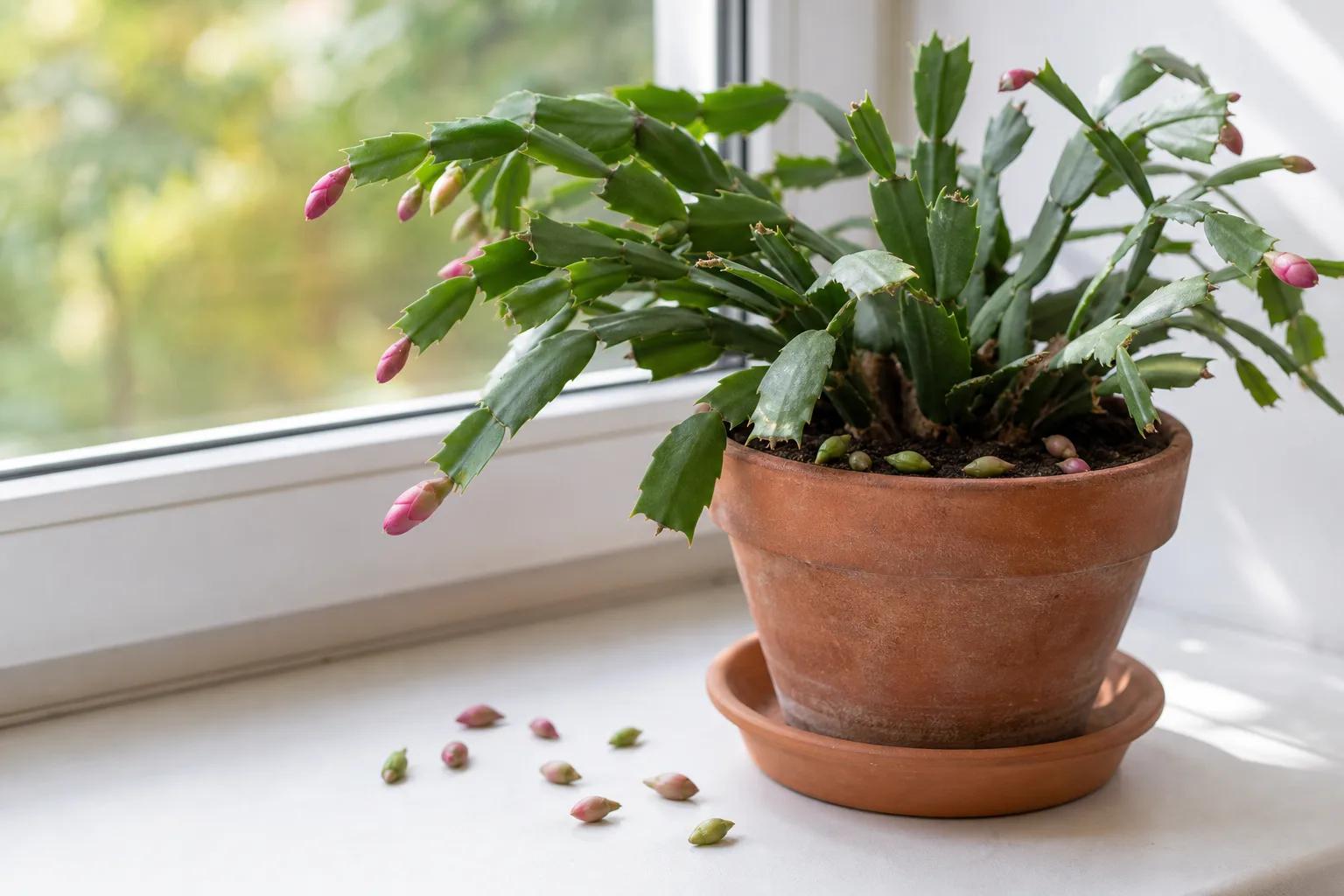
Bud drop after a location change, draft, heat spike, or dry mix at the bud stage—stabilize first, then plan a stricter fall dark/cool routine.
Pet Safety (ASPCA Non-Toxic — Still Not a Snack)
Christmas cactus is one of the safer holiday plants for pet homes. The ASPCA lists Christmas cactus as non-toxic to dogs, cats, and horses. NC State also tags the hybrid as non-toxic for cats and dogs. Non-toxic is not the same as edible. Chewing fibrous segments can still cause mild stomach upset. Discourage grazing, and contact a veterinarian or ASPCA Animal Poison Control at (888) 426-4435 if a pet eats a large amount and symptoms persist.
First-Hand Notes From Growing Holiday Cacti Indoors
These are LeafyPixels editorial observations from two plants in a north-central Ohio apartment (USDA zone 6a)—not universal schedules. Use them as decision benchmarks.
| Setup | Conditions | What happened |
|---|---|---|
| East-sill terracotta (5-inch) | ~12 in from east glass; mid-Sept 2024: covered with an opaque bin ~6 pm–8 am (~14 h dark); nights ~58–62°F in a cool bedroom | Tip buds visible by early November; blooms held when we kept the mix evenly moist and did not move the pot |
| Living-room plastic (6-inch nursery) | Same cultivar group near a floor lamp used after dark; warm room (~70°F+ nights); no cover | Firm green growth through fall 2023, zero buds—classic interrupted-night failure |
| Same plastic pot after move | Relocated to the cool bedroom cover routine mid-Sept 2025; watered when top felt dry until buds, then more often | Buds set; one cluster dropped after we left the plant on a sunny closed-car seat for an hour—heat/move shock, not “wrong fertilizer” |
Bud-stage watering on the terracotta: once buds showed, we checked every 2–3 days and soaked when the top felt just dry—often every 5–7 days in heated indoor air, versus 10–12 days during the cool pre-bud rest. The denser nursery peat in the plastic pot stayed wet longer; after the 2025 bark/perlite refresh, dry-down shortened and fungus-gnat pressure dropped.
Related Guides
- Christmas Cactus care hub — overview plus every topic and problem page
- Christmas cactus bud drop — stabilize moisture, drafts, and heat after buds form
- Christmas cactus no flowers — short-day and cool-night troubleshooting
- How to water indoor plants the right way — finger and pot-weight habits
- Indoor succulent care — contrast desert-succulent rules with epiphytic holiday cacti
- Jade plant care guide — true soak-and-dry desert-leaning succulent for comparison
- Can you use a pebble tray for succulents and cacti — humidity trays without drowning roots
Conclusion
First week with a new plant: quarantine, learn pot weight, water only when the top of an airy mix is dry, keep bright filtered light, and do not repot in bloom.
From mid-September: stop late-summer feeding, run cool nights plus 13–14+ hours of uninterrupted darkness for about six weeks, ease water until buds form, then keep even moisture without a swampy saucer—and leave the pot in one stable spot.
If something fails: wrinkled dry segments → soak and fix mix; soft wet segments → stop water and check roots; green plant, no buds → fix night light leaks next fall; buds falling → stabilize place, moisture, and temperature, then open bud drop or the Christmas Cactus care hub for the matching workflow.