How to Grow and Care for Anthurium
Anthurium (flamingo flower) care: light placement, soil mix, watering checks, fertilizer for blooms, propagation, pests, and ASPCA toxicity notes for pets.
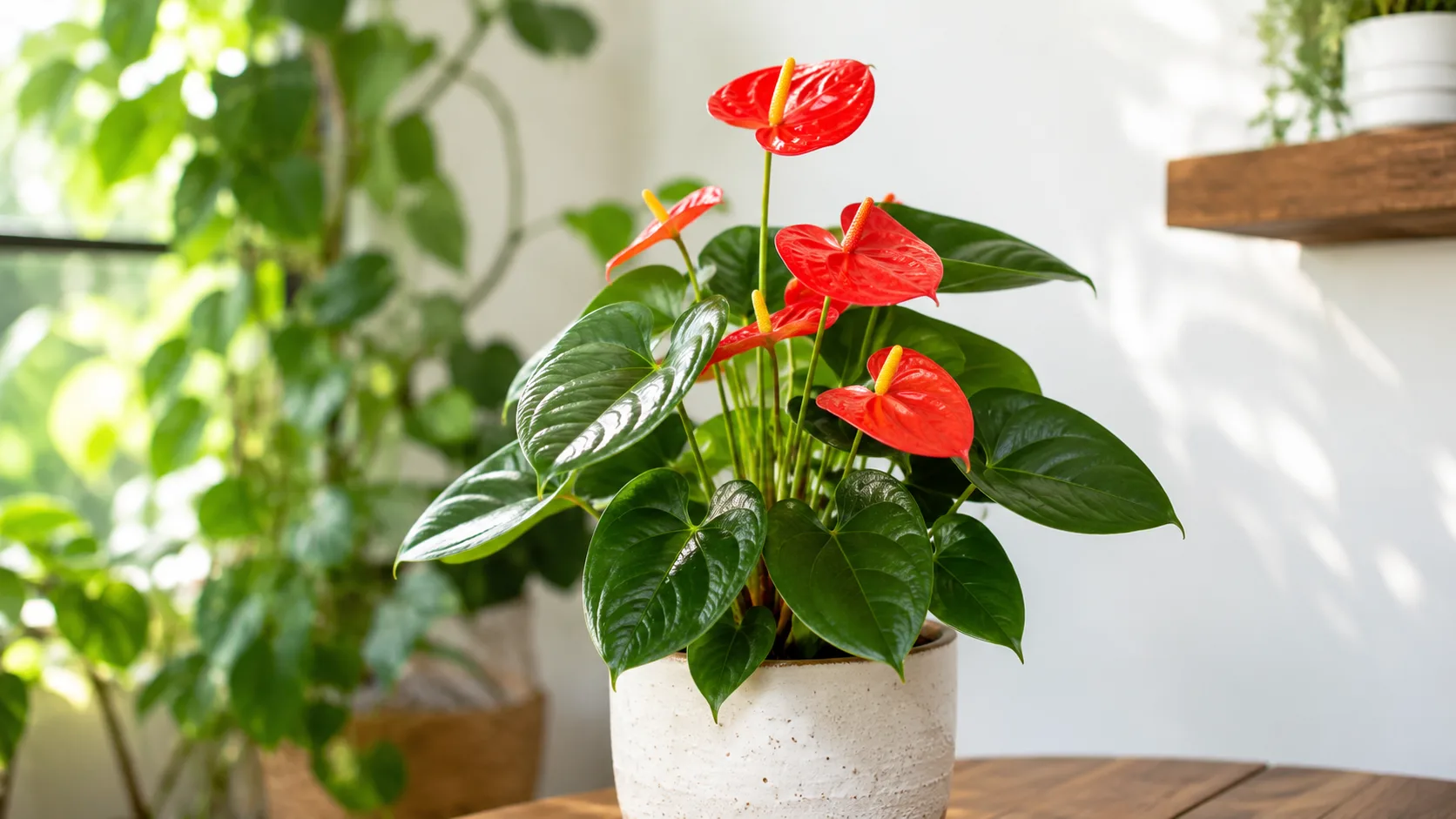
Anthurium—sold as flamingo flower, laceleaf, or tailflower—is one of those houseplants that looks effortless in a greenhouse and temperamental on a kitchen counter. The glossy red, pink, or white “blooms” are actually spathes: modified leaves wrapping a central spadix where the true tiny flowers sit. Get light, moisture, and humidity aligned with that tropical understory biology, and an Anthurium can push new spathes for months. Miss the balance—especially with soggy soil or dim corners—and you get yellow leaves, bare stems, and a plant you assume is “done” after the first flower fades.
This guide covers the full indoor care loop: placement, soil, watering, feeding, propagation, rebloom triggers, and the failure modes that actually show up in real homes. It is written for the common florist species Anthurium andraeanum and close relatives, not rare collector anthuriums that need greenhouse conditions.
Anthurium Quick Reference
Use this table before you change three variables at once. Anthuriums punish stacked mistakes—extra water in low light, or repotting into wet mix during a cold snap.
| Factor | Indoor target | Watch for |
|---|---|---|
| Light | Bright indirect; 6+ hours daily | Leggy stems, no spathes = too dim |
| Soil | Chunky aroid mix; fast drainage | Soggy center, sour smell = wrong mix |
| Water | When top 1 inch dries | Yellow + mushy base = overwater |
| Humidity | 50–80%; higher in winter heat | Crisp leaf tips = too dry |
| Temperature | 65–85°F (18–29°C) | Below 60°F slows growth; frost kills |
| Fertilizer | Monthly spring–summer; high-P if blooms weak | Salt crust, brown leaf edges = excess |
| Repot | Every 2–3 years; +1–2 inches pot max | Roots circling, fast dry-down = rootbound |
| Pets | Toxic (calcium oxalate) | ASPCA lists flamingo flower as toxic |
| Outdoor | USDA zones 11–12 only | Bring in before nights hit 60°F |
For topic-specific schedules—watering dry-down, soil amendments, propagation timing—the Anthurium plant hub breaks care into focused pages when one factor, not the whole plant, needs attention.
What Anthurium Is—and What Those “Flowers” Really Are
Anthurium is a large genus—NC State Extension notes over 1,300 species in the Araceae family, native to the Caribbean, Central America, and northern South America. (NC State Extension) Most houseplant anthuriums are terrestrial or semi-epiphytic perennials: they want airy roots, steady moisture without waterlogging, and warm humid air like their rainforest origin.
Retail plants are usually Anthurium andraeanum hybrids bred for long-lasting spathes in red, pink, white, coral, and bicolor forms. Anthurium scherzerianum is smaller, with a curling orange spadix and arrow-shaped leaves—often the most forgiving for beginners. Foliage collectors grow Anthurium crystallinum and similar velvet-leaved species; those are less about florist spathes and more about leaf texture and humidity discipline.
Spathe, Spadix, and Why Bloom Color Varies
The showy heart-shaped structure is the spathe; the finger-like column is the spadix, covered in tiny true flowers. Missouri Botanical Garden describes florist anthuriums as blooming freely indoors when light and moisture stay consistent, with yellow spadix and red spathe on the classic form. (Missouri Botanical Garden) Each spathe typically lasts two to three months before fading—longer than many tropical blooms, which is why anthuriums dominate office and hospitality plantings.
Some cultivars smell sweet or fruity; others smell unpleasant up close. Fragrance is species-dependent, not a care quality signal. When a spathe greenens or browns at the edges, it is finishing its cycle—not necessarily a crisis unless the stem rots at the base.
Before you commit to a shop plant, read what is in the pot. Firm, glossy leaves with no yellow halos suggest healthy roots. Choose specimens with one or two fresh spathes and visible new leaf buds at the crown—not only a single fading flower on bare stems. Pass on sticky residue (aphids or scale), webbing (mites), or sour-smelling soil. Quarantine new purchases for two weeks away from other houseplants.
Light Requirements for Healthy Leaves and Spathes
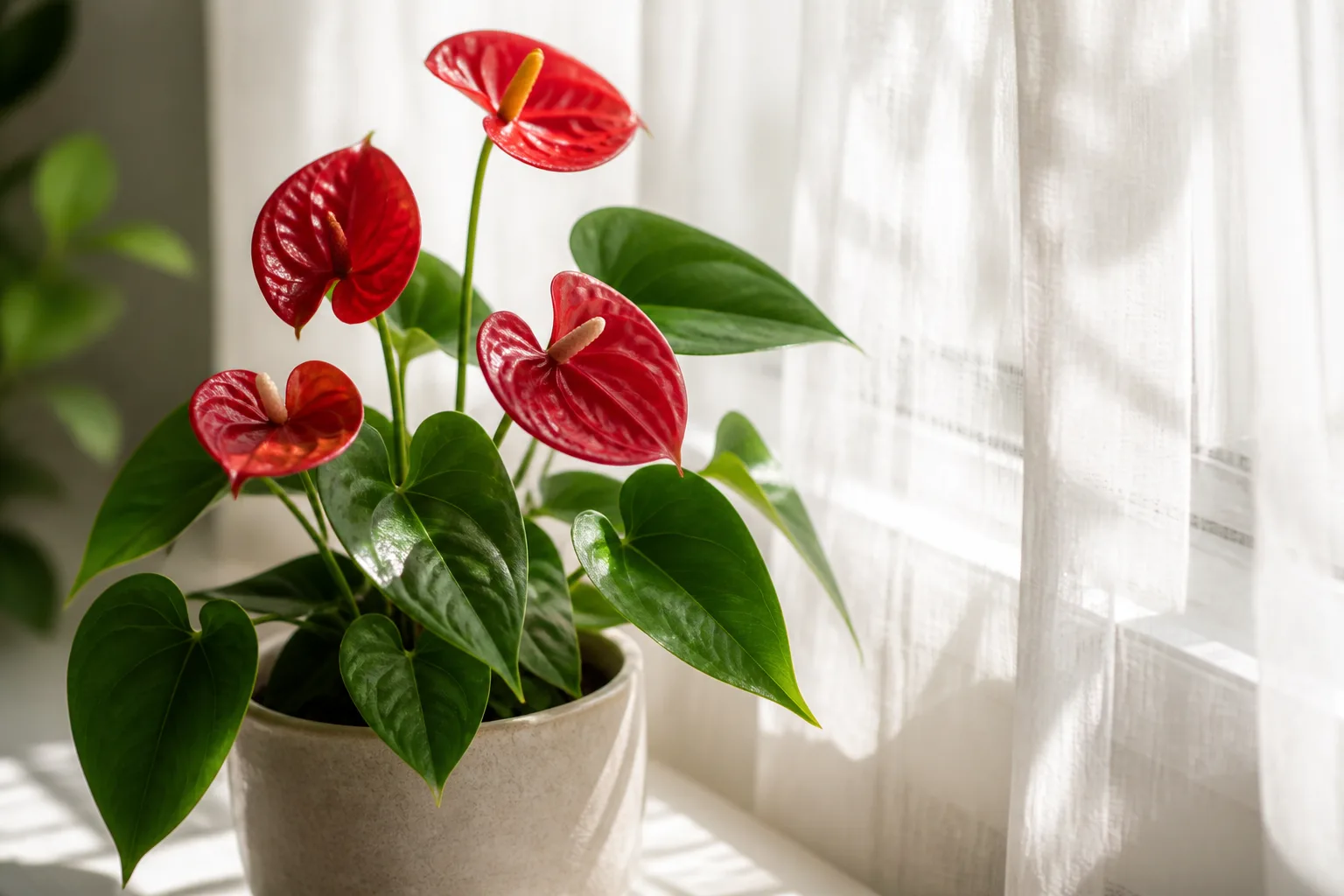
Anthuriums want bright indirect light for most of the day. NC State Extension recommends south- or west-facing windows with enough diffusion that leaves do not scorch; too little light slows growth and cuts spathe count sharply. (NC State Extension) Think “bright room,” not “dark corner that looks nice with the red flower.”
A practical placement hierarchy:
- East window — gentle morning sun plus bright afternoon ambient light; excellent for many homes.
- West or south window with sheer curtain — strong daylight filtered to prevent bleached or brown-tipped leaves.
- Three to five feet back from an unfiltered south window — often safer than glass-contact sunburn.
- Supplement with a full-spectrum grow light 12–14 hours daily if the only spot is medium brightness.
Rotate the pot a quarter turn every week or two so new leaves do not all lean one direction. Gift plants acclimated to greenhouse intensity may drop a leaf or two when moved; hold watering steady and avoid fertilizing until new growth looks stable.
Reading Light Stress on Anthurium Foliage
Too much direct sun: bleached patches, crispy brown tips on the sunny side, spathes fading fast. Too little light: dark green leaves spaced far apart on lengthening petioles, no new spathes for months, soil staying wet too long because transpiration dropped. If you must choose, slightly too bright with a curtain beats too dim—anthuriums bloom from light energy, not from fertilizer alone.
Soil, Pots, and Drainage for Epiphytic Roots
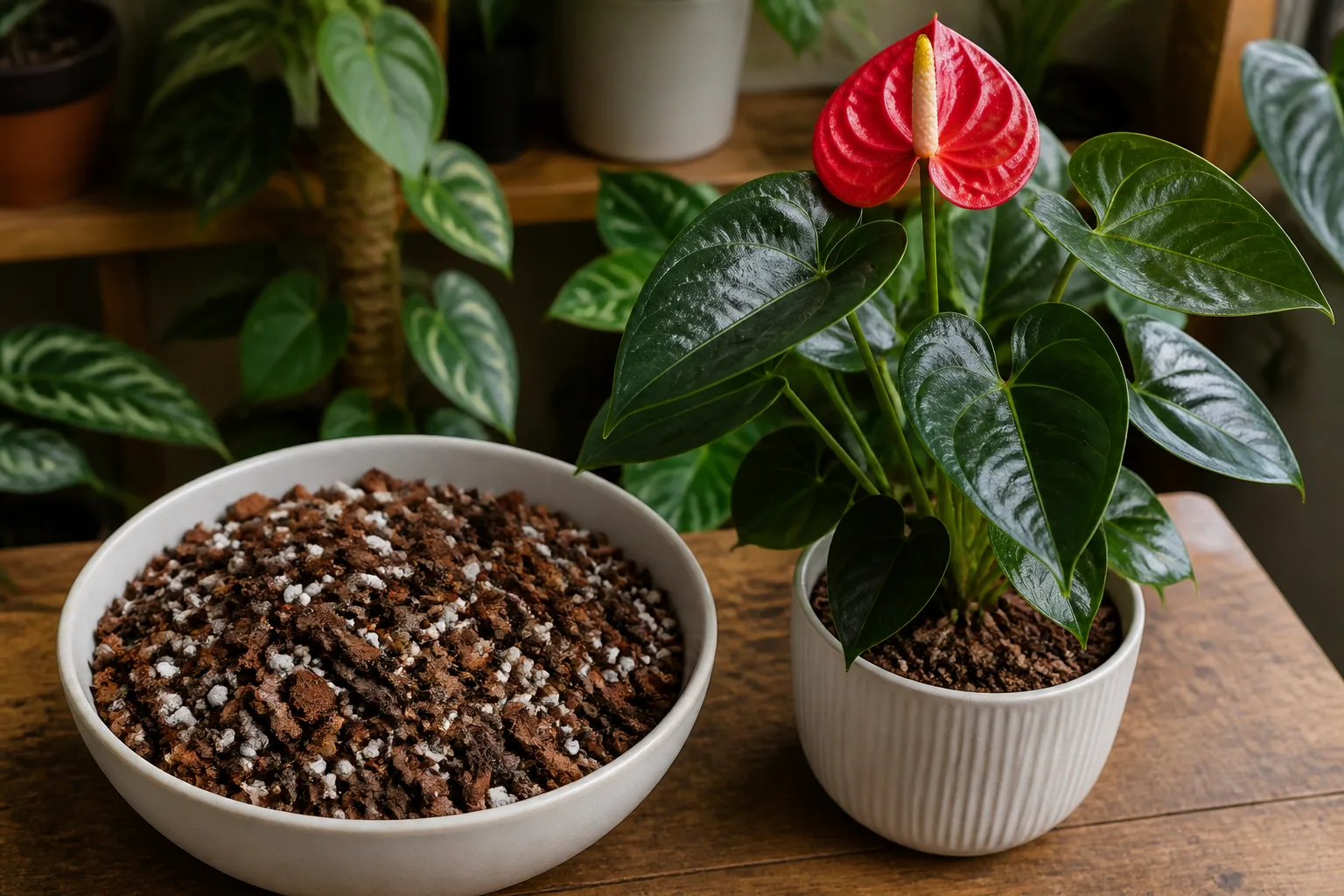
In nature many anthuriums grow on trees or in leaf litter with constant air around roots. A dense peat-heavy mix that stays saturated for days is the fastest route to root rot indoors. Missouri Botanical Garden advises a well-drained, peaty mixture with pot shards or coarse material at the bottom, plus sphagnum on the surface to cover exposed aerial roots.
A reliable indoor blend:
- 40% orchid bark or coco chips (chunk size ¼–½ inch)
- 40% peat-free potting mix or coco coir base
- 20% perlite or pumice
RHS suggests an ericaceous peat-free base with added bark and perlite for moisture retention and sharp drainage—anthuriums like steady moisture but not anaerobic mud. (RHS) Always use a pot with a drainage hole; cache pots are fine only if you empty runoff immediately.
Terracotta dries faster than plastic—helpful if you tend to overwater. Plastic or glazed ceramic holds moisture longer, which suits attentive underwaterers in bright light. Match pot material to your habits, not to aesthetics alone.
Watering Anthurium Without Inviting Root Rot
Water when the top inch of mix feels dry to your finger—roughly weekly in bright active growth for a medium pot, less in winter or dimmer rooms. NC State Extension says to water when soil is dry to the touch and prefers rainwater or purified water in hard-water areas where mineral crust builds on leaves and mix. (NC State Extension)
The soak-and-drain method:
- Water slowly until liquid runs from drainage holes.
- Let the pot sit in the sink for a few minutes to finish draining.
- Empty the saucer—never let the pot base sit in standing water.
- Wait until the top inch dries before the next soak.
Signs you are overwatering: yellow leaves, black mushy petioles, sour soil smell, fungus gnats. Signs of underwatering: limp leaves, loss of leaf sheen, brown crisp edges, lightweight pot, spathes browning prematurely. If you are unsure, underwater slightly in bright light rather than overwater in shade—Rhizoctonia and root rot follow wet cold soil.
Avoid ice-cold tap water straight from the fridge line; room-temperature water reduces shock. Leaf spotting sometimes traces to cold water on warm foliage combined with low airflow—water the soil, not the spathe.
Temperature, Humidity, and Winter Air
Anthuriums thrive at 65–85°F (18–29°C) during the day. Missouri Botanical Garden sets a minimum around 60°F in winter; below that, growth stalls and leaves yellow. Frost kills outright—outside culture is limited to USDA zones 11–12 in humid shade.
Humidity matters as much as temperature. NC State notes brown leaf tips when air is too dry; RHS recommends regular misting, grouping plants, or a pebble tray (pot above waterline on wet stones). (NC State Extension) (RHS) Target 50–80% relative humidity; heated winter rooms often sit in the 20–30% range without help.
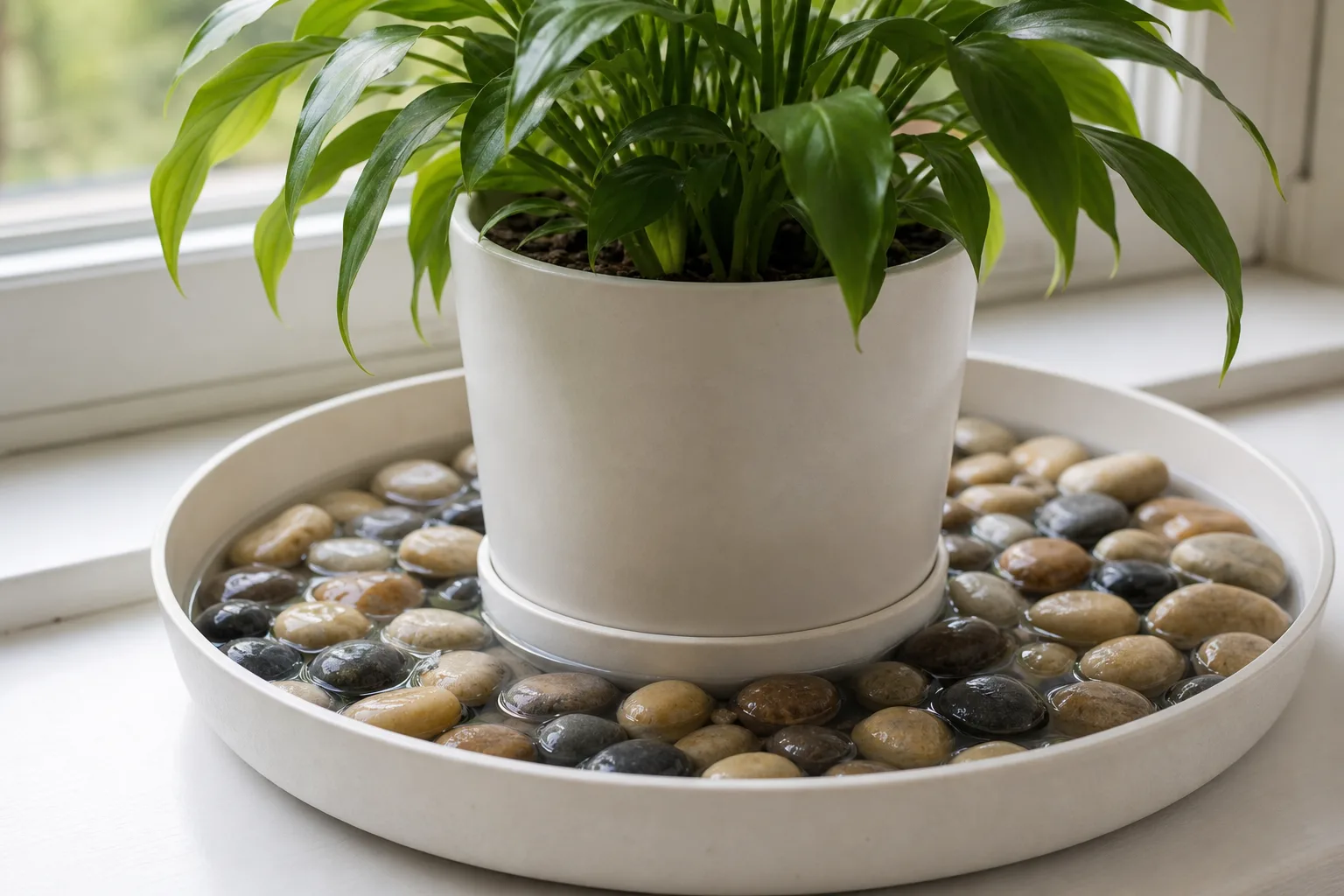
Effective humidity tactics ranked by stability:
- Humidifier near the plant (not blasting directly into leaves 24/7)
- Pebble tray wider than the pot, water below stone tops
- Grouped plants on one bright shelf
- Bright bathroom if window light is genuinely sufficient
- Misting as a supplement, not the sole strategy
Keep anthuriums away from forced-air vents and radiator blasts. Dry drafts brown leaf margins even when you water perfectly.
Growing Anthurium Outdoors and Overwintering Indoors
In USDA hardiness zones 11–12, anthuriums can live outdoors year-round in humid shade with protection from midday sun and cold wind. Missouri Botanical Garden notes they do not require winter dormancy in frost-free climates and prefer consistent moisture without letting containers dry completely. (Missouri Botanical Garden) Everywhere else, treat anthurium as a houseplant or patio specimen you bring inside before nights drop to 60°F (15°C).
Outdoor summer tips for temperate zones: harden the plant off over a week in bright shade, watch for wind desiccation, and water more frequently than indoors because pots dry faster on patios. Never leave a pot in a saucer that collects rain—one storm can waterlog roots overnight. When moving back inside for fall, inspect leaf undersides for hitchhiking pests and rinse foliage before placing the pot near other tropicals.
Indoor winter care is mostly about reduced growth, not a full shutdown. Lower light means slower dry-down, so extend the interval between waterings rather than keeping the summer schedule. Skip fertilizer unless supplemental grow lights keep the plant actively producing leaves. Avoid placing pots on cold windowsills where leaf tips touch glass; chill plus moisture invites brown margins. A stable 65–75°F room with a humidifier beats bouncing between a hot vent and a drafty hallway.
Fertilizer Strategy for Foliage and Repeat Blooms
Feed monthly spring through early fall with a balanced liquid houseplant fertilizer at half label strength. NC State Extension notes that high-phosphorus fertilizer encourages more blooms; apply a bloom-boosting formula at quarter strength weekly only while spathes are forming—not on a stressed dry plant. (NC State Extension)
Skip fertilizer in winter unless you use strong supplemental lighting and see active new leaves. Overfeeding shows up as brown leaf edges, white salt crust on soil, and weak floppy growth. Flush the pot with plain water twice a year if salts accumulate.
Dust blocks light on broad anthurium leaves. Wipe with a damp soft cloth every few weeks—support the leaf from underneath so you do not snap the petiole.
Anthurium Species and Cultivars Worth Knowing
| Species / type | What you notice | Home-grower notes |
|---|---|---|
| A. andraeanum | Heart spathes, straight spadix | Default florist plant; hybrid colors |
| A. scherzerianum | Curled orange spadix, compact | Often more forgiving |
| A. crystallinum | Velvety leaves, white veins | Foliage plant; higher humidity |
| A. faustomirandae | Huge stiff leaves | Greenhouse scale; not typical room plant |
Do not assume all anthuriums want identical light—velvet species tolerate slightly lower light but demand higher humidity. Match care to the leaf type in front of you, not to a generic “tropical plant” label.
Pruning, Deadheading, and Leaf Grooming
Remove spent spathes when they brown by cutting the flower stalk at the base with clean snips. Pinch or cut yellowing old leaves at the petiole base; always leave at least three to four healthy leaves on small plants so photosynthesis continues.
Shape pruning—shortening leggy stems or odd angles—is fine any time of year. Sterilize blades between cuts if you suspect bacterial wilt (oozing stem, rapid yellowing). Partial trimming of damaged leaf tips is cosmetic only; fix the underlying light or water issue or the next leaf repeats the damage.
Propagating Anthurium from Side Shoots
Anthuriums multiply by side shoots (pups) with aerial roots, division, or—riskier—stem cuttings. Seed takes years to bloom and is impractical for most homes. NC State lists stem cuttings and seeds as propagation options; for houseplant growers, pups are the safe default.
Side-shoot method:
- Choose a pup with at least one mature leaf and visible aerial roots.
- Sterilize a sharp knife or pruners.
- Cut the pup where it joins the main stem cleanly.
- Pot in fresh chunky mix, burying aerial roots but keeping leaf junctions above soil.
- Water once, then keep warm and bright-indirect; new growth in four to six weeks is typical.
Stem beheading—removing the top while leaving buds on the stump—can work but kills a weak parent if no buds remain. Only attempt on vigorous multi-node plants. Propagate in spring, not during winter stress.
Repotting on a Two-Year Rhythm
Repot every two to three years, or when roots circle the pot and water runs straight through. Size up only 1–2 inches in diameter—oversized pots stay wet too long. Missouri Botanical Garden notes frequent repotting helps flush unabsorbed minerals; refresh the top inch of mix annually if you are not upsizing.
Steps:
- Water lightly the day before so roots bend rather than snap dry.
- Slide the plant out; trim black mushy roots with sterile scissors.
- Place on fresh mix one-third full; fill around roots without burying the crown.
- Water once, drain fully, and skip fertilizer for four weeks.
Spring repotting aligns with rising light and temperature; avoid repotting into cold wet mix in dim winter rooms.
Getting Anthurium to Bloom—and Keep Blooming
Greenhouse-grown gift plants arrive mid-bloom cycle. Your job after purchase is maintaining energy, not forcing instant rebloom with heavy feed.
Rebloom checklist:
- Bright indirect light — the non-negotiable input.
- Stable humidity — especially if winter heat is dry.
- High-phosphorus feed at quarter strength during active growth when leaves look firm.
- Root space — slightly rootbound plants bloom well, but fully congested dry pots stall.
- Optional rest period — six weeks with slightly cooler nights (~60°F), reduced water, and no fertilizer can trigger another cycle in some cultivars (practice from experienced growers; not required for all plants).
Each spathe lasts two to three months. Multiple spikes can overlap on happy plants, giving the illusion of year-round color indoors. If spathes stop entirely for half a year despite good light, inspect roots for rot, increase humidity first, then consider gentle repotting—not a fertilizer dump.
Pests, Diseases, and When to Isolate
Common pests mirror most tropical houseplants: mealybugs, spider mites, scale, whiteflies, aphids, thrips. Inspect leaf undersides and new spathe bases weekly. First response: rinse foliage in the sink, improve airflow, isolate from neighbors. Persistent infestations may need insecticidal soap or horticultural oil—test a leaf first because some anthuriums are sensitive during bloom.
UF/IFAS Extension documents bacterial wilt, Rhizoctonia root/stem rot, leaf spot, and blight in commercial anthurium production. (UF/IFAS Extension) Home symptoms to know:
- Bacterial wilt: rapid yellowing, wilting despite moist soil, sometimes oozing stem—discard isolated plants; sterilize pots if you attempt salvage.
- Rhizoctonia: young stems flop at soil line; often linked to overwatering and poor drainage.
- Leaf spot fungi: brown lesions with yellow halos—reduce leaf wetness, improve airflow, remove affected leaves.
Insecticides can damage open spathes; treat pests early before flowers fully expand.
Troubleshooting Yellow Leaves and Floppy Stems
Yellow leaves from light: often upper leaves on the sunny side bleach first, or lower old leaves yellow naturally—remove them. Yellow from overwater: multiple leaves yellow together with soft base; check roots. Bacterial wilt: yellow spreads fast with collapse—different urgency.
Floppy new stems at the soil line point to Rhizoctonia or chronic overwater in cool soil. Back off water, repot into fresh airy mix if smell is sour, and keep warmer. Leggy floppy leaves on long petioles usually mean too little light, not too little water—correct placement before watering more.
Brown leaf tips usually mean low humidity, salt buildup, or fluoride/chlorine stress—humidify, flush soil, and switch water source before chasing pests.
Toxicity and Safe Placement Around Pets and Kids
Anthuriums contain calcium oxalate crystals that irritate mouth and digestive tissues. ASPCA lists flamingo flower (Anthurium) as toxic to dogs and cats, causing oral irritation, drooling, vomiting, and difficulty swallowing if chewed. (ASPCA) Keep plants on sturdy shelves, hang baskets out of reach, and clean fallen spathes promptly.
Wear gloves if sap irritates your skin when pruning. This is informational, not veterinary advice—contact your vet or ASPCA Animal Poison Control at (888) 426-4435 if a pet ingests plant material.
Conclusion
Anthurium rewards consistency more than constant fussing: bright indirect light, a chunky draining mix, water when the top inch dries, and humidity above 50% cover most failures before they start. Learn to read spathe cycles versus crisis signals, propagate from pups instead of gambling on stem cuts, and use the Anthurium plant hub when you want deeper single-topic guidance on watering, soil, or propagation. Nail the basics once, and those waxy spathes become a repeating habit—not a one-time florist miracle.