How to Grow and Care for Swiss Cheese Plant
Grow Monstera adansonii with bright indirect light, check-the-mix watering, aroid soil, and a moss pole for bigger fenestrated leaves. Pet-safe placement tips inside.
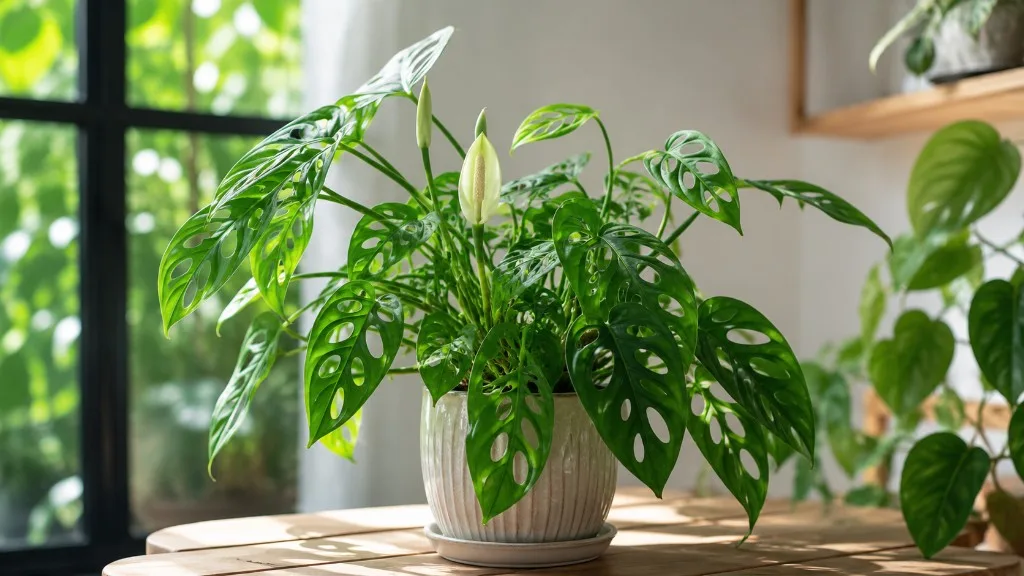
The Swiss cheese plant most people buy today is Monstera adansonii—a fast, vining aroid with heart-shaped leaves full of oval holes. It is not the giant split-leaf Monstera deliciosa that fills Instagram living rooms, though both share the same nickname and the same basic need for bright, humid, warm conditions. Get the species right, give the vine something to climb or room to trail, and a Monstera adansonii can grow into one of the easiest statement plants in a bright home. Get the watering or light wrong, and you will chase yellow leaves, stuck new growth, and a pot that never develops the holes you bought it for.
Swiss Cheese Plant Quick Reference
Use this table before you change three variables at once. Most Swiss cheese plant problems trace back to one row.
| Factor | Indoor target | What goes wrong when ignored |
|---|---|---|
| Light | Bright indirect; filter hot afternoon sun | Small leaves, few holes, leggy stems |
| Water | Top 1–2 in. dry, then soak and drain | Yellow lower leaves, mushy stems, gnats |
| Soil | Chunky aroid mix; pH roughly 5.5–7.0 | Wet center, slow roots, stalled growth |
| Temperature | 65–85°F (18–29°C); avoid below 50°F | Cold shock, blackened leaf tips |
| Humidity | 50%+ ideal; higher helps unfurling | Crisp edges, stuck new leaves |
| Support | Moss pole or trellis for larger fenestrations | Trailing OK but smaller leaves |
| Pets | Toxic to cats and dogs if chewed | Oral irritation, drooling, vomiting |
| Outdoor zones | USDA 10–12 year-round | Frost kills vines left outside |
North Carolina Extension lists Monstera adansonii as a tender evergreen climber from tropical America that reaches 3–8 feet indoors with partial shade, moist well-drained slightly acidic soil, high humidity, and a stake or moss pole in the pot. Penn State Extension summarizes Monstera houseplants as bright-light plants that prefer humidity above 50%, watering after the top 1–2 inches of mix dry, and well-draining organic potting media. Your room changes the calendar—judge the pot, not a generic weekly schedule.
What Is Monstera adansonii—and Why the Name Confuses Everyone
Monstera adansonii goes by Swiss cheese plant, Swiss cheese vine, Adanson’s monstera, five holes plant, and cheese plant. Garden centers also label Monstera deliciosa “Swiss cheese plant,” which is why two very different vines arrive home under the same common name. Always check the tag for the botanical name: adansonii leaves are smaller, thinner, and perforated with round holes rather than deep splits along the margin.
In the wild, the vine climbs rainforest trees using aerial roots while oval holes in the foliage let lower leaves receive filtered light. RHS notes that fenestrations likely evolved so climbing plants can pass light to leaves below as they ascend. Indoors, that biology translates into bright indirect light plus vertical support—not a dark corner where the plant survives but never looks like the photos that sold you on it.
How Swiss Cheese Plant Differs From Monstera deliciosa
| Trait | Monstera adansonii | Monstera deliciosa |
|---|---|---|
| Habit | Dense, fast vining | Slower, tree-like when mature |
| Leaf size | Smaller, thinner | Much larger, leathery |
| Fenestration | Many oval holes | Deep splits and holes |
| Indoor height | Often 3–8 ft. on support | Can reach ceiling on pole |
| Best display | Hanging basket or slim moss pole | Floor specimen |
Penn State Extension explicitly contrasts the two: adansonii shares common names with deliciosa but has much smaller leaves with unique oval holes and a denser, more vigorous growth habit indoors. If you wanted a wide floor monster, you bought the wrong species—but if you wanted a fenestrated vine for a shelf, pole, or basket, adansonii is the better fit.
Light Requirements for Healthy Fenestrations
Swiss cheese plants need bright, indirect light to grow steadily and develop holes in new leaves. NC State warns that direct sun scorches foliage and recommends partial shade outdoors—roughly 2–6 hours of direct sun in the garden, which indoors usually means an east window, several feet back from south or west glass, or south light softened by a sheer curtain. Adansonii’s thin leaves burn faster than deliciosa when moved abruptly from a dim shop shelf to harsh afternoon sun.
Low light will not kill a tough vine quickly, but it will produce small, solid juvenile leaves on long internodes—the classic “leggy Swiss cheese plant with no cheese.” Increase light gradually over a week if you move the pot closer to the window. Existing leaves will not grow new holes retroactively; judge progress on the next two or three leaves that unfurl after the change.
Reading Your Plant’s Light Signals
Too little light: long gaps between leaves, small solid new foliage, slow growth, soil staying wet too long. Too much light: bleached patches, blackened scorch marks, especially on afternoon-exposed leaves. About right: moderate internode spacing, new leaves opening cleanly with increasing fenestration as stems mature on a support. For placement specifics and window-by-window notes, see the Monstera adansonii light guide.
Watering Without Rotting the Roots
Water when the top 1–2 inches (3–5 cm) of potting mix feel dry to your finger and the pot feels noticeably lighter than right after a soak. Then water thoroughly until excess runs from the drainage holes and empty the saucer within 30 minutes. RHS advises letting compost become almost dry before a thorough watering and never leaving the pot standing in water—root rot follows soggy anaerobic mix. Penn State Extension ties the same dry-down interval to Monstera houseplants and flags overwatering as the primary rot trigger.
Hanging baskets and small pots dry faster than deep moss-pole containers; a trailing adansonii in a 6-inch basket may need water twice as often as a climbing specimen in an 8-inch pot. Weight beats calendar dates: lift the pot after watering once to learn the “wet” heft, then water only when it feels substantially lighter. In winter, extend the interval and skip fertilizer rather than keeping the mix constantly damp in short days.
Chronic underwatering shows up as wrinkled or curling leaves and crispy tips. Chronic overwatering yellows lower leaves, softens stems at the soil line, and invites fungus gnats that breed in the top wet layer—let the surface dry, deploy sticky traps, and fix the watering rhythm before reaching for sprays. See the watering guide and root rot page if mushy roots or persistent yellowing persist after you dry the mix out.
Soil, Pots, and Drainage for Aroid Vines
Swiss cheese plants want moist but never waterlogged mix. NC State recommends moist, well-drained soil with slightly acidic pH. RHS suggests an open, slightly acidic blend—about one part ericaceous peat-free compost to two parts orchid bark—for Monstera generally, and warns that poor drainage causes roots to rot quickly.
A practical indoor aroid mix: standard peat-free potting soil plus 20–25% perlite and 10–15% orchid bark or chunky coco. That mirrors what the Monstera adansonii soil guide recommends and keeps oxygen around roots between waterings. Any pot must have drainage holes; decorative cachepots are fine only if you lift the nursery pot to water and dump runoff.
Choose a stable, weighted pot if you add a tall moss pole—top-heavy vines tip easily. Terracotta dries faster than plastic, which helps heavy-handed waterers but means more frequent checks in summer. Avoid jumping more than one pot size up at repotting; excess empty mix stays wet and encourages rot.
Temperature, Humidity, and Drafts
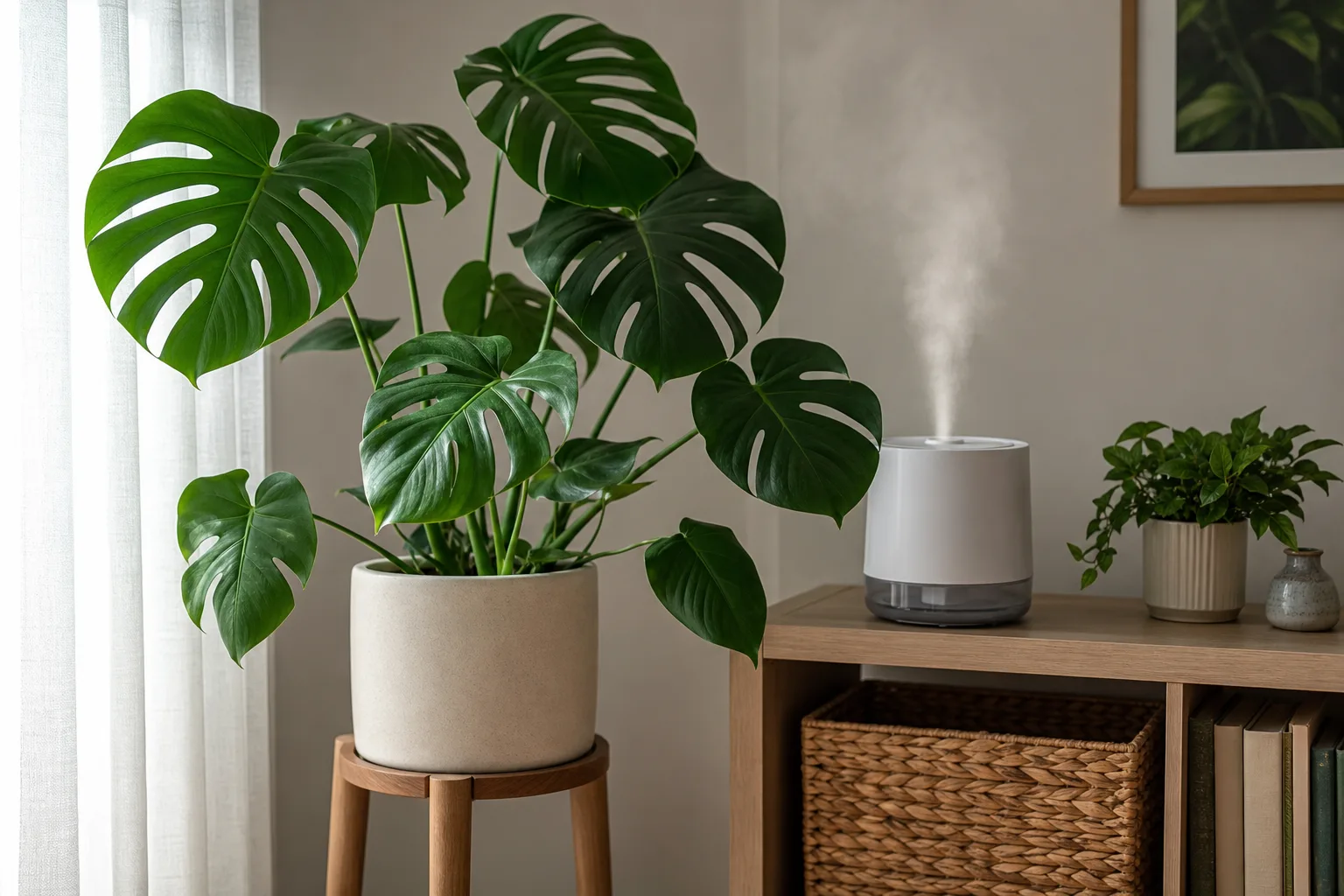
Swiss cheese plants thrive at 65–85°F (18–29°C) with humidity at or above 50%. NC State says to avoid cold drafts and temperatures below 50°F (10°C). Hot radiator air and icy window drafts both stress thin adansonii leaves—you may see brown tips or stalled unfurling within days.
Raise humidity with a pebble tray (water below stone tops), grouping plants, or a humidifier in dry winter rooms. Misting leaves briefly helps unfurling new growth but does not replace ambient humidity for the whole day. Bathrooms with bright windows can work if light is genuinely adequate, not just steam without lumens.
Climbing Support vs. Trailing Displays
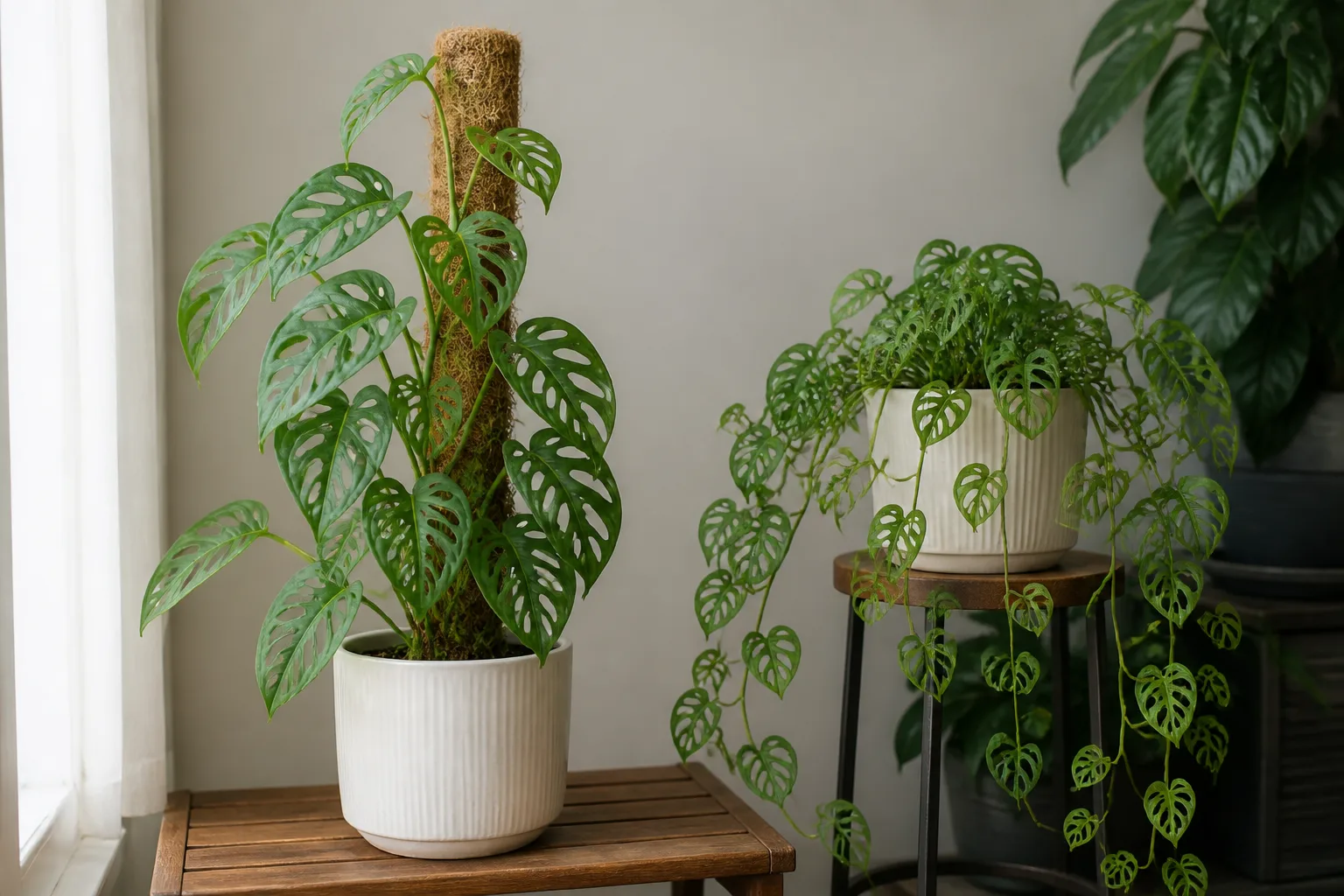
In habitat, adansonii climbs toward light using aerial roots. Indoors, a moss pole, coir totem, stake, or trellis is optional for survival but strongly shapes the plant you see. NC State explicitly recommends providing structure in the container. RHS notes that once a Monstera senses it is climbing a moist moss surface, it often produces larger leaves with more fenestrations.
Choose climbing when you want bigger perforated leaves and a vertical accent. Keep the pole lightly moist when you water the pot so aerial roots attach. Choose trailing from a shelf or hanging basket when horizontal space is limited—expect smaller leaves and sometimes fewer holes on cascading stems. Many growers climb the main leader and let side shoots hang for the best of both shapes.
Tie stems loosely with soft plant ties; never force brittle stems into sharp bends. Wear gloves when handling cut stems—NC State lists contact dermatitis as a low-severity risk alongside ingestion toxicity.
Fertilizing During Active Growth
Feed monthly in spring and summer with a balanced liquid houseplant fertilizer diluted to half the label strength. Penn State Extension recommends fertilizing every two weeks through the growing season and monthly in winter for Monstera generally; many indoor growers skip winter feeding entirely when growth slows and reduce burn risk.
Wait four to six weeks after repotting before feeding—fresh mix often includes slow-release nutrients and disturbed roots absorb poorly. Pale new leaves on an otherwise well-lit plant may need feeding; yellow lower leaves on wet mix almost never do. The fertilizer guide covers dilution and when to hold off.
Pruning to Control Size and Shape
Prune in spring when the vine outgrows its space or you want a bushier pot. Use clean shears and cut stems just above a leaf node, removing no more than 25% of live growth in one session. RHS warns that hard pruning can temporarily produce smaller, less fenestrated leaves until the plant re-establishes on its support.
Remove yellow or damaged leaves at the base anytime—they will not green up again. Every pruning cut above a node can branch into two stems—useful for fuller hanging baskets. Save healthy cuttings for propagation rather than composting them.
Propagating Swiss Cheese Plant From Stem Cuttings
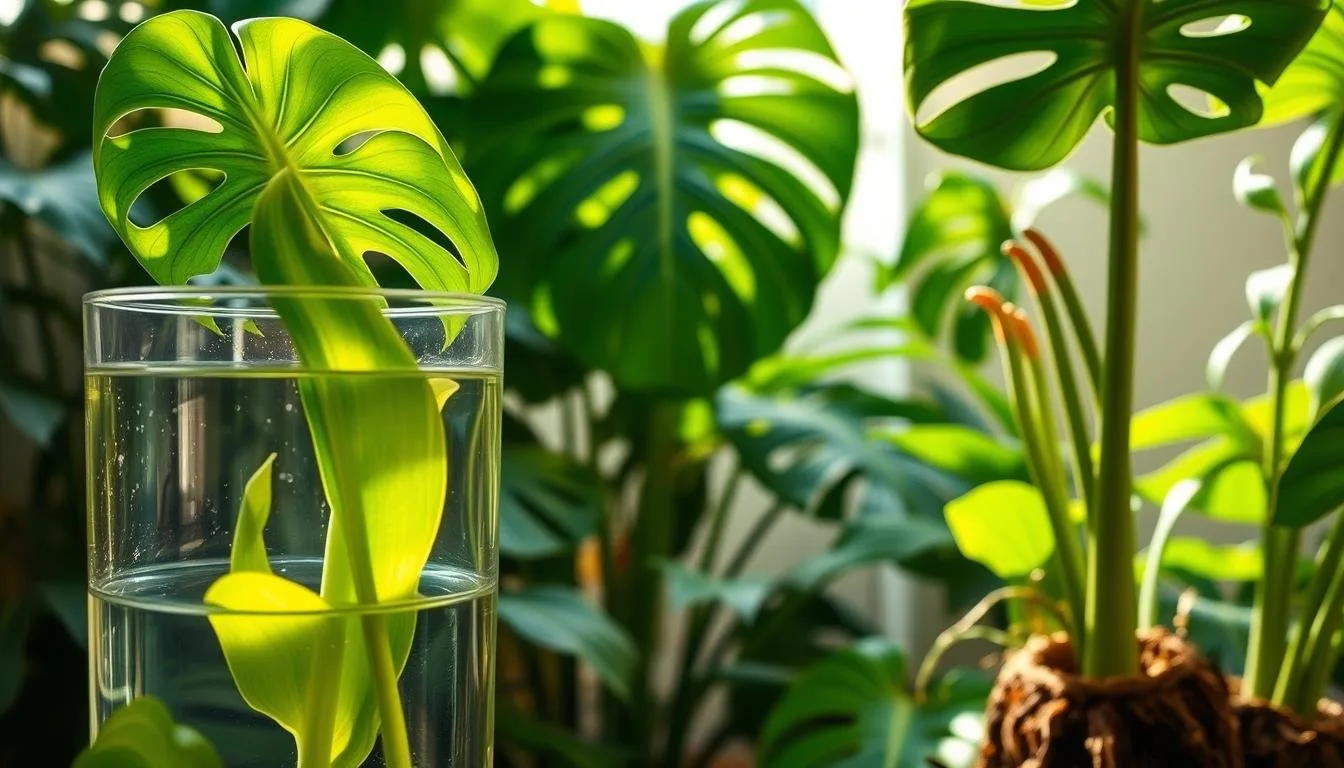
Propagation is the cheapest way to fill a pot or share a plant. NC State lists stem cuttings as the recommended propagation strategy. RHS describes rooting stem sections in water in bright indirect light, then potting once roots are several inches long.
Take a 4–6 inch cutting just below a node in spring or early summer. Remove lower leaves so one or two nodes sit bare. Root in water (change weekly), moist sphagnum, or airy potting mix covered loosely to retain humidity. Bright indirect light and warmth speed rooting—most cuttings show usable roots in four to eight weeks. Transfer to chunky aroid mix when roots reach 2–3 inches, and keep humidity high the first two weeks after potting. Full step-by-step photos live in the propagation guide.
Repotting Schedule and When to Size Up
Repot every two to three years, or when roots circle the drainage holes or water runs straight through dry mix. Spring is ideal—active roots recover faster. Move up one pot size only; RHS cautions that oversized pots keep compost wet too long and invite rot.
Refresh the top one-third of mix annually if you cannot size up yet. Do not repot on day one after purchase unless roots are rotting or the soil is clearly failing—quarantine new plants, learn their dry-down speed, then repot. Details on timing and mix swaps are in the repotting guide.
Cultivars and Related Monstera Species
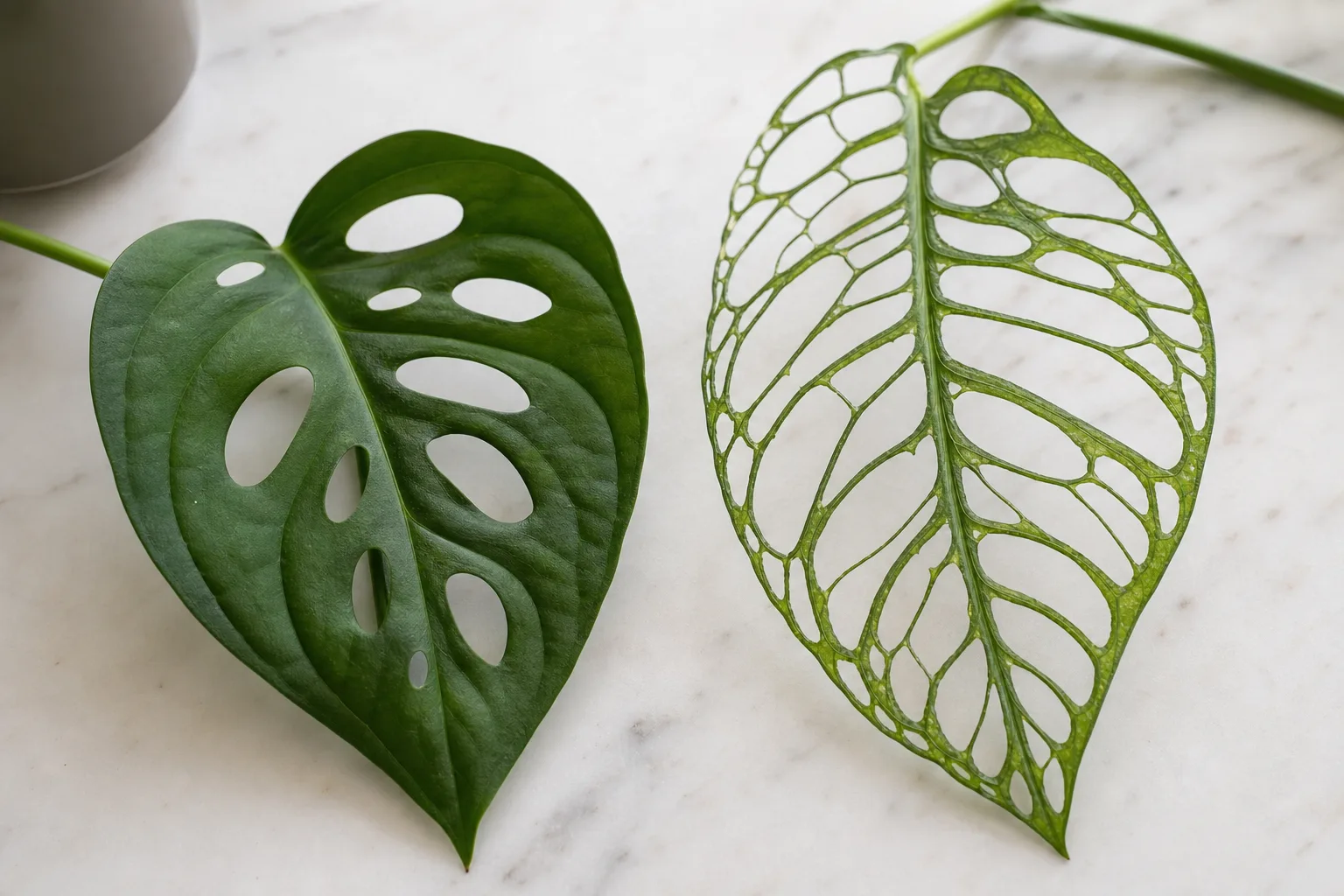
The species form has solid green leaves with oval holes. ‘Archipelago’ is a variegated cultivar with marbled cream and green foliage—brighter light and slower growth than the green form, and often a higher price tag. Penn State Extension mentions Monstera adansonii ‘Archipelago’ alongside the species.
Do not confuse adansonii with Monstera obliqua, a rare species with extremely thin, hole-heavy leaves—most “obliqua” sold online is mislabeled adansonii. Monstera siltepecana and Monstera dubia are related vining aroids with different juvenile and mature foliage. When buying, match leaf thickness and hole pattern to a verified adansonii, not just the words “Swiss cheese” on the label.
Common Pests and Plant Diseases
NC State lists spider mites, mealybugs, aphids, whiteflies, and scale as common pests, with root rot from overwatering as the main disease risk. Penn State Extension adds thrips and fungus gnats to the watch list for Monstera houseplants generally.
Inspect leaf undersides weekly. Mealybugs look like white cotton clusters; spider mites leave fine webbing and stippled leaves; scale appears as brown bumps on stems. Isolate affected plants, wipe off what you can, and treat with insecticidal soap or horticultural oil on two-week intervals. Gnats mean wet surface soil—dry the top inch and use sticky traps before assuming you need a systemic pesticide.
Avoid splashing foliage when watering and provide gentle air movement to reduce leaf spot fungi. Rust, powdery mildew, and blight can occur in poor air circulation—remove affected leaves and fix the underlying moisture or spacing issue.
Troubleshooting Leaf Problems
Yellow leaves on the lower stem usually mean overwatering or old foliage shedding—check moisture depth before feeding. Curling or wrinkled leaves often signal underwatering or low humidity while a new leaf unfurls. Black marks frequently follow direct sun scorch or cold injury. Drooping can mean either extreme—lift the pot; light dry mix wants water, heavy wet mix wants drying and root inspection.
No holes on new leaves combines three factors: leaf age (juvenile leaves are solid), light intensity, and whether the stem is climbing. Improve all three gradually rather than blasting the plant with afternoon sun in one move. Leaves falling off with pale, stretched growth points to chronic low light—move closer to the window or add a grow light.
Use symptom-specific pages when one issue dominates: yellow leaves, curling leaves, not enough light, and drooping leaves.
Moving Your Plant Outdoors in Summer
In USDA zones below 10–12, treat outdoor time as a seasonal vacation, not permanent planting. Wait until nights stay above 55°F (13°C), acclimate in full shade for a week, then offer bright shade or dappled morning sun only—never hot afternoon sun on a vine grown indoors. NC State lists hardiness in zones 10–12; frost kills stems quickly.
Bring the pot inside before nights drop below 50°F. Check for pests hitchhiking on leaves and stems when you transition back indoors. Outdoor humidity and rain may mean less manual watering—still verify drainage so summer storms do not waterlog the mix.
Conclusion
A Swiss cheese plant rewards you when you treat Monstera adansonii as a bright-light, climbing aroid—not a low-light filler and not the same plant as Monstera deliciosa. Give it filtered sun, let the top of the mix dry before soaking, use chunky soil in a drained pot, and offer a moss pole if you want the iconic perforated leaves. Keep it away from pets, watch watering more than fertilizer, and use the Monstera adansonii plant hub when you need deeper pages on light, water, soil, propagation, or specific symptoms. Nail those basics and this fast vine becomes one of the most satisfying tropical houseplants you can grow indoors.