How to Grow Dragon Fruit Cactus Indoors
Dragon fruit can grow indoors, but fruit needs strong light, space, and pollination. Plan the pot, support, and care routine before bringing one home.
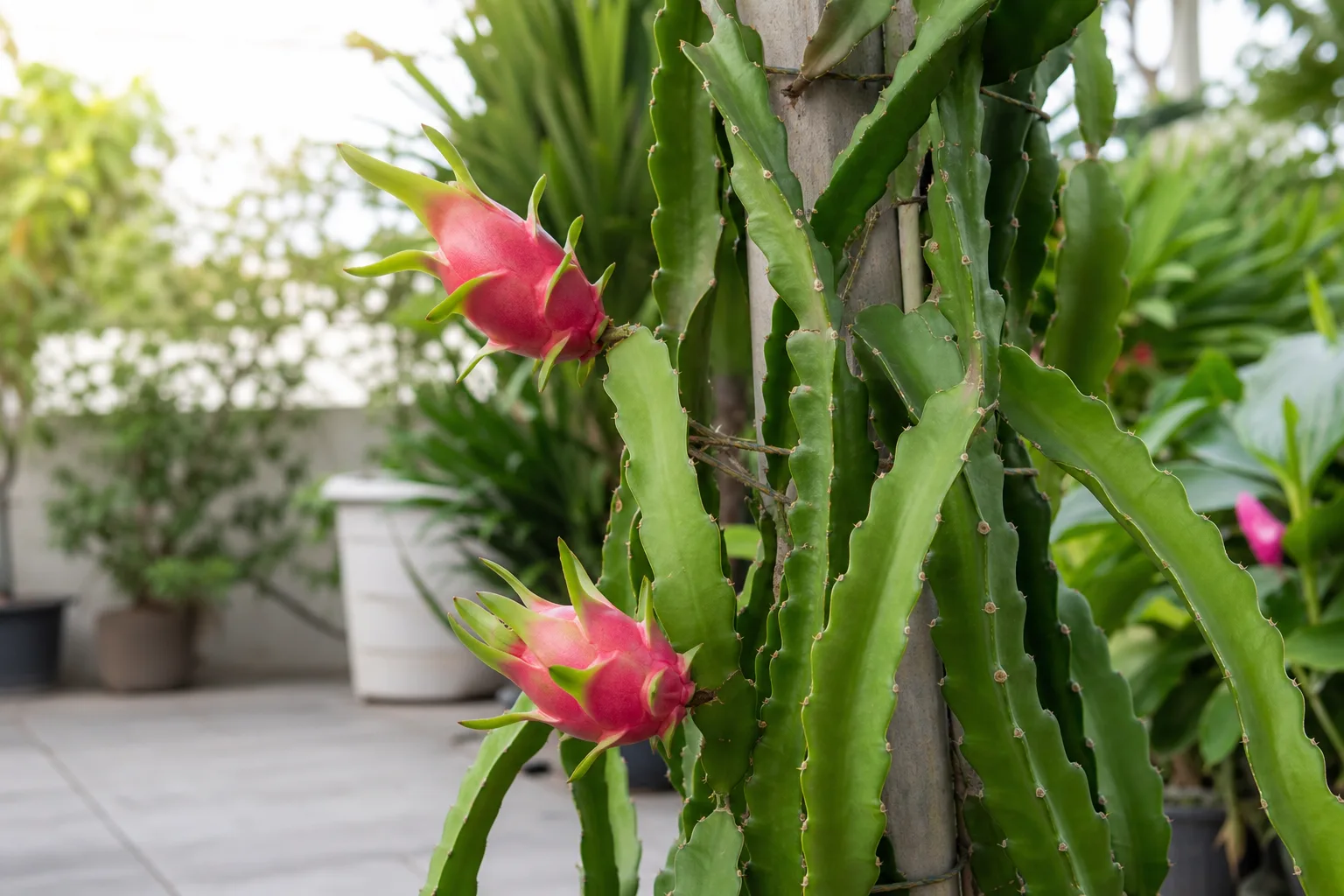
You can grow dragon fruit cactus indoors, but there is a difference between keeping one alive and getting it to produce fruit. A bright window, a large stable container, and a strong support can sustain a vigorous plant; flowers and fruit also depend on enough light, suitable temperatures, and pollination at night.
The plant sold as dragon fruit, pitaya, or pitahaya is a climbing tropical cactus, often listed as Hylocereus undatus or Selenicereus undatus. It does not behave like a compact desert cactus. Its long, fleshy stems climb, branch, and hang from a support, so decide where the mature canopy will go before you bring home a cutting. If your space cannot accommodate a heavy pot and trellis, treat it as an ornamental foliage plant rather than buying it for a guaranteed indoor harvest.
Is Dragon Fruit a Practical Indoor Plant?
Dragon fruit grows in a pot indoors when it gets warmth, bright light, well-drained but moisture-retentive mix, and room for its stems. Fruiting is the harder goal. In its native range, the plant climbs into bright, warm conditions and its large flowers open at night; in a home, you must reproduce enough of those conditions while also making room for a mature vine.
Do a simple room-fit check first. Can the plant sit at the brightest window without blocking a walkway? Can you secure a support to a container that will not tip when stems drape over it? Will you be able to move or prune the plant if it grows into the window or ceiling? If the answer is no, a smaller pot will not solve the problem; it will only postpone the need for a better plan.
Indoor growing is most realistic in a sunroom, greenhouse, bright conservatory, or room with an unobstructed south- or west-facing window in the Northern Hemisphere. A supplemental grow light can improve a marginal setup, but it cannot shrink the plant’s mature structure. Decide whether your priority is foliage, flowers, or fruit, because each step up that list asks more of your space and light.
Choose a Plant With Indoor Fruit Potential
When fruit is the goal, buy a named cultivar from a seller who can explain whether it is self-compatible and what type of pollen it needs. Some dragon fruit cultivars can set fruit with their own pollen; others are self-incompatible and need pollen from a genetically different cultivar flowering at the same time. UF/IFAS notes that compatibility information for many named selections is incomplete, so a tag that says only “dragon fruit” does not tell you enough to predict fruiting.
A single plant is the simplest indoor choice if the supplier confirms it is self-fertile. If the label is vague, you can still grow it, but plan to hand-pollinate and accept that fruit set may remain uncertain. Two genetically distinct plants improve your options for cross-pollination, but they also double the canopy and increase the size and weight of the support you need. Do not buy a second plant before confirming you can house both mature vines.
If you only want an unusual climbing cactus, cultivar compatibility matters less. Choose a healthy, established cutting with firm green stems and no soft, black, or sunken areas. A rooted plant is usually easier to establish indoors than a seedling with a long juvenile period.
Start with a rooted cutting if fruit is the goal
A cutting preserves the traits of its parent plant and generally reaches flowering age sooner than a seed-grown plant. UF/IFAS reports that seed-grown pitaya can take up to seven years to bear, while cuttings can be much faster in favorable growing conditions. Those field timelines are not a promise for an indoor pot: limited light, a small root system, winter slowdown, or missed pollination can delay fruiting.
If you start with an unrooted cutting, let the cut end dry and callus in a shaded, airy place before planting it in a small pot of free-draining mix. Keep the cutting upright and only lightly moist as roots form; saturated media around a fresh wound encourages rot. Once it shows stable new growth, acclimate it gradually to stronger light instead of putting it straight against intense afternoon sun.
Set Up the Light Before You Pot
Put the container where the plant will grow before you install a tall trellis or fill the pot. Dragon fruit needs much brighter conditions to flower and fruit than the average low-light houseplant. UF/IFAS describes pitaya as a full-sun crop for best growth and production, while noting that intense sun can injure stems in some conditions; for an indoor grower, the useful rule is to provide the brightest available light and acclimate the plant to direct sun over time.
A south-facing window often gives the longest exposure in the Northern Hemisphere; an east-facing window gives gentler morning light, while a west-facing window can be hot behind glass. Watch the plant during the first weeks after moving it. Pale bleached patches, tan scars, or sudden yellowing on the window side suggest sun stress, so move it slightly back or filter the harshest midday rays. Long, thin, weak stems leaning toward the glass point to insufficient light.
If the brightest window still gives only a few hours of sun, use a full-spectrum LED grow light positioned so the whole canopy receives usable light. Follow the manufacturer’s safe distance and daily schedule, and adjust based on growth rather than assuming a lamp’s wattage guarantees enough intensity. Keep the light close enough to reach the plant but far enough to avoid heating or bleaching tender stems; rotate the pot periodically if one side consistently receives more light.
Read the stems, not the room label
“Bright room” is not a measurement. A window may look luminous to you while the plant receives weak light because it sits several feet away, faces north, or is shaded by trees and buildings. Put the cactus close to the glass if temperatures there remain safe, then assess whether new growth stays broad, firm, and green rather than narrow and stretched.
A young cutting needs gentler treatment than an established plant. Give it bright filtered light while it roots, then increase direct exposure in stages over one to two weeks. If you move a potted plant outside for summer, repeat that acclimation process in reverse and protect it from both wind and a sudden blast of midday sun.
Install Support That Fits the Room
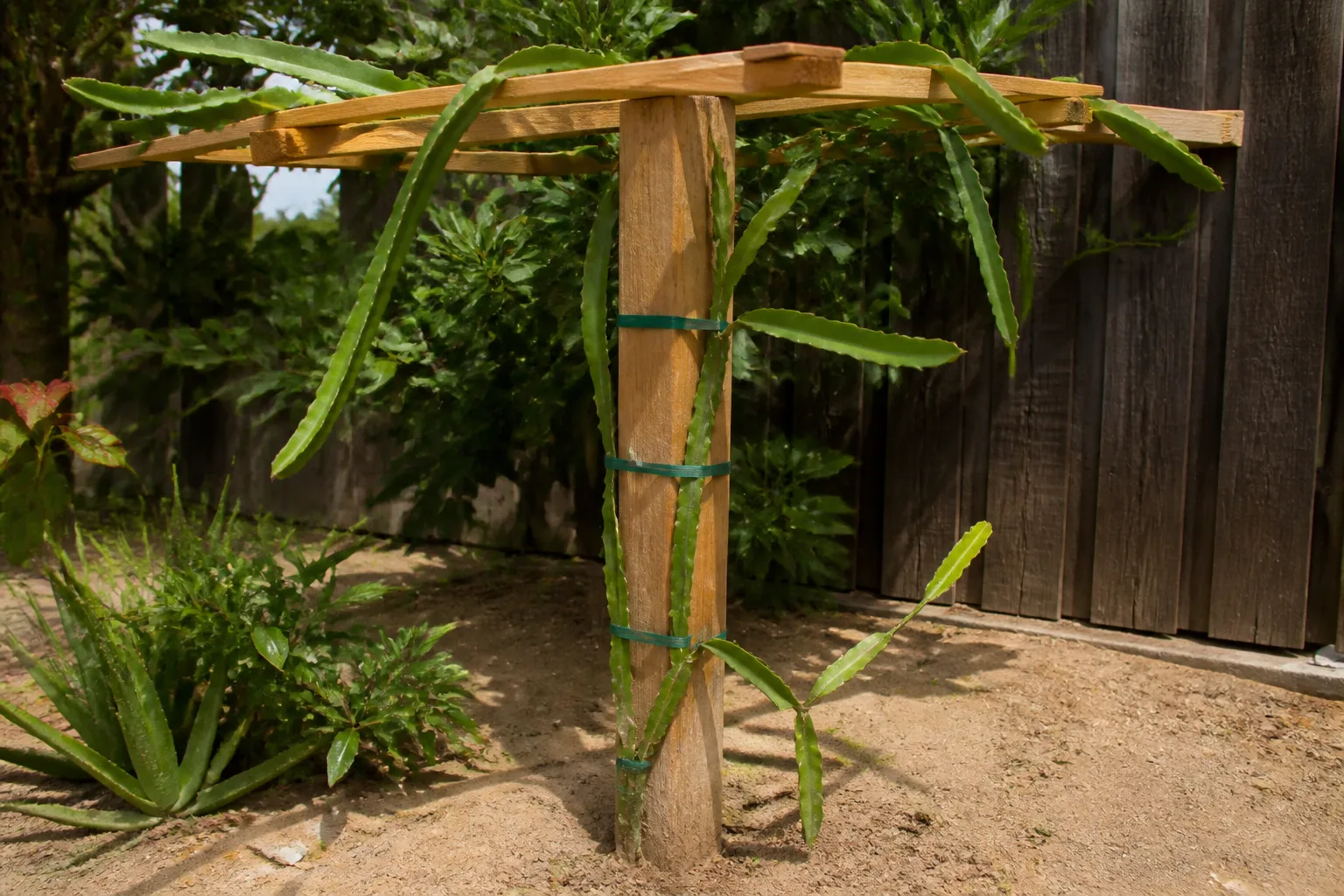
Dragon fruit is a climbing cactus with aerial roots that can grip nearby surfaces, but a house wall or curtain rod is not a dependable trellis. Use a sturdy central post or cage anchored inside the container, with a broad top frame that can support the weight of mature stems and any fruit. For an indoor plant, a compact post-and-crossbar or robust tomato-cage design can be easier to manage than an outdoor orchard pole; choose materials that will not cut or pinch stems.
Install the support while the plant is small, before roots spread through the pot. Tie the main stem loosely with soft plant ties as it climbs. A tie should hold the stem in place without tightening around it as it grows. Avoid sharp wire and flimsy stakes that will bend once the upper canopy begins to hang outward. The practical test is whether you can nudge the pot or move it carefully without the support rocking independently.
Plan to guide one or a few main stems up the support, then allow selected branches to spread and drape across the top. This creates a reachable canopy, keeps growth from sprawling across furniture, and improves access to flowers and fruit. If a full-size trellis will not fit your ceiling height, prune more often and accept lower production rather than letting the plant tangle itself into an immovable mass.
Choose a Stable Pot and Aerated Mix
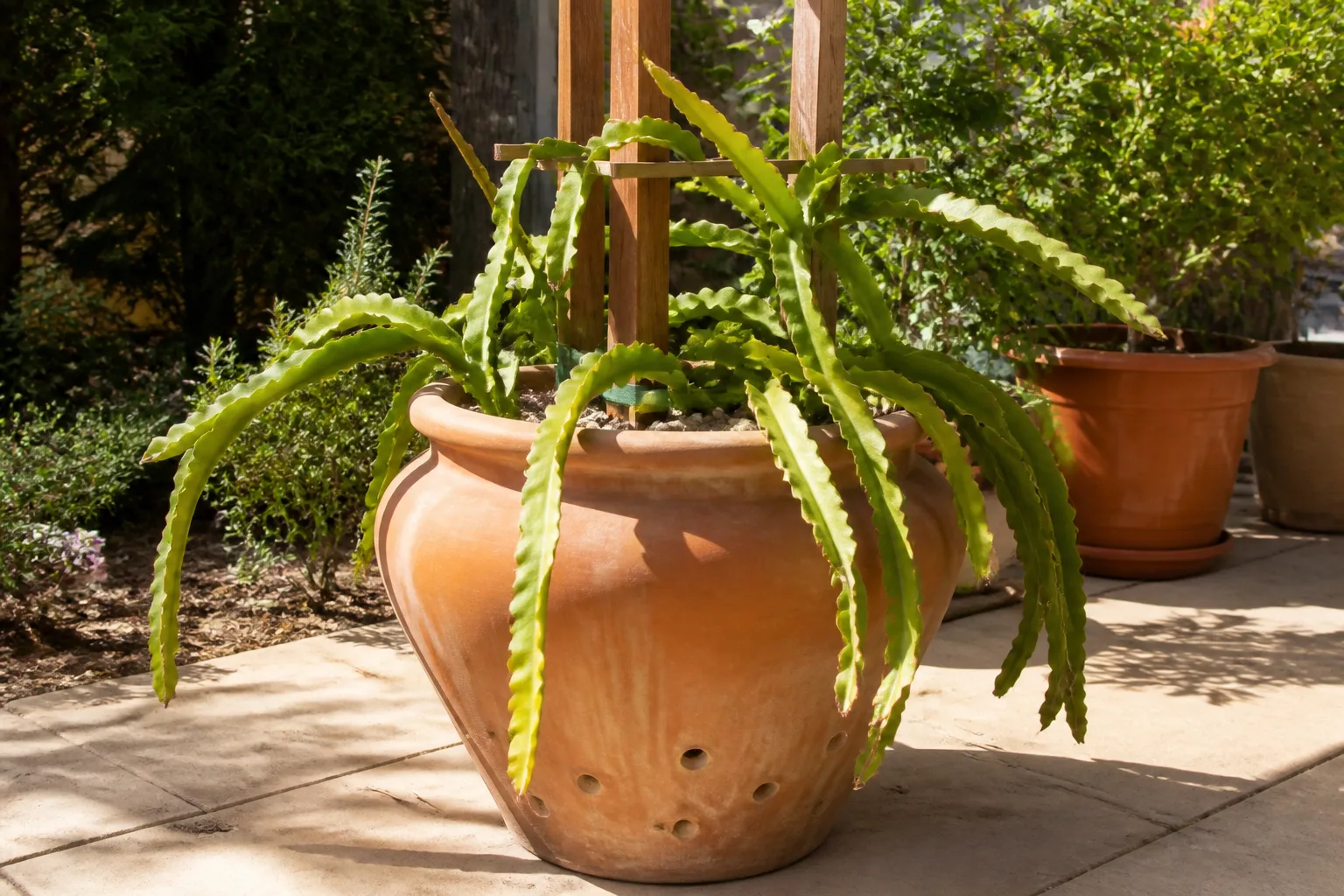
A container for dragon fruit has to do two jobs: drain quickly enough to protect the roots and resist tipping as the cactus grows above it. Choose a broad, heavy pot with several open drainage holes. A narrow, lightweight nursery pot is fine while rooting a cutting, but it is poor long-term support for a climbing vine. Put the final pot on a plant caddy rated for its filled weight if you need to move it seasonally.
Use a porous mix that holds some moisture without staying wet for days. Dragon fruit is a tropical cactus, not a desert cactus that wants an extremely dry, gritty medium. A workable starting blend is quality potting mix amended with perlite or pumice and a little fine bark; the exact balance depends on room temperature, pot material, and how quickly the container dries. UF/IFAS emphasizes well-drained soil with organic matter, and practical growers likewise caution against both soggy mix and low-nutrient, bone-dry media.
Do not put a layer of stones in the bottom as a substitute for drainage holes or a porous mix. That layer does not fix compacted soil; it reduces the volume of mix available to roots and can leave the perched wet zone higher in the pot. Use a pot with open holes, keep them clear, and water over a sink, tub, or saucer that you empty after excess water drains.
Move from a starter pot to a final container
An unrooted cutting does not need to begin in a huge tub. A small starter pot lets a young root system use the moisture in the mix before the lower layers remain wet too long. When roots are established and the plant is actively growing, step up to a larger container with room for the trellis post. A large mature plant may eventually need a container measured in tens of gallons; Epic Gardening recommends planning for roughly 20 to 35 gallons for indoor dragon fruit, a scale many homes cannot accommodate.
Repot when roots circle densely, growth stalls despite good light and care, or water races through a root-bound pot. Move up gradually if the plant is still small. When handling an established cactus, wear thick gloves and long sleeves, support the stems rather than pulling them, and protect the root ball as much as possible. The goal is not to repot every year; it is to provide enough root room without leaving a small plant in a large, persistently wet volume of soil.
Water by Dry-Down and Season
Water the mix thoroughly when the upper portion has dried, then let all excess drain. Do not water on a fixed weekly schedule: a small cutting in a cool room and a mature plant in a warm sunroom dry at very different rates. Check the pot with a finger or a wooden skewer, and use the pot’s weight as a second cue. If the mix still feels damp and the pot is heavy, wait; if it has dried several inches down and the plant is actively growing, water deeply.
Although it is a cactus, dragon fruit is not adapted to the same long drought cycles as many desert cacti. It has fleshy stems that store some water, but it grows in a tropical and subtropical context and benefits from moisture during active growth. The key is alternating a thorough watering with a real drying interval, not keeping the roots constantly wet and not letting the whole container go bone-dry for long periods while the plant is producing growth or fruit.
Reduce watering when days shorten, indoor temperatures fall, and growth slows in autumn and winter. Do not withhold water for months if the mix has dried completely or stems begin to shrivel; instead, give a measured drink and allow the pot to drain fully. Chronic wetness is a more serious indoor risk than a brief dry interval: sour-smelling soil, soft stems at the base, or blackening near the soil line calls for immediate inspection of drainage and roots.
Hold Warm Temperatures and Adjust for Winter
Dragon fruit prefers warm conditions and does not tolerate frost. UF/IFAS lists an optimum growth range around 65 to 77°F and warns that prolonged exposure below freezing can injure plants. Keep the container away from cold windowpanes, unheated entryways, and heating vents that dry or overheat one side of the stems. A stable room is better than repeatedly moving the plant between a warm living room and a chilly porch.
During winter, shorter days and lower light naturally slow growth. Keep the plant in the brightest safe spot, reduce watering in line with that slowdown, and pause fertilizer until you see active new growth again. A cool, dim room combined with summer-level watering is a common recipe for weak growth and root trouble. You do not need to create a hard dormancy indoors, but you should not force lush growth with frequent water and fertilizer when light has dropped.
If you use a grow light, give the plant a consistent day and night rather than leaving the lamp on around the clock. Dragon fruit’s flowers open after dark, and a dark period also gives the plant a normal daily cycle. Do not assume that extra lamp hours can compensate for low intensity or cold roots; fix the actual limiting condition.
Feed During Active Growth
Begin feeding only after a cutting has rooted or an established plant resumes active growth. Use a complete, balanced fertilizer diluted according to its label, and apply it to already moist mix rather than dry roots. Indoor containers have little buffering capacity, so a cautious rate is safer than trying to copy field fertilizer schedules intended for mature plants in the ground.
Avoid repeatedly applying a high-nitrogen product just to make the cactus grow faster. Excess leafy or stem growth can outpace the available light and support, and salts can accumulate in a container. A modest feeding during the active growing season is usually enough for a houseplant; reduce or stop in winter when growth is slow. If the stem tips are pale or growth stalls, check light, root condition, and drainage before assuming the plant needs more fertilizer.
Flush the pot occasionally by watering thoroughly until water runs from the drainage holes, then empty the saucer. If you see a white mineral crust on the mix or pot rim, reduce fertilizer strength and make sure the container drains well. Follow the fertilizer label for any edible crop use and avoid unregistered pesticide or fertilizer claims; nutrient ratios used in commercial pitaya fields should not be directly scaled to one indoor pot.
Train and Prune the Canopy
Training has two stages. While the plant climbs, keep one or a few strong stems moving upward and remove only side growth that prevents a clear route to the support. Once a stem reaches the top, pinch or prune its tip to encourage branching. Guide selected branches across the support and let them hang where the room has space, instead of allowing a dense tangle to form around a window or light.
Prune to keep the center open, remove damaged or diseased stems, and keep the plant within the safe capacity of its support. UF/IFAS recommends training the main stem to the trellis, then tipping it to produce lateral branches; later thinning improves light penetration and access. Use clean, sharp pruners and wear protective gloves because small spines or rough areoles can irritate skin even on stems that appear nearly smooth.
Do not strip every side branch from a mature canopy. Flowers develop along mature stems, so severe pruning can remove potential flowering sites and set back fruiting. If you must reduce size for indoor safety, remove a few crowded or poorly placed stems at a time and keep healthy, well-lit branches. Let cut sections callus before using them as propagation material rather than planting a fresh wound into wet mix.
Get Flowers to Set Fruit Indoors
Dragon fruit’s dramatic flowers are short-lived, fragrant, and typically open in the evening or at night. A flower can close by morning, so indoor growers cannot count on daytime insects to do the work. UF/IFAS explains that some cultivars are self-incompatible and that night pollination in cultivated plantings is not reliably observed; hand pollination is a practical way to improve your chances when flowers appear.
Fruiting is a chain of conditions: the plant must be mature enough to flower, receive enough light and warmth to sustain a bloom, have compatible pollen, and get that pollen onto the stigma while the flower is open. A bud that forms and then aborts points to stress or insufficient resources; a healthy bloom that closes with no swelling at its base points more strongly to pollination or compatibility. This sequence helps you change the right thing instead of watering or fertilizing blindly.
Check cultivar compatibility before the first bloom
Before flowering begins, look up the cultivar name and ask the seller whether it is self-fertile, self-pollinating, or self-incompatible. These terms are often used loosely in retail listings, so seek a clear explanation of whether pollen from the same plant can set fruit. UF/IFAS warns that compatibility information is incomplete for many selections, which means even a named plant may come with some uncertainty.
A self-compatible plant may set fruit with its own pollen, but hand-pollination can still help in a room without natural pollinators. A self-incompatible plant needs pollen from a different compatible genetic type; buying two plants that are cuttings of the same clone may not solve that problem. If you have room for only one vine, choose a verified self-compatible cultivar and consider fruit a possibility rather than a guarantee.
Hand-pollinate while the flower is open
Check buds each evening as they swell. When a flower opens fully, use a clean, soft paintbrush or cotton swab to pick up pollen from the anthers, the pollen-bearing parts around the center of the flower. Gently dab that pollen onto the broad stigma lobes at the center. If the plant is self-incompatible, collect pollen from a different compatible cultivar and apply it to the recipient flower.
Pollinate after the flower has opened and while it remains fresh, usually from dusk through the night and into early morning. Do not wait until the flower has wilted shut. Use a fresh brush or swab for each recipient if you want to keep pollen sources separate, and label the flower or stem if you want to track which pairing worked. Gardener’s Path describes hand-pollination as useful for both self-fertile and self-sterile plants; the most important distinction is whether your pollen donor is genetically compatible.
Over the next several days, watch the swollen base behind the flower. If it enlarges and remains green, fruit may be developing; if it yellows, shrivels, and drops, the flower did not set. One failed bloom does not prove the cultivar is incompatible. Check timing, pollen source, and light first, then try again with the next flower.
Diagnose Common Indoor Setbacks
Long, narrow stems or growth leaning at the window usually mean the plant needs stronger light or a closer position. Move it gradually, add a grow light, and rotate the pot so new stems do not all reach in one direction. Do not respond by feeding heavily; fertilizer cannot replace light.
Soft, dark stems near the soil suggest excess moisture or poor drainage. Stop watering, check that the drainage holes are open, and inspect the base for spreading rot. If only one stem is affected, remove it with clean pruners and let the remaining mix dry more between waterings. If several stems soften or the roots smell sour, the plant may need a faster-draining medium and removal of damaged roots.
Bleached or tan patches on the window side are consistent with sun stress, especially after a move from shade to direct sun. Filter the harshest rays and acclimate the plant over several days. A heavy canopy leaning or pulling the pot over is a support problem, not a pruning problem alone: stabilize the container, shorten the longest stems selectively, and rebuild the trellis before new growth adds more weight.
Flowers without fruit call for a compatibility and pollination check. Confirm the cultivar, pollinate while the flower is fully open, and use a second genetic type if needed. If the plant never flowers, first review light, maturity, and seasonal warmth; an indoor plant grown from seed may take years to reach reproductive size.
Move the Plant Outdoors in Summer, Then Bring It Back
A spell outdoors can increase light and air movement, but only move the dragon fruit once nights are reliably warm and frost risk has passed. Start in bright shade for several days, then increase exposure gradually. A plant that lived behind glass can sunburn quickly outdoors even when the same location seems pleasantly sunny to you. Put the pot where wind cannot topple the trellis, and check moisture more often because outdoor warmth and airflow dry containers faster.
Bring it back inside before cold nights arrive rather than waiting for visible damage. Inspect stems and the pot for insects, rinse off dust, and acclimate it back to indoor light. If your home has no bright window, move the grow light into its winter position before the plant returns so it does not spend days in dim light.
Location matters if you are in a warm climate and considering leaving the cactus outdoors permanently. UF/IFAS classifies Selenicereus undatus as invasive and not recommended for landscape planting in Central and South Florida, while its North Florida assessment says it is not documented as a problem species there. Check current local guidance before planting any vigorous fruiting cactus in the ground; keeping it in a container also makes growth easier to manage.
Harvest Fruit at Full Color
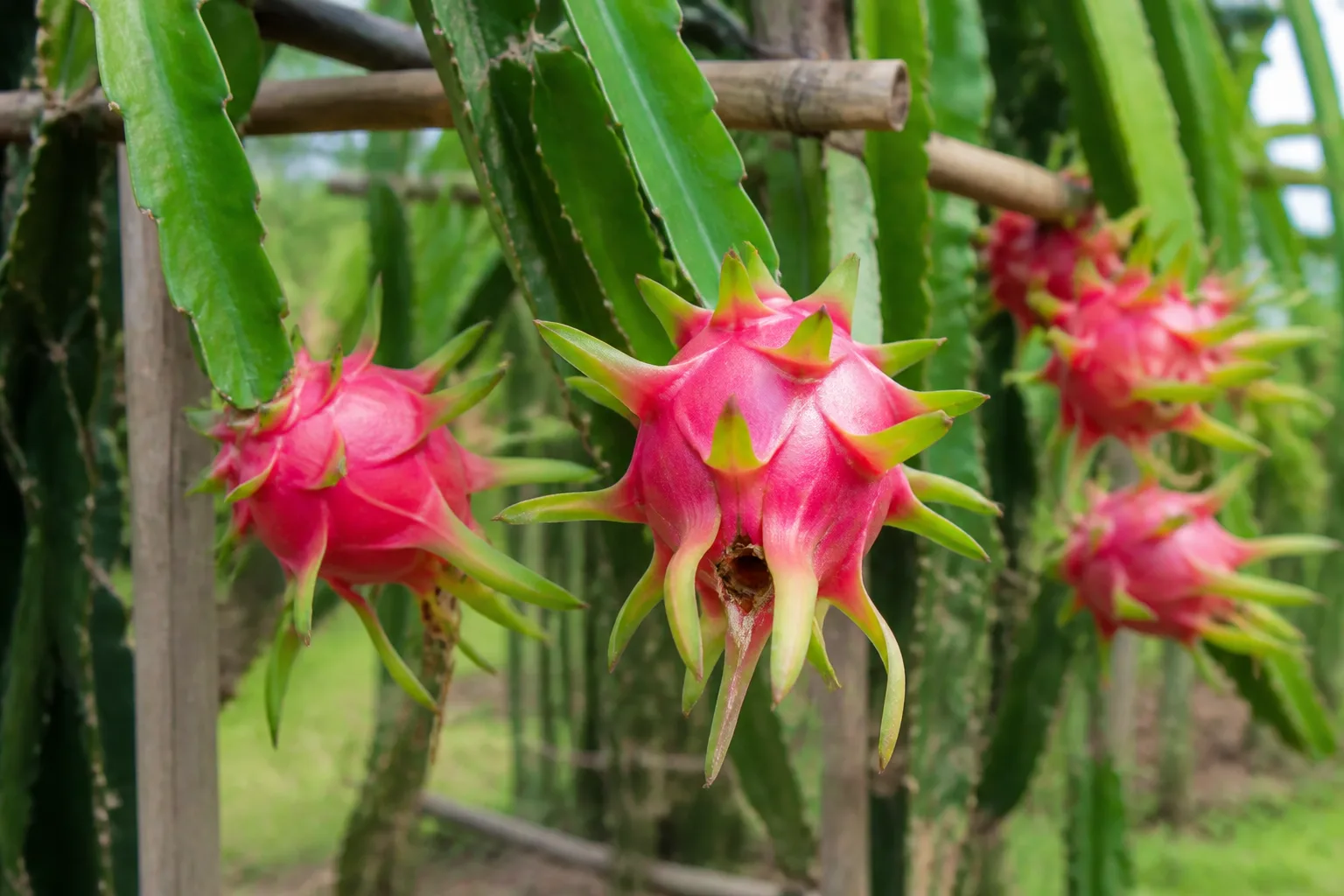
Harvest when the fruit has developed its full cultivar-specific color and the outer scales begin to lose their fresh green look. The exact skin color may be pink, red, or yellow, so use the variety’s expected color rather than waiting for every dragon fruit to look like grocery-store produce. The fruit should feel slightly yielding, not hard like an unripe fruit or soft and collapsing from overripeness.
Use clean hand pruners to cut the fruit stem rather than twisting or pulling hard on the cactus. That protects the fruit skin and avoids tearing a heavy branch off the support. Handle the plant carefully while reaching through the canopy; fruit harvest is when hidden spines and snagged stems are most likely to cause trouble.
If fruit stays green or shrivels, it may have been harvested too early, failed to develop after poor pollination, or lacked enough resources to finish. Keep notes on flower dates, pollen donor, and fruit color for the next bloom cycle. A simple record can tell you whether you need a better pollination partner, more consistent light, or a change in seasonal care.
Conclusion: Plan for the Canopy Before the Fruit
Dragon fruit cactus can grow indoors when you give it bright light, warm conditions, a draining mix, steady seasonal watering, and a support built for its mature weight. For fruit, add one more requirement: a compatible cultivar and a plan to hand-pollinate short-lived flowers at night. Those needs are substantial, but they are manageable when you plan the whole setup before the vine outgrows its pot.
Start with a healthy rooted cutting, place it where the brightest light is available, and choose a stable container that can hold both roots and trellis. If your home cannot provide the light or space needed for fruiting, the plant can still be an unusual ornamental cactus; set that expectation early and enjoy the climbing stems without measuring success only by harvest.