How to Grow and Care for String of Hearts
Grow string of hearts (Ceropegia woodii) with bright light, gritty soil, and dry-down watering—plus tuber propagation, cultivar picks, and fixes for yellow or curling leaves.

String of hearts (Ceropegia woodii) looks effortless in photos—silver-marbled hearts trailing from a hanging basket, bead-like tubers catching the light. In real homes it often arrives lush, then six months later the vines stretch thin, leaves shrink, and half the strand goes yellow while the pot still feels wet. That pattern is not bad luck. String of hearts is a South African succulent vine with tuberous roots and aerial beads that store water. Most living rooms run too dim and too wet for that biology. This guide gives you clear targets for light, watering, soil, and propagation—or helps you decide honestly when a string of pearls or hoya fits your space better.
String of Hearts Quick Reference
Use this table before you change anything. If several factors are off, fix light and watering first—fertilizer rarely saves a string of hearts in a dark, soggy pot.
| Factor | Indoor target | Notes |
|---|---|---|
| Light | Bright indirect; gentle morning sun once acclimated | Leggy gaps = too dim; bleached leaves = too much hot midday sun |
| Water | Soak, then dry down fully | Check mix depth and pot weight—not a calendar |
| Soil | Fast-draining cactus/succulent mix | Add perlite or pumice if mix stays wet |
| Pot | Shallow, snug; drainage holes required | Crowded roots are fine; oversized pots raise rot risk |
| Temperature | 65–80°F (18–27°C) active growth; avoid prolonged below 60°F | Winter rest above 60°F per Wisconsin Horticulture |
| Humidity | Average indoor (30–50%) | High winter humidity with cold soil encourages rot |
| Fertilizer | Dilute balanced or succulent formula monthly in spring–summer; none in winter | Low nitrogen; excess nitrogen softens growth |
| Pets | Not listed as toxic to cats or dogs on ASPCA plant lists | Still keep out of reach of chronic chewers |
| Vine length | Often 3–12 feet indoors over time | NC State Extension notes stems to about 3 feet; mature specimens trail farther |
| Outdoor zones | USDA 9–12 | Spreads easily in frost-free ground—contain if needed |
| Propagation | Stem cuttings, aerial tuber layering, soil pinning | Seeds are rare in trade |
For deeper dives, use the string of hearts care hub, watering guide, light guide, soil guide, fertilizer guide, repotting guide, and propagation guide.
What String of Hearts Actually Is
String of hearts belongs to genus Ceropegia in Apocynaceae—the dogbane family that also includes hoyas and milkweeds. The species epithet woodii honors John Medley Wood, a collector of native African plants. In habitat, the vine scrambles through other vegetation with thin, purple-tinged stems bearing opposite, heart-shaped leaves roughly 1–2 cm wide. Upper surfaces show dark green marbling on silver; undersides run green to purple. NC State Extension describes long wiry stems draping about three feet from a container, though well-grown indoor plants routinely exceed that length over years.
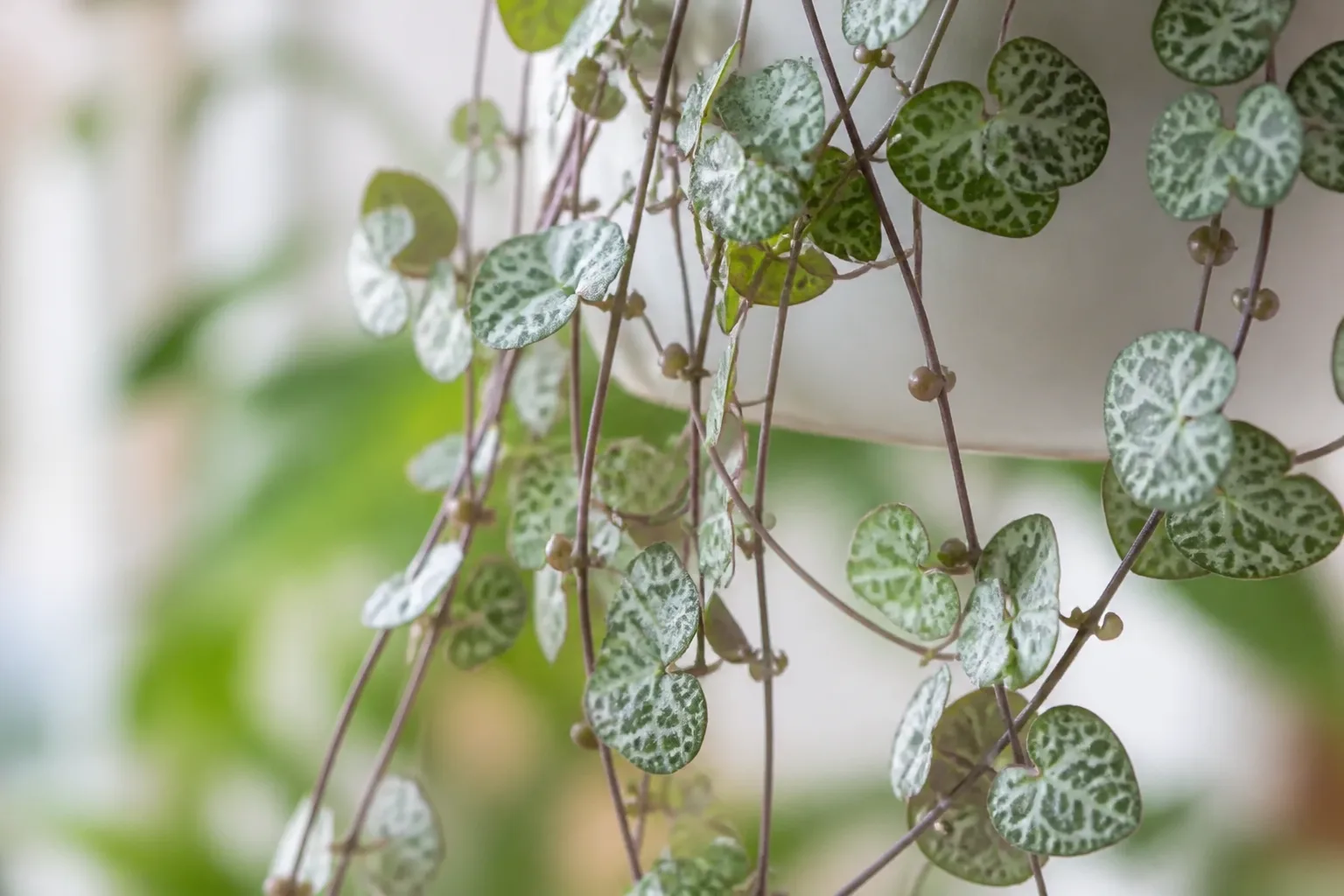
Common names map to real features: rosary vine and chain of hearts refer to the bead-like swellings along the stem; Chinese lantern nods to the pale magenta tubular flowers with a bulbous base. Those blooms are small—about an inch long—and more charming than showy. Insects occasionally enter the flower tubes, but string of hearts is not carnivorous despite the trap-like shape.
Aerial Tubers and the Rosary Vine Name
Along the stem, between leaf pairs, string of hearts forms aerial tubers (tubercles)—firm, pea-to-marble-sized beads that store starch and water. Wisconsin Horticulture notes these aerial tubers root readily when touching soil, which makes propagation unusually forgiving. Underground, the plant also develops a woody caudex and larger storage tubers that can eventually fill a pot. That dual storage system is why string of hearts tolerates missed waterings better than tropical foliage plants—and why it rots quickly when mix stays wet.
Understanding tubers changes how you diagnose problems. A firm bead on a healthy vine is normal. A shriveled bead with wrinkled leaves usually means thirst. A soft vine base with sour wet soil means rot, not “needs a drink.”
Light Requirements for String of Hearts
String of hearts is not a low-light plant. NC State Extension recommends bright, indirect sunlight—think dappled or filtered light rather than a dark corner. Wisconsin Horticulture adds that in strong light leaves darken and marbling shows clearly; in weak light they turn light green with wide internodes. That leggy stretch is the plant reaching for photons, not a personality quirk.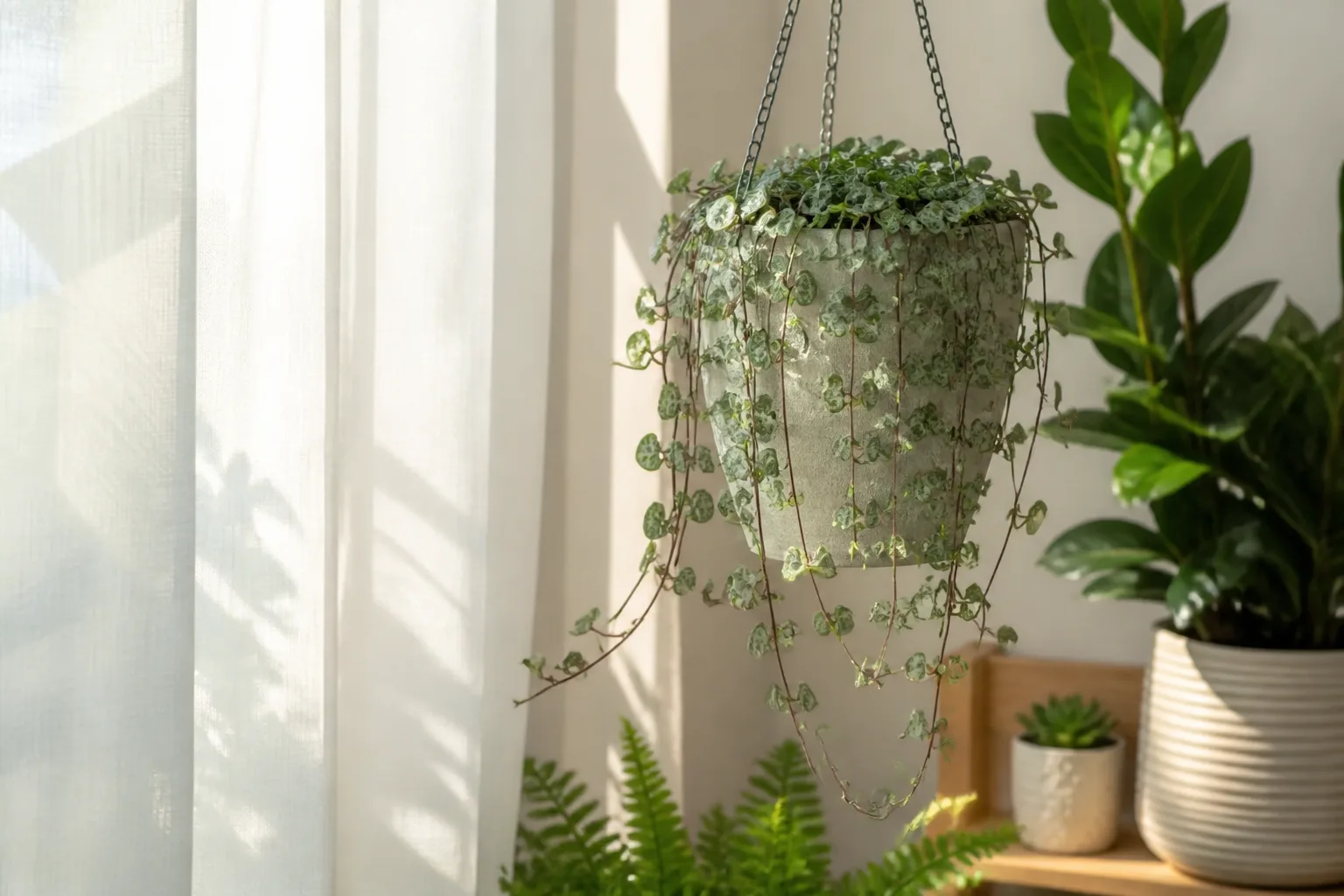
East-facing windows are ideal for many homes: bright morning sun, gentler afternoon. West and south windows work with a sheer curtain or a few feet of setback from hot glass. North rooms can grow string of hearts only if you supplement with a quality grow light for 10–12 hours daily. Without enough light, the plant uses water slowly, mix stays wet longer, and rot risk climbs even when you “water correctly.”
Window Placement and Variegation Needs
Variegated string of hearts (Ceropegia woodii ‘Variegata’, ‘Silver Glory’, and similar) need more light than the green type to keep cream, pink, or silver markings. Dim rooms produce revert-green growth and washed-out pattern. Place variegated pots within three feet of a bright window or under supplemental light, and rotate the hanger weekly so both sides of the cascade receive photons.
If you move a string of hearts outdoors for summer, acclimate gradually over 7–10 days. Wisconsin Horticulture warns that sudden strong sun causes sunburn—bleached or crisp patches on hearts that will not green up again. Bring pots indoors before frost; the species is not cold-hardy in temperate climates.
Soil and Pot Choice
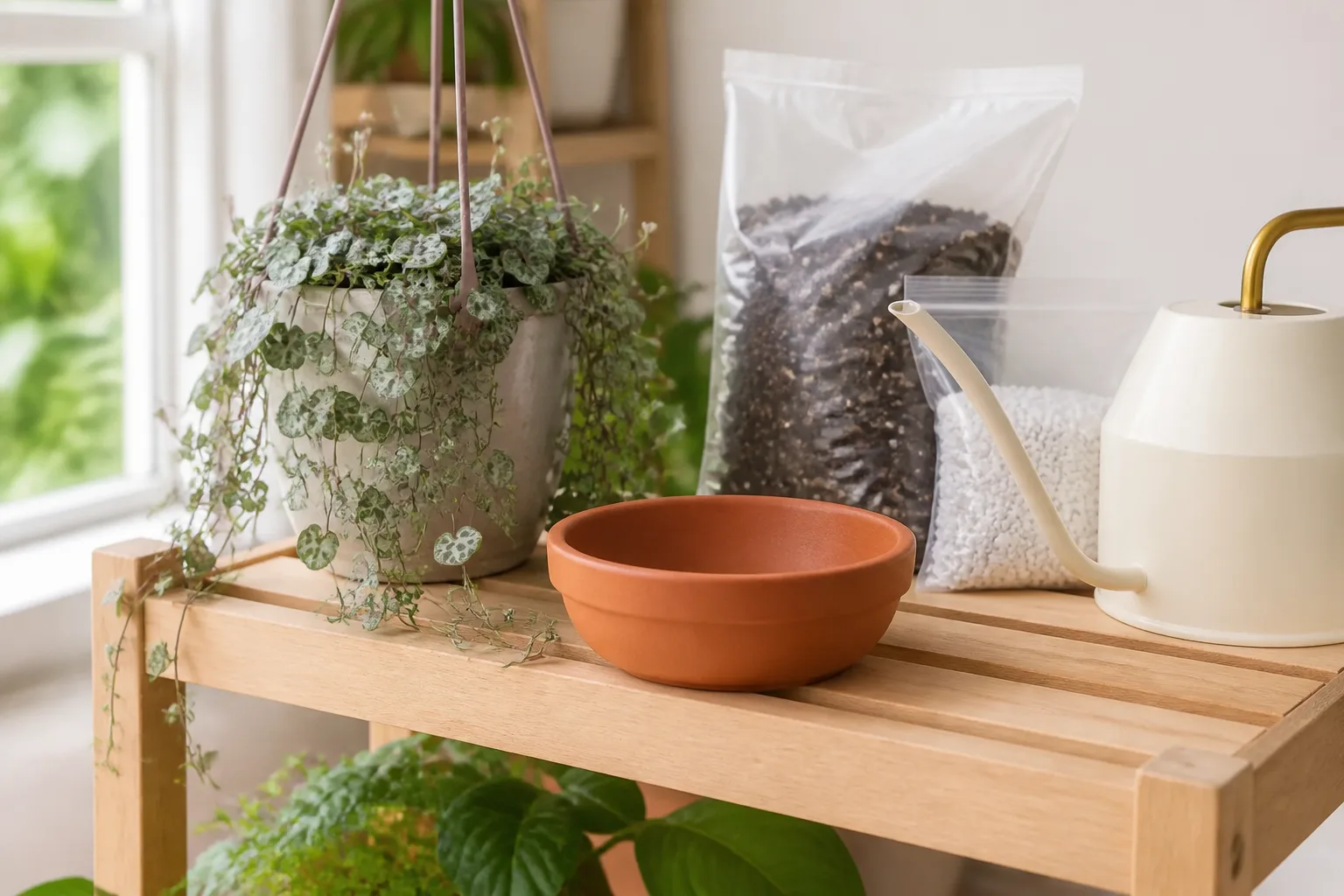
String of hearts wants excellent drainage above almost everything else. NC State Extension specifies well-drained sandy potting soil; RHS recommends cactus compost. A commercial cactus or succulent mix amended with extra perlite or pumice (roughly 20–30% by volume) suits most homes. Ordinary peat-heavy potting soil holds moisture too long unless you cut it with coarse grit.
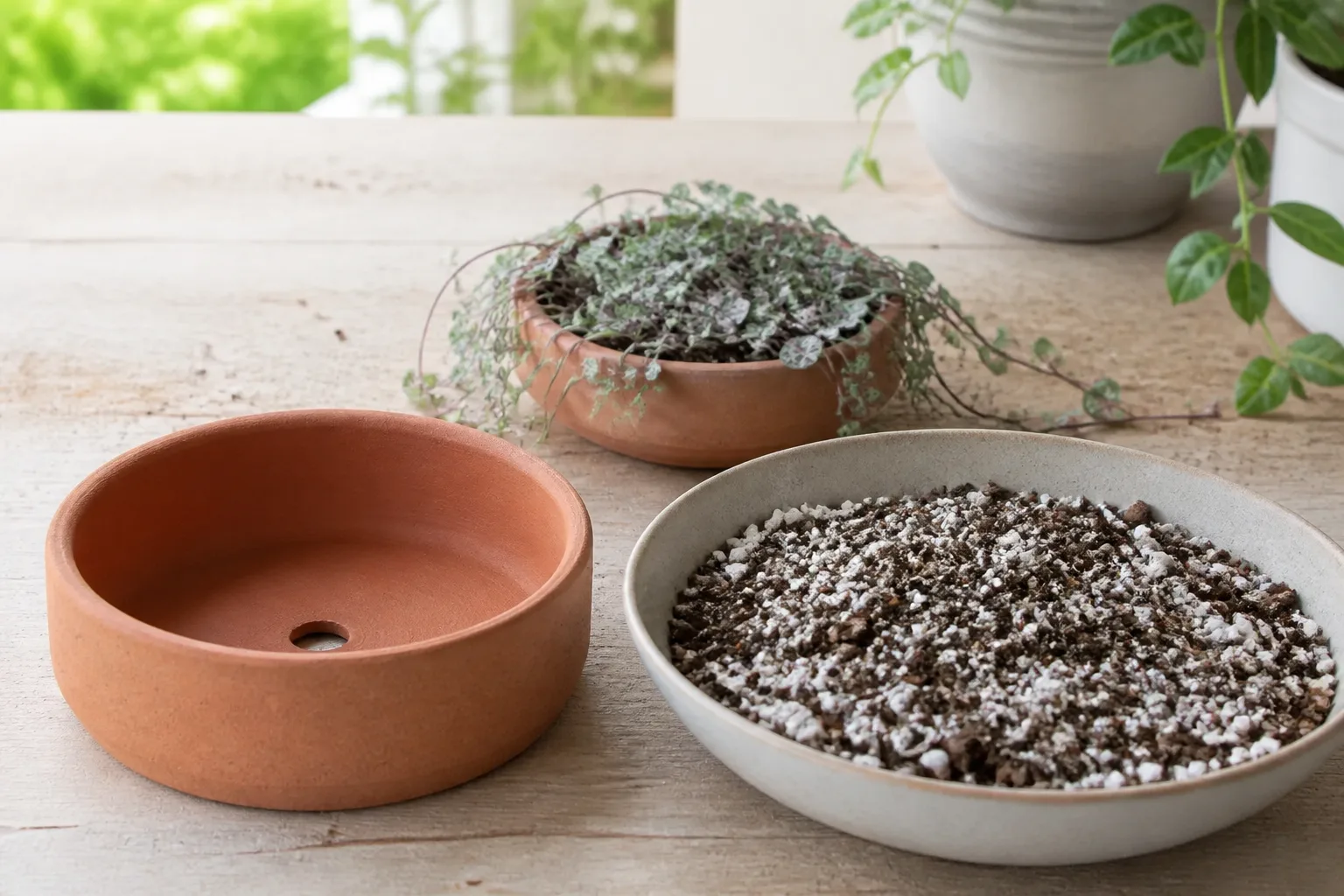
The plant prefers shallow, slightly snug pots with large drainage holes. Fine roots spread wide rather than deep; an oversized decorative pot full of wet mix is a common rot trap. Unglazed terra-cotta helps wick moisture and suits string of hearts well. Avoid pots without drainage holes, cachepots that trap runoff, and heavy garden soil indoors.
When to Repot Without Breaking Vines
String of hearts likes to be crowded—repot only when roots protrude from drainage holes, growth stalls despite good light, or mix has collapsed into a hydrophobic brick. Spring, as active growth resumes, is the safest window per Wisconsin Horticulture. Move up one pot size (often 4 inch to 5 inch or 6 inch for hanging baskets), support trailing vines with one hand, and backfill with dry-ish mix before one thorough soak.
Delicate stems snap easily during repotting. Water the plant lightly the day before so stems are pliable but mix is not mud. If you break strands, root them—see propagation below—rather than discarding them.
How to Water String of Hearts the Right Way
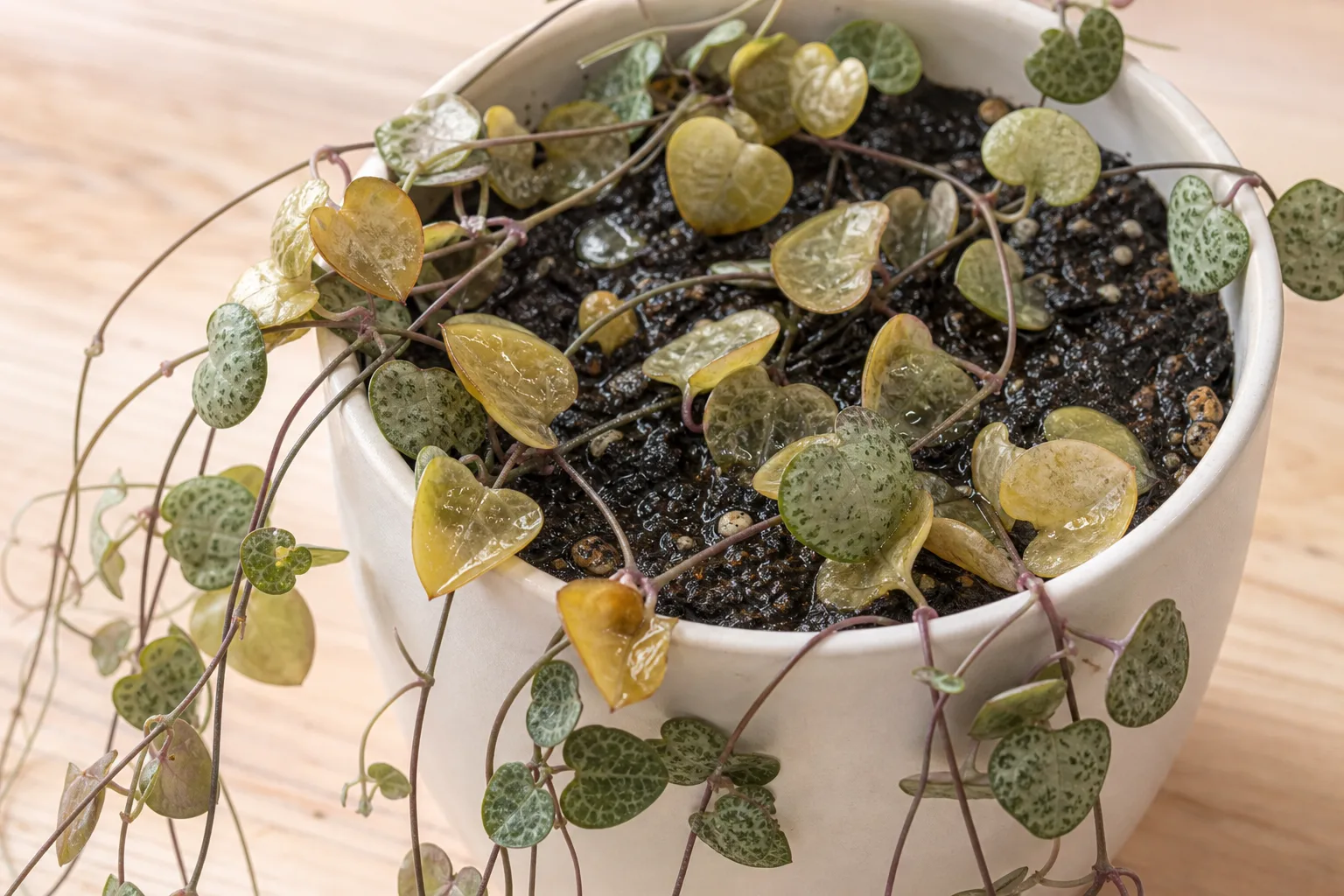
String of hearts is drought-tolerant yet wants more frequent drinks than desert cacti because thin leaves transpire steadily in bright light. The failure mode in most homes is not underwatering—it is watering on a schedule while light is too low. NC State Extension is explicit: allow soil to dry out completely between waterings, and reduce further in winter dormancy.
Use a finger or bamboo skewer two inches into the mix. When dry at that depth—or when the pot feels noticeably light—water until excess runs from drainage holes. Discard saucer water within 30 minutes. Never let the pot sit in standing water. If you use a moisture meter, wait until it reads dry in the root zone, not merely “moist” at the surface.
Thirst signs: wrinkled or curling leaves, soft but not mushy stems, shriveled aerial tubers. Overwater signs: yellowing lower leaves, translucent soft tissue, blackening stems at soil line, persistent fungus gnats. For the full diagnostic path, see yellow leaves and overwatering on the plant-care cluster.
Winter Dormancy and Dry-Down Rules
When temperatures stay below about 60°F (15°C) or daylight shortens, string of hearts slows growth and enters a rest period. Wisconsin Horticulture advises reducing water in winter and withholding fertilizer. Many indoor plants need water only every two to four weeks in cool, dim winter rooms—sometimes longer. Soggy cold soil is how healthy autumn plants die by February.
Resume normal dry-down cycles in spring as new leaf pairs open at vine tips and the pot lightens faster after each soak.
Temperature, Humidity, and Airflow
Active growth sits comfortably between 65–80°F (18–27°C). NC State Extension notes the species can handle brief dips near 20°F in unusual outdoor contexts, but prolonged cold—especially with wet roots—kills container plants. Indoors, keep pots away from forced-air heating vents that desiccate leaves in hours, and from single-pane winter glass that chills foliage below 50°F at night.
Average home humidity (30–50%) is fine. String of hearts does not need misting or pebble trays the way calatheas do. In fact, high humidity with cold, wet soil in winter encourages stem rot. Gentle air circulation from a ceiling fan on low reduces fungal issues on crowded hanging strands without blasting the plant.
Fertilizing During Active Growth
Feed only when the plant is actively growing—typically spring through early fall. RHS suggests a low-nitrogen liquid fertilizer two or three times during the growth season at diluted strength. Wisconsin Horticulture recommends half-strength houseplant fertilizer at most monthly when growing, and none during winter rest.
Excess nitrogen produces soft, weak vines that stretch and break. If your string of hearts is pale and leggy, light is the first fix—not more fertilizer. Skip feed for four to six weeks after repotting or propagation so new roots are not burned.
Popular String of Hearts Cultivars
The species type has gray-green marbled hearts. Trade selections add color and leaf shape variation:
| Cultivar / type | Look | Care note |
|---|---|---|
| C. woodii (standard) | Silver-marbled green hearts | Most forgiving in moderate bright light |
| ’Variegata’ | Cream, pink, silver edges | Needs brightest spot; slower in dim rooms |
| ’Silver Glory’ | Rounder, silvery leaves with dark green stripe | High light to keep silver; popular collector form |
| ’Orange River’ | Green leaves with warm orange flush | Slightly more light than standard for color |
| ’Heartless’ (string of spades) | Narrow spade-shaped leaves, pink undersides | Same culture; slightly faster internodes |
| Ceropegia linearis (string of needles) | Needle-like foliage | Even sharper drainage; slightly less forgiving |
All share the same watering and soil logic. Variegated forms are the ones most likely to revert or fade when light drops—treat brightness as non-negotiable.
Pruning for Fuller Cascades
Pruning is optional but useful when vines hit the floor or look bare at the top. Cut just below a node (where a leaf pair meets the stem) with clean scissors. String of hearts tolerates hard pruning; removed sections root easily. Prune in spring or summer so regrowth is fast.
To fill a sparse crown, coil trimmed vines across the soil surface and pin nodes with bobby pins or paper clips so they contact mix—an informal version of layering covered in the pruning guide. New shoots emerge from nodes near the soil line within weeks in bright light.
How to Propagate String of Hearts
Propagation is the reason many growers keep string of hearts forever—every trim becomes a new plant. NC State Extension notes seeds are uncommon in trade; stem cuttings and aerial tubers are standard. Spring through early fall rooting is fastest.
Water, Soil, and Tuber Layering Methods
Water propagation: Take a 4–6 inch cutting with at least two nodes. Strip lower leaves, submerge nodes in a clear jar of room-temperature water, bright indirect light. Change water every 5–7 days. Roots in 10–21 days in warm active growth. Plant when roots reach 1–2 inches.
Soil propagation: Bury two nodes in moist fast-draining mix; keep lightly moist, not wet. Roots in 2–4 weeks. A humidity dome helps in dry homes—vent daily.
Tuber layering (easiest for beginners): Press a firm aerial tuber onto moist mix while still attached to the parent vine. Wisconsin Horticulture describes roots forming in a few weeks to a couple of months; sever after a gentle tug meets resistance.
Butterfly method: Single-node cuttings with paired leaves laid on moist sphagnum produce two shoots per node—ideal for filling pots. Details live in the propagation guide.
UAEX Plant of the Week reminds growers that tubercles root when soil contact is maintained—pin vines instead of guessing.
Getting String of Hearts to Bloom
Indoor blooms are possible but not guaranteed. Flowers are tubular, pale magenta, roughly an inch long, with a swollen base—interesting up close, not dramatic from across the room. RHS lists bloom season summer into fall outdoors; indoor plants bloom less predictably.
To maximize odds: provide strong bright indirect light, keep the plant slightly root-bound, feed lightly during active growth, and avoid overwatering. Mature, well-lit specimens bloom more than young pots in dim offices. If flowers fail, you still have a beautiful foliage vine—do not chase bloom with heavy fertilizer.
Pests and Diseases to Watch For
NC State Extension lists aphids, mealybugs, and scale as the main pests. Mealybugs hide in leaf axils along thin stems; scale looks like brown bumps on vines. Treat with isopropyl alcohol swabs on visible insects, then insecticidal soap or horticultural oil on a test section, following label intervals. Repeat weekly until clear.
Root rot and fungal leaf spots follow overwatering and poor airflow. Black spots on leaves often trace to splashing cold water on foliage or chronic wet mix. Fix culture first: dry down, repot into gritty mix if roots are mushy, trim dead tissue with sterile tools. See root rot and mealybugs for cluster-specific steps.
Troubleshooting Yellow, Curling, and Dropping Leaves
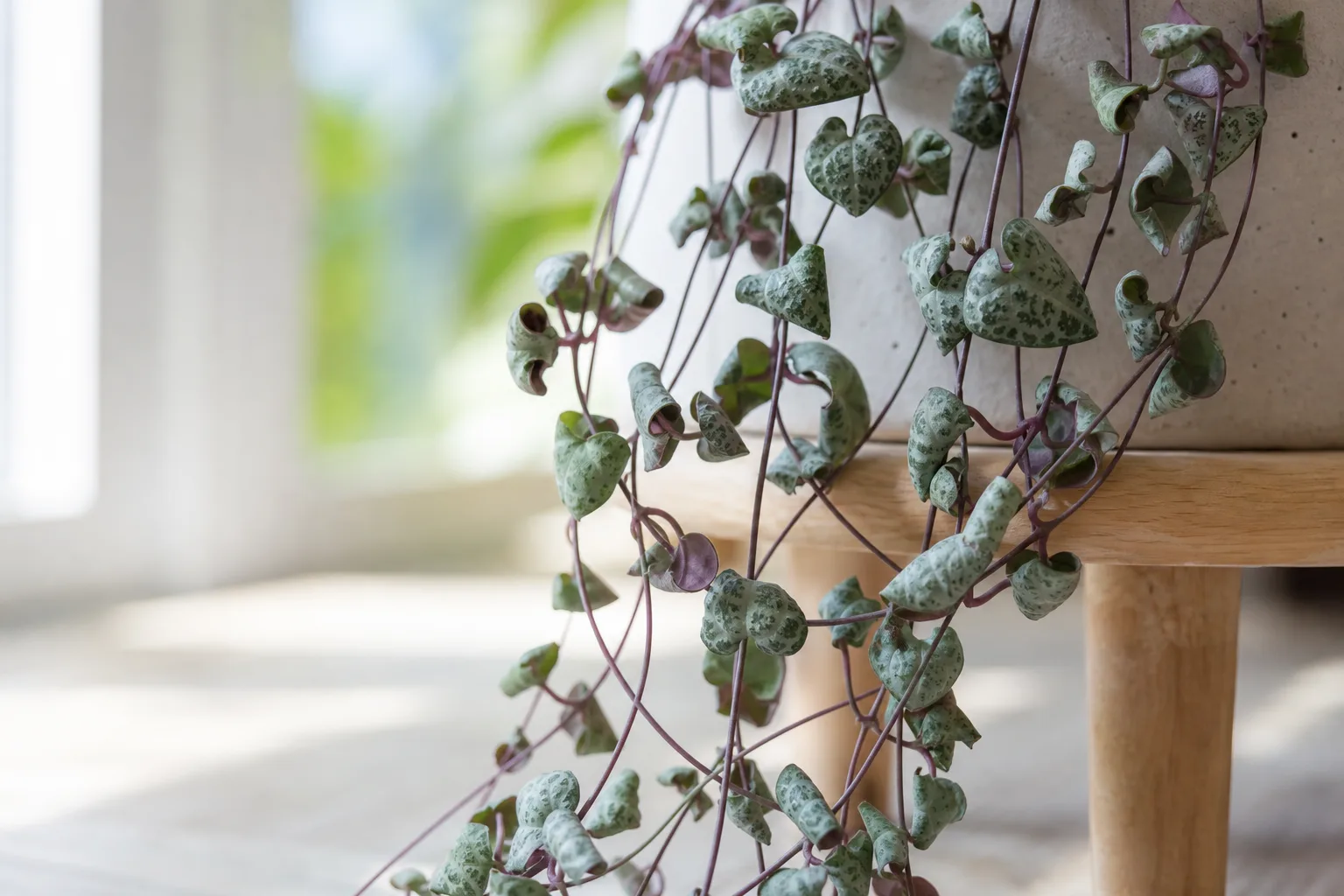
Most leaf problems are environmental, not mysterious disease.
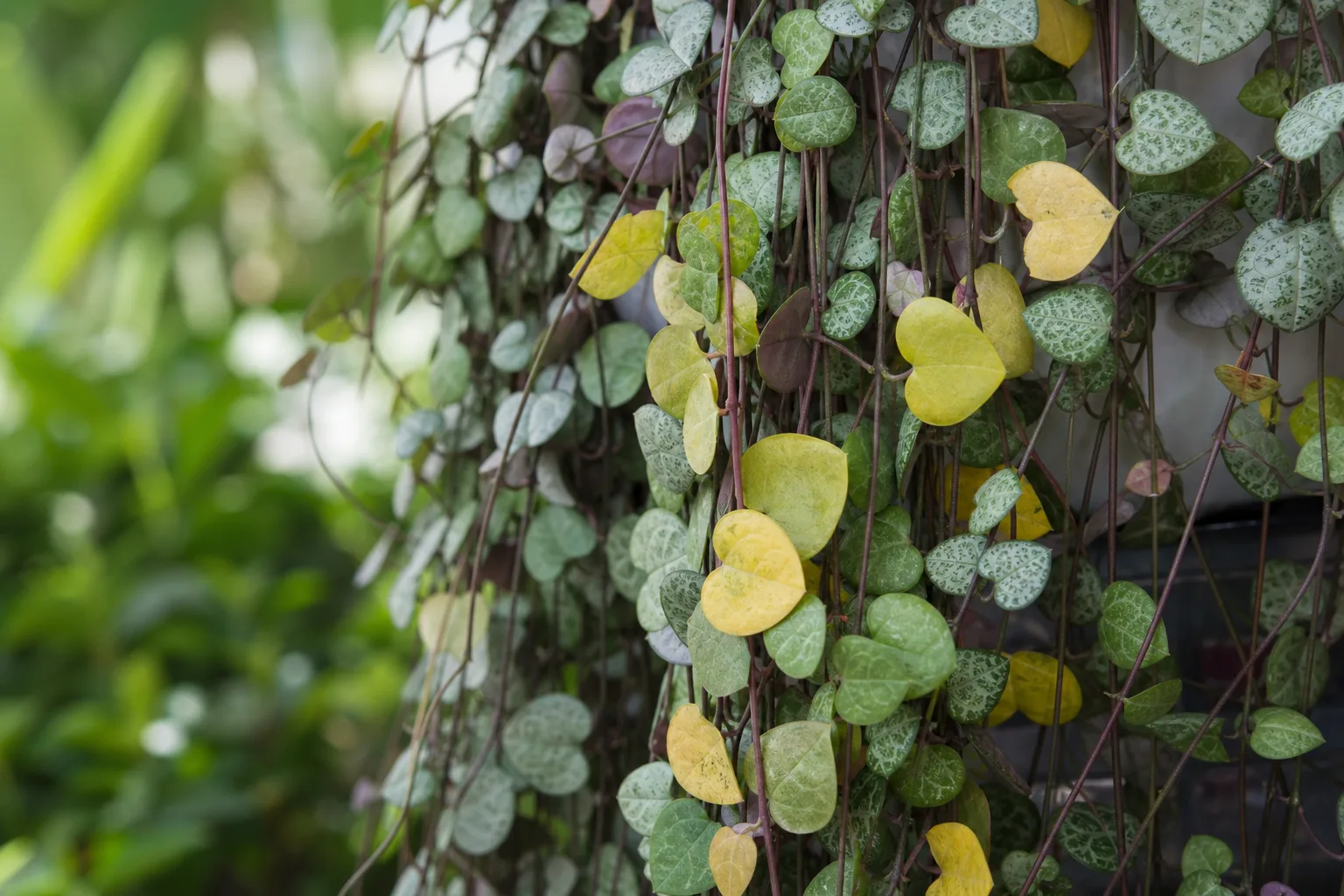
Yellow leaves usually mean overwatering, cool temperatures below 60°F, or sudden light reduction. Check mix moisture before reacting. If wet and heavy, stop watering and improve light. If dry and light, soak once and resume dry-down. Persistent yellow with mushy roots requires unpotting and trim-see yellow leaves.
Curling, wrinkled, or crispy leaves point to underwatering or extreme heat. Rehydrate with a full soak, then fix the schedule using pot weight. Do not dribble daily sips—that never rewets a dry root ball. See curling leaves.
Leaf drop combines both extremes: too wet, too dry, or too dark. Rule out pests with a magnifier on undersides. Leggy bare stems with small pale leaves are a light problem—move the plant or add a grow light before pruning back hard in spring. See leggy growth and not enough light.
Growing String of Hearts Outdoors
In USDA zones 9–12, string of hearts grows outdoors in well-drained soil with partial sun. NC State Extension warns it spreads easily in zone 10 landscapes—use containers or controlled beds if you do not want it wandering. In cooler zones, treat it as a summer patio plant: acclimate to morning sun, shelter from heavy rain that saturates mix, and bring indoors before nights drop below 50°F for extended periods.
Outdoor specimens often bloom more freely than indoor hangers. Frost kills above-ground vines; protect pots or move them inside before first freeze.
Conclusion
String of hearts rewards a simple contract: bright light, gritty soil, and honest dry-down watering with a real winter rest. Learn to read aerial tuber firmness and pot weight instead of watering on autopilot, and this vine becomes one of the easiest trailing houseplants to grow and share. When something looks off, check light and moisture before reaching for fertilizer or a bigger pot—those two variables explain most yellow, curling, and leggy strands. Keep the string of hearts hub bookmarked for watering, propagation, and problem-specific fixes as your cascade lengthens.