How Hot Is Too Hot for Houseplants? A Care Guide
How hot is too hot for houseplants? Learn practical temperature ranges, heat-stress signs, and a cool-first recovery plan for sun, vents, and dry air.
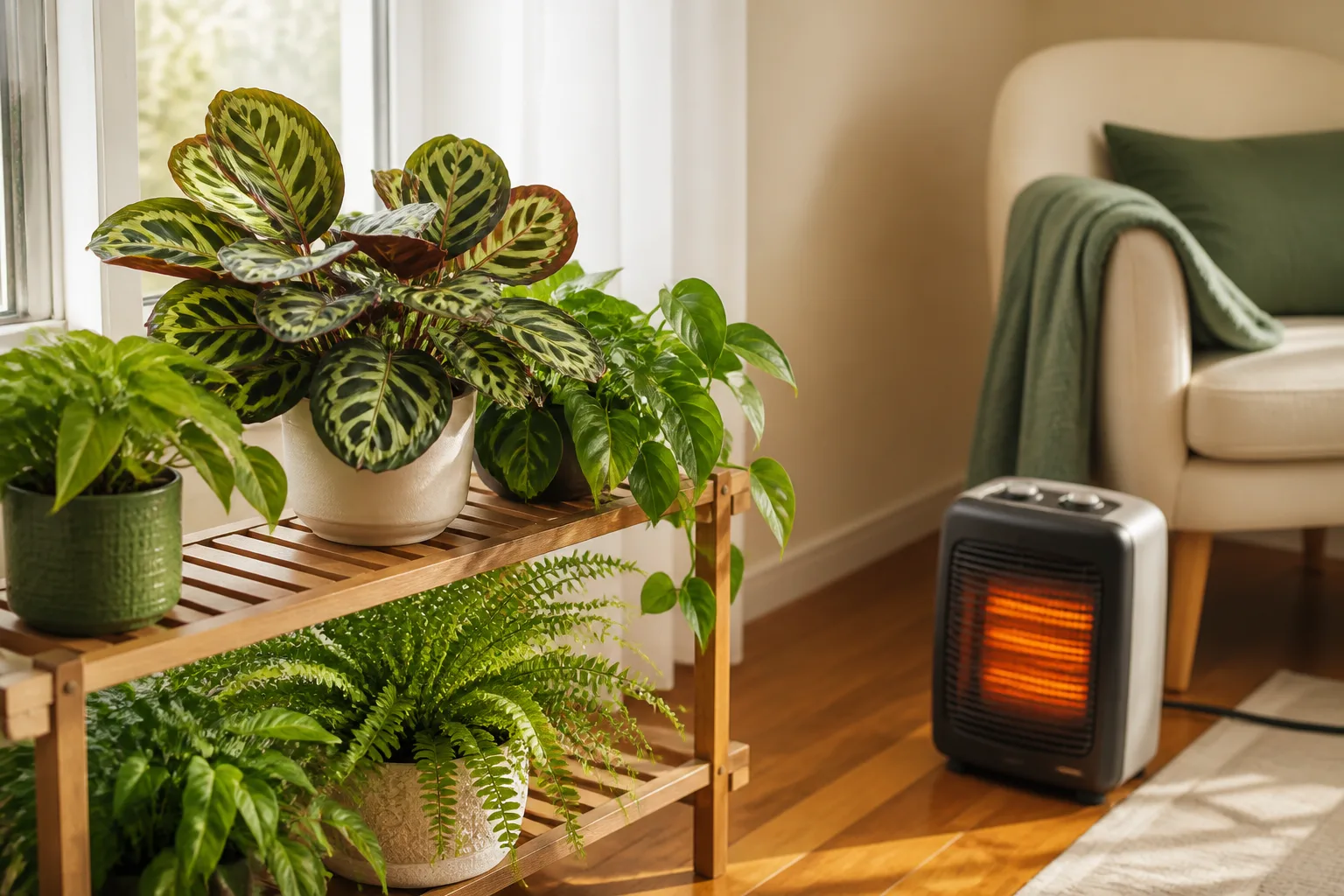
An 80°F room is not automatically too hot for a houseplant. For most tropical foliage plants, that temperature can be comfortable. The risk rises when heat arrives with direct sun, hot glass, dry moving air, a genuinely dry root ball, or a rapid swing that gives the plant no time to adjust.
That is why the thermostat can say 78°F while a plant beside a west-facing window wilts every afternoon.
Use temperature as a risk signal, not a verdict. Move a plant out of radiant heat or a hot air stream first, check the potting mix at root depth second, and only then decide whether it needs water. This order prevents the most common heat-wave mistake: adding water to a plant that is already wet but cannot function in the heat.
The quick answer: heat is a combination, not one number
There is no single temperature at which every houseplant fails. A thin-leaved maidenhair fern, a rubber plant, and a snake plant do not lose water at the same rate or respond to the same light.
As a practical indoor triage guide, treat 60–80°F (16–27°C) as a broadly comfortable working range for many common foliage plants, provided the light, moisture, and airflow are reasonable. Plants that prefer cool conditions may want less, while warm-growing tropicals can handle the upper end and sometimes higher. Colorado State University Extension groups houseplants by cool, intermediate, and warm temperature preferences rather than assigning one rule to all of them; its intermediate group is about 60–75°F and its warm group is above 75°F. That temperature-and-humidity guidance is a useful reminder that “houseplant” is not a climate.
Use these bands as a decision aid, not a promise:
| Air temperature at plant height | Practical reading |
|---|---|
| Below 55°F (13°C) | Caution for many tropical foliage plants; avoid cold glass and drafts. |
| 55–65°F (13–18°C) | Fine for many tolerant plants and some cool-growing types; reduce watering as growth slows. |
| 65–80°F (18–27°C) | Usually comfortable for common foliage plants when soil and light are appropriate. |
| 80–85°F (27–29°C) | Watch the root ball, sun exposure, and humidity; many plants still cope if conditions are steady. |
| 85–90°F (29–32°C) | High-risk zone for prolonged exposure, especially with direct sun, low humidity, or dry mix. |
| Above 90°F (32°C) | Treat as an active heat event: cool the placement, reduce radiant load, and monitor closely. |
The last two rows are practical triage thresholds, not universal species limits. A healthy succulent may manage a hot spell better than a fern, while a newly purchased tropical plant may fail sooner because it is already dehydrated or unacclimated. Follow a narrower range on the plant’s care label.
What heat actually does to a houseplant
Heat stress begins when the plant’s demand for water and cooling outpaces what its roots can supply. Leaves lose water through tiny pores called stomata. That movement, called transpiration, can cool the leaf and pull water upward, but it only works while the root zone can replace the water being lost.
When demand spikes, cells lose some of the water pressure that keeps leaves firm. The visible result can be a soft, folded, or curled leaf even when the mix is still moist. The roots may have water available, but they can be too hot, oxygen-starved, damaged, or simply slower than the leaves’ demand. A peer-reviewed review indexed by PubMed on plant responses to heat stress describes the broader pattern: high temperature can disrupt photosynthesis, water status, membranes, and other physiological processes. That research covers plants broadly, not every living-room pot, but it explains why heat is more than “the soil dried a little faster.”
The key distinction is temporary demand versus permanent tissue injury. A plant that droops at 3 p.m. and firms by morning may be protecting itself from a short-lived demand spike. A papery brown patch, bleached section, or fully crisp leaf has been injured; cooling stops new damage but cannot restore the old tissue.
Comfortable temperature bands by plant type
Warm tropical foliage—including many pothos, philodendrons, rubber plants, peace lilies, and calatheas—usually prefers stable warmth rather than repeated hot-cold swings. A room in the 70s can be ideal. The upper 80s may be manageable when humidity, moisture, and airflow are balanced, but a hot vent or sun-baked window can create a much harsher experience than that number suggests.
Ferns, prayer plants, and other thin-leaved moisture lovers often show heat stress early. Their leaves have a large surface area for water loss, and dry air can turn an ordinary warm room into a rapid-drying microclimate. The Royal Horticultural Society explains that many houseplants originate in subtropical regions where humidity is higher than in homes; its Houseplant 101 humidity guidance recommends paying attention to the air around the plant, not just the watering can.
Cacti, succulents, snake plants, and ZZ plants are generally more forgiving of warm, dry conditions because their leaves or stems conserve water or tolerate a longer dry interval. That does not make them heat-proof. Direct rays through glass can scorch them, a plastic pot can heat the root zone, and wet soil in a hot container can damage roots faster than a dry spell.
Why leaf temperature matters more than the thermostat
Your thermostat measures air where it is installed. A leaf pressed against sunlit glass, a pot sitting on a metal balcony rail, or foliage directly above a register experiences a different combination of radiation, air movement, and humidity. The plant can be stressed by that local load while the center of the room remains within a normal range.
Measure at the plant when you need a useful answer. Place a small thermometer at leaf height for the hottest part of the day, and check the pot itself with your hand. “Warm room” and “hot plant” are not interchangeable. If the pot feels noticeably warmer than nearby furniture or the leaf-facing side is heating rapidly, distance and shade will often help more than extra water.
Indoor heat sources that create dangerous microclimates
Hot air and radiant heat behave differently, but both can cause trouble. A furnace register or fan heater sends moving, dry air across leaves. A radiator or fireplace warms the surfaces and air near it, sometimes drying one side of the plant while the other side looks normal. Hot glass can combine radiant heat with intense light, creating both heat stress and sunburn.
Watch these locations first:
- South- or west-facing glass: afternoon rays and the greenhouse effect can raise leaf and pot temperature quickly. Keep leaves from touching the pane.
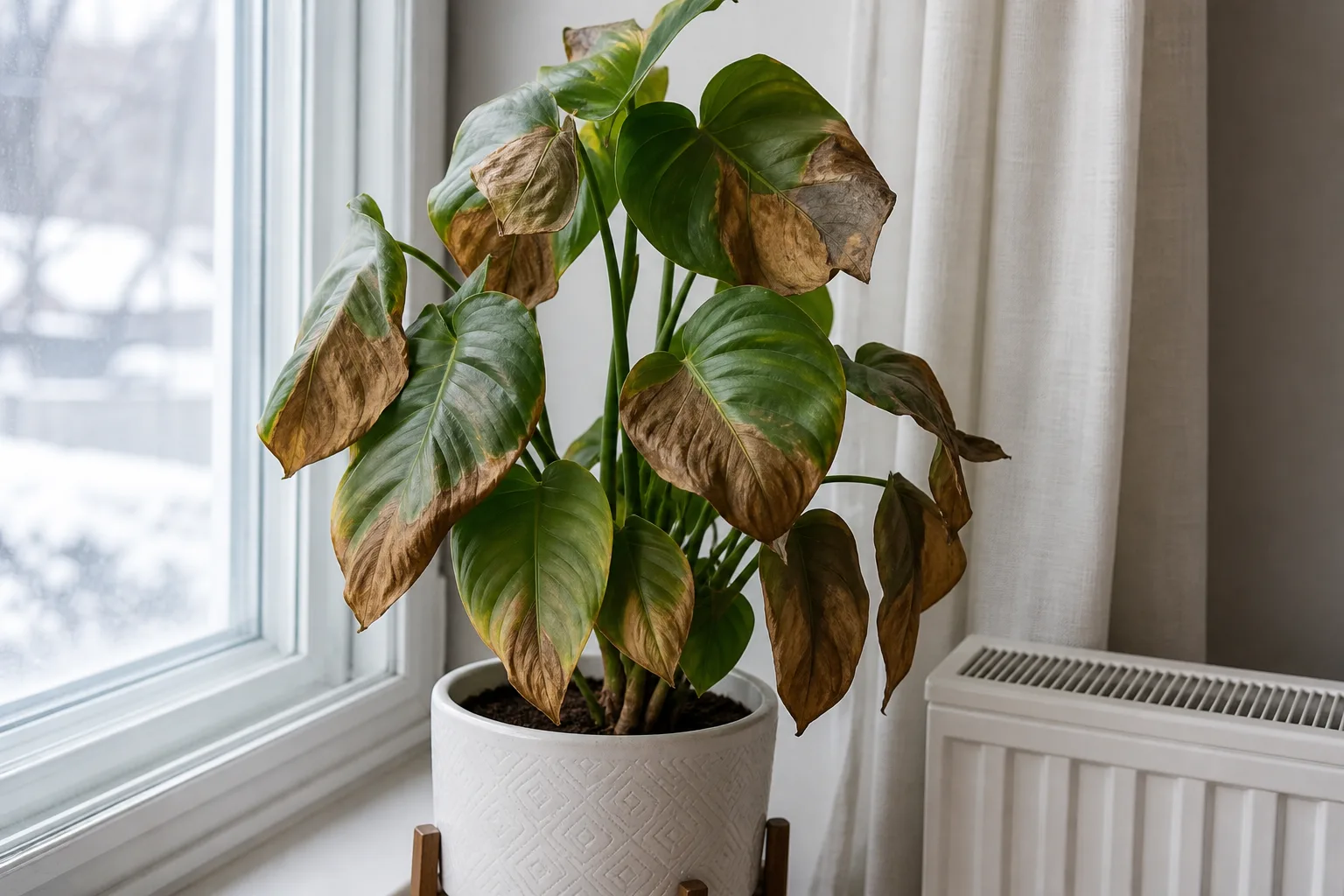
- Radiators and baseboard heaters: the plant may be exposed for hours even if the room temperature is moderate. The side facing the heater may crisp first.
- Furnace, heat-pump, and space-heater outlets: moving air accelerates transpiration and can desiccate leaf tips. A plant beside a vent may dry unevenly.
- Fireplaces and wood stoves: radiant heat can be intense at a mantel or nearby stand. A few feet may not be enough if the plant remains in the direct heat path.
- Closed sunrooms, glass balconies, and cars: stagnant air plus direct radiation can push the plant well beyond the room’s normal temperature. The draft examples from Get Busy Gardening also call out fireplaces, air conditioners, doors, radiators, and vents as common trouble spots. The useful lesson is not a fixed distance: keep the plant out of the stream or radiant path.
How to tell heat stress from sunburn, thirst, or root rot
Brown leaves and wilt are symptoms, not diagnoses. Before you change watering, look at the pattern, the timing, and the soil.
| Clue | Heat stress is more likely | Another problem is more likely |
|---|---|---|
| When it appears | Afternoon or during a hot spell; improves overnight | Persists all day regardless of temperature |
| Where it appears | Several leaves, the heater-facing side, or new growth | Only the window-facing side with pale patches suggests sunburn |
| Soil | Root zone may be moist, or it dries unusually fast | Light, dry pot suggests thirst; heavy, wet pot suggests root trouble |
| Tissue | Soft posture, inward curl, crisp margins after repeated stress | Water-soaked dark tissue suggests cold injury; stippling or webbing suggests pests |
| Response | Firms after cooling if roots are healthy | No improvement after cooling calls for a wider diagnosis |
Heat wilt versus dry-soil wilt
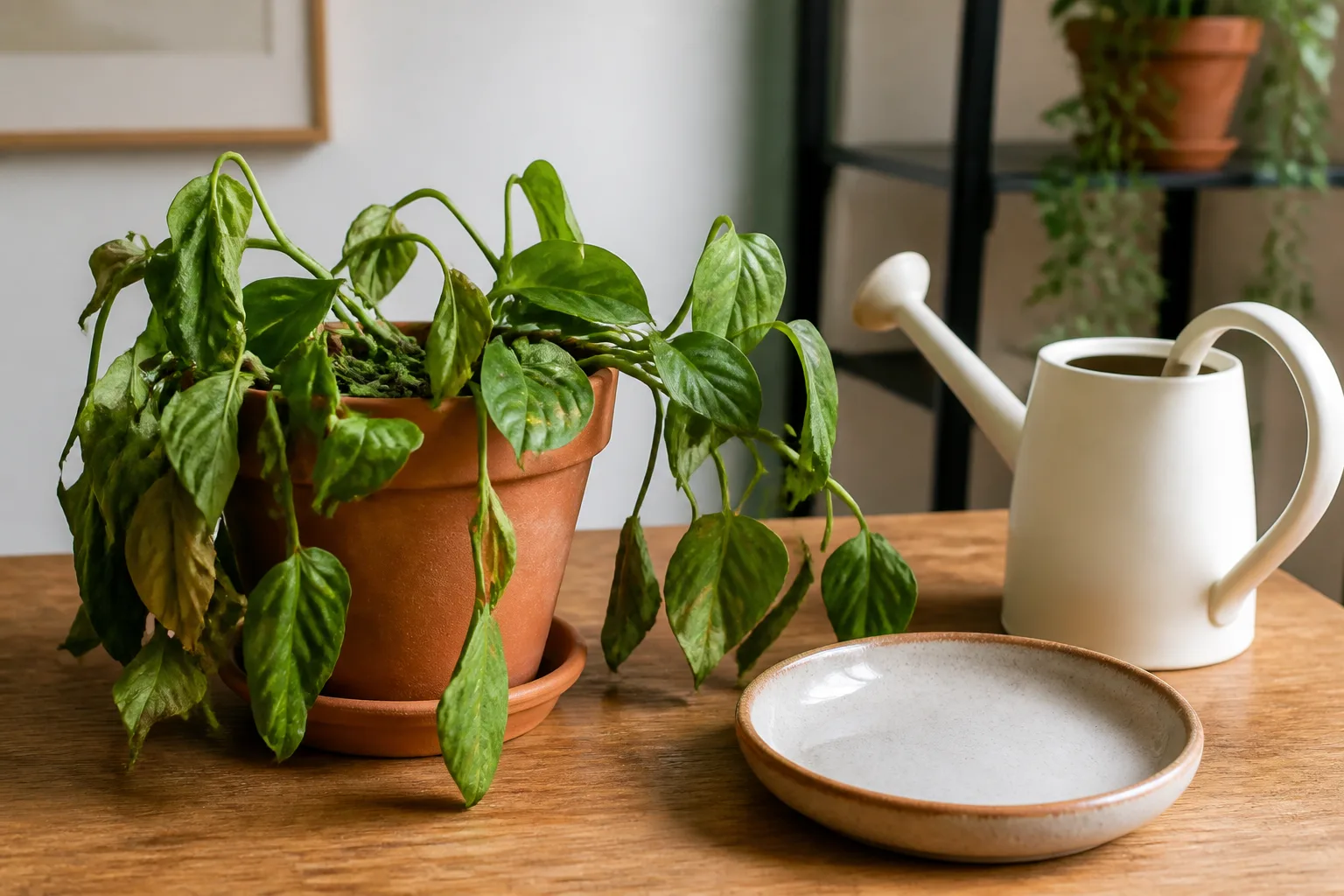
Heat-wilted leaves are often soft at the hottest part of the day, while the mix may still feel cool and moist below the surface. The plant is losing water faster than it can move it, but it has not necessarily run out of water. If the leaves recover in the evening or by the next morning, that pattern supports temporary heat wilt.
Dry-soil wilt usually comes with a light pot and dry mix below the surface. The leaves remain limp after the room cools because the roots have no water to draw from. Water thoroughly until the root ball is evenly moistened and excess drains, then reassess rather than watering repeatedly in small sips.
Wet-soil wilt is the dangerous lookalike. If the plant is limp on a heavy pot, the mix stays wet for days, the stem base is soft, or the soil smells sour, the roots may be failing. Watering a wet-wilted plant adds no useful supply; it reduces air-filled pore space and can accelerate root damage. Heat may have exposed the problem, but it is not the whole diagnosis.
Heat stress versus sunburn
Sunburn is directional light injury. It creates bleached, tan, papery, or sharply crisp patches on the side of a leaf facing a strong window or grow light. The rest of the plant may remain firm, and shaded leaves may look normal. A recent move from a dim shop or covered porch into direct sun is a strong clue because leaves need time to acclimate.
Heat stress is broader. The whole plant or several leaves may droop, curl, dull, and dry faster. Heat and sunburn commonly overlap at a hot west window, so one fix does not exclude the other. Move the plant out of the radiant path, provide bright indirect light, and do not expect the bleached patch to turn green again.
Heat damage versus cold-draft injury
Cold injury can look like heat injury at first because both cause collapse. Cold-exposed foliage often becomes water-soaked, translucent, dark, or black after the event, especially near a cold pane or open exterior door. Heat stress more often produces afternoon limpness, curled edges, and crispy margins.
Do not swing a damaged plant from a hot window to an icy porch or blast it with an air conditioner. Correct temperature gradually. The goal is a steady, moderate location while you observe which tissue is still viable.
The 60-second room-and-pot diagnosis
When a plant looks overheated, run this check before reaching for fertilizer, mist, or a larger pot.
- Name the change. Did a curtain open, a heatwave begin, the furnace switch on, or the plant move closer to glass? Timing often reveals the cause better than the leaf color.
- Find the hottest hour. Touch the pot and measure at leaf height if you can. Check the side nearest the window, vent, or heater.
- Map the damage. Is it directional, whole-plant, on new leaves, or only on old leaves? Photograph the same leaves so you can compare tomorrow.
- Check moisture below the crust. Use a finger, wooden skewer, or moisture meter according to the plant’s normal watering threshold. The surface can be dry while the center is saturated.
- Check the pot weight and drainage. A cachepot can hide standing water. Lift the nursery pot if possible and empty the outer container.
- Inspect for non-heat clues. Look under leaves for webbing, stippling, scale, or insects. Smell the mix and inspect stems if the plant stays limp.
- Make one change first. Move it out of direct heat, then observe for several hours. Changing location, watering, fertilizer, and pot size all at once makes the next symptom impossible to interpret.
If the plant improves after distance and the soil is appropriately moist, you have learned more than a generic “water more” rule could tell you.
What to do in the first hour
The first response should lower demand without creating a second shock.
- Move the plant out of the heat path. Put it several feet from a heater or vent, away from hot glass, or behind a sheer curtain. Keep it in bright indirect light rather than a dark closet.
- Ventilate the room gently. If outdoor air is cooler, improve circulation without directing a fan straight at the leaves. Avoid replacing hot, dry air with a high-speed draft.
- Stop the direct beam. Close a curtain during the hottest window, or move the pot back from the pane. Do not rotate a severely scorched plant into a stronger beam.
- Check the root zone. If it is dry at the plant’s normal depth, water thoroughly and allow the pot to drain. If it is moist or soggy, do not add water just because the leaves are limp.
- Remove only fully collapsed debris. Do not strip every imperfect leaf while the plant is stressed. Green tissue can still photosynthesize and support recovery.
Do not put ice on the soil or dunk a hot pot into cold water. A sudden temperature change can add stress, and a saturated root ball still lacks oxygen. A gradual move to a stable, shaded-but-bright position is safer.
Watering a hot plant without drowning it
Heat changes how often you check water; it does not replace the need to check. A sunny, warm plant may use water faster, but a plant with damaged roots may use less. Watering by the calendar is unreliable in both cases.
For a typical tropical foliage plant, check the mix at the depth where the root ball is active. If it is dry and the pot is light, water slowly until moisture runs from the drainage holes. Wait a few minutes, then empty the saucer or cachepot. If water runs down the gap between pot and mix, the root ball may be hydrophobic; re-wet in stages rather than leaving it standing in a tray.
If the mix is cool and moist, leave the watering can down. Move the plant first and check again after the heat of the day. A plant can wilt temporarily while its roots are hydrated. Repeatedly adding water to that plant can produce a wet, oxygen-poor root zone and turn a reversible heat response into root rot.
For cacti and succulents, do not respond to heat by keeping the mix permanently damp. Their heat tolerance depends partly on a dry interval and strong light. If a succulent is soft in a wet pot, treat that as a root and moisture problem even if the room is hot.
Humidity, airflow, and the misting trap
Warm air can feel comfortable while still being dry enough to increase leaf water loss. Indoor heating is a common winter example: Penn State Extension notes that winter indoor relative humidity can fall below 30%, while a typical indoor comfort range is much higher than that. Its humidity and houseplants guidance also points out that humidity needs vary by plant.

Use a hygrometer near the plant when humidity is part of the diagnosis. A single reading across the room may not represent a sunlit shelf or the air above a vent. Ferns, calatheas, palms, and other thin-leaved plants often show crispy margins sooner than drought-adapted succulents, but high humidity without airflow can invite fungal and bacterial problems.
Misting is a poor emergency fix. The moisture on a leaf evaporates quickly, and repeated wet foliage in stagnant air can create new problems. Colorado State University Extension similarly notes that misting must be frequent to have a lasting effect and may promote foliar disease. Use it, if at all, as a brief cleaning or cooling gesture—not as a replacement for a humidifier or a better location.
Pebble trays have a narrower use than many people expect. A shallow tray with stones and water can create a small humid boundary around a plant, but it does not meaningfully humidify the whole room. Keep the pot above the waterline so drainage holes never sit in standing water. Grouping plants, using a correctly sized humidifier, or enclosing a humidity-loving plant in a terrarium-like setup is more dependable when the air is persistently dry.
How care changes in summer and winter
Summer heat is usually a light-and-glass problem. A plant that was safe beside an east window in spring may scorch or wilt beside the same window after the sun’s angle changes. Move it back from the pane, use a sheer curtain during the hottest hours, and check the soil more often without assuming it needs water every day. If you move a plant outdoors, acclimate it to stronger light gradually; a sudden jump from indoor shade to direct sun can cause sunburn even when the air temperature is moderate.
Winter heat is usually an air-and-draft problem. A furnace register or radiator can dry leaf tips while the root ball remains wet because low light and shorter days slow water use. Keep plants out of direct heat, monitor humidity, and expect watering intervals to change. The Gardening Know How overview of temperature stress emphasizes that plant responses vary with moisture, sunlight, drainage, and day–night differences; the season changes all of those variables at once.
In either season, avoid abrupt moves between extremes. A plant can tolerate a warm room but struggle when shifted from a hot window to an air-conditioning blast, or from a heated room to a freezing balcony. Move in stages when possible and give it a stable position for a few days before making another major change.
Which houseplants tolerate heat best
Heat tolerance is not the same as drought tolerance, and neither means a plant belongs against a heater. Use the following as a starting point for placement:
- Cacti and succulents: usually tolerate warm, dry air if they receive appropriate light and the mix drains quickly. Protect them from hot glass and waterlogged pots.
- Snake plants and ZZ plants: often handle a warm room and missed watering better than thin-leaved plants, but they can still scorch or develop root problems.
- Pothos, philodendrons, and rubber plants: generally cope with warm indoor conditions when the root ball is healthy; dry vents and intense sun can still crisp new leaves.
- Ferns, calatheas, prayer plants, and palms: prefer steadier moisture and humidity. They are often the first plants to show curling, dullness, or crispy edges in hot dry airflow.
The best choice depends on your actual room. A heat-tolerant plant in a west window can fare worse than a sensitive plant three feet back behind a curtain. Fix the microclimate before replacing the species.
How to prevent repeat heat stress
Prevention starts with observing the room at the time it causes trouble, not at breakfast when every plant looks fine.
Keep a small thermometer and hygrometer at plant height for a few hot days. Note the highest reading, the time the leaves soften, the pot weight, and whether the plant recovers overnight. This turns “my room is 75°F” into useful information such as “the leaf area gets direct sun from 2 to 5 p.m. and the pot is dry by the next morning.”
Create distance from heat sources and preserve the right light. Pull plants back from radiators and registers, use curtains for strong afternoon sun, and raise pots off hot metal or stone. Do not solve hot glass by pushing a plant into a windowless corner; it still needs enough light to recover and grow.
Keep drainage visible. Use a pot with a drainage hole, lift it out of a decorative cover after watering, and empty standing water. Healthy roots are a plant’s best heat protection because they can replace the water leaves lose. A plant with compacted, rotted, or chronically wet roots cannot keep up with even moderate heat. Acclimate outdoor moves and humidifier changes gradually rather than chasing a perfect number.
When to prune, fertilize, or repot
Heat stress is a poor time for a makeover. Do not repot a plant simply because it wilted for one afternoon. Repot only when there is a separate reason—severe root binding, failing mix, poor drainage, or confirmed root damage—and do it after the plant is in a stable location unless the container itself is the emergency.
Wait on fertilizer during acute heat stress. Feeding encourages growth when the plant is already struggling to balance water and can add salts to a drying root zone. Gardening Know How’s heat-stressed plant recovery guidance recommends withholding fertilizer until strong recovery is visible. Resume the plant’s normal, species-appropriate feeding routine after conditions stabilize and new growth looks firm.
Prune for safety and health, not perfection. Remove leaves that are completely brown, papery, or detached. You can trim brown edges for appearance with clean scissors, but leave a narrow margin of dry tissue rather than cutting into green. Avoid hard pruning healthy leaves immediately after a heat event; they still provide energy while the plant rebuilds.
Signs of recovery and when to worry
Temporary heat wilt can improve within hours after the room cools, or by the next morning when leaf demand falls. That improvement is encouraging, but it does not mean the plant is ready for its old hot placement. Keep conditions steady and watch whether the afternoon collapse becomes less severe.
Over the next several days, the most useful sign is stopped damage. Existing brown tissue will remain, but new leaves should not develop fresh crispy margins or expanding bleached patches. The pot should begin drying at a rate that matches the plant and room rather than swinging from bone dry to saturated.
Over the next few weeks, look for firm new growth, stable stems, and normal posture at the hottest time of day. A damaged leaf will not repair itself, so judge the plant by new tissue and the absence of spread. Patience is safer than repeated fertilizer, pruning, or relocation.
Investigate beyond heat if the plant stays limp overnight, the mix remains wet, the stem base softens, roots smell sour or look mushy, or spots spread in a pattern unrelated to heat exposure. Also check for spider mites and other pests when the air is hot and dry. If the plant has a damaged crown but healthy cuttings, propagation may preserve it; if the root system and crown are both collapsing, discard the failing tissue rather than sharing pests or disease with healthy plants.
Conclusion
How hot is too hot for houseplants? There is no universal cutoff, but prolonged temperatures above the mid-80s become increasingly risky when combined with direct sun, hot glass, dry air, moving heat, or dry roots. Temperatures around 80°F are often manageable for common tropical foliage plants when the rest of the setup is balanced.
Read the plant’s microclimate: what its leaves feel, how fast the pot dries, where the damage appears, and whether the plant firms up overnight. Move it out of radiant heat or a direct vent, keep the light bright but gentler, check the root zone, and water only when the mix is ready. That cool-first, evidence-based sequence gives a heat-stressed houseplant the best chance to recover without turning one hot afternoon into a watering problem.



