How to Grow and Care for Coleus Plants
Learn how to grow and care for coleus plants with practical advice on light, watering, soil, pruning, propagation, winter care, pests, and pet safety.
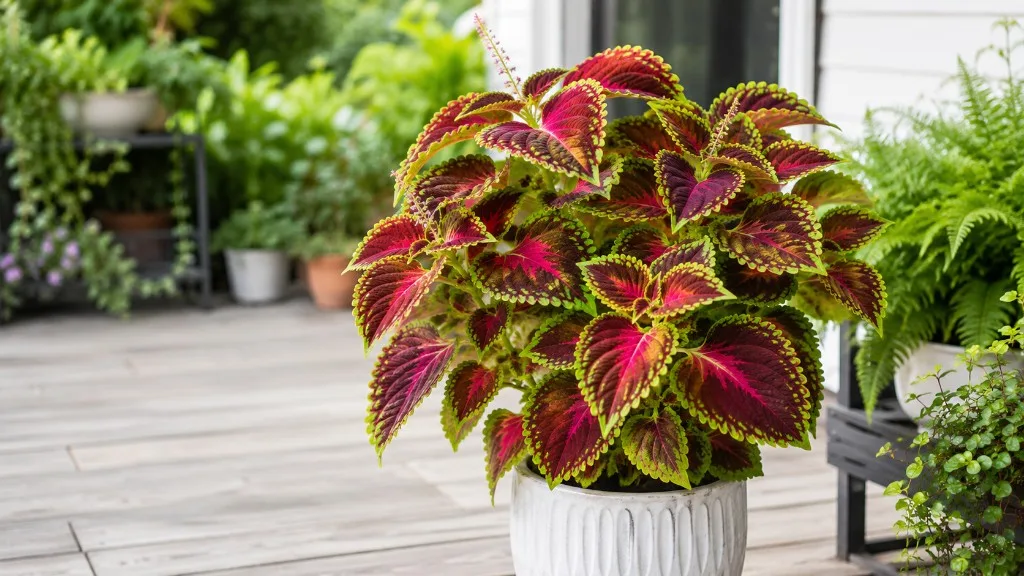
Coleus is easy to grow when you treat it as a fast, warm-season foliage plant rather than a nearly indestructible shade annual. The plant wants bright but cultivar-appropriate light, consistently moist soil with air around the roots, warmth, and regular pinching. Miss one of those for long enough and it can fade, stretch, wilt, or drop leaves even while the soil looks acceptable on the surface. For a plant-specific baseline, keep the coleus overview nearby as you work through the routine below.
The name on a plant tag may be Plectranthus scutellarioides, Coleus scutellarioides, or the former Solenostemon scutellarioides. These names are used for the familiar painted nettle grown for serrated leaves in burgundy, lime, pink, copper, red, cream, and green. North Carolina State Extension describes it as an upright annual or herbaceous perennial in the mint family, native from tropical and subtropical Asia to northern Australia. The practical implication is more useful than the taxonomy: coleus is a tender plant that can live for years indoors or in frost-free climates, but it is an annual outdoors wherever winter freezes the plant.
Know what coleus needs before you plant
Start with the plant you actually have. Coleus ranges from small, trailing cultivars suited to hanging baskets to upright plants approaching 3 feet tall and wide. Large-leaved types can wilt quickly after a move into intense sun, while newer sun-tolerant series are bred to keep their color across a wider exposure range. Missouri Botanical Garden lists the species as hardy outdoors only in USDA Zones 10–11, with part shade to full shade as the traditional exposure and some newer cultivars tolerating full sun.
That range is why one care rule fails so often. “Coleus likes shade” is safe for many older and large-leaved selections, but it can leave a sun-tolerant plant pale and loose. “Coleus likes sun” can scorch a shade strain. The best routine begins with the cultivar label, then uses the newest leaves, pot weight, and weather to refine the placement.
Coleus also has a useful growth habit for beginners: its soft, often square stems root readily from cuttings. A healthy plant can therefore be both a seasonal container accent and a source of next year’s plants. Plan for that from the beginning by choosing a parent plant with clean foliage, firm stems, and the color and habit you want to keep.
Choose the cultivar, setting, and placement
Match the cultivar to the job before you match the plant to a color scheme. The University of Minnesota Extension’s coleus guidance distinguishes cultivars suited to full sun, partial shade, and full shade. Proven Winners likewise recommends morning sun and afternoon shade for strong foliage color while noting that many modern types tolerate more sun. Series names such as ColorBlaze are useful clues, but the specific tag is more reliable than a broad label like “sun coleus.”
For an unlabeled plant, use bright filtered light with gentle morning sun as the starting point. An east-facing balcony, an open spot beneath a high tree canopy, or a west-facing patio protected after midday gives you room to adjust. In a mixed container, put an upright coleus where it can be the visual anchor, but give it enough space that neighboring plants do not keep the leaves wet and still.
Choose a bed or pot that makes moisture easy to manage. A garden bed needs loose, well-drained soil and protection from a low spot that stays saturated after rain. A container needs a real drainage hole, fresh potting mix, and enough volume that the plant does not dry in a few hours. A small plant does not need a huge pot; unused wet soil around a small root system is a common route to yellow leaves and root rot.
If you are moving a nursery plant outdoors, wait until nights are reliably above about 60°F (16°C) and the soil is warm. Proven Winners recommends planting outdoors once temperatures are consistently above 60°F. Set the plant at the same depth as it grew in its pot, water the root ball in, and protect it from a sudden jump into hot afternoon sun.
Give coleus the right light
Coleus needs enough light to build compact stems and maintain the contrast that makes its foliage valuable. NC State Extension notes that coleus grows in part shade and can tolerate full shade, while full shade may lead to leggy growth. Indoors, place it close to a bright east, south, or west window, using a sheer curtain when the glass delivers harsh midday or afternoon rays. A north window may keep a shade-tolerant plant alive in summer, but it often produces long gaps between leaves and duller color.
Outdoors, traditional shade types usually prefer morning light and afternoon protection. Sun-tolerant cultivars can handle more direct exposure after acclimation, but sun tolerance is not the same as immunity to heat, reflected pavement, hot dark pots, or drought. A plant beside a west-facing wall may receive more leaf heat than the same variety in an open bed, even if both locations have the same number of sunlight hours. Use the coleus light guide when a particular window or cultivar needs closer diagnosis.
Read the newest leaves before moving the pot
Old leaves are records of where the plant has been. Read the newest leaves and the length of the gaps between them to decide whether light is working. Firm stems, short internodes, and color close to the plant label suggest a good match. Long, floppy stems with small pale leaves point to insufficient light. Bleached patches, crisp margins, or a washed-out window-facing side point to excessive intensity or an abrupt transition.
Change exposure in steps over 7–14 days. Start with bright indirect light, add an hour of gentle morning sun, then extend exposure only if new foliage stays clean. If bleaching starts, reduce intensity with shade or a sheer curtain; do not immediately add fertilizer. For overwintered plants, a full-spectrum grow light for roughly 10–12 hours daily can preserve compact growth when winter windows are weak.
Water by soil moisture, not a fixed calendar
Keep coleus evenly moist but never saturated. During active growth, water when the top 1–2 inches of soil feels dry, then soak thoroughly until a little water exits the drainage hole. Empty the saucer or outer cachepot. Proven Winners gives the same top 1–2 inch check and warns that overwatering can cause root rot.
The important check is at depth. A plant with limp leaves and a light, dry pot is thirsty; a plant with limp leaves and a heavy, wet pot may have stressed roots and needs air, not more water. Coleus can recover from a single missed watering, but repeated hard wilting weakens fine roots and causes brown margins, leaf drop, and more severe midday collapse.
Avoid tiny daily sips. They wet the surface while the center of the root ball stays dry, encouraging a cycle of shallow roots and sudden wilt. When the mix is dry, water slowly enough to wet the whole ball, pause if water runs down the gap between pot and soil, then water again until runoff confirms that the root zone has been rehydrated. The coleus watering guide has the same check-based approach for containers that dry at different speeds.
Adjust the rhythm for containers and seasons
A small plastic pot in bright sun may need checking every day in midsummer; a large glazed pot in a dim room may stay damp for a week. Terracotta dries faster than plastic, wind increases water loss, and a dense mix holds water after the surface appears dry. These are reasons to check, not reasons to adopt a new calendar.
In fall and winter, coleus usually grows more slowly indoors, so the pot dries more slowly and the watering interval lengthens. Keep checking the soil, but do not continue a summer routine in a cool, dim room. Water sitting around cold roots is especially risky. If tips are brown while the pot remains wet, improve light and airflow and assess humidity rather than adding more water.
Use rich, well-drained soil and the right pot
The best coleus soil is rich enough to support rapid leaf production but open enough to let excess water escape. Proven Winners recommends rich soil with good drainage and warns that compacted or poorly draining soil can lead to root rot. Use a quality houseplant or container mix amended with perlite if it compacts easily. A practical starting blend is two parts potting mix to one part perlite; add organic matter in a garden bed rather than trying to make a pot behave like native soil.
In-ground coleus benefits from loose soil with good organic matter. Improve heavy ground with compost and choose a site that drains after rain. Do not put unamended garden soil in a container: it compacts, drains poorly, and makes a fast-growing plant difficult to read. A pH near slightly acidic to neutral is generally suitable, but texture and drainage usually matter more than chasing a precise number.
Use a pot only one size larger than the current root ball when repotting. The pot must have an open drainage hole, and the plant should sit at the same soil level rather than being buried deeper around the stem. Gravel in the bottom does not create drainage; it reduces the depth of usable soil and can leave a perched wet layer above it. Put a saucer beneath the pot instead, then empty it after watering. For a deeper mix decision, compare this advice with the coleus soil guide.
Hold steady temperature and moderate humidity
Coleus grows best in warm, stable conditions. Protect it from cold windows, air-conditioner blasts, and sudden temperature drops. Missouri Botanical Garden and NC State Extension both describe coleus as a warm tender perennial, while Proven Winners recommends keeping indoor plants at 60°F or higher. Frost is a hard stop: move containers indoors before frost, and do not expect an outdoor bed to recover from a freeze.
Humidity helps, but it cannot compensate for poor light or saturated soil. Average indoor humidity may be adequate if the plant is warm, bright, and well watered. In a very dry winter room, group plants or run a humidifier nearby. A pebble tray can modestly raise the immediate humidity around a pot, but the pot must sit on the pebbles above the waterline. Do not leave the drainage hole standing in water, and do not mist foliage as a substitute for airflow.
Fertilize for foliage, not flowers
Coleus is a moderate feeder during warm active growth, not a plant that needs constant fertilizer. In a rich bed, compost worked into the soil may be enough for the season. In a container, use a balanced water-soluble fertilizer at the label’s conservative rate every few weeks, or a slow-release all-purpose product at planting according to its label. Proven Winners recommends slow-release fertilizer at planting with monthly balanced feeding as needed.
Feed only when the plant is actively growing and the soil is already moist. Dry roots are more vulnerable to fertilizer salts. Brown tips, a white crust on the mix, or sudden decline after repeated feeding are reasons to flush the pot with plain water or refresh the soil, not reasons to increase the dose. Avoid high-phosphorus bloom boosters when your goal is foliage; flowering is normal, but excess feeding does not create better color.
Pinch and prune for a bushy plant
Pinching is the simplest way to turn one tall stem into a fuller coleus. When a young plant is about 6 inches tall, pinch the growing tip just above a pair of leaves or a visible node. Two side shoots can then develop below the cut. Repeat as stems extend, always leaving enough healthy foliage for the plant to keep photosynthesizing.
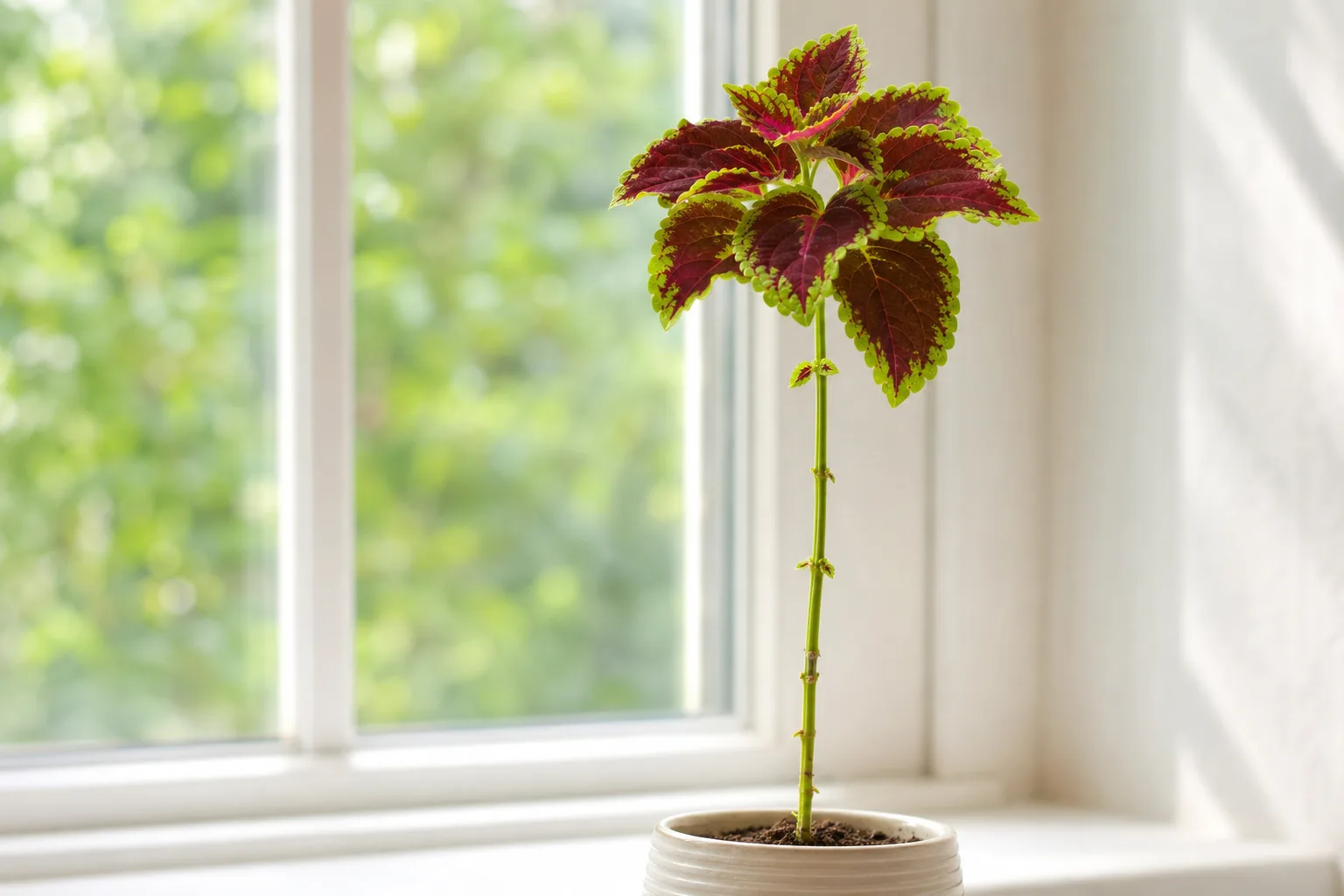
Remove damaged leaves and completely bare or collapsing stems with clean snips. If the plant became leggy in low light, correct the light first, then shorten the longest stems above nodes. Heavy pruning in a dark room can leave too little leaf area for recovery. Water normally after pruning, but do not respond to a cutback by immediately overwatering or overfeeding.
Coleus flowers are small and usually secondary to the foliage. Remove flower spikes when they appear if you want the plant to keep producing leafy shoots and a symmetrical mound. Leave a few flowers only when you want to observe or collect seed; seed-grown offspring may not repeat the parent’s color or form. The coleus pruning guide is useful when you are reshaping a plant that has already stretched.
Propagate coleus from stem cuttings
Stem cuttings are the best way to make a true copy of a favorite coleus. North Carolina State Extension and the New York Botanical Garden both note that coleus cuttings root readily in water or clean potting media. Take them during active growth, or take healthy cuttings before bringing a garden plant indoors for winter.
- Choose a firm, pest-free stem with vivid new growth and no flowers.
- With clean, sharp scissors, cut a 4–6 inch section just below a leaf node.
- Remove the leaves from the lower half, leaving one or two pairs at the top.
- Put the bare nodes in water, or insert them into pre-moistened, airy rooting mix.
- Keep the cutting warm in bright indirect light; direct sun can wilt an unrooted stem.
- Keep the medium moist, not drenched, and check it every day or two.
Most healthy cuttings show roots in about 2–3 weeks. A clear cover can help maintain moisture in a dry room, but it must not touch the leaves and should be removed or vented if condensation remains heavy. Once roots are about 1–2 inches long, pot a water-rooted cutting into fresh mix. Pinch the tip after it resumes growth to encourage branching.
Choose water or soil rooting
Water rooting is easy to observe and useful when you are taking a few winter cuttings. Keep the leaves above the water and change the water if it becomes cloudy. Soil rooting avoids the transition from water roots to potting mix and is efficient when you are making several cuttings, but the medium must stay evenly moist and airy.
Rooting hormone is optional for coleus. The node, warmth, cleanliness, and moisture balance matter more. Do not root cuttings from a plant with spreading disease or an active pest infestation; propagation multiplies the problem. For a rare cultivar, take several cuttings so one failure does not cost you the parent plant’s color. The coleus propagation guide covers the same process with plant-specific timing and aftercare.
Grow coleus from seed when variability is acceptable
Seed is a good choice when you want many inexpensive plants or enjoy seeing variation. It is not the right choice when you need an exact copy of a named hybrid. Many modern nursery coleus are selected and maintained through cuttings, so seedlings can differ in leaf color, size, shape, and sun tolerance.
Start seed indoors about 8–12 weeks before the last frost date, following Missouri Botanical Garden’s timing guidance. Sprinkle the tiny seeds over moist seed-starting mix and press them in; do not bury them deeply. Keep the tray warm, bright, and evenly moist. A clear cover can help germination, but remove it once seedlings emerge so stagnant humidity does not encourage damping-off.
Pacific Northwest Pest Management Handbooks identify Pythium and Rhizoctonia as causes of coleus damping-off. The seedling or cutting may collapse at the soil line, especially in cool, overly wet media. Use clean trays, fresh or properly sanitized equipment, a light medium, and enough warmth for quick emergence. Let the surface dry slightly between checks without allowing the young roots to wilt.
When seedlings have two sets of true leaves and sturdy stems, pot them individually. Harden them off gradually before outdoor planting: begin with a few hours in sheltered shade, then increase outdoor time and light over roughly a week. The same transition protects indoor cuttings and overwintered plants from wind and sun shock.
Repot when growth slows or roots crowd
Repot a coleus when roots circle the drainage hole, the mix collapses and stays wet, water runs straight down the pot wall, or new leaves become smaller despite good light and moisture. Fast summer growth can fill a small pot quickly. A bigger container is not automatically better; move up one size so new soil does not remain wet around a small root system.
Repot during active growth when possible. Slide the plant out, inspect for firm pale roots, loosen only the outer roots that are tightly circling, and set it into fresh, well-drained mix at the same depth. If roots are dark and mushy, remove the damaged tissue with sanitized scissors, use a clean pot close to the remaining root mass, and hold fertilizer until new growth resumes. Follow the coleus repotting guide for the root inspection and aftercare sequence.
Do not combine every stressful intervention at once. After repotting, stabilize light, moisture, and temperature before pinching hard or changing fertilizer. A short pause in growth is normal; continued decline, sour-smelling mix, or a soft stem base means inspect the roots again.
Overwinter coleus before frost
In Zones 10–11, coleus may persist outdoors as a tender perennial, but even there a cold event can damage an exposed plant. In colder climates, choose between letting an outdoor annual finish, bringing a healthy container indoors, or taking cuttings. Epic Gardening recommends moving potted coleus indoors as nighttime temperatures approach 50°F (10°C), before frost stress begins.
Before the move, inspect every leaf underside, stem joint, and drainage hole for aphids, spider mites, whiteflies, mealybugs, and fungus gnats. Remove dead foliage and isolate the plant from houseplants for a short observation period. Do not bring a plant with active disease indoors; a warm room can turn one infected pot into a collection-wide problem.
Place the overwintered plant in bright indirect light, keep it warm, and water only when the upper soil has begun to dry. Growth slows in winter, so a summer watering rate can keep the root zone too wet. Pause fertilizer while growth is stalled. The plant may drop a few leaves after the move because light, wind, and humidity have changed; stable care is more useful than repeatedly relocating it.
Bring in-ground plants indoors as cuttings
You cannot lift a whole established bed into the living room efficiently. Instead, take several clean stem cuttings from the best growth before the first frost, root them indoors, and keep the young plants under bright light. This preserves the cultivar without importing garden soil, pests, or a large root mass.
In spring, wait until temperatures stay above about 60°F, then harden the indoor plants off. Start outdoors in bright shade for a few hours, extend the time over a week, and add direct sun gradually according to the cultivar. A plant that survived winter indoors still needs acclimation; new indoor leaves are not prepared for wind and unfiltered sun.
Solve common coleus problems
Yellow leaves: Start with the pot. Widespread yellowing or lower leaves on a heavy, wet pot suggests overwatering, poor drainage, or root stress. Pale yellow-green leaves with long internodes and normal soil moisture suggest too little light. One or two older lower leaves turning yellow while new tips stay colorful can be normal aging. Cold exposure can also cause sudden softness and discoloration. If yellowing continues, use the yellow leaves on coleus guide for a symptom-specific fork.
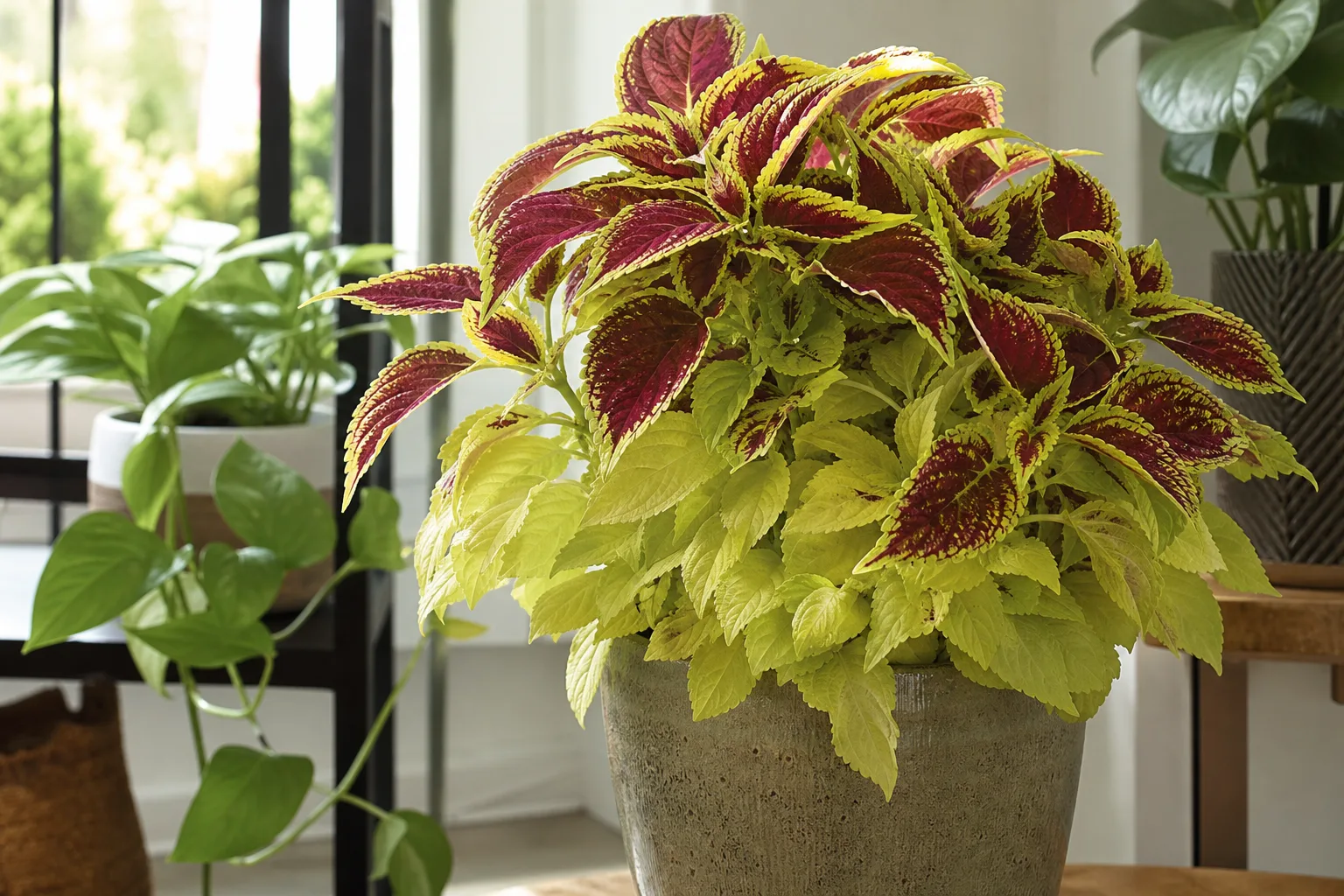
Wilting: A light, dry pot that recovers after a thorough watering points to drought. A heavy, wet pot that stays wilted points to root stress, not thirst. Check the stem base for softness and smell the mix before watering again. Move sun-stressed plants into temporary afternoon shade while you correct moisture, but do not keep the soil permanently wet. The coleus wilting guide helps separate thirst from wet-root stress.
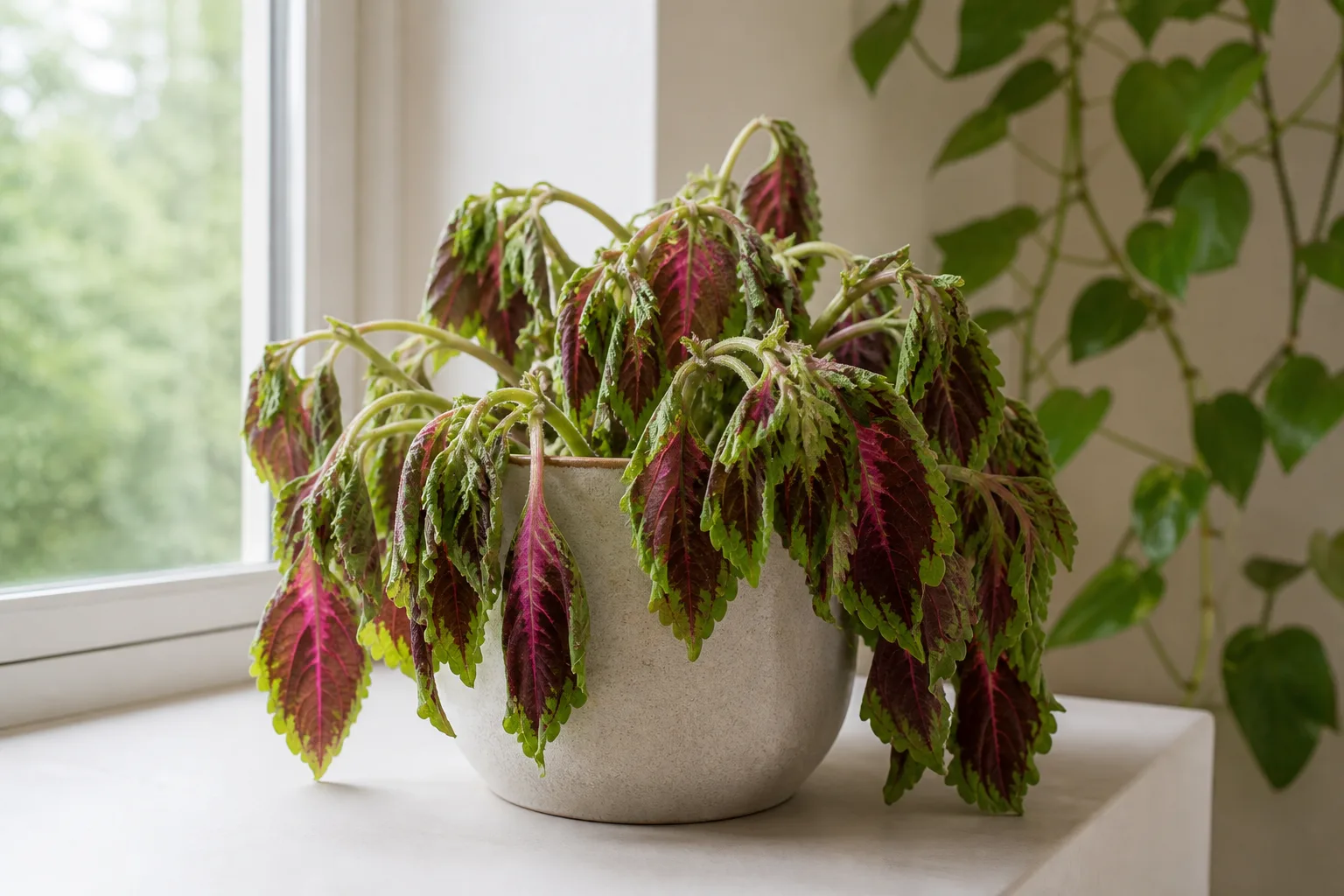
Brown or crispy edges: Drought cycles, hot direct sun, very dry air, salt buildup, and damaged roots can all brown margins. Look for the pattern: sun-facing bleaching suggests light, a salt crust suggests accumulated fertilizer, and crispy leaves on a very light pot suggest water stress. Brown tissue will not turn green again; judge recovery by clean new leaves.
Leggy growth and faded color: Increase brightness before pruning. Deep shade can produce survival growth but not a compact, richly colored plant. Once the plant receives better light, pinch above nodes and remove the weakest bare stems. If an indoor plant remains stretched in winter, add supplemental light rather than feeding harder.
Tell drought, overwatering, and disease apart
Disease deserves a different response from ordinary care stress. The Pacific Northwest Pest Management Handbooks describe coleus downy mildew as causing chlorotic, distorted, stunted foliage, with violet-brown growth on leaf undersides under high humidity. It can begin on young leaves, then leave older lower leaves falling away. Isolate the plant, remove infected material, keep foliage dry, improve spacing and airflow, and avoid carrying the plant indoors. For serious disease, use only a product labeled for the crop and problem in your location; follow the label rather than improvising a concentration.
Damping-off is mainly a seedling and cutting problem: a stem collapses at the soil line in cool, overly wet media. Prevention is more reliable than rescue. Use clean containers, fresh airy media, warmth, moderate moisture, and very little misting after cuttings are stuck. For pests, inspect leaf undersides weekly and isolate new plants. A water rinse can dislodge light infestations; any insecticidal soap, horticultural oil, or other treatment must be labeled for the plant and used exactly as directed.
Coleus is also toxic to cats, dogs, and horses according to the ASPCA coleus listing, which lists essential oils as the toxic principle. Keep the plant where a chewing pet cannot reach it. If a pet may have eaten coleus, contact your veterinarian or the ASPCA Animal Poison Control Center at (888) 426-4435 promptly rather than waiting for symptoms.
Conclusion
Growing coleus well is mostly an exercise in matching conditions to the plant’s current stage. Give a shade type filtered light, let a sun-tolerant type acclimate before stronger exposure, keep the root zone moist but airy, and pinch regularly while the plant is actively growing. Use clean cuttings when you want an exact copy, seed when variation is welcome, and move the parent plant or its cuttings indoors before cold weather turns a seasonal display into a loss.
When the plant looks wrong, check in this order: temperature, light, pot weight, drainage, roots, pests, and disease patterns. That sequence prevents the common mistake of adding fertilizer or water to a plant whose real problem is cold, low light, or a saturated root zone. Coleus rewards that kind of observation with fast new growth, long-lasting color, and more plants from the one you already have.