How to Grow and Care for Monstera Dubia
Keep Monstera dubia healthy with a stable climbing surface, bright indirect light, a breathable mix, careful watering, and node-based propagation advice.
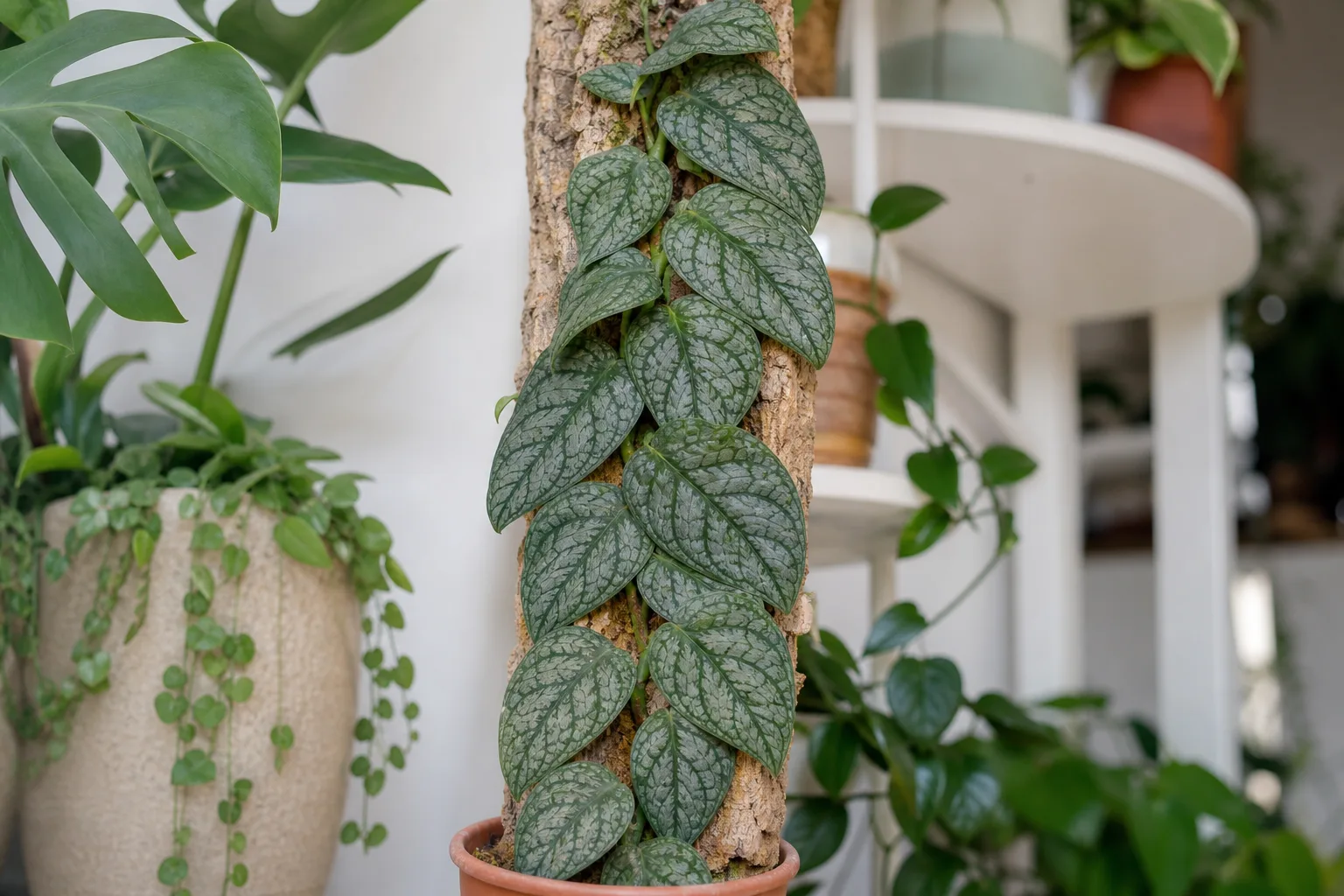
Monstera dubia, often called the shingle plant, is a climbing aroid whose young leaves lie close to a tree trunk or other vertical surface. That unusual habit is the point of the plant: instead of letting the vine trail from a pot, you guide it up a board, cork slab, or pole so its patterned leaves can overlap in a tight column.
The care itself is manageable once you solve that climbing setup. Give the plant bright filtered light, a warm and steady location, an airy mix that drains freely, and water only after checking the pot. The details below explain how to provide support, acclimate a new plant, take a viable cutting, and tell a normal change in foliage from a problem.
Monstera dubia at a glance
| Need | Practical starting point |
|---|---|
| Light | Bright, indirect light; soften direct sun |
| Support | Stable vertical board, cork, or textured pole |
| Water | Thoroughly water when the upper layer of mix has dried |
| Substrate | Chunky, airy, moisture-retentive, and freely draining |
| Temperature | Warm room conditions; avoid cold drafts and abrupt shifts |
| Propagation | Stem cutting with a node and viable growth point |
Monstera dubia belongs to the aroid family Araceae. The main indoor challenge is not a special fertilizer or a rigid humidity number; it is keeping the root zone aerated while giving the climbing stem a surface it can actually attach to. University houseplant guidance for Monstera supports bright indirect light, warm conditions, drainage, and room for climbing, while a species-focused care guide describes the flat juvenile habit that makes dubia distinctive (Penn State Extension, Healthy Houseplants).
Treat care schedules as starting points, not promises. Pot size, room temperature, light, substrate, and season all change how quickly the mix dries, so your plant’s conditions matter more than a weekly watering rule.
Why its juvenile leaves shingle
Young Monstera dubia leaves are typically heart-shaped and patterned in shades of green and silver. As each new leaf emerges, it tends to settle close to the climbing surface and overlap the leaves below it, creating the layered look that gives the plant its common name. Aerial roots form at the stem nodes and help anchor the vine as it climbs.
The plant can change as it matures. Leaves may become larger and the growth habit can shift away from the close, flat juvenile form; mature foliage is not guaranteed in a typical room, and there is no dependable height or age at which every indoor plant will transform. If your plant keeps making healthy small, shingling leaves, it is not failing simply because it has not produced dramatic fenestrations. Focus on steady growth and healthy roots rather than trying to force a mature form with an extra-tall pole or stronger fertilizer.
Choose support that keeps the leaves flat
Support is both a structural aid and a display choice. A broad, stable surface gives the plant somewhere to press its leaves and aerial roots, while a very narrow stake may hold the stem upright without producing the close shingling pattern you want. Position the support before the vine becomes long and tangled; fitting one later can disturb roots and require you to bend or lift stems that have already attached.
Board, cork, or moss pole?
A flat untreated board, cork slab, or rough vertical panel is often the simplest option when your priority is a broad shingling face. It should be sturdy, untreated or plant-safe, and wide enough for the plant’s current growth. A board does not need to stay wet for the leaves to attach, and a plain surface is easier to keep clean than constantly damp material.
A moss or coir pole can work when you want a moisture-retentive climbing surface or have limited wall space. Its round shape may encourage the vine to wrap around it, so the leaves can point in different directions rather than form one flat panel. Penn State Extension and the RHS describe moss-covered poles and other supports for climbing Monstera generally; for dubia, choose the shape that matches your goal and keep the structure stable in the pot (Penn State Extension, RHS).
Attach the vine without damaging it
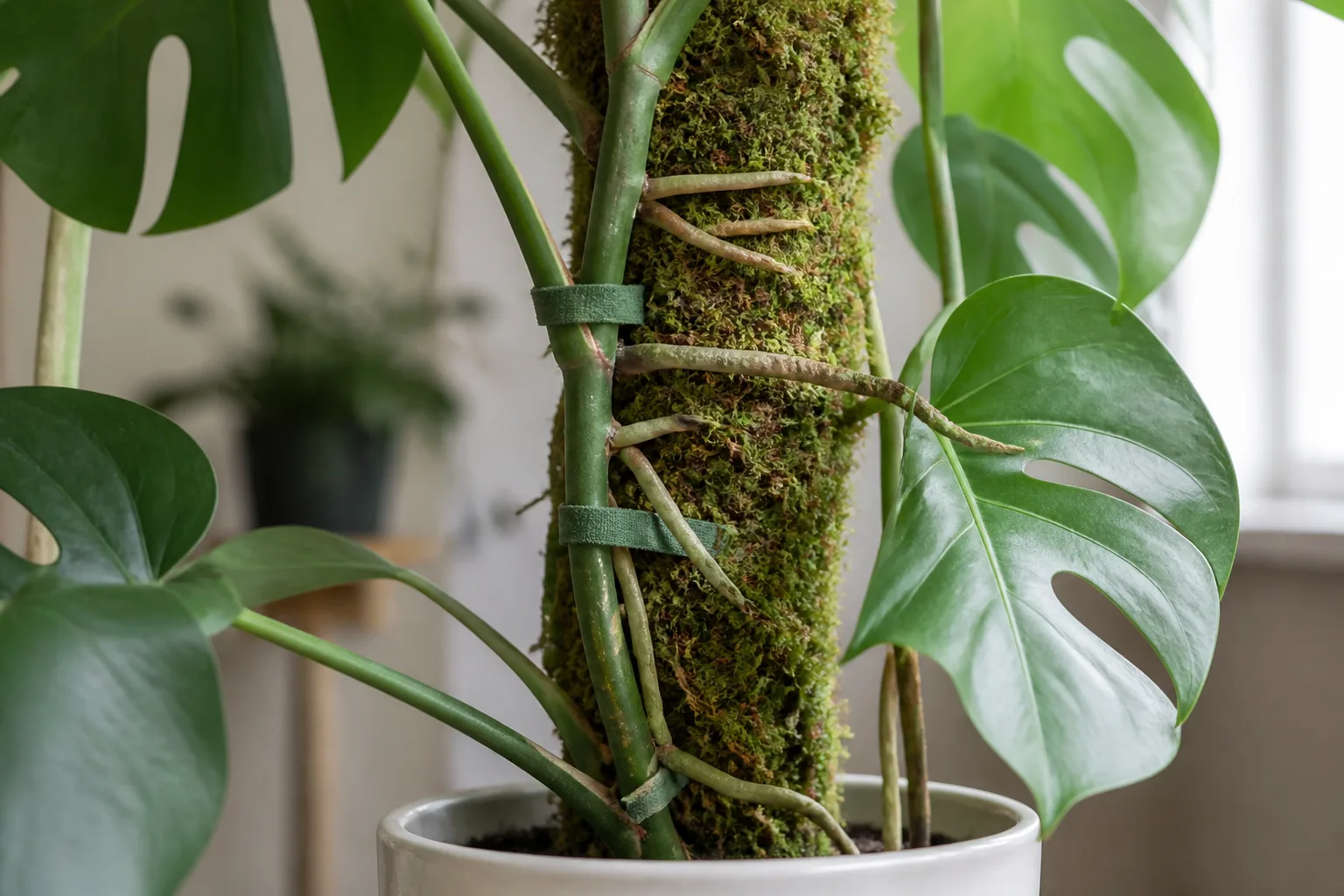
Set the board or pole so the plant’s stem nodes and aerial roots face the surface. Use a soft plant tie, a loose strip of hook-and-loop tape, or a gentle clip to keep the stem close enough for contact. Place ties around the stem rather than across a leaf blade, and leave enough slack that the stem can thicken without being pinched.
Do not press every leaf flat by force or glue leaves to the board. The leaves will position themselves as new growth develops; ties are temporary guides, not clamps. Check them periodically, especially after a flush of growth, and loosen or remove any tie that is rubbing or indenting the stem. Once roots are holding, you can remove the ties that no longer serve a purpose. Avoid pulling attached roots off a surface just to rearrange the plant; if you need to move it, support the vine and work slowly.
Give it bright, indirect light
Place Monstera dubia near a bright window where the leaves receive filtered daylight rather than several hours of harsh direct sun. An east-facing window may offer gentle morning light; at a strong south- or west-facing window, move the plant back or use a sheer curtain. In a dim room, a grow light can help maintain steady growth, but position it according to the light’s instructions and watch how the leaves respond.
Light affects more than speed. When illumination is weak, new growth may be sparse, the spaces between leaves can lengthen, and the plant may lean toward the window. Too much direct sun can bleach or scorch the patterned parts of young leaves. The RHS notes that low light can limit characteristic Monstera foliage and direct sun can scorch leaves, and Penn State recommends bright light without direct sun for indoor Monstera (RHS, Penn State Extension).
Rotate the pot a little when one side is consistently reaching toward the light, but keep the support facing the direction you want the leaves to display. A plant that has settled into good growth does not need repeated moves around the room. If it came from a shaded store or enclosed cabinet, increase its light over several days rather than placing it in a suddenly brighter window.
Water by checking the mix, not the calendar
Water when the top layer of substrate has dried, then soak the root ball evenly until water drains from the pot. Empty the saucer or cachepot afterward; roots should not sit in standing water. Check with a finger or a wooden skewer near the edge of the pot, and learn how a freshly watered pot feels compared with one that is ready for another drink.
The interval will change with season and setup. A warm, bright room and a small bark-heavy pot may dry quickly, while a large pot in winter can remain damp much longer. Do not water because the calendar says it is time, and do not let the whole root ball repeatedly become bone dry. University and RHS guidance for Monstera likewise emphasizes thorough watering followed by a drying interval, with less frequent watering as growth and light decrease (Penn State Extension, RHS).
Humidity can help new leaves unfurl without crispy margins, but the plant does not need a sealed terrarium to survive. A room humidifier is more consistent than misting; keep some air movement so foliage and supports do not stay wet for long periods. If you use a moss pole, moisten the pole only as appropriate for the material and the roots that have reached it. A wet pole is not a reason to keep the potting mix saturated.
Use an airy, moisture-retentive substrate
The best mix holds enough moisture for roots to take it up but leaves large air spaces after watering. A practical starting blend is one part quality indoor potting mix or coco coir, one part orchid bark, and one part perlite or pumice by volume. Adjust it to your home: use a little more bark or perlite if the mix stays wet, or slightly more fine organic material if it dries unusually fast.
Test the mix by watering it before planting. Water should move through the pot rather than pooling on top, and the material should feel damp but not sludge-like afterward. Use a pot with open drainage holes; decorative cachepots are fine only if you can lift the nursery pot out to drain. Avoid a dense garden soil or a potting mix that compacts into a wet block, because low oxygen around roots makes root decline more likely. RHS recommends open, well-drained compost for Monstera, and Wisconsin Horticulture similarly stresses drainage and careful watering for climbing Monstera (RHS, University of Wisconsin Horticulture).
You do not need a laboratory-perfect pH or a long list of additives for an indoor dubia. Bark and perlite are useful because they change structure; charcoal, worm castings, and special mineral products are optional, not a substitute for drainage. If a mix is so coarse that water rushes through without wetting the root ball, add a little more fine potting medium and water slowly in two passes.
Keep conditions warm and acclimate changes slowly
Choose a warm, stable room away from cold window drafts, heating vents, and air-conditioning blasts. General Monstera guidance commonly places the comfortable indoor range around normal warm room temperatures; Penn State gives 60–85°F, while the RHS recommends 65–77°F for Swiss cheese plants (Penn State Extension, RHS). For a dubia, steady conditions within that overlap are a sensible target. Avoid exposing it to a sudden cold night or the hot, dry airflow directly above a radiator.
Give a recently purchased plant time to adjust before changing every part of its care. Keep it in a bright, indirect spot, inspect the undersides of leaves and nodes for pests, and wait to repot unless the mix is waterlogged, the roots are damaged, or the pot has no drainage. If you move it outdoors in warm weather, acclimate it gradually in bright shade and bring it back inside before nights become cool. A sudden shift in light, moisture, and temperature can cause leaf loss that looks like a care failure even when the roots are sound.
Fertilize lightly during active growth
Use a balanced houseplant fertilizer at the label’s conservative indoor rate while the plant is actively producing leaves in spring and summer. If your product is concentrated, start at half strength; fertilize only after watering or when the mix is already slightly moist so a concentrated solution does not hit dry roots. Pause or reduce feeding when growth slows in the darker months, and do not combine multiple fertilizer products unless their instructions make that combination clear.
Extra fertilizer will not make a plant mature faster or replace a stable support. Excess salts can build up in a pot and contribute to brown tips or root stress. If you see a white crust on the mix or pot rim, pause feeding and flush the substrate with clean water if it drains freely. Resume at a lower rate only after the plant is growing and the root zone looks healthy. The RHS recommends balanced liquid feeding during the active season for Monstera; follow your chosen product’s label rather than adopting a rigid schedule from another climate or potting mix (RHS).
Prune and clean without stripping healthy leaves
Prune only when you need to remove damaged growth, shorten a vine, or take a cutting. Use clean, sharp shears and cut just below a node when you want the upper portion for propagation. Removing healthy leaves does not reliably make the plant fuller, and cutting off aerial roots simply because they look unusual removes part of the climbing system.
Dust the leaves gently with a soft damp cloth so the patterned surfaces can receive light and so you can inspect for pests. Do not scrub the silvery areas or use leaf-shine products that leave residue. If a leaf has one old brown edge but the rest of the plant is healthy, trim only the damaged margin for appearance or leave it in place; changing the watering routine will not restore tissue that has already died.
Propagate from a viable stem node
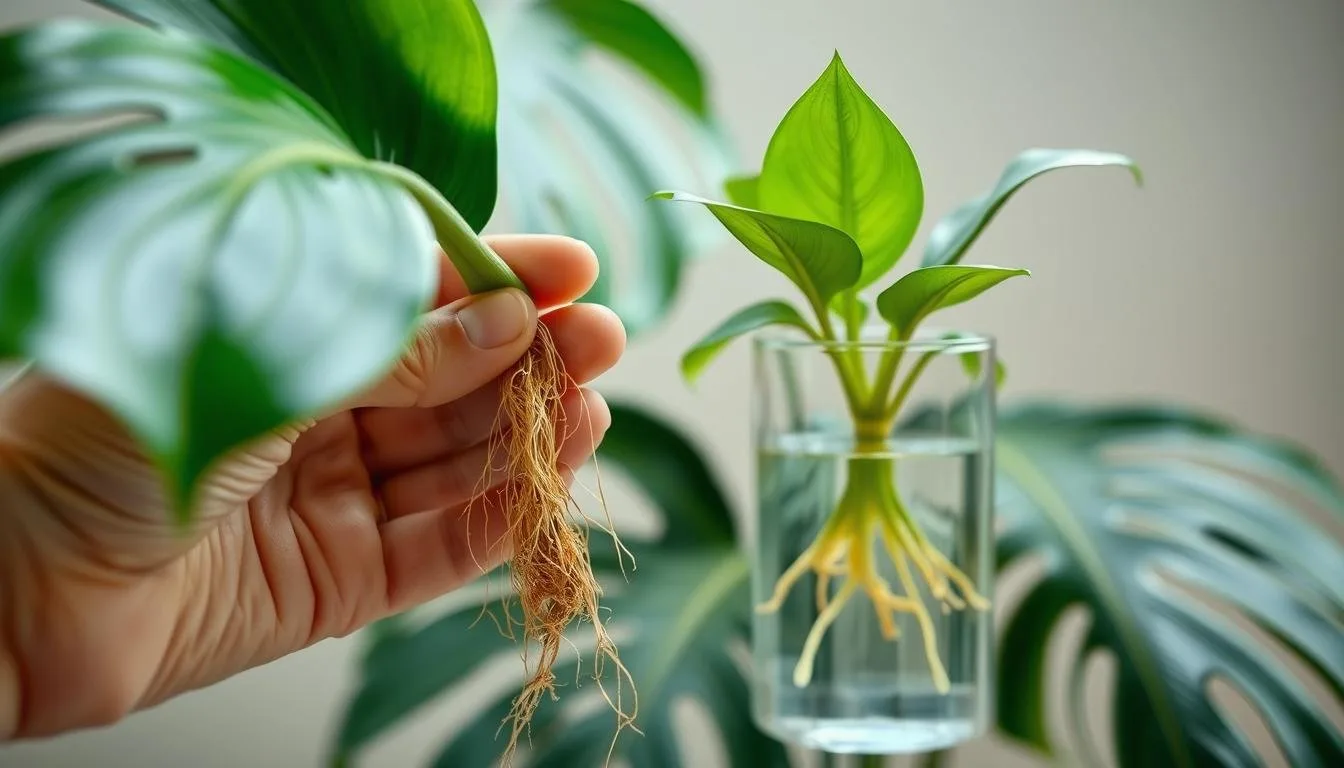
Choose a healthy stem section with at least one node and a visible growth point or axillary bud. A leaf by itself, or a detached petiole without a node, cannot grow into a new vine. If an aerial root is present at the node, it can help the cutting establish, but the node and viable bud are the essential parts. Gardening Know How’s Monstera propagation guide also stresses the node-and-bud requirement and describes both water and growing-medium methods (Gardening Know How).
With clean shears, cut below the node so it stays attached to the cutting. Place the node in clean water or in a lightly moist, airy rooting medium; keep the leaf above the water or substrate and provide warm indirect light. Refresh water when it clouds or every few days, and check medium-grown cuttings for moisture without keeping them soggy. Rooting may take several weeks, and the exact pace depends on temperature, light, and cutting condition.
Choose water, moss, or a chunky rooting mix
Water propagation makes it easy to see whether roots are forming, but roots adapted to water still need a careful transition into potting mix. Wait until the cutting has several established roots rather than moving it as soon as a tiny nub appears; plant it in pre-moistened airy mix and keep the first few weeks evenly, lightly moist while it adjusts. Then return to the same check-and-water routine as the parent plant.
Rooting directly in a small pot of sphagnum, perlite, or a fine but airy propagation mix avoids the water-to-soil transition. Keep the material lightly moist, not dripping wet, and provide enough humidity to slow drying while the cutting has few roots. A clear propagation box can help, but vent it and check often for mold or rot. If the stem softens or darkens, remove the damaged portion with clean shears and restart only if a healthy node remains.
Air layering is another option if the vine is long and you want it to root before severing it from the parent. Wrap a node and aerial root in damp sphagnum, secure it loosely, and check moisture until roots are visible. Then cut below the rooted node and pot it up. This method reduces the period when a new cutting has no roots, but it takes more setup than a single stem cutting.
Repot while preserving the climbing setup
Repot when roots circle densely, emerge from drainage holes, the mix has broken down and stays wet, or the plant is unstable in its container. A calendar interval alone is not enough reason. Move up only one pot size, keeping the root ball at its previous depth; a much larger pot holds unused wet mix around the roots and can slow drying.
If you need to install a support, repotting is a convenient time to place it near the root ball without driving a stake through established roots. Anchor it firmly and guide the stem toward it with a loose tie. Avoid burying the stem node or packing mix tightly around aerial roots. Afterward, water to settle the mix, let the pot drain, and give the plant stable indirect light while it resumes growth. RHS guidance also cautions against overpotting Monstera because excess compost can remain wet and encourage root rot (RHS).
Troubleshoot yellow, brown, curling, or stalled leaves
Read the whole plant and its growing conditions before you change anything. One older leaf fading slowly is different from several leaves yellowing in a week; a brown tip can come from dry air, irregular watering, salts, or root trouble. Check soil moisture, drainage, light changes, and the underside of leaves before adding fertilizer or humidity.
| What you notice | Check first | A measured response |
|---|---|---|
| Several leaves yellow, mix remains wet | Drainage, pot size, roots, and watering frequency | Let the mix dry appropriately; inspect roots if decline continues |
| Leaves droop and mix is very dry | Root ball moisture and how evenly it wets | Water thoroughly, drain, then check again before watering |
| Brown or crispy margins | Recent dry air, sun exposure, salts, or missed watering | Correct the likely condition; old brown tissue will not turn green |
| Long gaps between leaves or slow new growth | Light level, season, and recent move | Improve indirect light gradually and wait for new growth |
| New leaves do not lie flat | Stem orientation and support contact | Aim nodes toward a stable surface; do not force leaves down |
If you need to inspect roots, slide the plant from its pot and look for firm, pale roots versus dark, soft, foul-smelling tissue. Remove only clearly dead roots with clean shears, replace waterlogged mix, and use a pot with open drainage. Do not treat every yellow leaf as fertilizer deficiency; adding food to stressed, wet roots can compound the problem.
Check for pests and root trouble
Inspect leaf undersides, stem joints, and the places where the vine touches its support. Spider mites can leave fine webbing and stippled leaves; thrips may leave silvery scarring or dark specks; scale and mealybugs can look like bumps or cottony residue. Isolate a plant with suspected pests before it touches other houseplants, then identify the pest and use a treatment labeled for that plant and setting. Repeat inspections matter because one cleaning may miss eggs or insects hidden in nodes.
Root rot is more often a growing-condition problem than a disease that can be solved with a quick spray. A dense mix, oversized pot, blocked drainage, or frequent watering while growth is slow can leave roots oxygen-starved. If the stem base is firm and only one leaf is affected, first correct the conditions and observe the next growth; if the plant continues collapsing, inspect the root ball and remove rotted material before repotting into fresh airy mix. Wisconsin Horticulture notes that Monstera’s aerial roots attach to supports and that wet growing media can contribute to root decline, so keep the support and pot moisture as separate decisions (University of Wisconsin Horticulture).
Keep the plant away from pets and children
Treat Monstera dubia as unsafe to chew. University of Florida IFAS identifies all Monstera species and plant parts as toxic to dogs, cats, and people because needle-shaped, insoluble calcium oxalate crystals can irritate the mouth and digestive tract (UF/IFAS Extension). Keep fallen leaves and pruning pieces out of reach, and place the climbing support where a pet cannot pull the pot down or reach the foliage.
Wear gloves if you are sensitive to plant sap, wash your hands after pruning, and avoid touching your eyes while handling cut stems. If a child or pet chews the plant, remove visible plant material from the mouth without forcing it, and contact a poison-control professional, pediatric clinician, or veterinarian for case-specific advice—especially if there is swelling, trouble swallowing, or breathing difficulty. Do not try home remedies or induce vomiting unless a qualified professional tells you to.
Conclusion
Monstera dubia grows best when you treat it as a climbing vine with a particular display habit, not as a standard trailing pot plant. Give the stem a stable board or textured support, aim the nodes toward it, provide bright indirect light, and keep the roots in an airy mix that can dry between thorough waterings.
After that, the routine is simple: acclimate changes gradually, feed lightly during active growth, inspect leaves and roots when something shifts, and propagate only from a cutting that includes a viable node. The plant may remain in its juvenile shingling form indoors, and that can still be a healthy, successful Monstera dubia.