Monstera Esqueleto Care Guide: Light, Water, Soil
Grow Monstera esqueleto indoors with bright filtered light, check-based watering, airy soil, climbing support, propagation steps, and problem fixes.
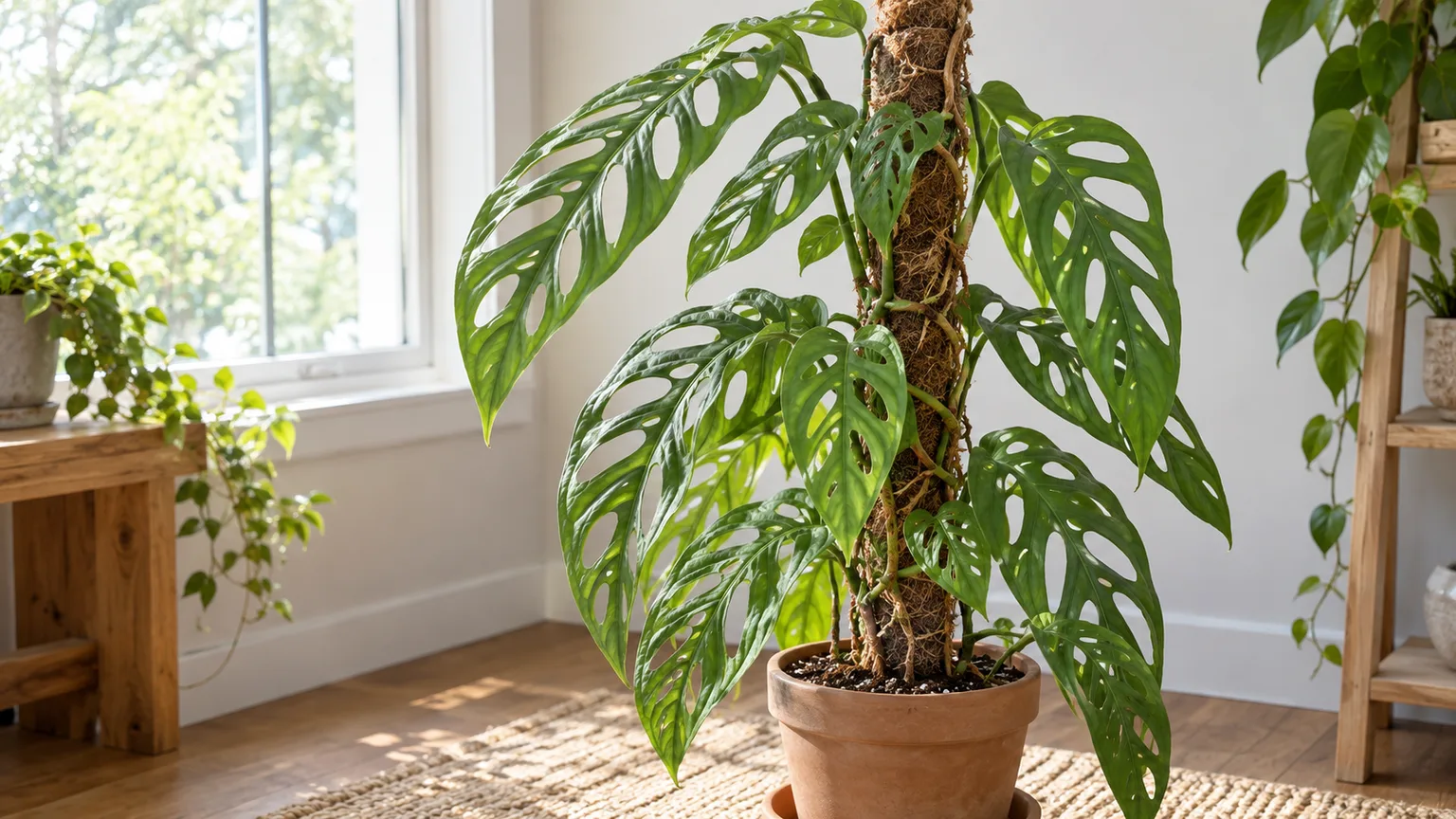
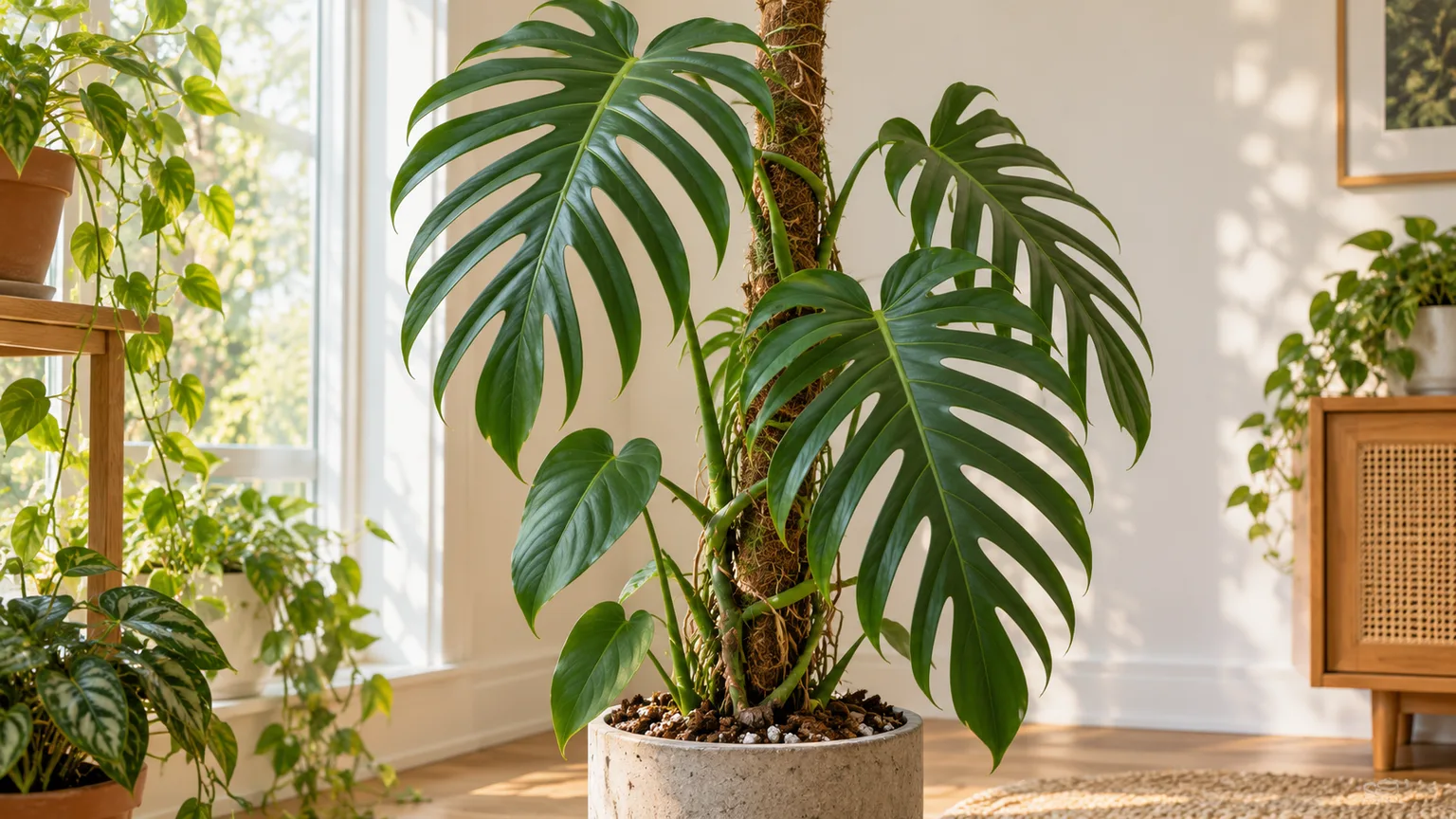
Monstera esqueleto is a climbing aroid for people who like leaves with more air than surface. A healthy plant carries elongated, light-green foliage punched with large internal fenestrations, then uses aerial roots to grip a support as it grows. The care is not difficult, but the plant is less forgiving of a dark corner, a saturated pot, or a mislabeled cutting than a common Monstera deliciosa.
The most useful routine is simple: give it bright filtered light, keep the root zone airy, water only after a meaningful dry-down, and offer vertical support if you want mature climbing growth. This guide also explains the name, the difference between juvenile and mature leaves, a safe way to propagate a node, and what to check when the plant turns yellow, brown, or stubbornly solid-leaved.
Quick Monstera Esqueleto Care Snapshot
Start with these indoor targets, then adjust them to your pot, window, and climate. The plant should be growing from a stable container, producing firm new leaves, and drying at a reasonable pace rather than staying wet for a week after every watering.
| Care factor | Practical starting point | What to watch |
|---|---|---|
| Light | Bright, indirect or filtered light | Stretching and solid new leaves mean too little; crisp bleached patches mean too much |
| Water | Soak when the top 1–2 inches of mix are dry | A heavy, wet pot plus wilt suggests root trouble, not thirst |
| Soil | Airy, chunky mix that still holds some moisture | Fine, collapsed mix and slow drainage raise rot risk |
| Humidity | Average home air can work; 50–70% is a helpful target | Brown edges need a humidity check, but also a root, salt, and sun check |
| Temperature | About 65–80°F (18–27°C) with no cold drafts | Growth slows when the root zone or leaves are chilled |
| Support | Moss pole or trellis for a climbing form | Support improves direction and may improve mature foliage; it is not a cure for low light |
| Feeding | Dilute balanced houseplant fertilizer during active growth | Skip stressed, newly repotted, or dormant plants |
The species profile from NC State Extension describes bright indirect or dappled light, high humidity, moist but well-drained organic soil, filtered or rainwater, and temperatures around 65–80°F. Treat those as a growing envelope, not a demand to keep the pot constantly wet.
What Monstera Esqueleto Is (and Why the Name Varies)
The name most useful for care is Monstera epipremnoides, a species in the Araceae family. Plants of the World Online from Kew accepts that species and gives its native range as Costa Rica to Panama, where it grows as a climber in wet tropical conditions. NC State also lists M. epipremnoides and includes ‘Esqueleto’ as a cultivated form with huge, glossy, skeletal-looking leaves.
That does not mean every plant sold as “esqueleto” is perfectly documented. Collector and nursery labels may use Monstera esqueleto, M. epipremnoides, or M. epipremnoides ‘Esqueleto’, and photographs can blur the line between this plant, large-leaved M. adansonii, and other holey Monsteras. The label matters when you are buying, but the growing clues matter more once the plant is home: a true mature esqueleto should climb, produce aerial roots, and develop long leaves with many perforations rather than only a few edge splits.
Indoors, give it enough vertical and horizontal room for a substantial vine. NC State reports houseplant specimens of the species commonly reaching about 6–8 feet, while the plant can grow taller in favorable frost-free conditions. A small nursery plant may look like a trailing houseplant for a while; that juvenile stage is not proof that it will stay compact.
How to Recognize the Plant You Bought
Inspect the growth point, stem, and newest leaves instead of judging a single old leaf. Look for a climbing stem with visible nodes, a petiole that joins the leaf at the base, and aerial roots emerging along the stem. Leaves may be less perforated when young, and nursery conditions can temporarily flatten the plant’s expression, so one solid leaf is not enough to identify a mislabeled specimen.
Be cautious with a “rare” cutting that has only a leaf and petiole. A Monstera leaf can remain green for months without a viable bud; a new plant needs a node, because the node contains the growth point. Ask for a clear photo of the node and confirm the cutting is not soft, blackened, or already infested before paying a collector’s price.
Light That Protects Thin Leaves and Encourages Fenestrations
Place Monstera esqueleto in bright filtered light, similar to the broken light beneath a forest canopy. The goal is a bright room where the plant can photosynthesize strongly without the hottest sun landing on its delicate leaf tissue for hours. Low light does not always kill a Monstera, but it often produces longer gaps between leaves, slower growth, and less impressive fenestration on new foliage.
Fenestrations are not a switch you turn on with a single sunny afternoon. Leaf age, genetics, plant maturity, energy balance, and climbing conditions all contribute, and a young plant may produce mostly solid leaves before it changes form. Give a stressed plant stable light and root care for several new leaves before deciding that it has permanently lost its character.
Window Placement and Grow-Light Adjustments
An east-facing window is a forgiving starting point because it supplies bright morning light with less afternoon heat. Near a south or west window, use a sheer curtain or move the pot back from the glass, especially when the sun is strong; increase exposure gradually if the plant came from a dim shop or shipping box.
Read the leaf pattern when you adjust the location. Long internodes, a vine leaning hard toward the window, and new leaves that stay small or nearly solid point toward insufficient light. Pale tan patches on the window-facing surface, crispy margins after a sudden move, or a hot leaf temperature suggest excessive intensity or an acclimation problem. Change one variable at a time so you do not mistake sun scorch for underwatering.
If the brightest natural spot is still weak, a full-spectrum grow light can provide consistency. Keep the light above and slightly in front of the crown, follow the fixture’s distance guidance, and use a timer rather than leaving it on all night. A grow light can improve the energy budget for new leaves, but it cannot repair an already damaged leaf or replace an airy root zone.
Watering: Let the Root Zone, Not the Calendar, Decide
Water when the top 1–2 inches of mix are dry and the pot has become noticeably lighter, then soak the entire root ball until water drains freely. Empty the saucer or cachepot after drainage; a plant that sits in runoff is effectively being watered again from below. This check-based approach fits the species’ preference for moisture while protecting the roots from the low-oxygen conditions created by saturation.
A weekly schedule may work for a small plant in warm bright light, while a large plant in a cool room or an oversized pot may need much longer. Penn State Extension’s Monstera guidance likewise emphasizes thorough watering followed by partial drying, and BBC Gardeners’ World’s Monstera adansonii guide recommends watering after the top few inches of compost dry. Those related-Monstera intervals are useful starting logic, not a fixed prescription for every esqueleto.
A Reliable Indoor Dry-Down Routine
Use the same short inspection each time:
- Push a finger or wooden skewer 1–2 inches into the mix away from the stem. If that zone is cool and damp, wait; if it is dry and the pot feels light, water.
- Carry the grow pot to a sink, tub, or drain-safe tray. Pour slowly across the surface until water runs from the holes, then let the pot finish draining.
- Check the cachepot after 10–20 minutes and remove trapped water. Never use a decorative pot without a drainage path as the only container.
- Recheck sooner after a heat wave, a new support installation, or a move to brighter light. Recheck later after repotting, in winter, or when growth has slowed.
Do not compensate for dry indoor air by watering more often if the mix is still wet. Dry air can crisp leaf edges while overwatered roots simultaneously wilt the plant, so read the pot and roots before adding water. If your tap water leaves a chalky crust, periodically flush the mix with plenty of plain water and consider filtered water; NC State specifically lists rainwater or filtered water as options for this species.
Potting Mix, Container Size and Drainage
Use a chunky, moisture-retentive but fast-draining aroid mix. A practical starting blend is two parts quality indoor potting mix, one part orchid bark, and one part perlite or pumice by volume. The exact ingredients are less important than the result: roots should have access to both moisture and air, and the mix should not collapse into a dense layer that remains wet around the crown.
Choose a pot with several open drainage holes and only a modest amount larger than the root ball. A pot that is 1–2 inches wider is usually easier to manage than a dramatic size increase, because fresh unused mix holds water around roots the plant has not reached. UConn’s Monstera cultivation guidance also warns that Monsteras tolerate being somewhat pot-bound better than being over-potted.
Do not bury the stem deeper just to make a tall vine stable. Set the root ball at its previous depth, anchor the support separately, and keep the growing tip and stem junction above the mix. If the plant wobbles, use a heavier outer pot or a discreet tie rather than packing wet soil against the stem.
Support and Climbing: When a Moss Pole Earns Its Space
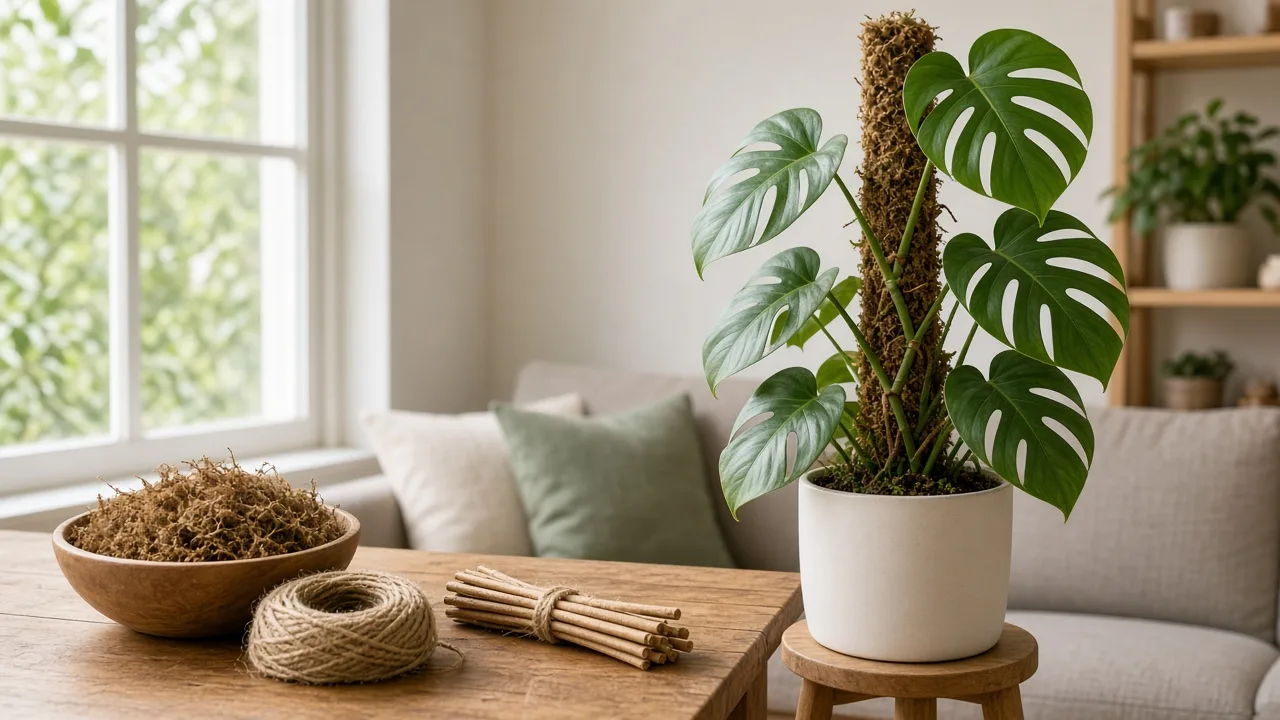
Monstera esqueleto is an epiphytic climber, not a naturally bushy floor rosette. It can survive without a moss pole if you let it trail from a shelf, but a vertical support gives the stem a direction, keeps large leaves from dragging, and lets aerial roots find a surface. UConn notes that support and attachment are associated with larger mature foliage in Monstera culture; that is a reason to support a healthy plant, not a guarantee that every leaf will become huge.
Choose a moss pole when you want an upright specimen and can keep the support stable as the vine gains weight. A trellis, rough bark-covered board, or other textured support can work when you prefer a drier, lower-maintenance setup. A smooth stake mainly holds the stem; it does not give aerial roots much to grip.
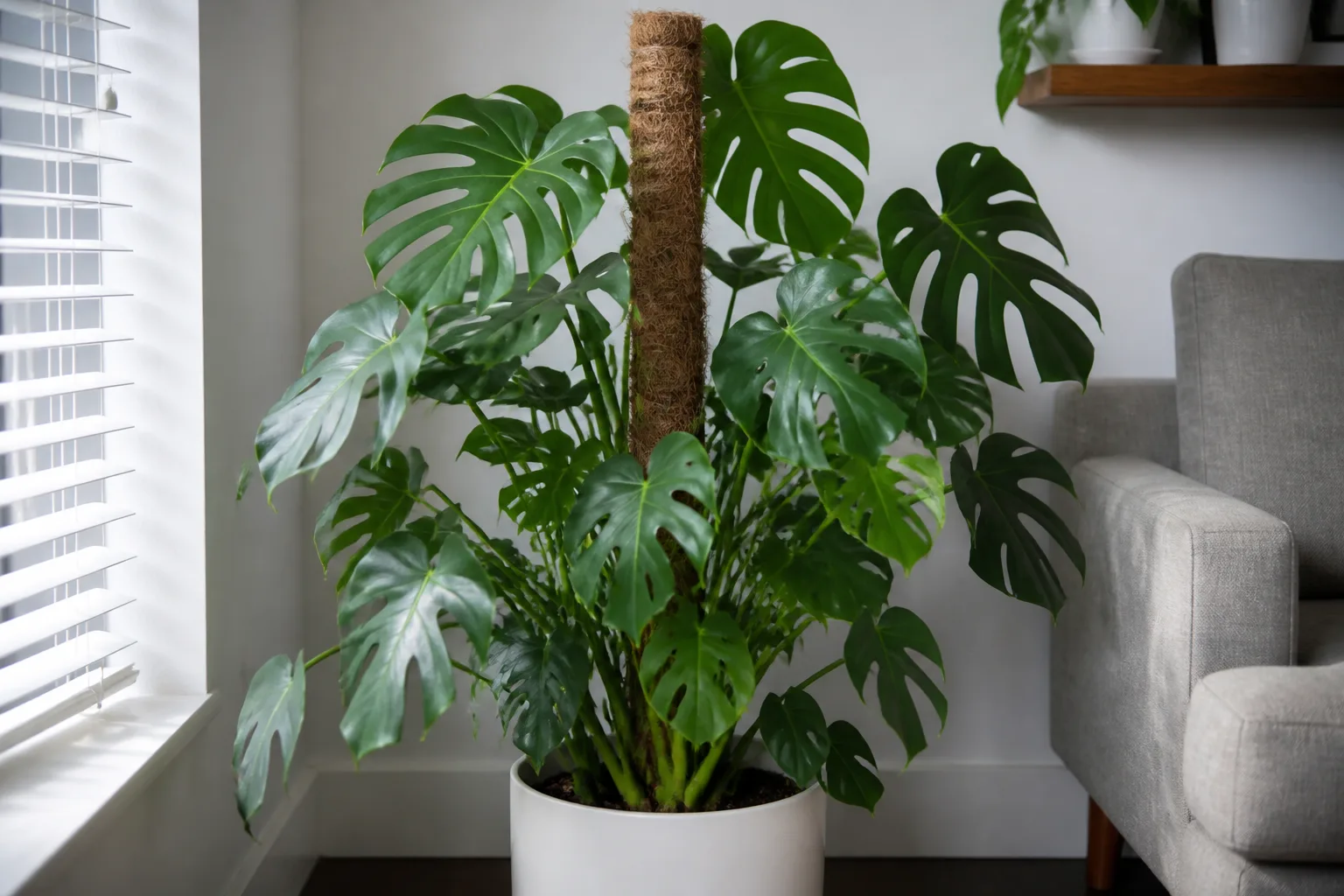
The support should be installed early, while the stem is flexible and the root ball is still manageable. Do not force a mature vine into a sharp bend or push a pole through dense roots if you can avoid it. If the plant is already attached to a small stake, extend or replace the support at repotting so you can position everything without repeatedly disturbing the roots.
How to Train Aerial Roots Without Damaging the Stem
Face the newest growth toward the support and use soft ties to hold the stem, not the leaf petioles. Leave slack for the stem to thicken, check the ties every few weeks, and remove any that cut into the tissue. Guide aerial roots toward the pole if they are flexible, but do not staple, glue, or bury a root that is still attached above the soil.
Keep a moss pole lightly and evenly moist only if its material and the plant’s setting benefit from it. A constantly soaked pole next to a poorly ventilated crown can add dampness without solving the real problem. If new leaves remain small, check light and root health before assuming the pole needs more misting.
Humidity, Temperature and Airflow
Higher humidity supports a tropical Monstera, but it is not a substitute for light or drainage. Aim for roughly 50–70% relative humidity when practical, especially while a new leaf is unfurling, but do not panic over a short spell of average household air. A humidifier is the most controllable option; grouping plants can help locally, while a pebble tray has a limited effect near the pot and must not leave the grow pot standing in water.
Keep the plant warm and away from heating vents, air conditioners, open winter windows, and strong drafts. NC State places M. epipremnoides around 65–80°F, while Penn State gives a broader warm-houseplant range for Monstera. Protecting the plant from abrupt cold is more useful than chasing a perfect number with a thermostat.
Airflow matters when humidity rises. Leave space between large leaves and a wall, use a small fan on a low setting if the room is stagnant, and avoid repeatedly misting foliage that cannot dry. Brown edges in a dry room may improve after humidity rises, but persistent spots, a sour pot, or a soft stem calls for a root and disease inspection instead.
Feeding, Pruning and Leaf Cleaning
Feed during active growth, usually spring through late summer indoors, with a balanced liquid houseplant fertilizer diluted according to the product’s conservative houseplant rate. Monthly feeding is a safe starting rhythm for a small or recently purchased plant; a vigorous specimen in strong light may use a more frequent dilute schedule, but more fertilizer cannot compensate for dim light or damaged roots.
Skip fertilizer when the plant is freshly repotted, drought-stressed, infested, or sitting in cold wet soil. Excess salts can burn roots and leave brown tips, so flush the mix occasionally with plain water when the pot drains well. Resume lightly only after the plant is producing firm new growth.
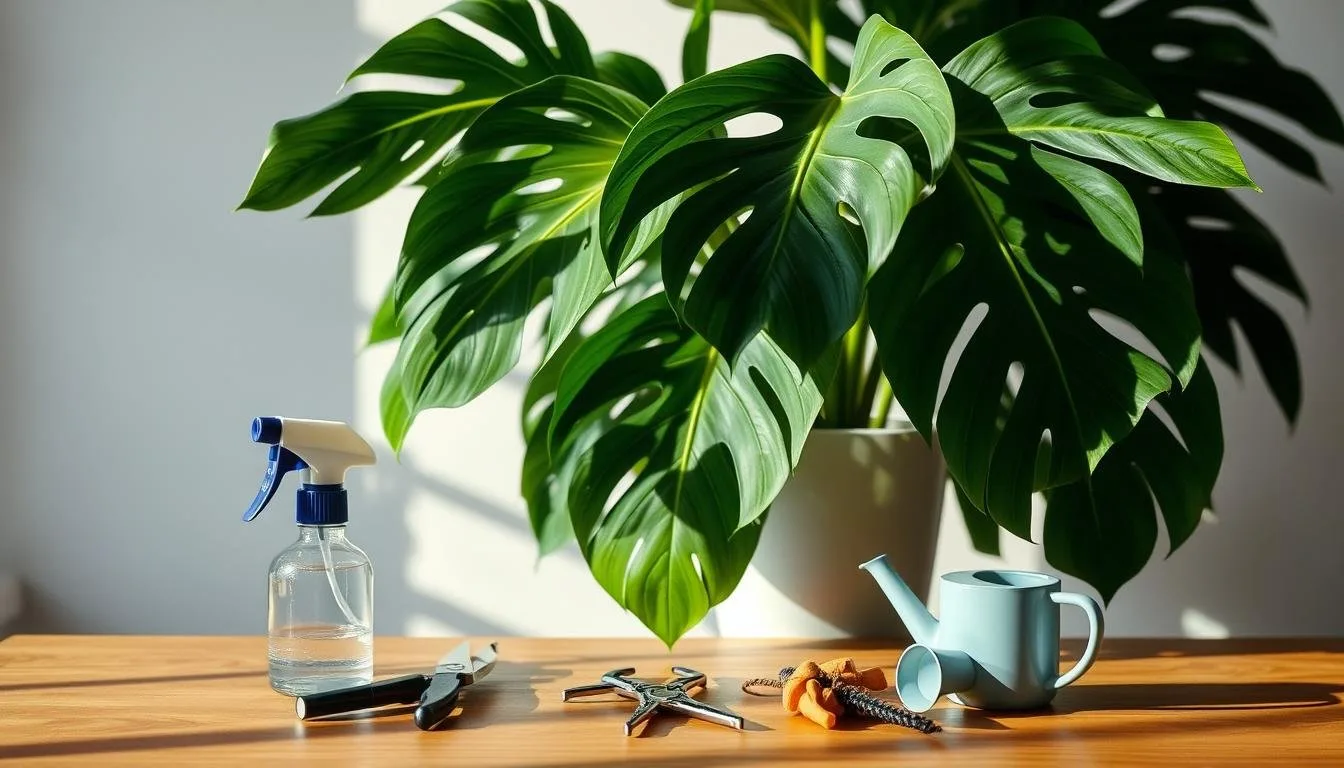
Prune damaged, fully yellow, or diseased leaves with clean shears, cutting the petiole near its base without slicing the main stem. To shorten a long vine, cut just above a node and keep the healthy cutting for propagation; do not remove a large section simply because one leaf has not fenestrated. Wipe dust from the broad leaves with a damp soft cloth, and avoid oily leaf-shine products that can interfere with the leaf surface.
Propagating Monstera Esqueleto From a Node Cutting
Propagate only from a vigorous, pest-free parent unless you are deliberately rescuing the last healthy section. A cutting must include a node—the slightly swollen stem junction where a leaf, dormant bud, and often an aerial root meet. A leaf without a node may look alive but cannot reliably produce a new vine.
Use clean, sharp shears and wear gloves if the sap irritates your skin. Take a cutting just below a node, keeping one healthy leaf and at least one viable node; an aerial root is a useful bonus, not a requirement. If you have a long healthy stem, divide it into sections with one or two nodes each, but do not remove so much that the parent loses more than it can support.
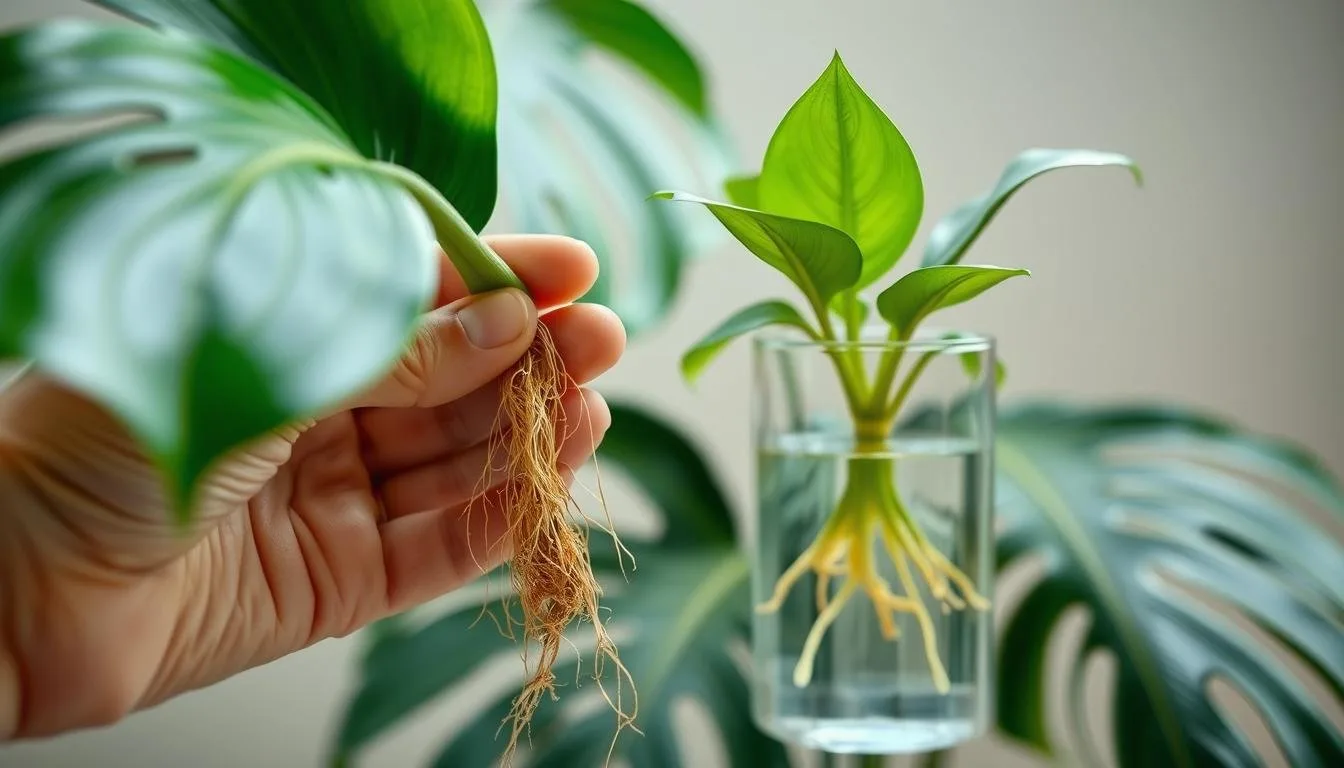
Let the cut surface dry briefly if it is wet, then choose water or a lightly moist rooting mix. Place the node in the rooting medium while keeping the leaf and most of the stem above it, set the cutting in warm bright filtered light, and keep it away from direct sun. New roots may take several weeks; a slow start is normal in cool or low-light conditions.
Water or Soil: Choosing the Better Rooting Method
Water is useful when you want to see root development. Put only the lower node and any aerial-root section below the water line, keep the leaf out of the water, and replace the water about weekly while topping it up as needed. The advantage is visibility; the cost is that long water roots can need a careful transition when they move into potting mix.
Soil or a light mix is less visible but avoids that water-to-soil transition. Set the node into a moist mix of potting medium and perlite or similar aeration material, keep it evenly moist rather than saturated, and maintain warm filtered light. Epic Gardening’s Monstera propagation guide also stresses a healthy parent, clean tools, a node, bright indirect light, and the different upkeep of water and soil rooting.
Pot a water-rooted cutting when it has several firm roots about 1–2 inches long, not at the first tiny nub. Use a small drainage pot, spread the roots gently, water the new mix once, and keep it a little more evenly moist than an established plant for the first week or two. Do not move it into a large pot or strong sun at the same time.
Repotting Without Setting the Plant Back
Repot when roots circle the bottom, emerge repeatedly from drainage holes, the mix has broken down, or water either races through or stays trapped for too long. A plant that is merely growing slowly does not automatically need a bigger pot; first check light, roots, pests, and temperature. Spring or the beginning of active growth is the easiest time because the plant can replace disturbed roots sooner.
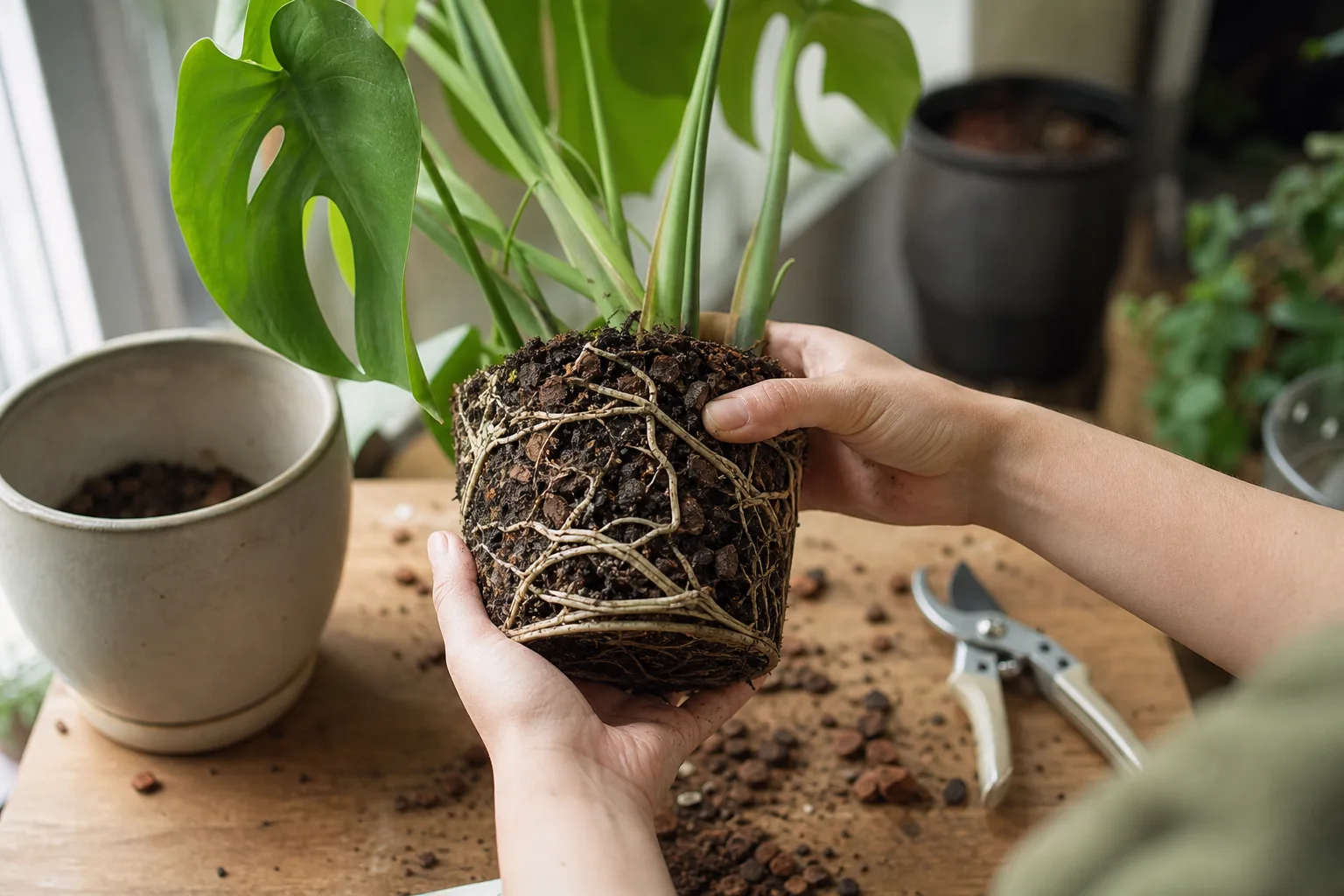
Prepare the new pot, support, and mix before you unpot the plant. Slide out the root ball, inspect for healthy firm roots versus brown mushy tissue, loosen only the outer circling roots, and remove damaged roots with sterile scissors if necessary. Set the plant at the same depth, fill around it without compressing the mix into a brick, and water thoroughly so the new medium contacts the roots.
Keep the repotted plant in the same bright filtered location for several days. Do not fertilize immediately, do not keep watering because the calendar says so, and do not combine a major haircut with a root disturbance unless rot or damage requires it. The first goal after repotting is stability: firm leaves, drainage, and a normal dry-down.
Diagnose Yellow, Brown or Holeless Leaves
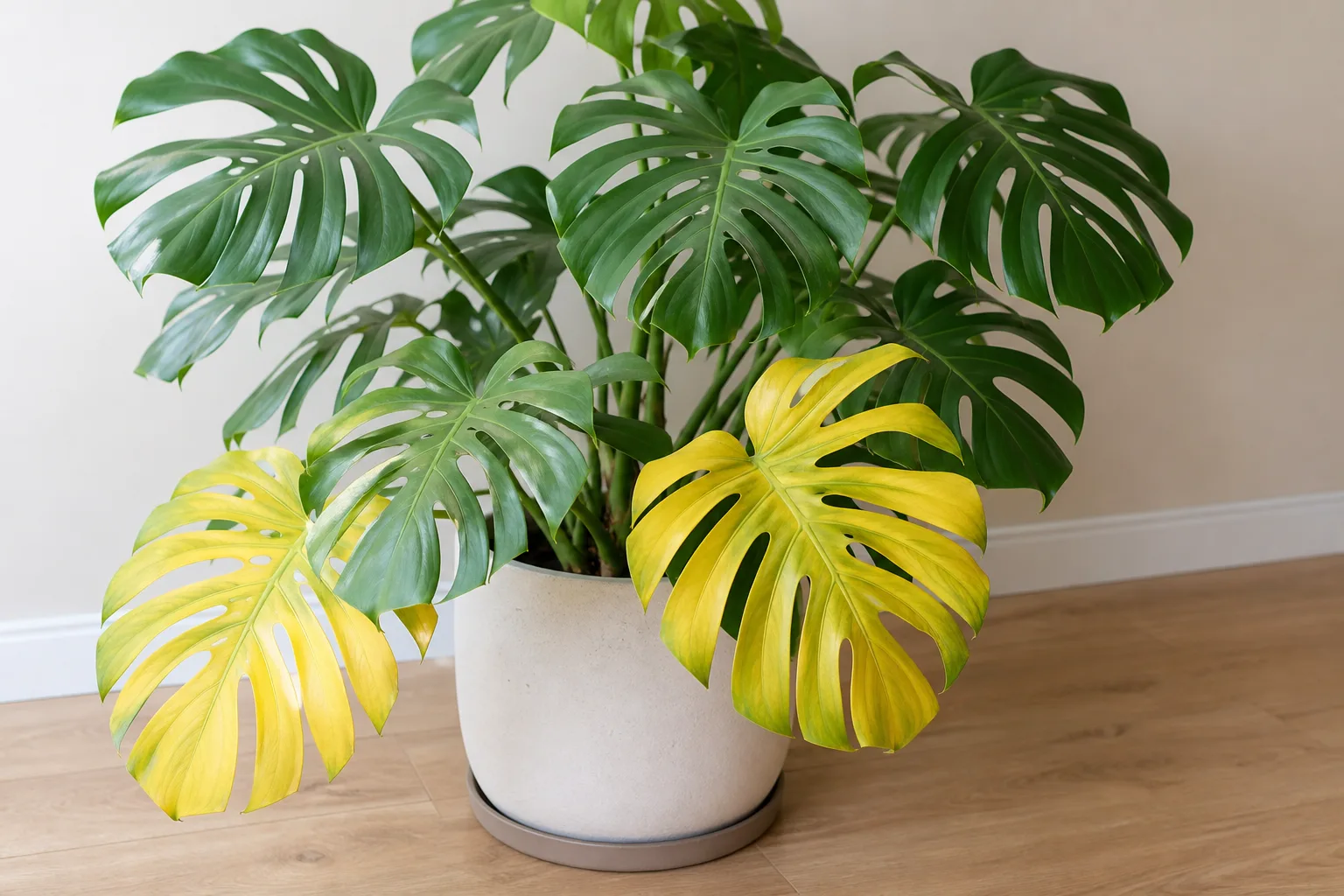
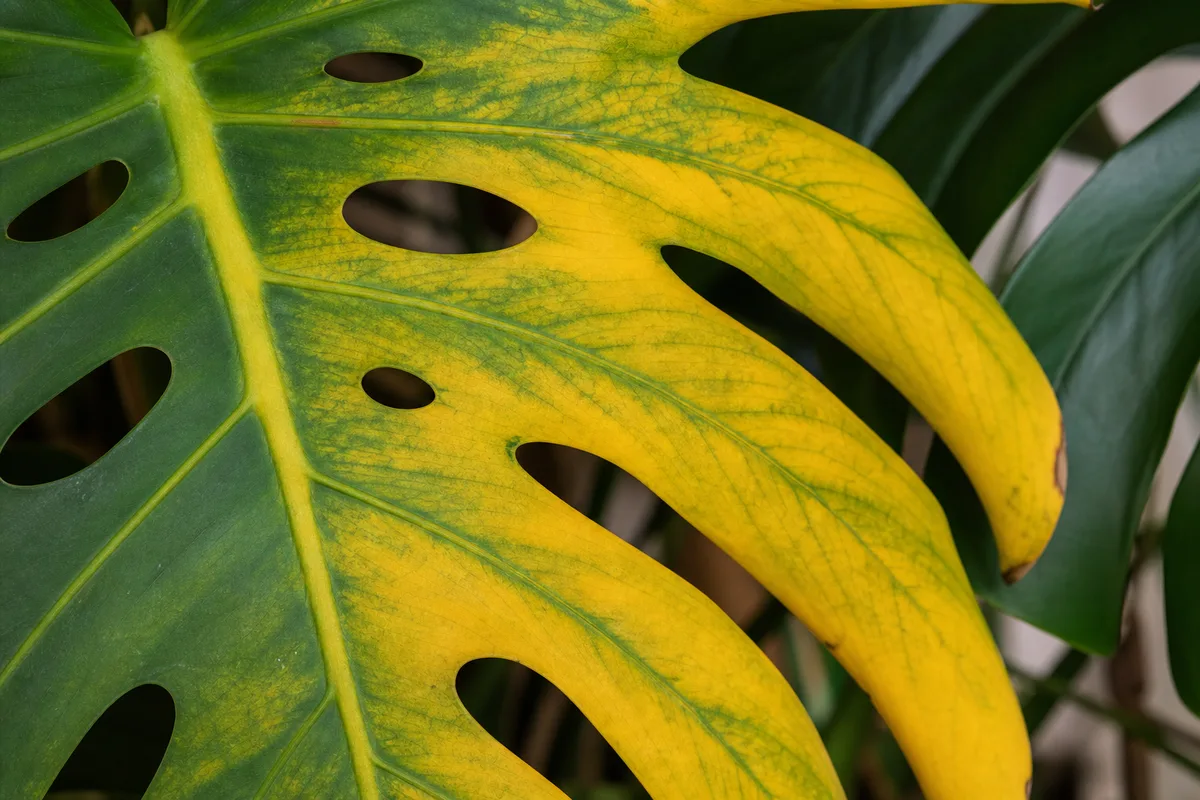
One symptom can have several causes, so start with the newest leaf, the pot’s weight, and the pattern of damage. NC State’s species profile lists under- or overwatering, direct-sun burn, and common sap-feeding pests as issues to monitor. Use the table below to choose the first inspection rather than spraying or fertilizing at random.
| What you see | Most useful first question | First action |
|---|---|---|
| Several lower leaves turn yellow and the pot stays heavy | Is the mix staying wet for many days? | Pause watering, improve drainage and light, and inspect roots if it continues |
| Leaf is yellow, thin, and the pot is very light | Has the root ball dried completely? | Water thoroughly, then shorten the next inspection interval |
| Tan crisp patches face the window | Did light intensity change suddenly? | Move back or filter the light; do not flood the pot to treat scorch |
| Brown tips with dry mix or dry room | Is the plant losing water faster than the roots replace it? | Check dry-down, humidity, salts, and drafts together |
| Fine pale stippling or webbing | Are spider mites present under leaves? | Isolate, rinse leaf undersides, and use a labeled houseplant treatment if needed |
| New leaves stay small and mostly solid | Is light weak, the plant juvenile, or the vine unsupported? | Improve filtered light and support; judge several new leaves, not one |
| New leaf unfurls damaged or fails to open | Was the plant moved, chilled, or allowed to dry during unfurling? | Stabilize warmth, moisture, and light; do not force the leaf open |
Do not cut holes into solid leaves. Fenestrations form as the leaf develops, and a hole punched by hand is an injury, not a sign of maturity. If the newest leaves are consistently smaller and less perforated, solve light and root-zone problems first; support can help a mature climber, but it cannot override a weak energy supply.
Pests, Leaf Spot and Root Decline
Check leaf undersides, petiole joints, and new growth for mealybugs, scale, whiteflies, or mites. UConn’s Monstera fact sheet describes mealybugs, spider mites, and aphids as sap-feeding pests and recommends starting with isolation, physical removal or washing, and an appropriate houseplant product when needed. Follow the label for any insecticidal soap or pesticide, test a small area first, and repeat only as directed rather than mixing remedies.
Leaf spot needs a different response from dry tips. Isolate a plant with spreading dark spots, keep leaves from staying wet overnight, improve airflow, and remove badly affected tissue with clean tools. If several leaves wilt while the soil is wet, the stem softens, or roots are brown and mushy, unpot the plant and inspect for root or stem rot; moving it into drier air without correcting the root system will not solve the decline.
Pet Safety and Handling Precautions
Treat Monstera esqueleto as toxic if chewed or swallowed. NC State specifically flags M. epipremnoides for low-severity poison characteristics and notes that all parts are toxic except fully ripe fruit, which an indoor plant rarely produces. The ASPCA’s Monstera deliciosa listing identifies insoluble calcium oxalates and symptoms such as oral irritation, intense burning, drooling, vomiting, and difficulty swallowing; that is useful genus-level safety context for a plant sold under a Monstera name.
Place the pot where cats, dogs, and young children cannot chew leaves or fallen trimmings. Wear gloves if sap causes irritation, wash tools and hands after pruning, and do not taste fruit from a houseplant simply because a mature outdoor Monstera can produce edible fruit under the right conditions. If a pet may have ingested the plant, call a veterinarian or your local animal poison service promptly; in the United States, ASPCA Animal Poison Control lists (888) 426-4435.
Conclusion
Monstera esqueleto rewards a steady routine more than a collection of special products. Give it bright filtered light, an airy mix in a draining pot, a thorough drink after the upper mix dries, warm draft-free air, and enough humidity for new leaves to unfurl without turning the root zone soggy.
If you want the plant to become the skeletal climber it is known for, add a stable support while the stem is young and guide aerial roots gently. When a leaf yellows, browns, or lacks holes, diagnose the pot, light, roots, and pests in that order; old damage will not reverse, but the next flush of growth can tell you whether the correction worked. Propagate only a healthy node, keep rare-plant labels in perspective, and keep the plant away from pets that might chew it.