Monstera Siltepecana Care: Complete Indoor Growing Guide
Learn Monstera siltepecana care indoors: light, watering, soil, support, propagation, and troubleshooting for silver juvenile leaves and mature growth.

Monstera siltepecana is an adaptable tropical vine, but the plant you bring home may not keep the same look as it grows. Its familiar juvenile leaves are narrow and silver-marked; with age and climbing support, new leaves can become larger, greener, and fenestrated. Decide whether you want a silver trailing vine or a taller climbing plant first, then set up light, watering, and support around that goal.
This guide focuses on indoor growing, where light, potting mix, and the size of the root system change how quickly the soil dries. The care rules are straightforward: bright filtered light, an airy medium, a draining pot, and thorough watering when the upper root zone has begun to dry. A fixed weekly schedule or a promise of adult foliage by a certain month will not fit every home.
Start With the Plant’s Two Looks
The name silver monstera refers to the gray-green sheen and dark veining on the plant’s juvenile leaves. North Carolina Extension describes these young leaves as small, pointed, and lance-shaped; the adult foliage is larger, darker green, and develops fenestrations, or natural openings in the blade. That change is normal development, not a loss of health or a sign that the plant is reverting. (North Carolina Extension Gardener Plant Toolbox)
Kew lists Monstera siltepecana as an accepted species native from eastern Central America into southern Mexico, growing as a climber in a wet tropical biome. That climbing habit explains why a plant in a hanging basket and one trained upright can look quite different even when both are healthy. (Kew Plants of the World Online)
North Carolina Extension lists siltepecana as a rapid-growing vine and gives a mature range of about 5–8 feet tall and 3–5 feet wide. Treat that as a possible supported specimen, not a guaranteed indoor measurement; the available light and structure determine how much vertical space you actually use. (North Carolina Extension Gardener Plant Toolbox)
Juvenile Silver Leaves and Mature Green Leaves
A young plant usually has narrow, silver-patterned leaves without holes. When a plant is established and allowed to climb in good light, it may begin producing larger, darker leaves with fenestrations; the old juvenile leaves do not change shape, so the transition shows up in new growth. North Carolina Extension documents this foliage shift, while the Royal Horticultural Society notes that larger plants develop tear-shaped or oval perforations. (RHS plant profile)
The timing varies. A young cutting can remain juvenile for a long time, and indoor conditions rarely match a tropical forest. Brightness, warmth, root health, plant age, and access to support all affect how the next leaves develop. Treat fenestrations as a possible sign of maturity, not a deadline or the only measure of success.
If the leaves are turning uniformly green on new growth, that may be normal maturation on a climbing vine. If silver fades while leaves also bleach, crisp, or decline, check light exposure, moisture, and pests before assuming the plant has matured.
What the “El Salvador” Label Means
Some retailers sell plants under the name Monstera siltepecana “El Salvador,” often suggesting unusually large leaves or a more compact growth habit. Kew and North Carolina Extension recognize the species Monstera siltepecana, but their profiles do not establish a separate species-level category or confirm fixed leaf dimensions for plants sold under that label. Treat “El Salvador” as a seller’s horticultural label, ask for photos of the actual plant, and buy based on healthy roots and foliage rather than a promised size.
Siltepecana can also be confused with Scindapsus pictus, sometimes marketed as satin pothos. Both can have silver markings, but the plant’s pointed leaves, climbing aroid stems, nodes, and aerial roots help distinguish Monstera siltepecana from the heart-shaped leaves of Scindapsus. A clear botanical label matters more than a rare-sounding retail name.
Choose a Trailing or Climbing Display
You can let the vine cascade from a hanging pot or train it upward. A trailing plant keeps the smaller, silver-marked juvenile foliage for longer and is easier to fit on a shelf; a climbing plant uses vertical space and may develop larger adult leaves over time. Neither display is wrong. Choose based on the foliage and shape you want, not because one is the only acceptable way to grow it.
Pick Support That Fits Your Goal
For an upright plant, install a stake, trellis, rough board, coir totem, or moss pole while the vine is still flexible. Tie the main stem loosely at a node with soft garden tape or plant clips; do not bind the petioles or force an aerial root into a tight position. A rough or textured support gives the stem and roots something to catch, while a smooth stake mainly keeps the vine upright.
A moss pole can give aerial roots a humid surface to grip, but it does not need to be constantly soaked. Keep the pole lightly moist if you want roots to attach, and avoid letting water run into a pot that is already wet. A dry trellis or board can still provide physical support even if aerial roots do not penetrate it. The RHS describes the species as both climbing and trailing, so a hanging basket remains a sound option when you prefer the juvenile look. (RHS plant profile)
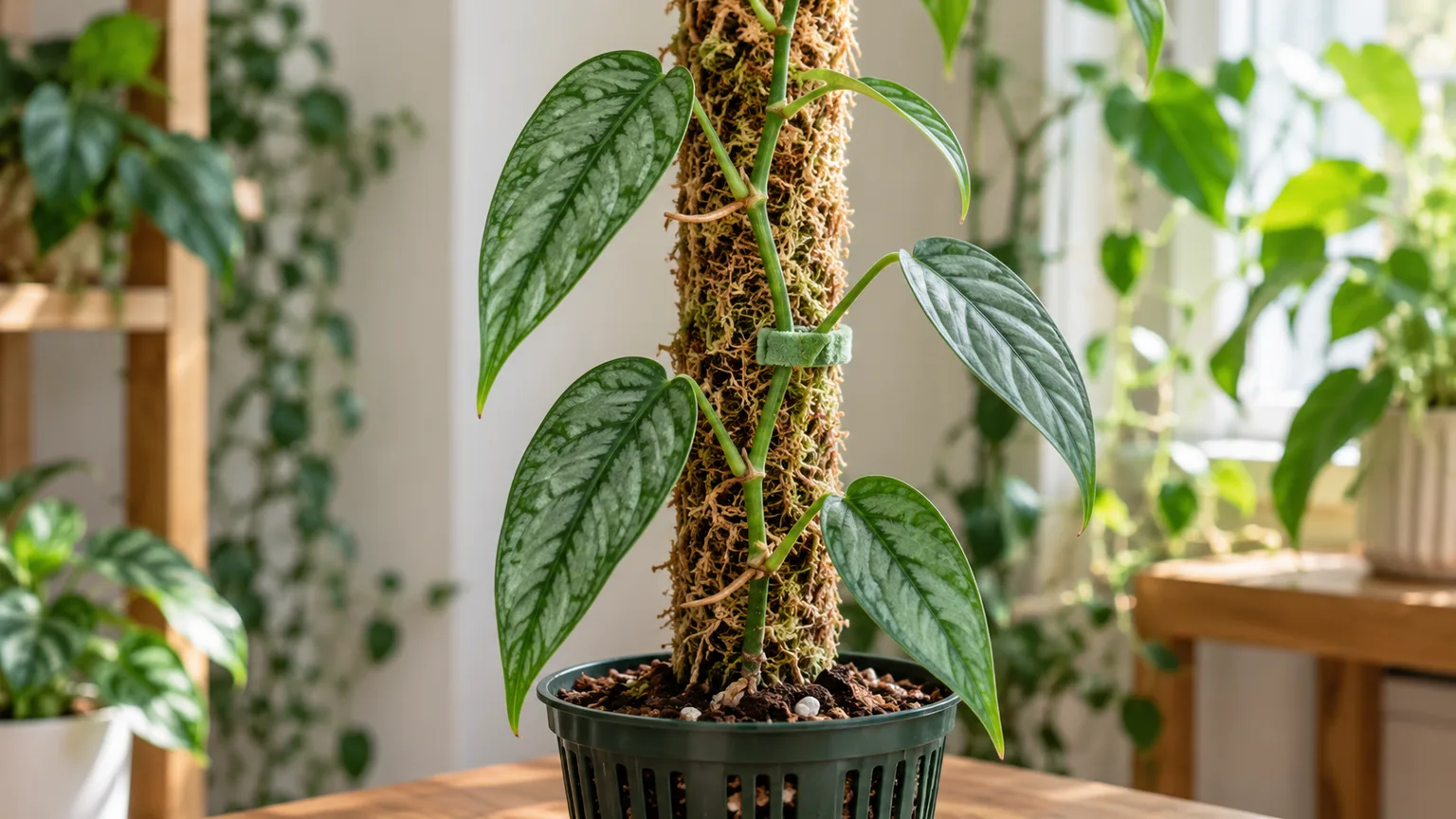
Expect each new leaf to respond to the conditions it grows under. A support alone will not create mature leaves if the plant is kept in dim light or is struggling with damaged roots. If it becomes leggy, address light and stability before repeatedly pruning the vine. For more on root attachment and training, see the Monstera aerial roots guide and the Monstera siltepecana overview.
Place It in Bright, Filtered Light
Give Monstera siltepecana a bright spot where it receives plenty of ambient daylight but little harsh midday sun through glass. An east-facing window often provides gentle morning sun; a bright north-facing window may work in a sunny climate, while a west- or south-facing window may need a sheer curtain or a little distance from the glass. The RHS recommends bright indirect light, and a grower’s account from Trex Plants similarly found brighter, filtered conditions useful for healthy growth. (RHS cultivation guidance; Trex Plants growing notes)
If the vine leans toward a window or produces long bare gaps between leaves, increase light gradually. Move it closer over a week or two, rotating the pot occasionally so one side does not do all the reaching. Pale, dry patches on the window-facing side suggest sun scorch; move the plant back or diffuse the light rather than compensating with extra water.
In a dim room, a grow light can help, but avoid placing the plant in a dark corner simply because it tolerates shade outdoors. Low light reduces growth and slows soil dry-down, so watering more often in that setting increases the chance of root problems. For window placement and grow-light details, use the Monstera siltepecana light guide.
Water by Root-Zone Dryness
Water thoroughly when the top few centimeters of potting mix feel dry and the pot has become noticeably lighter. For a small pot, check about 2–3 cm down; for a larger pot, check deeper as well so you do not mistake a dry surface for a dry root ball. Then pour water slowly over the whole surface until it drains from the bottom, and empty the saucer or cachepot.
This plant prefers moisture with air around its roots, not a pot that stays saturated. The RHS advises watering while the plant is growing and keeping the mix just moist in winter. Iowa State Extension also recommends checking the soil rather than watering by the calendar because light, temperature, container, and medium all affect drying time. (RHS cultivation guidance; Iowa State University Extension)
Adjust for Season, Pot, and Growing Setup
In warm bright conditions, the plant may use water quickly; in winter or a cool, low-light room, the same mix may take much longer to dry. A small nursery pot with many roots can dry faster than a large decorative pot, while a dense mix or blocked drainage hole can stay wet for days. Check the actual root zone each time rather than using “once a week” as a rule.
If the pot is still heavy and the mix feels damp, wait and check again in a few days. If the mix is bone dry and has pulled away from the pot, water slowly in two passes so it can absorb instead of running down the gap. Yellow leaves do not tell you by themselves whether the plant is thirsty or overwatered; compare soil moisture, drainage, and root condition. The Monstera siltepecana watering guide explains the seasonal adjustments in more detail.
Use an Airy Mix With Reliable Drainage
Use a loose, moisture-retentive but fast-draining mix. A practical starting blend is two parts quality indoor potting mix or coco coir, one part orchid bark, and one part perlite or pumice. The fine organic portion holds water; bark and mineral particles leave larger air spaces so roots are not packed into a dense, wet mass. The exact ratio can shift with your room: add more coarse material if the mix stays wet too long, or slightly more potting mix if it dries almost immediately.
A standard indoor mix can work if it is loose and drains well, but dense garden soil or a compacted peat-heavy mix is a poor choice for a climbing aroid in a small container. Do not add gravel to the bottom of a pot as a substitute for drainage; it does not solve a blocked hole or heavy substrate. Iowa State Extension recommends a drainage hole and warns against leaving houseplants in runoff. (Iowa State University Extension)
The pot should have at least one open drainage hole. You can set a nursery pot inside a decorative cachepot, then tip out collected water after watering. For a detailed ingredient and ratio discussion, see the Monstera siltepecana soil guide and Monstera soil-mix walkthrough.
Keep It Warm and Moderately Humid
Stable indoor warmth suits this tropical plant. Keep it away from cold drafts, air-conditioning blasts, and hot heater vents; these rapid changes can cause leaf stress even when the room’s average temperature seems comfortable. North Carolina Extension lists the species for warm hardiness zones, while the RHS recommends protected cultivation under glass in cooler climates. If you live in a frost-prone area, grow it in a container and bring it indoors before nights turn cold. (North Carolina Extension Gardener Plant Toolbox; RHS plant profile)
It can adapt to ordinary household humidity if light, watering, and roots are in good shape. A humidifier is useful when indoor air is consistently dry and leaf edges repeatedly become crisp, but first rule out salts, underwatering, and direct sun. Grouping plants may create a small local increase in humidity; misting is brief and does not maintain a lasting humidity level. Iowa State Extension notes that misting raises humidity only for a short time and recommends a humidifier when a meaningful room-wide increase is needed. (Iowa State University Extension)
North Carolina Extension lists outdoor hardiness zones 9a through 11b, but a zone number is not a promise that a potted plant will tolerate frost, wind, or a sudden cold snap. Outdoors, use bright shade or filtered light and protect the plant from direct afternoon sun. Move it back inside if temperatures are expected to approach freezing.
Feed Only During Active Growth
Use a balanced liquid houseplant fertilizer during spring and summer if the plant is actively producing leaves. Start at half the label strength and apply no more often than about once a month; if the mix already contains fertilizer or the plant was recently repotted, wait before feeding. RHS species guidance recommends a balanced liquid feed monthly while in growth. (RHS cultivation guidance)
Skip fertilizer when growth has slowed in a cool, dim winter room. Fertilizer cannot compensate for weak light, poor drainage, or damaged roots, and excess salts can burn root tips. A white crust on the soil or pot, brown margins, or stalled growth are reasons to pause feeding and flush the mix with plain water if drainage is good. The Monstera siltepecana fertilizer guide covers timing and dilution.
Repot When the Roots Need Space
Repot when the root ball is crowded, the mix has broken down, or the pot dries unusually fast despite consistent care. Roots poking through a drainage hole are a useful prompt to inspect, but one root at the bottom does not mean the plant is urgently root-bound. Slide the root ball out gently: if firm roots circle around a dense mass with little mix left, move it to a pot only one size larger.
North Carolina Extension describes Monstera siltepecana as fast-growing and recommends repotting about every one to two years; in a home, use that as a reminder to inspect rather than a strict deadline. Spring is convenient because active growth can help the plant re-establish, but rescue a plant with rotting roots or unusable soil as soon as needed. Iowa State Extension likewise advises moving houseplants up only one or two container sizes and removing dead or mushy roots during repotting. (North Carolina Extension Gardener Plant Toolbox; Iowa State University Extension)
Keep the new pot only modestly wider than the root ball. An oversized pot holds a larger volume of wet mix that the roots cannot use quickly, which can prolong saturation and increase risk of rot. Do not use a pot without drainage unless you keep the plant in a separate draining nursery pot inside it.
Add or Extend Support During Repotting
If you want the plant to climb, set a stake or pole into the pot while there is room to position it beside the stem. Backfill gently and secure the vine loosely; forcing a thick pole into a finished root ball can damage roots. Choose a support that can be extended as the plant grows, and keep the pot stable enough that a tall vine will not tip it over.
Do not cut healthy aerial roots just because they extend beyond the pot. Guide them toward the mix or support if practical, or leave them alone if the plant is stable. More detail on root inspection and support placement is in the Monstera siltepecana repotting guide.
Prune Without Weakening the Vine
Remove dead or badly damaged leaves with clean, sharp scissors. To control length, cut the stem just below a node, where a leaf and growth point attach; that piece can become a cutting if it includes a viable node. Prune during active growth when possible, and avoid removing a large share of healthy foliage at once because the plant needs leaves to support new roots and shoots.
Wear gloves if you are sensitive to plant sap, and wash tools after cutting. If the goal is a fuller pot, rooting several node-bearing cuttings and planting them back into the same container may be more reliable than repeatedly shortening a single vine. Use the Monstera siltepecana pruning guide for cut placement and aftercare.
Propagate With a Node-Bearing Cutting
The reliable home method is a stem cutting, and the cutting must include a node. A leaf on its own may stay green in a glass for a while, but without a node and growth point it cannot make a new vine. North Carolina Extension lists stem cuttings as the recommended propagation method for this species; the RHS also lists cuttings and layering in summer. (North Carolina Extension Gardener Plant Toolbox; RHS propagation guidance)
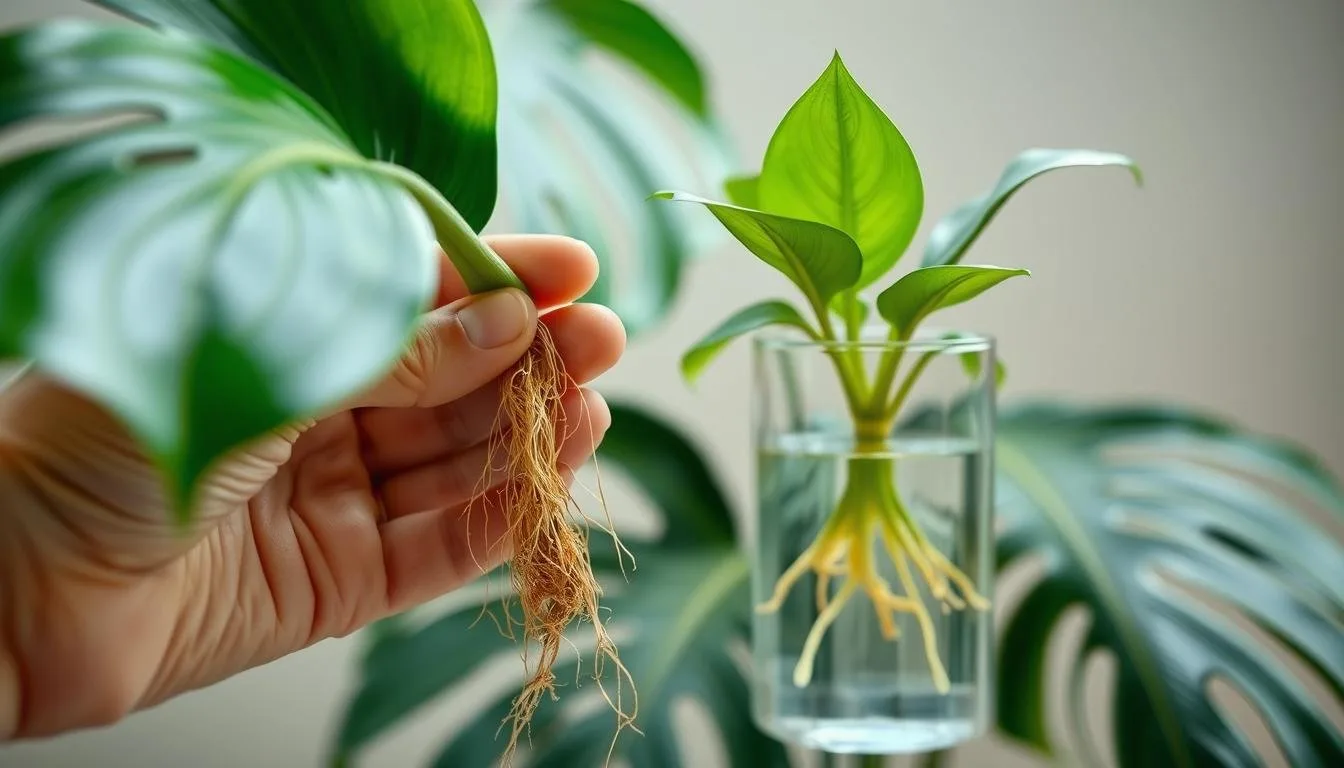
Choose a healthy section with one or two leaves and at least one visible node. A node is the joint along the stem where a leaf stalk emerges and where a small aerial root or bud may be visible. With clean snips, cut just below the node. Remove any leaf that would sit under water or below the soil surface, but leave the upper leaf in place to support the cutting. The same node-first approach appears in Little Green Obsession’s siltepecana care notes.
Root the Cutting in Water or Mix
For water rooting, place the node under clean water and keep the leaf above the surface. Change the water when it becomes cloudy and keep the glass in warm, bright indirect light. Pot the cutting once it has several firm roots a few centimeters long; short, branching roots usually adapt more easily than long tangled roots.
For direct soil rooting, insert the node into a small pot of airy mix, water it enough to settle the medium, and let excess drain. Keep the mix lightly moist but not soggy while roots form. Do not tug on the stem every few days to check progress; look for new growth and gentle resistance after several weeks instead.
Warmth and bright indirect light help, but exact rooting time varies with season, node condition, and temperature. Spring and summer are convenient because the parent plant is growing, though healthy cuttings can root at other times in a warm room. Once established, move the new plant into the same light and watering routine as the parent. See the full Monstera siltepecana propagation guide.
Troubleshoot Leaves, Roots, and Pests
Symptoms overlap, so inspect the soil and the newest growth before changing several care factors at once. One aging lower leaf can yellow naturally; multiple yellow leaves with wet soil point toward a different problem than a limp plant in dry mix. Use the pattern and root-zone condition together.
| Symptom | Check first | Useful first move |
|---|---|---|
| Several yellow leaves | Is the mix wet and heavy, or dry and pulling from the pot? | Correct the watering cause; inspect roots if wet soil persists |
| Brown, crispy tips | Direct sun, dry mix, salt crust, and room humidity | Fix root-zone moisture and salt buildup before buying a humidifier |
| Long stems with widely spaced leaves | Light level and whether the vine has support | Move toward brighter filtered light gradually and secure new growth |
| Pale or scorched patches | Recent move into stronger direct sun | Diffuse the light; do not try to fix sunburn with more water |
| Soft stem base or sour soil smell | Drainage, root condition, and mix texture | Stop watering, remove rot, and replace dense or sour mix |
Overwatering is not simply “too much water at once”; it is often a root zone that remains wet too long because the pot is too large, drainage is poor, the mix is compacted, or light is low. If the roots are firm and the mix is evenly damp, wait for more dry-down before watering again. If roots are brown, soft, or foul-smelling, remove the damaged tissue and repot into fresh airy mix. For more diagnosis, see the Monstera siltepecana yellow-leaves guide and root-rot guide.
Inspect new plants and the undersides of leaves for scale, spider mites, mealybugs, aphids, or thrips. The RHS lists scale insects and glasshouse red spider mite among potential pests for this species. Isolate an infested plant, rinse or wipe off what you can see, and use a product labeled for indoor plants according to its instructions; repeat checks because eggs and hidden insects may survive the first cleanup. (RHS plant profile)
Protect Pets and Children From Plant Sap
Keep the plant and fallen leaves where children and pets cannot chew them. University of Florida IFAS identifies all Monstera species as containing needle-like, insoluble calcium oxalate crystals that can irritate the mouth, throat, eyes, and digestive tract; North Carolina Extension also lists Monstera siltepecana as poisonous to people, cats, and dogs. Wear gloves if sap irritates your skin, and wash hands after pruning. (University of Florida IFAS; North Carolina Extension Gardener Plant Toolbox)
If a child or pet chews the plant, remove any visible plant material from the mouth and contact a medical professional or veterinarian for advice. The ASPCA lists Swiss cheese plant as toxic to cats and dogs and provides animal-poison-control guidance. (ASPCA Animal Poison Control)
Conclusion
Grow Monstera siltepecana in bright filtered light, an airy mix, and a draining pot; water when the upper root zone has started to dry, then let excess water leave the container. The biggest aesthetic choice is whether to keep its compact silver juvenile foliage trailing or give the vine support and room to mature. Watch the plant’s new growth and the moisture in its pot, and adjust one condition at a time when something changes.



