How to Grow and Care for Monstera Albo Indoors
Learn Monstera Albo care from light and watering to soil, support, propagation, and troubleshooting. Keep roots healthy without chasing white on every leaf.
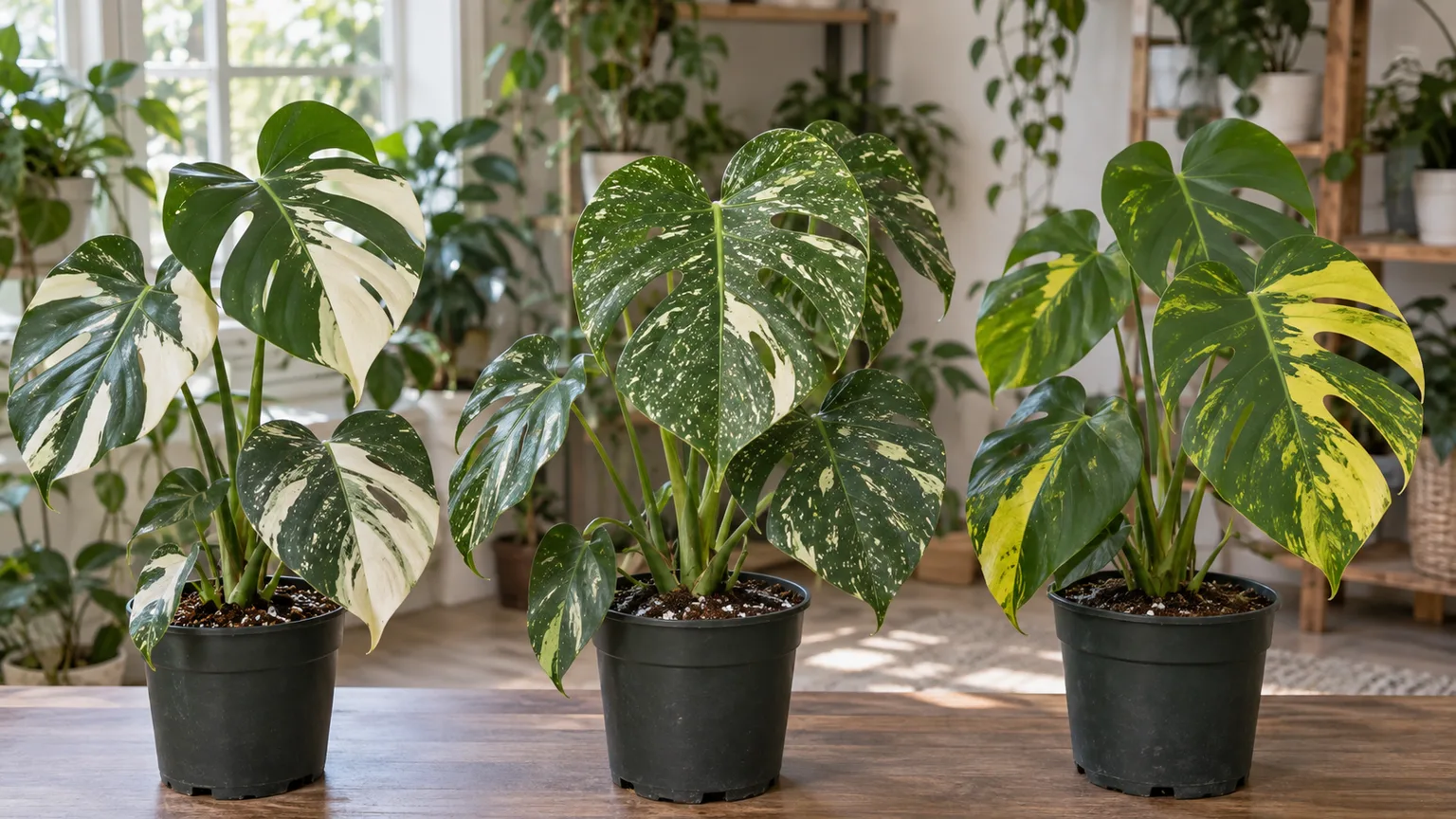
Monstera Albo has the climbing habit of a regular Swiss cheese plant, but its white leaf sectors change the margin for error. The green tissue supplies most of the leaf’s photosynthetic capacity; the white sections add the pattern collectors want but cannot contribute in the same way. Give the plant enough bright, filtered light to support growth, then protect its roots from staying wet for too long.
A stable setup matters more than a complicated routine. Identify the plant correctly, acclimate it before changing several conditions, and water according to how quickly its mix dries. The goal is a healthy vine with balanced new growth—not a guarantee that every leaf will have the same amount of white.
Identify Albo Before You Adjust Its Care
“Monstera Albo” usually refers to Monstera deliciosa ‘Albo Variegata,’ a variegated cultivar of the species. It is not a subspecies, and it is not the same plant as Monstera adansonii, which has smaller leaves with holes that stay inside the blade rather than the large, deeply split leaves of mature M. deliciosa. NC State Extension lists ‘Albo Variegata’ among the species’ cultivars; Kew’s Plants of the World Online recognizes M. deliciosa as the accepted species name. (NC State Extension, Kew Plants of the World Online)
You may also see sellers use “Albo Borsigiana.” Trade naming is inconsistent, so do not base care or a purchase decision on that word alone. Look for the actual plant: a climbing M. deliciosa with irregular white sectors across otherwise green leaves. A leaf can look dramatic in a listing photo while the stem or newest growth tells a different story.
Albo or Thai Constellation?
Both Albo and Thai Constellation are variegated forms of Monstera deliciosa, but their patterns are easy to distinguish. Albo usually has larger, sharper blocks or sectors of white against green; Thai Constellation tends to show cream-colored speckles and marbling spread through the leaf. Penn State Extension identifies both as variegated forms and notes that Thai Constellation is fuller and more compact because its internodes—the spaces between leaves—are shorter. (Penn State Extension)
That difference can help you assess a plant before you buy it, but it does not create two unrelated care regimes. Both need a climbing support as they mature, bright filtered light, and a potting mix that drains freely. Albo’s broad white sectors can make its growth less forgiving when light is weak or roots remain wet; do not compensate with extra fertilizer or a wetter soil mix.
What Variegation Changes—and What It Does Not
White leaf areas lack chlorophyll, the green pigment that captures light energy. Variegated plants therefore tend to grow more slowly and need a brighter position than darker green forms, as the Royal Horticultural Society explains. NC State likewise notes that variegated M. deliciosa cultivars need more light than darker green cultivars. (RHS: How Plants Use Light to Grow, NC State Extension)
More light does not manufacture white variegation, and more fertilizer does not make it stronger. The pattern is part of the cultivar’s growth; a particular leaf’s balance of white and green can vary. A bright, steady position supports the green tissue that fuels the plant, but an abrupt move into hot direct sun can scorch leaves, especially pale sectors. Think “enough usable light without a sudden exposure shock,” not “as much sun as possible.”
This balance is why Albo is usually a collector plant rather than a low-light, low-attention choice. If your only available spot is several feet from a small north-facing window or behind a curtain that keeps the room dim, a green Monstera is more likely to grow steadily. A grow light can help in a darker home, but keep it at the maker’s recommended distance and increase exposure gradually.
Buy and Acclimate an Albo Without Rushing It
Before buying a rooted plant or cutting, inspect more than the largest leaf. Check that the stem includes a visible node, the point where a leaf or aerial root emerges; a leaf without a node cannot produce a new vine. Favor a cutting with some green tissue along the stem and a firm growing point. Repeated all-white leaves may look striking, but a plant with very little green tissue has less capacity to support itself.
For a potted plant, check the undersides of leaves and the folds around petioles for webbing, cottony clusters, scale bumps, or silvery scarring. If you can inspect the roots, healthy ones should feel firm rather than soft and smell-free rather than sour. Avoid a pot that is saturated and heavy if the plant is being sold from a dim display; that combination can be harder to correct than a slightly dry plant.
At home, keep a new Albo separate from your other plants for a short quarantine period and place it in bright, indirect light. Let it settle and learn how quickly its current pot dries before repotting or changing the medium. If there is no active rot or pest emergency, do not repot, prune, fertilize, and relocate it in the same week. One change at a time makes it easier to tell whether a new leaf or symptom reflects shipping stress, the room, or the roots.
Light: Bright, Filtered, and Stable
Give Monstera Albo bright light for much of the day, softened by distance, a sheer curtain, or a nearby window that does not beam hot afternoon sun onto the leaves. A bright east-facing window is a useful starting point in many homes; a strong south- or west-facing window may need filtering. Window direction is only a rough cue: trees, buildings, season, hemisphere, and glass all affect how much light reaches the plant.
Watch how the plant responds over several weeks. A vine that stretches toward the window, makes long bare gaps between leaves, or produces smaller, greener leaves may need a brighter position. Move it closer in small steps rather than shifting it from a dim corner straight to an exposed sill. If white sections become papery or develop sharply edged tan patches on the side facing the glass, filter the light and check for heat buildup before assuming the plant needs more water.
In winter, daylight can fall enough that growth slows even in a familiar room. A full-spectrum grow light can supplement natural light if the plant is far from a window, but do not keep the lamp inches from the foliage or run it around the clock. Leave a dark period, and use the newest leaf and internode spacing—not one old leaf—as your feedback.
Water: Let the Root Zone Dry Partway
Water thoroughly when the upper part of the potting mix has dried, rather than following a weekly calendar. A practical starting check is the top 1 to 2 inches (about 2.5 to 5 centimeters), or roughly the upper quarter to third of the mix in a deeper pot. Penn State Extension recommends letting that upper layer dry between waterings; NC State gives a similar top-quarter-to-third dry-down rule. (Penn State Extension, NC State Extension)
Check the mix with a finger or wooden skewer and lift the pot to learn its weight after a full watering and after it dries. When the surface has dried but the root ball still feels cool and damp, wait and check again in a few days. When the upper layer is dry and the pot is noticeably lighter, water slowly until it runs from the drainage holes, then empty the saucer. Do not leave the nursery pot standing in runoff inside a decorative cachepot. Gardening Know How describes the same two-part rhythm: let the upper mix dry, then water thoroughly without leaving standing water. (Gardening Know How)
The interval changes with light, temperature, pot size, root mass, and mix. A small pot in a bright warm room can dry much faster than a large pot in winter. Water less often when growth slows, but do not let a small cutting dry to the point that its tender roots shrivel. If several leaves yellow while the mix stays wet, stop watering on schedule and inspect drainage and roots; adding more water to a limp plant can worsen root loss.
Soil and Pot: Keep Roots Airy
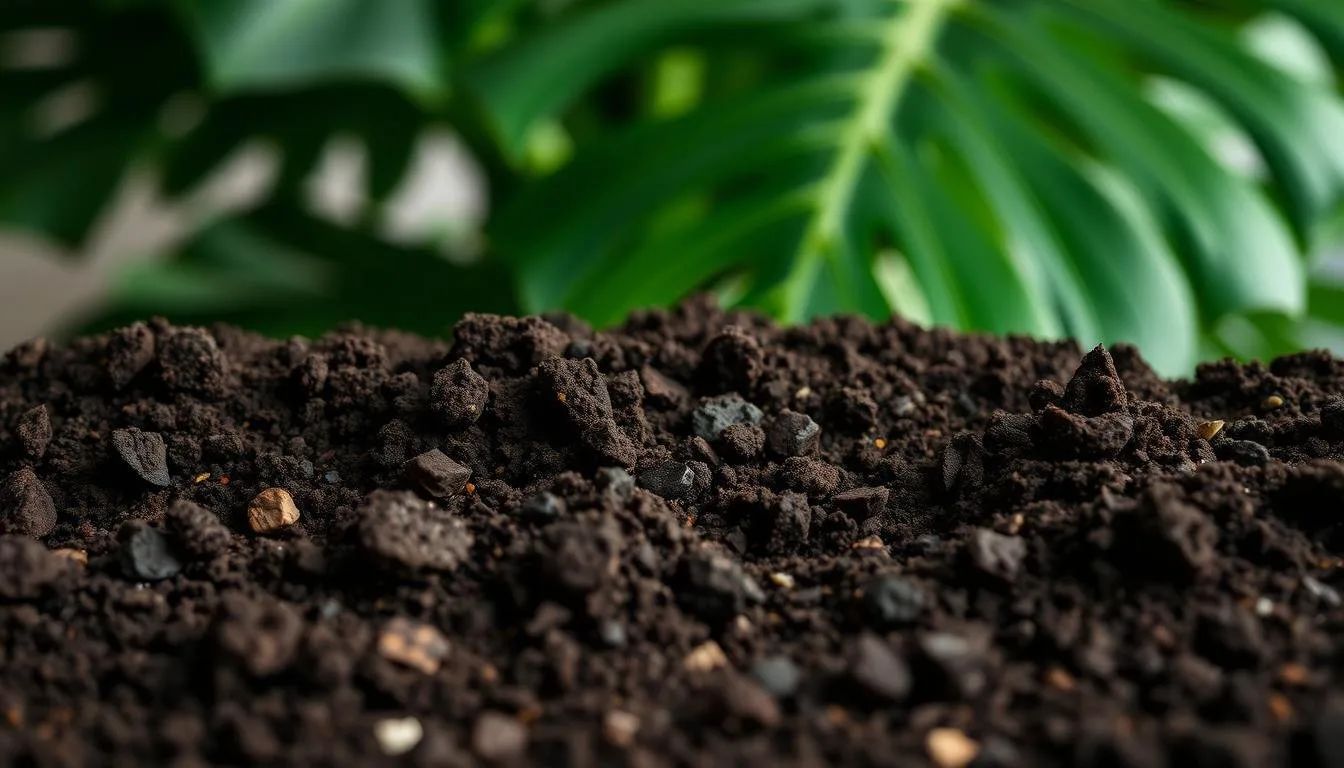
Use a loose, moisture-retentive but fast-draining houseplant mix. A simple starting blend is two parts quality indoor potting mix, one part orchid bark, and one part perlite or pumice. This is a practical recipe, not a requirement: if your room is hot and dry, use a little more base mix; if the pot stays wet for many days, increase the coarse components or use a smaller container. Penn State Extension notes that bark, perlite, or charcoal can be added to a well-draining soilless mix rich in organic matter. (Penn State Extension)
Choose a pot with open drainage holes and only a modest size increase when repotting. A container that is much wider than the roots holds extra wet mix the plant cannot use quickly. That is a bigger root-rot risk than a plant that is slightly snug. Avoid packing the mix down tightly, and do not put a layer of gravel in the bottom as a substitute for drainage; water needs a path out of the pot.
The right mix should hold enough moisture for roots to take up water while leaving air spaces after irrigation. If a nursery mix has broken down into dense, compact peat, drains very slowly, or smells sour, replace it when the plant is stable. If water runs around the edge without wetting the center, the root ball may have dried and pulled away from the pot; re-wet it gradually instead of assuming the soil is now well hydrated.
Temperature and Humidity: Avoid Extremes
Monstera Albo grows best in a warm, steady room without cold drafts or blasts from heating and air-conditioning vents. NC State and Penn State give a general species range around 60 to 85°F (16 to 29°C), with bright light, humidity, and warmth supporting indoor growth. Protect the plant from chilling near an open winter window and from hot glass that heats the leaves. (NC State Extension, Penn State Extension)
Ordinary room humidity may be adequate if new leaves unfurl normally and the plant is not drying too quickly. Penn State suggests humidity above 50 percent, but there is no need to chase a fixed number if your plant is growing well. A small hygrometer can help if leaf edges repeatedly crisp in a dry heated room; a nearby humidifier is more dependable than misting, which briefly wets leaves without maintaining room humidity. Keep airflow around the foliage and avoid placing the pot directly over a heater.
Humidity is not a substitute for correct watering. If the soil is dry and the pot light, hydrate the root ball; if it is wet and the plant is limp, investigate root function rather than raising humidity first. Very humid air combined with crowded, wet foliage can also slow drying, so keep the leaves from touching one another and do not trap the plant in a stagnant enclosure.
Fertilizer: Feed Growth, Not Color
A balanced houseplant fertilizer can support active growth, but Albo does not need an unusually strong feeding program. Start with the product’s houseplant directions during spring and summer when the plant is producing new leaves. If growth is slow or the potting mix already contains fertilizer, feed less often. Reduce or pause feeding when the plant is not actively growing in winter rather than continuing a calendar dose in low light.
Never raise fertilizer strength to push more white or force faster growth. Fertilizer supplies mineral nutrients; it does not change the cultivar’s variegation pattern. Too much can leave salt buildup at the mix surface or cause brown leaf tips, while weak light and damaged roots can prevent the plant from using the nutrients you add. If you see a crust on the soil or pot rim, flush the mix with clean water and let it drain fully, then resume at a lower frequency.
If you repot into a mix with slow-release fertilizer, wait according to that product’s label before adding liquid feed. If the plant is newly purchased and not growing, stabilize its light and roots first. A plant that is stressed by shipping or root rot is unlikely to respond well to extra fertilizer.
Support and Climbing: Train the Vine Early
Monstera deliciosa is a climbing vine. In nature it uses aerial roots to attach to a support and climb upward; indoors, a sturdy moss pole, coir pole, wood plank, or trellis can keep the stem upright and reduce the chance of a top-heavy plant tipping. NC State and Penn State both describe the species as a climbing plant that benefits from sturdy support. (NC State Extension, Penn State Extension)
Install support before the vine is large enough to lever itself out of the pot. Face the back of the stem—the side that produces aerial roots—toward the pole, and secure the stem with soft ties. Do not cinch a tie around a petiole or leaf stalk; those need to move as leaves turn toward the light. Guide aerial roots toward a pole or leave them alone if they are not causing a problem. They are not a sign that the plant needs a larger pot.
A pole can encourage a more upright habit and give aerial roots somewhere to anchor, but it cannot make a plant grow large leaves by itself. Light, root health, maturity, and stable support work together. A moss-filled pole may need occasional watering to stay suitable for roots to attach; if you do not want that extra task, a dry plank or coir support still gives the vine something stable to climb.
Pruning, Reversion, and All-White Leaves
Prune only when there is a reason: a damaged leaf, an overlong vine, or a sustained run of growth that no longer carries useful green tissue. Use clean, sharp shears and cut just above a node if you want the remaining stem to branch or continue growing. Removing one old yellow leaf is normal maintenance; removing healthy green leaves simply because they are green reduces the plant’s working leaf area.
If new leaves become mostly green, first check the light and the stem around the active growth point. Better light can support variegated growth, but it cannot guarantee that a green section will turn white again. Grower practice is to cut back a persistently green shoot to a node with visible variegation in the stem, then wait for the next growth point; results vary, and a cut can leave you with a shorter vine rather than a more patterned leaf.
If repeated new leaves are almost entirely white, do not treat the pattern as an upgrade that needs more sun or fertilizer. White tissue contributes little photosynthetic capacity, so a plant with too little green can weaken as it produces new growth. If you prune, keep enough healthy green foliage and choose a stem node that has a balanced pattern. Albo-specific pattern behavior is not captured by a universal pruning formula, so judge the actual stem and new growth instead of expecting a guaranteed result.
Propagating a Cutting With a Viable Node
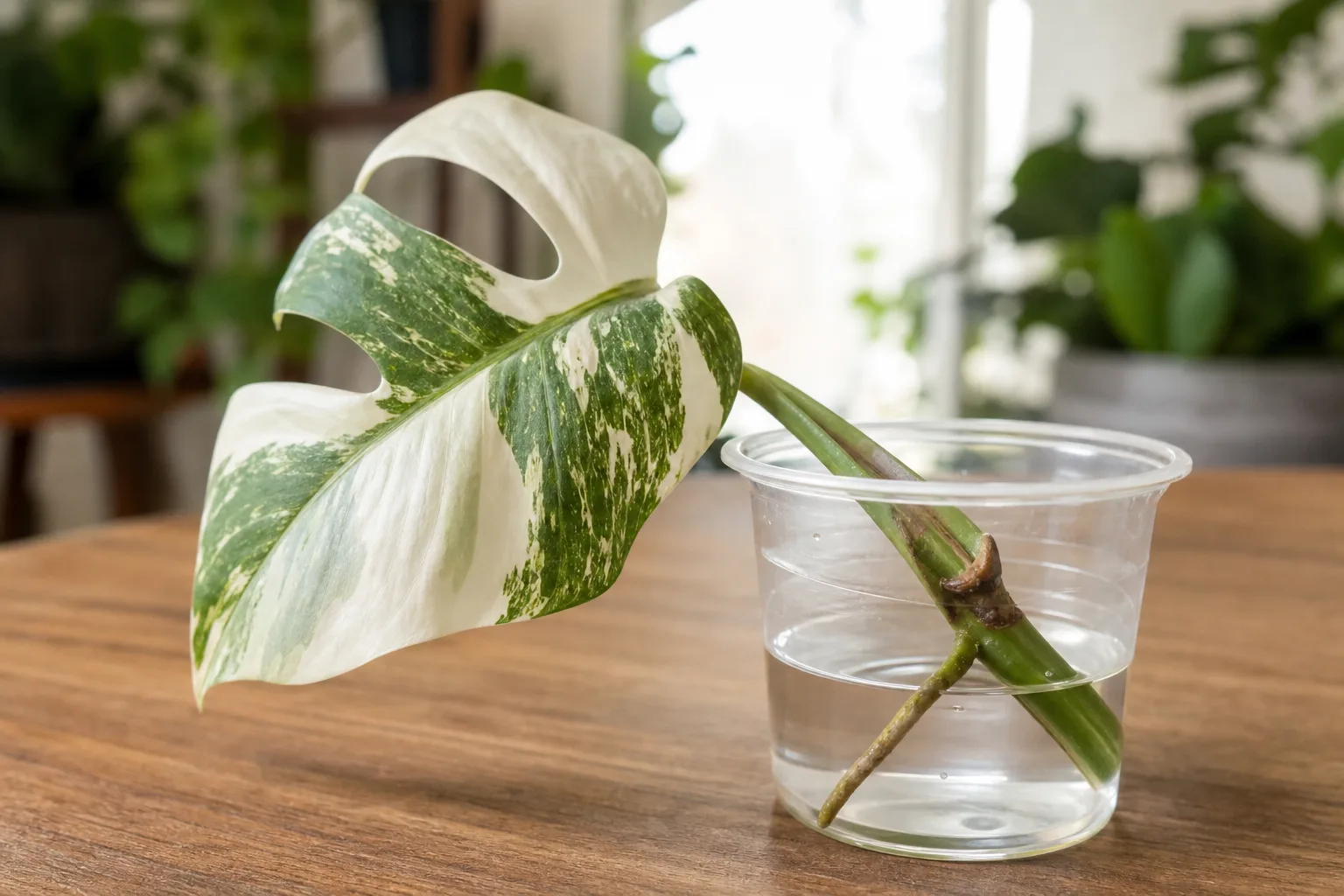
A Monstera Albo cutting needs a viable node, not just a leaf and petiole. The node contains the growth point needed for a new vine; a leaf-only cutting may remain attractive for a time but will not make a new stem. For the best chance, choose a healthy section with one node, at least one leaf, and preferably an aerial root. Leave some green tissue in the stem and avoid taking a cutting from a plant already weakened by root or pest problems.
Make a clean cut below the node with sanitized pruners. You can root the cutting in water or an airy, evenly damp medium such as perlite or sphagnum moss. For water, submerge the node while keeping the leaf above the surface; change the water when it becomes cloudy. For moss or perlite, pre-moisten the medium and use a container with enough air exchange that it stays damp but not waterlogged. Penn State Extension recommends stem cuttings or air layering for Monstera, UConn Extension describes taking a cutting below a node, and Gardeners’ World details water and soil rooting for the species. (Penn State Extension, UConn Extension, BBC Gardeners’ World)
Place the cutting in warm, bright indirect light and keep the rooting medium consistently moist, not flooded. Roots may take several weeks or longer; do not keep pulling the cutting out to check progress. Once it has several roots with side branches, pot it into a small draining container with airy mix and keep the mix slightly more evenly moist while the new roots settle. Avoid starting it in an oversized pot, where a small root system can sit wet for too long.
Repot Only When the Root Ball Needs It
Repot when roots have reached the sides and bottom of the pot, water passes through almost immediately because the mix is crowded with roots, or the pot no longer supports a climbing vine. A rough interval of a few years is common for a slow-growing indoor plant, but it should not override what you see. UConn Extension recommends repotting when roots have reached the bottom and sides, increasing pot size incrementally, and notes that Monstera tolerates being somewhat pot-bound better than being over-potted. (UConn Extension)
Move up only one pot size and keep the crown at its previous soil level. Slide the root ball out gently, trim only roots that are clearly soft or dead, and retain healthy firm roots. Refill around it with fresh airy mix, water once to settle the medium, and let excess drain. Do not aggressively loosen every root on a healthy plant just to remove all old mix.
Spring or early summer is a convenient time because growth is usually more active, but a plant with active rot should be treated when the problem is found. After repotting, return it to similar bright indirect light and wait for the mix to dry partway before watering again. Hold fertilizer until new growth or the fresh mix’s label indicates feeding is appropriate.
Troubleshooting: Read the Pattern Before Treating
One damaged leaf rarely identifies the cause by itself. Start with the growing mix and light exposure, then inspect the root system or leaf undersides if the first checks do not explain the pattern. Make one correction and give the plant time to respond before changing humidity, fertilizer, and watering together.
| What you see | First check | Useful first response |
|---|---|---|
| Crispy tan patches on white areas facing a window | Hot direct sun or heat against glass | Filter the light and move the plant back gradually |
| Several yellow leaves while the mix stays wet | Drainage, pot size, and roots | Pause watering; inspect for dark, soft roots if decline continues |
| Limp leaves with a very light, dry pot | Root ball is too dry | Water slowly until the mix is evenly moist and drains |
| Limp leaves while the pot is heavy and wet | Root stress or rot | Empty runoff, improve airflow, and check roots if it does not recover |
| Smaller, greener leaves with long stem gaps | Light and support | Move brighter gradually and secure the vine before feeding |
| Brown tips on otherwise firm leaves | Dry mix, salt buildup, or heater exposure | Check moisture and pot salts before raising humidity |
Yellow, brown, or limp? Start with the growing mix
If the plant is yellowing and the pot feels wet days after watering, do not add fertilizer as a first response. Check that the container has drainage holes and that water is not trapped in a cachepot. If the plant is also limp, slide the root ball out only if the decline continues or the roots smell sour; healthy roots are firm, while rotting roots are dark, soft, or easy to pull apart. UConn Extension describes root and stem rot as a cause of wilt and recommends well-draining media and avoiding standing water. (UConn Extension)
If the pot is dry and light, water the root zone fully, then observe whether the leaves regain firmness. Brown patches only on the window-facing white sectors point more toward sun scorch; move the plant out of direct heat rather than soaking it repeatedly. One old leaf yellowing as a plant grows is not the same as a run of yellow leaves, so use the pattern across several leaves and the condition of the mix to decide whether a larger intervention is warranted.
Pests and Disease: Inspect Before Spraying
Check the undersides of leaves, petiole joints, and the newest unfurling leaf for spider mites, thrips, scale, aphids, or mealybugs. Fine stippling with webbing suggests mites; sticky residue or fixed bumps can point to scale; cottony material in crevices is consistent with mealybugs. UConn Extension describes these common Monstera pests and recommends identifying the pest and treating accordingly. (UConn Extension)
Isolate a plant with a confirmed pest, rinse or wipe reachable insects away, and recheck new growth and leaf undersides over the following weeks. Do not apply an insecticide as a routine preventative: it adds exposure without solving a problem that has not been identified. If a labeled houseplant treatment is needed, follow its directions and keep treated foliage away from pets and children until the label permits contact. Fungus gnats usually indicate persistently damp mix; let the surface dry as appropriate and check that the pot drains rather than spraying the leaves.
Toxicity and Safer Placement
Monstera deliciosa, including its Albo cultivar, is toxic to cats and dogs if chewed or swallowed. The ASPCA lists the Swiss cheese plant as toxic to both and identifies insoluble calcium oxalates as the toxic principle; chewing can irritate the mouth and digestive tract. (ASPCA Animal Poison Control)
Place the plant where pets cannot reach or knock it over, and do not assume a tall shelf is safe for a climber that can send leaves and stems outward. Sap can also irritate skin, so wash hands after pruning and keep cuttings away from curious children and animals. If a pet chews the plant, contact a veterinarian or animal poison-control service for case-specific advice rather than trying a home remedy.
Conclusion
Monstera Albo care is mostly about maintaining a sound green-and-white vine: provide bright filtered light, water after the upper mix dries partway, use an airy draining medium, and give the stem stable support. Keep changes gradual, and diagnose a symptom from the soil, light, and roots before adding fertilizer or extra water.
The white pattern is the plant’s appeal, but it is not something a grower can dial up on demand. Preserve enough healthy green tissue, choose node-bearing cuttings, and give each new leaf time to show you how the plant is responding. A steady setup will not guarantee perfect variegation, but it gives the plant the best chance to grow well.