Planting by the Moon: What Is Moon Phase Gardening?
See what to plant during waxing and waning moons, how to use a lunar calendar safely, and why frost, soil temperature, and crop timing still come first.
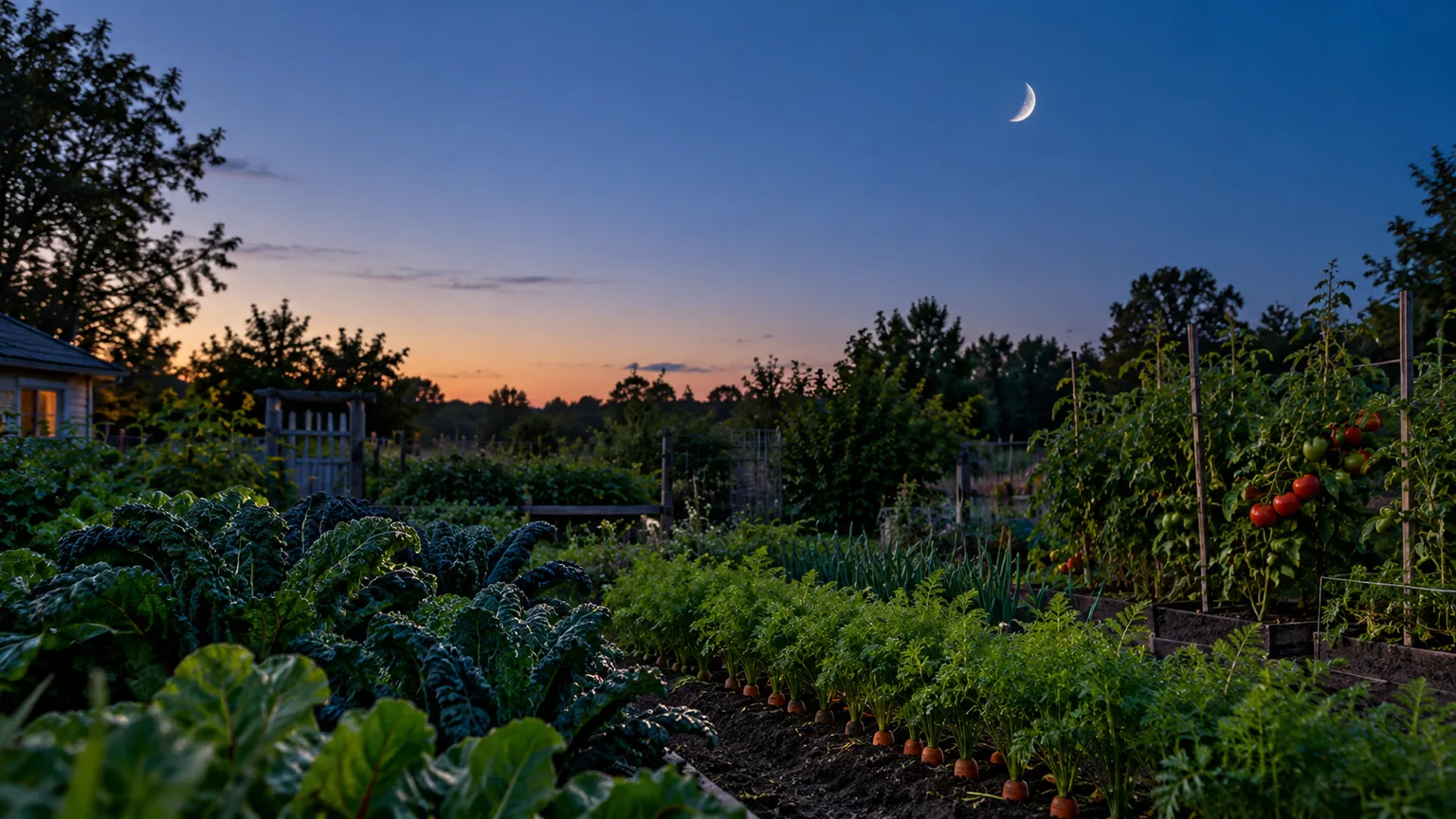
Moon phase gardening is a traditional way to schedule planting around the lunar cycle. Its simplest rule is to sow crops that produce above the soil while the Moon waxes, from new to full, and plant root crops, bulbs, and other plants valued for root growth while it wanes, from full back to new. Some calendars add categories for leaf, fruit, flower, and root crops; others also use the Moon’s zodiac position.
The practice can give a garden a memorable rhythm, but its crop rules are not a substitute for a seed packet, soil thermometer, or local frost information. Research has found that plants can respond to moonlight under certain conditions, yet that does not establish that following a lunar calendar reliably improves germination, plant health, or harvest size. If you want to try the tradition, use it as a preference within a safe planting window—not as a reason to miss one.
What Moon-Phase Gardening Means
A lunar phase is the changing appearance of the Moon as it orbits Earth and we see different portions of its sunlit half. The familiar sequence—new moon, waxing crescent, first quarter, waxing gibbous, full moon, waning gibbous, third quarter, and waning crescent—takes about 29.5 days to repeat from one new moon to the next (NASA Science). “Waxing” means the illuminated portion we see is growing; “waning” means it is shrinking. The Moon is not physically growing or losing light.
Moon-phase gardening uses that visible cycle as a calendar. The common version divides the month into two planting windows: the brightening half for crops harvested above ground and the dimming half for root crops and plants expected to establish below ground. These are traditional associations, not crop requirements measured by a seed company or extension service. You can sow the same tomato or carrot seed at any lunar phase if the seed, soil, temperature, water, and growing conditions are suitable.
The phrase can also mean several different systems. A simple moon-phase calendar uses only waxing and waning; a more detailed biodynamic calendar may classify plants as root, leaf, flower, or fruit and may take lunar position relative to zodiac constellations into account. Those calendars should not be treated as interchangeable. If you are trying the tradition for the first time, use the basic waxing/waning rule and record which calendar you followed.
The Four Moon Phases, and the Two Gardening Windows
Gardening calendars often name four anchor points: new moon, first quarter, full moon, and third or last quarter. They are convenient markers inside a continuous cycle. The moon does not switch from one gardening effect to another at a single instant, and there is no established horticultural cutoff at the exact moment a quarter phase occurs.
A new moon occurs when the Moon is between Earth and the Sun from our point of view, so its illuminated side mostly faces away from us. The first quarter is roughly a week later, when half of the visible disk is illuminated and the light is increasing. At full moon, the side facing Earth is nearly fully lit. The third quarter comes about a week after full, when half of the disk is lit again but the illuminated portion is decreasing. Weather and local horizon can make the Moon hard to see, but phase calendars calculate the geometry whether the sky is clear or cloudy.
Waxing moon: new to full
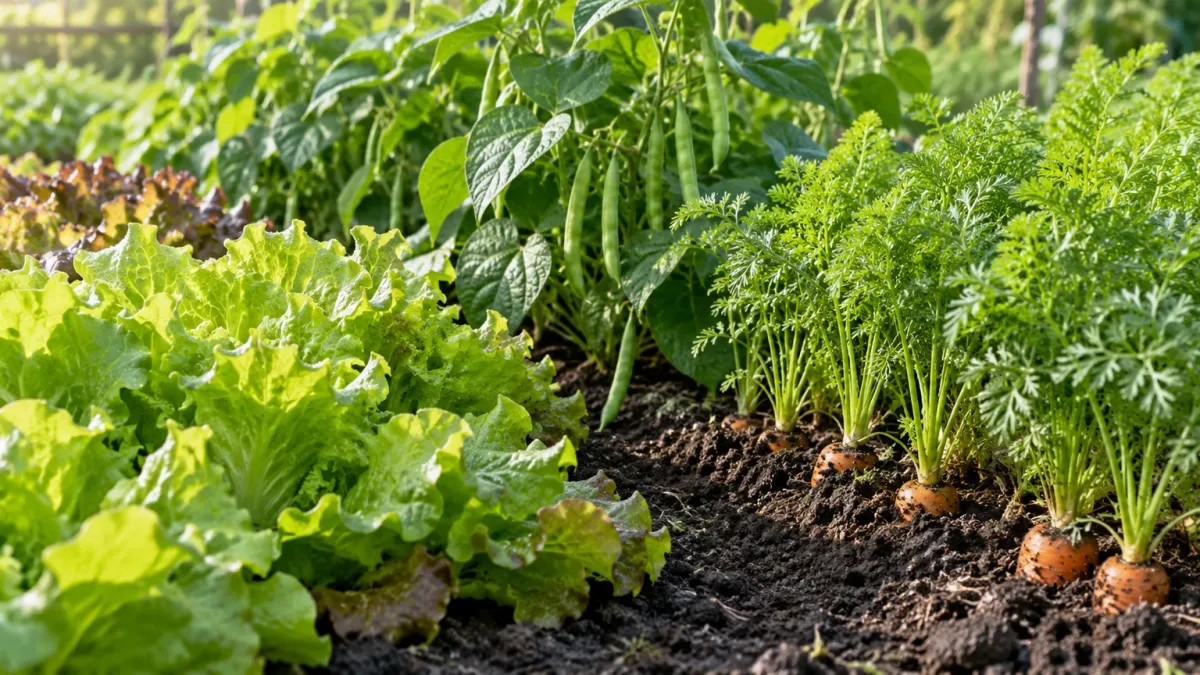
The waxing period starts at new moon and continues until full moon. Traditional calendars associate its increasing nighttime light with upward growth and recommend sowing many annual flowers and crops whose edible parts form above ground. That can include lettuce, spinach, beans, peas, tomatoes, peppers, squash, and sweet corn, although the classification varies: some calendars distinguish leaf crops from fruiting crops and assign them to different parts of the waxing half.
Waning moon: full to new
The waning period runs from full moon until the next new moon. The traditional association is with root development, so calendars often place carrots, beets, radishes, turnips, potatoes, onions, and flowering bulbs in this window. Some versions also recommend perennials and biennials because their first-year success depends on establishing roots. This is a scheduling convention, not evidence that the Moon redirects a plant’s growth from leaves to roots.
Quarter phases are markers, not hard rules
Some versions divide each half into quarters. For instance, a gardener may assign leafy greens to the first-quarter period and fruiting crops to the second quarter, then reserve the third and fourth quarters for root crops, pruning, or garden maintenance. Other almanacs state only the broad aboveground-versus-belowground rule. There is no single authority across traditions, so follow one calendar consistently if you want to learn what that particular method recommends.
Do not assume that a “best day” calendar is automatically a moon-phase calendar. A calendar may also use a Moon sign or other astrological rules, which are separate claims from the visible waxing and waning phase. Before planning, check the calendar’s key: does it list only lunar phases, or does it include signs, elements, or additional “barren” and “fertile” days? Knowing which system you are testing prevents you from changing rules midseason.
What to Plant in Each Lunar Window
The simplest traditional sorting rule is based on the part of the crop you eat. Sow aboveground vegetables and annual flowers during the waxing Moon; sow root crops and plant bulbs during the waning Moon. The Old Farmer’s Almanac describes this convention and notes that these timing recommendations are part of a long-running gardening tradition (Planting by the Moon). Use the table as a description of the custom, not as a scientifically verified crop calendar.
| Lunar window | Traditional choices | Examples |
|---|---|---|
| Waxing, new to full | Crops harvested above ground; annual flowers | Lettuce, beans, peas, tomatoes, peppers, squash, corn, zinnias |
| Waning, full to new | Crops harvested below ground; bulbs; plants where root establishment is emphasized | Carrots, beets, radishes, turnips, potatoes, onions, tulips, daffodils |
Aboveground fruit and leaf crops
In the traditional scheme, “aboveground” is not just a list of leafy vegetables. It includes plants such as tomatoes, beans, and squash, whose edible harvest develops on stems or vines, as well as many annual flowers. If a calendar separates leaf and fruit crops, follow its own finer categories rather than combining rules from several sources. The labels describe the harvest location; they do not mean that an edible plant grows only above or below the soil.
For most warm-season vegetables, the practical planting window depends on frost risk and warm soil. A waxing Moon in early spring does not make cold soil suitable for tomatoes, peppers, or beans. Conversely, if your last safe planting window is closing, sowing on a waning date is a better choice than delaying a crop until the next waxing cycle.
Root crops, bulbs, and perennials
Carrots, radishes, beets, and turnips are usually direct-sown because disturbing their developing roots can lead to poor form. A lunar calendar may label them “root crops,” but good seedbed preparation, consistent moisture at the shallow sowing depth, and correct spacing matter more for a straight, even harvest. For bulbs such as tulips or garlic, use the crop’s seasonal planting requirements first; a waning phase does not make a spring-planted bulb behave like a properly timed fall-planted one.
Perennials and biennials are a less tidy fit. A plant may spend its first season building roots, but its planting date still depends on the species, local climate, and whether it is sold as seed, bare-root stock, or a transplant. If you garden by the Moon, you can choose a favorable waning day within the suitable season. There is no reason to postpone planting a healthy perennial in good conditions solely because the Moon is waxing.
How to Use a Lunar Calendar Without Missing the Planting Window
Start with your crop, not the Moon. Find the seed packet’s sowing depth, spacing, germination temperature, and expected time to maturity; then check your local planting calendar and frost dates. University of Minnesota Extension, for example, recommends using soil temperature as a planting indicator and distinguishes cool-season crops from warm-season crops that must wait until frost risk passes (Planting the Vegetable Garden). Specific numbers vary by crop and location, so local extension guidance is more useful than a generic lunar date.
Once you know the safe window, check whether a waxing or waning period falls inside it. If it does, choose a convenient day when the soil is workable and the forecast is reasonable. If the lunar date comes while soil is waterlogged, hard, or too cold, wait for the soil conditions to improve. If the good lunar window falls outside the crop’s planting season, plant in the correct season instead.
This hierarchy also applies to seedlings. A transplant that has been hardened off and is ready to move should not be left root-bound or exposed to worsening heat just to match a phase. Choose a cool, calm day, water the seedling before planting, and protect it from harsh weather as needed. For direct-sown seeds, prepare the bed and water according to the crop’s needs; the best moon day is of little use if the seedbed dries out or crusts over.
Local climate complicates any one-size-fits-all calendar. The same lunar phase may occur during a warm spring in one region and a freezing one in another. For a fall crop, the main deadline is often the number of weeks remaining before cold weather, not whether the sowing date falls before or after a full Moon. A short-season gardener should favor varieties and dates that can mature locally, then use lunar timing only among those workable options.
What Science Says About Moon Gardening
There are two different scientific questions that are often blended together: can plants detect some lunar-related environmental signal, and does scheduling planting by lunar phases improve garden performance? The first question is receiving experimental attention. The second requires evidence that the old planting rules consistently change germination, growth, yield, or storage across crops and conditions.
A 2020 review in Agronomy assessed agronomy and plant-science references, earlier research, and proposed physical explanations. The authors concluded that the available evidence did not reliably support agricultural practices scheduled by lunar phase (Mayoral et al., “What Has Been Thought and Taught on the Lunar Influence on Plants in Agriculture?”). That conclusion is not proof that no plant can ever respond to moonlight; it is a judgment that the evidence then available did not justify general planting recommendations.
Individual experiments have reported phase-related results. In a two-season carrot study under biodynamic management in Brazil, researchers compared sowing dates associated with lunar rhythms and found some differences in dry root mass across particular phase contrasts, while fresh root and leaf mass did not show the same pattern (Jovchelevich and Câmara, 2008). That is a result worth acknowledging, but it came from one crop, site, and management context; it does not establish that carrots, much less all root vegetables, reliably yield more when planted in a particular phase.
Tides, soil moisture, and gravity
The familiar explanation says that because the Moon drives ocean tides, it must also pull water upward through soil and plant sap. Ocean tides are a real consequence of gravitational forces acting across an enormous connected body of water. A garden bed is not an ocean: soil water is held in pores by capillary forces, and its availability to a seedling changes with soil texture, drainage, rainfall, evaporation, irrigation, and root uptake. Those everyday factors can be measured directly and have clear effects on growth.
The gravitational pull of the Moon also does not switch off between phases. The new and full moons align the Sun, Earth, and Moon in ways that produce stronger spring tides in the oceans; first and third quarter phases are associated with weaker neap tides. But a calendar’s claim that the waxing half lifts soil moisture toward the surface and the waning half pushes it down is not established by the fact that the sea has tides. No practical soil-watering schedule should be based on lunar phase.
Harvesting during a waning Moon is sometimes said to improve storage because less sap or moisture is moving through the plant. That is a traditional belief, not a dependable storage method. For longer keeping, harvest the crop at the right maturity, avoid bruising and disease, and provide the temperature and humidity appropriate to that crop. The lunar date cannot correct a damaged potato or an onion cured while wet.
Moonlight can be a signal without being a yield boost
Moonlight is reflected sunlight, and its intensity is far below daytime sunlight. That does not automatically mean a plant cannot detect it: biological systems can respond to weak signals that do not provide meaningful energy for photosynthesis. A study of Coffea arabica reported changes in gene expression after exposure to full moonlight, including changes involving circadian-clock and stress-response genes (Breitler et al., 2020). Later work with tobacco also reported molecular responses to full moonlight (Singiri et al., 2023), and 2026 research examined light receptors involved in moonlight responses in Arabidopsis thaliana (PubMed record).
These experiments make “plants never notice moonlight” too broad a statement. They do not, however, test whether sowing tomatoes during a waxing phase or carrots during a waning phase gives a home gardener a larger crop. A short-term gene-expression response in controlled conditions is not the same outcome as germination success or yield across an outdoor growing season. Light can be a cue without being a reliable planting instruction.
The evidence also has limits in both directions. A small body of positive results cannot prove that a calendar works broadly, while a review finding insufficient support cannot rule out every subtle response in every species. A useful current conclusion is narrower: the lunar calendar’s practical yield claims remain unproven, and the evidence does not support sacrificing a crop’s known temperature, season, or moisture requirements for a phase.
How to Test the Tradition in Your Own Garden
If following the Moon makes gardening more enjoyable, you can test the practice without treating one unusually large tomato as proof. Pick one fast-growing crop you already know how to grow, such as radishes or lettuce. Use seed from the same packet, the same containers or bed, the same growing medium, and the same sowing depth. Decide in advance what you will measure: days until emergence, number of seeds that sprout, seedling survival, or final harvest weight.
Make a comparison with more than one seed per date. For a small indoor test, sow several identical trays on dates your chosen lunar calendar recommends and on dates it does not, while keeping light, watering, temperature, and seed handling as consistent as possible. Rotate tray positions if one side of a windowsill or grow shelf receives more light. Repeat over several lunar cycles; a one-time result can easily reflect seed variation, temperature, moisture, or a different day’s conditions rather than the phase itself.
For a garden-bed comparison, use replicated short rows and label them with the date, crop, variety, and conditions. Because each sowing happens on a different date, record daily weather and soil temperature too. Do not compare a cool, rainy week’s sowing with a hot, dry one and attribute the difference to the Moon. You can treat the experiment as a way to practice careful observation, but a backyard trial will not isolate every variable well enough to settle the question for all crops.
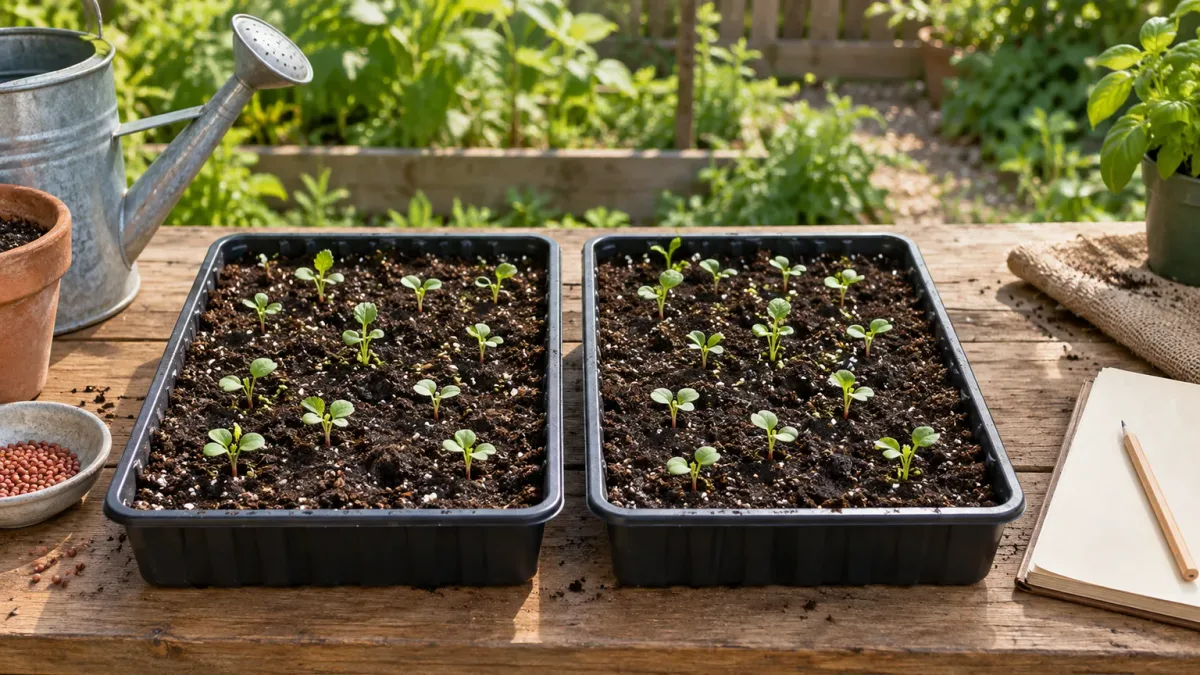
Keep the notebook simple and write the prediction before sowing. For example: “The lunar calendar predicts the waxing sowing will have a higher emergence rate; I will count emerged seedlings on day seven and weigh the harvest at the same age.” Record results even when they do not match the prediction. That reduces the temptation to remember only the season that seemed to confirm the rule.
When to Ignore a Moon Calendar
Plant when the crop and conditions say to plant if waiting would shrink or endanger your harvest. A cold-sensitive crop facing an approaching frost, a fall crop nearing its maturity deadline, or a seedling suffering in a cramped pot should not be held for the next lunar window. In cold climates, soil temperature and frost risk can determine whether a seed germinates at all; University of Minnesota Extension notes that soil temperature is a key indicator and gives separate guidance for cool- and warm-season crops. Oregon State Extension likewise emphasizes crop-specific soil temperatures and adjustments for local conditions (Educator’s Guide to Vegetable Gardening).
Skip the calendar if the soil is too wet to work. Digging or walking on saturated soil can compact it, and a seed sown in cold, wet ground may rot or emerge unevenly. Wait until the bed crumbles instead of sticking to tools, then prepare the seedbed at the depth and spacing listed for the crop. A convenient lunar day is not worth damaging the soil structure you will need for the rest of the season.
The same priority applies to harvesting. Pick tomatoes when they reach the ripeness stage you want, harvest greens before heat or bolting ruins their quality, and cure storage crops under the right conditions. If the waning Moon happens to coincide with the right harvest stage, enjoy the alignment; if not, harvest at the appropriate maturity. Plant and harvest quality are determined by the crop and conditions you can observe, not the calendar alone.
Common Mistakes in Moon-Phase Gardening
Treating tradition as a guarantee. Lunar calendars describe what a method recommends, not what every plant will do. Avoid claims that a particular phase guarantees stronger roots, faster germination, bigger fruit, or longer storage unless a relevant, repeatable study supports that specific result.
Waiting for the “perfect” phase. A lunar cycle lasts about a month, but many planting windows do not. Missing the right season can cost a crop; missing a preferred lunar date usually does not. When the calendar and the crop disagree, use the crop’s frost, temperature, and maturity requirements.
Mixing multiple rule systems. One calendar may sort crops as aboveground versus underground; another may separate leaf, fruit, flower, and root crops; a biodynamic calendar may add zodiac signs. Combining these without noticing the differences makes the practice impossible to evaluate. Pick one method, keep notes, and label it honestly.
Calling every lunar response proof of better gardening. A plant can respond to a faint light cue or show a change in a lab measurement without producing more vegetables in a garden. Ask what was measured, which plant was studied, how long the experiment ran, and whether the result was repeated. “Plant activity changed” and “this phase improves harvests” are different claims.
Confusing moon gardens with moon-phase gardening. A moon garden is designed to look or smell appealing at night, often with pale flowers or evening-blooming plants. Moon-phase gardening is a timing method; it does not require planting after dark or choosing white flowers. You can follow a lunar calendar while doing all your gardening in daylight.
Conclusion
Moon phase gardening is a traditional calendar rule: use the waxing Moon for crops harvested above ground and the waning Moon for root crops, bulbs, and plants where root establishment is emphasized. Calendars vary, and some add finer crop categories or astrological signs. NASA’s 29.5-day lunar cycle gives the practice its rhythm, but the phase itself does not tell you whether your garden soil is warm, workable, or safe from frost.
Research has become more nuanced than a simple “the Moon has no possible effect” or “the Moon makes better crops.” Experiments show that plants can respond to moonlight under certain conditions, yet reliable improvement in home-garden yields from phase-based planting has not been demonstrated. If the tradition helps you plan and observe your garden, use it as a secondary calendar preference. Plant when the crop, soil, and weather are ready, and let a garden journal—not a single lucky harvest—tell you whether the practice seems useful in your own space.