How to Grow and Care for Ctenanthe (Never Never Plant)
Learn Ctenanthe care, from indirect light and a moisture-check watering routine to humidity, division, repotting, and fixes for brown or curled leaves.
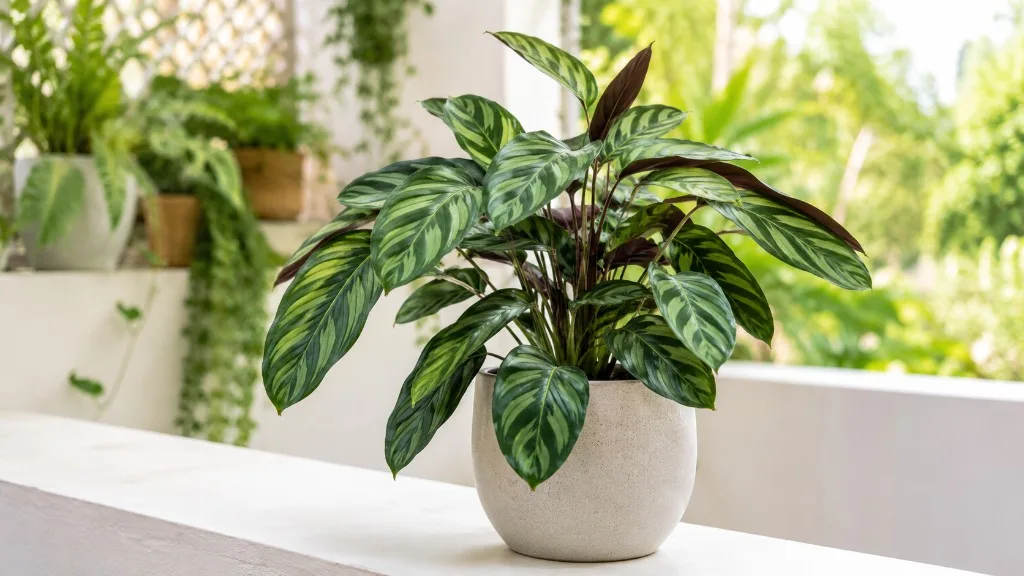
Ctenanthe makes its impression with leaves, not flowers: long blades patterned in stripes, fishbone marks, or irregular patches, often with burgundy undersides. Its care is less about chasing a perfect humidity number and more about building a steady routine—bright filtered light, a root zone that stays lightly moist but airy, warmth, and enough humidity to prevent chronic crispy edges.
The name “never never plant” is used for several plants in the genus Ctenanthe, so the label on a nursery pot may not tell you exactly which species you have. The practical guidance below works for common indoor types, but identification matters for growth habit and for interpreting care advice. Nighttime leaf folding is normal; a plant that stays curled through the day needs a closer look at light, water, temperature, and roots.
Ctenanthe at a glance
Ctenanthe is a tropical plant genus in the prayer-plant family, Marantaceae. Kew’s Plants of the World Online accepts the genus and records its native range from Costa Rica through tropical South America; many popular houseplant species originate in Brazil. Indoors, growers prize its foliage and clumping habit. Its leaves move with the day-night cycle, a behavior called nyctinasty, in which leaves rise or fold after dark and open again in daylight (Kew Plants of the World Online).
The ideal indoor spot resembles a sheltered forest understory in one important way: light is filtered rather than harsh. But “understory” does not mean a dim hallway. Give the plant enough ambient light to make sturdy new growth, keep the potting mix evenly moist without leaving roots in stagnant water, and protect it from cold air. Those three choices prevent more problems than frequent misting or a complicated feeding schedule.
As a rough size reference, many cultivated Ctenanthe stay in the range of a few feet tall or wide, though species and cultivars vary. NC State Extension describes C. lubbersiana as an upright, clumping plant that can reach about 2 to 3 feet tall and spread 3 to 4 feet indoors; its profile for C. oppenheimiana describes a bushy plant up to about 3 feet tall. Allow room for leaves to arch outward rather than squeezing the pot between furniture (NC State Extension: C. lubbersiana; NC State Extension: C. oppenheimiana).
Identify your plant before comparing care advice
Retail names for prayer plants are inconsistent, and similar foliage can lead shops to use older botanical names or mix common names. “Never never plant” may refer to more than one Ctenanthe, while “fishbone prayer plant” is often attached to C. burle-marxii. A label that says “Calathea” may reflect a former or mistaken name rather than the accepted genus; Kew lists Ctenanthe and Goeppertia as separate genera within Marantaceae.
Look at the leaf pattern, undersides, and growth shape, then keep the nursery tag or take a photo for later reference. Narrow, strongly striped leaves differ from the longer foliage of other types. Since labels can be unreliable, observe your plant before making a species-specific adjustment.
Common Ctenanthe species and cultivars
Ctenanthe burle-marxii is known for repeating, angled markings that can resemble a fish skeleton; ‘Amagris’ is a compact cultivar with silvery tones. C. setosa is commonly sold as ‘Grey Star’ or ‘Silver Star’ and is recognized by pale, silvery foliage with darker markings and reddish undersides. Both are useful choices where the leaf pattern is the main attraction.
C. oppenheimiana has longer, pointed leaves, and its ‘Tricolor’ cultivar carries creamy white and green variegation with pink or burgundy tones. C. lubbersiana has broader green leaves marked with yellow-green patches or streaks; ‘Golden Mosaic’ and ‘Brazilian Snow’ are familiar retail names. NC State Extension’s species profiles are useful identification references, but color and size vary with cultivar and conditions. Treat labels as a starting point, not a guarantee of identical care response.
Give Ctenanthe bright, indirect light
Place a Ctenanthe where it receives plenty of daylight with no prolonged, hot beam of direct sun on its leaves. An east-facing window is often convenient; a north-facing window may work in a bright room, while a south- or west-facing window usually calls for a sheer curtain or a position set back from the glass. The right distance depends on the window, season, and obstructions, so assess the light at leaf height rather than choosing a spot by compass direction alone.
A practical test: can you read comfortably near the plant during the day without turning on a lamp? A spot across the room from a small window may still be too dim. Watch new growth: long gaps between leaves, smaller leaves, or leaning toward the window suggest too little light; bleached patches or sharply scorched edges suggest too much direct sun.
Move the pot gradually if it has been in a dark spot. A sudden jump into stronger sun can damage leaves that were formed in lower light. Rotate the container a quarter turn every week or two if growth consistently leans, but do not keep relocating the plant whenever a leaf changes. Stable placement makes it easier to judge whether watering or light is the actual issue.
A grow light can help in a dim home or during short winter days. Follow its distance and timing instructions and adjust gradually. Compact growth and normal-sized new leaves suggest the current light is adequate; direct sun is not needed to intensify variegation.
Water by checking the mix, not the calendar
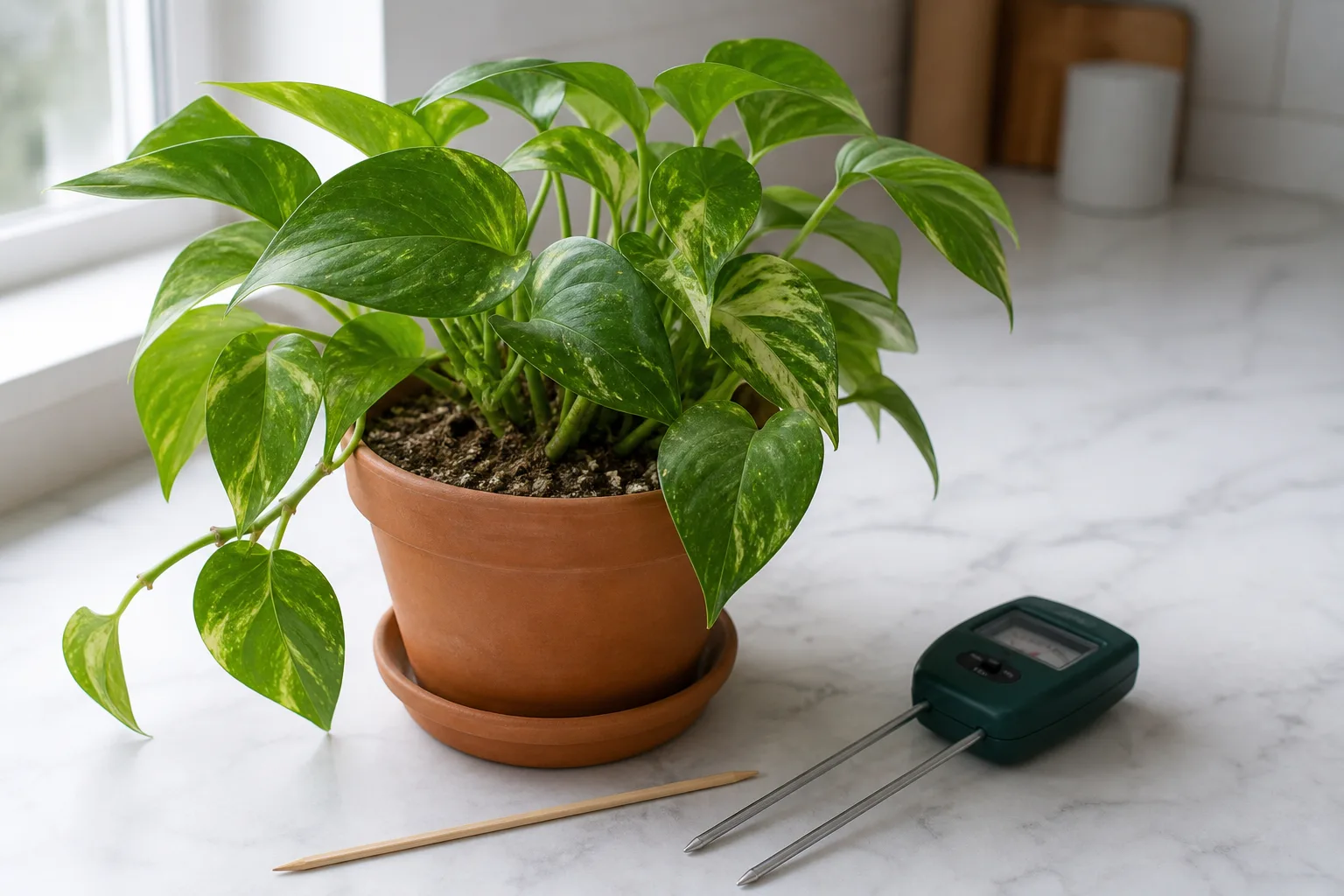
Ctenanthe prefers consistent moisture but can decline in a mix that stays saturated. Check the top inch of potting mix with a finger or a clean wooden skewer. When that surface layer has dried while the mix below still feels slightly cool or moist, water thoroughly until a little drains from the bottom; then empty the saucer. This lets the root ball hydrate evenly while restoring air to the spaces between particles.
Do not water “every Sunday” unless your own checks show that the pot is ready each Sunday. A plant in warm bright light may dry faster than the same plant in a cool room during winter. Pot size, root density, soil texture, airflow, and humidity all change the interval. Learn the pot’s weight just after watering and as it dries; lifting it is a useful second check when the surface looks dry but the root zone may still be wet. Bloomscape’s Ctenanthe guide also uses the top-inch check and advises draining runoff rather than leaving roots in saucer water (Bloomscape).
Avoid both extremes. Repeated shallow sips can leave the center of the root ball dry, while frequent soaking of a slow-drying pot deprives roots of oxygen. If water runs straight down the pot wall without wetting the mix, rehydrate the root ball slowly in several passes and check whether the mix has become compacted or water-repellent. If the pot remains heavy and cold for many days, check drainage holes and the soil rather than adding more water because the leaves look limp.
When water quality contributes to brown tips
Mineral-rich water can leave salts in a container over time, and some Ctenanthe show sensitivity to minerals or treatment chemicals in tap water. NC State Extension specifically notes mineral and salt buildup as a possible cause of brown leaf tips for C. oppenheimiana and recommends filtered or distilled water; its C. lubbersiana profile also describes filtered or distilled water as a suitable choice. That does not mean every brown edge is caused by tap water, or that every household must switch water sources.
If the mix and watering interval seem reasonable but new leaves repeatedly develop crisp margins, check your local water report for hardness and dissolved minerals. You can trial rainwater collected in a clean container, reverse-osmosis water, or distilled water for several weeks and watch the next leaves. Letting water stand may allow some free chlorine to dissipate, but it does not remove dissolved minerals or fluoride. If the problem persists, also check dry air, fertilizer buildup, drafts, and direct sun before assuming water quality is the only cause.
Where drainage is excellent, an occasional thorough rinse with lower-mineral water can help carry accumulated salts out of the pot. Let the container drain completely; do not leave the root ball sitting in runoff. If you use distilled or reverse-osmosis water long-term, keep nutrition balanced with a modest houseplant fertilizer during active growth rather than adding salts through strong feeds.
Choose a moisture-retentive but airy potting mix
Use a loose indoor potting mix that holds some moisture but does not collapse into a dense, airless mass. A practical starting point is a quality houseplant mix amended with perlite or pumice for air space and a small amount of fine orchid bark for structure. Coir or another moisture-retentive component can help in a warm, dry home, but use less of it if the plant already dries slowly. The goal is not a magic ratio; the goal is a mix that wets evenly and drains freely in your pot and room.
The container must have open drainage holes. Decorative cachepots are fine if the nursery pot can be lifted out to drain after watering. A layer of gravel at the bottom does not replace a drainage hole and can leave the root zone perched in water. Choose a pot only slightly larger than the root ball; an oversized container holds extra mix that the roots cannot dry efficiently, increasing the chance of chronic wetness.
Terracotta dries quickly through its porous sides, which may help in a humid room but can worsen repeated dry edges in hot, dry air. Plastic or glazed ceramic holds moisture longer. Adjust watering after any container change.
Keep the plant warm and raise humidity thoughtfully
A typical warm room suits a Ctenanthe better than a cold windowsill or a spot beside an exterior door. NC State Extension gives a 60°F to 85°F range for C. lubbersiana and warns against drafts and temperatures below 60°F. Avoid placing leaves against cold glass in winter or directly in the path of an air-conditioning vent, heater, or frequent door draft. A room thermometer near the plant is more useful than the thermostat across the house.
Humidity can influence leaf quality, especially where indoor air becomes dry from heating or air-conditioning. Start by measuring relative humidity at the plant with an inexpensive hygrometer rather than guessing from how the room feels. If the room regularly drops below about 40% and new leaves develop crispy margins, grouping tropical plants or running a clean humidifier nearby may help. Garden Betty describes Ctenanthe as benefiting from higher humidity, while NC State Extension categorizes C. lubbersiana as humidity tolerant; those points support a preference for humid air, not a universal threshold that guarantees perfect leaves (Garden Betty).
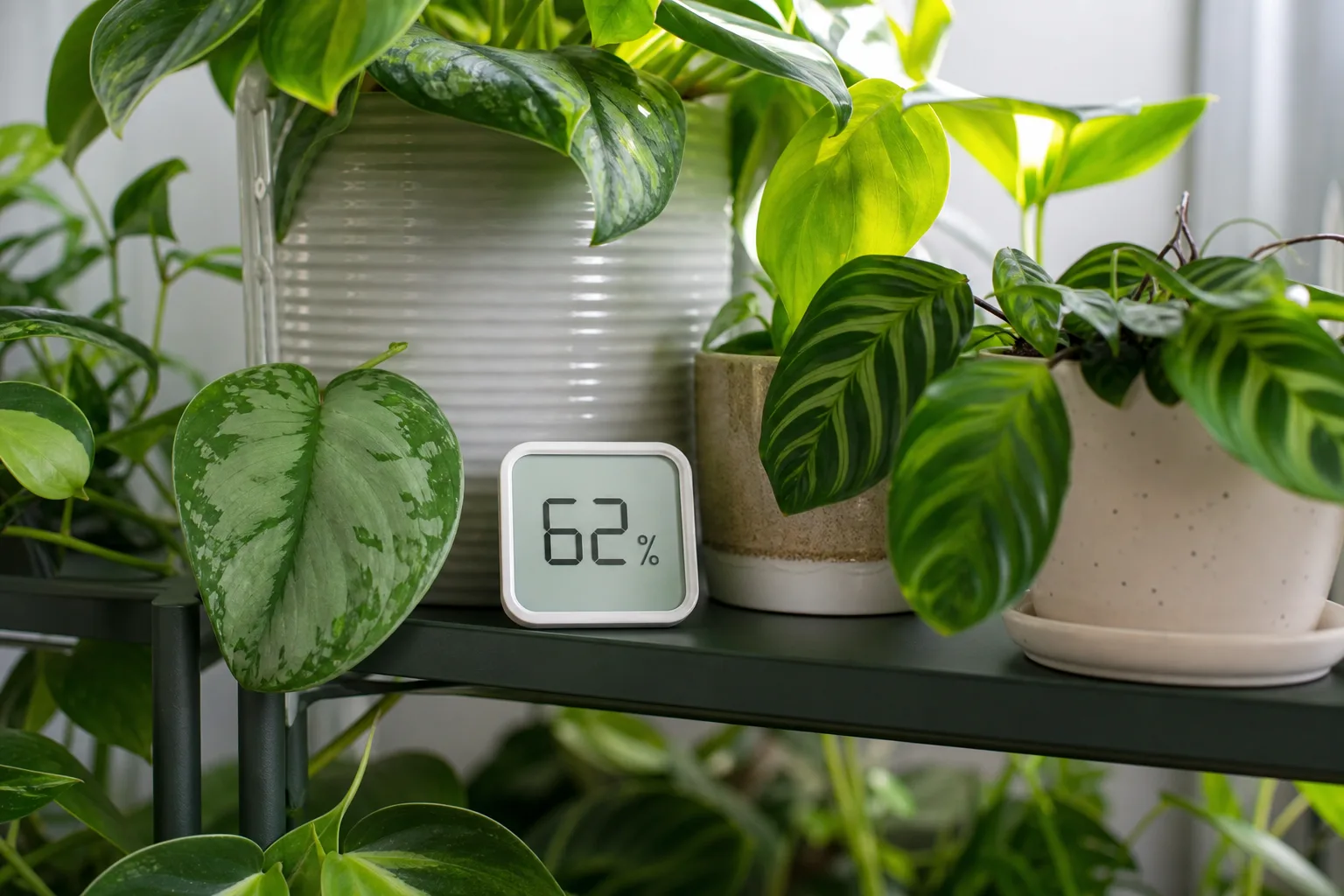
A humidifier changes room humidity more consistently than brief misting. Keep it clean and leave space for air to move around foliage; moisture trapped on leaves in stagnant air can encourage spotting. Pebble trays affect only the nearby air, so they are unlikely to correct a very dry room. Keep the nursery pot out of standing water.
If the plant grows steadily and new leaves open without persistent crisp edges, do not buy equipment just to meet a number. A bathroom can be suitable if it also has usable indirect light and the room is warm, but steam alone does not guarantee all-day humidity. Air circulation, light, root health, and water quality still matter.
Fertilize during active growth and prune lightly
Feed only when the plant is making active new growth, usually during brighter, warmer months indoors. A balanced liquid houseplant fertilizer diluted to half the label rate about once a month is a cautious starting point; follow the specific product label and reduce or skip feeding if the plant is stressed or the mix already contains fertilizer. NC State Extension recommends monthly half-strength feeding during the active growth cycle for common Ctenanthe species.
More fertilizer will not correct weak light, root rot, or low humidity. Overfeeding can leave salts in the mix and add to brown margins, so do not apply a full-strength dose every time you water. If you suspect buildup, pause feeding, check the roots and drainage, and flush the pot only if water passes freely through it. Resume lightly once healthy growth returns; avoid fertilizing a newly divided plant until it begins to establish.
Pruning is mostly cleanup. Use clean, sharp scissors to remove a fully yellow, dead, or badly damaged leaf by cutting its stalk near the base without slicing into the crown. A partly brown leaf can remain if most of its green surface is healthy; trimming only the dry margin is cosmetic and will not treat the cause. Wipe dust from broad leaves with a soft damp cloth so you can inspect them and keep their surface clear. Avoid leaf-shine products, which can coat foliage without improving plant health.
Repot when roots or the mix show a need
Do not repot only because a certain number of years has passed. Look for roots densely circling the pot or emerging through drainage holes, a root ball that dries unusually fast despite proper watering, or mix that has broken down and stays wet or unevenly dry. If water is draining and the plant is producing healthy growth, it can remain slightly snug in its container.
When repotting is justified, choose a pot just one size larger and a fresh, airy mix. Spring or early summer is a convenient time because the plant can resume growth in brighter conditions, but a failing, waterlogged mix should be corrected whenever you find it. Ease the root ball out without pulling on leaf stalks. Remove only loose, exhausted mix and any soft, dark roots; preserve healthy roots and the central clump.
This is also the natural moment to divide a mature plant if you want more pots. If the clump is healthy and you want it to keep filling out, leave it together and disturb the roots as little as possible. After repotting, water until the mix is evenly damp, allow it to drain, and keep the plant in warm indirect light while it settles. Skip fertilizer for a few weeks or until fresh growth indicates that the roots are functioning again.
Propagate by dividing an established clump
Division is the most dependable way to make more Ctenanthe at home because it preserves a rooted growing point. Wait until a mature plant has several distinct shoots or sections and is actively growing. A tiny plant with only one or two shoots is not ready; dividing it now may leave both pieces too weak to recover. Garden Betty also recommends division as the practical route for this clumping houseplant, while NC State Extension lists division for C. lubbersiana and both division and stem cuttings for C. oppenheimiana (Garden Betty; NC State Extension: C. oppenheimiana).
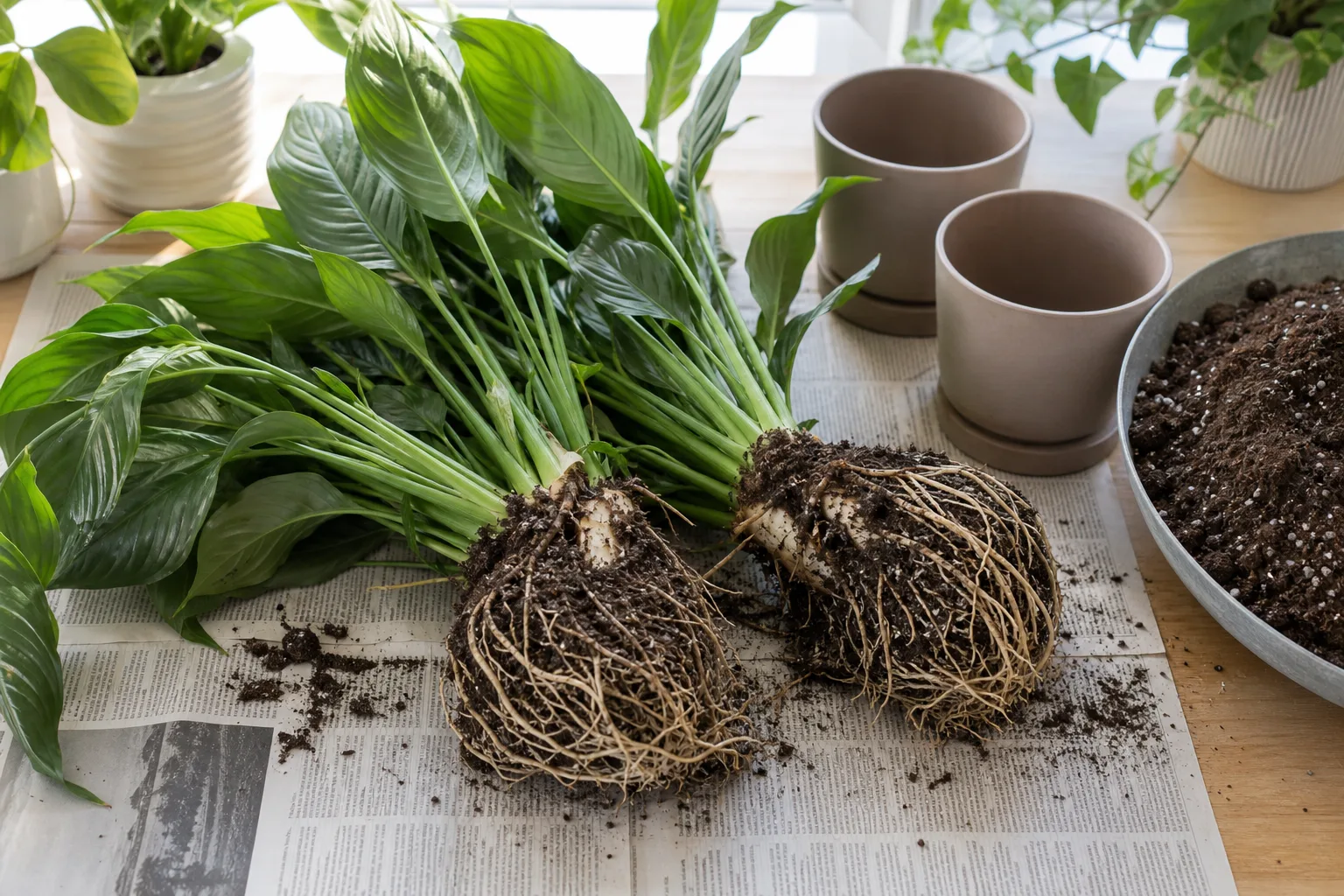
Water the parent plant a day or so before dividing if the mix is dry; a hydrated root ball is easier to handle, but it should not be soggy. Slide it out of the pot and gently remove enough loose mix to see how the stems connect to the roots or rhizome. Separate natural sections by hand when they come apart cleanly. If needed, use a sterilized knife to make a deliberate cut through the root mass, ensuring each division keeps several leaves or shoots and a substantial portion of healthy roots.
Pot each section at its former soil depth in a small container with drainage holes. Do not bury the leaf bases more deeply to make a loose section stand upright; firm the mix gently and support the plant until roots anchor it. Water thoroughly once, let it drain, and then keep the mix lightly moist rather than wet. Place divisions in warm, bright indirect light away from hot sun and drafts. Avoid strong fertilizer until you see new growth, which is a more useful sign of establishment than a fixed number of days.
When a stem cutting may work
A detached leaf or leaf stalk without a piece of stem and a viable node will not reliably make a new plant. Some Ctenanthe species produce visible stems with nodes, and NC State Extension includes stem cuttings as a propagation option for C. oppenheimiana. Other plants sold under the common name may be easier to propagate only by division, so inspect the plant structure before cutting and do not mistake a petiole for a stem node.
If your identified plant has a true stem with a node, you can test one healthy cutting rather than sacrificing several shoots. Use a clean tool, include a node, and place it in a warm, humid rooting environment with indirect light. Rooting success is less predictable than division and depends on species and cutting condition. If the cutting has no node, keep the leaf for the parent plant and wait until it forms a larger clump that can be divided.
Troubleshoot common Ctenanthe problems
Match the symptom’s pattern and timing to soil conditions and recent changes. One damaged leaf rarely proves a single cause. Change one factor at a time; old brown tissue will not turn green, so judge recovery by the next leaves.
Brown edges, curled leaves, or pale patches
Crispy brown margins can follow a root ball that dried too far, chronically dry room air, mineral buildup, a fertilizer overdose, or a hot sunbeam. Check the pot moisture first: if the entire root ball is dry and the pot feels light, water it fully and resume moisture checks before it becomes bone-dry. If the soil is evenly moist, inspect the room humidity, recent feeding, water source, and window exposure instead of adding more water.
Curling after dark that reverses by morning is normal nyctinasty. Persistent daytime rolling or curling is a warning, particularly if the soil is dry, the room has a cold draft, or the leaves are receiving strong direct sun. Move the plant away from the stressor and correct moisture gradually; do not flood already-wet soil to treat a curl. Pale or bleached patches on the window-facing side point toward excessive direct light, so filter or diffuse it rather than relocating the plant into a dark corner.
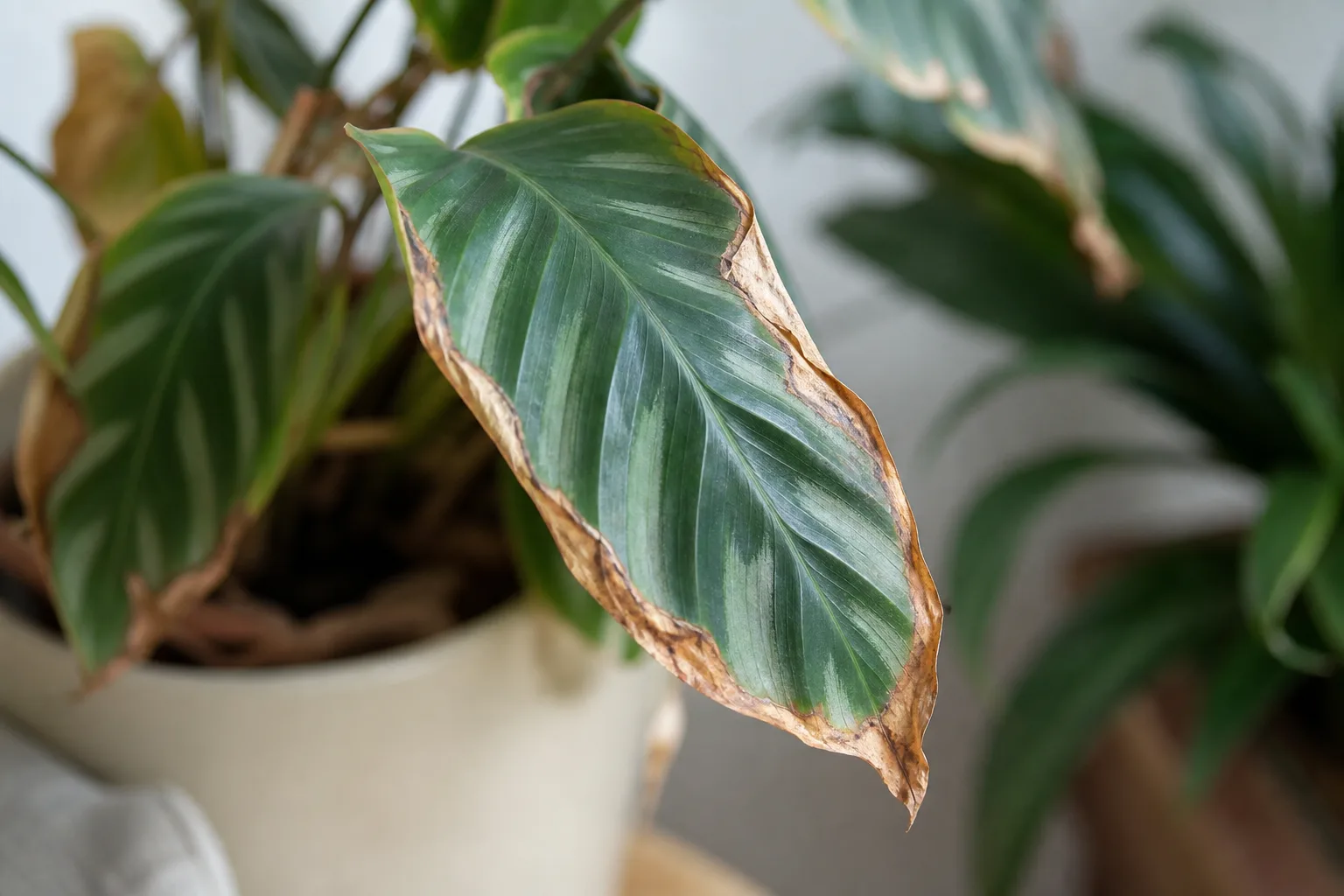
Trim brown tissue only if its appearance bothers you, following the natural leaf shape and leaving a narrow brown edge rather than cutting into green tissue. If every new leaf develops the same symptom, treat it as an unresolved care issue. Check water quality and fertilizer history, then measure humidity and observe light over several days. Avoid changing all four at once: otherwise, you will not know what helped and may create a new problem.
Yellow leaves, drooping, or leaf drop
One older leaf yellowing as new leaves emerge can be ordinary turnover. Several leaves yellowing together, especially with soft stalks or persistently wet soil, calls for a root and drainage check. Pull the pot from its cachepot, inspect the drainage holes, and make sure water is not standing underneath. If the root ball smells sour or roots are dark and mushy, remove only the damaged tissue with a clean tool and repot into fresh, free-draining mix in a container sized to the remaining roots.
Drooping can mean either drought or root trouble, so use the soil to distinguish them. A light pot with dry mix needs a thorough drink; a heavy pot with wet mix should not receive more water. If the plant wilted after a cold night or sudden move, restore warmth and stable indirect light before making a drastic cut or fertilizer application. Leaf drop after a period of severe drought can happen; stabilize moisture and allow time for new growth rather than soaking the plant repeatedly each day.
If the plant has been in the same mix for a long time, low nutrition is possible, but it is not the first explanation to reach for when multiple leaves turn yellow. Check light, water retention, pot drainage, and root condition first. Feeding a plant with damaged roots can raise salt levels without solving the underlying problem.
Spider mites, mealybugs, and root rot
Inspect leaf undersides, folds, and stem joints every time you water. Fine stippling, pale flecks, or delicate webbing may indicate spider mites; white cottony clusters around stems can indicate mealybugs. Isolate a suspect plant, examine nearby plants, and rinse foliage carefully where the plant can drain and dry. University of Minnesota Extension’s indoor insect diagnostic guide can help narrow an unknown pest by appearance and size (University of Minnesota Extension).
Repeat inspection because one rinse may not remove every life stage. If you choose a pest treatment, use a product labeled for the plant and indoor setting, follow its directions exactly, and test a small area first. Avoid applying concentrated household cleaners or oily products to delicate leaves, and do not treat for a pest you have not identified.
Root rot is more about oxygen-starved, persistently wet mix than about a single generous watering. A pot without drainage, an oversized container, compacted mix, or repeated watering before the root ball has begun to dry can keep roots wet too long. Correct the container and mix, remove only soft decayed roots, and reset the watering trigger; do not expect a fungicide or a pebble layer to compensate for poor drainage.
Adjust care as indoor conditions change by season
Ctenanthe does not need a complicated monthly calendar, but it does respond to changes in light and temperature. As days shorten and rooms cool, growth may slow and water use may drop. Keep checking the mix, but expect a longer gap between waterings if the pot is drying more slowly. Pause or reduce fertilizer when the plant is not actively growing.
In spring, stronger daylight and warmer conditions can increase water use. Recheck the pot every few days until you understand its new drying pattern, and resume feeding only when you see active growth. Before moving a houseplant outdoors for summer, wait until nights are reliably warm, place it in deep shade or bright open shade, and acclimate it gradually. Direct afternoon sun and wind can scorch or desiccate leaves quickly, even when outdoor humidity is higher.
Bring the plant back indoors before cold nights arrive. Inspect the undersides of leaves and stems for pests, rinse off dust, and keep it separate from other houseplants for a short observation period if you suspect hitchhikers. A stable indoor location out of drafts is usually better than repeatedly moving it to chase warmth or humidity.
Conclusion
Good Ctenanthe care starts with enough filtered daylight, a mix that stays lightly moist without remaining saturated, warmth, and a realistic plan for household humidity. Check the plant and pot before watering, use drainage as a non-negotiable, and consider water quality only when the symptom pattern supports it. A healthy established clump can be divided when you want more plants; a leaf without a node cannot replace that method.
When foliage changes, separate normal night movement from daytime stress, then inspect soil moisture, roots, light exposure, humidity, and water source in that order. Correct the clearest cause and judge success by the next leaves. That patient, evidence-based routine keeps this patterned tropical plant attractive without turning its care into guesswork.