Philodendron Billietiae Care: Light, Water and Soil
Learn Philodendron billietiae care with practical light, watering, soil, humidity, support, propagation, pest, root-rot, and pet-safety guidance.
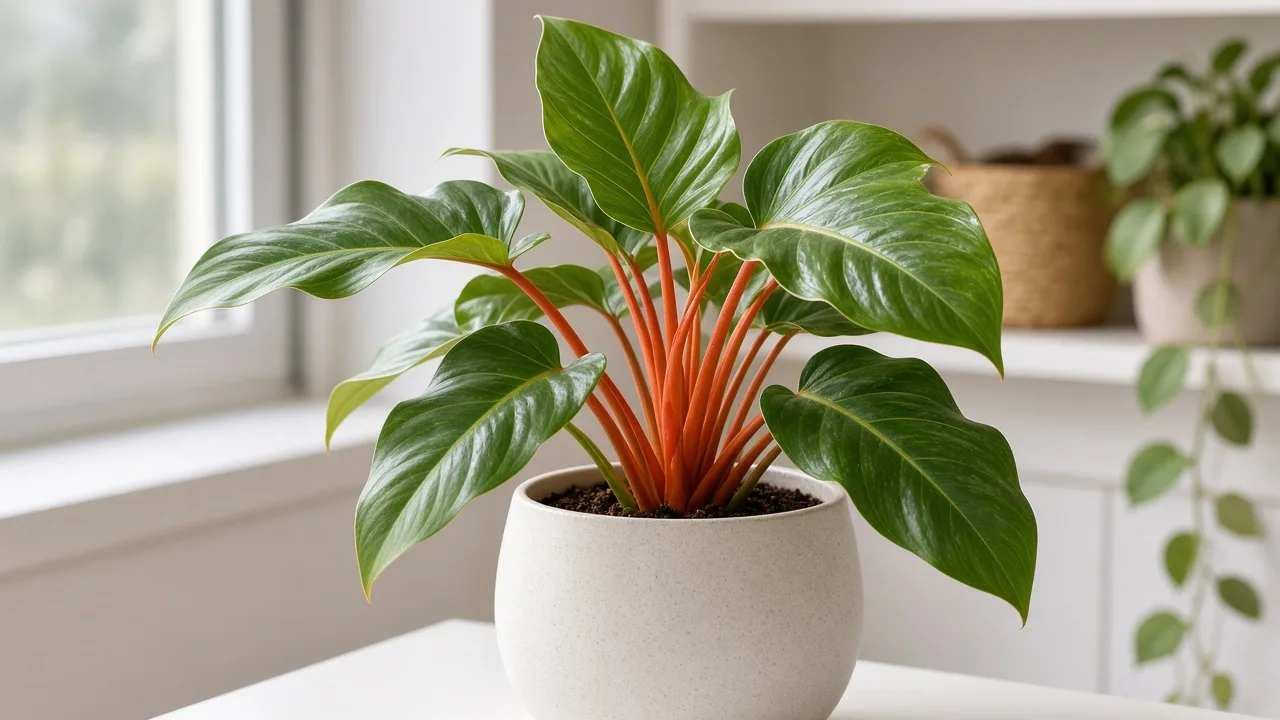
Philodendron billietiae is a climbing aroid with long, arrow-shaped leaves and orange to copper-colored petioles that make even a young plant look dramatic. It is not difficult because it needs a mysterious ingredient; it is difficult when a grower treats a slow-drying pot like a thirsty tropical vine. The reliable approach is to give it strong filtered light, an airy root zone, and enough time for the mix to partially dry before you water again.
The species is associated with Guyana, Brazil, and French Guiana, and Kew’s Plants of the World Online record places it within Araceae. In a home, its rainforest origin matters as a pattern rather than a literal instruction: warm roots, moving air, bright canopy-filtered light, and periods when excess water can escape. The guide below turns that pattern into checks you can make in an ordinary room.
Billietiae at a Glance
| Care factor | Practical indoor starting point | What to watch |
|---|---|---|
| Light | Bright, indirect light; gentle morning sun can work | Scorching, bleached patches, or long weak growth |
| Water | Soak when the upper 2–5 cm (about 1–2 in) is dry and the pot is lighter | A wet lower root zone can remain hidden below a dry surface |
| Soil | Coarse, airy mix with potting medium, bark, and perlite | Dense mix stays wet and reduces oxygen around roots |
| Temperature | Roughly 18–29°C (65–85°F), protected from cold drafts | Growth slows sharply in chilly, wet conditions |
| Humidity | Average home humidity can work with airflow; higher is helpful | Crispy margins plus dry mix point to a different issue than root rot |
| Support | Moss pole, plank, or trellis once the stem begins to climb | Tie loosely; never bury the stem or force aerial roots |
| Safety | Keep away from pets and children | Philodendrons contain irritating calcium oxalate crystals |
This is a starting range, not a watering prescription. A plant under a grow light in a small plastic pot may dry in days; the same plant in a cool room and a large ceramic pot may stay damp for weeks.
Choose the Right Position Before You Water
Place billietiae close to a bright window where a sheer curtain filters the strongest rays, or use a grow light above the foliage. An east-facing window is often forgiving. A bright south- or west-facing position can work when the plant is set back from the glass or protected at midday, but unfiltered summer sun can heat the leaf surface and leave tan, papery patches.
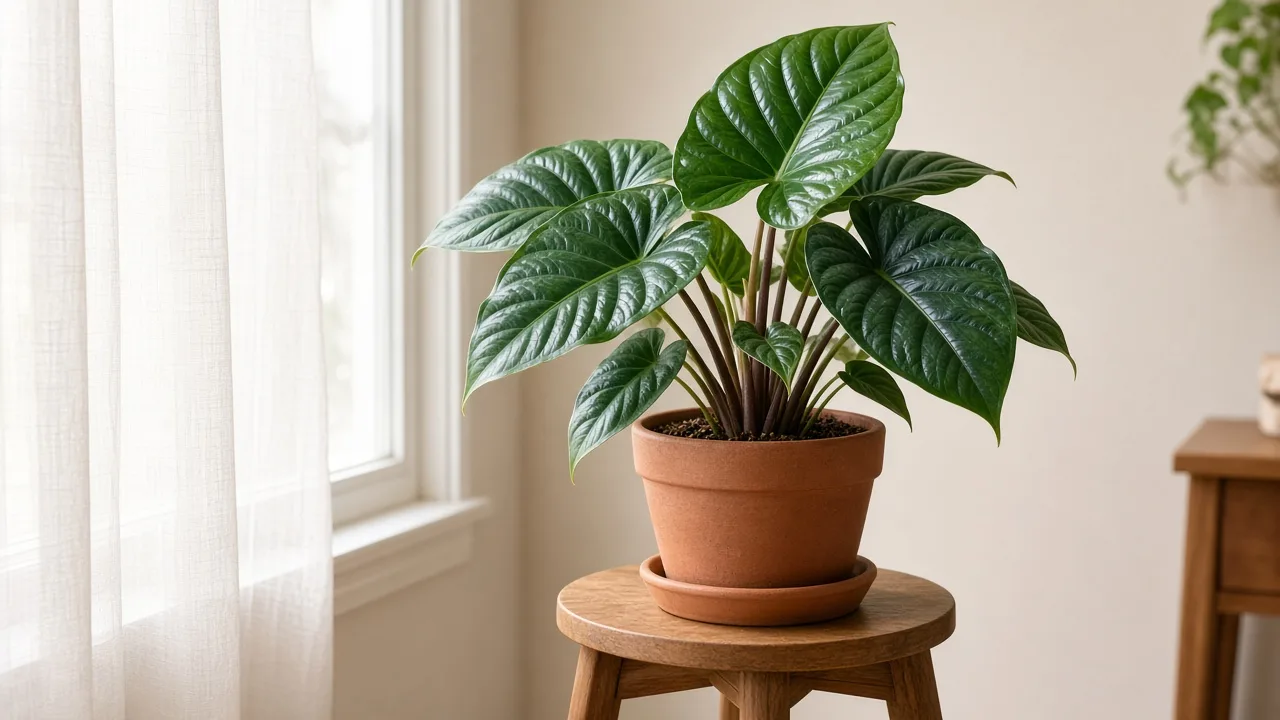
Keep the plant away from a radiator, air-conditioner outlet, or frequently opened cold door. A stable position is more useful than chasing a perfect humidity number. Rotate the pot a quarter turn every week or two if one side is leaning, but do not move a recently acclimating plant repeatedly between rooms.
Reading Light From the Newest Leaf
Judge the position by new growth, not by the color of an old leaf. In sufficient light, the next leaf should emerge with a firm petiole and a normal shape. If internodes lengthen, the plant leans toward the window, and new leaves are noticeably smaller, increase light gradually. If a leaf develops a sharply bounded bleached or brown area on the window-facing side, reduce direct exposure before increasing water or fertilizer.
Build an Airy Root Zone
Use a potting mix that holds some moisture but has large pores for air. A practical blend is two parts quality indoor potting mix, one part orchid bark, and one part perlite or pumice. This follows the emphasis on porous, well-drained houseplant media in the NC State Extension philodendron guidance, while the Royal Horticultural Society’s philodendron growing guide is a useful reminder that warmth, drainage, and filtered light work as a system rather than as isolated numbers. A little coco coir can replace part of the potting mix, but do not make the recipe so bark-heavy that the root ball dries immediately after watering. The correct texture should become evenly moist when soaked and then release excess water without turning into mud.
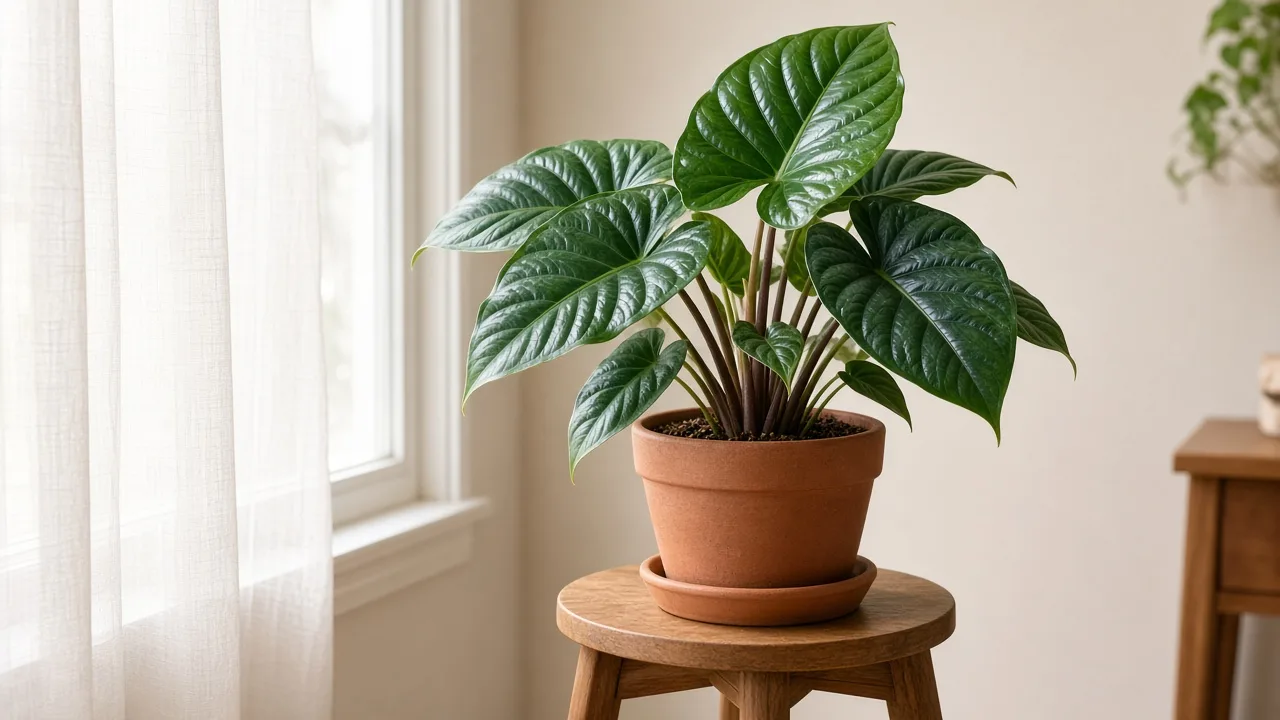
The pot must have an unobstructed drainage hole. Do not put a gravel layer inside the pot as a substitute for drainage; it reduces the depth available for roots and does not correct a water-retentive mix. Set the nursery pot inside a cachepot if you like the look, but empty collected water after watering.
Water by Dry-Down, Not by Calendar
Before watering, push a finger or wooden chopstick 2–5 cm into the mix, lift the pot, and look at the plant as a whole. When that upper zone is dry and the pot feels substantially lighter, water slowly over the surface until some drains from the bottom. Wait a few minutes and drain the saucer. A small sip that only wets the top encourages a misleading cycle: the surface looks damp while the lower mix remains old and compact.
The interval changes with season, light, pot size, and root mass. In active growth it may be about every 7–14 days, while a cool or dim winter room can take longer. If the plant droops but the pot is heavy and the mix is wet, do not water; inspect the roots instead. If the pot is light, the mix is dry deep down, and the leaves recover soon after a thorough drink, underwatering is more likely.
Water quality is rarely the first variable to change. If you see a crust on the mix or pot rim, flush the pot with plenty of water on a day when it can drain completely, then resume normal watering. Do not leave the plant standing in runoff.
Balance Warmth, Humidity, and Airflow
Billietiae grows best when it is warm and not exposed to abrupt temperature swings. Normal household humidity is not automatically fatal, especially when light, roots, and watering are well matched. Higher humidity can support larger, cleaner leaves, but a sealed, stagnant corner can turn moisture into a disease and pest problem.
Measure near the plant with a hygrometer if the room feels unusually dry. A humidifier can help in winter, but clean it regularly and leave enough space around the foliage for air movement. Grouping plants may raise local humidity modestly. Misting is temporary and does not replace a humidifier or a good root zone; repeated wet foliage in still air can increase spotting risk. Pebble trays are optional decoration, not a cure for dry air, and the pot should sit above—not in—the water.
Feed Lightly During Active Growth
Fertilize only when the plant is actively producing leaves and the mix is already moist. Use a complete liquid houseplant fertilizer at half the label strength once a month during spring and summer, or follow a slow-release product’s label. More fertilizer will not compensate for low light. It can instead create salt buildup, damaged roots, and brown tips.
Skip feeding a recently repotted plant for several weeks if the fresh mix already contains fertilizer. Pause during a dark, cool period when growth has stopped. If white crust accumulates or leaf edges burn after feeding, flush the mix thoroughly and reduce concentration or frequency after the roots recover.
Give a Climbing Philodendron Real Support
Billietiae is a climber, so a moss pole, rough plank, or stable trellis can help it grow upward and present its leaves to the light. Install support before the stem becomes awkward to position. Anchor it deeply enough that the pot will not tip, then attach the stem with soft ties that leave room for thickening.
Support does not create light or humidity. A pole cannot correct small leaves caused by a dark room, and aerial roots do not need to be forced into wet moss. If you use a moss pole, keep it lightly moist rather than permanently saturated, and keep the plant’s main root ball in a mix that drains freely.
Repot Without Losing the Root Ball
Repot when roots circle densely, emerge from the drainage hole, the mix has collapsed and stays wet, or the plant dries unusually fast because it is root-bound. Spring or early summer is a convenient window, but a failing root system should be addressed whenever necessary. Choose a pot only one size larger—usually 2–5 cm (1–2 in) wider than the old one.
Slide the plant out and inspect before disturbing everything. Healthy roots are firm and pale tan to brown; rotten roots are soft, hollow, dark, or foul-smelling. Trim only clearly dead tissue with clean scissors, refresh the mix, and keep the crown at the same height. A much larger pot is not generous—it is a reservoir of wet soil around a relatively small root system.
Propagate From a Viable Node
Stem propagation works only when the cutting includes a node, the point where a leaf and often an aerial root emerge. A leaf without a node can stay green for a while but cannot produce a new vine. Use a clean blade and choose a healthy section with at least one viable node and, ideally, one leaf.
- Cut just below the node, keeping the cutting’s leaf above the rooting medium.
- Let a wet cut surface dry briefly, then place the node in clean water, damp sphagnum, or a lightly moist airy propagation mix.
- Give the cutting warmth, bright indirect light, and gentle airflow. Keep the medium damp, not waterlogged.
- In water, change it when it becomes cloudy. In moss or mix, check the node frequently so it does not dry completely.
- Pot up when roots are several centimeters long and branching, not merely when a single nub appears.
- After potting, keep moisture even and avoid fertilizer until new growth shows that the cutting has resumed.
Propagation can stall in cool rooms or from a weak node. Rotting at the cut means the medium is too wet, the cutting lacks airflow, or the tissue was already damaged. Cut back to firm tissue only once, then restart in a cleaner, less saturated setup.
Manage Pests Before They Spread
Inspect leaf undersides, petiole joints, and new unfurling leaves whenever you bring home a plant. Thrips can leave silvery scarring and black specks; spider mites favor hot, dry conditions and may leave fine webbing; scale appears as fixed bumps with sticky residue. Fungus gnats are usually a sign of persistently wet mix rather than a reason to pour an insecticide into the pot.
Isolate a suspect plant. Wipe accessible pests away, rinse foliage where the plant and room allow it, and use a product labeled for the specific pest and indoor use. Repeat only as the label directs. Do not mix household soaps, essential oils, or concentrated pesticides by guesswork. Check neighboring plants because pests move through a collection faster than a single treatment suggests.
Prevent and Respond to Root Rot
Root rot is a root-zone failure, not simply “too much water” in isolation. It usually combines saturated mix, poor drainage, low oxygen, cool conditions, or damaged roots. The early clues are a pot that stays wet far past its normal dry-down, yellowing lower leaves, a soft stem base, and wilting that does not improve after watering.
Unpot the plant if those clues cluster. Remove soft roots, trim back to firm tissue, and repot into a clean pot with fresh, airy mix. Do not put a severely reduced root system into its old oversized pot. Keep the plant in bright filtered light, water sparingly but thoroughly when the new mix dries, and wait for new growth before feeding.
Diagnose Yellow, Brown, or Torn Leaves
One old yellow leaf is not a diagnosis. Look at the pattern and the pot.
| Symptom | More likely clues | First response |
|---|---|---|
| Several yellow leaves, wet mix, heavy pot | Overwatering or root stress | Pause watering; inspect drainage and roots |
| Yellowing with very dry, light pot | Underwatering or severe dry-down | Soak thoroughly and shorten the next interval |
| Tan bleached patch on window side | Sun scorch or heat | Filter or move the plant farther from glass |
| Brown crispy edge with dry mix and dry air | Drought stress or low humidity | Check root-zone moisture, then improve consistency |
| Silvery streaks, distorted new leaves, black specks | Thrips | Isolate and begin labeled pest control |
| Small leaves and long gaps between nodes | Insufficient light | Increase filtered light gradually |
| Dark spreading spots on wet foliage | Leaf disease or prolonged leaf wetness | Improve airflow, keep leaves drier, remove badly affected tissue |
Do not remove every marked leaf immediately. A mostly green leaf still contributes energy while you correct the cause. Remove leaves that are mostly dead or clearly diseased with clean tools, and monitor the next two leaves for evidence that the change worked.
Flowering, Size, and What to Expect
Indoor billietiae is usually grown for foliage, not flowers. A mature plant may flower under strong, stable conditions, but a lack of blooms does not prove poor care. Do not increase fertilizer or keep the roots constantly wet to force flowering.
Size depends on age, light, support, pot volume, and whether the plant is a cutting or an established specimen. Give it vertical room as the stem climbs, but remember that a larger leaf is not produced by support alone. Light, a functioning root system, warmth, and a place for the stem to attach all work together.
Keep Pets Away From the Plant
The ASPCA philodendron listing identifies philodendrons as toxic to dogs and cats. The irritating calcium oxalate crystals can cause mouth pain, drooling, vomiting, or difficulty swallowing after chewing. Keep the plant and fallen leaves out of reach; do not assume that a pet which ignored it once will ignore it forever. Contact a veterinarian or animal poison service promptly if ingestion occurs, especially if swelling or breathing difficulty appears.
A Simple Weekly Care Routine
Once a week, look at the newest leaf, feel the upper mix, lift the pot, and scan the undersides of leaves. Wipe dust from broad foliage with plain water when needed, but avoid polishing products that leave residue. Confirm that ties are not tight, the support is stable, and the cachepot is not holding runoff.
Every few weeks, turn the plant if it is leaning and check the stem joints for pests. Monthly during active growth, decide whether the plant is making enough growth to justify feeding. Seasonal changes should adjust the interval, not the principles: more light and warmth usually mean faster dry-down; less light and cooler air mean you should wait longer.
Conclusion
Successful Philodendron billietiae care is a sequence: place it in bright filtered light, let the mix partially dry, soak and drain completely, and keep the root zone airy. Add warmth, moderate humidity with airflow, light feeding during growth, and support as the stem climbs. When something goes wrong, inspect the pot and newest growth before changing five variables at once.
The plant’s dramatic leaves reward consistency more than perfection. If you can read dry-down, distinguish root stress from thirst, and protect the plant from pests, cold, harsh sun, and curious pets, billietiae can become a vigorous, climbing centerpiece rather than a fragile collector’s ornament.