Prayer Plant Flowers: What to Expect From Maranta Indoors
Find out why prayer plants flower indoors, why most do not, and how light, season, maturity, and steady care shape the odds of a bloom without forcing it.
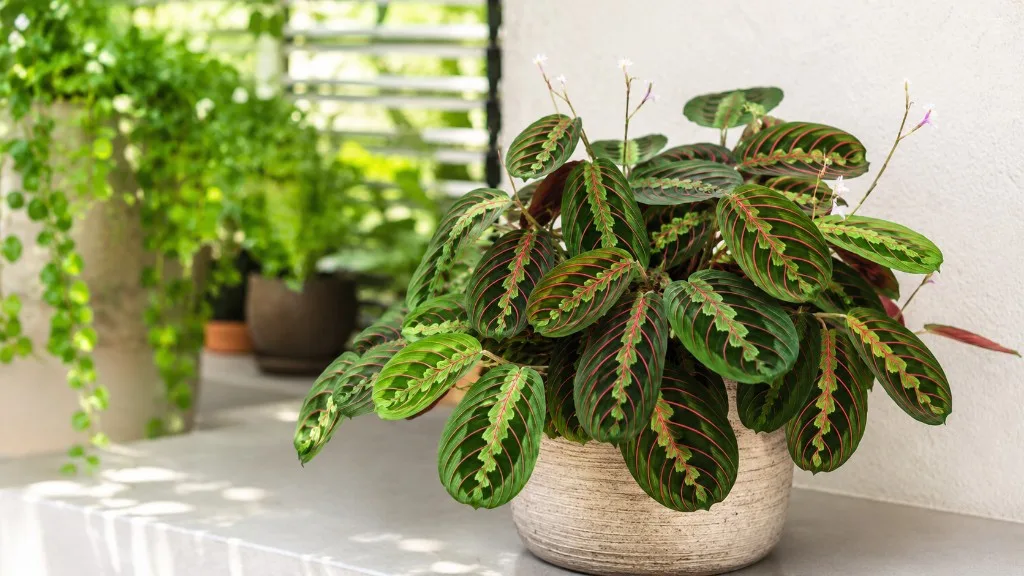
The short answer: yes, but indoor flowers are uncommon
Yes. If by “prayer plant” you mean Maranta leuconeura, it can produce flowers, including indoors. The plant is grown mainly for its patterned leaves, though, and a houseplant that never blooms is normal. The Missouri Botanical Garden describes its white flowers as small and says they infrequently appear on houseplants; NC State Extension likewise says it can flower under ideal conditions but that the blooms are small. Those observations are more useful than a promise that any particular care routine will make flowers appear.
A bloom is not a bad sign, and it does not mean the plant is about to die. It is part of the plant’s ordinary reproductive cycle. At the same time, one flower stalk does not prove that every part of its care is perfect: a Maranta can flower while it has a separate issue with dry air, watering, light, or roots. Read the leaves and the potting mix as well as the flower.
The most sensible goal is a healthy plant first. Give it the warm, humid, filtered-light conditions that suit a tropical Maranta, and let flowering be a possible bonus. You cannot reliably schedule a bloom indoors, and trying to force one with stronger sun, excessive fertilizer, drought, or other stress can damage the foliage you bought the plant to enjoy.
What prayer plant flowers and stalks look like
A prayer plant flower usually appears on a slender stalk that rises above or between the leaves. The individual blooms are small compared with the bold foliage, often white to pale purple or white with purple markings. The Missouri Botanical Garden describes the flowers as two-lipped and purple-spotted, typically appearing on slender spikes in late spring to early summer; NC State Extension notes that flower color can range from white to purple and that the stalk bears a small inflorescence.
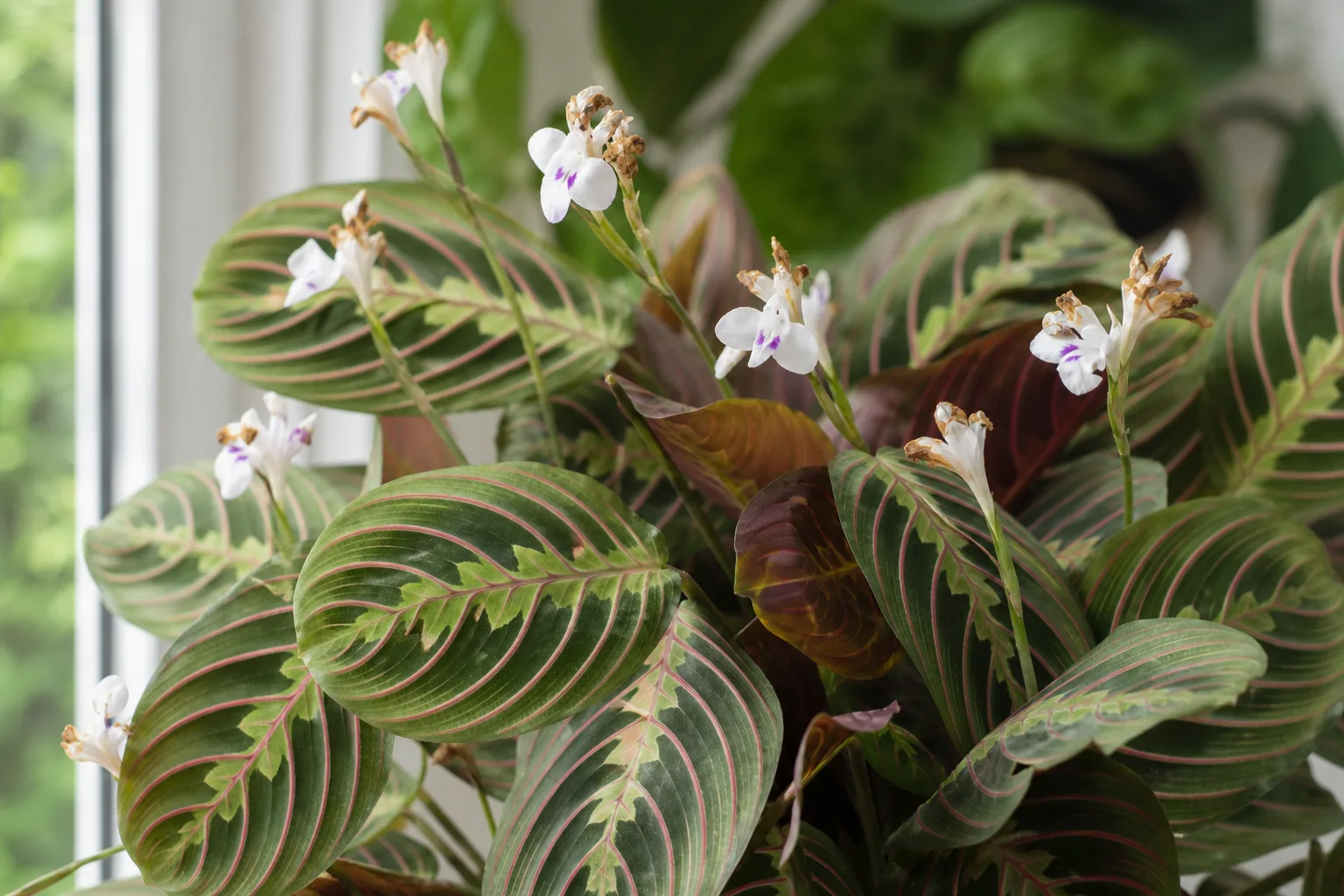
The flowers may open in succession along the stalk, so a plant can have a few fresh blossoms beside buds or aging flowers. Each one is modest rather than showy. You may notice a little color above the leaves and miss the rest if the plant is dense or tucked into a shelf.
Some care references describe the flowers as insignificant because the leaves are the main ornamental feature. That is a design judgment, not a sign that the flowers are abnormal. If you like seeing the plant’s full life cycle, the flowers are worth a closer look; if you prefer the clean outline of foliage, you can tidy the stalk after the blooms fade.
Tell a flower spike from a new leaf
New leaves on Maranta begin as narrow, rolled structures that gradually unfurl into a broad patterned blade. A flower stalk is generally a thinner, more upright stem carrying buds or small blossoms, rather than one folded leaf with a single pointed tip. Looking for several buds arranged along a stalk is a good clue that you have a flowering stem.
The distinction matters because a new leaf is part of the plant’s next round of foliage and should be left alone. If you are unsure, give the structure a few days to develop instead of cutting it immediately. A stalk that begins to show tiny buds will become easier to identify; a rolled leaf will widen and reveal its leaf pattern.
“Prayer plant” can also refer loosely to other members of the Marantaceae family, including some plants sold as Calathea or Goeppertia. Their growth and flowering patterns are not interchangeable with Maranta leuconeura. The advice here is for Maranta; if a plant label names another genus, check care guidance for that exact species rather than assuming the common nickname predicts its bloom.
Flowering is normal, but it is not a health diagnosis
When a prayer plant flowers, the simplest interpretation is that it has reached a point in its growth cycle when it can produce flowers. That is usually welcome, but it is not a test with a pass or fail result. A blooming plant is not automatically thriving in every respect, and a non-blooming plant is not necessarily unhappy.
Look at the whole plant before deciding whether anything needs attention. If leaves remain firm and richly patterned, new growth continues at a reasonable pace, and the soil is neither constantly soggy nor repeatedly bone-dry, there is no reason to change your routine just because flowers appeared. If you also see persistent leaf curling, widespread yellowing, crispy edges, or weak growth, investigate those signs on their own; the flowers do not explain them.
Maranta is a tropical perennial, not a plant that must be discarded after flowering. It can continue growing leaves after its flowers finish. The Missouri Botanical Garden describes it as an evergreen, rhizomatous perennial, and its care notes call for reduced watering and fertilizer in the cooler part of the year rather than a post-bloom shutdown. The bloom is therefore not a warning to repot, cut back the whole plant, or give it a special recovery treatment.
Why a prayer plant may flower indoors
Flowering depends on several factors working together, and no single one is a reliable switch. A mature, established plant with suitable light, warmth, moisture, and steady care has a better chance than a newly divided or stressed plant, but none of those conditions guarantees flowers. The sources describe indoor blooming as uncommon, not as a predictable outcome of a specific fertilizer formula or temperature setting.
Maturity and time to settle in
A young plant may first put its resources into roots, stems, and leaves. A recently purchased plant may also be adapting to a different light level, watering pattern, room temperature, and humidity than it had at the nursery. A divided plant has the additional work of re-establishing roots. It is reasonable to let these plants settle and grow before judging their bloom potential, but there is no dependable age or pot size at which a Maranta should flower.
Maturity is one influence, not a timer. Two mature plants can behave differently in the same room, and a plant can produce flowers one year and none the next. Do not repot into a larger container simply to chase maturity or blooms; a pot that holds excess wet mix can create root problems without making flowering more likely.
Light and the seasonal shift
Maranta needs light to grow, but its rainforest origins make strong direct sun a poor shortcut. The New York Botanical Garden recommends partial shade and protection from the strongest rays, while NC State Extension says to place the plant in bright, indirect light indoors and warns that excess sun can bleach its foliage. A healthy light level supports normal growth; there is no evidence that putting the plant in a scorching window forces a safe or reliable bloom.
Botanical and horticultural references commonly place Maranta flowers in late spring or early summer, as noted by the Missouri Botanical Garden and Gardening Know How. In a home, that seasonal cue may show up as longer days and stronger ambient light, but an indoor room does not reproduce a rainforest’s natural cycle exactly. Window direction, curtains, buildings outside, artificial lighting, and the hemisphere all change what “spring light” means at a given plant. The flowering season is a pattern, not a calendar appointment.
Temperature, moisture, and overall growing conditions
A Maranta kept in a stable warm room is more likely to grow steadily than one repeatedly chilled by a draft, air conditioner, or cold window. The New York Botanical Garden lists ordinary household temperatures around 65 to 70°F as ideal and cautions against sudden changes; Gardening Know How gives a broader household range. These references differ in their exact numbers, so use them as a comfortable range, not a thermostat target that guarantees flowers.
Moisture and humidity influence the plant’s overall condition, which in turn affects whether it can put energy into new growth. A root ball that stays waterlogged or dries completely for long stretches is not a sound flowering strategy. The same is true of low humidity that repeatedly leaves the leaf edges crispy. A stable routine matters more than trying to create a brief “bloom event” with an extreme change.
Species and cultivar differences
“Prayer plant” is an informal common name, and shops may use it for more than one related species. This guide focuses on Maranta leuconeura. A Calathea or Goeppertia may also fold its leaves at night, but its own species and cultivar determine its flowering behavior, so first confirm the botanical name on the label.
Cultivars of M. leuconeura are selected primarily for differences in leaf pattern and color. A cultivar’s genetics can influence how a plant grows and may contribute to its likelihood of flowering, but the botanical and extension sources reviewed here do not establish a reliable ranking of Maranta cultivars by indoor bloom frequency. Treat a cultivar name as useful identification, not a guarantee that the plant will flower—or a reason to assume it never will.
Favor bloom-friendly conditions without forcing flowers
There is no special bloom recipe to follow. Keep the plant in a position where it can sustain attractive foliage, water according to the actual mix and season, avoid temperature extremes, and feed modestly while it is growing. These habits improve the chance that an established Maranta will flower without sacrificing the leaves or roots when it does not.
Give it brighter indirect light, not harsh sun
Place the pot where it receives generous ambient daylight while the leaves are shielded from hot direct rays. The New York Botanical Garden recommends partial shade, and NC State Extension recommends bright indirect light indoors. An east-facing window can work if the plant is not pressed against intense morning sun; near a bright south- or west-facing window, use distance or a sheer curtain to soften the light. A few feet can make a large difference, so check the leaves over time instead of relying on the compass direction alone.
If the color starts to bleach or large patches look scorched, move the plant a little farther from the window or filter the sun. If stems stretch toward the light and new leaves are small, move it to a brighter indirect-light position gradually. The aim is steady, usable light that supports foliage, not sun stress. A grow light can help in a dim room, but keep it at a normal, measured distance and use a consistent day-night schedule rather than leaving it on around the clock.
Keep moisture steady and drainage open
Water when the upper part of the potting mix has begun to dry, then water thoroughly enough for some to drain from the bottom. Empty the saucer so the pot does not sit in runoff. The exact interval changes with pot size, mix, light, room temperature, and season, so a weekly schedule is only a starting point, not a reliable rule.
Care guides do not give identical dry-down advice: the New York Botanical Garden recommends keeping the mix thoroughly moist during active growth and reducing water in winter, while The Sill suggests letting the mix dry partway between waterings. In practice, avoid both extremes. Check the mix with a finger or wooden stick, use a pot with drainage, and adjust if it remains wet for many days or becomes dry all the way through before the next watering. The Missouri Botanical Garden also recommends a well-drained, soil-based potting mix.
Use room-temperature water if possible. If your tap water is very hard, mineral deposits or leaf-edge problems may make filtered or rainwater worth trying, but changing water type is not a bloom trigger. If roots smell sour or the mix stays saturated, solve the drainage or watering problem first; adding fertilizer to a struggling root system is unlikely to help.
Maintain warmth and practical humidity
Keep the plant away from cold drafts, heating vents, and sudden temperature swings. It does not need to sit in a hot greenhouse-like enclosure to bloom. A comfortable, stable room is safer than alternating cold nights with intense heat or placing it beside a radiator to imitate tropical warmth.
Prayer plants appreciate humid air, but you do not need to chase an extreme number to care for one responsibly. The New York Botanical Garden advises keeping humidity above 50 percent and notes that a pebble tray or occasional mist may not be enough in a dry room. If leaf edges repeatedly crisp and indoor air is dry, a small humidifier near the plant can make conditions steadier; allow air to circulate and keep the potting mix from remaining waterlogged. Humidity helps the plant stay comfortable, but it cannot promise blooms.
Feed for steady growth, not a quick bloom
Use a balanced houseplant fertilizer at the label’s conservative rate during active growth if the plant is growing and the potting mix or feeding schedule calls for it. Reduce or pause feeding when growth naturally slows in winter. The Missouri Botanical Garden recommends monthly feeding through the growing season and substantially less in the colder months; other care sources recommend different intervals, so follow the product label and your plant’s response rather than stacking multiple feeds.
Do not add a high-phosphorus “bloom booster” just because a stalk has not appeared. The available Maranta guidance calls for ordinary houseplant fertilizer, not an indoor flower-induction product, and NC State Extension warns that overfertilization can burn prayer-plant leaves. If growth is weak, first check the light, root health, moisture, and whether the plant is actively growing. More fertilizer cannot replace any of those conditions and can add salts to the pot.
What to check if your prayer plant never flowers
Start with identification, not troubleshooting. Confirm that the plant is Maranta leuconeura, then ask whether it is a young division or still settling into your home. If its leaves are growing normally, a lack of flowers is not itself a problem to fix; many indoor Marantas never bloom, even when the foliage looks excellent.
If the plant is struggling in other ways, use those symptoms to guide the next step. Pale or bleached leaves point you to light exposure; a consistently wet pot suggests drainage or watering needs attention; crispy edges may warrant a closer look at humidity and water quality. A flower bud that dries or drops is frustrating, but it is not a diagnosis on its own. Review recent moves, cold drafts, missed waterings, or a sudden change in light, then correct only what the evidence supports.
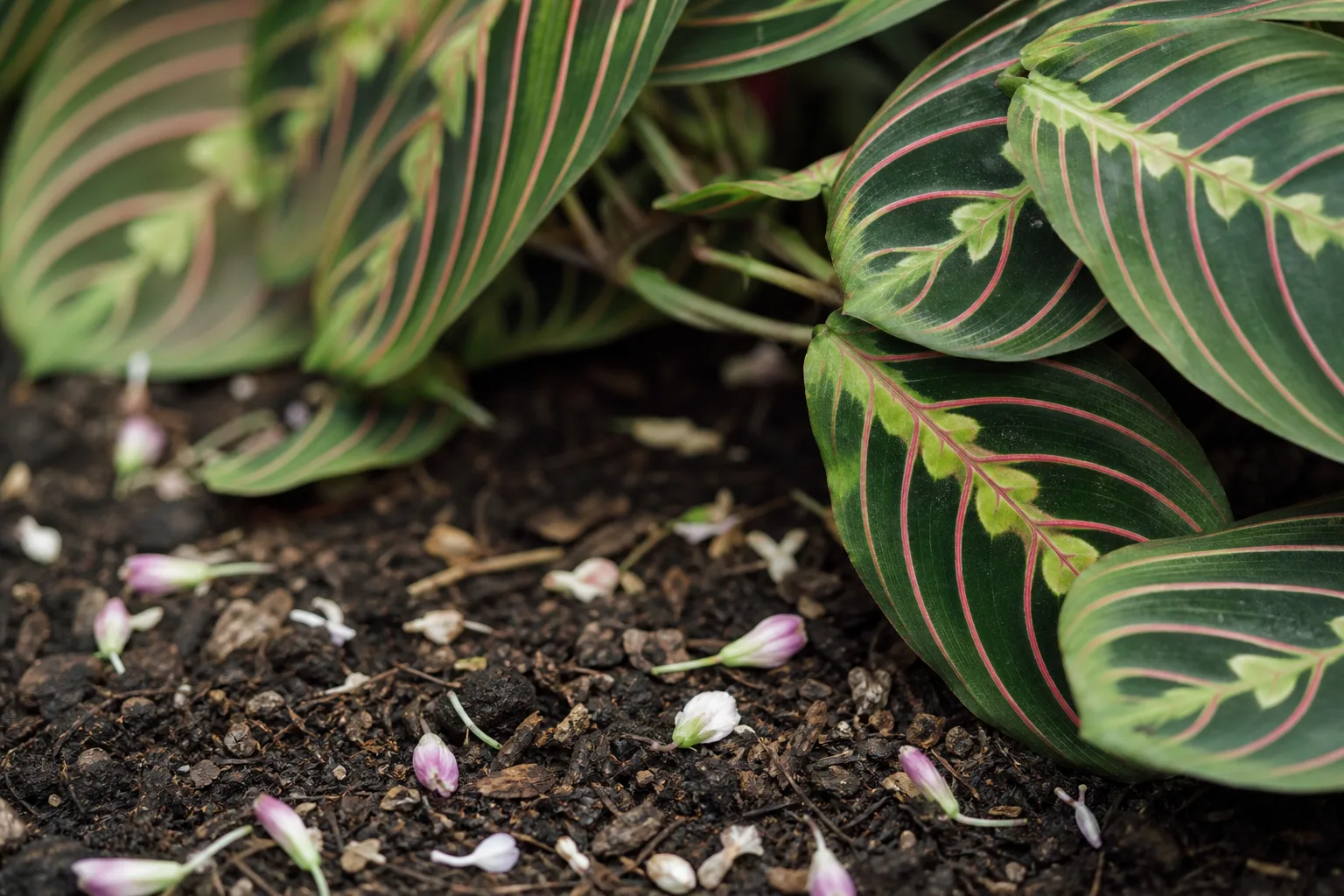
Use this quick check before changing care:
| What you observe | What it suggests | First response |
|---|---|---|
| Healthy leaves, steady growth, no flowers | Normal indoor behavior | Keep the routine; do not force a bloom |
| Long, stretched stems or small new leaves | Light may be too low | Move gradually to brighter indirect light |
| Bleached or scorched leaf patches | Sun may be too direct | Filter the rays or move the pot back |
| Mix stays wet and smells sour | Drainage or root trouble | Let the mix approach a healthy dry-down; check the pot and roots |
| Crispy tips with dry indoor air | Humidity or watering consistency may be poor | Check both the root ball and room humidity before adjusting |
| Buds fall after a sudden move | A recent environmental change may be involved | Stabilize the position and routine; watch new growth |
Make one adjustment at a time and give the plant time to respond. Moving it, repotting it, changing the soil, increasing fertilizer, and raising humidity all in the same week makes it harder to tell what helped. If the plant is otherwise healthy, waiting through an active growing season is a reasonable choice; there is no treatment required for the absence of flowers.
Should you deadhead or keep the flowers?
Either choice is fine. Leave the stalk in place if you enjoy the flowers or want to observe how the plant develops them. If you prefer the foliage without thin flower stems, wait until the blooms fade and the stalk begins to look spent, then remove it for appearance.
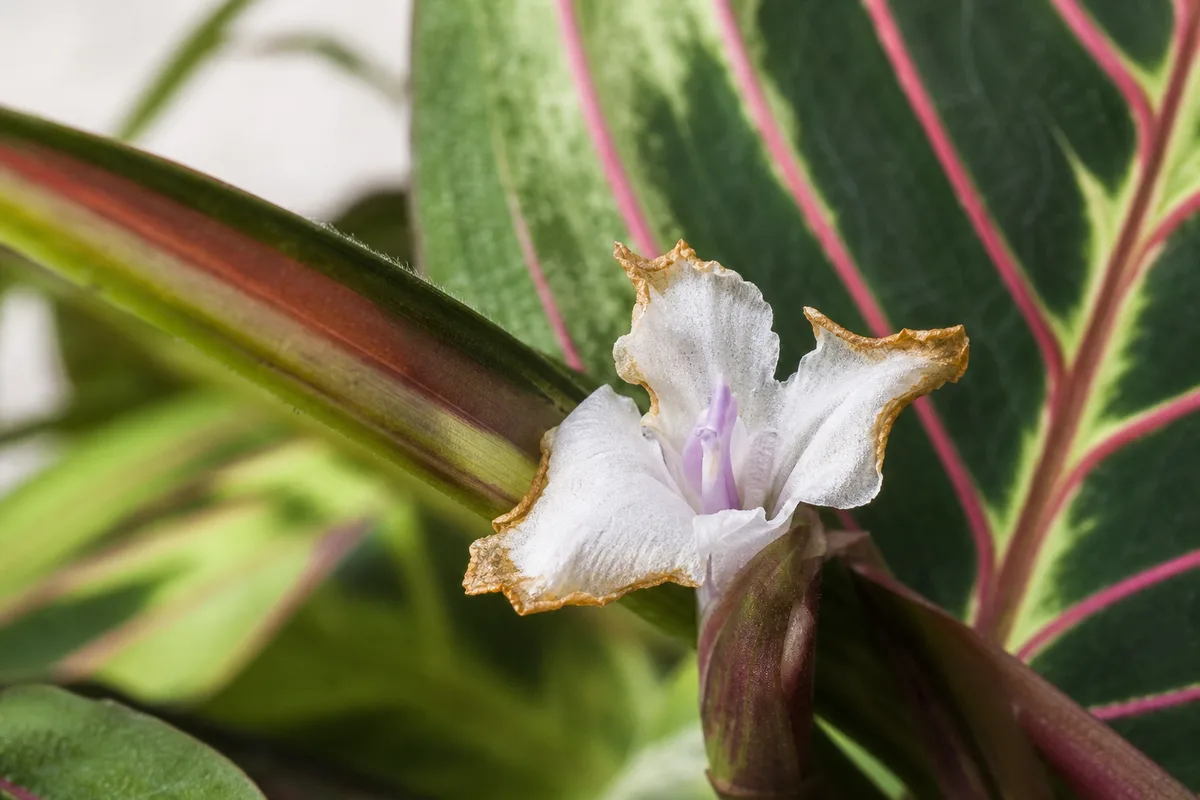
There is no good reason to cut off every new stalk on the assumption that doing so will make the plant produce more leaves. Flowering is a normal phase, and a healthy Maranta can continue growing foliage afterward. Removing a stalk may tidy the plant, but it is not a dependable way to increase leaf size, speed up growth, or guarantee a second flush.
When you do remove one, use clean, sharp scissors and cut the flower stalk near its base without nicking nearby leaves or stems. Avoid pulling or twisting it out, since that can tear soft plant tissue. Do not confuse an emerging leaf with a flower spike; if the shape is unclear, wait until buds or a leaf blade make the structure obvious.
Simple care after the flowers fade
After the last flowers fade, remove the stalk if you no longer want it. The plant does not need a special post-bloom feed, extra water, or a full repot just because flowering ended. Continue checking the soil and watering as the mix begins to dry, then adapt the frequency as days shorten or indoor temperatures change.
Prune dead, damaged, or yellow leaves separately from healthy ones. Make cuts at the base of the individual leaf stalk with clean scissors, and avoid stripping out green leaves to “make room” for new growth. If the plant has become uneven, you can trim a few long stems selectively; the goal is a balanced shape, not a severe cutback that leaves the plant with too little foliage to recover.
If a stalk and its flower buds dry while the leaves remain healthy, the cycle may simply be over. If the whole plant declines, examine roots and growing conditions rather than blaming the bloom. Keep notes on the plant’s position, watering interval, and any recent temperature or humidity change, then make one measured correction at a time. For details on changing a pot or creating new plants, see the Maranta leuconeura care guide and prayer-plant propagation guide.
Conclusion
Prayer plants can flower indoors, but they do so irregularly, and most people grow Maranta leuconeura for its leaves. Small white or purple-marked flowers on a slender stalk are normal; they are not a sign that the plant is dying or proof that every care condition is ideal.
Give your Maranta stable warmth, suitable indirect light, steady moisture with good drainage, and practical humidity. Let an established plant bloom if it chooses to, remove spent stalks only if you prefer, and judge its health by the whole plant rather than by whether it produces flowers. That approach keeps the care useful whether the next stalk appears or not.



