Should You Mist Houseplants? A Practical Guide
Should you mist houseplants? Learn which plants may benefit, which should stay dry, why misting rarely fixes humidity, and what works better.
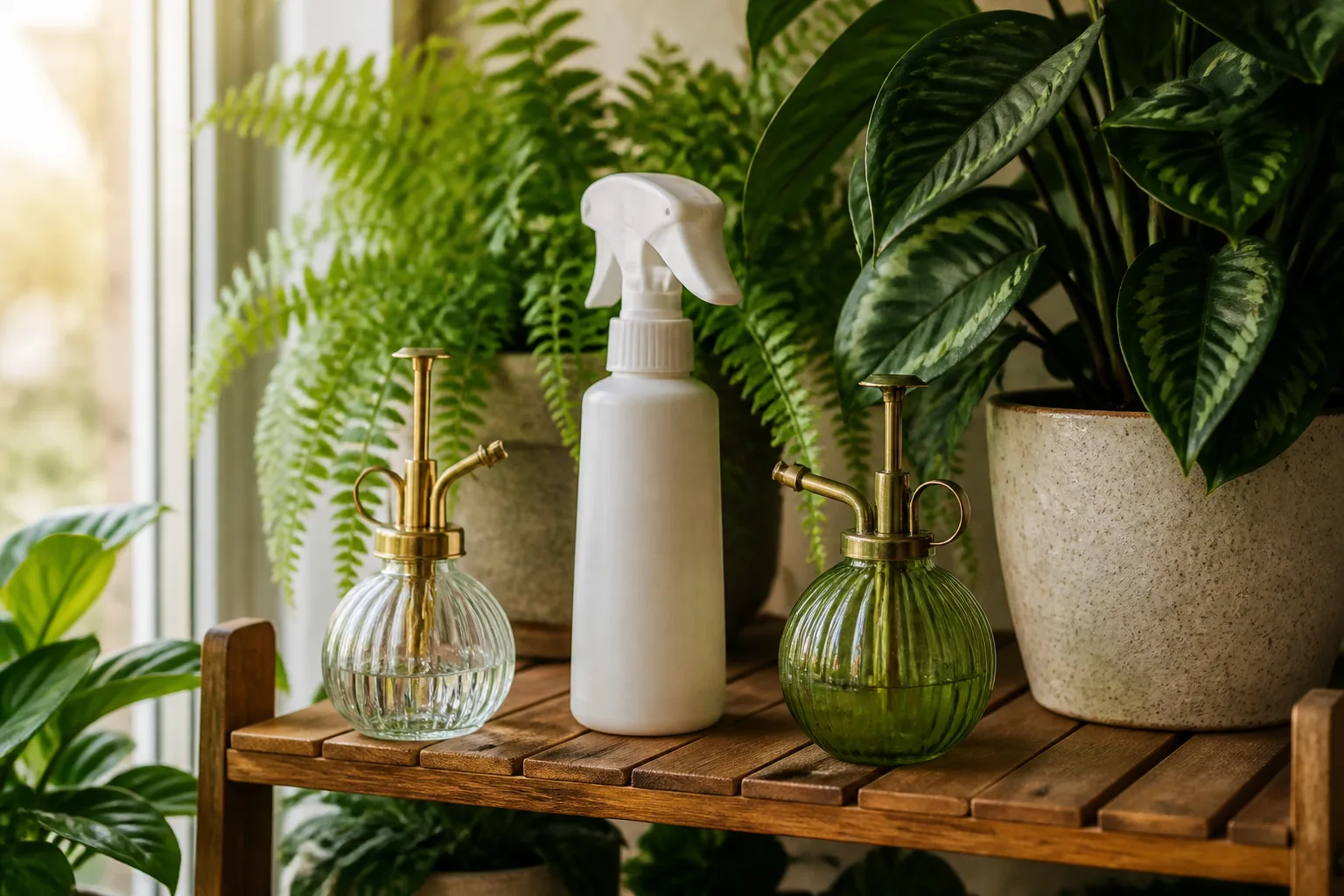
Misting houseplants feels helpful because it is visible: you spray, the leaves sparkle, and the plant looks refreshed. But a wet leaf is not the same thing as a hydrated root system, and a few minutes of damp air is not the same thing as a humid room.
The practical answer is usually no, you do not need to mist routine houseplants. Misting can be an optional short-lived treatment for some smooth-leaved tropical plants, and it has a legitimate place in the care of air plants and some epiphytic orchids. It is a poor substitute for watering, and it is the wrong habit for succulents, cacti, fuzzy foliage, or any plant whose crown stays wet.
The short answer: misting is optional, not basic watering
Start with the problem you are trying to solve. If the potting mix is dry, water the root zone thoroughly and let excess drain; if the room is dry, measure the relative humidity and improve the environment; if the leaves are dusty, clean them in a way that suits their texture. A spray bottle is not a universal answer to all three problems.
Penn State Extension explains that misting raises humidity only until the water evaporates, which can happen within minutes. The Royal Horticultural Society’s houseplant humidity guidance also frames humidity as an environmental condition that varies by plant, not as a reason to follow one misting schedule for every pot.
There is still a reasonable case for occasional misting. A light spray can help you inspect a plant closely, rinse loose dust from smooth leaves, and briefly wet the surface of a plant that is adapted to take in moisture from exposed leaves or roots. Think of it as a narrow-purpose care action, not a daily requirement.
What misting can and cannot do
Misting puts a thin film of water on leaves and briefly increases moisture immediately around the plant. As the droplets evaporate, that local effect fades; it does not reliably raise the relative humidity of the whole room or keep a humidity-loving plant in tropical conditions.
That distinction matters because many houseplant problems are caused by the wrong variable. A crispy edge may reflect dry air, but it can also follow underwatering, a hot window, a heating vent, fertilizer salts, root damage, or a sudden change in light. Misting the symptom can make the foliage wetter while leaving the cause untouched.
Misting can also be useful as a moment to look for pests, dust, webbing, scale, and changes in new growth. That benefit comes from attention, not from the spray itself. If the ritual helps you notice problems earlier, keep the inspection and drop the water whenever the plant or room does not suit wet leaves.
Leaf wetness is not root-zone watering
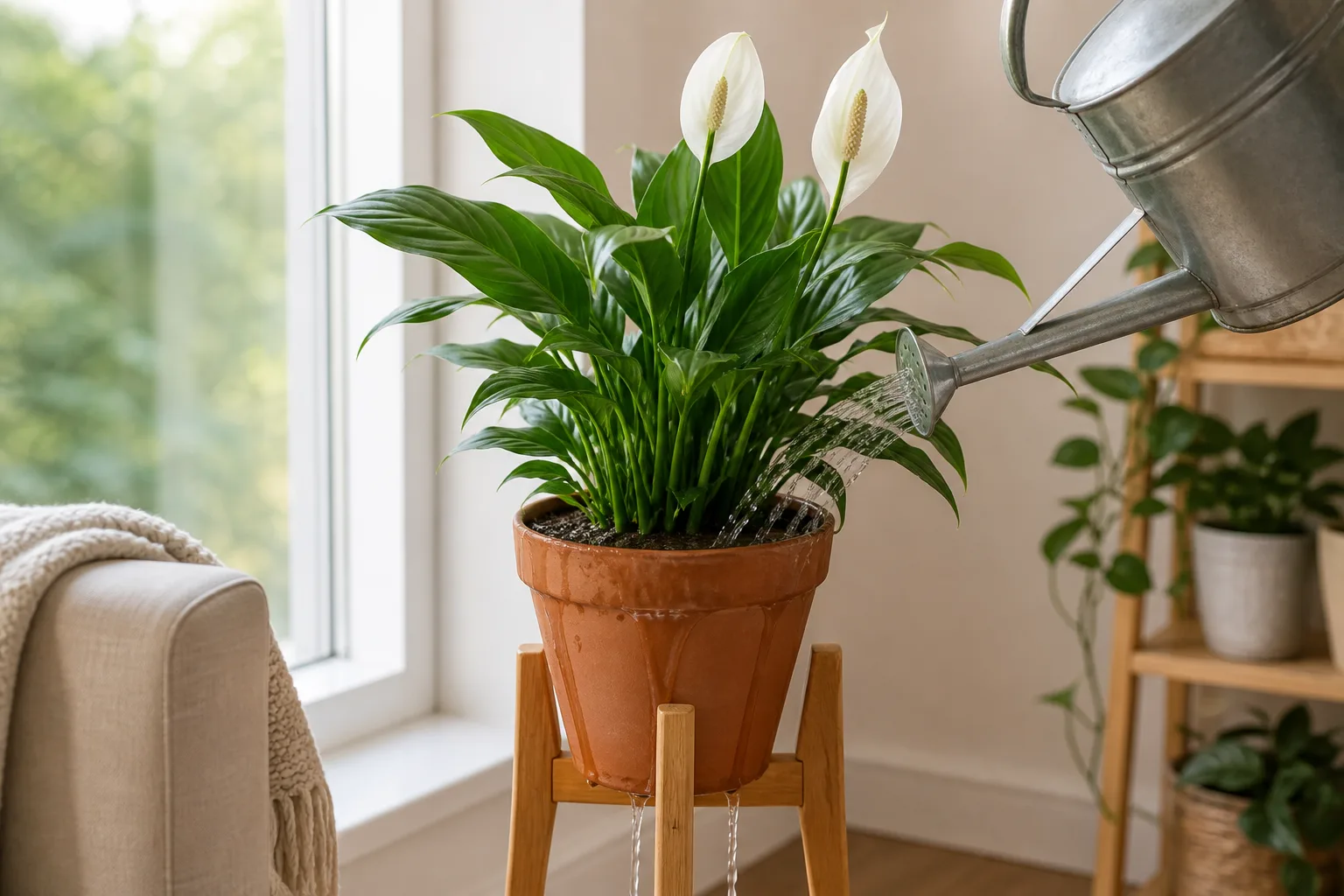
Most potted plants take up the bulk of their water through roots in the potting mix. A misted leaf may stay cool and damp briefly, but it cannot deliver the volume of water that a dry root ball needs. If a plant is wilting and the mix is dry, misting may make it look better for a short time while the roots remain thirsty.
The reverse is just as important. If the plant is drooping while the mix is still wet, add no more water—whether from a watering can or a mister. Check the roots, drainage, and light instead; wilt in saturated soil can signal root trouble rather than dehydration.
Air plants (Tillandsia) and some orchids with exposed roots are the useful exceptions, but even they need species-appropriate watering rather than an automatic daily spritz. For a moth orchid, for example, misting exposed roots can be part of a routine, while the potting medium still needs to be watered and allowed to drain according to its bark or moss mix.
Decide by measured humidity, plant texture, and symptoms
Humidity is not a personality test for your plant. It changes with season, heating, air conditioning, sunlight, room size, ventilation, and how close the plant is to a draft. Two pots in the same home can experience different conditions if one sits beside a radiator and the other is in a crowded, still corner.
Use three questions before you mist:
- Is the room actually dry? Measure near the foliage rather than guessing from brown tips.
- Does the plant have a reason to tolerate wet leaves? Smooth tropical foliage is different from fuzzy leaves or a tight crown.
- Can the leaves dry quickly? A warm, bright, gently ventilated room is safer than a cool, crowded shelf.
This turns misting into a decision instead of a reflex. If the answer to any question is no, choose a different care action.
Use a hygrometer before changing your routine
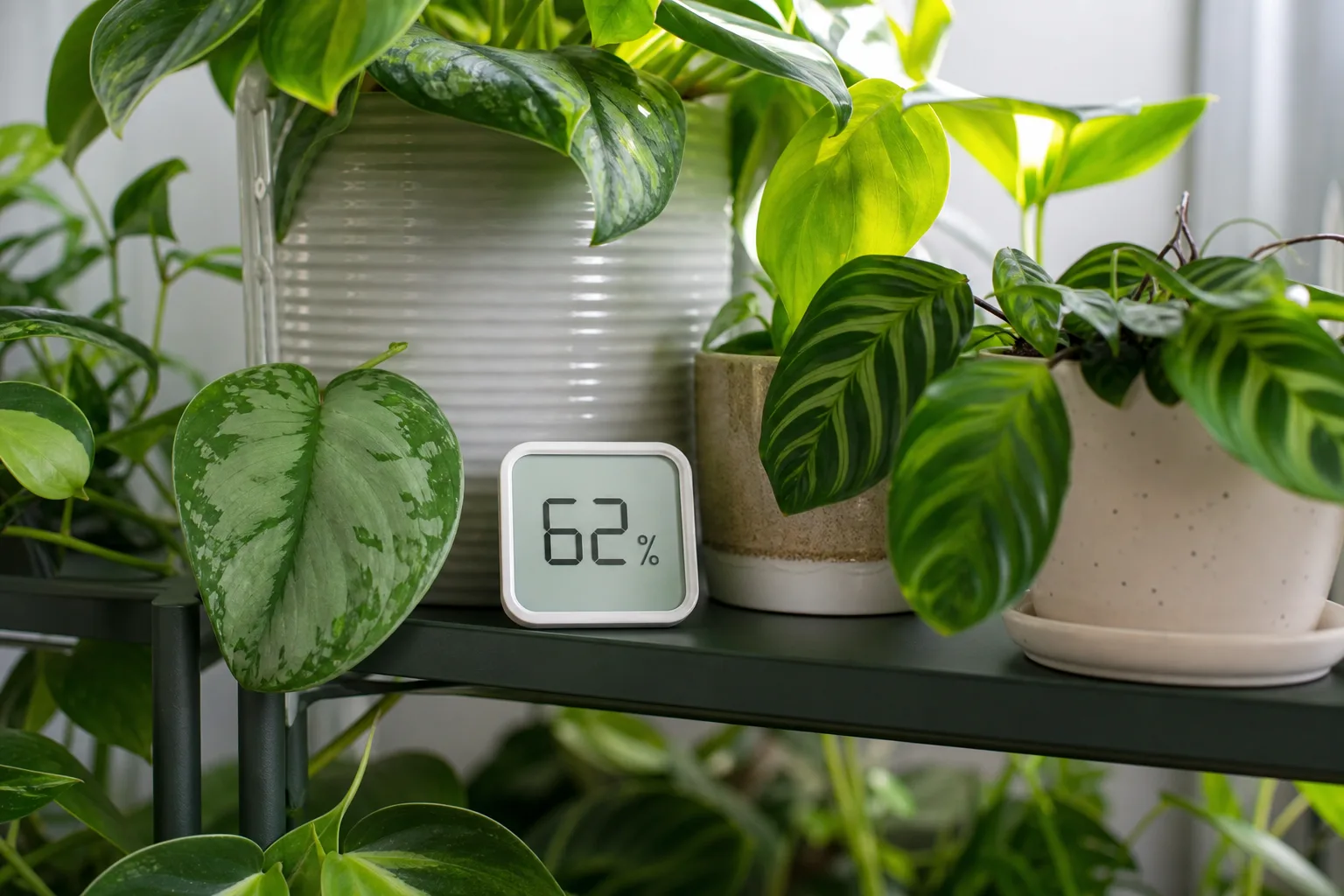
A small hygrometer is more useful than a calendar reminder. Penn State Extension notes that indoor relative humidity can fall below 30% during winter heating, while a general indoor range of about 30% to 60% is commonly recommended for human comfort. Gardens Illustrated reports that many ordinary homes sit around 40% to 50% and that numerous common houseplants tolerate that range.
Treat those numbers as a starting point, not a universal prescription. A reading around 40% to 60% is usually adequate for adaptable foliage, while some ferns, calatheas, stromanthe, and other thin-leaved tropicals may perform better with more stable moisture in the air. A succulent that is healthy at 30% does not become healthier simply because you push the room to 70%.
Place the meter at leaf height for a few days and compare morning, afternoon, and overnight readings. If the room is comfortable but one plant still develops brown edges, investigate roots, watering, light, heat, and drafts before deciding that misting is missing.
Brown tips have more than one cause
Brown tips are a clue, not a diagnosis. Dry air can increase water loss, especially when a plant is close to a heat source or receives more light than its roots can support. But inconsistent watering, compacted or damaged roots, fertilizer or mineral buildup, and direct sun can create similar damage.
Use the pattern to narrow the cause. Crispy tips on several plants clustered beside a heater point toward a dry, hot microclimate; brown margins with white crust on the soil suggest salts; a single plant with wet mix and yellowing lower leaves deserves a root and drainage check. Spots that are dark, expanding, or soft are a reason to stop wetting leaves rather than mist more often.
Gardens Illustrated’s humidity and misting guidance is useful here because it treats drafts, temperature, and watering as possible causes alongside humidity. That prevents the common mistake of spraying every brown edge while the plant continues to sit in a hot window or a waterlogged pot.
Which plants may benefit from occasional misting
The safest candidates are plants whose natural ecology involves frequent contact with humid air or rainfall and whose leaves can dry promptly indoors. Even then, “may benefit” does not mean “must be misted.” Stable room humidity, correct light, and root-zone care matter more.
Air plants are the clearest exception to ordinary potted-plant logic because they absorb water through their leaves and specialized surface structures. A mist can be useful between more thorough soaks, but an air plant that remains damp in a dark, still room can rot. Give it bright filtered light, strong drying airflow, and the full watering method recommended for the species.
Epiphytic orchids, especially moth orchids, may also tolerate targeted moisture on exposed roots. Do not confuse that with spraying flowers, filling the crown, or leaving water trapped where new growth emerges. If the orchid is potted in bark or moss, check the medium and roots; leaf misting alone is not a watering plan.
Air plants, orchids, ferns, and tropical foliage
Ferns, calatheas, marantas, fittonias, stromanthe, some palms, monsteras, philodendrons, and other tropical foliage often respond better to a stable humid environment than to repeated leaf spraying. The RHS lists high-humidity preferences for several of these plants but also warns about keeping water out of sensitive centers and avoiding leaf spotting on some varieties.
For a smooth-leaved tropical plant, an occasional morning mist can be harmless when the room is warm and airy. It can also wash off surface dust, but wipe large leaves with a soft damp cloth when you need a thorough clean; a cloud of droplets rarely reaches every leaf surface evenly.
Ferns illustrate the trade-off. A bird’s nest fern likes high humidity, yet water sitting in its central crown can lead to rot. Aim moisture at the surrounding air or use a humidifier, not a heavy spray into the funnel. A delicate maidenhair fern may need more consistent environmental humidity than a mister can provide, especially in a dry room.
Which plants are better kept mostly dry
Plants adapted to arid conditions store water in leaves, stems, or roots and generally do not need extra moisture on their foliage. They are often harmed more by the chain reaction around misting—damp leaves, slower drying, and a grower who waters again—than by a single spray itself.
Keep routine misting off the care list for cacti, aloe, many echeverias, haworthias, jade plants, and other drought-adapted succulents. Snake plants, ZZ plants, ponytail palms, and yuccas also cope with ordinary dry indoor air and should not be treated like rainforest plants simply because they are houseplants.
Succulents, cacti, and fuzzy or crown-sensitive leaves
The surface matters as much as the plant’s origin. Fuzzy leaves can hold droplets in the hairs, creating patches that dry slowly and become difficult to clean. African violets and many begonias are classic examples; water on their foliage can leave marks, while water sitting in the crown raises the risk of rot.
Avoid spraying any plant with a tight crown, folded growth point, or rosette that traps water unless its care instructions specifically call for it. Do not use misting to treat a dry-looking succulent, either. If the leaves are wrinkled, test the mix and roots, then give the plant a proper deep watering only when its soil and species call for it.
The same caution applies to plants under weak light, in cool rooms, or beside other pots with little air movement. A leaf that would dry in an outdoor breeze may remain wet for hours indoors. If you cannot provide a fast-drying setting, skip the spray.
How to mist houseplants safely when it makes sense
If the plant passes the texture, humidity, and airflow test, keep the application light and purposeful:
- Check the plant first. Confirm that the soil does not need watering and that you are not trying to correct droop or severe dehydration with leaf spray.
- Use a clean mister. A bottle that once held cleaner, fragrance, or pesticide is not safe for plant care, even after a quick rinse.
- Choose a warm part of the day. Morning to early afternoon gives leaves time to dry before temperatures fall overnight. Martha Stewart’s horticulture guidance recommends earlier timing because wet leaves at night can remain damp longer.
- Make fine droplets. Aim for a light coating, not runoff. Large droplets collect in leaf joints, crowns, and the base of petioles.
- Avoid sensitive zones. Keep water off fuzzy foliage, flowers, new growth, and the crown or growing point unless the species specifically needs moisture there.
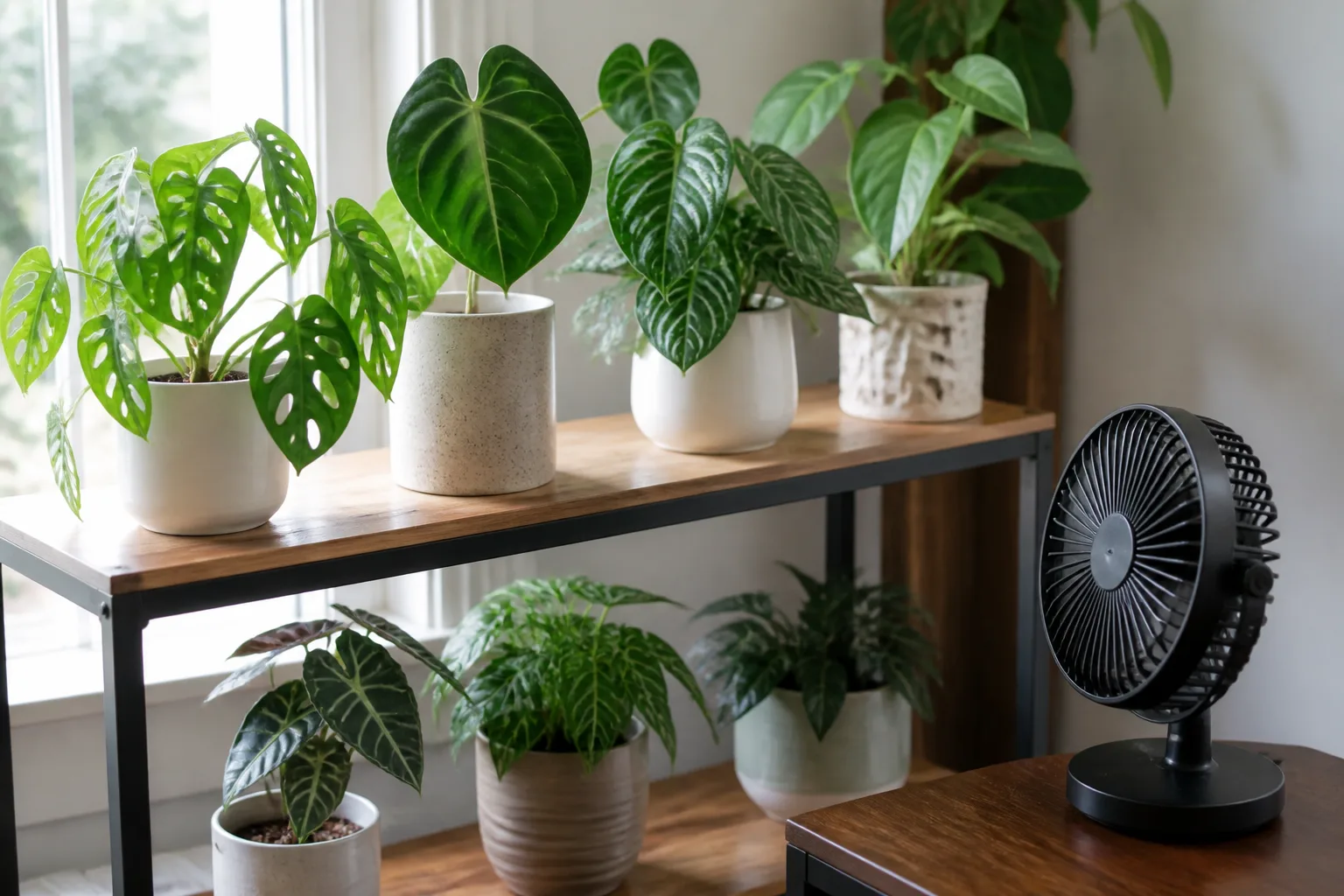
- Provide airflow. Leave space between pots and avoid placing a freshly misted plant in a dark corner or directly against a cold window.
- Watch the next 24 hours. If leaves are still wet at night, spots appear, or the plant declines, stop misting and reassess the setup.
This is deliberately less frequent than the “spray whenever you walk past” habit. A fixed weekly schedule is not automatically safe if the room is cool or the plant is already showing leaf disease. Let the drying time and the plant’s response set the boundary.
Choose the morning, fine droplets, and good airflow
The goal is to create a brief wetting event that ends quickly. Morning is a useful default because light and normal daytime warmth help evaporation, but bright light does not make it safe to leave leaves soaked; direct sun on wet foliage can also create temperature stress or spotting.
Do not mist into a closed cabinet, terrarium, or packed plant shelf without checking condensation and ventilation. Enclosed spaces are a different growing system: they hold humidity longer, so a spray that is harmless in an open room can be excessive inside glass.
Never place a misted pot in front of a heater, air conditioner, or fan on high. Rapid drying from hot or cold air can stress the plant, while a stagnant corner keeps foliage wet without creating a useful stable humidity level.
Use clean equipment and water that will not leave residue
Use fresh, room-temperature water. If your tap water is hard or leaves dry with white spots, filtered or distilled water can reduce mineral residue; Martha Stewart’s horticulture coverage specifically flags white mineral patches as a problem with frequent misting.
Do not add fertilizer, soap, essential oils, leaf shine, or homemade pest ingredients to a routine mister. Foliar feeding and pest treatments are separate interventions with their own labels, concentrations, and plant-safety rules. A plain-water spray is easier to evaluate and less likely to burn foliage or leave a film.
Rinse the bottle regularly and let it dry between uses. If the nozzle starts producing a single stream, replace or clean it; a heavy stream is more likely to pool in the crown and soil than to create a useful fine mist.
When a different humidity fix is better
If the hygrometer shows persistently dry air, change the environment rather than increasing the number of sprays. This is especially important for a collection of humidity-loving plants, for a plant that repeatedly develops crispy new growth, or for a room heated so aggressively that leaves dry soon after every mist.
A humidifier is the most direct way to change room humidity, but it is not “set and forget.” Use a meter to avoid turning the room into a condensation chamber, keep the unit clean according to its instructions, and leave enough space for air to circulate. Gardens Illustrated notes that high humidity without ventilation can create mold and fungal problems around the room as well as on plants.
Humidifiers, grouping, terrariums, bathrooms, and pebble trays
A humidifier makes sense when several plants share a room and the RH is consistently low. Choose capacity and placement for the room, not just the plant; aim the output into the air rather than directly at leaves, walls, or furniture. A timer can help, but the hygrometer decides whether the runtime is appropriate.
Grouping plants can create a modest, local microclimate, especially when the pots have similar light and watering needs. Do not pack them so tightly that leaves touch, air stops moving, or a pest can spread unnoticed from one plant to the next. Grouping a cactus beside a calathea also creates a care compromise rather than a perfect climate for either.
A terrarium or cloche can work for small plants that genuinely enjoy high humidity. It holds moisture far longer than a spray, so include ventilation and watch for condensation, overheating, and fungal growth. Keep it out of harsh direct sun.
A bathroom or kitchen may be temporarily humid during a shower or while cooking, but that does not guarantee suitable light or all-day humidity. Penn State Extension recommends measuring the room rather than assuming its use makes it a plant-friendly climate.
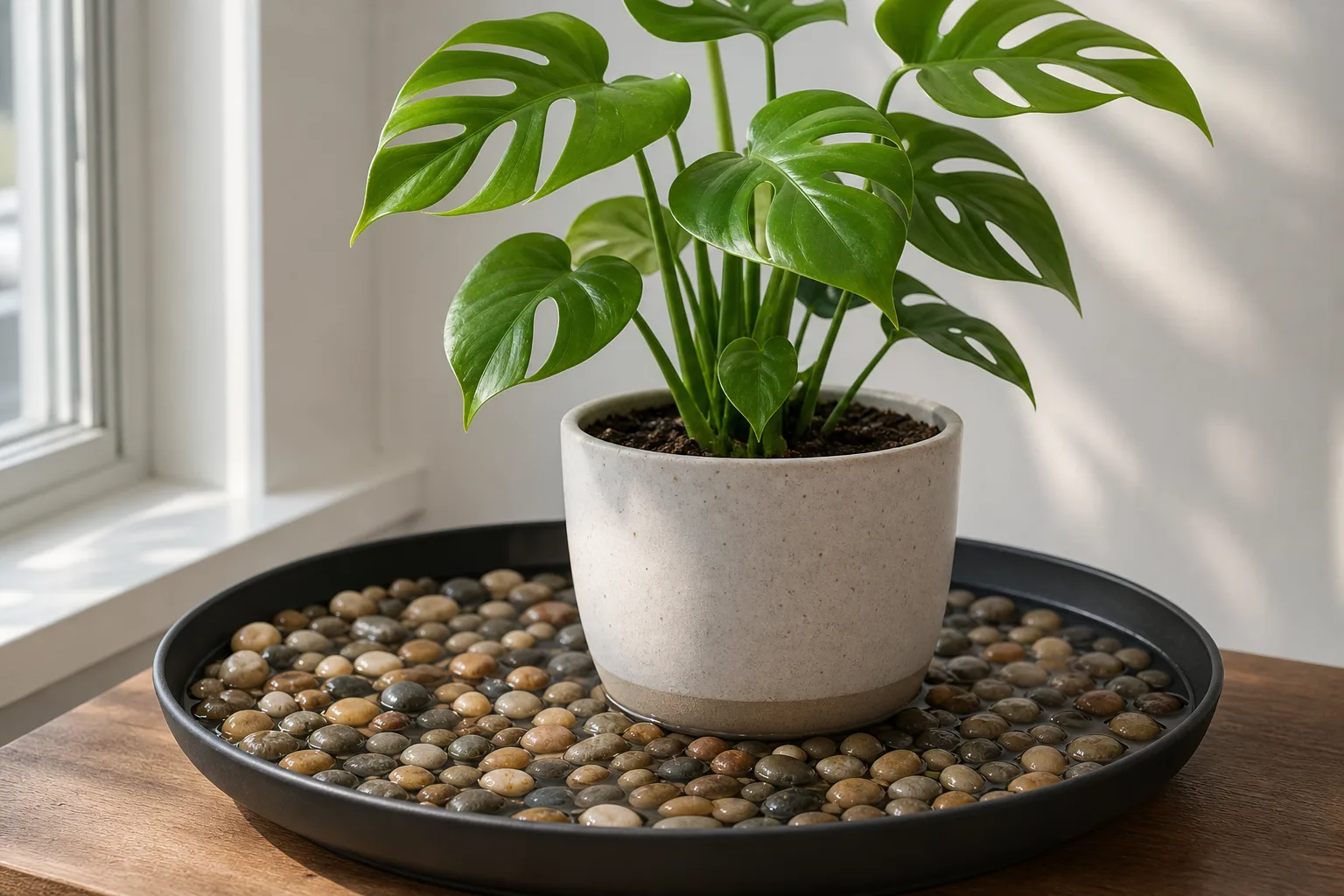
A pebble tray is best treated as a spill-catcher or attractive local setup, not a guaranteed humidity machine. Penn State Extension and Gardens Illustrated both explain that water evaporating from a tray disperses through the room and may have little effect at leaf height. If you use one, keep the pot on the pebbles above the waterline, make sure the tray is wider than the pot, and never let the container sit in standing water.
For a deeper comparison of the options, see our guide to indoor humidity and pebble trays and humidifier placement for houseplants. The short version is simple: measure first, correct drafts and heat, and use a humidifier when you need a sustained room-level change.
Misting mistakes and how to recover
The most common mistake is escalating a weak solution. A plant develops brown edges, the owner mists more often, the soil gets splashed, and the leaves stay wet longer—yet the original issue may be a dry root ball, root rot, salt buildup, or low light.
Another mistake is treating a plant list as a guarantee. “Tropical” describes a broad group with different leaf textures and growth forms; a smooth-leaved pothos, a fuzzy African violet, and a bird’s nest fern do not have the same tolerance for water sitting on foliage. Use plant-specific care information when it conflicts with a general rule.
What to do about spots, rot, droop, and persistent brown tips
If you see new leaf spots after misting, stop spraying immediately and keep foliage dry. Move the plant into brighter, indirect light with gentle airflow, inspect both sides of the leaves, and remove badly damaged tissue with clean scissors if needed. If spots continue to spread, consult a local extension service or a reliable plant-disease diagnosis resource rather than adding homemade treatments.
If the crown or stem feels soft, isolate the plant from a crowded collection and check the roots and pot drainage. Remove standing water, let the mix dry only as the species allows, and repot only when you have identified a drainage or root problem; repeatedly changing pots while the plant is stressed can add shock.
If the plant is drooping, test the soil before misting. Dry mix calls for a proper root-zone watering, while wet mix calls for a root, drainage, temperature, and light check. A mister should not be used to disguise either condition.
For brown tips, work through this order: check the soil and roots, look for heat or drafts, inspect the light change, look for fertilizer or mineral crust, and measure humidity. If the room is dry and the plant is a known humidity lover, improve the environment; if the room is already moderate, misting is unlikely to be the missing fix. You can trim only the dead brown tissue for appearance, but trimming will not stop new damage until the cause changes.
Conclusion
For most houseplants, misting is optional and short-lived—not a substitute for watering or a reliable way to raise room humidity. Use it sparingly for suitable smooth-leaved tropical plants, and more intentionally for air plants or exposed orchid roots, while keeping succulents, cacti, fuzzy leaves, and water-trapping crowns mostly dry.
The best routine is to measure humidity, inspect the plant’s texture and symptoms, keep leaves able to dry, and choose the tool that matches the problem. When the room truly needs more humidity, a clean, monitored humidifier or a better placement usually accomplishes more than a spray bottle.



