Pruning Houseplants Before Winter: When It Helps
Pruning houseplants before winter can help or hurt depending on the cut. This guide explains safe cleanup, species exceptions, and why major shaping belongs in late winter or spring.
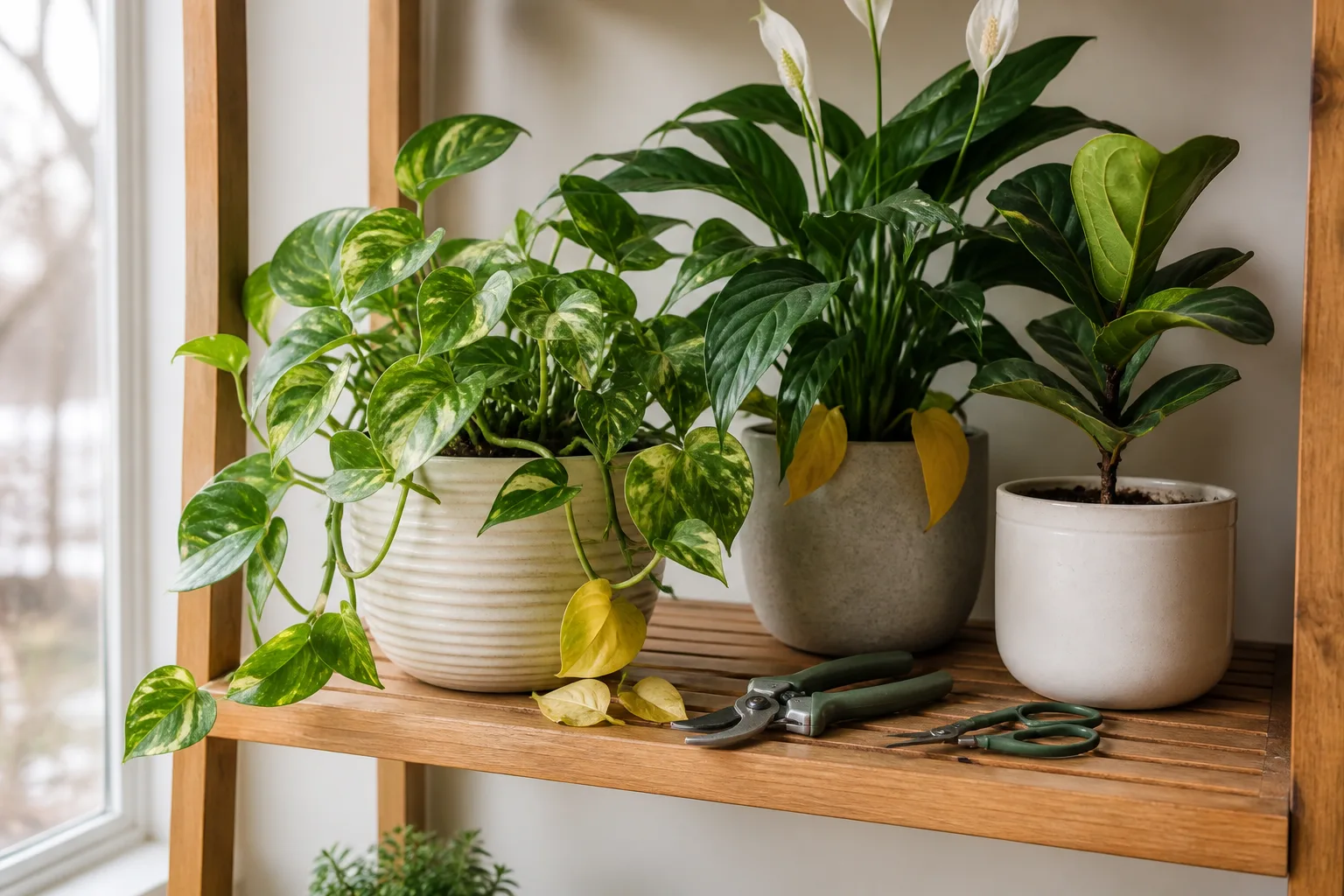
Your fiddle leaf fig looks messy after a summer on the patio. The pothos has three yellow leaves at the base. The peace lily finished blooming and the stalks are turning brown. November arrives and every instinct says grab the shears and reset the plant before winter — but most houseplants are entering a slow-growth period, not asking for a haircut. The question is not whether pruning is ever appropriate in fall. It is whether the cut you are about to make is cleanup or shaping. One protects the plant through winter. The other steals energy the plant cannot replace until spring.
The Short Answer: Cleanup Yes, Heavy Shaping No
Yes — remove dead, yellow, diseased, broken, or spent flower material any time of year, including late fall and winter. That is sanitary pruning, not seasonal shaping. It prevents fungal spores and pests from lingering on tissue the plant will never repair, and it does not ask the plant to push major new growth.
No — postpone hard pruning, size reduction, renovation, and bushiness training until late winter or early spring when daylight lengthens and most foliage houseplants move back into active growth. University of Wisconsin-Madison Extension notes that plants in active growth require more water and resources than during slow-growth periods such as winter (UW-Madison Extension). Cutting heavily when growth is idling forces the plant to heal wounds and sprout new shoots without the light and root activity that make recovery fast.
If you are standing over a leggy monstera in December wondering whether to cut it in half, the calendar is telling you to wait. If you are removing a papery brown leaf that snapped in a draft, cut it now.
What to cut now versus what to postpone
| Cut type | Fall / winter? | Why |
|---|---|---|
| Dead, brown, papery leaves | Yes | No regrowth expected; reduces disease carryover |
| Yellow leaves (not soil-related crisis) | Yes | Frees minor resources; improves inspection |
| Broken stems, pest-chewed tips | Yes | Stops damage from spreading |
| Spent peace lily / orchid flower stalks | Yes | Prevents rot at crown or spike |
| Leggy vine reduction, topping, notching | Wait | Stimulates growth the plant cannot sustain in low light |
| Renovation of overgrown shrubs (ficus, schefflera) | Wait | Large reserve loss + slow healing |
| Repot + major prune same week | Avoid | Stacks root and canopy stress |
For the full year-round cut-placement workflow, see our pruning indoor plants guide. For seasonal watering and light shifts that matter more than shears in winter, see winter houseplant care.
Why Winter Changes How Plants Respond to Pruning
Houseplants do not read the calendar on your phone. They read light duration, light intensity, temperature, and humidity. In most North American homes, all of those trend down from October through February. That combination changes what happens after the blade closes.
Shorter days and slower growth
As daylight hours shrink, photosynthesis drops. Less light means less transpiration — water moving through the plant and out through leaves. UW-Madison Extension ties watering demand directly to growth stage: during slow-growth periods, the same pot dries more slowly and needs less frequent watering (UW-Madison Extension). Growth hormones follow the same pattern. Apical dominance — the tendency of the top bud to suppress side shoots — is weaker when the plant is not in full growth mode, but triggering new branches still costs energy the plant is not currently budgeting for.
Growli, a houseplant care resource that cross-references RHS and extension guidance, summarizes the practical rule: most houseplants prune best during active growth season (roughly early spring through mid-summer), when recovery is fast (Growli). Winter dormancy or quasi-dormancy is fine for very minor cuts — one yellow leaf — but stresses the plant for larger interventions.
Cuts heal more slowly in low light
A clean cut is a wound. The plant seals it with callus tissue and redirects resources to the wound site. In bright spring light, pothos may show new nodes breaking within two to four weeks. In a dim winter room, that same cut can sit visibly unchanged for months — not because the plant is dying, but because it is not building tissue aggressively. Low light also keeps soil cooler and wetter longer near windows, which raises the risk that a slow-healing stem sits in a humid microclimate where fungal spores thrive.
That is why experts who grow indoors year-round still separate sanitary removal from structural pruning. Removing a brown peace lily stalk at the crown is a one-way trip — that stalk was finished anyway. Cutting eighteen inches off a dracaena cane to force bushiness is a bet on future growth you are not currently providing.
What Counts as Safe Winter Pruning
Safe winter pruning is anything that removes tissue that will not recover or stops an active problem without expecting a flush of replacement growth.
Dead, yellow, and damaged leaves
Dead leaves — brown, papery, no green when you scratch a remaining stem — should come off entirely. They are not coming back, and they can harbor spores or shelter pests. Yellow leaves are more nuanced: if the whole plant is yellowing from overwatering, fix the watering mistake before you strip the canopy. If one or two lower leaves on a healthy pothos yellowed naturally as the vine matured, cut them at the base or detach them cleanly.
For plants like peace lily where each leaf is its own stem from the crown, cut the entire petiole at soil level rather than leaving a stub that rots (Growli). For vining plants, cut just above a node if you are removing a damaged segment — never mid-stem with no node below, or you create a dead tip that cannot branch.
Spent flower stalks and pest-damaged growth
Peace lilies, anthuriums, and many orchids benefit from removing finished flower stalks before they mold at the base. Cut peace lily stalks all the way down where they emerge from the crown. On Phalaenopsis orchids, many growers cut the spike above the second or third node rather than at soil line if a secondary bloom is possible — but remove fully brown, dried spikes anytime.
Pest-damaged tips — mealybug clusters on new growth, thrips-scarred leaves — should be removed when you are also treating the infestation. Pruning alone does not cure pests, but it removes reservoir tissue. Bag and discard heavily infested material rather than composting it.
What to Avoid Pruning Before Winter
The cuts that cause winter regret are the ones that ask the plant to rebuild structure when it is trying to coast.

Major size reduction and hard renovation
Never remove more than about 30% of live foliage in a single session, even in spring (Growli). In winter, treat that limit as even stricter — think single stems, not percentages of the whole plant. If a fiddle leaf fig has grown into the ceiling, topping it in November removes stored reserves and opens a large wound that will not branch quickly. Missouri Botanical Garden renovation guidance for indoor plants emphasizes staged reduction across seasons rather than one dramatic session (Missouri Botanical Garden).
Plants that slow dramatically in winter — fiddle leaf fig, monstera, bird of paradise, schefflera, dracaena, hoya, most ferns — respond better to shaping when higher light returns and roots are actively taking up water and nutrients.
Stimulating new growth late in the season
Pinching, notching, and topping are growth commands. They break apical dominance and wake dormant buds. FloraSense’s pre-spring pruning guide puts the sweet spot at late winter through early spring, when plants sense lengthening days and ramp growth engines (FloraSense). Pruning in fall or early winter leaves fresh wounds exposed when healing power is lowest — their words, and they match what extension educators say about slow-growth periods.
If you top a rubber plant in December, latex bleeds, the cut calluses slowly, and new branches may not appear until March. The plant spends winter energy on wound management instead of maintaining the leaves you still need for whatever light is available.
Which Houseplants Tolerate Light Winter Trimming
Forgiving species handle light cleanup and occasional tip trimming better than slow or woody growers. These are the plants experts often call sturdy enough for gentle winter housekeeping:
- Pothos and heartleaf philodendron — remove yellow leaves; shorten a wildly long runner if it is blocking a walkway, but avoid halving every vine.
- Spider plant — trim brown leaf tips following the natural taper; remove spent runners if you do not want plantlets.
- Snake plant and ZZ plant — remove damaged leaves at soil line only; do not cut leaves halfway (they do not regrow from the cut point).
- Peace lily and cast iron plant — sanitary stalk and leaf removal; both tolerate neatness cuts.
- Tradescantia and coleus — soft stems heal relatively fast even off-peak if light is decent.
Even on forgiving plants, light touch is the rule. One yellow leaf today beats three aggressive shortening cuts because you are bored on a rainy Sunday.
Which Plants Should Wait Until Spring
Postpone structural work on:
- Fiddle leaf fig and rubber plant — Ficus latex, slow branching, best response April through July (Growli).
- Monstera deliciosa — large wounds on thick stems; spring and summer recovery for aerial-root cuts.
- Dracaena, schefflera, bird of paradise — upright growers that need visible lateral buds and strong light to fill in.
- Hoya — many species are slow; hard cuts in winter produce bare stems for months.
- Ferns — do not respond to traditional branching cuts; remove entire fronds only when fully brown.
- Palms — never cut the growing tip; remove only fully brown fronds.
- Calathea and prayer plants — remove individual damaged leaves at soil line; they do not branch after pruning.
- African violets and flowering plants with visible buds — wait until after bloom unless removing diseased tissue.
If the plant is already stressed — recent repot, root rot recovery, heat-dry shock, major pest outbreak — fix the stress first. Growli lists pruning a stressed plant as a top mistake because it compounds decline (Growli).
Indoor Herbs Are the Main Exception
Potted rosemary, thyme, mint, oregano, basil, parsley, and chives brought indoors for winter are the main group where light trimming in November and December can be appropriate — because you are often harvesting usable foliage, not restructuring the plant. The limit is photosynthesis: leave enough healthy leaf area to feed the roots through short days.
Harvest small amounts at a time. Rotate the pot so remaining foliage gets even light. Northern window exposure is often brightest in winter for these Mediterranean herbs, but still weaker than summer — so under-harvest rather than over-harvest. If an herb is dropping leaves and wilting, skip harvest and address light, airflow, and watering first.
Basil indoors in winter is marginal for many homes; treat heavy pruning as a last resort and expect slow regrowth until you supplement light or wait for spring.
How Much You Can Safely Remove
The 30% rule is the ceiling in spring. In fall and winter, stay well below it.
For sanitary cuts, you are only removing tissue that is not contributing — dead leaves do not count toward the limit. For live tissue, think in stems, not vibes: one peace lily stalk, one pothos runner segment, one dracaena tip — not a whole-shelf makeover.
If a plant truly needs renovation — half-dead, leggy, overgrown — stage it:
- Session 1 (late winter): remove worst deadwood and up to ~30% of the weakest live growth.
- Session 2 (+6 weeks): another moderate reduction once new growth shows.
- Session 3 (+6 weeks): final shaping.
Three moderate sessions beat one winter massacre. Slow is faster when light is limited.
Tools and Cut Placement That Matter in Winter
Dull blades crush stems and leave ragged edges that dry slowly — exactly what you do not want in a cool room. Use precision snips for soft vines, bypass shears for woody ficus and mature monstera stems. Wipe blades with 70% isopropyl alcohol or a diluted bleach solution between plants to limit disease spread (University of Minnesota Extension via pruning indoor plants).
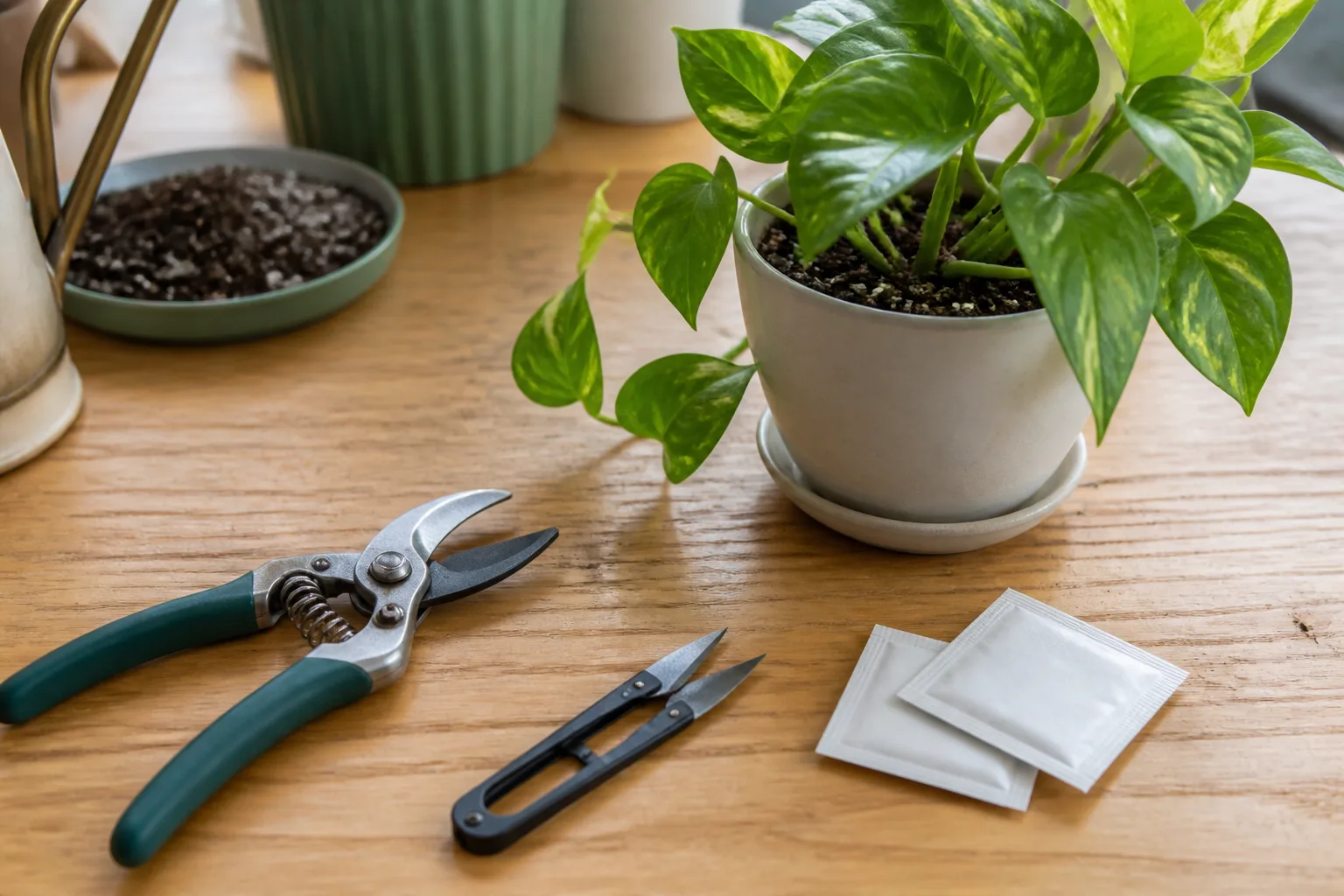
Cut about one centimeter above a node at a slight angle on vining plants so water sheds off the wound. On crown-type plants, cut at the base of the offending stem, not mid-petiole. Wear gloves for Ficus — latex irritates skin.
Because winter healing is slow, clean cuts matter more, not less. One confident cut beats sawing back and forth.
Pruning vs Repotting: Do Not Stack Stressful Jobs
Fall is when many growers bring patio plants indoors, inspect for pests, and notice root-bound pots. UW-Madison Extension recommends repotting at the beginning of active growth (spring for most plants) so roots establish before winter (UW-Madison Extension). If you must repot in fall because a plant is severely root-bound or soil is exhausted, keep pruning minimal — dead leaves only.
Stacking repot + hard prune + light shock from moving indoors is how a healthy summer monstera becomes a winter decline story. Sequence the jobs: acclimate light first, quarantine for pests, repot only if necessary, sanitize with light cleanup cuts, and schedule shaping for late winter.
If overwatering is the real problem — yellow leaves and wet soil — see winter houseplant watering mistakes before you blame legginess and prune for shape.
What to Do Instead of Pruning Right Now
When you cannot reshape yet, you can still improve the plant’s winter odds:
- Raise light — move closer to the brightest window or add a grow light for key specimens; legginess is often a light problem masquerading as a pruning problem.
- Adjust watering — slower growth means slower drying; check soil before every pour (UW-Madison Extension).
- Increase humidity — heated winter air crispens leaf margins; misting is weak compared to grouping plants or using a humidifier.
- Inspect for pests — spider mites love dry winter interiors; catch them before they force emergency pruning.
- Document — photo the plant now; plan cuts for late winter with visible targets marked.
Propagation can wait too. Spring and summer cuttings root faster with stronger light. If you must save a pothos runner, water propagation under a grow light works in winter — but that is rescue, not routine shaping.
When Late Winter Becomes the Better Window
Late winter through early spring — roughly February through April in most temperate climates — is when pruning houseplants before the main growing season pays off. FloraSense describes this as the moment plants sense longer days and redirect energy into new shoots (FloraSense). Minnesota Extension’s spring houseplant care guidance aligns: refresh, groom, and repot as growth resumes (University of Minnesota Extension via pruning indoor plants).
Use late winter for:
- Reducing leggy pothos and philodendron before the spring flush
- Topping or notching fiddle leaf fig and rubber plant when you can follow with brighter light
- Dividing snake plant clumps and spider plant masses as part of grooming
- Shaping dracaena and schefflera before new leaves expand
If your home is bright and warm year-round — strong south exposure, supplemental lights, consistent 70°F — plants may never fully idle. You can prune slightly earlier, but still avoid heavy cuts right before a planned move to a darker winter room.
Conclusion
Pruning houseplants before winter is not a single yes or no. Sanitary cleanup — dead, yellow, broken, spent blooms, and obvious pest damage — belongs on your November and December checklist. Major shaping, size reduction, renovation, and bushiness training belong on your late-winter calendar, when longer days and rising growth give the plant resources to heal and branch.
Match the cut to the season: remove what is finished, protect what is still working, and postpone the dramatic makeover until the plant can answer with new growth. Sterilize your blades, cut above nodes on vines, never stack repot and hard prune in the same stressed week, and treat indoor herbs as a narrow harvest exception rather than a template for your tropical foliage. Get the cleanup done now, plan the real prune for February or March, and your collection enters spring tidy — not depleted.



