Types of Hibiscus: 44 Varieties for Every Garden
Compare 44 hibiscus types by USDA zone, bloom size, and use—hardy dinner-plate, tropical patio, and rose of Sharon cultivars with ID tips and spread warnings.
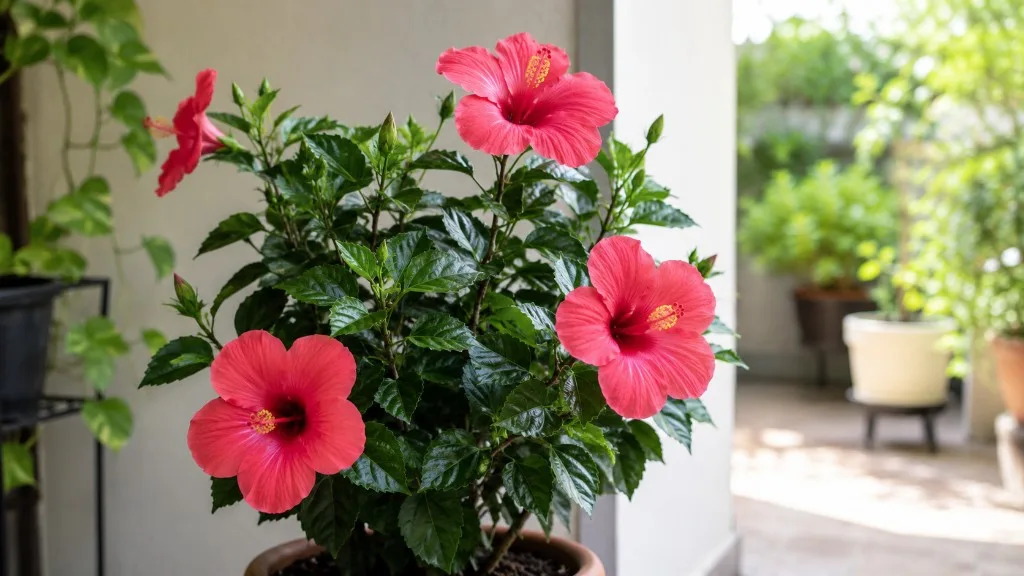
Walk into a garden center in July and every pot seems to shout hibiscus—yet the plants on the bench may have nothing in common beyond the genus name. One is a woody shrub that survives Zone 5 winters. Another is a herbaceous perennial that dies to the ground and returns with dinner-plate blooms. A third is a tropical patio plant that must move indoors before frost. The genus Hibiscus holds several hundred species and countless hybrids; this guide organizes 44 of the most garden-worthy types by the decisions that actually matter: your USDA zone, soil moisture, space, and tolerance for self-seeding.
If you already own a plant and need watering, light, or bud-drop help, start with our hibiscus care guide—this page is for choosing and identifying the right type before you commit.
How to Choose the Right Hibiscus Type for Your Yard
Most hibiscus failures start with the wrong plant for the site—not bad luck. Sort candidates with three filters before you fall for flower color on a tag.
Match Hardiness to Your USDA Zone
Check your zone on the USDA Plant Hardiness Zone Map, then match it to plant behavior:
- Zones 4–9, cold winters: Hardy hibiscus (Hibiscus moscheutos and hybrids) or rose of Sharon (H. syriacus)—both survive freezing soil, but they behave differently in winter (see below).
- Zones 9–12, frost-free or nearly so: Tropical hibiscus (H. rosa-sinensis) grows outdoors year-round; cooler Zone 9 pockets may still see occasional cold damage.
- Zones 7–11 with mild winters: Cotton rose (H. mutabilis), roselle (H. sabdariffa), and some specialty species work in-ground; verify your microclimate before planting marginally hardy types.
If the tag lists “protect from frost” or “patio plant,” assume tropical until proven otherwise.
Match Soil Moisture Before You Shop
Hibiscus is not one water recipe. Hardy rose-mallow and native wetland species want consistently moist to wet soil—ideal for rain gardens and pond edges. Rose of Sharon tolerates occasionally dry soil once established. Tropical hibiscus in containers needs even moisture without standing water; drought stress drops buds fast on hot patios.
Buy the plant that matches your wettest spot, not your dream border if drainage is poor.
Hardy Hibiscus vs Tropical vs Rose of Sharon
These three groups cover most of the 44 types below. Confusing them leads to wrong pruning, wrong overwintering, and dead plants.
| Trait | Hardy hibiscus (H. moscheutos group) | Tropical hibiscus (H. rosa-sinensis) | Rose of Sharon (H. syriacus) |
|---|---|---|---|
| Winter habit | Stems die to ground; crown survives | Evergreen in frost-free zones; tender elsewhere | Woody branches persist; leaves drop |
| Typical zones | 4–9 | 9–12 (container annual elsewhere) | 5–9 |
| Leaf texture | Large, often matte or heart-shaped | Glossy, deep green, oval | Smaller, toothed, lobed, deciduous |
| Flower size | 6–12 in. dinner-plate blooms | 4–8 in. trumpet flowers | 2–4 in. crepe-like, one-day blooms |
| Best use | Rain gardens, back-of-border drama | Patio pots, warm-climate hedges | Hedges, late-summer shrub color |
| Spread risk | Clumps widen slowly; some seed | Low in pots; limited seed outdoors | Self-seeds freely in many regions |
Proven Winners notes that all three share the genus name but have drastic cultural differences—treat “hibiscus care” articles as useless until you know which hat your plant wears.
How to Identify Hibiscus Types at the Nursery
Tags often say only “hibiscus.” Use this sequence before you checkout:
Read the botanical name. Hibiscus rosa-sinensis = tropical. H. moscheutos or “hardy hibiscus” = herbaceous perennial. H. syriacus = rose of Sharon shrub.
Inspect stems at soil level. Hardy types send up multiple soft canes from a crown each spring. Rose of Sharon shows permanent woody trunks and branches. Tropical plants in pots usually have a shrubby woody framework above the soil line year-round.
Feel the leaves. Tropical = glossy and houseplant-smooth. Hardy = larger, less shiny, sometimes burgundy on dark-leaf cultivars. Rose of Sharon = smaller, shrubby, lobed foliage.
Plan the winter test. If stems turn brown after frost and new shoots emerge from the base in spring, you have hardy hibiscus. If woody branches stay but leaves fall, rose of Sharon. If the plant must come indoors before freezing nights, tropical.
Flower color alone is unreliable—both hardy and tropical types bloom pink, red, white, and bicolor.
Hardy Rose-Mallow Species and Dinner-Plate Cultivars
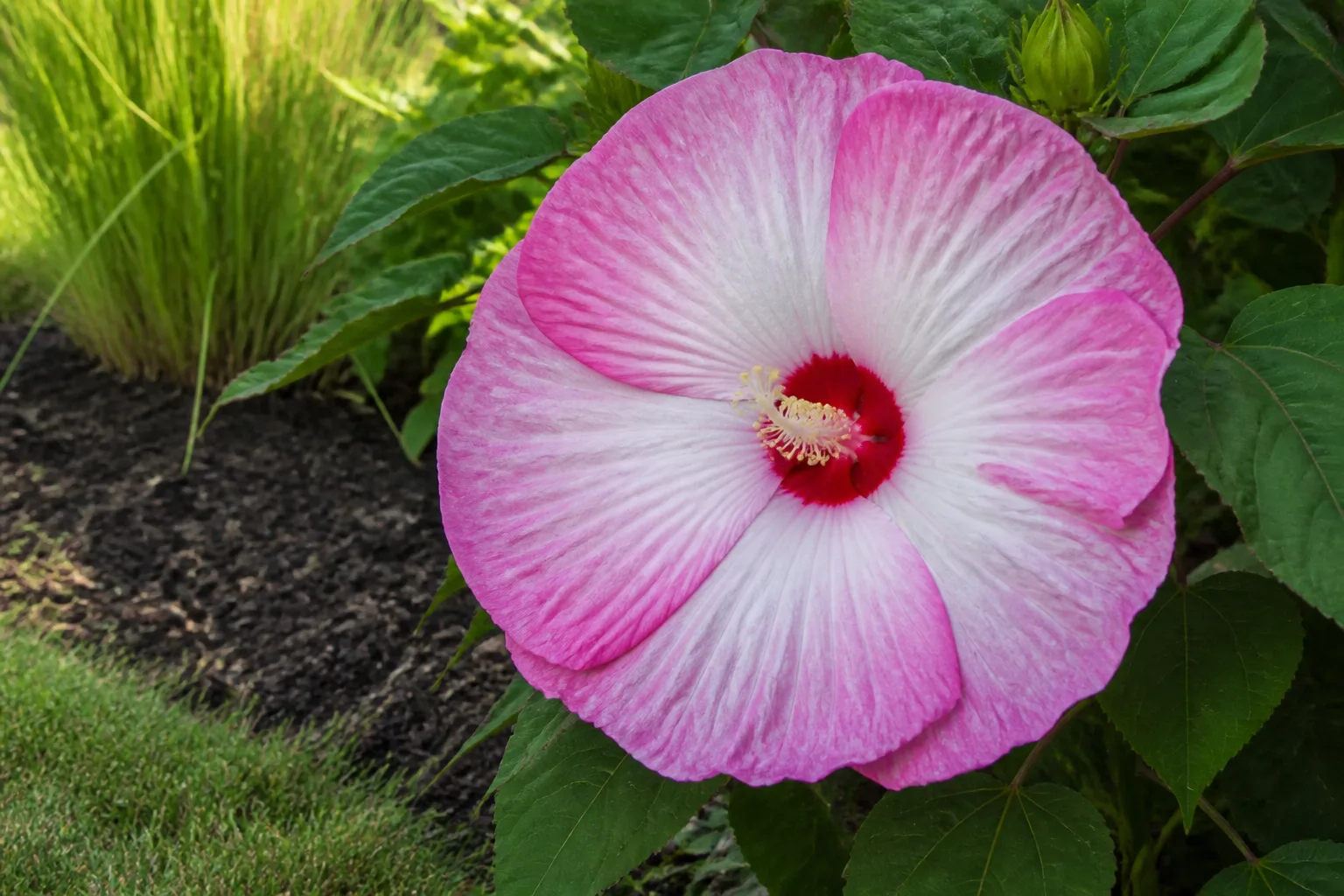
Hardy hibiscus (Hibiscus moscheutos), also called rose mallow, is native to wetlands and creek edges across the Southeast and is found throughout North Carolina, according to NC State Extension. Plants reach 2–6 feet tall with 6–8 inch flowers (cultivars up to 12 inches) in white, pink, red, or burgundy with contrasting eyes. Individual blooms last one day, but the season runs midsummer into fall.
Shared needs: full sun for best bloom and disease resistance; wet to constantly moist loam or silt; cut stems nearly to the ground in fall. NC State recommends leaving 12–24 inches of dead stem for stem-nesting native bees when possible.
Species and types in this group:
- Hardy hibiscus (H. moscheutos) — the classic dinner-plate perennial; backbone of the Summerific and Luna series.
- Swamp hibiscus / Texas star (H. coccineus) — vivid red star-shaped flowers; tolerates wet soils along ponds; Zones 6–9.
- Swamp rose-mallow (H. grandiflorus) — very large pink blooms; native to wet, marshy Southeast sites; Zones 5–9.
- Halberd-leaf rosemallow (H. laevis) — delicate pink or white cups; very high water needs; Midwest and East Coast native; Zones 4–9.
- Woolly rose-mallow (H. lasiocarpos) — white or pale pink with red centers; 5–9; tolerates heat if soil stays moist.
- Sleepy hibiscus (H. furcellatus) — deeply cupped pink-purple flowers; 5–9; needs consistent moisture in hot weather.
Standout hardy cultivars:
- ‘Midnight Marvel’ — deep red 9-inch blooms on dark purple-green foliage; compact 4–5 ft.; wet-soil tolerant.
- Summerific ‘Perfect Storm’ — bicolored blooms with near-black foliage; Proven Winners series bred for landscape performance.
- Luna series — semi-dwarf; pink, red, white, and swirl colors; good for containers in cold zones.
- ‘Lord Baltimore’ and ‘Lady Baltimore’ — classic red and pink with red eyes; long-standing landscape favorites.
Native Wetland Hibiscus for Rain Gardens
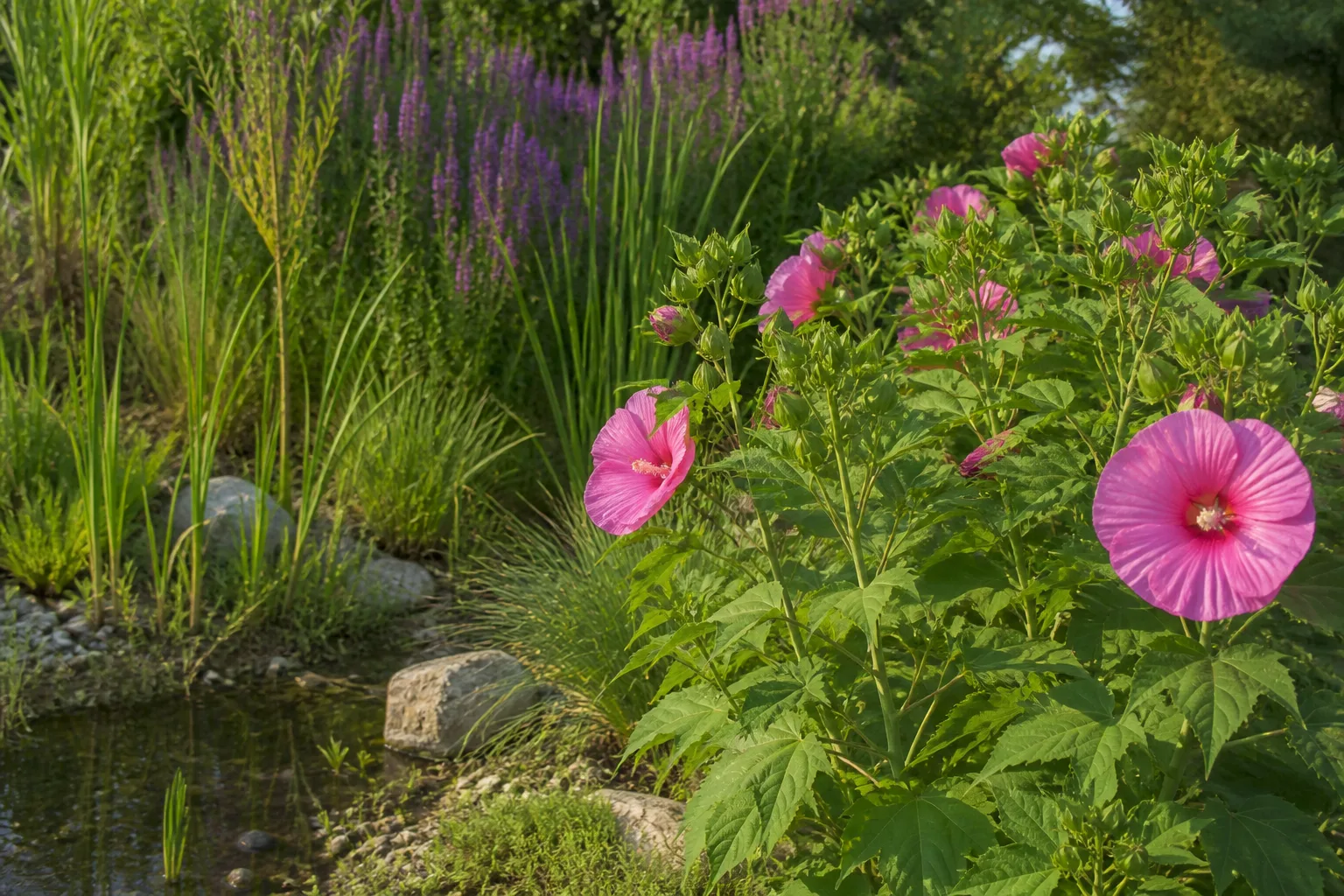
If your yard has a low spot, downspout basin, or pond margin, native hibiscus outperform dry-border shrubs. NC State lists rose mallow for rain gardens, stream banks, and pollinator plantings—attracting hummingbirds, butterflies, and the specialized bee Ptilothrix bombiformis.
Best native picks: H. moscheutos, H. coccineus, H. laevis, H. grandiflorus, and H. lasiocarpos. Pair them with saturated soil and full sun; do not force these into raised dry beds without irrigation.
Rock hibiscus (H. denudatus) is the outlier for dry gardens—a compact 1–3 ft. Southwest native with pink-purple flowers, rocky sandy soil, and drought tolerance (Zones 7a+). Water occasionally for heavier bloom; avoid overwatering.
Rose of Sharon Species Overview and Spread Risk
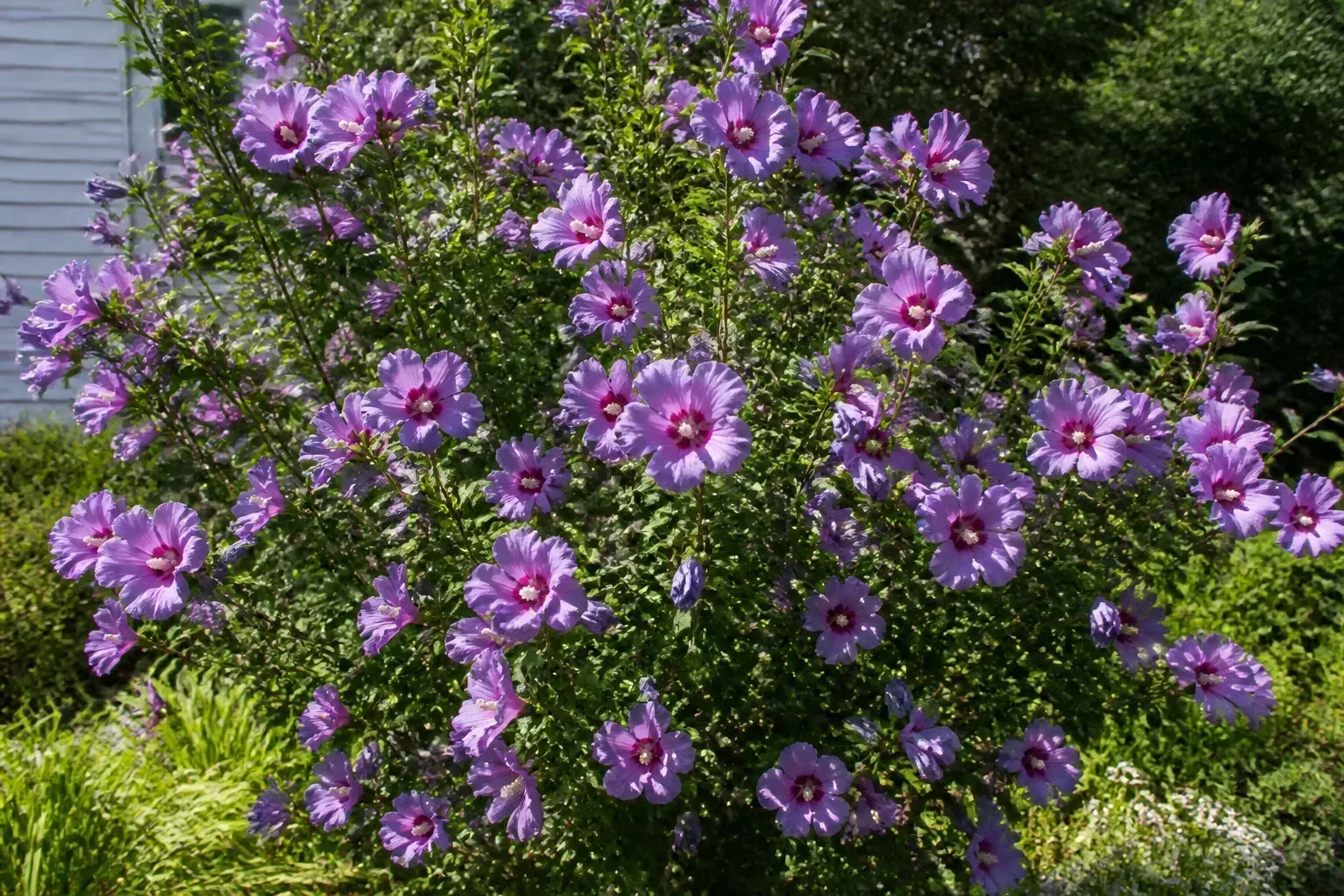
Rose of Sharon (Hibiscus syriacus), also called shrub althea, is a deciduous woody shrub reaching 6–12 feet with 2–4 inch crepe-paper flowers from midsummer through fall. NC State Extension lists hardiness Zones 5a–9b, full sun to partial shade, and good drainage to moist soil.
Each flower lasts one day, but buds open in succession for weeks. The shrub tolerates heat, poor soil, and urban conditions—which is both its strength and its problem.
Spread risk: NC State reports rose of Sharon invasive in some states, including Virginia and Kentucky. Open-pollinated seedlings volunteer in lawns and fence lines. If spread is a concern, choose sterile triploid cultivars (Chiffon, Satin, and Sugar Tip series) or deadhead spent flowers before seed capsules mature.
The ASPCA lists hibiscus including H. syriacus as non-toxic to dogs, cats, and horses—though any plant material can cause mild GI upset if chewed.
Best Rose of Sharon Cultivars by Flower Color and Form
Nursery lists name dozens of rose of Sharon cultivars; these are the most distinct and widely available, grouped by what gardeners actually shop for.
Blue and purple tones: ‘Blue Chiffon’ (semi-double powder blue), ‘Blue Satin’ (blue-violet with red throat), ‘Blueberry Smoothie’ (double violet-blue), ‘Lavender Chiffon’ (semi-double light purple), ‘Purple Satin’ and ‘Purple Pillar’ (purple doubles; Pillar is narrow columnar form).
Pink and bicolor: ‘Aphrodite’ (bright pink, red throat, sterile), ‘Sugar Tip’ and ‘Sugar Tip Gold’ (variegated foliage with pink or purple doubles; seedless), ‘Red Heart’ (white petals, red throat—strong hedge plant), ‘Orchid Satin’ (large single pink with red veining), ‘Minerva’ (pinkish-purple, drought-tolerant once established), ‘Lucy’ (double magenta, seedless hedge candidate).
White: ‘White Chiffon’ (pure white semi-double; heat and salt tolerant), ‘Lil Kim’ (dwarf white with red center, 3–4 ft.).
Compact and Columnar Rose of Sharon for Small Spaces
Not every yard can host a 12-foot vase-shaped shrub.
- ‘Lil Kim’ and ‘Lil Kim Red’ — 3–4 ft. dwarfs for borders and pots.
- ‘Sugar Tip’ / ‘Sugar Tip Gold’ — 4–5 ft. with variegated leaves for three-season interest.
- ‘Purple Pillar’ — 10–16 ft. tall but only ~3 ft. wide; fits narrow side yards and entry columns.
Prune rose of Sharon in late winter or early spring to shape; it blooms on new wood.
Sterile Cultivars That Won’t Self-Seed
If you are in Kentucky, Virginia, Tennessee, Pennsylvania, or any area with volunteer seedlings, prioritize these low-seed or seedless options:
Chiffon series (Blue, White, Lavender), Satin series (Blue, Purple, Orchid), ‘Aphrodite’, ‘Lucy’, ‘Sugar Tip’, ‘Sugar Tip Gold’, and ‘Purple Pillar’.
Deadheading open-pollinated species-type rose of Sharon still helps where sterile cultivars are unavailable.
Tropical Hibiscus for Warm Climates and Containers
Tropical hibiscus (Hibiscus rosa-sinensis), also called Chinese hibiscus or shoe flower, is an evergreen shrub in frost-free climates (Zones 9–12) with 4–10 inch trumpet blooms in red, pink, orange, yellow, purple, and bicolor singles or doubles. In cooler regions it is a summer container star or houseplant brought indoors when nights approach 50°F.
Tropical types need full sun (some afternoon shade in hottest deserts), acidic well-drained soil, and consistent moisture—pot weight and top-inch dryness checks beat calendar watering. Double cultivars drop buds more easily under stress; singles forgive more margin.
Double hibiscus (H. rosa-sinensis cv.) — ruffled multi-petaled forms for hedges, mass plantings, and large containers in warm zones; prune in late fall to shape.
For day-to-day care—bud drop, fertilizer, indoor move timing—see our hibiscus care guide.
Standout Tropical Hibiscus Cultivars and Hybrids
Collectors and patio growers chase these showpiece tropical types from specialty nurseries:
- ‘Black Dragon’ — 8-inch crimson blooms with deep purple centers; slow to start, then spreads; needs excellent drainage.
- ‘Fiesta del Sol’ — 8-inch petals open orange, fade yellow through the day; burgundy-pink-white center rings.
- ‘Midnight Tryst’ — multicolor pink-edged purple-gray stars with red center; colors shift by day two.
- ‘The Path’ — ombre yellow-orange-pink gradient; full sun and steady water.
- ‘Voodoo Queen’ — 7-inch blooms shift reddish-orange to yellow with lavender-gray centers through the day.
- ‘Christmas Angel’ — inverted color scheme: red petals, white center with white veining.
- ‘Variegated Pink’ — cream-edged gray-green leaves plus ruffled pink blooms; compact 2–3 ft.
- ‘White Hot’ — seasonal color flip: red with yellow speckles in cool weather, yellow with orange in summer heat.
- ‘Queen of Dreams’ — rare double shifting peach-pink-lavender; container favorite.
- ‘Kona’ — frilly double pink; blooms throughout the growing season.
- ‘Flameball’ — double orange streaked yellow; 5-inch summer flowers.
Edible and Specialty Hibiscus Types
Several hibiscus species earn garden space for flavor and foliage, not just flowers.
Roselle (Hibiscus sabdariffa) — Florida cranberry; deep red calyces make sorrel, agua de jamaica, and jams; pale pink flowers; Zones 9–10; full sun, well-drained soil.
Cranberry hibiscus (H. acetosella) — grown for deep red palmate leaves (edible, tangy); pink fall flowers; Zones 9a–11b; full sun deepens leaf color.
Cotton rose (H. mutabilis) — 6–15 ft. shrub or small tree; flowers shift white to pink to red in one day; fuzzy seed pods; Zones 7–11; deer resistant; prune dead wood in late winter.
Sea hibiscus / hamabo (H. tiliaceus) — yellow flowers aging to orange; 10–25 ft. tree in tropics; invasive potential in coastal southern Florida—check local guidance before planting.
Hawaiian white hibiscus (H. arnottianus) — rare fragrant white endemic; Zones 9–11; container or perennial in subtropics.
Unusual Flower Forms: Fringed, Double, and Color-Changing Types
Beyond standard trumpets, these types add architecture and drama:
Coral / fringed hibiscus (H. schizopetalus) — pendant red flowers with feathered, fringed petals and long stamens; Zones 10–12 or cool-climate container; rich moist soil.
Double tropical cultivars — ‘Queen of Dreams’, ‘Flameball’, ‘Kona’, and double H. rosa-sinensis selections; heavier flowers, narrower bud-drop margin.
Color-changing hybrids — ‘Voodoo Queen’, ‘White Hot’, ‘Fiesta del Sol’, ‘Midnight Tryst’, and H. mutabilis (cotton rose) shift hues within a day or across seasons; stable light and water keep transitions predictable.
Variegated foliage types — ‘Sugar Tip Gold’ (rose of Sharon), ‘Variegated Pink’ (tropical); provide shoulder-season interest when bloom pauses.
Container and Overwintering Strategies by Type
Tropical hibiscus in pots: Move indoors before frost when nights hit ~50°F; brightest window available; reduce water as growth slows; inspect for aphids and whiteflies before bringing inside. Treat as annual in Zones 7 and below if indoor space is limited.
Hardy hibiscus in pots: Use large containers and never let the root ball dry completely; sunken pots or winter mulch in Zone 5; expect late spring emergence—do not declare the crown dead in April.
Rose of Sharon in pots: Feasible for dwarf cultivars (‘Lil Kim’, ‘Sugar Tip’); needs large soil volume and winter protection in Zone 5; do not prune to the ground like hardy types.
Fringed and specialty tropics (H. schizopetalus, show hybrids): Plan on greenhouse, sunroom, or bright indoor overwintering anywhere frost occurs.
Common Mistakes When Choosing Hibiscus Varieties
Buying by flower photo alone. A tropical double and a hardy dinner-plate both look red in a catalog; winter behavior tells the truth.
Planting wetland natives in dry raised beds. H. moscheutos, H. laevis, and H. coccineus need moisture; rock hibiscus (H. denudatus) is the dry-garden exception.
Ignoring rose of Sharon seedlings. One “free” shrub becomes a lawn weed in favorable climates; choose sterile cultivars or deadhead.
Pruning rose of Sharon like hardy hibiscus. Cutting woody shrubs to the ground removes the framework; prune branches in late winter, not crowns.
Expecting tropical bloom indoors without light. Winter buds need bright direct sun; mediocre light yields yellow leaves and zero flowers.
Assuming all hibiscus are pet-toxic. ASPCA lists hibiscus as generally non-toxic, but discourage chewing any plant material.
Conclusion
The 44 hibiscus types worth growing fall into clear buckets: hardy dinner-plate perennials for moist sun in cold climates, rose of Sharon shrubs for late-summer hedges (with sterile cultivars where spread is a problem), and tropical Chinese hibiscus for frost-free yards and summer containers everywhere else. Match zone, moisture, and winter habit first; then choose cultivars for color, size, and seedlessness. Native wetland species reward rain-garden gardeners with pollinator value no tropical import can match. Once you have picked a type, carry the same plant through seasons with our hibiscus care guide—identity and culture stay paired, and your blooms stay on the plant instead of on the compost pile.



