Lawn Pro Irrigation Setup for Healthy Grass
See the in-ground zones, smart controllers, and cycle-and-soak schedule turf pros use at home to keep grass deep-rooted without overwatering.
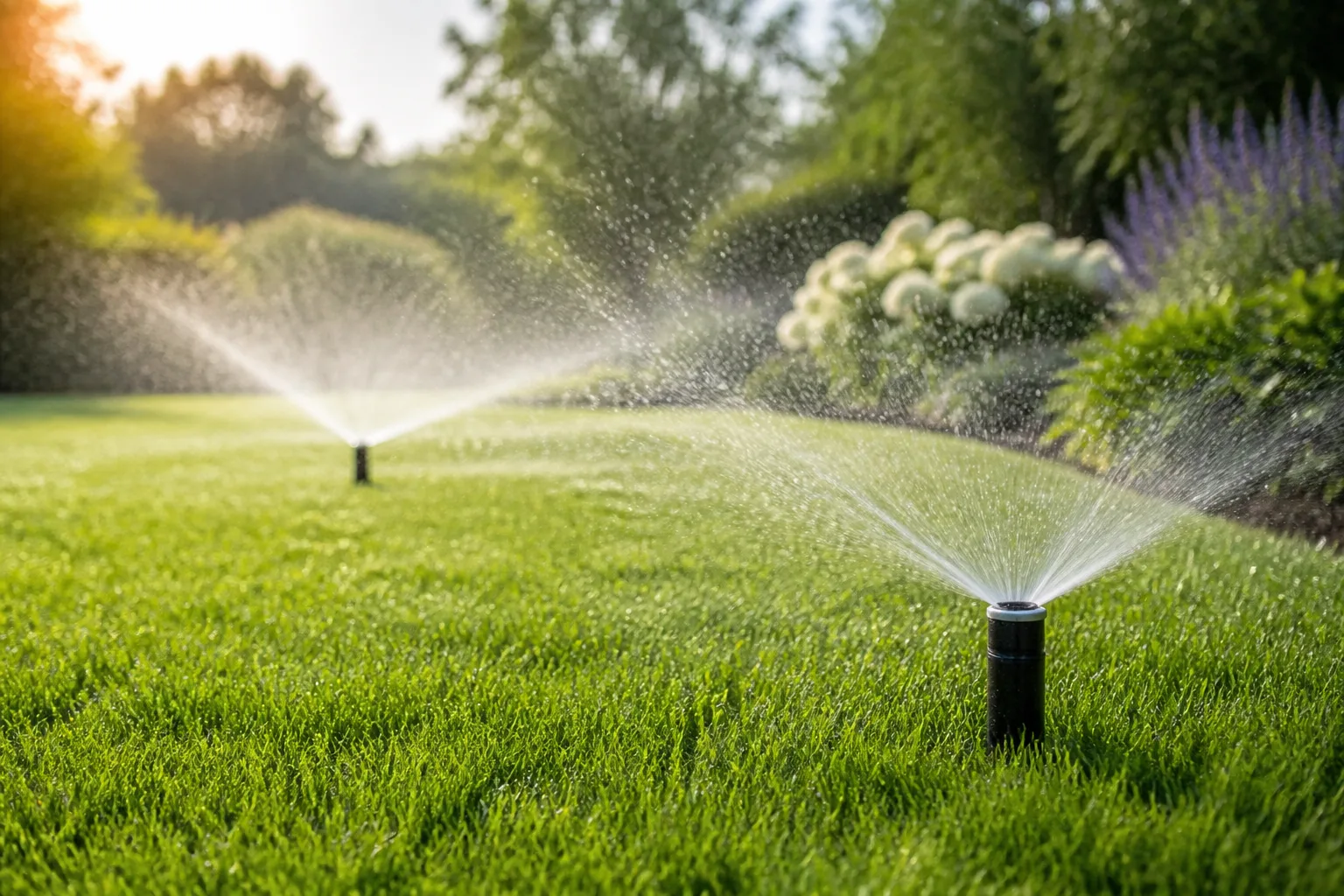
The irrigation setup most turf professionals run at home is not exotic. It is a zoned in-ground spray system with a programmable controller, heads spaced for even coverage, and a schedule built from soil depth and output measurements—not a generic “20 minutes every other day” sticker on the timer. The goal is deep, infrequent watering that keeps roots alive through heat while cutting runoff, disease pressure, and the bill.
If your grass still looks stressed after you water, the problem is rarely “more minutes.” It is usually wrong zones, weak overlap, or a runtime copied from a neighbor whose soil and sun exposure do not match yours. Start with the system layout, then calibrate output. Our guide on why your lawn is still brown after watering walks through diagnosis when color does not improve even after you fix the schedule.
What turf pros actually install at home
Most lawn specialists who maintain high-quality cool-season or warm-season turf at home choose permanent in-ground irrigation for the lawn itself. They split the yard into independent zones so sunny front turf, shaded side yards, slopes, and planting beds are not forced onto one runtime. Pop-up spray or rotary heads from major manufacturers such as Rain Bird and Hunter are common because parts are standardized, adjustable, and easy to service.
That does not mean every homeowner should trench a full system tomorrow. Pros also keep hose-end sprinklers and manual spot watering in the toolkit for new seed, isolated dry patches, and beds where drip is more appropriate than overhead spray.
In-ground spray systems with separate zones
An in-ground lawn system hides pipe and heads below grade. Each zone is one valve and one station on the controller; only the heads on that valve run at a time. Pros like this setup because it delivers consistent coverage at a set time, reduces the daily hose-dragging chore, and lets them tune runtimes zone by zone.
Install cost is real—materials, trenching, backflow prevention, and sometimes permit fees add up—but the payback is control. You can run 12 minutes on a sandy front lawn and 22 minutes on a clay backyard without touching a hose. You can shut off the bed zone during lawn dormancy while keeping trees on a separate drip line. For anyone managing more than a few thousand square feet of turf, that convenience is why pros choose in-ground at home.
When hose-end sprinklers are the smarter choice
Small lawns, rental properties, and newly graded yards where final contours are not settled are often better served by a good oscillating or rotary hose-end sprinkler plus a simple timer at the spigot. You lose zone independence, but you also skip thousands in install cost and avoid burying pipe before you know where paths, beds, and downspouts will land.
Hose-end gear still needs calibration. Place catch cups or tuna cans under the spray, run the sprinkler until you know how many minutes produce half an inch, and only then set the timer. Move the sprinkler to eliminate dry corners rather than doubling runtime on the whole area. If you are happy with hose-end results on a 1,500-square-foot patch, upgrading to in-ground is a lifestyle choice—not a turf-health requirement.
Design zones around sun, soil, slope, and beds
Every landscape pro repeats the same line because it is true: watering needs follow the site, not the calendar. A zone should contain areas that share similar sun exposure, soil texture, slope, and plant type. Mixing full-sun bermudagrass on a slope with shaded fescue under maples on one station guarantees one area is always too wet or too dry.
How many stations most lawns need
A typical suburban lot might use three to six lawn zones plus separate stations for planting beds, containers, or drip loops. Count separate zones when:
- Sun exposure changes sharply (south-facing front vs north side under trees).
- Slope exceeds what your soil can absorb in one pass without runoff.
- Soil texture shifts (builder sand in front, native clay in back).
- Turf and beds differ—lawns need overhead spray; shrubs and perennials often do better on drip with their own schedule.
Keep tree and shrub roots in mind. Mature woody plants compete for the same water you apply to turf. Colorado State University Extension notes that root zones of trees and shrubs also need water, and mature landscapes with mixed plantings may require more total irrigation even when the grass looks fine. If beds under large trees always look dry while the open lawn floods, split them—not double the lawn runtime.
Head spacing and overlap without guesswork
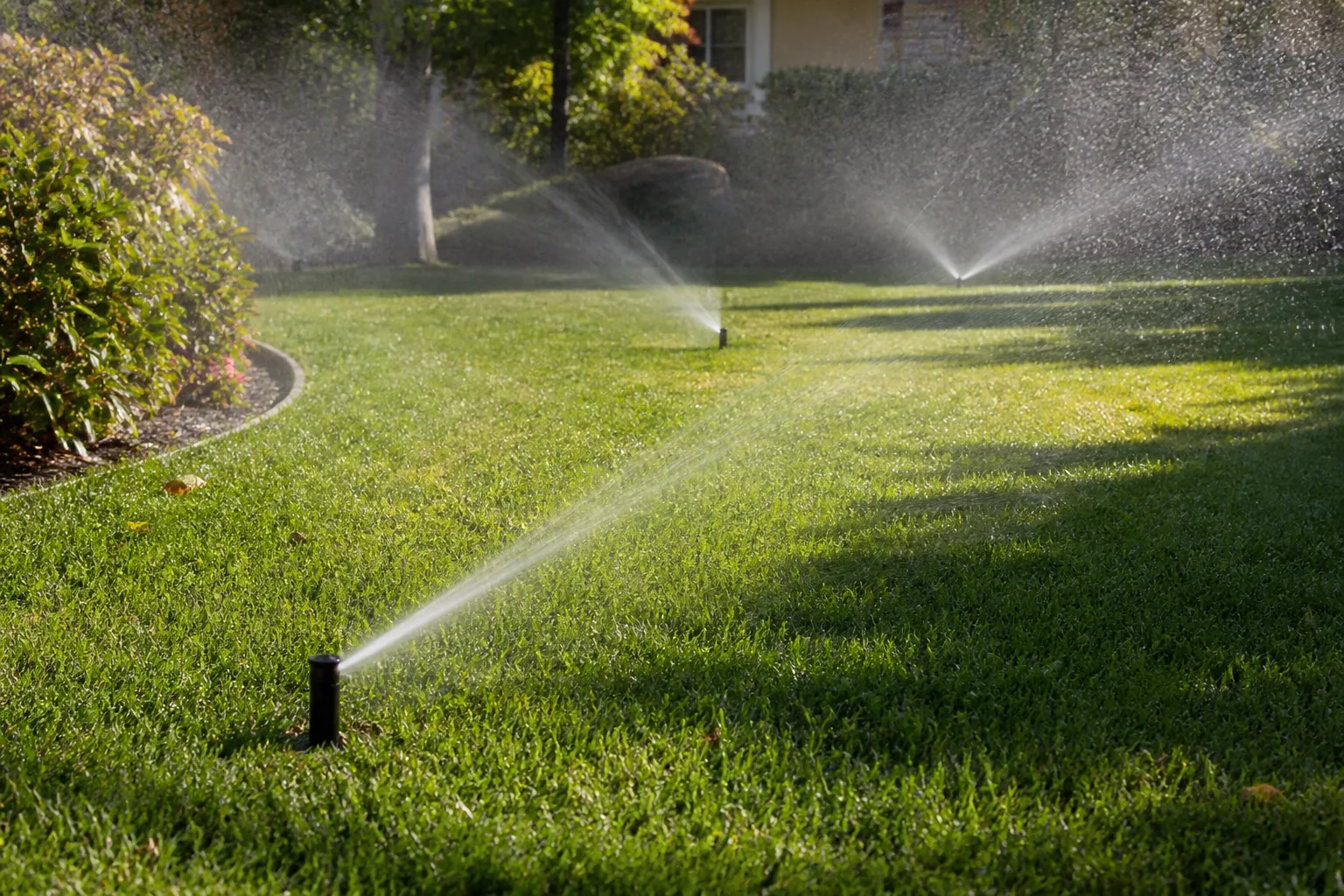
Dry stripes along head spacing lines are the most common “I water every day but still have brown grass” complaint. Spray heads should be laid out for head-to-head coverage: each head throws far enough to reach the next head, with overlap on all sides. Rotary nozzles use different spacing math than fixed sprays—follow the manufacturer chart for your pressure and nozzle, then verify in the field with catch cups, not just on paper.
Check pressure too. Too much pressure misting away; too little and the last head in the line starves. Pros install pressure-regulated heads or a regulator at the valve when supply pressure swings. If one corner is always dry, raise or replace the head, clean the filter screen, and confirm nothing is blocking the arc before you add minutes to the whole zone.
Pick a controller that matches how you manage water
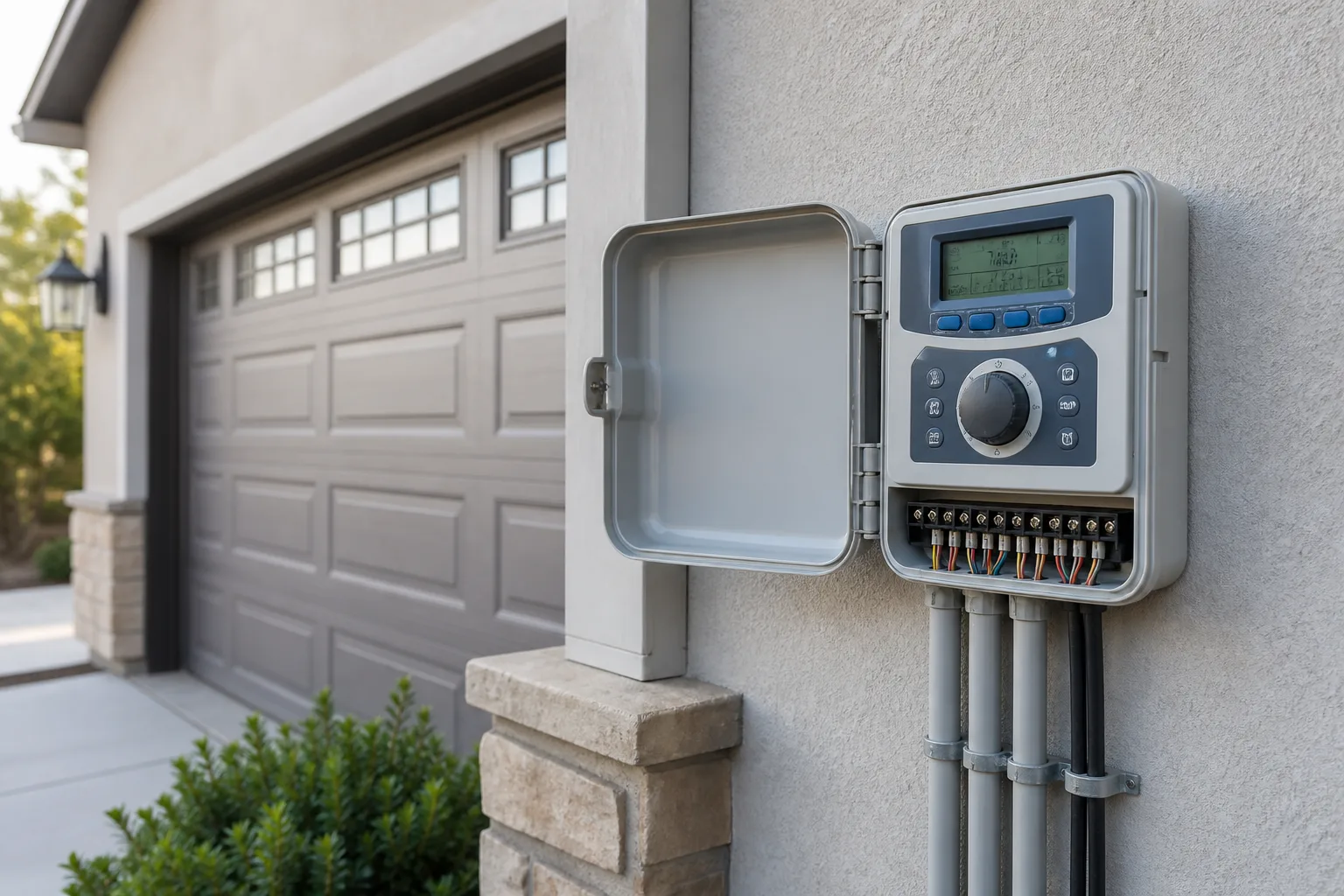
The controller is the brain. Pros at home usually run something programmable at minimum; many upgrade to weather-aware controllers that adjust for rain, temperature, and season. The right choice depends on how often you will audit the system physically—no controller replaces broken heads or clogged nozzles.
Weather-smart and soil-moisture controllers
Smart controllers (Wi‑Fi models from Rachio, Hunter Hydrawise, Rain Bird, and others) use local weather data, optional flow sensors, and sometimes soil moisture probes to skip or shorten cycles when the root zone is already wet. They shine when your schedule would otherwise run through a rainy week or when you travel and cannot manually shut off the timer.
They are not magic. You still enter plant type, soil, slope, sun, and head type during setup so the algorithm has sane starting runtimes. You still walk the lawn monthly during the first season to confirm no dry spots. Pair a smart controller with a rain shutoff sensor or onboard rain skip even if you do not buy the top model—running sprinklers during a downpour is pure waste and may violate local rules.
Basic timers that still work if you calibrate them
A standard multi-station timer is enough if you will recalibrate each season and manually suspend watering when it rains. Set multiple start times on the same zone to built-in cycle-and-soak (covered below) rather than one long block that runs off clay hills.
Write the active schedule on tape inside the controller door: date of last catch-cup test, minutes per zone, and number of cycles. Pros do this because memory fades and the next homeowner—or you, next July—will otherwise guess.
The watering schedule pros run on their own lawns
There is no universal “run zone 3 for 18 minutes on Tuesdays.” Healthy turf gets water when the root zone dries, in amounts that wet the full rooting depth without runoff. Gardening Know How puts it plainly: water when grass shows stress, confirm with a probe, and avoid daily light sprinkles that train shallow roots.
Water on grass stress, not a fixed calendar
Use the footprint test. On a cool morning, walk across the lawn. If footprints remain an hour later, the turf is under drought stress and it is time to irrigate. If grass springs back, wait—even during hot weather. Grass can look slightly dull before it truly needs water; daily watering to prevent that look is how bills climb and roots stay shallow.
When you do irrigate, apply enough water to moisten the active root zone. For many lawns that means roughly 0.5 inch on sandy soil and up to 1 inch on heavier loam or clay per application, enough to penetrate several inches deep. Colorado State University Extension gives useful benchmarks: bluegrass may need up to 2.25 inches per week under hot, dry, windy summer conditions in some climates, while buffalograss may stay green for weeks without irrigation. Your grass species, shade, and local ET matter more than a national average—calibrate locally.
Frequency follows soil texture. Sandy soils hold little plant-available water, so they need more frequent, smaller doses. Clay and loam accept less frequent, deeper applications. Never apply all the water in one blast if it runs off the surface; split into cycles instead.
Best time of day—and what local rules allow
Early morning is the standard pro window: lower wind, lower evaporation, and grass that dries before evening disease-favoring humidity. Many sources cite roughly 4 a.m. to 9 a.m., finishing before full sun if possible so large systems complete all zones before heat peaks.
Colorado State University Extension also lists late evening to midnight as efficient for some sites, and notes that night watering does not by itself cause disease—leaf wetness duration and turf health matter more. Before you program a 2 a.m. start, check local ordinances. Some utilities restrict overnight irrigation to prevent waste from broken heads nobody sees until morning.
Avoid midday watering when evaporation is highest. Avoid evening starts that leave turf wet all night on disease-prone cool-season grass in humid regions—if your only legal window is evening, keep runtimes short enough to finish and dry before dark when you can.
Use cycle-and-soak on clay, thatch, and slopes
Cycle-and-soak means splitting one long runtime into two or more short cycles on the same zone with 30–60 minutes between so water infiltrates instead of running down the storm drain. Pros use it on clay, compact soil, thatchy turf, and slopes—exactly the sites where a single 25-minute pass puddles at the bottom and leaves the top dry.
Example: instead of 20 minutes once, run 8 minutes, wait an hour, 8 minutes, wait an hour, 4 minutes. Total applied inches stay the same; infiltration improves. Watch for runoff during the first cycle; if water escapes before you finish, stop early, wait, then resume. On steep grades, use low-precipitation nozzles and run cycles along the contour, not by blindly adding time.
This is the fix behind the pro advice that your landscape “is not a storage tank.” Soils have a finite intake rate. Overfilling wastes water and does not help roots below the surface.
Calibrate every zone with a catch-cup test
Guessing runtime is how homeowners overwater the easy areas and underwater the corners. A catch-cup test (tuna cans, commercial catch cups, or straight-sided containers) turns minutes into inches applied.
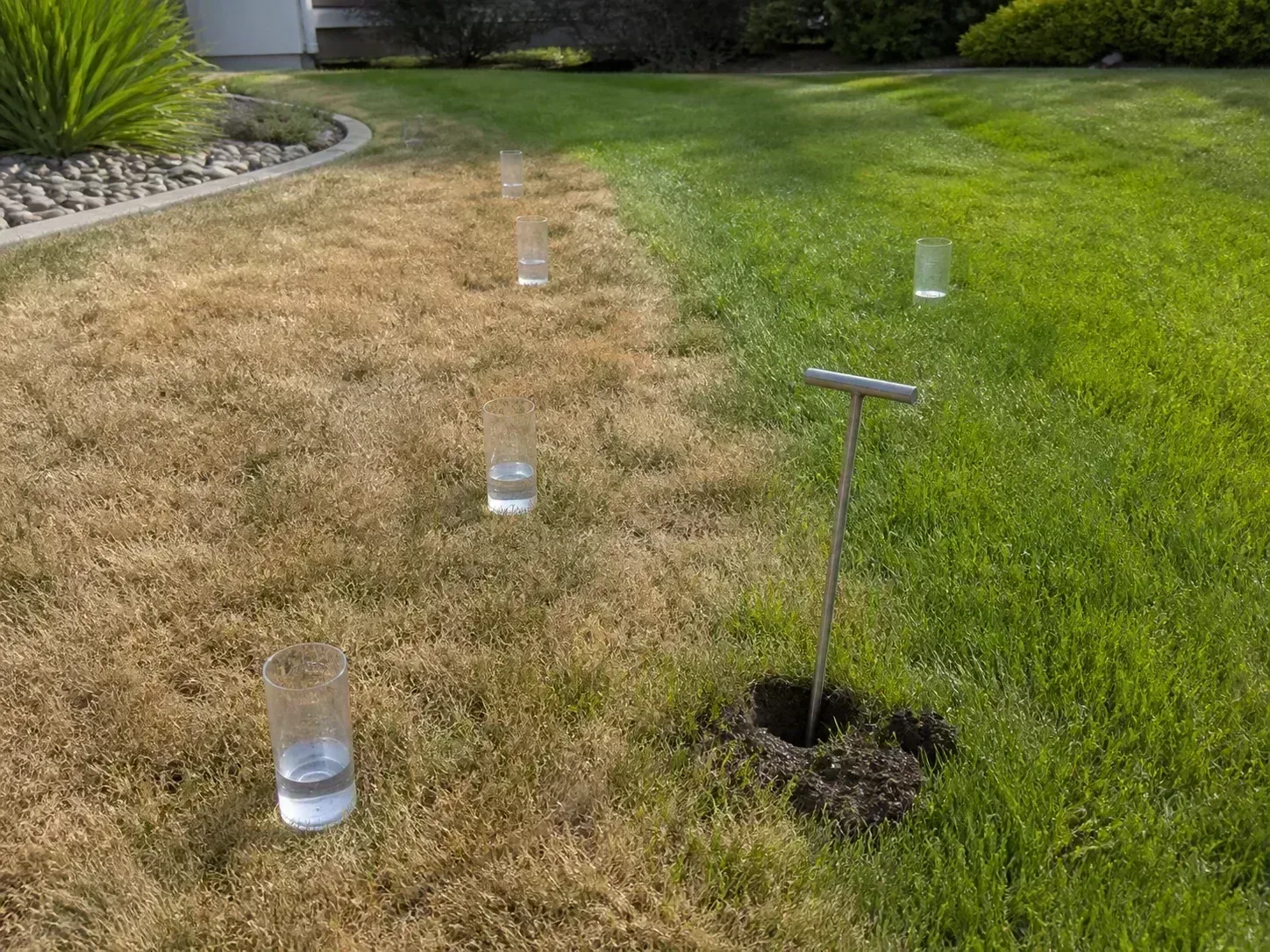
Place at least five cups per zone—one near each head and one between heads. Run that zone for 15–20 minutes (or your usual runtime). Measure depth in each cup with a ruler. Average the depths. That average tells you inches per cycle.
Adjust heads before you adjust minutes: fix tilt, arc, and clogged nozzles so cup readings are within 10–15% of each other. Then set runtime to hit your target depth. If you need 0.5 inch per cycle and the zone averages 0.25 inch in 15 minutes, you need about 30 minutes—or two 15-minute cycles with soak time between.
Repeat the test each season and after any head replacement. Pressure and wear change output more than people expect. Oklahoma City’s public irrigation guidance emphasizes tying schedules to actual output and weather, reducing watering when rain satisfies need—your catch-cup data is how you know what “reduce” means in minutes.
Annual maintenance that keeps coverage honest
Pros treat irrigation like mower maintenance: a short annual audit prevents expensive turf problems.
Walk the system monthly in peak season and once each spring before heavy use:
- Raise sunken heads so they pop up fully; trim grass away from spray arcs.
- Replace cracked nozzles and mismatched heads on the same zone.
- Flush valve boxes and clean filter screens after mainline debris events.
- Check for leaks—soggy spots, valve boxes that never dry, or spinning meter when everything is off.
- Test backflow devices per local code; many areas require annual certification.
- Winterize in freeze zones—blow out lines or drain manifolds before hard frost.
Mark head locations on a simple sketch. When you aerate or renovate, you will know where not to punch a hole through PVC. If brown patches persist in the same shape year after year, see our guide on how to get rid of brown patches on lawn—irrigation may be only part of a disease or compaction story.
Seven irrigation mistakes that waste water and weaken turf
Daily light watering keeps roots near the surface and makes heat stress worse. One runtime for every zone ignores sun and soil differences. Running during rain—whether from laziness or a failed rain sensor—throws money away; EPA WaterSense outdoor guidance centers on matching irrigation to plant need and local conditions, not fixed habits.
Mixing beds and lawn on one spray zone overheads shrubs while starving grass or vice versa. Ignoring runoff on clay and slopes washes fertilizer into the street and leaves upper banks dry. Never auditing head coverage lets dry stripes become “dead grass” when the fix is a $3 nozzle. Mowing too short while irrigating heavily invites drought stress and disease—keep mowing height up during heat; our August mowing guide explains seasonal deck height trade-offs.
After heavy rain, running the system on schedule compacts wet soil and invites fungal issues—pause until the root zone dries, as noted in what not to do to grass after heavy rain.
Troubleshoot dry stripes without drowning the whole yard
When one band stays tan while the rest greens up, do not add 10 minutes to every zone. Fix the local problem:
- Watch the zone run—are heads popping up? Is spray blocked by a shrub or parked car?
- Check overlap—add a head or switch to a nozzle with longer throw if spacing is wrong.
- Compare cup readings in the dry band vs green area; adjust arc or replace worn nozzles.
- Look for pressure loss at the end of the line; split the zone if too many heads share one valve.
- Spot-water new seed or repair areas by hand until they establish.
If the whole lawn wilts but soil is wet several inches down, you may have root disease, grub injury, or compaction—more water will not help and may hurt. Step back to diagnosis before you reprogram the controller.
Mulch in beds—not turf—reduces evaporation from planting areas so you are not tempted to steal lawn minutes for thirsty shrubs. See does mulch prevent weeds for bed mulch depth that actually suppresses weeds without smothering plants.
Conclusion
The irrigation system a lawn pro uses at home is less about brand names and more about structure: zoned in-ground spray (or a calibrated hose-end setup on small lots), a controller matched to how hands-on you will be, morning or ordinance-approved timing, and runtimes derived from catch-cup math plus cycle-and-soak where soil demands it. Water when the grass shows stress, wet the full root zone once per cycle group, and audit heads every season.
Do that and you keep grass deep-rooted and green with less daily work—no hose dragging, fewer dry stripes, and no guilt about the water bill every time the timer clicks on. Skip calibration and zone thinking, and even the most expensive controller becomes an automatic way to overwater the low spots while the hills still bake.



