When to Plant Cucumbers: Frost Dates and Soil Temperature
Learn exactly when to direct-sow or transplant cucumbers, the soil temperatures they need, how to plant earlier safely, and when to sow a second crop.
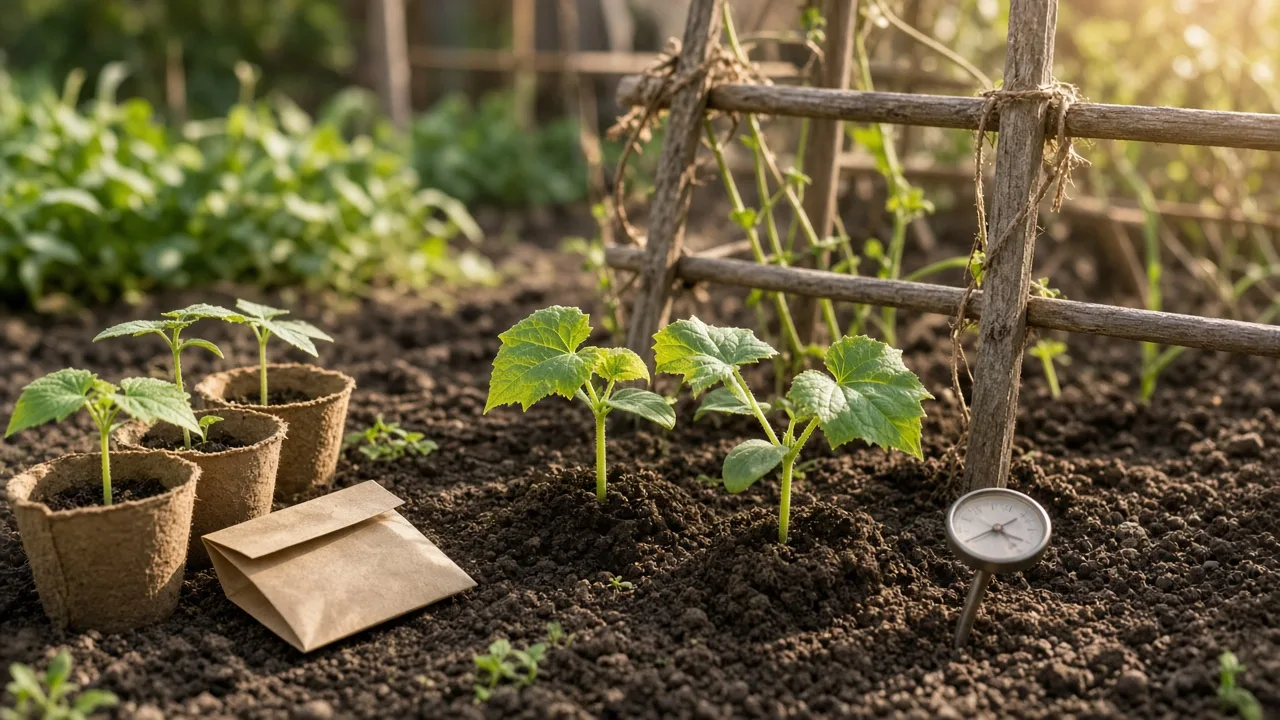
Cucumbers are often planted too early because the air feels like spring while the soil is still cold. They are tropical-origin warm-season vines, and cold soil slows germination, increases the time seeds sit vulnerable to decay, and makes transplants stall. A cucumber planted two weeks later into genuinely warm soil can easily overtake one planted prematurely.
The best planting rule is therefore based on soil temperature plus frost risk, not a fixed date. Utah State University Extension recommends planting when soil is about 65°F or warmer and frost danger has passed. University of Minnesota uses an even more conservative direct-sowing threshold of 70°F at one inch deep. In a cool spring, waiting for that temperature is often more important than following the date printed in a generic planting chart.
This guide explains when to direct-sow, when indoor starts are worthwhile, how to use black plastic and row covers for an earlier crop, how to harden transplants, and how to decide whether there is time for a second planting.
Use your last frost date as the first filter
Cucumbers cannot tolerate frost. Begin by finding the average last spring frost for your location from a reliable local weather or extension source. “Average” does not mean guaranteed; late frosts occur, so watch the forecast as planting time approaches.
Do not transplant cucumber seedlings merely because the calendar has reached the average date. If a 35°F night is forecast, the plant will still be badly stressed even without an actual freeze.
The frost date tells you when cold risk begins to decline. Soil temperature tells you when the root zone is truly ready.
Measure soil temperature instead of guessing
A simple soil thermometer removes much uncertainty. Insert it to the depth where seeds will sit—roughly one inch for many cucumber plantings—and measure at the same time for several mornings.
One warm afternoon after a sunny day is not enough. Look for a stable warming trend. Cold rain can lower soil temperature again.
If the bed remains below 60°F, wait. Between about 65°F and 70°F, germination becomes much more dependable. Warm soil is one of the cheapest forms of disease prevention because seedlings emerge quickly rather than lingering in cold wet media.
Direct sowing is usually the simplest method
University of Minnesota calls direct seeding the best way to start cucumbers in home gardens. Seeds are large, germinate quickly in warm soil, and dislike root disturbance.
Prepare a fertile, well-drained bed in full sun. Sow according to the packet and your support system. Minnesota recommends about a half-inch depth in its conditions; Utah State recommends about one inch. Heavy cool soils generally favor shallower sowing than light fast-draining soils.
Keep the seed zone evenly moist but not saturated until emergence. Once seedlings have true leaves, thin rather than allowing a cluster to compete all season.
Why early cucumber sowing often fails
Cold cucumber seeds may rot before they germinate. Seedlings that do emerge can sit nearly motionless because roots are unable to function efficiently in cold soil.
Cold wet conditions also favor damping-off organisms. The result can look mysterious: seed disappears, stems collapse at the soil line, or plants remain pale and undersized.
Gardeners sometimes respond with more water and fertilizer, which makes the root zone colder and wetter. The better solution is often simply to replant when conditions warm.
Starting indoors can move harvest forward slightly
Transplants can mature around a couple of weeks earlier than direct-seeded plants when handled well. The advantage is useful in a short growing season, but cucumber seedlings should not be started months in advance.
Sow indoors about three to four weeks before you expect to transplant. Use individual pots or cells so roots remain intact. Peat or paper pots can reduce disturbance, but they must be handled correctly so no dry pot rim wicks moisture away from the root ball after planting.
Provide strong grow lights. A sunny windowsill often produces stretched seedlings that are less prepared for outdoor wind and sun.
Do not let transplants become oversized
Utah State recommends young transplants with two or three mature leaves and a developed root system. Overgrown cucumber seedlings tangle roots, begin flowering in tiny pots, and experience greater transplant shock.
If spring remains cold beyond your planned date, it is sometimes better to discard an old root-bound transplant and start fresh seed outside than to force the oversized plant into cold ground.
Do not disturb the root ball unnecessarily. Cucurbit roots are more sensitive to rough handling than tomatoes or brassicas.
Harden seedlings off before planting
Indoor seedlings are adapted to still air, moderate temperatures, and filtered artificial light. Move them outdoors gradually over about a week.
Start with a sheltered spot for a few hours, then increase exposure to direct morning sun and wind. Bring plants inside if nights become too cold. Utah State cautions against over-hardening cucurbit transplants with temperatures below about 55°F because growth can be delayed.
Water normally during hardening. Wilted seedlings do not become “tougher”; they become stressed.
Plant in full sun and warm soil
Cucumbers need abundant light for flowering and fruiting. Choose a site receiving at least six hours of direct sun, preferably more in moderate climates.
Warm soil before transplanting if the bed runs cold. Black plastic laid over prepared soil captures solar heat and can advance planting. Cut small holes for seeds or transplants rather than exposing the whole bed.
Dark landscape fabric can also warm the surface, but product behavior varies. Remove or replace synthetic materials at the end of their useful life rather than allowing fragments to enter soil.
Row covers can protect an early crop
Lightweight spun fabric over hoops traps some warmth and blocks cucumber beetles while plants are young. Secure every edge so cold wind and insects do not enter underneath.
Row covers are not magical frost protection. Read the product’s stated frost protection and add additional layers only when appropriate.
Most importantly, remove or open the cover when ordinary cucumber varieties begin producing female flowers so bees can pollinate them. Parthenocarpic greenhouse-type cultivars are an exception because they can set fruit without pollination.
Raised beds warm faster but dry faster
A raised bed drains and warms earlier than flat heavy ground, which can help cucumber planting in a cold climate. The tradeoff is faster moisture loss in summer.
Fill the bed with a stable mineral-and-organic soil mix rather than pure compost. Excessive organic material settles and can hold water unpredictably.
Once vines begin covering the bed, inspect soil moisture below the surface rather than assuming the foliage shades it enough.
Wait to apply cooling organic mulch
Straw, shredded leaves, and other pale organic mulches help conserve moisture, but they also insulate the soil from spring sun. Utah State advises waiting until soil has warmed substantially before applying organic mulch to cucumbers.
In a cold spring, mulch immediately after sowing can delay warming. In summer, that same mulch becomes valuable for reducing evaporation and soil splash.
Black plastic works differently because it absorbs heat. Choose the material based on the season’s goal.
Spacing depends on whether vines climb
Traditional cucumber vines can occupy several feet of ground. Trellising lets you use vertical space, keeps fruit cleaner, and improves access for harvesting.
For a trellis, place plants close enough for efficient use but far enough apart for airflow; packet recommendations vary by cultivar. Bush cucumbers are bred for compact growth and can fit containers and smaller beds.
Crowding does not create more fruit per square foot indefinitely. Dense leaves stay wet longer and can increase disease pressure.
Planting cucumbers in containers
Choose a container large enough for the cultivar, with drainage holes and a quality potting mix. Bush varieties are easiest, but a vining cucumber can grow in a large container with a sturdy trellis.
Containers warm early, which sounds ideal, but their roots also experience greater temperature swings. A black pot in full midsummer sun can become dangerously hot.
Plant outdoors only when night temperatures are reliably mild. A movable container can be brought into a garage during an unexpected cold snap, but repeated moves become impractical once a vine covers a trellis.
Warm-climate gardeners may have two seasons
In climates with very hot midsummers, cucumbers may perform best in spring and again in late summer or early fall. Extreme heat can reduce pollination and fruit quality even though the plant is technically warm-season.
Work backward from periods of frost and extreme heat. A fast-maturing cultivar can fit into a shoulder season better than a long-vining variety that needs two months before harvest.
Local extension planting calendars are especially valuable in warm climates because “spring” may begin while northern gardens are still frozen.
How to plan a second sowing
Find the cultivar’s days to maturity and count backward from the expected first autumn frost. Add at least one or two weeks of cushion because shortening days and cooler late-season temperatures slow growth.
For example, if a cultivar lists 55 days and you have 80 reliably warm days left, a second sowing is reasonable. If only 50 days remain, choose another crop unless season extension is realistic.
Succession planting can also be used earlier: sow a second group two or three weeks after the first so harvest peaks are staggered rather than simultaneous.
Planting for pickling versus slicing
Pickling cucumbers are often harvested small and can be planted in blocks where many fruits mature together for preserving. Slicing cucumbers may be planted for a longer steady harvest.
Choose disease-resistant cultivars suited to your region rather than assuming all cucumbers perform alike. Powdery mildew, downy mildew, bacterial wilt, and cucumber beetles are recurring regional concerns.
The correct planting date cannot overcome a cultivar poorly matched to local disease pressure.
Do not transplant into soggy soil
Warmth alone is not enough. Cucumbers need well-drained soil. A bed that remains saturated after rain excludes oxygen from roots and increases disease risk.
If the site has drainage problems, use raised beds or correct grading before planting. Do not dig a deep hole and fill it with fluffy compost inside heavy clay; that can create a water-holding basin around the root ball.
Wait until soil is workable rather than compacting a wet bed with footsteps and tools.
Protect seedlings from cucumber beetles
Young cucumber plants can be heavily damaged by striped and spotted cucumber beetles, which may also transmit bacterial wilt. Row cover is one of the most useful early barriers.
Inspect seedlings several times per week. Remove covers at flowering for pollination unless the cultivar does not require bees.
Clean up crop debris after harvest and rotate cucurbits when practical. Cucumber, squash, pumpkin, melon, and watermelon share many pests and diseases, so rotating only cucumber with squash is not a true rotation.
Water consistently after planting
Newly germinated seeds need the top layer of soil to remain moist. As roots deepen, switch to less frequent, deeper watering that wets the root zone.
Cucumbers are mostly water and become bitter, misshapen, or low-yielding under severe moisture stress. At the same time, saturated roots decline.
Drip irrigation or a soaker hose keeps foliage drier than overhead watering. If you water overhead, morning is preferable so leaves dry during the day.
A planting checklist
Before putting cucumber seed or a transplant outdoors, confirm:
- The average last frost date has passed or you have reliable protection.
- Soil is at least 65°F and preferably near 70°F for direct sowing.
- The forecast does not contain a string of cold nights.
- The bed receives strong sun and drains well.
- Trellis or spacing is planned before vines run.
- A row cover is available if beetle pressure is high.
- Transplants are young, hardened, and not root-bound.
- Irrigation is ready before hot weather arrives.
If several of these are missing, another week of waiting is often cheaper than replanting.
Conclusion
Plant cucumbers after frost danger has passed and the soil has genuinely warmed. About 65°F is a practical minimum; around 70°F is an excellent target for direct sowing in cool climates. Direct seeding is usually simplest, while three- to four-week-old transplants can gain a little time in short seasons if their roots are handled carefully.
Use black plastic and row covers when an earlier crop is worth the effort, but do not confuse protection with immunity to cold. Remove pollination barriers at flowering, water consistently, and plan second sowings by counting backward from autumn frost. Cucumbers grow so quickly in warm soil that patience in spring often produces an earlier effective harvest than struggling against cold.