Will Soapy Water Hurt Plants? The Safe Answer
Will soapy water hurt plants? Learn why dish detergent can burn leaves, when insecticidal soap is appropriate, and what to do after a bad spray.
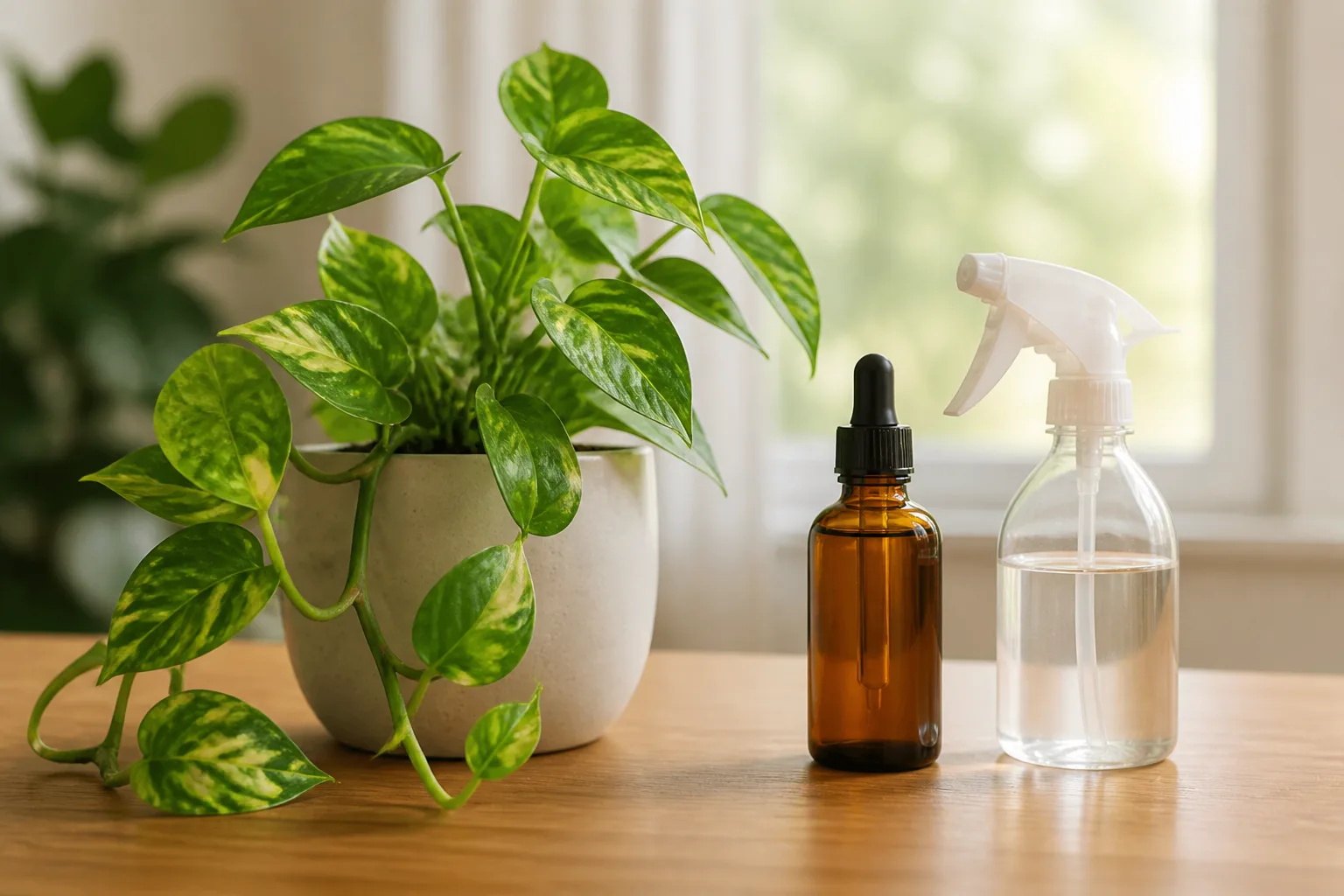
If you are asking whether soapy water will hurt your plant, the honest answer is sometimes—and household dish soap is the part to distrust. A diluted detergent may kill a few aphids while also stripping the leaf’s protective surface, leaving brown spots, scorched edges, or a stressed plant behind.
The safer distinction is not “natural soap versus chemical soap.” It is unlabeled cleaning product versus a pesticide formulated and labeled for use on plants. A true insecticidal soap is usually made from potassium salts of fatty acids and is designed to contact certain pests; dishwashing liquid is a variable degreaser made for dishes, not foliage.
The short answer: yes, sometimes
Soapy water can hurt plants when the product is too strong, the leaves stay wet in hot sun, the plant is already drought-stressed, or the formula contains detergents and additives that damage the leaf cuticle. The risk is not theoretical: extension guidance lists yellow or brown spotting, burned tips, and leaf scorch as possible phytotoxicity symptoms after soap applications.
That does not mean every soap spray is automatically dangerous. Labeled insecticidal soap can be useful for a narrow pest problem when it is applied to a healthy, permitted plant under suitable conditions. The label, the plant’s condition, the pest’s location, and the weather all matter more than a generic recipe.
“Safer” also does not mean “risk-free.” A product can be relatively low-risk to people or quick to break down while still scorching a particular cultivar, killing an exposed beneficial insect, or harming fish if it reaches water. The useful question is whether the expected benefit of treating this pest, on this plant, today is greater than the risk of leaving the infestation alone or using a lower-risk control.
Soap versus insecticidal soap: the label matters
The word “soap” hides several different products. Treating them as interchangeable is the reason a quick homemade spray can produce such different results from one garden to the next.
Why household detergent can damage leaves
Dishwashing liquid is generally a detergent engineered to dissolve grease and oils. That cleaning action is useful in a sink, but a leaf also relies on a thin waxy cuticle to slow water loss and help block pathogens. Removing or disrupting that surface can turn a pest treatment into a leaf-injury problem.
Formulas vary widely. Fragrance, dyes, antibacterial ingredients, degreasers, solvents, rinse aids, and “ultra” concentrations make a teaspoon from one bottle unlike a teaspoon from another. Gardening Know How explains the detergent-versus-insecticidal-soap distinction, while Garden Myths offers a practical warning about dish detergents stripping protective oils and waxes. Neither a familiar brand name nor the fact that a product is safe for dishes makes it tested for leaves.
Why formulated insecticidal soap works differently
Commercial insecticidal soaps are pesticides based on potassium salts of fatty acids. They act by direct contact: the spray disrupts the pest’s cell membranes and protective surface, causing the exposed soft-bodied insect or mite to die. UConn Extension’s fact sheet explains why the spray has no residual effect after it dries, and UC Integrated Pest Management identifies these products as a lower-toxicity option for soft-bodied insects.
The same contact action that harms a small pest can injure a sensitive plant if the product, concentration, timing, or coverage is wrong. “Insecticidal” is not a guarantee that every species tolerates every formulation; it means the product has a defined use that you still need to follow.
Identify the pest before reaching for a spray
Soap is a tool for a specific job, not a general leaf cleaner or a cure for every problem that looks like “bugs.” Spraying without identifying the pest adds plant stress and may kill helpful insects without solving the cause.
Read the plant, not just the bottle
Look at the undersides of leaves, new growth, stems, and the surface beneath the pot or branch. Aphids often cluster around tender tips and may leave sticky honeydew; whiteflies flutter when foliage is disturbed; mealybugs look cottony; spider mites are associated with fine stippling or webbing; and scale may look like fixed bumps, especially on stems.
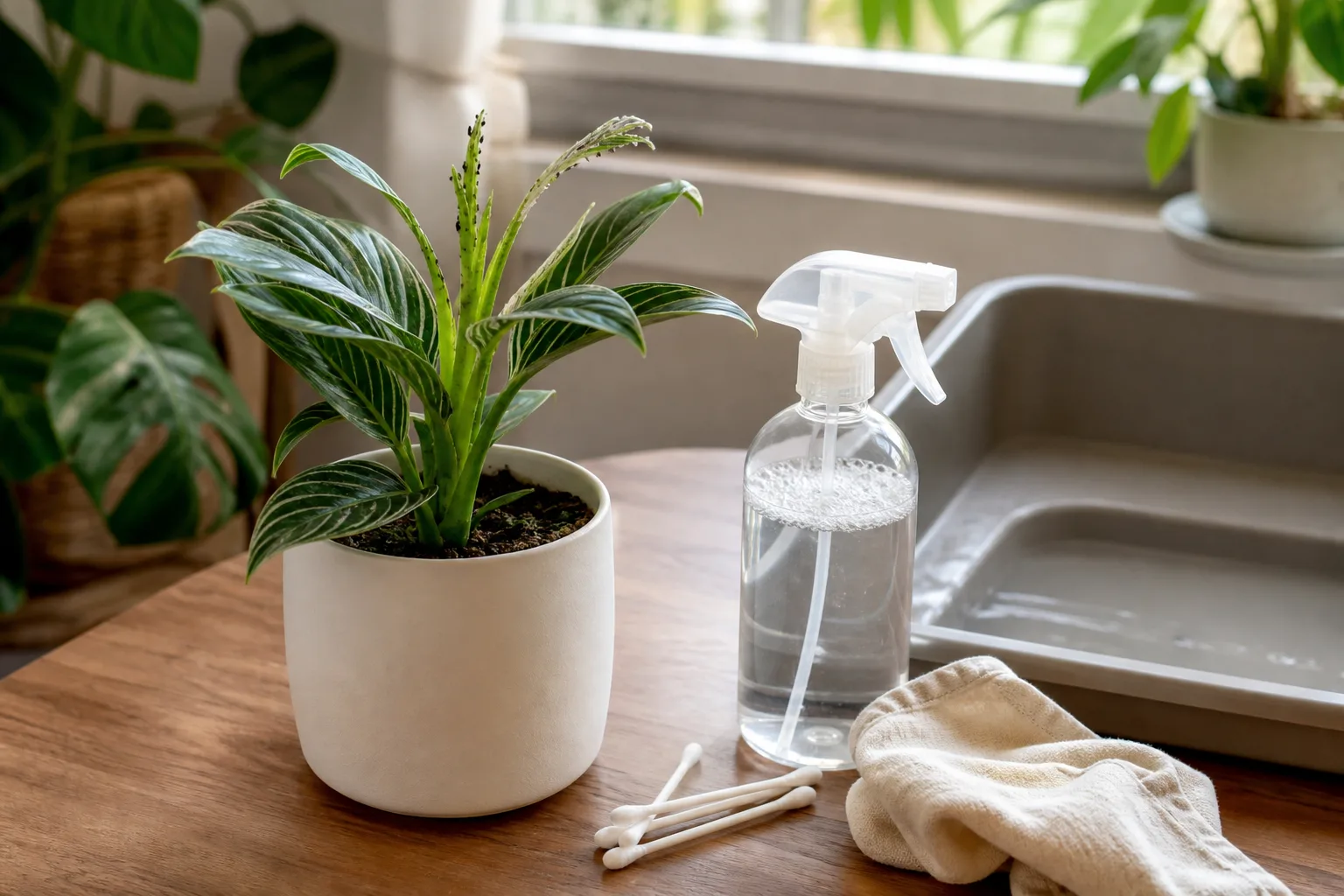
Inspect leaf undersides and new growth before choosing a treatment; a spray only works when it reaches the pest.
Also check whether the damage is actually an insect problem. Sun scorch, overwatering, nutrient issues, cold injury, and fungal leaf spots can all produce yellow or brown tissue. A soap spray will not fix any of them, and a second stress can make the diagnosis harder.
Use the pattern of damage as a quick filter before you mix anything. Fine pale stippling plus delicate webbing points more toward spider mites; sticky honeydew, ants, or clusters of tiny insects on new growth points toward sap-feeders; neat holes or ragged edges suggest a chewing pest that contact soap may not reach. If you cannot find a pest after checking both leaf surfaces and the growing tips, pause and diagnose the plant’s light, water, temperature, and root conditions instead.
Start with water and isolation when they fit
For a light aphid or whitefly infestation on a sturdy plant, a firm but gentle stream of plain water can dislodge pests without exposing the leaf to detergent. Wipe broad leaves with a damp cloth when appropriate, remove badly infested leaves, and isolate a houseplant so the pest does not spread while you inspect nearby plants.
This lower-risk step may need repeating because water knocks pests off rather than leaving a residual treatment. Gardening Guides recommends water and beneficial predators for mild aphid problems before escalating to a labeled insecticidal soap. If the population is growing, the pest is hidden on leaf undersides, or the plant is valuable and sensitive, move to a product whose label actually covers that plant and pest.
When labeled insecticidal soap is a reasonable choice
Use insecticidal soap when the problem fits its mode of action and the product label permits the plant, pest, setting, and crop. It is most useful as one part of integrated pest management, not as an automatic weekly wash for every plant in the collection.
The soft-bodied pests it can contact
The usual targets include aphids, whiteflies, mealybugs, thrips, spider mites, and scale crawlers. Some labels also cover adelgids, lace bugs, leafhoppers, psyllids, plant bugs, or certain sawfly larvae. The exact list varies, so use the product label rather than assuming a soap sold for houseplants is approved for a vegetable garden.
Coverage is the key. The spray must wet the pest itself, including pests tucked under leaves or in leaf axils. NC State Cooperative Extension describes the contact action and lists small soft-bodied insects such as aphids, mealybugs, thrips, scale crawlers, and spider mites as susceptible targets.
That contact requirement changes how you spray. A quick pass over the top of a plant may leave most of the population untouched, particularly when the insects feed below leaves or inside a dense canopy. Turn leaves gently, open crowded stems, and use enough spray to wet the pest without creating a stream that runs into the pot or bed.
The pests and life stages it will miss
Insecticidal soap is usually weak against eggs, hard-bodied adults, and pests the spray never touches. It does not keep killing after it dries, so a pest that walks onto a treated leaf later may be unaffected. That is why a single application can look like a failure even when the product worked on the insects it reached.
Lace bug eggs protected in leaf tissue, beetles with hard wing covers, caterpillars feeding inside foliage, and pests hidden in webbing or tight crevices need a different approach or a carefully timed follow-up. Scout again after the label’s interval instead of increasing the concentration because the first pass did not reach every life stage.
Think of the first spray as a population-reduction step rather than a sterilizing treatment. Remove badly infested leaves when the plant can spare them, wash off honeydew after the pests are controlled, and look for natural enemies before repeating. A second or third application may be appropriate for a fast-moving infestation, but more frequent spraying also increases exposure to the plant and to beneficial insects.
How to apply it without burning the plant
The goal is enough contact to wet the target pest without turning the entire plant into a detergent-soaked surface. Follow the label on the exact bottle for dilution, permitted plants, protective equipment, reapplication interval, harvest timing, and any rinse direction.
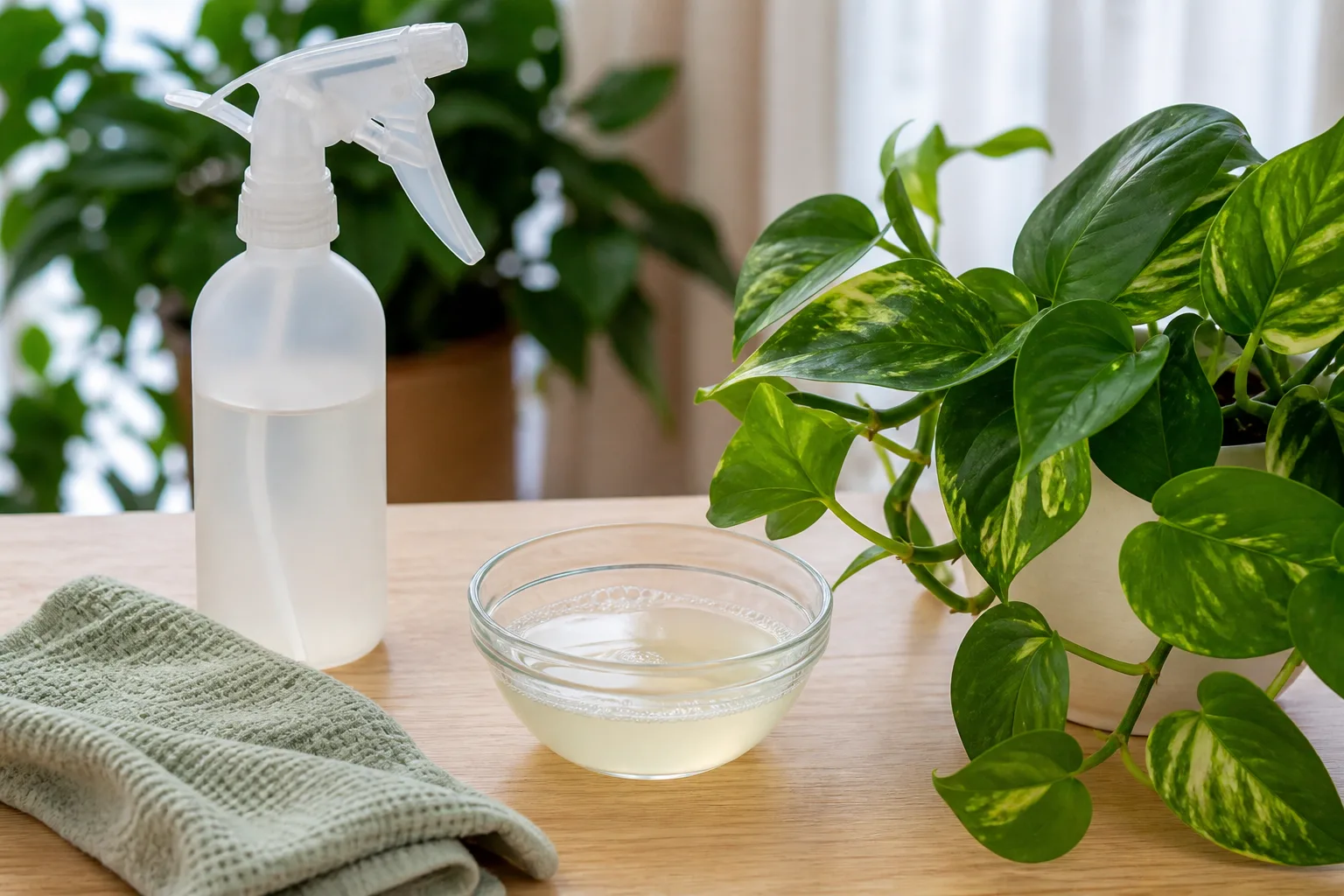
A controlled setup helps you measure, aim, and contain spray instead of coating every plant in the room.
Before spraying: label, test, and conditions
- Confirm the product. Choose an insecticidal soap labeled for the pest and plant. A ready-to-use bottle is not diluted the same way as a concentrate, and a kitchen detergent is not a substitute for either.
- Check the plant. Do not treat drought-stressed, wilted, newly transplanted, unrooted, or actively recovering plants unless the label and a qualified local recommendation say otherwise. Tender new growth and open flowers can be especially vulnerable.
- Read the weather. Avoid hot, bright conditions and rapid drying. UConn Extension and NC State guidance both warn about injury in heat around or above 90°F; early morning or early evening is generally safer when the label allows it.
- Spot-test first. Spray a small, inconspicuous section and wait at least 24 hours. If the area dulls, spots, curls, or scorches, do not treat the whole plant.
- Use clean, suitable water. Hard water can bind with the fatty acids, forming a precipitate and reducing performance while increasing the chance of plant injury. UConn Extension explains this hard-water problem; when water quality is uncertain, follow the product’s directions rather than improvising a stronger mix.
Sensitive plants deserve a longer pause than a spot test on a robust pothos. If the label lists the species as sensitive or excludes it, do not use the product simply because an online recipe says a small amount is harmless.
Leaf texture is a useful clue, but it is not a substitute for the label. Thick, glossy, waxy foliage can be vulnerable because detergents and soaps interact with its surface coating, while thin, soft, fuzzy, or newly expanding leaves can dry or scorch quickly. A plant that tolerates one application in mild weather may react to the same product after repotting, during a heat wave, or when a new flush of growth is unfolding.
During spraying: coverage without runoff
Spray the pest’s hiding places, especially leaf undersides, stems, and new growth, until they are thoroughly wet but not dripping into the soil or running off the plant. A fine, controlled spray is easier to aim than a heavy stream, and treating one plant at a time helps keep the dose consistent.
Avoid flowers that pollinators are visiting and prevent drift onto neighboring blooms, ponds, aquariums, or waterways. UC IPM notes that pesticide labels carry the specific precautions for flowering plants, bees, and other non-target organisms; “low toxicity” does not mean “safe to spray everywhere.” Wear the protection specified on the label and keep people and pets away from wet spray.
For outdoor plants, spray only the affected plant when possible rather than broadcasting across an entire bed. This reduces the amount of product landing on flowers and gives predators such as lady beetles, lacewings, and predatory mites a better chance to remain where they are useful. For indoor plants, place the pot where overspray will not land on food-preparation surfaces, wood finishes, or an aquarium, and wash the sprayer according to the label after use.
Do not add vinegar, bleach, essential oils, neem oil, or another pesticide to a soap mixture unless the label expressly allows the combination. Homemade combinations are difficult to measure and can change the chemistry, burn leaves, or create a product that is not approved for the crop.
After spraying: scouting and repeat applications
Let the product work for the label-specified contact period and follow its rinse instructions. There is no universal rule that every insecticidal soap must be rinsed immediately; many have no residual activity after drying. If you used an unlabeled dish detergent by mistake, however, rinse the foliage promptly with plain water because the detergent—not a tested insecticidal-soap formulation—is the risk.
Return to the plant after the label’s interval and look for live pests, new damage, and plant injury. Repeat only when the label permits it and scouting shows a reason. UC IPM notes that thorough coverage and sometimes repeat applications are necessary, while UConn emphasizes that untreated eggs or hidden pests can restart the infestation.
Plants and conditions that deserve a pass
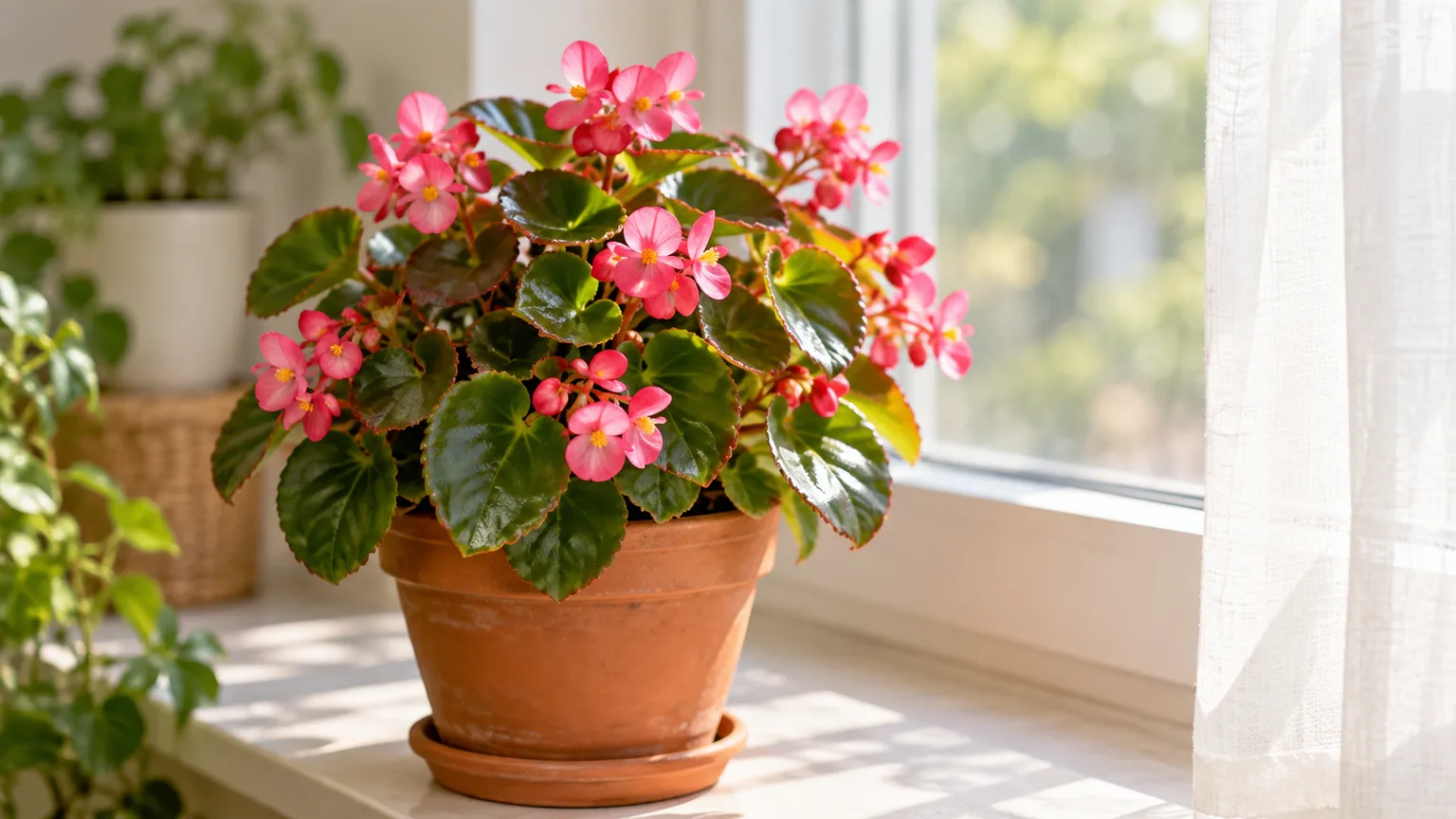
Some plants are more likely to show soap injury even when the product is used carefully. UConn Extension lists horse chestnut, Japanese maple, mountain ash, bleeding heart, and sweet peas as very sensitive, and notes that begonias, gardenias, jade plants, palms, ferns, impatiens, poinsettias, schefflera, some succulents, and other species may also react.
Treat that list as a warning, not a complete safety database. Leaf texture, cultivar, plant vigor, humidity, spray pH, temperature, concentration, and the number of applications can change the result. Waxy or glaucous leaves, fuzzy foliage, tender seedlings, soft new growth, and plants already stressed by drought or heat are poor candidates for an experiment.
When the plant is irreplaceable, the pest population is small, or the label is unclear, skip soap. Isolation, hand removal, plain-water washing, pruning of a heavily infested leaf, or advice from a local extension office may be a better trade-off.
What to do if dish soap is already on your plant
An accidental spray does not guarantee that the plant will die. The next few actions matter more than trying to counteract the detergent with fertilizer, oil, or another household ingredient.
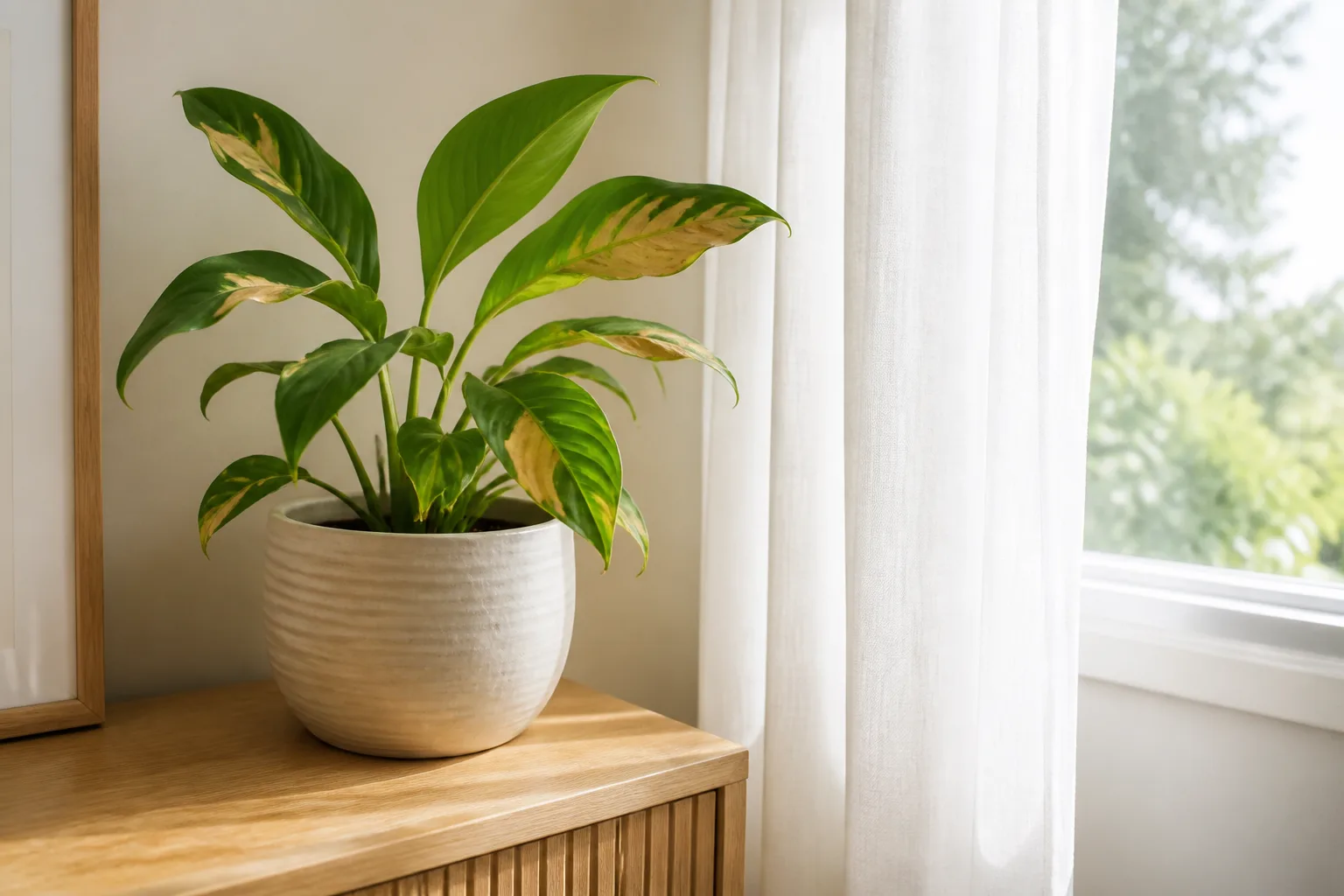
Leaf scorch can resemble several kinds of stress; compare new symptoms with the timing of the spray and inspect for live pests before diagnosing the cause.
If the leaves are still wet: move the plant out of direct sun and rinse every leaf surface with plain lukewarm water, including the undersides. For a garden plant, use a gentle hose stream; for a houseplant, a sink or shower makes it easier to remove residue without scrubbing.
If the spray has dried: rinse once conditions are cool, let the foliage dry in bright indirect light, and stop all further soap applications. Keep the plant’s normal watering routine—do not flood the pot to “flush” a leaf treatment, because waterlogged roots create a separate problem.
Watch new and old leaves over the next several days for a dull or waxy film, yellow flecks, brown spots, curling, crispy margins, or sudden drop. These signs can also come from sun, drought, or the original pest, so compare untreated foliage and inspect for live insects before deciding what happened.
Do not cut off every marked leaf immediately. Leave partly green leaves in place while the plant recovers; remove tissue only when it is fully dead or diseased, using clean pruners. Avoid strong fertilizer during the first recovery period, because forcing tender growth can add stress rather than repair the damaged cuticle.
Is soapy water safe for soil or edible crops?
Routine watering with used dishwater is not a good plant-care practice. Dishwater can contain detergents, grease, food residue, salts, fragrances, and other additives that were never evaluated as irrigation for your soil, roots, or nearby waterways. A brief accidental splash is different from repeatedly directing graywater into a pot or garden bed.
For vegetables, herbs, and fruit, use only a product whose label includes the crop and pest, and follow its application rate and pre-harvest interval. Some labeled insecticidal soaps can be used on food crops close to harvest, but that does not make homemade dish-soap mixtures acceptable for edible plants. UC IPM’s guidance starts with checking the label for the plant and pest situation, and its active-ingredient database explains why labeled potassium-fatty-acid products still carry application and bee precautions.
There is also an environmental reason to be selective. Soap sprays can affect non-target insects, and the active ingredient is toxic to fish and aquatic organisms according to product and extension guidance. Keep spray, rinse water, and concentrated product away from ponds, storm drains, streams, and aquariums.
Do not use soapy water as a soil drench to kill fungus gnat larvae, root pests, or weeds unless a product label specifically gives that use. A foliar contact spray is formulated and tested for a particular route of exposure; pouring it around roots creates a different concentration and can disturb soil organisms without reliably reaching the pest. For a root-zone problem, let the diagnosis determine the treatment rather than repurposing a leaf spray.
As a simple decision rule:
| Situation | Better first move |
|---|---|
| A few aphids on sturdy foliage | Rinse or wipe them away and recheck |
| Confirmed soft-bodied infestation on a permitted plant | Use labeled insecticidal soap with complete contact coverage |
| Brown spots with no visible pest | Diagnose light, water, temperature, or disease before spraying |
| Stressed, tender, or highly sensitive plant | Skip soap and choose isolation, removal, or local advice |
| Vegetable crop with an unknown mixture | Do not spray; choose a crop-labeled product or nonchemical control |
The table is deliberately conservative because plant injury is harder to reverse than a small pest population. You can always escalate after better scouting; you cannot easily undo a leaf cuticle that has already been damaged.
The same principle applies to graywater. If you are trying to conserve water, use a reuse method designed for your local conditions and a product known to be appropriate for irrigation; do not assume that water from a sink full of detergent is equivalent to clean irrigation water. Repeated detergent inputs can also affect nearby soil and aquatic systems even when a single accidental splash causes no visible plant injury.
Conclusion: use the least risky effective step
Soapy water is not a yes-or-no plant remedy. Household dish detergent can hurt plants, especially when it is concentrated, sprayed on a stressed or sensitive plant, or left to dry in hot sun. Labeled insecticidal soap can help when the pest is a susceptible soft-bodied insect, the product is approved for that plant, and you apply it with thorough contact coverage under suitable conditions.
Start with identification, plain water, isolation, or hand removal when those options fit. If you do use insecticidal soap, let the label—not a viral recipe—set the dilution and timing, spot-test before broad treatment, protect flowers and waterways, and keep scouting. That approach gives you the pest control you want without making the plant pay for it.