Potassium Deficiency on Alocasia Cuprea: Causes, Checks &
Quick answer
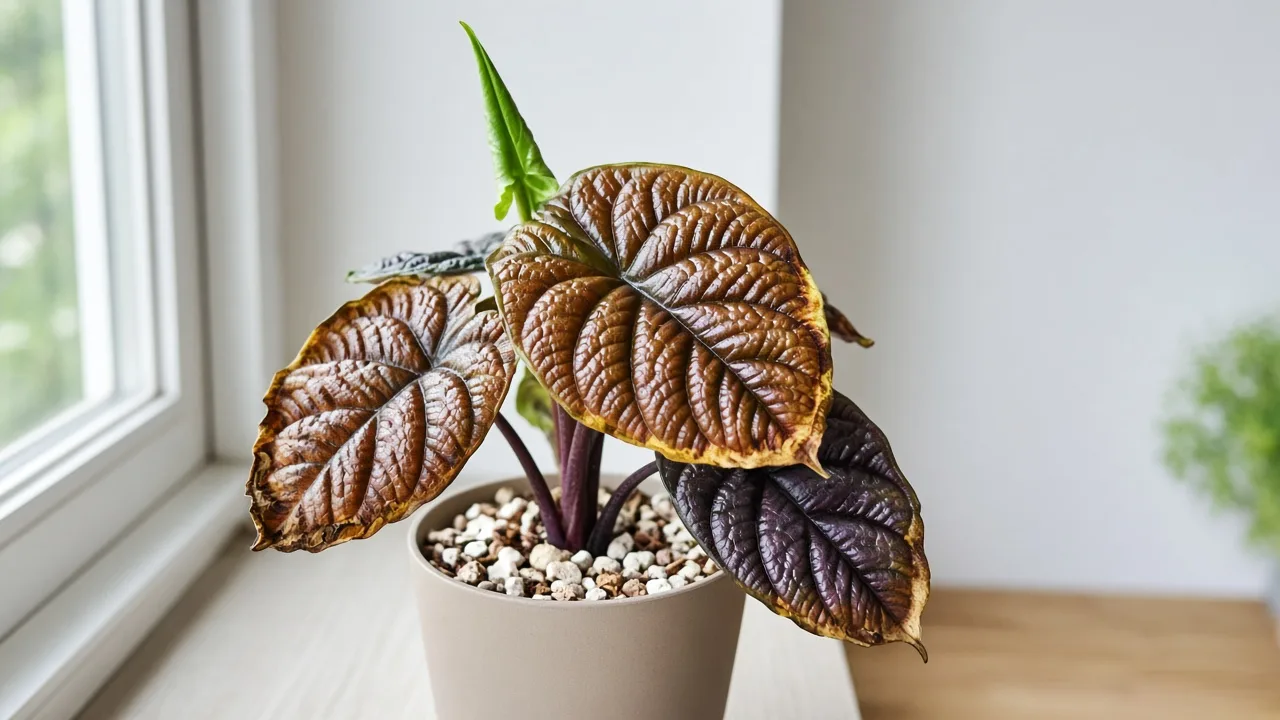
Potassium deficiency on Alocasia Cuprea shows as yellowing or brown scorch along the margins of older copper-bronze bullate leaves while the newest unfurling mirror spear at the corm crown stays relatively green. First step: confirm edge-first burn on multiple lower leaves—not tip-only crisping from salts or dry air—and review feeding history before adding fertilizer.
Potassium Deficiency on Alocasia Cuprea: Causes, Checks & Fixes
This guide covers potassium deficiency on Alocasia Cuprea. See also the general Potassium Deficiency guide, watering, and light pages for this plant.
Potassium Deficiency on Alocasia Cuprea: Causes, Checks & Fixes
Quick answer
Potassium deficiency on Alocasia Cuprea—the slow jewel alocasia with metallic copper-bronze mirror leaves and a dark purple underside—shows as yellowing or brown scorch along the margins of older bullate leaves while the newest unfurling mirror spear at the corm crown stays relatively green. Potassium is mobile within plants—when soil reserves run low, Cuprea pulls potassium from old tissue to support the slow new flush at the crown. Older leaves show chlorosis with browning of tips, scorching of margins, and brown spots near the margins in classic potassium shortage.
See our potassium deficiency guide for general marginal-scorch mechanics. On Cuprea, inspect the outer edges of the lowest mature copper-bronze mirror blades first—edge-first burn on multiple old leaves differs from tip-only brown tips on a single blade or new-spear distortion from calcium deficiency.
First step: confirm marginal scorch on multiple older lower mirror leaves, then check for salt crust and review feeding history before adding fertilizer.
When to use this page vs other Cuprea guides
| Pattern | Read next |
|---|---|
| Old mirror leaf margins yellow or scorched, new crown spear green | Potassium deficiency (this page) |
| Dry tan tips only, interior leaf green | Brown tips from salts or dry air |
| Uniform pale old blades, small new leaves | Nitrogen deficiency |
| Yellow between veins on old leaves | Magnesium deficiency |
| New unfurling spear cupped or margin-burned | Calcium deficiency |
| Scorched margins right after heavy feeding | Salt injury—pause feed and flush |
| All leaves yellow on wet heavy pot, corm soft | Overwatering or Root rot |
| Multiple yellow causes at once | Yellow leaves |
What potassium deficiency looks like on Alocasia Cuprea
Healthy Cuprea holds glossy copper-bronze bullate mirror leaves with deeply indented veins and a dark purple underside on stiff petioles rising from a compact corm crown. Potassium stress breaks that pattern at the margins of older lower leaves, not at the unfurling crown spear first.
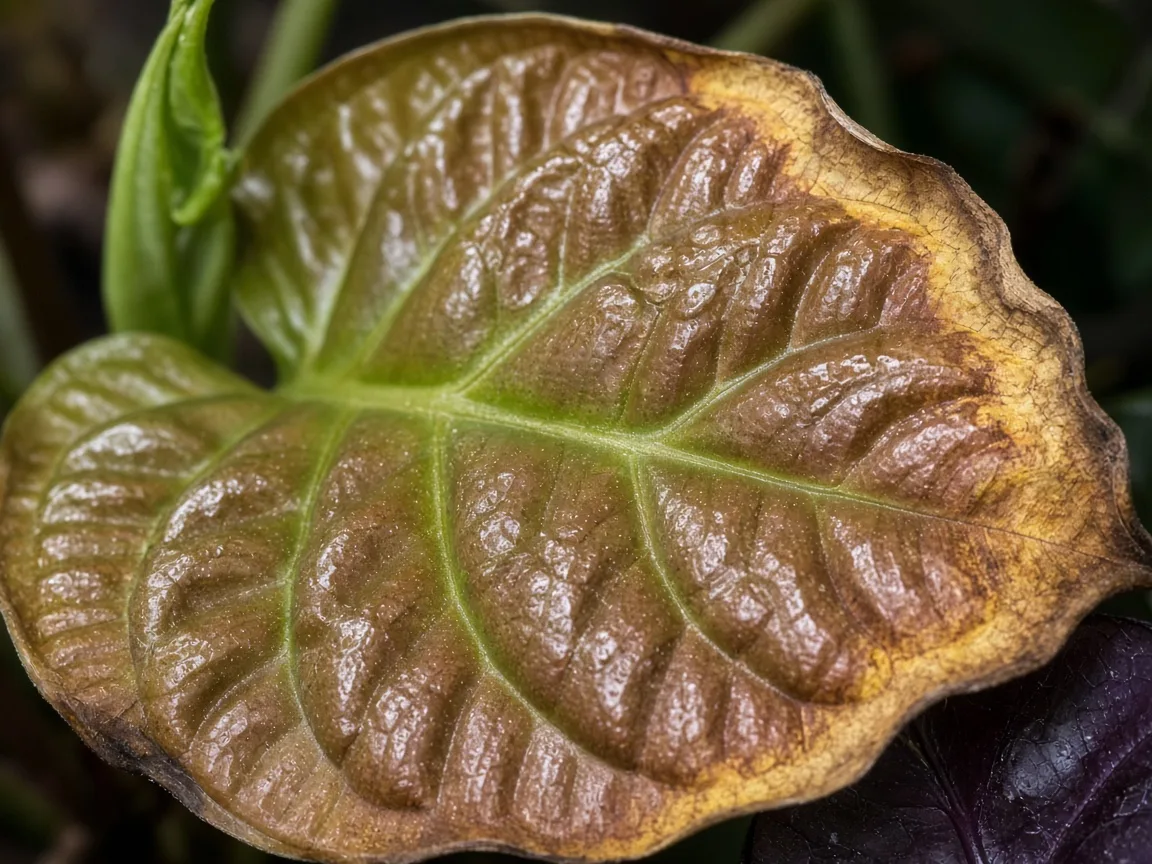
Older copper-bronze bullate leaf with yellow-tan scorch band along the outer margin while the newest mirror spear at the crown stays greener—a classic mobile-potassium pattern on jewel alocasias.
Typical signs:
- Yellow or tan scorch along outer margins of several older lower mirror blades—the damage often starts at the edge and creeps inward while veins stay greener longer
- Crisp brown marginal tissue on firm bullate leaves, not soft mushy petioles
- New copper-bronze spear at the corm crown stays greener than the lowest leaves for weeks
- Slow spread up the stem as deficiency advances—more mid-stem leaves gain similar edge burn
- Stalled spear size in advanced cases when potassium cannot support water regulation in thick mirror blades
- Firm corm at soil line and normal dry-down rhythm unlike limp overwatered Cuprea on soggy mix
Not potassium deficiency:
- Tip-only crisp brown on one exposed blade face—brown tips from salt buildup, dry air, or uneven watering
- Uniform pale washout on whole old leaves—nitrogen deficiency
- Yellow between veins with green midrib bands—magnesium deficiency
- Cupped or crinkled newest unfurling spear—calcium deficiency
- Marginal burn within days of a concentrated fertilizer dose—salt injury, not shortage
- One bottom leaf yellowing while a green spear unfurls above—often normal senescence during dormancy; see yellow leaves
Why Alocasia Cuprea gets potassium deficiency
Cuprea is a slow-growing corm aroid that pushes one mirror leaf at a time when light, humidity, and warmth align. Potassium regulates stomatal function and stress tolerance—deficiency often appears as marginal scorch when roots cannot supply enough K to sustain older bullate blades while the crown keeps growing.
Cuprea-specific causes:
- Light-feeding culture on a slow jewel alocasia — Cuprea needs far less fertilizer than faster aroids. Months without any complete feed during an active summer growth push can deplete mobile potassium in old chunky bark-perlite mix even when the plant looks healthy from stored corm reserves.
- Distilled or reverse-osmosis water — Owners chasing brown tips with ultra-soft water remove incidental minerals unless fertilizer replaces what leaches during each watering cycle.
- Leaching in airy aroid mix — Thorough watering through fast-draining mix washes mobile potassium out if you never replace what drains. Cuprea’s top 2–3 cm dry-down rhythm means frequent leaching events through summer.
- Salt-blocked uptake — White crust from overfeeding or hard tap water limits potassium absorption even when fertilizer sits in the cabinet. Jewel alocasias burn easily from salt stress that mimics deficiency margins.
- Root or corm stress limiting uptake — UC IPM notes container plants often show deficiency symptoms when root uptake is restricted, not only when soil lacks potassium. Chronic wet mix on an oversized pot mimics starvation while the corm softens.
Do not diagnose potassium shortage on sour wet soil with mushy petioles at the base—that is root failure from overwatering until you confirm a mostly firm corm and white feeder roots.
Copper-bronze mirror color masking marginal yellow
Cuprea’s metallic copper-bronze cuticle can hide early chlorosis better than on plain green houseplants. Owners often notice potassium stress only after margins turn crisp tan or brown against the reflective bullate surface—not when a faint yellow band first appears at the edge.
The diagnostic clue is distribution and tissue age, not leaf color alone. Potassium shortage hits multiple older lower mirror blades with similar edge-first yellowing or scorch. A single bottom leaf fading while the crown pushes a red-to-copper new spear is often normal senescence or slow growth in dim light—not mobile potassium redistribution.
Compare the newest unfurling spear at the corm. If it opens green or red-flushed with clean margins while three blades below show progressive edge burn, mobile potassium fits better than a whole-plant drought event or new-tissue calcium deficiency.
One slow spear at a time and potassium timing
Unlike peace lilies or pothos that flush multiple leaves per month, Cuprea commonly produces one mirror spear every few weeks in good conditions. Each new thick bullate blade demands potassium pulled from older tissue when soil reserves are thin.
That slow rhythm means deficiency can look mild for months—one scorched lower leaf at a time—then accelerate when summer light triggers a faster flush sequence. A plant that skipped fertilizer through spring while pushing two spears in bright humidity depletes potassium faster than a dormant winter corm resting leafless.
Match correction to growth speed: a Cuprea producing a new spear every two to three weeks in a bright bathroom needs measured feeding per the Cuprea fertilizer guide. A leafless dormant corm in winter needs no feed at all until spring growth resumes.
Salt crust vs marginal scorch on light feeders
Jewel alocasias are among the easiest houseplants to over-fertilize into marginal burn that looks identical to potassium deficiency. Cuprea’s fine roots and small corm cannot process heavy salt loads the way larger Alocasia hybrids tolerate.
Salt injury pattern: Scorched margins appear within days to two weeks of a concentrated feed on dry mix or repeated full-strength doses. White or yellow crust rings the pot rim or sits on the chunky mix surface. Newest spear may show tip burn alongside old margins.
True potassium shortage: Edge burn develops gradually over weeks on multiple old leaves while the crown spear stays greener. No recent heavy feed. Months without complete fertilizer during active growth.
If white crust is visible, pause fertilizer and leach salts before assuming deficiency. Salt accumulation damages roots and leaf margins on indoor plants—adding more potassium fertilizer on salty mix worsens the scorch.
Dormancy leaf drop vs potassium marginal burn
Cuprea commonly slows or drops leaves in winter when light and temperatures fall, leaving a firm corm below the soil line. Dormant plants shed older lower leaves one at a time with minimal watering—not a potassium crisis.
Potassium marginal scorch during active growth hits several old mirror blades with edge-first damage while the crown still pushes new spears. The corm stays firm. Do not feed a leafless dormant pot; resume half-strength complete fertilizer only after at least one new leaf has hardened in spring.
If marginal scorch appears only on the first spring flush and the second spear opens clean after one measured feed on firm roots, that was a timing gap—not chronic deficiency.
Lookalike symptoms
| Pattern | Check | Likely cause |
|---|---|---|
| Old mirror margins scorched, crown spear green | Feeding history, salt crust | Potassium deficiency (this page) |
| Tip-only crisp brown | Water source, vent placement | Brown tips |
| Uniform pale old blades | Whole-leaf washout | Nitrogen deficiency |
| Yellow between veins on old leaves | Complete fertilizer used? | Magnesium deficiency |
| New spear cupped or margin-burned | New vs old tissue | Calcium deficiency |
| Margins burned within days of feeding | White soil crust | Salt injury—flush and pause feed |
| All yellow, wet heavy pot, corm soft | Root smell, petiole softness | Overwatering |
| New leaves yellow, green veins | Vein pattern | Iron deficiency |
How to confirm
- Leaf age pattern—Marginal yellow or scorch on older lower mirror blades; crown spear greener.
- Margin shape—Edge-first band around much of the leaf perimeter, not isolated tip point only.
- Feeding history—No complete balanced feed for months during active spear production?
- Salt check—White crust on mix surface or pot rim suggests burn, not deficiency.
- Corm firmness—Firm potato-like corm at soil line supports feeding; spongy corm needs rot correction first.
- Moisture cross-check—Underwatering crisp edges follow dry spells; potassium margins persist on stable dry-down rhythm.
- Light and growth—Slow growth in a dim corner may be light before nutrition; bright active Cuprea with scorched old margins fits potassium depletion better.
First fix for Alocasia Cuprea
One dilute balanced liquid fertilizer at half label strength on already-moist mix—only after confirming a firm corm, no white salt crust, and months without complete feed during active growth.
Follow the Cuprea fertilizer guide—jewel alocasias need half strength or less on balanced formulas during spring through early fall only. One measured feed—not repotting plus double fertilizer the same week.
If white salt crust rings the pot or marginal burn appeared within two weeks of a heavy feed, pause fertilizer and leach salts with plain water until it drains freely before assuming deficiency.
Do not feed a waterlogged pot, a plant you repotted within the last month, or a specimen with active pest damage on new spears. Fix the limiting stress first, then resume half-strength feeding during active growth.
Step-by-step recovery
- Apply half-strength balanced feed once on moist mix; repeat every four to six weeks through active growth if new spears open with cleaner margins.
- Flush salts if white crust rings the pot rim—leach with plain water until it drains freely, then wait four to six weeks before feeding again.
- Adjust watering so the top 2–3 cm dries between drinks per Cuprea watering—uptake fails in chronic wet mix.
- Repot into fresh chunky aroid mix if roots circle the pot surface and marginal scorch persists after two measured feeds—see Cuprea repotting.
- Trim fully scorched older mirror blades only when they pull away easily; do not strip half the canopy at once on a slow single-spear plant.
- Monitor the next two crown spears for clean margins and normal bullate texture.
Mistakes to avoid
- Confusing salt tip burn with potassium margin scorch—Tip-only damage after a heavy feed is usually salts, not K.
- Full-strength feed on dry roots—Always water normally first, then fertilize moist mix at half label rate.
- Feeding through salt crust—More fertilizer on salty mix worsens marginal burn that looks like deficiency.
- Potassium before drainage—Fertilizer on waterlogged roots fails to correct scorch and can burn tissue.
- Feeding through winter dormancy—A leafless corm needs rest, not rescue fertilizer.
- Expecting scorched margins to re-green—Judge new crown spears, not old burned edges.
Recovery timeline
Correct feeding on healthy roots shows cleaner margins on the next one to two crown spears within four to eight weeks. Older scorched edges do not heal; Cuprea replaces them slowly as the corm pushes new mirror leaves.
Full canopy refresh on a mature specimen may take one growing season given the slow single-spear rhythm. Judge success by margin color on fresh spears, not by old burned tissue darkening again. If three successive new leaves open with edge burn after two measured half-strength feeds with a firm corm, reassess salt accumulation, light, and overlapping brown leaves causes.
Prevention
- Feed lightly with complete balanced fertilizer during active growth per the Cuprea fertilizer guide—avoid bloom-only formulas that skimp on potassium for foliage jewel alocasias.
- Flush salts mid-season if you use hard tap water or feed frequently in bright light.
- Refresh depleted chunky mix every one to two years when roots crowd drainage holes per Cuprea soil guidance.
- Match feed frequency to spear production—a bright bathroom Cuprea uses more potassium than a slow winter-dormant corm.
- Track whether margins scorch on multiple old mirror blades before new crown spears fade; early edge burn on lower leaves is easier to correct than a fully stunted corm.
Related Alocasia Cuprea guides
- Alocasia Cuprea overview
- Cuprea fertilizer
- Cuprea watering
- Cuprea soil
- Nitrogen deficiency
- Magnesium deficiency
- Calcium deficiency
- Alocasia Cuprea problems hub
Conclusion
Scorched margins on older Cuprea mirror blades with a greener new spear at the crown are a potassium signal—confirm the pattern starts on lower leaf edges, rule out salt crust and tip-only brown tips, then feed once at half strength on moist soil when the corm is firm.
Related tool
Use the Fertilizer Dilution Calculator to narrow causes for potassium deficiency on this plant before changing multiple variables at once.