Ashwagandha Pruning Guide: When, Where, and How Much to Cut
Ashwagandha Pruning Guide: When, Where, and How Much to Cut
Ashwagandha Pruning Guide: When, Where, and How Much to Cut
First action: Walk the plant and remove only yellow, brown, soft-rotted, or clearly diseased leaves and stems with clean sharp scissors or bypass pruners—finish that cleanup before you pinch healthy tips or shorten leggy branches. Ashwagandha is grown for a deep, healthy root system as much as for foliage, so you want a clear map of firm live stems and leaf nodes before you decide how much green to take.
For whole-plant context—full sun, sandy drainage, and watering rhythm—see the Ashwagandha overview.
Reviewed by LeafyPixels Review Board · Author: sai-ananth
Quick answer
Prune Ashwagandha (Withania somnifera), also sold as Indian ginseng, winter cherry, or asgandh, to keep this short erect shrub compact, remove failing tissue, and encourage side branching—not to “fix” shade stretch, soggy roots, or frost damage. NC State Extension describes a small shrub grown as an annual in zones colder than 8, needing full sun and soil that dries between waterings; Useful Tropical Plants lists height around 1 m and notes it is often cultivated as an annual in India.
Make tip and shape cuts just above a leaf node—about one-quarter inch above a healthy bud—limit live canopy removal to about one-third per session on pots, and schedule major shaping for warm active growth. Pruning improves form and branching, but it cannot replace full sun or a watering rhythm that lets the top of a free-draining mix dry before the next drink.
What pruning does for Ashwagandha
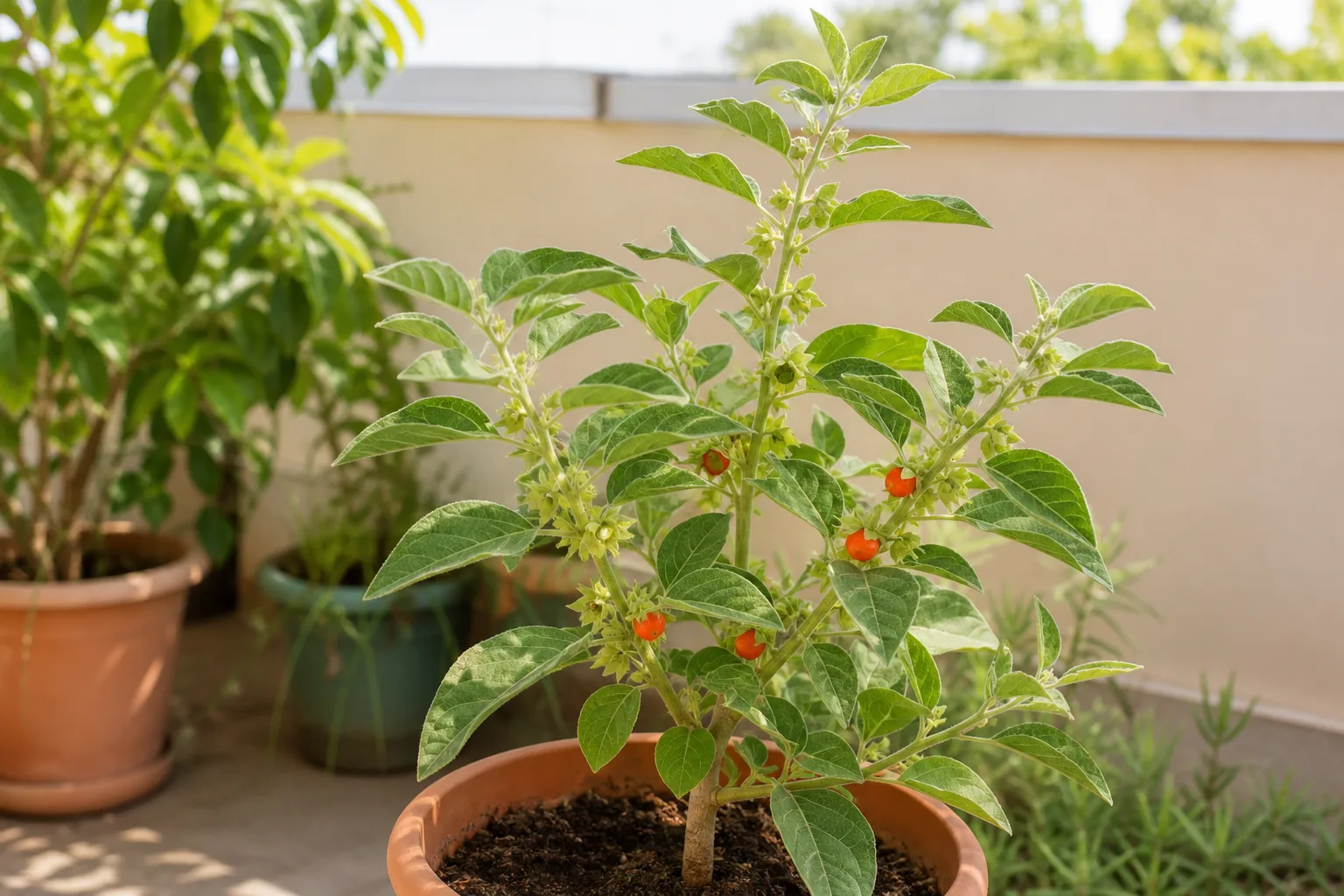
Ashwagandha is a Solanaceae shrub with erect, spreading stems covered in fine silvery hairs and alternate ovate leaves. Plants For A Future describes an evergreen shrub growing to about 1 m that cannot grow in the shade. Left alone in strong sun it stays relatively short; in weak light it stretches into sparse, leaning stems with long internodes. The flowers are small and pale green at the leaf nodes, later forming lantern-like calyces around orange-red berries that NC State lists as poisonous if eaten.
Four jobs show up repeatedly:
- Cleanup removes yellow, scorched, pest-coated, or rotting leaves and soft stem tips whenever you spot them.
- Tip pinching / heading shortens soft leaders just above a node to encourage side shoots and a denser framework.
- Size control shortens overlong or leaning stems when a balcony pot outgrows its space.
- Pre-harvest restraint eases off hard top cuts late in the season if your goal is root mass rather than a leafy hedge.
Pruning cannot fix chronic shade (long internodes, pale thin shoots), waterlogging (soft crown, yellow leaves on wet mix), or frost kill. NC State notes the plant cannot grow in shade and that stem and root rot can affect it—correct light and drainage first, then cut.
Cleanup vs tip pinch vs size control
Cleanup is safe anytime and should always come first. Clemson HGIC advises removing dead, diseased, or injured growth before any shaping cuts, then heading back to a healthy bud when you shorten shoots. Tip pinching is the early-season job that builds a bushier plant from a single upright seedling. Size control is the heavier job: when stems flop or race past your target height, cut back to a lower outward-facing node—not stripping every green stem at once.
When to prune Ashwagandha
Best season for structural pruning
Use warm active growth—typically spring through late summer in Indian climates—for tip pinching, thinning, and height reduction. Buds below a cut break fastest when nights stay warm and the plant sits in full sun. NC State notes that plants grown from seed flower and fruit in the first year; that rapid cycle means you often prune a young shrub the same season you plant it.
Avoid stacking a hard cutback with cool, stagnant weather or a chronically wet pot. Growth slows when light drops and roots sit cold and soggy, so a heavy late-autumn cut on a shaded balcony may sit longer before nodes break. Light maintenance—removing a yellow leaf or pinching a soft tip—is fine whenever you see firm green growth.
If you repotted within the last two to three weeks, delay heavy pruning unless you are only removing dead material. Root disturbance plus a large canopy cut stacks two stresses on a plant that already dislikes wet feet.
Root-harvest timing and late-season restraint
NC State advises harvesting medicinal roots when flowers and fruits form and leaves start to dry out. Useful Tropical Plants similarly notes the root is harvested in autumn. If that is your goal, keep late-season pruning to cleanup only: hard tip cuts then push new leafy shoots when you want the plant finishing its top growth and packing root mass.
What can be removed anytime
Dead leaves, fully yellow leaves, broken tips, and clearly soft or diseased stem sections can be removed year-round. That cleanup is different from reshaping a healthy canopy. Defer major cuts if the plant was just moved, newly repotted, or is yellowing from wet soil—fix drainage and light first.
What to check before cutting
Before your first structural cut, check four things:
- Node positions: New shoots break from leaf nodes, not smooth mid-internode stubs. Find the joint where a leaf meets the stem and cut just above it.
- Light quality: Ashwagandha wants full sun—six or more hours of direct light. Long internodes and pale thin tips usually mean not enough light—improve placement before expecting a topped plant to stay compact.
- Current stress: Soft bases, sour wet soil, or ongoing yellowing means delay major cuts. Pair with watering checks when the pot stays heavy.
- Goal: Leafy balcony shrub versus root crop. Early pinching suits both; late hard cutbacks suit only the foliage-first plant.
Wash hands after handling cut material. NC State lists all plant parts as poisonous to humans if eaten (medium severity), and Useful Tropical Plants also warns the plant is toxic if eaten—keep pruned stems and berries out of reach of children and pets.
How to prune Ashwagandha step by step
Work in this order each session:
- Remove dead, yellow, or soft-rotted tissue back to firm green wood or to the soil line if a stem is fully collapsed.
- Pinch or tip-cut soft leaders that have added several leaf pairs and need branching.
- Shorten leggy or leaning stems to a lower outward-facing node if internodes have stretched.
- Thin crossing stems that rub and create wounds in the crown.
- Step back and check balance—pinch any stem racing ahead of the others.
Use sharp scissors or bypass pruners. Soft tips can be pinched with clean fingernails if you do not crush the tissue. Position blades about one-quarter inch above the node and make one clean snip on a slight slant, matching Clemson’s heading-cut guidance. Wipe blades with 70% isopropyl alcohol when moving from soft-rotted or diseased stems to healthy wood.
The first tip pinch on a young plant
Start the first pinch once a seedling or nursery start has several true leaf pairs and a firm stem—typically when it reaches roughly 15–20 cm (6–8 inches) and is growing strongly in warm sun. Snip or pinch the top growing point just above a healthy leaf node, leaving enough foliage below for photosynthesis. Within one to three weeks in full sun you should see side shoots emerging from axils below the cut.
Heading cuts for shape and size
When a stem outgrows the pot or leans, cut just above an outward-facing leaf node so new growth moves away from the center rather than into a tangle. Head shoots to several different heights rather than shearing every tip to one flat plane—Clemson notes routine shearing pushes dense growth at the outer canopy and leaves the interior stemmy.
Using healthy cuttings
Healthy tip wood from a warm-season prune can become stem cuttings—NC State lists stem cutting among recommended propagation strategies. Use the Ashwagandha propagation guide if you want to root them rather than composting everything. Do not propagate soft, yellow, or rotting tissue.
How much you can safely remove
Do not remove more than about one-third of the plant’s total leafy growth in one session during active season. That limit protects the leaf surface feeding the roots—especially important on Ashwagandha, where root health is the long game. Daily tip pinches of a few millimeters rarely approach one-third; the rule matters when you renovate a leggy plant or take many cuttings at once.
If you need a large size drop, take one-third now, wait for new shoots to firm up (often two to three weeks in heat), then take another measured pass. Never scalp a stressed, shaded, or newly repotted plant down to bare stubs.
Aftercare and recovery
After pruning:
- Keep the plant in its strongest available sun—do not move it into shade “to rest.”
- Water only when the top few centimeters of mix are dry; do not soak the pot to “help it recover.”
- Skip fertilizer for a week or two after a hard cut; resume light feeding only when new shoots are visible and the plant is drinking on its normal rhythm.
- Watch the crown for soft rot—remove any newly mushy tissue promptly.
Recovery timeline
Tip pinches usually show new side shoots within one to three weeks in warm full sun. Harder renovation can take two to four weeks before the canopy looks filled again. Cool nights, weak light, or wet soil stretch that timeline. Signs pruning worked: firm new tips from nodes below your cuts, stopped decline of remaining leaves, and a more balanced silhouette. Signs you cut too hard or too late: no new buds after several warm weeks, soft crown tissue, or widespread yellowing on remaining stems.
Mistakes to avoid
- Shearing every tip flat — produces a dense outer shell and bare interior; head to staggered heights instead.
- Cutting mid-internode — leaves a stub with no bud to activate.
- Scalping a shaded, wet pot — regrowth will be weak; fix light and drainage first.
- Hard late-season cutbacks on a root crop — pushes leafy regrowth when the plant should be finishing toward root harvest.
- Stacking prune + repot + heavy feed the same day — one stress at a time.
- Ignoring soft stems — stem and root rot are known problems; cleanup is not optional.
When not to prune
Skip structural pruning when nights are cold, the plant is wilting from drought or waterlogging, you just repotted, or the only problem is shade stretch you have not fixed yet. Emergency removal of dead or rotting tissue is still appropriate in those cases—just do not add tip pinching and size-control cuts on top.
Related Ashwagandha guides
- Ashwagandha overview — full care context and growth habit
- Ashwagandha light — full-sun needs before you expect dense regrowth
- Ashwagandha watering — dry-down rhythm after cuts
- Ashwagandha soil — drainage that prevents crown rot
- Ashwagandha propagation — rooting healthy pruning wood
- Ashwagandha repotting — when to delay pruning after a pot change