Spider Mites on Ashwagandha: Causes, Checks & Fixes
Quick answer
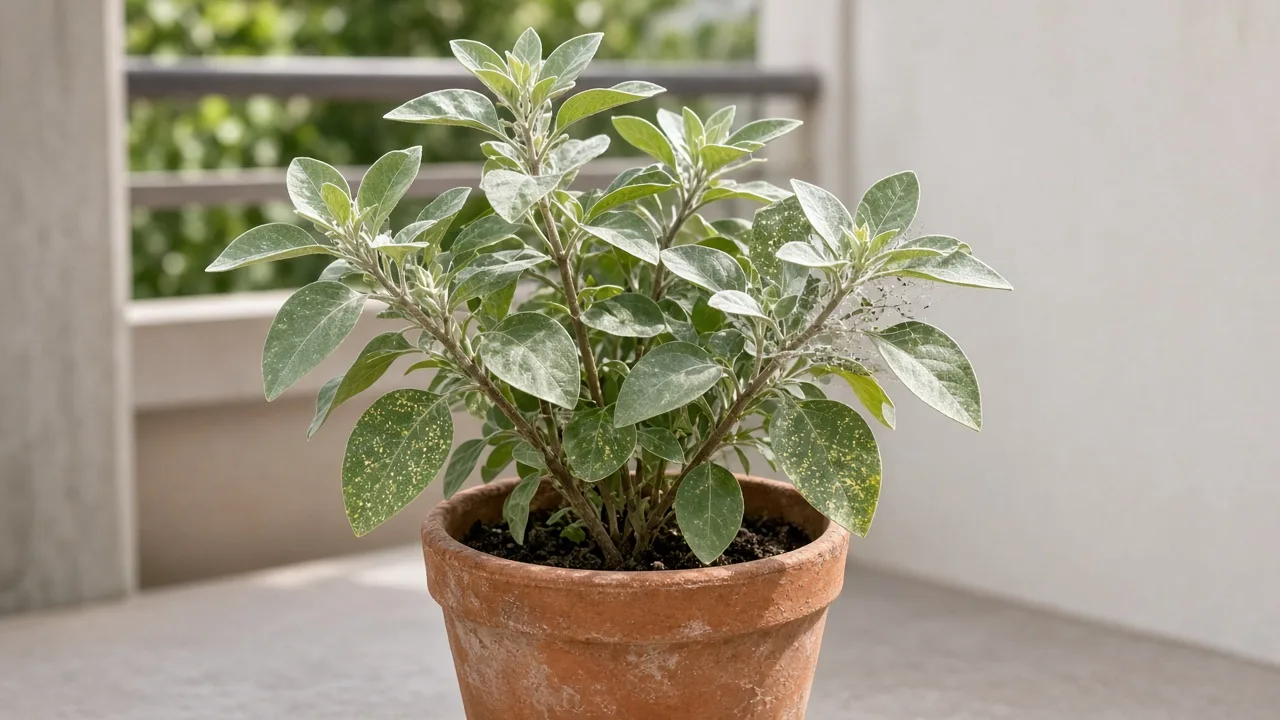
Spider mites on Ashwagandha show up as pale stippling and fine silk webbing on older silvery leaves—usually in hot dry terrace corners or overwintering pots beside heating vents, not on sticky tender shoots like aphids. First step: shake a damaged leaf over white paper and blast hairy undersides with a firm lukewarm stream before spraying anything.
Spider Mites on Ashwagandha: Causes, Checks & Fixes
This guide covers spider mites on Ashwagandha. See also the general Spider Mites guide, watering, and light pages for this plant.
Spider Mites on Ashwagandha: Causes, Checks & Fixes
Quick answer
If your Ashwagandha has pale stippling and fine webbing on older silvery leaves but firm erect stems, spider mites are a more likely culprit than underwatering alone. Withania somnifera carries short fine silver-gray hairs on ovate alternate leaves along woody stems—mites colonize those hairy undersides in hot dusty dry conditions, not the sticky tender shoot tips where aphids cluster.
First step: shake a damaged leaf over white paper and blast hairy undersides with a firm lukewarm stream. Moving dust specks on the paper confirm mites. A soft, mushy stem base on wet mix is a different emergency—see the Ashwagandha root rot guide before you treat pests.
For how spider mites reproduce, stipple leaves, and spread in general, see our spider mites pest guide. On Ashwagandha, the pattern usually shows up on mature silvery foliage in hot dry terrace corners or overwintering pots beside heating vents, not as a generic houseplant wilt.
Why Ashwagandha gets spider mites on hairy older leaves
Dry heat favors mites on this drought-tolerant shrub. Spider mites prefer hot dusty conditions and reproduce rapidly in warm weather. Ashwagandha is built for open disturbed dry habitats and full sun—outdoor terrace pots rarely struggle with mites when airflow is good. Problems spike when a frost-protection pot moves indoors beside a heating vent, when a south-facing window bakes dry mix for weeks without rinsing dusty leaves, or when low humidity in a closed winter room compounds water stress.
Mites target undersides, not tender buds. Ashwagandha farming guides note red spider mites feed on leaf undersides, causing yellowing and curling. On container plants, stippling often appears on older silvery foliage and along branch midsections while newest shoots and swelling flower buds look cleaner—the opposite pattern from aphids on soft tips.
Nightshade neighbors share pests. Balcony Ashwagandha beside peppers, tomatoes, or eggplant can pick up two-spotted spider mites that disperse on air currents when a colony outgrows one host. Quarantine new plants before placing them in a sunny herb row.
Broad-spectrum sprays can backfire. Pyrethroid or organophosphate sprays for other insects often kill mite predators and trigger mite outbreaks. If you recently treated whiteflies or thrips with a harsh pesticide, suspect mites on the rebound.
What spider mites look like on Ashwagandha
- Tiny moving dots—less than 1/20 inch—visible with a 10X lens on hairy leaf undersides
- Pale yellow, white, or bronze stippling on individual silvery ovate leaves before whole-leaf yellowing
- Fine silk webbing between leaf edges, petioles, and branchlets—not sticky like aphid honeydew
- Older mature leaves affected first; tender shoot tips often stay greener longer than aphid damage
- Bronzed or dull patches on densely hairy undersides while stems remain firm and erect
- Premature leaf drop on heavily infested branches during peak summer heat
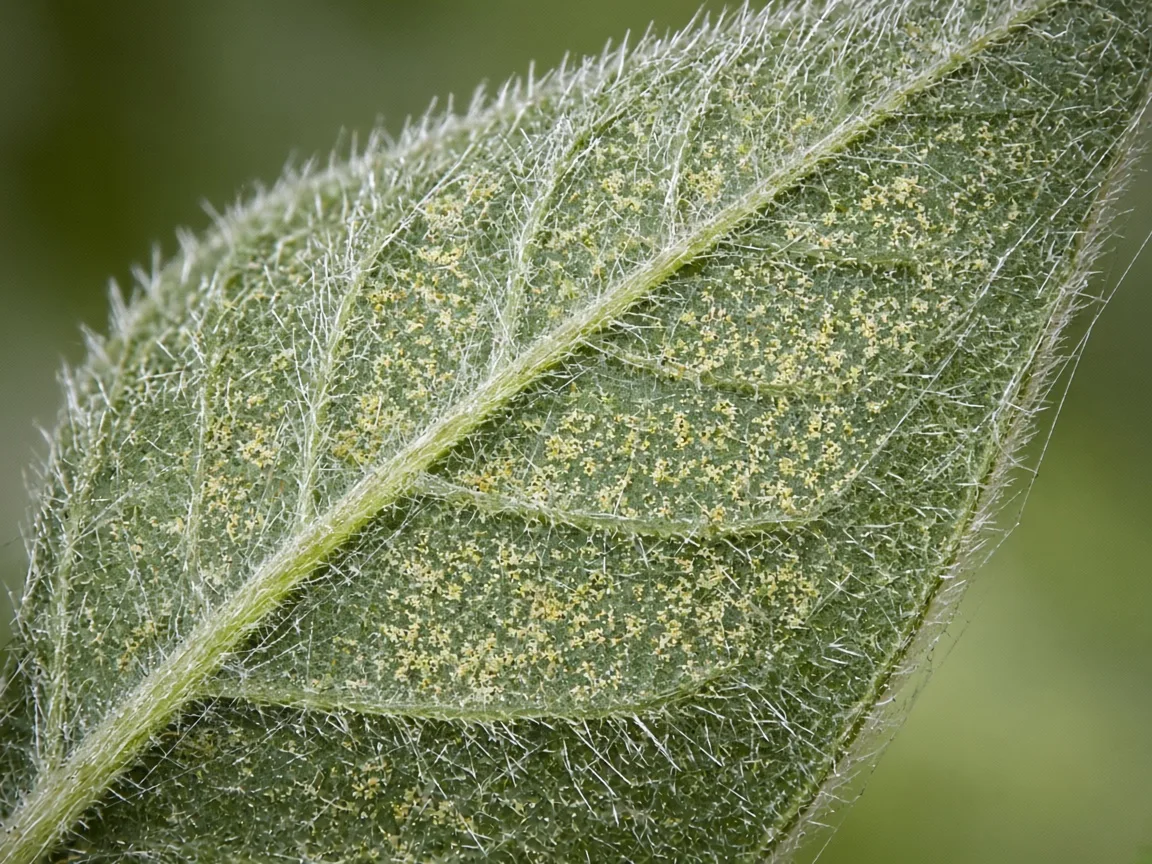
Pale stippling and fine silk on a silvery Ashwagandha leaf underside—compare with healthy tissue on the same branch.
On Ashwagandha’s velvety gray hairs, early stippling can look like nutrient stress or sun fade until you spot webbing or shake mites onto white paper.
Hairy undersides and the white-paper test: confirm before you spray
This check is specific to Ashwagandha’s tomentose foliage and wrong for smooth-leaved houseplants.
- Choose an older stippled leaf on a firm branch—not the softest new shoot tip.
- Hold white paper under the hairy underside and tap or shake the leaf firmly.
- Watch for moving specks—mites disperse rapidly once disturbed.
- Scan with a 10X lens along the midrib and leaf edge for colonies, eggs, and webbing.
- Stem-base press — Firm erect stems with mite damage only on foliage point to pests. Soft crown on damp mix means rot first.
- Dry-down cross-check — Finger-test the top 3–4 cm per the Ashwagandha watering guide; drought wilt usually hits the whole plant evenly, not stippled older leaves alone on moist soil.
Confirmed diagnosis — Moving specks on paper plus stippling and webbing on hairy undersides with firm stems. Suspected — Pale dots without visible mites may need repeat checks on several leaves before treating.
Winter overwintering vs outdoor terrace: where Ashwagandha mites flare
Ashwagandha growers in cool zones bring pots indoors before frost. That transition creates a mite hotspot unique to this species:
| Situation | Mite risk | Why |
|---|---|---|
| Full-sun terrace with airflow | Low to moderate | Matches native dry open habitat |
| South window + heating vent below pot | High | Hot dry indoor corners stress leaves while mix dries unevenly |
| Dim room after frost move, no mites yet | Low for mites; high for stretch | See not enough light instead |
| Bone-dry pot in July heat wave | High | Water-stressed plants are highly susceptible |
Pull overwintering pots at least 60 cm from heating vents, keep them at the brightest glass you have per the Ashwagandha light guide, and rinse dusty leaf undersides weekly in dry rooms.
Confirm spider mites vs drought, aphids, mealybugs, and low humidity
Symptom lookalike comparison
| What you see | Likely cause | Key check |
|---|---|---|
| Pale stippling + fine webbing on older hairy leaves | Spider mites | White-paper test; mites move |
| Soft pear-shaped insects on fresh shoots | Aphids | Sticky honeydew on tips; no webbing |
| White cottony masses in stem crevices | Mealybugs | Stationary wax; alcohol turns orange-gray |
| Papery brown tips beside a radiator, no stippling | Low humidity | Hygrometer at pot height; no moving specks |
| Midday wilt on light pot, no webbing | Underwatering | Dry mix to 3–4 cm; whole plant limp |
| Silver streaks and black frass in leaves | Thrips | Ragged scarring; no silk webbing |
| Limp stems, soft crown, wet mix | Overwatering / rot | No mite colonies; sour soil odor possible |
Do not confuse harvest senescence with mites. Lower silvery leaves yellowing as orange winter-cherry fruit forms is normal energy shift toward roots—not stippling with webbing on scattered older leaves.
First fix: isolate, rinse undersides, and treat safely
Isolate the plant away from other sun-loving herbs and nightshades until you see no new stippling for at least two weeks after treatment.
Blast hairy undersides with water first. Spray or mist leaf undersides at least once daily when mites are active. This is the lowest-risk first fix for Ashwagandha—no residue on foliage you may harvest later.
Morning rinse timing for full-sun plants
Schedule rinses in early morning so hairy leaves dry quickly in full sun. Wet foliage sitting through a hot afternoon on a terrace can stress the plant even when mites are present. Outdoor plants in peak summer should be rinsed before direct midday heat.
Repeat every two to three days to knock down nymphs that hatch between rinses. Increase frequency in hot dry indoor corners during overwintering.
Insecticidal soap and neem on hairy nightshade foliage
If colonies remain after two or three rinse cycles, apply insecticidal soap or neem oil labeled for ornamentals. Ashwagandha farming guides suggest neem oil at 3–5% for mites. Clemson Extension recommends a 1 to 2% soap solution (about 2½ to 5 tablespoons per gallon) with coverage until runoff, repeated every four to seven days until pests are gone.
Critical rules for Ashwagandha:
- Spray early morning or late evening—do not apply above 90°F or in full midday sun on outdoor plants.
- Coat tops and hairy undersides until runoff; contact sprays only kill mites they touch.
- Patch-test one lower leaf and wait 24 hours before treating the whole plant.
- Avoid stacking repot, heavy prune, or fertilizer the same week you start spray.
Wear gloves when handling stems and sprayed foliage—NC State Extension classifies all Ashwagandha parts as poisonous to humans if eaten, including leaves and orange winter-cherry berries.
What not to do the same day
Do not increase watering because stippled leaves look stressed—check stem firmness and soil dry-down first. Do not apply oil sprays at midday on sun-exposed terrace plants. Do not use broad-spectrum insecticides that kill predatory mites. Do not mist hairy leaves into a stagnant indoor corner—that raises humidity locally without fixing mites and can invite fungus gnats on wet mix.
Recovery timeline and root-harvest expectations
Visible mites should clear within one to two weeks of consistent rinsing or soap treatment. Expect clean new silvery leaves within three to five weeks during active warm growth. Stippled mature leaves will not fully re-green—judge success by the next clean flush, not by repairing bronzed tissue.
Firm erect stems throughout treatment are a good sign. Widespread yellowing with webbing on most branches during peak heat may mean leaf drop before recovery—reduce stress with morning rinses and correct vent placement on indoor pots.
If you grow Ashwagandha for roots, heavy foliar feeding loss can slow the deep taproot development this plant is valued for. Stop visible mite damage early so energy returns to stem and root growth rather than replacing dropped leaves every week.
How to prevent spider mites on Ashwagandha
Quarantine every new Ashwagandha for two weeks before placing it near other plants. Inspect hairy undersides weekly during spring and summer active growth—and again weekly when pots overwinter indoors.
Keep care aligned with the full Ashwagandha care hub—full direct sun, sandy fast-draining mix per the soil guide, and dry-down watering so plants are not chronically drought-stressed in heat waves. Outdoor airflow on a terrace beats raising room humidity for this arid-climate shrub.
Beneficial predators such as predatory mites and lacewings help on outdoor plants when broad-spectrum sprays are avoided. Indoor specimens need regular underside rinses in dry winter air.
When to escalate — chronic infestations and toxicity
Escalate if stippling spreads to most branches after three full treatment cycles, if webbing covers flower clusters you need for seed, or if leaves yellow and drop faster than new growth emerges. Chronic mite pressure during warm months can weaken the shrub over time even when rot has not started.
For heavy recurring outdoor infestations, a local extension office can confirm the pest and discuss miticide options. Systemic products move through plant sap and may affect roots you plan to harvest—contact rinses and soaps are usually safer first choices for medicinal herbs unless an expert recommends otherwise.
Pet and child safety: All parts of Ashwagandha are poisonous if eaten, with orange berries inside the papery calyx especially hazardous. Keep treated plants out of reach and contact your veterinarian or poison control if ingestion is suspected.
Spider mites alone rarely kill a mature Ashwagandha with firm stems, but they can ruin foliage quality and open the door to secondary stress if you respond with extra water or fertilizer.
Before you water again
Stippled older leaves on firm erect stems mean rinse hairy undersides first—not another drink. Soft crown on wet mix means rot protocol, not mite spray. That single check keeps most Ashwagandha growers from making the problem worse while they treat the right cause.
When to use this page vs other Ashwagandha guides
- Ashwagandha watering guide — Use for routine dry-down checks before assuming spider mites is the main issue.
- Ashwagandha problems hub — Browse all common issues on this species.
- Low Humidity on Ashwagandha — Different entry point when crisp tips appear without stippling or webbing.
- Aphids on Ashwagandha — Different entry point when sticky tender shoots, not older stippled leaves, are the problem.
- Curling Leaves on Ashwagandha — Different entry point when leaves cup without visible mite webbing.