Curling Leaves on Ashwagandha: Causes, Checks & Fixes
Quick answer
Curling leaves on Ashwagandha usually mean drought stress on a sunny terrace, sap-sucking pests on tender branch tips, or heat curl on otherwise moist soil—not random leaf damage. First step: finger-test the top 3–4 cm of mix and inspect the newest hairy leaves at branch tips before you change watering or reach for spray.
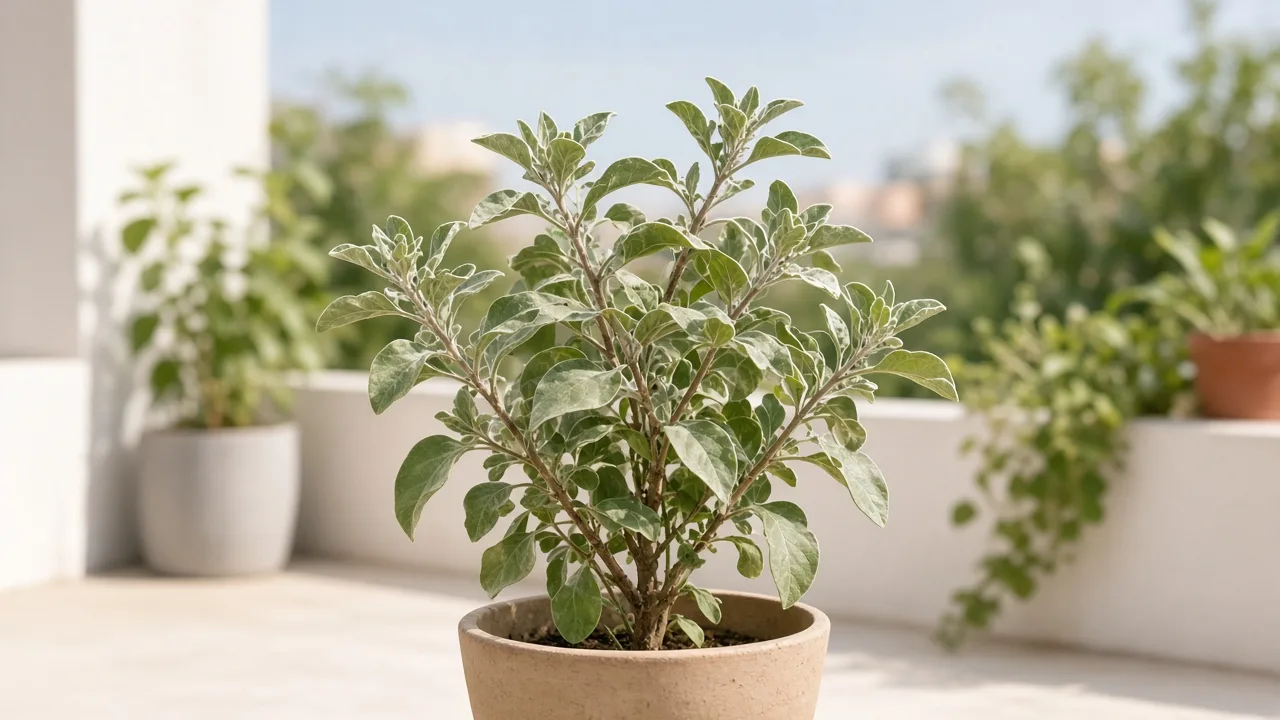
Curling Leaves on Ashwagandha: Causes, Checks & Fixes
This guide covers curling leaves on Ashwagandha. See also the general Curling Leaves guide, watering, and light pages for this plant.
Curling Leaves on Ashwagandha: Causes, Checks & Fixes
Quick answer
Curling leaves on Ashwagandha (Withania somnifera) show up as cupped, rolled, or twisted ovate blades on erect silvery-green stems—often on the newest growth at branch tips before lower leaves yellow or wilt. On this full-sun medicinal nightshade, curl is usually a moisture, heat, or pest signal, not a random cosmetic flaw. For how leaf curl works as a general protective stress response, see our curling leaves guide. On Ashwagandha, pair the 3–4 cm dry-down check with a branch-tip pest scan before you change watering or reach for spray.
First step: finger-test soil at 3–4 cm depth, then inspect the newest hairy leaves at branch tips and any swelling flower buds. Dry, light soil with dull cupped leaves points to underwatering on Ashwagandha. Cool damp soil with stippling, webbing, or sticky residue on tender tips points to spider mites, aphids, or thrips. Curl that appears only in harsh afternoon sun on otherwise moist mix is often heat stress—wait for a morning soil read before soaking again.
What curling leaves look like on Ashwagandha
Ashwagandha carries ovate leaves with a gray sheen from dense tiny hairs on an upright shrub—not the broad flat blades of a peace lily or the compound leaflets of a legume vine. Curl patterns read differently on that silvery nightshade architecture.
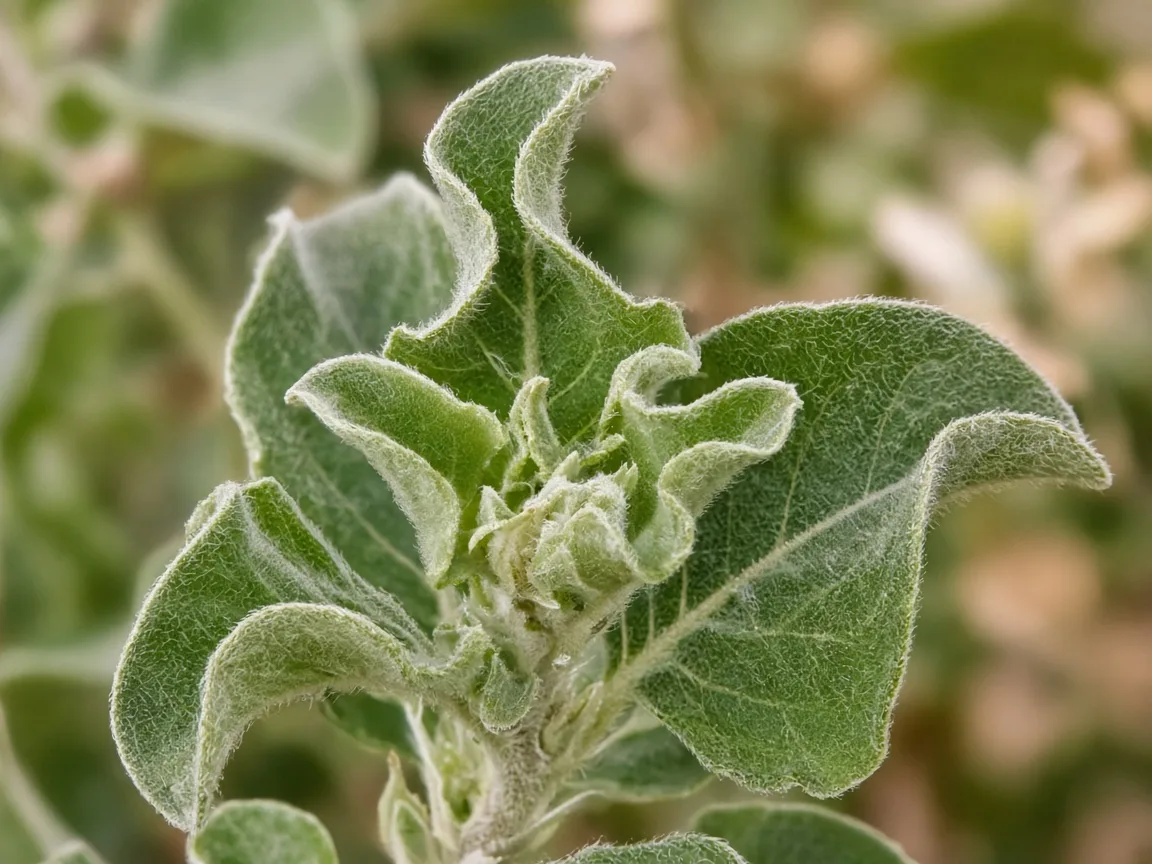
Curling leaf symptoms on Ashwagandha—compare cupped margins on a young shoot with flat silvery tissue lower on the same stem.
Drought curl (common on sunny terraces)
- Individual leaves cup lengthwise or roll inward, often starting at branch tips in peak summer
- Silvery surface turns dull gray-green before full wilting appears
- Soil at 3–4 cm is dry; pot feels light
- Stems stay firm and erect; curl eases within hours after a deep base soak
Spider mite curl
- Newest leaves twist, bronze, or look sandblasted on the upper surface
- Fine webbing on densely hairy undersides and along tender stem tips
- Red spider mites on Ashwagandha feed from undersides, causing yellowing and curling
- Soil moisture looks normal; curl worsens in hot dry balcony air
Aphid curl on tender shoots
- Young leaves at branch tips pucker or curl downward, sometimes around pale green flower buds at the nodes
- Sticky honeydew, ants on stems, or aphids clustered on tender shoots
- Older lower leaves may stay flat while only the tip curls
Heat-stress curl on moist soil
- Curl appears in midday sun on a well-watered terrace plant
- Leaves partially flatten by evening when temperatures drop
- No stippling, webbing, or dry soil at 3–4 cm the next morning
Overwatering-related curl (often paired with yellowing)
- Leaves cup while soil stays wet five or more days after one drink
- Lower leaves may yellow; soft stems at the base are a red flag
- Sour smell or fungus gnats point to saturated mix—see overwatering on Ashwagandha
Why Ashwagandha leaves curl
Fast dry-down in full sun
Ashwagandha needs full sun—six or more hours of direct light daily and cannot grow in shade. More light drives transpiration through hairy ovate leaves on a terrace or south-facing ledge. A small container can cross from moist to dry at 3–4 cm in a single hot afternoon during peak summer.
The species tolerates drought better than wet feet, but water only when the soil dries out—not on a fixed calendar. Growers who treat it as “never needs water” often see curl before obvious wilt on sunny balconies.
Spider mites on hairy leaf undersides
Ashwagandha farming guides list red spider mites feeding on leaf undersides, sucking sap and causing yellowing and curling. The dense pubescence on the underside gives mites cover while the gray sheen on top can hide early stippling. Dry air, heat, and drought-stressed shrubs invite mites faster—curl from thirst and curl from mites can overlap on the same plant.
Aphids on soft new shoots and buds
Nightshade shrubs push soft new growth at branch tips and around flower buds during warm weather. Aphids gather on tender shoots, extracting nutrients and potentially transmitting viruses that cause distorted new leaves. The rest of the shrub may look fine while only the top shoot curls—easy to misread as thirst.
Midday heat on moist roots
On metal railing pots and west-facing terrace edges, leaves can temporarily cup when root-zone temperature and transpiration demand spike—even with adequate soil moisture. This is protective, not a call for another drink. Confirm with a morning finger test at 3–4 cm per the Ashwagandha watering guide.
Wet roots and oxygen loss
Ashwagandha does not like wet feet. Chronic saturation—cachepots, saucer water, or heavy peat mix—stresses uptake. Leaves may curl or dull while lower pairs yellow. This overlaps with root rot when stems soften at the base.
Weak light after an indoor move
A plant moved from full sun to a dim room may show pale, slightly cupped growth without insects—cross-check the Ashwagandha light guide before assuming every curled leaf is pest damage.
Hairy silvery leaf curl vs heat wilt on terrace plants
Ashwagandha’s tomentose leaves fold slightly toward the central vein even when healthy. Learn your plant’s normal gray sheen before calling every subtle fold “curl.”
Heat wilt on moist soil: Curl appears between late morning and mid-afternoon on a recently watered terrace pot. Stems stay firm. Soil at 3–4 cm reads cool and slightly moist the next morning. Leaves partially relax overnight.
True drought curl: Soil at 3–4 cm is crumbly dry for a full day. Pot is light. Curl persists into morning until you soak at the base.
Pest curl: Stippling, webbing, honeydew, or visible insects on branch tips while soil moisture looks normal. Curl does not fully flatten overnight without treatment.
This timing read prevents the most common Ashwagandha mistake—soaking a heat-curled plant at bedtime and sliding into overwatering curl by morning.
Branch-tip inspection: where pests hide on nightshade shoots
Ashwagandha grows as an erect shrub with new shoots at branch tips and pale green flower buds at leaf nodes. The youngest half-unfurled leaf—still soft and silvery—is the first place aphids and mites settle.
Inspection order:
- Follow the newest active shoot to its tip
- Gently lift the youngest leaf and check the densely hairy underside
- Scan any swelling flower bud clusters at the nodes
- Wipe a white paper towel on the underside; orange, green, or gray streaks confirm sap feeders
If pests are present, isolate the shrub away from peppers, tomatoes, and other nightshades. Rinse branch tips under lukewarm running water in early morning so hairy leaves dry before midday sun. Do not soak the whole pot to “help” a mite problem—that worsens wet-soil stress on a plant that already dislikes wet feet.
Stem-base firmness: curl with erect stems vs soft crown
On Ashwagandha, partial leaf curl with firm erect stems usually means thirst, mites, aphids, or heat—not immediate root death. Whole-shrub collapse with limp stems and a soft crown crosses into wilting and needs a wet-vs-dry diagnosis first.
Read the pattern along the shrub:
- Tip-only curl on one branch — aphids, mites, or local drought on that shoot
- Uniform curl on multiple branches with dry 3–4 cm soil — pot-wide dry-down or heat event
- Curl plus yellow lower leaves on wet soil — overwatering or poor drainage, not underwatering
Press the stem base with a gloved finger—all Ashwagandha parts are poisonous if eaten, so avoid bare-hand sap contact around children and pets. Firm tissue supports pest or drought paths. Mushy crown on damp mix means rot protocol before any foliar spray.
How to confirm the cause
- Moisture at 3–4 cm — Dry crumbly mix confirms drought per our watering guide. Cool clinging mix while leaves curl points to pests, heat, or wet-root stress—not thirst.
- Pot weight — Light container plus curl equals dry-down. Heavy pot plus curl on wet soil equals drainage or root issue.
- Branch-tip pests — Webbing, stippling, honeydew, or pear-shaped aphids on new growth.
- Time of day — Afternoon-only curl on moist soil suggests heat; morning curl on dry soil suggests thirst.
- New growth direction — Active branch tips and swelling buds mean the shrub can still recover once the cause is fixed.
- Smell and saucers — Sour mix or standing water rules out underwatering as the primary cause.
The first fix to try
Check soil at 3–4 cm and inspect the newest branch tips before you water or spray.
- If soil is dry and the pot is light: water deeply at the base until drainage runs clear, then return to the 3–4 cm dry rule.
- If soil is moist and you find webbing, stippling, or aphid colonies: isolate the shrub and rinse branch tips and hairy leaf undersides thoroughly in early morning; confirm active pests before applying insecticidal soap.
- If soil is moist, no pests, and curl appeared only yesterday afternoon: wait for a morning recheck—do not add water overnight.
Do not fertilize curled shrubs. Do not repot on day one unless roots are clearly failing in sour wet mix per the Ashwagandha soil guide.
Step-by-step recovery
- Correct the primary stress — Soak for drought; dry cycle for wet soil; rinse for mites or aphids; provide afternoon shade during extreme heat if needed.
- Improve airflow — Space terrace pots so hairy leaves dry after rain or rinsing. Stagnant humid corners invite whiteflies and mites.
- Empty saucers — Cachepots keep bottom mix saturated and mimic overwatering curl on a drought-tolerant shrub.
- Hold fertilizer — Wait for firm new shoots before light balanced feed per our fertilizer guide.
- Trim only fully damaged tips — If mite webbing consumed a branch tip, snip above the next healthy node after the plant stabilizes.
- Re-learn dry-down — After any move to a hotter balcony, track how fast 3–4 cm dries for two weeks.
Recovery timeline
| Stage | What to expect |
|---|---|
| 6–24 hours | Drought curl often eases after one correct soak; heat curl may flatten overnight |
| 3–7 days | Mite- or aphid-rinsed shrubs should show cleaner new leaves without fresh stippling |
| 2–3 weeks | Firm new branch tips and healthy silvery leaf color are the main success markers |
| 4–6 weeks | Flower buds may return on recovered shrubs in warm bright conditions |
Old cupped leaf edges rarely flatten perfectly once they harden. Watch new growth, not damaged tissue.
Lookalike symptoms
| Pattern | What you see | Likely cause |
|---|---|---|
| Dry 3–4 cm + cupped leaves | Dull tips, light pot | Underwatering |
| Stippling + webbing on new tips | Bronze upper surface | Spider mites |
| Sticky branch tips | Ants, puckered young leaves | Aphids |
| Afternoon curl, moist soil | Evening partial recovery | Heat stress |
| Wet soil + yellow lower leaves | Soft stem base possible | Overwatering |
| Silver streaks + distorted unfurling | Bud scarring | Thrips—see distorted leaves |
Mistakes to avoid
- Watering every curled shrub without a soil check — Wet-root curl gets worse with more water on a plant that already dislikes wet feet.
- Treating Ashwagandha like a moisture-loving fern — It is a full-sun nightshade that still needs dry-down discipline between soaks.
- Spraying pesticides before rinsing and confirming pests — Heat-stressed hairy leaves burn easily in midday sun.
- Ignoring branch tips — Lower leaves can look flat while mites or aphids consume the growing point.
- Stacking repot, prune, and spray the same week — Masks whether curl came from care stress or pests.
When to worry
Escalate when curl spreads on sour wet soil, stems soften at the crown, or fine webbing returns within a week after treatment. Unpot and inspect roots if wet-soil curl persists more than ten days despite dry-down. Established Ashwagandha rarely dies from one dry afternoon—but untreated mites, chronic aphids, or waterlogged roots can stall the shrub for a full growing season and weaken root harvest quality.
Pet and child safety: All parts of Ashwagandha are poisonous if eaten, with orange winter-cherry berries especially hazardous. Keep treated plants out of reach and contact your veterinarian or poison control if ingestion is suspected.
How to prevent curling leaves next time
Maintain the 3–4 cm dry-down rhythm year-round. Grow in sandy well-draining mix with full sun per our light guide and soil guide. Empty saucers after heavy rain. Rinse branch tips weekly in hot dry weather. Quarantine new plants for two weeks. Use yellow sticky traps near terrace pots to monitor winged aphids before colonies explode on tender shoots. Avoid heavy nitrogen during long warm days—soft over-fertilized shoots attract aphids faster than firm growth.
When to use this page vs other Ashwagandha guides
- Ashwagandha watering guide — Use for routine moisture checks before assuming curl is the main issue.
- Wilting on Ashwagandha — Better entry when whole stems collapse, not just cupped leaves.
- Underwatering on Ashwagandha — When dry soil and light pot confirm thirst.
- Aphids on Ashwagandha — When sticky branch tips and pear-shaped insects dominate.
- Distorted leaves on Ashwagandha — When thrips scarring or virus-like twisting appears.