Ashwagandha Light Needs: Full Sun & Placement
Ashwagandha Light Needs: Full Sun & Placement
Ashwagandha Light Needs: Full Sun & Placement
Ashwagandha (Withania somnifera) is a short Solanaceae shrub—described by the NIH Office of Dietary Supplements as an evergreen shrub cultivated in tropical and subtropical areas of Asia, Africa, and Europe—grown for a deep, healthy root system, not for soft, shade-grown foliage. NC State Extension is unambiguous: give it full sun (6 or more hours of direct sunlight a day) and expect failure in shade. (NC State Extension Plant Toolbox) Plants For A Future matches that cultural rule: it cannot grow in the shade, wants a warm sheltered position in full sun, and prefers well-drained, often dry stony ground. (Plants For A Future)
The practical goal is simple. Put Ashwagandha where new stems stay firm and silvery-green under real daytime sun, then match watering and drainage to that metabolism. This guide covers how much light the plant needs, terrace and balcony placement for Indian and similar climates, seedling acclimation, indoor winter limits, grow-light backups, and the warning signs that tell you to move the pot before you redesign fertilizer.
How Much Light Ashwagandha Actually Needs
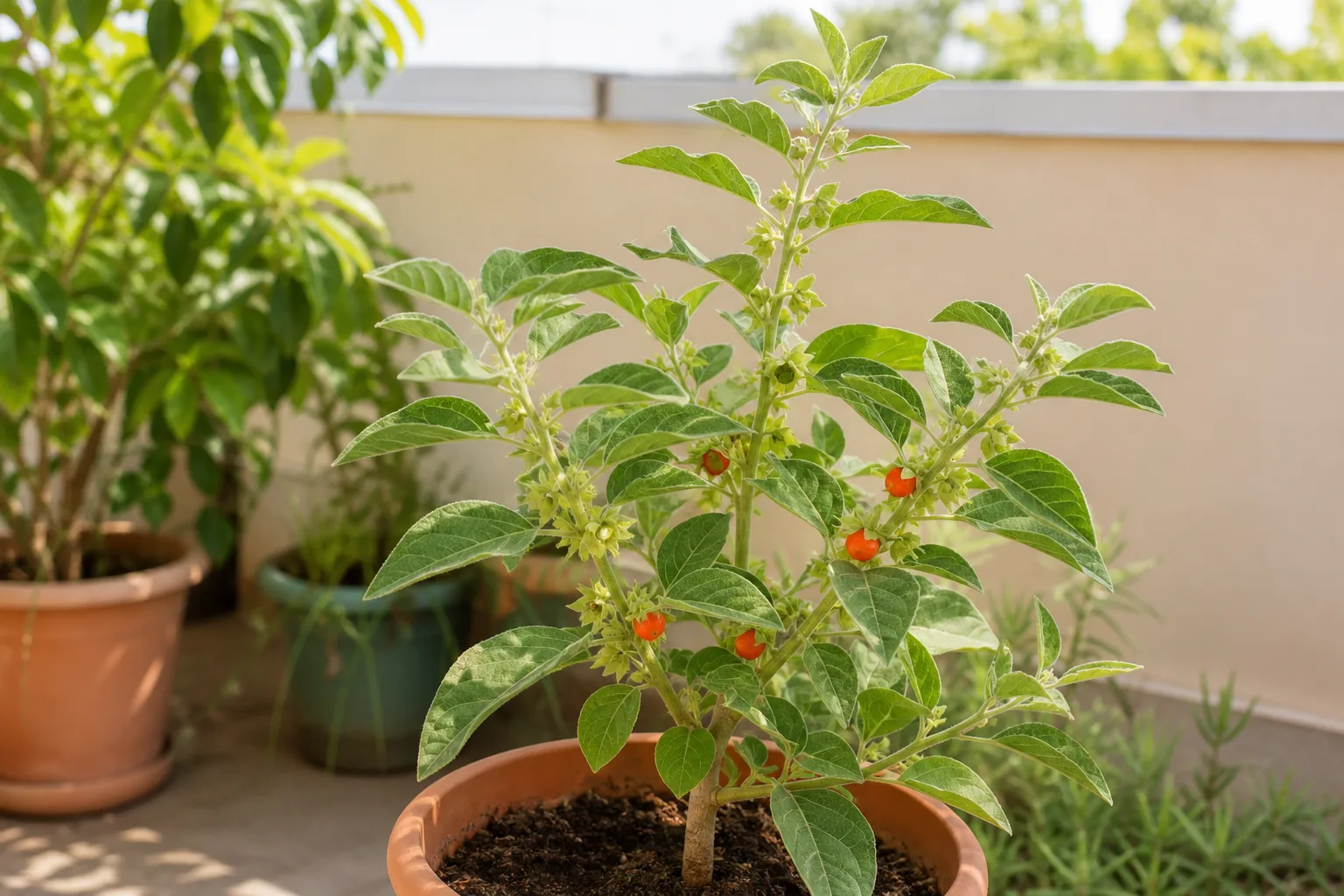
Aim for at least 6 hours of direct sunlight daily for container and bed plants you want to keep stocky, actively growing, and capable of building usable roots. That is the home-grower translation of NC State’s full sun rating for Withania somnifera. (NC State Extension Plant Toolbox) Part shade may keep a nursery seedling from cooking for a few days, but it is not the long-term target for a mature Asgandh shrub on a balcony.
Use a simple field check. On a clear day, hold your hand next to the foliage. If you cast a sharp, dark shadow for much of the day, you are closer to what Ashwagandha wants than a bright-looking living room that only throws a soft shadow. Human eyes adapt to interiors; this plant’s gray-hairy leaves do not.
Full sun vs anything less
Authoritative garden profiles agree that mature Ashwagandha wants open sky. NC State lists light as full sun and states flatly that it cannot grow in the shade. (NC State Extension Plant Toolbox) Plants For A Future marks the species with a full sun icon and repeats the same shade ban, while recommending a warm sheltered full-sun site with well-drained soil. (Plants For A Future)
“Bright room” is not full sun. A north verandah, a deep overhang, or a window that only gets reflected sky light for an hour is shade culture for this species—even if the space feels cheerful to you. Treat those spots as temporary holding zones, not permanent homes.
Surviving vs thriving for a root crop
A plant that “survives” in a bright indoor lobby or a half-shaded courtyard often looks acceptable for weeks because woody stems and hairy leaves do not collapse overnight. Thriving looks different: steady new growth, firmer silvery foliage, shorter internodes, and a potting mix that dries on a predictable schedule after deep watering.
Survival mode shows as long gaps between flushes, pale soft shoots racing toward the brightest wall, delayed flowering, and soil that stays heavy long after you water. At that point people usually blame the Ashwagandha watering guide first. Fix light before you redesign the watering calendar—weak light slows uptake and makes wet feet more dangerous on a plant that already dislikes soggy roots. (NC State Extension Plant Toolbox)
Why Ashwagandha Is a Sun Shrub, Not a Shade Herb
Marketing sometimes sells Ashwagandha as an easy “medicinal houseplant” you can grow anywhere warm. Botany is stricter. NC State describes Withania somnifera as a small shrub or herb of open and disturbed areas, grown as an annual in cooler zones and as a perennial in its native range. (NC State Extension Plant Toolbox) Plants For A Future places it in open places and stony undershrub habitats, not deep woodland understories. (Plants For A Future)
That habitat maps cleanly to home care. Ashwagandha evolved for bright, dryish, well-drained sites. Parking it under a mango canopy or behind a curtain reverses that biology and usually produces lanky stems with little root payoff.
Open, disturbed, stony habitats
In dry regions of India, Sri Lanka, and similar climates, Ashwagandha behaves like an open-ground plant: it sees strong daytime brightness, heat that drives soil dry-down, and soils that drain rather than stay swampy. Plants For A Future notes a preference for dry stony soil even while listing well-drained garden mixes as workable. (Plants For A Future) NC State pairs full sun with good-draining, slightly alkaline sandy soil and watering only after the mix dries. (NC State Extension Plant Toolbox)
Light and drainage travel together. A sunny terrace that stays warm drives both photosynthesis and dry-down. A cool, dim room slows both, which is why poorly lit containers often fail from wet roots rather than a mysterious disease. Pair strong sun with the fast-draining mix in the Ashwagandha soil guide.
Best Placement for Indian Homes and Similar Climates
For most Indian apartments and houses, the winning placement is outdoors: the sunniest terrace, roof, or south-facing balcony where the crown sees open sky most of the day. Use the Ashwagandha plant hub and the Ashwagandha care overview for whole-plant context; this page is the placement deep-dive.
Choose a spot where the pot receives direct sun for the majority of daylight hours, not where the room merely feels bright. If neighboring buildings or a deep overhang cut the sky to a narrow strip of morning light, treat that balcony as part shade and expect slower, lankier growth unless you can raise the pot onto a more open roof edge.
Terrace, roof, and balcony orientation
In the northern hemisphere, south-facing exposures usually deliver the longest daily sun for containers. West-facing balconies can work well but run hotter in late afternoon; watch leaf and pot temperature on black plastic against concrete walls during May–June heat. East-facing balconies give reliable morning sun and are often the gentlest entry point for plants moving out of nursery shade. North-facing balconies are usually too dim for vigorous Ashwagandha unless the site is unusually open to reflected sky light—and even then, growth is typically maintenance-level only.
Rotate the container a quarter turn every two to three weeks if one side leans hard toward the open edge. Leaning is directional growth toward light, not a fertilizer problem. Shelter pots from strong gusts while still keeping the crown in open sun so stems do not snap before they harden.
Indoor windows as winter cover only
Indoor culture is a winter or short-term option, not the ideal permanent home. NC State notes that in cooler climates the plant must be brought indoors, and that it is grown as an annual in zones colder than USDA 8. (NC State Extension Plant Toolbox) Plants For A Future rates it frost tender (about UK zone 9) and says it is not hardy in temperate climates, though it can still flower and fruit in its first year from seed when grown as an annual. (Plants For A Future)
In cooler North Indian winters, move pots under cover or to the brightest protected spot before nights approach freezing—not after soft tips blacken. When you bring a sun-grown shrub indoors, place it against the brightest south or west glass you have, accept slower growth, and cut watering to match the dimmer indoor day. As soon as nights stay reliably warm, return it outdoors and rebuild full-sun hours gradually.
Seedlings, Nursery Starts, and Safe Acclimation
Young Ashwagandha can handle brief filtered light during germination and early nursery life—but only briefly. NC State recommends sowing seed 2 cm deep once air temperatures stay above 70°F (21°C) in full-sun, well-draining sites. (NC State Extension Plant Toolbox) Plants For A Future suggests greenhouse sowing in early spring, then planting out after frost risk with optional cloche protection until plants are established. (Plants For A Future)
That nuance is easy to misuse. Temporary soft light for germinating seeds or soft nursery stock is biology. Permanent shade for a six-month patio plant is a growth trap. Once your container shrub is past the nursery phase, do not keep it under shade cloth “just in case.” Temporary afternoon filtering during an extreme heat wave is fine; multi-month shade culture is how Ashwagandha becomes pale, leggy, and root-poor.
Acclimate over two to three weeks. Week one: morning sun or filtered terrace light for a few hours. Week two: longer direct exposure, still softening the hottest late-afternoon blast if leaves look thin. Week three: full outdoor schedule unless new growth shows bleaching. Do not combine a major light jump with same-day repotting and heavy feeding—change light first, then confirm a flush before other interventions.
Direct Sun, Heat, and Glass Intensity
Acclimated Ashwagandha handles full outdoor sun—that is the normal condition across Indian regions where it is grown as a medicinal field or terrace crop. Problems appear when intensity jumps overnight: a plant from a dim nursery, indoor shelf, or shaded verandah moved straight onto reflective concrete in peak summer.
Heat and light interact. Black plastic pots on a west terrace can cook roots even when leaves look only mildly stressed. Use a light-colored pot, elevate for airflow, and make sure the mix drains fast so wet heat does not combine with full sun to smother roots. NC State’s cultural note—full sun plus soil that dries between drinks—is the paired rule that keeps containers alive. (NC State Extension Plant Toolbox)
Morning sun is the safest first exposure when you are stepping a plant up from shade. Afternoon sun on open terraces is normal for established plants once foliage has thickened through a few weeks outdoors. The riskiest scenario for containers is often direct sun through glass on a plant that lived indoors: panes raise leaf temperature quickly, and unacclimated tissue can bleach or crisp on the sun-facing side.
Low-Light Limits and Honest Indoor Reality
Ashwagandha does not have a meaningful long-term low-light lifestyle. Both NC State and Plants For A Future state that it cannot grow in the shade. (NC State Extension Plant Toolbox) (Plants For A Future) A dim corner may keep a woody stem green for a while, but you should expect stalled flushes, stretched internodes, weak response to fertilizer, and a pot that stays wet dangerously long.
If your only option is a north room or an interior office, treat Ashwagandha as the wrong plant for that spot—or commit to a strong grow light (next section). Do not try to “toughen” this nightshade into shade the way you might with a snake plant. Different biology, different deal.
Also remember toxicity when you move pots indoors for winter: NC State rates the plant as medium-severity poison if eaten, with toxic flowers, fruits, leaves, and roots—especially the orange winter-cherry berries. (NC State Extension Plant Toolbox) Keep bright indoor placements out of reach of pets and children.
Grow Lights When Outdoor Sun Is Not Enough
Grow lights are a backup for winter apartments, shaded courtyards, and short-term indoor housing—not a free pass to keep Ashwagandha in a closet. Use a full-spectrum LED panel or bar positioned so the top foliage receives strong plant-facing light for roughly 12–14 hours daily during indoor stretches. Keep the fixture close enough that leaves cast a clear shadow, but not so close that soft new growth feels hot to the touch.
Raise the light or increase duration if new shoots stay pale and elongated after two weeks. Lower intensity slightly if sun-facing leaves bleach after a sudden move from darkness. Pair any indoor lighting plan with reduced watering and good airflow; artificial brightness without dry-down control still risks root stress. When outdoor nights are warm again, transition back to real sun rather than leaving a full-sun shrub on lamps permanently.
Warning Signs of Too Little or Too Much Light
Too little light usually shows as pale or thin new leaves, long soft shoots with wide internodes, leaning toward the window, stalled flowering, and soil that remains heavy for many days after watering. Weak light also makes overwatering more likely because the plant uses moisture slowly while still sitting in a mix that never sees heat.
Too much sudden intensity—especially after indoor or nursery shade—shows as bleached or crispy patches on the sun-facing side within days of a move, sometimes with leaf drop. That is an acclimation injury, not proof that Ashwagandha “hates sun.” Established outdoor plants rarely need shade cloth for light alone; they more often need wind shelter, drainage, and a pot that does not cook roots.
When you are unsure, change one variable: move toward stronger outdoor sun (with a gradual schedule), then watch the next flush for two weeks before altering fertilizer or pot size. If the mix stays wet after you improve light, revisit watering and soil rather than stacking more interventions. For root-focused harvests, judge success by firm stems and steady growth in strong sun, not by lush soft foliage in shade.
When to Use This Page vs Other Ashwagandha Guides
Use this page when the question is where the plant should live and whether sun is the limiting factor. Switch to sibling guides when the bottleneck is clearly something else:
- Ashwagandha watering — dry-down timing, summer heat drinks, and cool-season cutbacks once light is adequate
- Ashwagandha soil — sandy, fast-draining mixes that keep full-sun pots from staying swampy
- Ashwagandha fertilizer — feeding only after light and roots are stable
- Ashwagandha repotting — pot size when growth stalls despite full sun
- Ashwagandha propagation — seed and cutting starts, including warm bright aftercare
- Ashwagandha pruning — shaping sun-grown shrubs without hiding them from light
Related Ashwagandha Guides
- Ashwagandha plant hub — species profile, size, and grower notes
- Ashwagandha overview — full care summary across topics
- Ashwagandha watering — how sun-driven dry-down changes the calendar
- Ashwagandha soil — drainage for sun-heated containers
- Ashwagandha propagation — starting plants that will need full sun later
Conclusion
Ashwagandha is a full-sun medicinal shrub. Give established plants at least 6 hours of direct light on the brightest terrace or balcony you have, treat indoor windows as temporary winter cover, and use soft light only for brief seedling stages. When growth turns pale or leggy, move toward stronger sun before you rewrite watering or fertilizer. Get placement right, and the rest of the Ashwagandha care cluster becomes much easier to manage.