Root Rot on Ashwagandha: Crown Rescue Steps
Quick answer
Root rot on Ashwagandha starts underground while silvery-green hairy leaves still look partly healthy—then a mushy black stem crown climbs on damp sandy mix. First step: stop all watering and press the woody stem base just above the soil line with clean fingers.
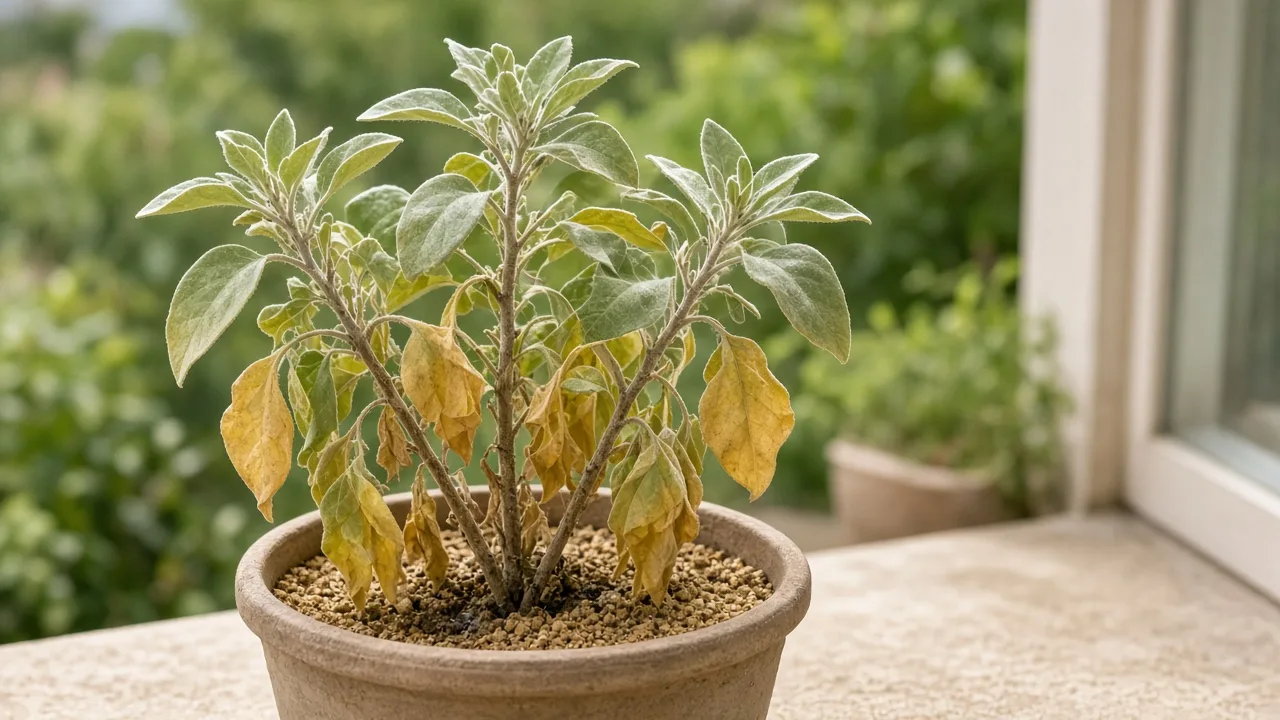
Root Rot on Ashwagandha: Causes, Checks & Fixes
This guide covers root rot on Ashwagandha. See also the general Root Rot guide, watering, and light pages for this plant.
Root Rot on Ashwagandha: Causes, Checks & Fixes
Quick answer
Root rot on Withania somnifera (Ashwagandha, Indian Ginseng, Winter Cherry) is crown failure from chronic wet mix—not a mysterious leaf spot. This woody Solanaceae shrub evolved in open and disturbed dry habitats and stony open ground. When soil stays saturated, roots lose oxygen and die; decay then climbs the hairy woody stem crown long before the whole shrub collapses.
For how chronic wet soil destroys roots in general, see our root rot guide. On Ashwagandha, the tell is a heavy wet pot, sour smell, yellowing lower silvery leaves, and—most critically—a soft, spongy, or black stem base just above the soil line while upper branches still look partly green.
First step: stop all watering immediately. Then press the woody stem crown just above the soil line with clean fingers. Soft or hollow tissue on wet mix means unpot and inspect roots the same day—do not add water, fertilizer, or fungicide first.
When to use this page vs other Ashwagandha guides
| Pattern | Read next |
|---|---|
| Heavy wet pot, yellow lowers, firm stem crown | Overwatering — dry-down pause may be enough |
| Soft crown + wet soil + mushy roots (this page) | Stay here for unpotting and salvage |
| Light dry pot, firm stems, midday wilting | Underwatering |
| Whole plant limp on wet soil | Advanced rot—start surgery below |
| Fungus gnats + surface mold only | Fungus gnats or mold on soil — moisture alarm, not always crown rot yet |
| Silvery leaves drooping, firm base | Drooping leaves |
What root rot looks like on Ashwagandha
Unlike soft-leaved houseplants, Ashwagandha holds silvery-green, softly hairy leaves on stiff erect woody stems above a firm crown—until rot climbs from below. Lower leaves yellow and drop first; upper foliage can stay deceptively green while roots have already failed.
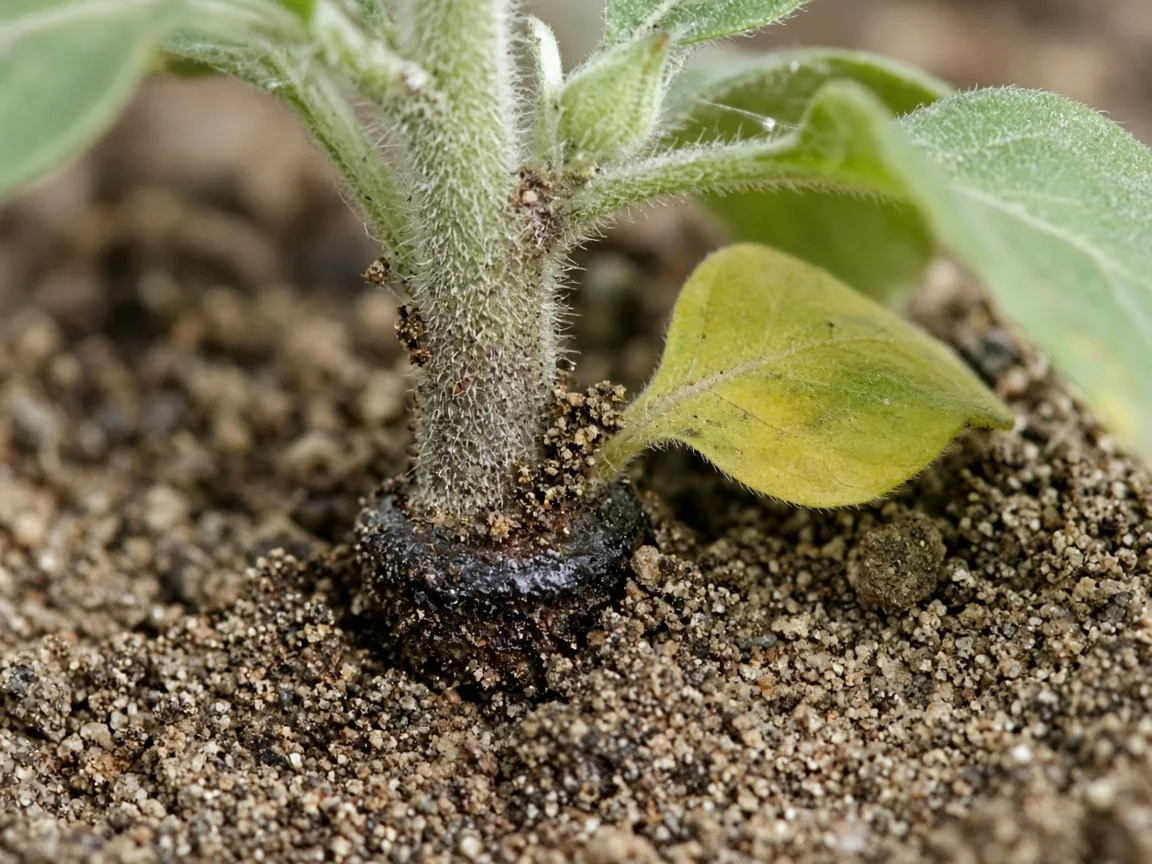
Root rot at the soil line—darkening and spongy tissue on the hairy woody stem crown while damp sandy mix clings to the lowest stem section.
Early signs (roots failing, crown still partly firm)
- Heavy pot days or weeks after watering; mix never fully dries at 3–4 cm depth
- Sour or rotten smell from drainage holes or when you tilt the pot
- Yellowing lower silvery leaves that stay limp rather than crispy on damp mix
- Slightly spongy stem at the soil line while upper woody branches still feel erect
- No new silvery tips for weeks while mix stays damp near the crown
- Fungus gnats or surface mold over persistently wet mix
- Unpotting reveals brown, mushy, or translucent roots while stem bases still feel mostly solid
Advanced signs (rot climbing the woody crown)
- Mushy, blackening, or hollow stem crown spreading up the lowest hairy stems
- Wilt paradox—limp drooping leaves despite wet soil because damaged roots cannot move water; see wilting if several stems sag at once
- Sudden collapse of multiple lower leaves overnight on unchanged soggy soil
- Black tissue above the soil line with no firm woody tissue left at the root crown
- Stalled growth in warm weather while mix never dries—pair with slow growth only after you rule out shade and rot
A single yellow lower leaf on firm stems is not automatically root rot—this shrub naturally sheds older foliage, especially near harvest. Root rot adds wet mix + soft crown + progressive yellowing + sour smell to that picture.
Reading the woody stem crown before you unpot
This plant-only check does not apply to ferns or pothos. Ashwagandha is a short woody Solanaceae shrub grown for deep roots, not soft foliage. Press each stem base just above the soil line:
- Firm like a young tree branch — Roots are likely still functional. Match yellow leaves to shade weakness, seasonal drop, or brief thirst—not automatic surgery.
- Spongy or denting at the crown — Stop all water even if leaves look dry. Stem and root rot is a listed problem when drainage fails. Unpot the same day.
- Slight flex on fully dry sandy mix — Acceptable in summer active growth; water deeply only when the top 3–4 cm is dry per your dry-down rhythm.
Pair stem feel with pot weight. A heavy, cool pot days after you thought you watered lightly means wet mix at depth even when the surface looks pale and dry—a common pattern when the plant sits in weak indoor or shaded light.
Harvest-season yellowing vs true root rot
Ashwagandha growers often watch foliage as a root-readiness signal, not just a decoration problem. When orange winter-cherry berries mature inside their papery calyx, lower leaves commonly yellow and dry before roots are dug—similar to how NC State describes harvesting roots when flowers and fruits form and leaves start to dry.
That pattern is different from rot:
- Stems stay erect and firm at the base
- Mix dries on schedule after watering; no sour smell
- Damage climbs slowly from the oldest nodes upward, not a sudden collapse on unchanged soggy soil
- Newest tips may still look green or only lightly faded
If you are mid-season on a young patio plant with soft stems and wet mix, treat it as pathology—not harvest timing.
Why Ashwagandha gets root rot
Withania somnifera is a rapid-growing sun shrub that still punishes wet crowns harder than brief drought. Root rot happens when woody stems sit in saturated, low-oxygen mix until tissue breaks down from the roots upward.
Calendar watering without a probe. Watering every few days because the label said “keep moist” ignores the 3–4 cm dry-down rule. Sandy mix in full sun may need a deep drink weekly in summer; the same schedule drowns a shaded pot.
Heavy, water-retentive mix in containers. Outdoor beds tolerate loam better than peat-heavy indoor pots. Without extra perlite or coarse sand, roots in waterlogged soil die from lack of oxygen and fail to supply the shrub evenly.
The shade-and-wet-mix trap. Ashwagandha needs full sun with good-draining sandy soil and cannot grow in the shade. Plants For A Future adds a preference for dry stony ground in open habitats. Weak light slows transpiration; water you add on Tuesday is still sitting near the crown on Friday—see not enough light if stems are pale and stretched.
Cool dormancy with summer watering habits. Ashwagandha slows in cool weather. Mix that would dry in two days on a July terrace may take two weeks indoors in winter—yet many owners keep the same pour volume.
Escalation from overwatering. Mild chronic wet mix often shows up first as overwatering—yellow lower leaves and a heavy pot. Root rot is confirmed once roots turn mushy and the stem crown softens. Treat overwatering with a dry-down pause only while tissue is still firm.
Fungal pathogens in wet soil accelerate breakdown, but the trigger is almost always excess moisture at the root crown—not airborne leaf disease.
How to confirm the cause
Work through these checks in order. Root rot is confirmed by mushy roots and soft stem crowns in wet mix—not by leaf color alone.
- Stop watering — Every additional soak spreads decay through stored stem tissue.
- Lift the pot — Heavy days after watering means saturation; learn your dry weight.
- Smell drainage holes — Sour or rotten odor means anaerobic decay, not a surface issue.
- Probe at 3–4 cm — Wet, cool, soil-stained probe on a heavy pot supports rot risk.
- Press each stem crown — Soft, hollow, or squishy on wet mix confirms rot has climbed from roots.
- Unpot and inspect roots — Healthy roots are pale and firm with a characteristic strong odor. Rotted tissue is brown, black, mushy, or slips off the stem.
- Compare to underwatering — Light pot, crumbly dry mix, firm erect stems means thirst, not surgery.
If mix is wet, roots are mushy, and the stem crown softens, you have confirmed root rot. No fungicide replaces removing wet soil and decayed tissue.
First fix for Ashwagandha
Stop all watering immediately. Move the pot to the sunniest placement you have with good airflow—do not blast damaged roots with harsh midday sun on the first day.
Then unpot the same day if the crown is soft, black, or smells sour:
- Wear gloves—all parts are poisonous if eaten, including roots and berries.
- Knock the plant out gently and shake off all wet mix. Discard foul soil entirely.
- Rinse roots lightly with lukewarm water only if mix is heavily compacted—work quickly so tissue does not sit wet longer.
- With sterilized shears, cut away every mushy root and any soft black stem tissue at the soil line. Keep cutting until you reach firm woody stem.
- If rot has entered the lowest inch of stem, cut above firm tissue on each affected branch.
- Let cut surfaces air-dry uncovered in bright indirect light for 24–48 hours so wounds callous.
- Repot remaining firm stems into dry fast-draining sandy mix in a pot sized to trimmed roots—not the original oversized container. See soil guide.
- Wait one to two weeks before the first light soak at the pot edge.
That single sequence—stop water, remove decay, dry repot—is the rescue. Do not stack fertilizer, misting, or pesticide on the same day.
Stem-cut salvage when rot climbs the crown
When the root crown is hollow but upper branches are still firm and green, stem-cut propagation beats saving the base. NC State Extension lists stem cutting as a recommended propagation strategy for this species—this salvage path does not apply to ferns or peace lilies.
- Identify the highest firm green tissue on each branch—press along hairy stems; rot feels soft or hollow.
- Cut above the rot with sterile shears. Wear gloves when handling cut tissue.
- Lay firm cuttings on dry newspaper in bright indirect light for 3–7 days until cut faces callous and no longer look wet.
- Plant callused tops in dry warm sandy mix, buried only deep enough to stand upright—see propagation guide.
- Do not water for the first week; then give a light edge soak only when the top 3–4 cm is fully dry.
- Discard mushy lower sections and contaminated soil—do not compost wet rot tissue indoors.
One healthy 15 cm cutting can regrow a full shrub over a warm season. A collapsed crown rarely recovers once woody tissue has turned black and spongy above the soil line.
Step-by-step recovery
Week 1–2: Stabilize without water
Keep the plant in bright sun with airflow—this sun shrub recovers faster when it can photosynthesize, but avoid scorching freshly trimmed crowns. Do not water. Yellow lower leaves will not re-green; judge by stem firmness and whether soft spots stop spreading.
Week 3–4: First cautious drink
If mix is completely dry throughout the pot at 3–4 cm depth, give a light soak and empty the saucer immediately. Water only when soil dries out—this species does not like wet feet.
Month 2–3: Watch for new silvery tips
Clean new leaves at branch tips are the best sign rot has stopped. A firm stem crown with no new soft spots is positive even when lower leaves are gone.
Month 3+: Resume minimal care
Resume sparse feeding only after new growth looks normal for two weeks and the crown stays firm. Follow the watering guide dry-down rhythm strictly—one wet spell can restart rot on weakened roots.
Recovery timeline
| Stage | What to expect | Positive sign | Warning sign |
|---|---|---|---|
| Days 1–14 | Plant looks unchanged or worse above soil | Stem crowns stay firm; soft spots do not spread | Sour smell returns; crown softens further |
| Weeks 3–4 | First dry-down cycle completes | Mix dries evenly at 3–4 cm; no new black tissue | Pot stays heavy; mix never fully dries |
| Months 2–3 | New silvery tips possible on upper branches | Firm stems + fresh tip flush | Additional yellowing with wet-feeling mix |
| Month 3+ | Gradual fill-in if salvage succeeded | Multiple firm branches producing new growth | Hollow stem crowns after repotting |
Realistic expectation: mild cases caught while most roots remain firm often stabilize within one to three months. Severe crown loss usually means stem-cut propagation, not a quick return to a mature harvest-sized root ball.
Lookalike symptoms
| What you see | Likely cause | Key check | First action |
|---|---|---|---|
| Soft crown, wet soil, mushy roots | Root rot | Stem crown gives under pressure | Stop water, trim, dry repot |
| Heavy wet pot, firm crown, yellow lowers | Early overwatering | Roots still firm on unpotting | Dry-down pause |
| Light pot, firm stems, dry mix | Underwatering | Crown firm; roots pale and dry | Soak when fully dry |
| Crispy brown margins, light pot | Drought or sun scorch—brown leaves | Base firm; no sour smell | Adjust watering and light |
| Pale yellow-green on wet mix | Root stress—yellow leaves | Check crown firmness | Stop water; inspect roots |
| Limp stems, wet soil, soft crown | Advanced rot (this page) | Black tissue at soil line | Same-day surgery |
Root rot specifically means mushy roots and soft stem crowns in wet mix. Firm erect stems on crumbly dry soil point elsewhere even when lower leaves look unhappy.
Mistakes to avoid
- Keep watering wilted leaves when soil is already wet. Wilt with saturated mix often means rotting roots cannot take up water—not thirst.
- Wait for the whole shrub to collapse before unpotting. Silvery upper foliage hides crown failure; press the lowest inch of every stem.
- Repot into standard potting soil. Moisture-retentive peat repeats the conditions that caused rot.
- Repot into a larger container. A bigger wet zone makes recovery harder—size to trimmed roots.
- Fertilize a stressed shrub before crowns stay firm for two weeks.
- Water immediately after repotting. Fresh wounds on trimmed roots and stems need callous time in dry mix.
- Assume fungicide replaces surgery. Wet soil and mushy tissue must be removed physically.
- Confuse harvest yellowing with rot when mix is sour and stems dent on wet soil.
Ashwagandha care cross-check
Root rot is almost always a stacking failure of water, soil, light, and pot choice—not bad luck.
Watering. Water only when the top 3–4 cm is dry. Full rhythm details match NC State’s guidance to water when soil dries out.
Soil. Use sandy well-draining mix with perlite or coarse sand. Dense peat holds moisture around the stem crown for days—see the soil guide.
Light. Full sun on the sunniest terrace you have helps mix dry predictably. Dim corners slow water use—stretch intervals accordingly.
Pot and drainage. Open drainage holes, right-sized containers, and empty saucers within 30 minutes of every watering.
Season. Cut watering sharply in cool dormancy when growth slows and mix takes longer to dry.
How to prevent root rot next time
- Water only when the top 3–4 cm of sandy mix is fully dry—not on a calendar.
- Use fast-draining sandy mix in a pot with open drainage holes.
- Size pots to the root ball; avoid large decorative containers that hold excess soil moisture.
- Press the lowest inch of every woody stem whenever you water.
- Learn dry pot weight by lifting weekly.
- Reduce watering frequency in winter when rooms cool and growth slows.
- Empty saucers and cachepots after every soak.
Missouri Botanical Garden notes that waterlogged soil causes roots to die from lack of oxygen—that single dry-down habit prevents most root rot cases on a plant built for dry open habitats.
When to worry
Treat as urgent when the crown feels mushy, the mix smells sour, or black tissue climbs above the soil line with no firm woody tissue left. Same-day trimming and dry repotting gives the best chance.
Salvage is unlikely when every stem base is hollow and mushy. Before discarding the plant, take stem cuttings from any firm upper tissue—Withania somnifera roots from stem cuttings in warm sandy mix once callused.
Mild cases caught while stem crowns are still mostly firm recover well if you act before decay reaches the woody core. If rot has already hollowed the crown, stem-cut propagation is often more realistic than saving the original root ball.
Related Ashwagandha guides
- Ashwagandha overview
- Overwatering — dry-down pause before rot advances
- Watering — soak-and-dry rhythm after recovery
- Light — full sun placement that speeds dry-down
- Soil — sandy mix that drains fast
- Propagation — stem-cut salvage protocol
- Fungus gnats — wet-mix follow-on pest
- Problems hub
Conclusion
Root rot on Ashwagandha is a stem-crown and root-ball problem hidden by silvery-green hairy foliage. Stop water, press the woody stem base just above the soil line, and unpot when tissue softens on wet mix. Firm crowns, dry sandy soil, and clean new silvery tips at branch ends are the recovery signals; yellow lower leaves will not re-green, and that is normal once the root zone stabilizes.
Related tool
Use the Root Rot Risk Checker to narrow causes for root rot on this plant before changing multiple variables at once.