Leaf Miners on Barrel Cactus: Rare on Ferocactus — What
Quick answer
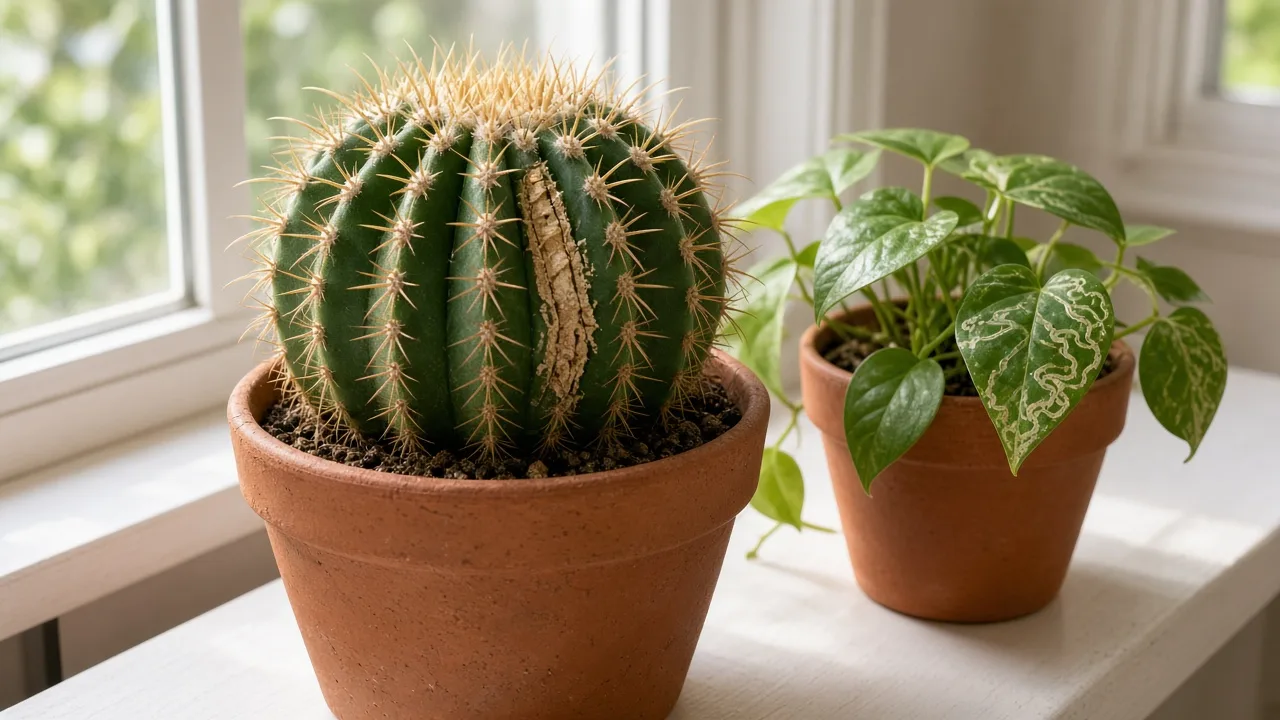
Leaf miners tunnel inside broad leaves — barrel cactus (Ferocactus) is a ribbed, mostly leafless stem cactus, so true serpentine mines on the plant itself are extremely rare. First step: confirm the damage is on the cactus ribs or crown, not on a leafy potmate; then magnify for a bordered internal tunnel before you spray.
Leaf Miners on Barrel Cactus: Causes, Checks & Fixes
This guide covers leaf miners on Barrel Cactus. See also the general Leaf Miners guide, watering, and light pages for this plant.
Leaf Miners on Barrel Cactus: Causes, Checks & Fixes
Quick answer
Leaf miners are tiny fly larvae that feed between the upper and lower surfaces of broad leaves, leaving twisting pale trails (mines) as they grow. Barrel cactus (Ferocactus) is a ribbed, spine-covered desert stem with no conventional leaf canopy — flowers bloom in a crown formation on top, and the body is hardened rib tissue, not thin blades miners can tunnel inside.
For how leaf miner life cycles work and why contact sprays miss larvae, see our leaf miners guide. On barrel cactus, the practical pattern is different: owners search this symptom when they see pale lines on ribs, crown stippling, or — most often — serpentine tunnels on a leafy neighbor sharing the same windowsill.
First step: photograph the exact spot, then confirm whether you are looking at actual leaf tissue on the cactus or at rib scars, crown pests, or mines on a different plant beside the pot.
A firm base on bone-dry mix with only hard dry marks on ribs usually means lookalike damage — see black spots or holes in leaves routing. A soft base on wet mix is a different emergency — read root rot on barrel cactus before you treat for flies.
When to use this page vs other Barrel Cactus guides
This page is the misidentification and routing entry for serpentine tunnel symptoms near a barrel cactus.
| Pattern | Read next |
|---|---|
| Bordered pale tunnel inside a thin leaf blade (on any plant) | Treat the leafy host; see global leaf miners |
| Hard dry linear scar on a rib, no internal tunnel | Black spots or old mechanical injury |
| Ragged surface chew with frass pellets at crown | Caterpillars |
| Open through-damage on stem skin | Holes in leaves routing (stem injury) |
| White cottony patches in areole crevices | Mealybugs |
| Hard brown bumps that do not move | Scale insects |
| Fine webbing and yellow stippling on ribs | Spider mites |
| Soft base, yellow lower tissue, wet mix | Overwatering or root rot |
What leaf miners look like — and why they rarely fit barrel cactus
The clearest leaf miner sign is a serpentine mine — a twisting white or pale trail inside a leaf blade, often with a dark line of larval waste (frass). Adult flies are small black insects that lay eggs inside leaves; larvae are yellow maggots feeding between epidermal layers for about two weeks in warm weather before dropping to pupate in soil or on the pot surface.
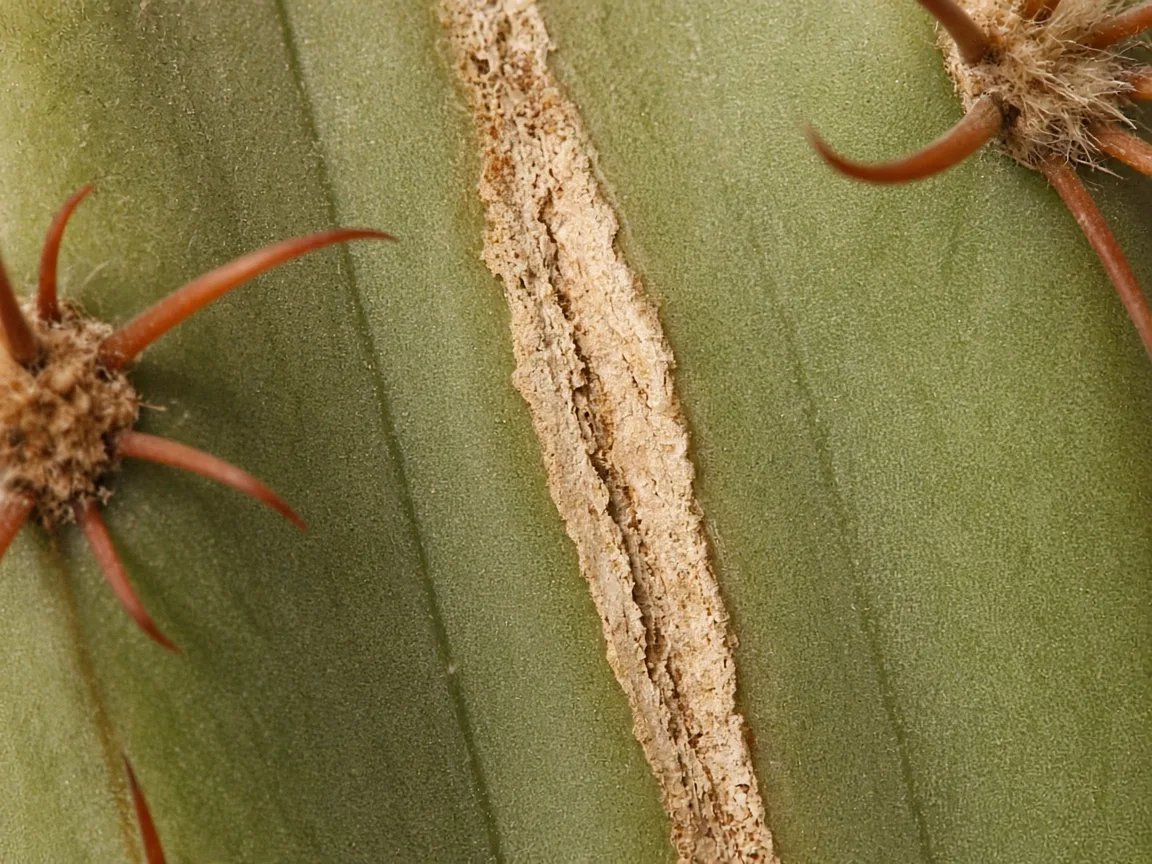
Hard dry corky line on rib tissue between areoles — owners sometimes mistake this for a serpentine mine, but true leaf miner tunnels require an enclosed leaf blade.
On Ferocactus, the body is a thick cylinder-like stem with well-defined ribs and sharp curved spines. There is no leaf undersurface to inspect. NC State Extension lists mealybugs, spider mites, fungus gnats, and scale as occasional barrel cactus pests — leaf miners are not on that list because this genus does not offer the broad-leaved hosts miners prefer (begonia, impatiens, tomato, bean, marigold, and similar ornamentals per UC IPM host records).
What owners actually see near a barrel cactus:
- Serpentine mines on a leafy potmate — Pothos, pepper seedlings, coleus, or herbs on the same sill are far more likely hosts than the cactus.
- Pale linear corking or healed scars on ribs — Firm, dry lines that do not widen over days; see black spots.
- Crown stippling or bud distortion — Often aphids or thrips at the only soft tissue, not enclosed tunnels.
- Surface grazing at the crown — Caterpillar chew removes tissue outright with pellet frass on the skin, not bordered internal mines.
Rib-surface inspection without leaf undersides (barrel cactus only)
Leaf miner guides for houseplants tell you to check leaf backs and backlight blades. Ferocactus has no leaf backs — your inspection path runs crown → upper areoles → rib grooves → soil line. Use kitchen tongs wrapped in paper towel to tilt the pot and photograph the growing tip where ribs meet. A true mine would require a thin enclosed blade; rib skin is one continuous hardened layer. If you cannot backlight tissue and see a bordered tunnel with intact green on both sides, you are not looking at a leaf miner on the cactus body.
Windowsill companion-plant check (barrel cactus only)
Barrel cactus often sits on the brightest south or west sill beside faster-growing leafy plants that miners actually attack. Leafminer populations move between hosts as new plants become available each season. Before you dab alcohol on cactus spines, scan every neighboring pot for pale winding trails inside leaves. Treat and isolate the leafy host; the barrel may need no pest treatment at all.
Spine-safe crown exam when flies are suspected (barrel cactus only)
If adult leaf miner flies are hovering — small active black flies often with yellow markings — they are almost certainly emerging from a leafy plant, not from ribbed stem tissue. Still, wear protective gloves when handling barrel cactus before you inspect the crown up close. Dab, do not scrub, if you find aphid or scale colonies at the growing tip instead of mines.
Why barrel cactus almost never gets leaf miners
No leaf canopy to mine. Leafminers in the genus Liriomyza need leaf tissue between epidermal layers. Ferocactus photosynthesizes through its ribbed stem; spines arise from areoles. The plant’s softest tissue is the crown and swelling flower buds in late spring to early summer — flies that need enclosed blades target neighbors, not fishhook spines.
Desert-adapted pest resistance. Barrel cactus is usually pest and disease resistant indoors when kept dry and bright. The pests that do appear — mealybugs, mites, gnats, scale — feed on sap at areoles or soil, not inside nonexistent leaves.
Warm sill + mixed collections. Indoor barrels on hot windowsills sit beside miner-prone ornamentals. Owners attribute nearby tunnel damage to the most dramatic plant in the pot grouping.
Misread rib scars. Corking, old spine wounds, and sunburn on the brightest rib create pale or tan lines that look like trails in photos but are hard, dry, and static on close inspection.
Leaf miners rarely kill established plants even on true hosts. On a firm barrel cactus with stable full sun and dry-down watering, cosmetic rib marks are a routing problem, not a colony crisis.
How to confirm the cause
Work through these checks in order:
- Identify the host plant. Is the serpentine trail inside a leaf blade, or on rib/crown skin? Leaf blade = leafy neighbor or weed in the pot, not the cactus stem.
- Backlight test (leafy plants only). A bordered internal tunnel with a frass line confirms miners on that host. Rib scars do not show an enclosed tunnel when magnified.
- Skewer and base press. Dry skewer through the pot; firm ribs on dry mix mean prioritize lookalike routing over fly sprays on the cactus.
- Crown scan with tongs. Look for aphids, mealybugs, or scale at the growing tip — the real pests on soft crown tissue.
- Neighbor pot sweep. Inspect every plant within two feet on the same sill for active expanding mines.
- Expansion check. True mines lengthen over several days. Hard rib lines that stay the same size for weeks are scars or corking.
- Frass location. Miner frass sits inside a bordered tunnel in a leaf. Pellet frass on the surface at the crown points to caterpillars.
If every leafy plant on the sill is clean and the barrel shows only firm dry rib marks, you likely do not have a leaf miner problem on the collection — maintain mineral soil and rare watering and monitor monthly.
First fix for barrel cactus
Photograph the damage, then isolate and treat the actual leafy host — not the barrel — if you confirm a bordered serpentine mine on a blade.
When mines are on pothos, herbs, or other neighbors, remove mined leaves from that plant, bag the foliage, and move it away from the cactus immediately. Insecticides are not very effective for leafminer control even on true hosts — pruning mined blades beats spraying the barrel.
When damage is only on Ferocactus ribs or crown with no internal leaf tunnel:
- Do not spray neem, soap, or horticultural oil on the whole barrel as a first response — products that miss larvae inside leaves still stress a desert cactus and can pool at the crown.
- Route to the correct guide — corky hard lines → black spots; crown sap feeders → aphids or scale; surface chew → caterpillars.
- Hold watering steady per the barrel cactus watering guide — extra moisture after a misread pest scare invites root rot.
| Confirmed pattern | First fix |
|---|---|
| Serpentine mine inside a neighbor’s leaf | Isolate leafy host; prune mined blades; bag foliage |
| Hard dry line on rib, no tunnel | No miner treatment; monitor or see black spots |
| Soft insects at crown | Alcohol swab crown colonies; see aphids |
| Ragged crown chew with surface frass | Hand-pick; see caterpillars |
| Soft base, wet mix | Stop watering; see overwatering |
Step-by-step recovery
Once you have routed the symptom correctly:
- Treat true hosts only. Prune expanding mines on leafy plants; leave the barrel on its normal light and watering schedule if ribs stay firm.
- Scout the sill weekly through warm months when leafminer generations turn over quickly. Check neighbors before re-inspecting cactus ribs.
- Scrape brown pupae from saucers and bench surfaces beneath infested leafy pots — larvae drop to the ground to pupate.
- Avoid broad-spectrum sprays on mixed collections; killing parasitic wasps often triggers worse miner flares on ornamentals beside your cactus.
- Re-check the crown in three to five days if you found sap feeders instead of miners — new spine clusters should look clean, not sticky or distorted.
Do not repot the barrel, rotate it into dimmer light, and spray pesticides on the same day. Ferocactus recovers best when you change one variable and read the ribs.
Recovery timeline
On leafy neighbors with true mines: New clean leaves often appear within two to three weeks after pruning if the plant is vigorous. Mining usually has little impact on plant growth on established specimens.
On the barrel cactus itself: Rib scars and corking do not disappear — they stay as dry marks. Recovery means:
- Firm ribs and stable base on dry mix
- Clean new spine growth at the crown without stickiness or soft spots
- No spreading soft tissue at the soil line
Barrel cactus grows very slowly. Judge success by crown health over months, not days.
Signs the situation is worsening: softening base on damp mix, black spreading patches on ribs within a week, or mines multiplying through every leafy plant on the sill despite pruning — escalate neighbor isolation and consider discarding severely infested herb or annual seedlings that are not worth saving.
Mistakes to avoid
- Spraying the barrel because a neighbor has mines. Contact products do not reach larvae inside distant leaves and add stress to a leafless cactus.
- Treating hard rib scars as active tunnels. Static dry lines rarely need any pesticide.
- Heavy crown rinses. Water pooling at the growing tip invites rot on a plant built for dry air — see overwatering.
- Confusing caterpillar chew with miners. Surface frass pellets and ragged crown tissue mean caterpillars, not enclosed trails.
- Composting mined leaves from neighbors. Pupae can survive and reinfest the windowsill collection.
- Handling the barrel bare-handed while inspecting the crown — sharp spines can puncture skin.
How to prevent leaf miner confusion next time
- Quarantine new leafy plants two weeks before placing them beside a barrel cactus on the bright sill.
- Inspect patio returns for serpentine mines on leaves before winter bring-in — eggs may be inside blades weeks before tunnels show.
- Keep the barrel on mineral mix with full drainage per the soil guide so rib corking from moisture stress is less common.
- Photograph suspicious marks when they first appear — static scars and expanding mines behave differently over a week.
- Reserve broad-spectrum insecticides for confirmed scale or mite crises, not routine prevention on mixed sills.
- Space pots slightly so you can inspect leafy neighbors without brushing against cactus spines.
Related Barrel Cactus guides
- Barrel Cactus overview — care hub for Ferocactus basics
- Barrel Cactus problems hub — full symptom index
- Caterpillars on Barrel Cactus — ragged crown chew, not internal tunnels
- Holes in leaves — stem surface damage routing
- Black spots on Barrel Cactus — hard rib scars and rot sorting
- Aphids on Barrel Cactus — crown sap feeders
- Watering guide — dry-down rhythm after a pest scare
- Light requirements — full sun placement for firm growth
Use this page when you are deciding whether serpentine tunnel symptoms belong on your barrel cactus at all. Route to caterpillars for crown chew, black spots for hard rib marks, and the global leaf miners guide for true mines on leafy hosts nearby.
Related tool
Use the Plant Problem Diagnosis Tool to narrow causes for leaf miners on this plant before changing multiple variables at once.