Custard Apple Overwatering: Wet-Pot & Shallow-Root Fixes
Quick answer
Overwatering on Custard Apple (Annona squamosa) shows as a heavy wet pot long after watering, yellow lower leaves while the top 3–5 cm stay cool and clinging, limp lanceolate foliage on soggy mix, and stalled flushes on shallow roots that cannot tolerate waterlogging. First step: stop all irrigation, empty saucers, and wait until the upper 3–5 cm of mix feel dry before the next deep soak.
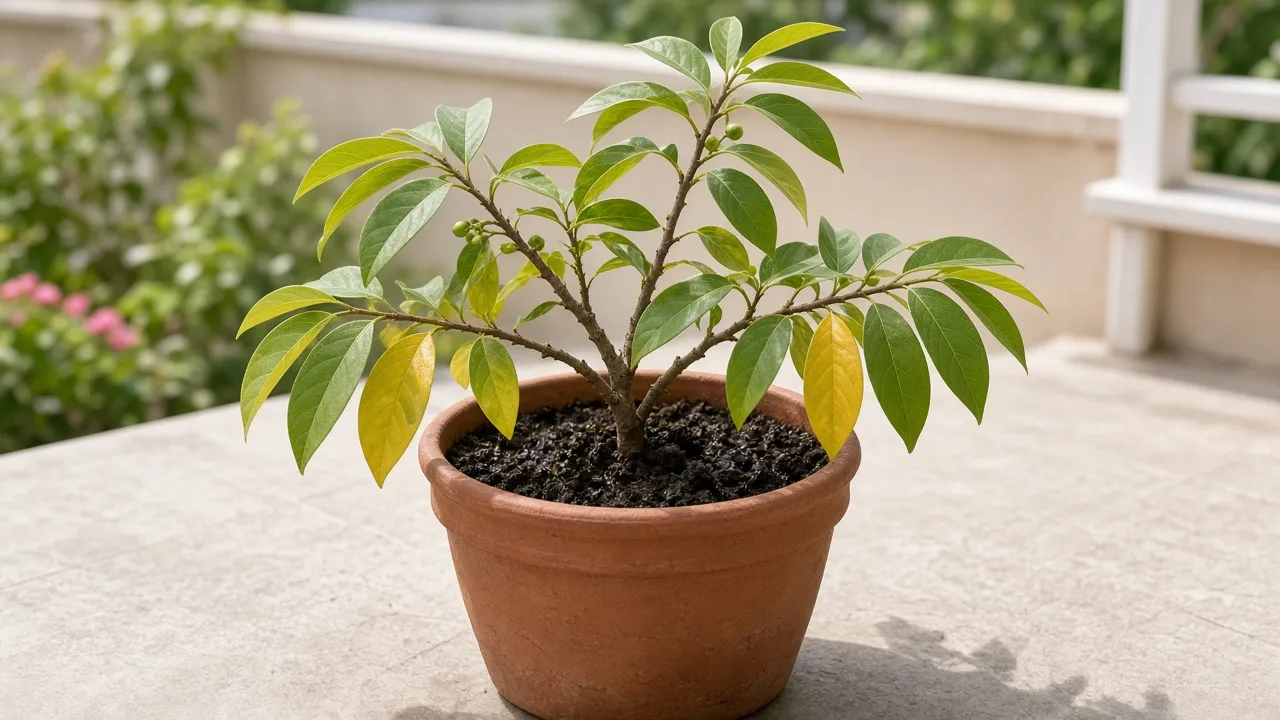
Overwatering on Custard Apple: Causes, Checks & Fixes
This guide covers overwatering on Custard Apple. See also the general Overwatering guide, watering, and light pages for this plant.
Overwatering on Custard Apple: Causes, Checks & Fixes
Quick answer
Overwatering on Custard Apple (Annona squamosa—Sitaphal, sugar apple) is the shallow-root wet-feet failure: a tropical fruit tree that needs good drainage and cannot tolerate water-logging, yet often lives in compost-heavy terrace pots watered on calendar autopilot through monsoon rain and fruit-fill season. When pore spaces stay flooded, roots lose oxygen and the plant yellows and wilts while mix still feels moist—the opposite of the drought droop on a feather-light dry pot.
For how chronic wet mix damages roots in general, see our overwatering guide. On Sitaphal, the tell is a heavy pot long after watering, yellow lower lanceolate leaves on cool clinging soil, limp canopy on soggy mix, and zigzag twigs that stop flushing while the upper 3–5 cm never dry.
First step: stop all supplemental watering. Empty saucers and cachepots, then wait until the top 3–5 cm of mix feel dry before one slow soak that drains freely. If the stem base is already soft on wet mix, escalate to root rot triage the same day—do not fertilize, hard-prune, or repot on top of saturation.
When to use this page vs other Custard Apple guides
| What you see | Read next |
|---|---|
| Light dry pot, dusty top 3–5 cm, limp leaves after heat | Underwatering |
| Heavy wet pot, yellow lowers, firm trunk (this page) | Stay here; escalate if base softens |
| Sudden soft collapse across the crown | Wilting |
| Gradual leaf hang, wet vs dry pot fork | Drooping leaves |
| Yellowing without urgent trunk softening | Yellow leaves |
| White fuzz on damp surface only | Mold on soil |
| Mix stays wet despite sparse watering | Soil and watering |
| Full care picture | Custard Apple overview |
What overwatering looks like on Custard Apple
Healthy Sitaphal holds dull-green, lanceolate leaves along somewhat zigzag branchlets on an open crown. Overwatering stress usually starts in the root zone and lower canopy while upper leaves still look acceptable—especially on young grafts in plastic nursery pots on hot terraces.
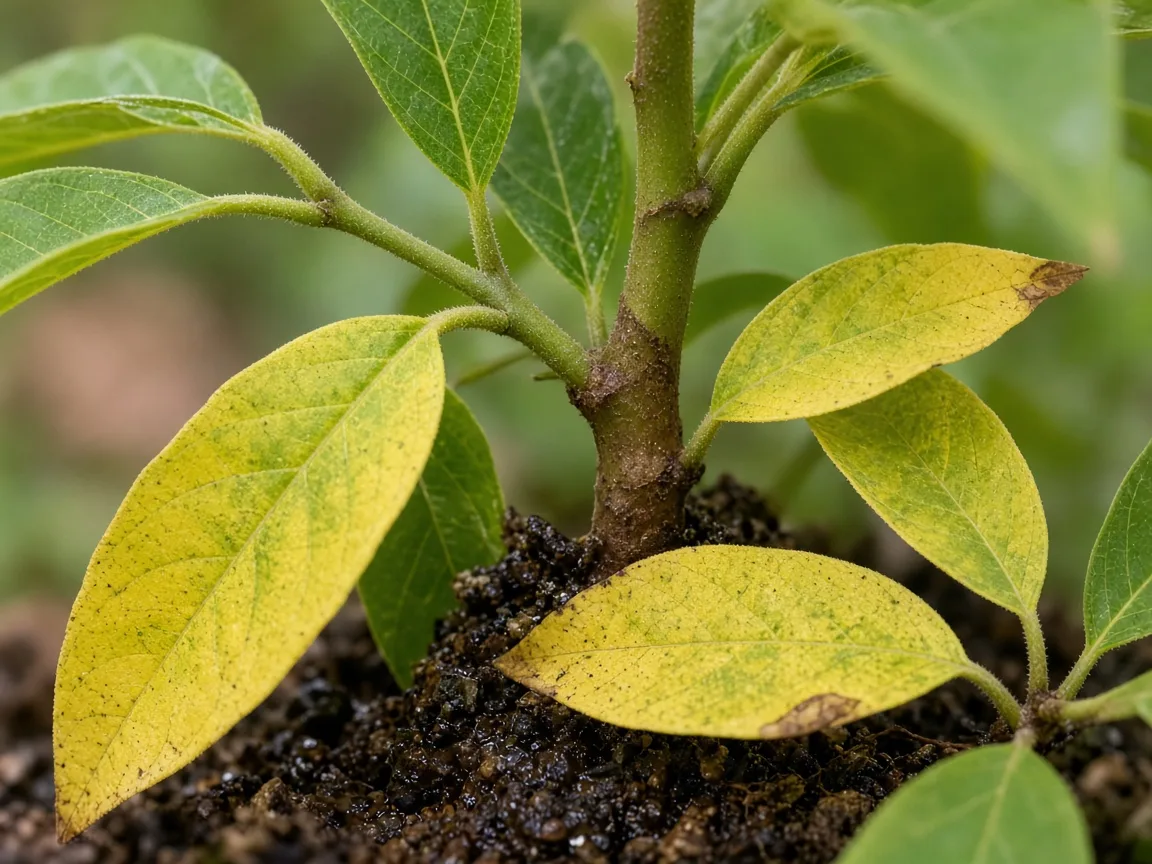
Yellow lower leaves on clinging wet mix at the stem base—confirm pot weight and smell before you water again.
Early signs
- Heavy pot that does not lighten between your usual watering days—or stays damp through monsoon weeks
- Yellowing lower leaves while the top 3–5 cm feel cool, dark, and clinging—not dusty dry
- Limp lanceolate leaves on wet soil that do not improve when you add water (uptake failure, not thirst)
- Stalled new flush along branch tips for weeks in warm sun on saturated mix
- Fungus gnats or mold on soil when the surface rarely dries
- Sour smell when you scrape the top layer—soil kept too long without oxygen often smells sour or rotten
Advanced signs
- Soft or darkening tissue at the soil line on wet mix—structural failure, not cosmetic yellowing
- Several leaf clusters yellow at once on a waterlogged container
- Brown mushy roots if you slide the root ball out—route to root rot
- Fruit drop or failure to size when roots are failing, even though you “water for fruit fill”
- Whole-tree list as feeder roots die in anaerobic mix
A single older yellow leaf on firm wood can be normal senescence or seasonal rest—Annona squamosa may shed leaves in severe drought. Overwatering adds wet mix + spreading yellowing + stalled tips or soft bark to that picture.
Why Custard Apple gets overwatered
Shallow roots in a deep-watering culture
Morton notes the sugar apple is shallow-rooted and does not need deep soil but water-logging is intolerable even on otherwise forgiving sites. Most terrace growers soak until water runs out—correct for a deep drink—but then repeat before the upper root layer re-aerates. Those feeder roots live in the top profile where oxygen disappears first.
Fruit-fill guilt watering
From flowering through harvest, irrigation during ripening increases fruit size and UF/IFAS recommends watering from flowering through fruit development during prolonged dry periods. The mistake is translating “steady moisture” into daily sprinkles on already-damp mix, which keeps the shallow ball saturated without ever drying.
Monsoon plus calendar schedule
When monsoon rain keeps soil moist, continuing terrace soaks leaves glaze pots waterlogged at the bottom while the surface feels merely cool. UF/IFAS advises reducing or stopping watering once leaves have mostly dropped in fall and winter, noting that watering a mostly leafless tree during the fall and winter may lead to root rot and loss of vigor.
Timer and saucer traps
Using lawn sprinkler systems on a timer may result in over watering and cause sugar apple trees to decline because too much water too often applied causes root rot. On balconies, closed saucers and cachepots recreate the same standing-water problem in a smaller volume.
Heavy, slow-draining mix
Peat-rich potting soil in oversized tubs holds moisture at the core while the top looks acceptable. NParks lists moderate water with good drainage for Annona squamosa—volume without perlite, grit, or open holes turns every deep soak into a long wet spell. Cross-check the soil guide before blaming the tree.
How to confirm overwatering (before you change five things)
Work through this order on a terrace Sitaphal:
- Pot weight — Lift the container. Heavy days after rain or watering supports saturation; light and dusty supports drought.
- 3–5 cm finger test — Cool, clinging soil at that depth on a heavy pot is the Custard Apple overwatering signature. A dry surface alone is misleading—the surface generally dries out first.
- Stem squeeze — Firm wood at the flare is early stress; soft black tissue at the line on wet mix is urgent.
- Newest flush — Leaves opening along zigzag tips mean roots still work. Tips stalled for weeks on wet heavy soil means root zone failure.
- Smell — Sour or rotten odor from the mix or surface roots confirms long oxygen deprivation.
| Signal | Overwatering | Underwatering |
|---|---|---|
| Pot weight | Heavy for days | Light, lifts easily |
| Top 3–5 cm | Cool, clinging | Dusty, crumbly |
| Leaf pattern | Yellow lowers on wet mix | Limp all over on dry mix |
| After one deep soak | Stays limp on wet soil | Perks within 24–48 h if roots OK |
| Season | Monsoon + daily sprinkles | Hot dry spell, missed watering |
Wilt-on-wet-soil belongs here—not underwatering. Crispy brown tips on a light pot after drought points to brown tips or thirst, not this page.
First fix for Custard Apple
Make one correction first so you can read the plant’s response:
- Stop watering immediately — No “just a little” because leaves look sad on already-wet mix.
- Empty every saucer and cachepot — Stagnant water re-saturates shallow roots within hours.
- Improve airflow and sun — Move the pot off a wet corner if safe; full sun and breeze help the upper layer dry (see light).
- Wait for dry-down — Let the top 3–5 cm pass your dry check. That may take several days on a large tub in humid monsoon weather.
- One deep soak, then drain — When dry at depth, water slowly until it exits drainage holes; do not leave standing water in the saucer.
- Re-check roots only if the base softens — Slide the root ball out if smell, listing, or mush is present; trim black tissue and repot into faster mix only after you understand drainage—see root rot.
Do not fertilize a yellowing tree on wet mix—salts on damaged roots worsen burn. Do not stack repotting, heavy pruning, and pesticide on the same day.
Recovery timeline
- Mild (firm trunk, yellow lowers only): Mix dries on rhythm; new small leaves along tips may appear within one to three weeks in warm growth.
- Moderate (stalled flush, gnats, sour smell but firm base): Expect several weeks to a month before flushes look normal; old yellow leaves may drop rather than re-green.
- Severe (soft base, mushy roots): Recovery is uncertain; focus on saving firm wood and healthy scion—may take a full season or require replacement graft.
Judge success by firm stem flare, lighter pot between soaks, and clean new growth—not by old yellow blades turning green.
What not to do
- Do not water because leaves wilt on wet soil — That deepens oxygen starvation.
- Do not rely on surface dryness — Probe depth or lift the pot.
- Do not keep monsoon calendar soaks when rain already wets the mix.
- Do not winter-water a mostly leafless tree on autopilot—UF/IFAS links that pattern to root rot.
- Do not confuse drought leaf-fall with overwatering — Severe dry spells can defoliate Annona squamosa; the pot will be light, not heavy.
How to prevent overwatering next time
- Anchor rhythm to the watering guide — Deep soak, full drain, dry top 3–5 cm before the next drink.
- Count monsoon rain as irrigation — Pause supplemental water when sheltered pots stay moist.
- Use fast-draining terrace mix — Perlite, grit, and open holes matter more than organic richness for shallow roots.
- Right-size the pot — Oversized tubs stay wet at the core for weeks.
- Separate lawn timers from tree wells — Timer-driven overwatering declines sugar apple.
- Ease off after leaf drop — Reduce or stop watering through rest unless a prolonged dry spell threatens young grafts.
Lookalike symptom check
| Looks like | Differentiator on Sitaphal |
|---|---|
| Drooping leaves | Gradual hang; same wet-vs-dry pot fork—overwatering droop stays on heavy wet soil |
| Wilting | Faster collapse; often heat shock or advanced root failure |
| Seasonal leaf drop | Gradual on firm trunk, often with rest—not sour wet mix |
| Low humidity | Crispy margins on dry mix, not yellow lowers on clinging wet soil |
| Slow growth | Can follow chronic wet feet—fix moisture before blaming fertilizer |
Conclusion
Custard Apple overwatering is a terrace drainage and rhythm problem on shallow Annona roots—not a reason to abandon fruit-fill watering entirely. Stop irrigation on heavy wet pots, dry the upper 3–5 cm, and align deep soaks with monsoon, rest, and Morton’s rule that water-logging—not brief drought—is what this species cannot forgive. Confirm with pot weight, smell, and stem firmness before you stack treatments.
Related Custard Apple guides
- Overview — Sitaphal identity, size, and seed toxicity
- Watering — 3–5 cm dry checkpoint through growth and fruit fill
- Soil — perlite, grit, and drainage for containers
- Drooping leaves — wet-soil vs dry-soil hang
- Mold on soil — surface fuzz on the same damp habitat
- Root rot — mushy roots and sour smell escalation
- Problems hub — full symptom index
Related tool
Use the Root Rot Risk Checker to narrow causes for overwatering on this plant before changing multiple variables at once.