Custard Apple Care Guide: Sitaphal Growing Tips
Annona squamosa
Grow Custard Apple in full sun and free-draining soil. Learn Sitaphal watering, container tips, and why seeds and leaves stay away from pets.
Custard Apple Care Guide: Sitaphal Growing Tips
Start with wateringThe most common care mistake for Custard AppleWatering guide →Custard Apple care essentials
Light
Water
Water deeply when the top 3–5 cm of soil has dried, then let excess drain fully. Keep young and container trees evenly moist through active growth, but never leave roots waterlogged—Annona squamosa is shallow-rooted and intolerant of standing water.
Soil
Moist but freely draining sandy loam or a similar container blend. Morton notes good performance on sand, limestone, and heavy loam when drainage is reliable; prolonged saturation is not tolerated. Aim near pH 6.0 (tolerates alkaline soils toward pH 8 with good structure).
Humidity
Temperature
Fertilizer
About Custard Apple
Custard Apple is native to Tropical Americas (exact origin uncertain); widely cultivated across tropical India, Southeast Asia, the Caribbean, and other warm regions, typically reaches 3–6 m (10–20 ft) tall as a small open-crowned tree; keep shorter in large containers with pruning and cultivar choice indoors, with moderate in sustained tropical warmth; seasonal leaf fall bridges dry spells growth. Custard Apple has a tree like growth habit and part of the Annonaceae family. It is also known as Sitaphal, Sugar Apple, Sweetsop, Sharifa, and Ata.
| Detail | Information |
|---|---|
| Also known as | Sitaphal, Sugar Apple, Sweetsop, Sharifa, Ata |
| Native region | Tropical Americas (exact origin uncertain); widely cultivated across tropical India, Southeast Asia, the Caribbean, and other warm regions |
| Mature size | 3–6 m (10–20 ft) tall as a small open-crowned tree; keep shorter in large containers with pruning and cultivar choice |
| Growth rate | Moderate in sustained tropical warmth; seasonal leaf fall bridges dry spells |
| Growth habit | Tree Like |
| Scientific name | Annona squamosa |
| Family | Annonaceae |
Custard Apple Care Guide: Sitaphal Growing Tips
Custard Apple, widely sold in India as Sitaphal or sugar apple, is a small tropical fruit tree—not a low-light foliage plant for a dim room. Annona squamosa belongs to the custard-apple family Annonaceae, and the RHS plant profile lists the same species under sugar apple, sweetsop, and scaly custard apple. Give it open sun, sustained warmth, and a shallow root zone that drains freely, and it can reward you with knobby, segment-rind fruit and creamy pulp. Keep it wet, cold, or shaded, and you will manage leaf drop and stalled flushes instead of a crop.
This overview covers the whole growing system so you can decide whether your terrace or garden can support Sitaphal, then points you into watering, soil, light, and the other cluster guides when you need depth.
Custard Apple care at a glance
Provide full outdoor sun, frost-free warmth, and moist but freely draining soil. Water deeply when the top 3–5 cm of mix has dried, then empty any saucer. Feed modestly through warm active growth. Keep canopy size under control with selective spring pruning, and choose a grafted plant when early, uniform fruiting matters.
Do not treat Custard Apple like a drought succulent or like a swamp plant. Julia Morton records high drought tolerance once established, yet also that waterlogging is intolerable and that severe dry spells can harden fruit rind until rain causes splitting. Useful Tropical Plants likewise notes that India’s “hardy Sitaphal” reputation is only partly correct: leaf fall helps the tree bridge a dry season, but adequate moisture during the growing season is still required.
Know the tree you are growing
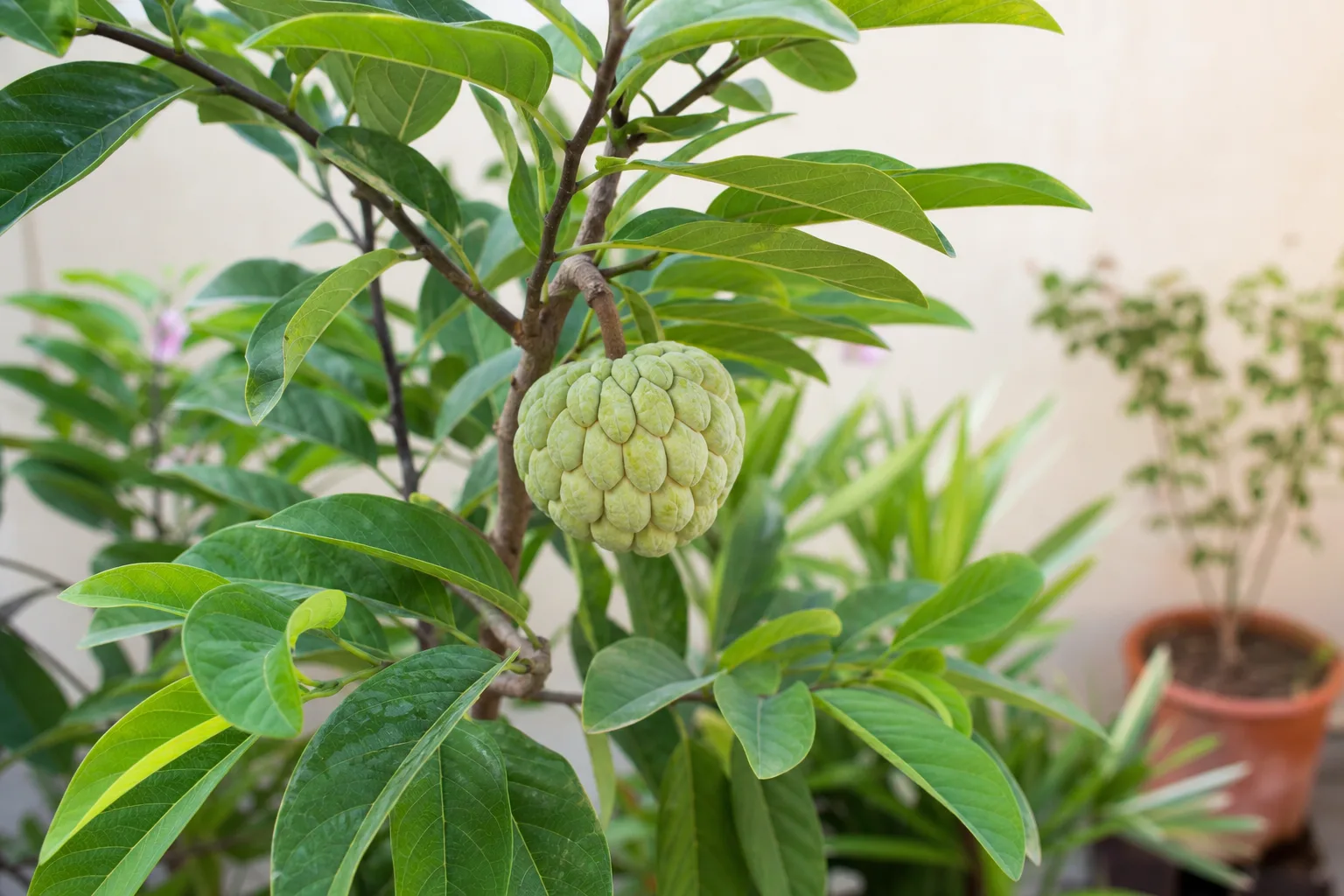
Confirm the label is Annona squamosa. Other Annona species—cherimoya, atemoya, bullock’s heart—are sometimes sold under overlapping common names, and their cold tolerance and fruit quality differ. Morton’s sugar-apple monograph is the classic species account: fragrant yellow-green flowers along branch tips, compound fruit with knobby segments, and creamy segmented flesh around hard dark seeds.
In India you will also meet Sitaphal, Sharifa, and Ata as market names for this crop. Cultivars differ in rind colour, seediness, and season; some red-rind forms exist, and novelty seedless types are occasionally offered. Choose a locally proven graft when fruit quality matters more than curiosity.
Growth habit and realistic size
An unpruned Custard Apple is a small open-crowned tree about 3–6 m (10–20 ft) tall with irregular, somewhat zigzag branches and deciduous leaves that drop when the tree bridges dry weather. Useful Tropical Plants gives a similar height around 6 m and notes success in subtropical to tropical elevations when rainfall and heat are adequate.
Expect moderate growth in sustained warmth, not the explosive flush of a banana. The root system is comparatively shallow, which helps explain both drought bridging through leaf fall and rapid decline when the pot or planting pocket stays saturated.
Choose warm sun and airflow
Place Custard Apple on a warm terrace, courtyard, rooftop, or frost-free garden edge with unobstructed sun for most of the day. PFAF lists the species as needing full sun and USDA hardiness roughly zones 10–12; Useful Tropical Plants adds that plants can tolerate occasional light frosts but are not built for hard freezes or long cold spells. Protect young trees from unusual northern winters and from prolonged cold wind on exposed balconies.
During bloom, humid air without rain supports pollination better than a dry, wind-blasted corner. Morton concludes that drought during flowering interferes with set, so the ideal bloom window is high atmospheric humidity without rain on the flowers. Leave space around the canopy so air moves through the open crown and scale or sooty mold is easier to spot.
Acclimate nursery foliage over several days when moving a shade-grown plant into harsh afternoon sun. Start with morning light, then lengthen exposure while watching new leaves for pale, crisp scorch.
Can Custard Apple grow in a container?
Yes, if you treat the pot as a managed root zone rather than a decorative tub of wet compost. Use a heavy container with several unobstructed drainage holes, start only one size wider than the nursery root ball, and step up gradually. A huge pot around a small root system stays wet too long; a severely rootbound pot can dry within hours and shed flowers or young fruit.
Plan to keep the canopy shorter than a garden tree through cultivar choice and selective pruning. For pot sizing, root checks, and aftercare, use the Custard Apple repotting guide. If the site cannot deliver strong direct sun for most of the day, treat the plant as experimental foliage rather than a reliable fruit tree.
Water for growth, never for standing water
Check the top 3–5 cm of soil and the pot’s weight. When that upper layer is dry, soak until water runs from every drainage hole, then empty the saucer. In hot, dry weather a container may need checking every few days; in cooler or humid spells the interval stretches. Young trees and fruiting pots need closer attention than established in-ground trees that have already leafed through a dry season.
Irrigate through dry growth and fruit fill. Morton notes that irrigation during the dry season and once during ripening increases fruit size, while severe drought can shed leaves and harden the rind. During dependable monsoon rain, pause irrigation and move pots out of roof runoff. The first action when leaves wilt is always a moisture check: wilt above wet soil is a root-oxygen problem, not a cue to water again.
For seasonal examples and over- versus underwatering patterns, open the Custard Apple watering guide.
Use free-draining soil around a shallow root system
Custard Apple is not fussy about soil texture when drainage is reliable. Morton records good performance on sand, limestone, and heavy loam provided water does not stand, and notes the tree is shallow-rooted so it does not need deep soil. Useful Tropical Plants prefers a moist but well-drained sandy loam near pH 6, with success also on rocky alkaline soils toward pH 8 when structure stays open.
In a container, a practical blend is roughly half quality potting mix or sandy loam, one-quarter mature compost, and one-quarter coarse perlite, grit, or pine bark. The goal is even wetting with prompt drainage—never a dense, peat-heavy mix that stays sour for days. Fix drainage before chasing fertilizer when new leaves yellow over soggy mix; see the Custard Apple soil guide for mix adjustments.
Feed during active growth, prune only in spring
Feed only a rooted, actively growing tree. Morton reports that a fertilizer providing roughly 3% N, 10% P, and 10% K can increase flowering, set, and yield in production settings; in a home pot, start with a balanced fruit-tree product at the label’s container rate and divide applications through warm growth rather than dumping one heavy dose. Flush the pot with plain water periodically so salts do not accumulate against shallow roots.
Prune for shape and strength only in spring when sap is rising. Morton warns that pruning at the wrong time may kill the tree, so do not stack hard cuts, heavy feeding, and a sudden move into fierce sun in the same week. Use the Custard Apple fertilizer guide and Custard Apple pruning guide before major corrections.
Start with grafted plants when fruit matters
Seed is easy and often true enough for a backyard tree, but timing and uniformity favour vegetative plants. Morton notes seedlings may take 2–4 years to fruit, while selected clones grafted in India have flowered within months and fruited far sooner. Useful Tropical Plants similarly places first bearing for many trees at 3–4 years from planting.
Buy a healthy grafted or budded plant from a reliable nursery when early crops matter. Reject circling roots, trunk wounds, soft scale or mealybug colonies, and sour-smelling mix. For seed, budding, and aftercare detail, use the Custard Apple propagation guide.
Support flowering, pollination, and harvest timing
Fragrant flowers are borne singly or in small clusters near branch tips and often need help for a heavy crop. Morton records that older trees rarely exceed about 50–100 fruits without hand pollination, and incomplete set produces misshapen fruit. Hand-pollinate during the receptive stage when you want denser crops, keep humidity reasonable without rain on open flowers, and avoid drought stress while flowers are open and fruit is filling.
Harvest when rind segments begin to separate and a pale tint appears between them. Fruit left fully on the tree often falls apart; fruit picked too early may blacken and dry instead of ripening. Eat the ripe pulp and keep the hard seeds out of reach of pets and children.
Light quality still drives flowering energy. If shoots are weak and internodes stretch toward a wall, solve placement with the Custard Apple light guide before blaming fertilizer.
Adjust care through Indian seasons
In hot, dry pre-monsoon weather, check containers often, mulch lightly without piling material against the trunk, and irrigate through growth and fruit fill. In monsoon, prioritise drainage and airflow, withhold irrigation while rain keeps the root zone wet, and clear fallen diseased material. In a cooler leaf-fall rest, ease watering further and pause hard feeding until warm flushes resume.
Northern growers should treat unusual cold as a real risk for young plants even if Useful Tropical Plants allows occasional light frost. Move portable trees beside a warm wall under cover overnight, and resume structural pruning only when sap is rising in spring.
Read warning signs before changing care
Yellow leaves while the mix stays wet, sour soil, soft dark roots, or stalled flushes after prolonged saturation point to waterlogging first. Premature leaf drop in severe drought, limp new leaves over dry mix, or hard fruit that splits after sudden rain following drought stress point to moisture extremes rather than a mystery disease. Brown margins in containers can follow dry-down, salt build-up, or hot reflected heat from concrete.
A vigorous tree that flowers poorly may be too young, too dry at bloom, shaded, or simply unpollinated. Diagnose moisture, light, recent pruning, and which tissues are affected before adding products.
Keep seeds and plant parts away from pets
Ripe Custard Apple flesh is a familiar human food, but that does not make the whole plant pet-safe. Morton records the seeds as acrid and poisonous, with bark, leaves, and seeds containing alkaloids such as anonaine. PFAF likewise flags seeds, leaves, and roots as poisonous. Keep fallen seeds, crushed seed paste, leaves, bark, and pruning waste away from pets and children, and never use seed powder near eyes. Seek veterinary advice after ingestion or distress; do not treat edible pulp as proof that browsing the tree is safe.
When to use this page vs other Custard Apple guides
- Use this overview to decide whether your site can support a sun-loving Sitaphal tree and to set the whole-care baseline.
- Use Custard Apple light to judge terrace, rooftop, or garden sun and to acclimate foliage safely.
- Use Custard Apple watering when leaf drop, wilt, or monsoon timing is unclear.
- Use Custard Apple soil for container recipes, drainage failures, and pH context.
- Use Custard Apple fertilizer before choosing a product or correcting pale growth.
- Use Custard Apple repotting when roots circle, the pot dries within a day, or the tree becomes unstable.
- Use Custard Apple propagation to compare seed, grafting, and nursery plants.
Related Custard Apple guides
- Custard Apple plant hub — species profile, toxicity notes, and the full care cluster.
- Custard Apple pruning — spring timing and size control without killing cuts.
- Custard Apple light — full-sun placement and sun-stress diagnosis.
- Custard Apple watering — root-zone checks for pots, gardens, and monsoon weather.
- Custard Apple soil — free-draining mixes for shallow roots.
- Custard Apple fertilizer — feeding through warm growth and fruiting.
- Custard Apple repotting — pot sizing and aftercare.
- Custard Apple propagation — seed versus grafted plants.
Conclusion
Successful Custard Apple care starts with accepting what Sitaphal is: a tropical Annona tree that wants open sun, warm conditions, and a shallow root zone that never sits waterlogged. Water deeply after the upper mix begins to dry, build a free-draining soil, feed only through active growth, and prune only in spring when sap is rising. Choose a grafted plant when early fruit matters, and plan on humidity without rain at bloom—plus hand pollination if you want denser crops.
For an Indian terrace or garden, the biggest seasonal shift is from rapid dry-down before monsoon to prolonged moisture during it. Watch the root zone instead of the calendar, keep toxic seeds and plant debris away from pets, and make only one major intervention at a time. With realistic placement and drainage, Custard Apple can stay manageable while producing healthy flushes, flowers, and eventually fruit.
How to care for Custard Apple?
When should you water Custard Apple?
Water deeply when the top 3–5 cm of soil has dried, then let excess drain fully. Keep young and container trees evenly moist through active growth, but never leave roots waterlogged—Annona squamosa is shallow-rooted and intolerant of standing water.
- Test the top 3–5 cm and the pot's weight - Water deeply when the top 3–5 cm of soil has dried, then let excess drain fully.
- water thoroughly only when that layer is dry - Water deeply when the top 3–5 cm of soil has dried, then let excess drain fully.
- then empty any saucer - Water deeply when the top 3–5 cm of soil has dried, then let excess drain fully.
- Drain excess water - Water deeply when the top 3–5 cm of soil has dried, then let excess drain fully.
What soil works best for Custard Apple?
Moist but freely draining sandy loam or a similar container blend. Morton notes good performance on sand, limestone, and heavy loam when drainage is reliable; prolonged saturation is not tolerated. Aim near pH 6.0 (tolerates alkaline soils toward pH 8 with good structure).
- 50% quality potting mix or sandy loam - Moist but freely draining sandy loam or a similar container blend.
- 25% mature compost
- 25% coarse perlite, grit, or pine bark - Moist but freely draining sandy loam or a similar container blend.
Grower notes for Custard Apple
What matters most with Custard Apple
Custard Apple (Annona squamosa), also sold as Sitaphal or sugar apple, is a tropical fruit tree—not a low-light houseplant. Give it full sun, sustained warmth, and a shallow root zone that drains freely. Morton records high drought tolerance once established, but waterlogging is intolerable; irrigate young trees and containers through dry growth, then ease off when rain or cool rest reduces demand.
Best placement in a real home
Use a warm terrace, courtyard, rooftop, or frost-free garden with unobstructed sun and airflow. Unpruned trees reach about 3–6 m with an open, irregular crown, so large containers need a heavy pot and periodic size control. Useful Tropical Plants notes occasional light-frost tolerance, but protect young plants from hard freezes and prolonged cold. During bloom, humid air without rain supports pollination better than a dry, wind-blasted corner.
Before you buy this tree
Choose a healthy grafted or budded plant when early, uniform fruiting matters—seedlings often take 2–4 years, while grafts can fruit much sooner. Reject circling roots, trunk wounds, soft scale or mealybug colonies, and sour-smelling mix. Confirm the label is Annona squamosa (Sitaphal/sugar apple); other Annona species are sometimes sold under overlapping common names.
First month after bringing it home
Acclimate nursery foliage to intense sun over several days, quarantine the plant, and learn how fast the pot dries before any major repot. Water the whole root ball, then wait for the upper 3–5 cm to dry. Do not stack hard pruning, heavy fertiliser, and a sudden move into harsh afternoon sun in the same week—Morton advises pruning only in spring when sap is rising, or cuts can kill the tree.
Seeds, leaves, and bark are not pet treats
Ripe Custard Apple flesh is a familiar food, but Morton records the seeds as acrid and poisonous, with bark, leaves, and seeds containing alkaloids such as anonaine. Keep fallen seeds, crushed seed paste, and pruning waste away from pets and children, and never use seed powder near eyes. Treat the whole plant as unsafe to chew even though the ripe pulp is edible for people.
How flowering and fruiting work
Fragrant yellow-green flowers are borne singly or in small clusters along branch tips and often need help setting a heavy crop—hand pollination commonly raises yield beyond the roughly 50–100 fruits typical of unassisted trees. Pick when rind segments begin to separate and pale tint appears between them; fruit left fully on the tree often falls apart. Drought during bloom can reduce set; irrigation during dry ripening improves fruit size.
Is Custard Apple safe for pets?
Ripe Custard Apple pulp is a common human food, but the seeds are poisonous and leaves and bark contain alkaloids. Keep seeds, crushed seed material, leaves, bark, and pruning waste away from pets and children.
Annona squamosa does not have a species-specific ASPCA toxic/non-toxic listing cited for this hub. Julia Morton (Fruits of Warm Climates) records the seeds as acrid and poisonous and notes alkaloids such as anonaine in bark, leaves, and seeds. Do not classify the whole plant as pet-safe from the edibility of ripe flesh. Seek veterinary advice after seed or plant-part ingestion, eye exposure to seed powder, or any distress.
Watering Custard Apple
For Custard Apple, test the top 3–5 cm and the pot's weight; water thoroughly only when that layer is dry, then empty any saucer and water every 3–5 days for containers in hot dry weather; every 7–14 days in cooler or humid periods, adjusted for pot size and rainfall. Irrigate through dry growth and fruit fill; reduce when monsoon rain is dependable; ease off further during cool leaf-fall rest.
| Detail | Information |
|---|---|
| How often | Every 3–5 days for containers in hot dry weather; every 7–14 days in cooler or humid periods, adjusted for pot size and rainfall |
| How to check | Test the top 3–5 cm and the pot's weight; water thoroughly only when that layer is dry, then empty any saucer |
| Seasonal changes | Irrigate through dry growth and fruit fill; reduce when monsoon rain is dependable; ease off further during cool leaf-fall rest |
Signs of overwatering
- yellowing leaves while the mix stays wet
- sour-smelling or soggy soil
- soft dark roots or stem dieback
- stalled flushes after prolonged saturation
Signs of underwatering
- premature leaf drop during severe drought
- hard, splitting fruit rind after sudden rain following drought stress
- limp new leaves and paused growth
- dry brown leaf margins in containers
Soil & potting for Custard Apple
Use a mix of 50% quality potting mix or sandy loam, 25% mature compost, 25% coarse perlite, grit, or pine bark for Custard Apple. Free drainage is essential; waterlogging causes decline even though the tree can bridge drought once established. Target soil pH around 5.5–7.5 preferred; can succeed on rocky alkaline soils near pH 8 when drainage is excellent. Repot every 1–2 years while young; root-prune and refresh the mix every 2–3 years once the tree occupies its final large container, ideally in spring, as warm active growth resumes and sap is rising.
| Detail | Information |
|---|---|
| Recommended mix | 50% quality potting mix or sandy loam, 25% mature compost, 25% coarse perlite, grit, or pine bark |
| Drainage | Free drainage is essential; waterlogging causes decline even though the tree can bridge drought once established |
| Soil pH | 5.5–7.5 preferred; can succeed on rocky alkaline soils near pH 8 when drainage is excellent |
| Repotting frequency | Every 1–2 years while young; root-prune and refresh the mix every 2–3 years once the tree occupies its final large container |
| Best season to repot | Spring, as warm active growth resumes and sap is rising |
Signs it needs repotting
- roots circling densely or exiting drainage holes
- pot drying within a day in warm weather
- tree becoming unstable or top-heavy
- growth stalling despite full sun and appropriate watering
Humidity & temperature for Custard Apple
Fertilizer & pruning for Custard Apple
Common problems on Custard Apple
Yellow Leaves
MediumLikely cause: Common on this plant type; confirm with recent watering, light, and root checks.
Quick fix: Inspect the plant and correct the most likely care stressor before stacking treatments.
Full fix guide →Brown Tips
MediumLikely cause: Common on this plant type; confirm with recent watering, light, and root checks.
Quick fix: Inspect the plant and correct the most likely care stressor before stacking treatments.
Full fix guide →Root Rot
MediumLikely cause: Common on this plant type; confirm with recent watering, light, and root checks.
Quick fix: Inspect the plant and correct the most likely care stressor before stacking treatments.
Full fix guide →Overwatering
MediumLikely cause: Common on this plant type; confirm with recent watering, light, and root checks.
Quick fix: Inspect the plant and correct the most likely care stressor before stacking treatments.
Full fix guide →Underwatering
MediumLikely cause: Common on this plant type; confirm with recent watering, light, and root checks.
Quick fix: Inspect the plant and correct the most likely care stressor before stacking treatments.
Full fix guide →Spider Mites
MediumLikely cause: Common on this plant type; confirm with recent watering, light, and root checks.
Quick fix: Inspect the plant and correct the most likely care stressor before stacking treatments.
Full fix guide →Mealybugs
MediumLikely cause: Common on this plant type; confirm with recent watering, light, and root checks.
Quick fix: Inspect the plant and correct the most likely care stressor before stacking treatments.
Full fix guide →Aphids
MediumLikely cause: Common on this plant type; confirm with recent watering, light, and root checks.
Quick fix: Inspect the plant and correct the most likely care stressor before stacking treatments.
Full fix guide →Leggy Growth
MediumLikely cause: Common on this plant type; confirm with recent watering, light, and root checks.
Quick fix: Inspect the plant and correct the most likely care stressor before stacking treatments.
Full fix guide →Slow Growth
MediumLikely cause: Common on this plant type; confirm with recent watering, light, and root checks.
Quick fix: Inspect the plant and correct the most likely care stressor before stacking treatments.
Full fix guide →Wilting
MediumLikely cause: Common on this plant type; confirm with recent watering, light, and root checks.
Quick fix: Inspect the plant and correct the most likely care stressor before stacking treatments.
Full fix guide →Drooping Leaves
MediumLikely cause: Common on this plant type; confirm with recent watering, light, and root checks.
Quick fix: Inspect the plant and correct the most likely care stressor before stacking treatments.
Full fix guide →Low Humidity
MediumLikely cause: Common on this plant type; confirm with recent watering, light, and root checks.
Quick fix: Inspect the plant and correct the most likely care stressor before stacking treatments.
Full fix guide →Not Enough Light
MediumLikely cause: Common on this plant type; confirm with recent watering, light, and root checks.
Quick fix: Inspect the plant and correct the most likely care stressor before stacking treatments.
Full fix guide →Fungus Gnats
MediumLikely cause: Common on this plant type; confirm with recent watering, light, and root checks.
Quick fix: Inspect the plant and correct the most likely care stressor before stacking treatments.
Full fix guide →Mold on Soil
MediumLikely cause: Common on this plant type; confirm with recent watering, light, and root checks.
Quick fix: Inspect the plant and correct the most likely care stressor before stacking treatments.
Full fix guide →