Mealybugs on Custard Apple: Fruit, Stem & Leaf Checks
Quick answer
Mealybugs on Custard Apple form white cottony clusters in leaf axils, along thin zigzag twigs, and at the stem end of young knobby fruit—often with sticky honeydew and sooty mold on nearby leaves. First step: isolate the tree from other terrace plants and dab every visible wax tuft with a cotton swab soaked in 70% isopropyl alcohol before spraying the whole canopy.

Mealybugs on Custard Apple: Causes, Checks & Fixes
This guide covers mealybugs on Custard Apple. See also the general Mealybugs guide, watering, and light pages for this plant.
Mealybugs on Custard Apple: Causes, Checks & Fixes
Quick answer
Mealybugs on Custard Apple (Annona squamosa, Sitaphal or sugar apple) are small, soft insects covered with white, cottony wax. They suck sap from thin twigs, leaf axils, and developing fruit, leave sticky honeydew that can support sooty mold, and often hide where the open, irregular crown creates pockets owners miss from across the terrace.
For how mealybugs reproduce, why ants defend them, and when alcohol dabs work in general, see our mealybugs pest guide. On custard apple, the decisive pattern is cottony wax at the stem end or shady side of knobby young fruit, in zigzag twig forks, and along the upper canopy—not yellow leaves from soggy shallow roots alone.
First step: isolate the tree from other warm-climate plants on the same bench, then dab every visible cottony cluster with a cotton swab soaked in 70% isopropyl alcohol before you spray the whole plant.
When to use this page vs other Custard Apple guides
This page is the pest-first entry for white cottony sap feeders on Annona twigs and fruit.
| Pattern | Read next |
|---|---|
| Soft green pear-shaped insects on new flush tips | Aphids |
| Fine webbing and stippling on leaf undersides | Spider mites |
| Yellow leaves on heavy wet mix, no wax | Yellow leaves or overwatering |
| Whole tree limp on dry mix without insects | Wilting or underwatering |
| Tiny flies above damp soil, not on stems | Fungus gnats |
| Long bare zigzag shoots toward one wall | Leggy growth or light guide |
What mealybugs look like on Custard Apple
Annona squamosa carries dull to glossy green, lanceolate leaves on thin, zigzag branches with knobby green or maturing fruit. Mealybugs settle in the protected angles that architecture creates:
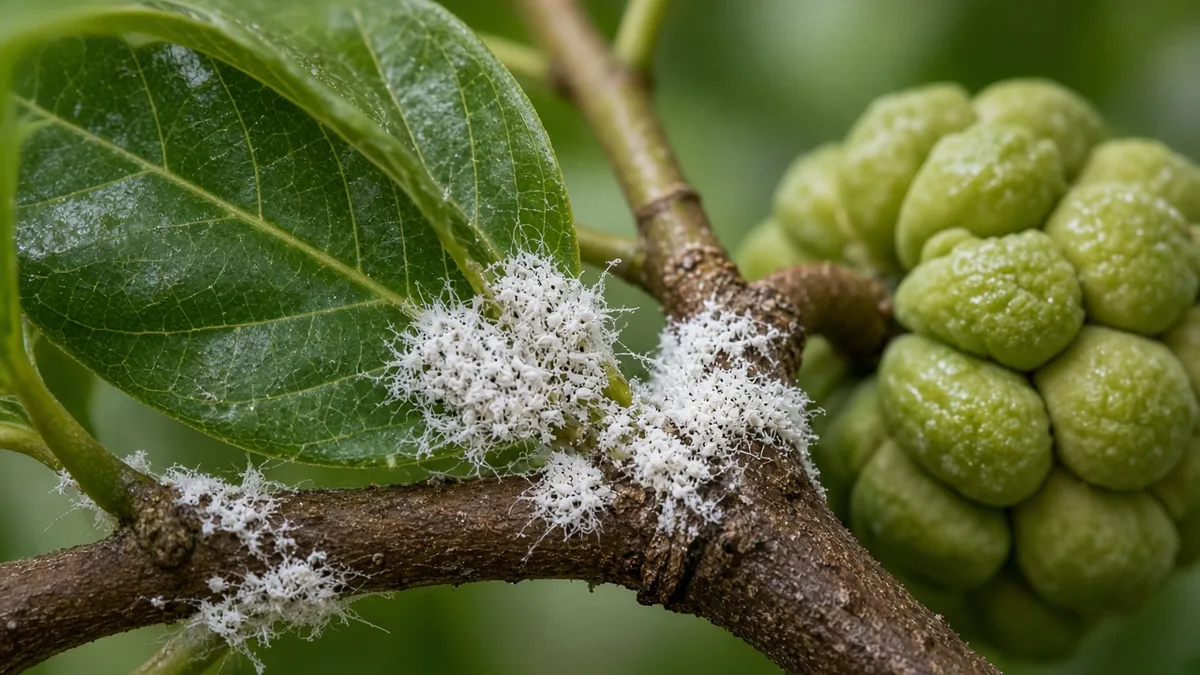
Cottony mealybug masses where a leaf meets a zigzag twig—compare with clean green tissue on the same branch.
- White cottony tufts in leaf axils and twig forks — Wax-covered colonies where leaves attach along zigzag wood
- Clusters at the stem end or shady side of young fruit — Annona pest references describe mealybugs at the fruit stem-end and on the shaded fruit surface, with honeydew and sooty mold on adjacent leaves
- Sticky shine on petioles, fruit, or lower leaves — Honeydew collects where mealybugs feed
- Black sooty coating on leaves or fruit rind — Fungus growing on dried honeydew, not stem rot
- Ant trails on the pot rim, terrace, or trunk — Ants harvest honeydew and protect colonies from lady beetles and lacewings
- Slow yellowing or premature fruit drop — Heavy feeding during fruit fill weakens rinds; do not confuse with drought cracking alone
- Pale crawlers before wax builds — Mobile nymphs are orangish until they settle and produce cottony coating
Morton describes sugar apple as a small irregular-crowned tree with deciduous leaves. Seasonal leaf drop during cool or dry rest is normal on this species—a few old leaves low on firm wood are less urgent than fresh cottony tufts at every branch tip during active growth.
Where mealybugs hide on zigzag twigs and knobby fruit
Custard apple branches in a zigzag pattern with relatively sparse foliage compared to bushy houseplants. Mealybugs follow protected angles, not the open faces you see from the doorway.
- Stem end and shady side of developing fruit — Mealybugs are commonly found at the stem-end of Annona fruit; check every knobby green fruit during pollination and fill
- Newest flush at branch tips — Warm terrace growth produces tender tissue where mealybugs often live in protected areas such as branch crotches
- Leaf axils on upper twigs — Where each lanceolate leaf meets zigzag wood; overhead rinsing rarely reaches these grooves on container trees
- Soil line and upper roots on potted Sitaphal — Shallow-rooted custard apple in large pots can host root-zone mealybugs while stems look clean
- Shared terrace introductions — New plants often introduce mealybugs before owners notice wax on a blooming Annona beside citrus or hibiscus
Outdoor and conservatory custard apples in frost-free warmth can grow year-round, so all life stages may be present throughout the year without a cold season to knock populations back.
Why custard apple gets mealybugs (beyond “bad luck”)
Fruit and twig architecture invites colonies. Knobby immature fruit and forked zigzag stems create exactly the sheltered feeding sites UF/IFAS lists among insects that attack sugar apple stems and fruit, including mealybugs alongside several scale species.
Introduction beats watering as the trigger. Most infestations start on stressed or recently purchased plants. Mealybugs hitchhike on nursery stock, shared tools, or hands moving between terrace pots. Quarantine new plants for at least three weeks before placing them beside a fruiting custard apple.
Soft, overfed growth hosts larger colonies. Over-application of nitrogen combined with regular irrigation stimulates tender new growth where mealybugs prefer to lay eggs. Heavy feeding during a bloom or fruit flush can weaken rinds without softening the woody base—do not confuse that with overwatering on shallow roots alone.
Terrace collections lack predators. Populations can build without outdoor biological control on warm container trees kept year-round—common for Sitaphal on south-facing patios.
In Florida Annona plantings, foliage feeders most frequently reported include scales and mealybugs. Pink hibiscus mealybug (Maconellicoccus hirsutus) is documented on Annona spp. and can cause severe damage on related soursop; recognize long waxy filaments and pink-toned wax if your region has this regulated pest.
Confirm mealybugs vs scale, mites, mildew, and drought
Work in good light with a magnifying glass. Trace every fork from soil line to fruit tips—custard apple wood is thin and easy to snap if you wrench branches.
- Stem and trunk firmness — Firm woody base with white wax in upper axils points to mealybugs. Soft black tissue at the soil line means root rot first.
- Crevice scan — Stationary white waxy clumps that smear pink when crushed confirm mealybugs. Flat tan or brown domes without cotton suggest scale (treat as a contact pest, not drought).
- Alcohol swab test — On houseplants and container trees, a 70% or less alcohol solution dabbed directly on mealybugs can kill or remove them; mineral crust and dried latex do not turn orange-gray.
- Fruit-focused check — Rotate each young fruit and inspect the stem end and shaded cheek—Annona mealybug descriptions emphasize those sites, not only leaves.
- Lookalike rule-out — Fine webbing on leaf undersides suggests spider mites. White powdery patches on leaf surfaces without insects underneath may be mildew, not mealybugs.
Symptom lookalike comparison
| What you see | Likely cause | Key check |
|---|---|---|
| White cotton in twig forks on firm stems | Mealybugs | Alcohol dab turns insects orange-gray |
| Pear-shaped green insects on new flush | Aphids | Soft bodies, not waxy cotton |
| Fine webbing, stippled leaves | Spider mites | Dry air; mites on undersides |
| Soft base, wet mix, no wax | Root rot | Mushy tissue at soil line |
| Yellow leaves, wet mix, no insects | Overwatering | Shallow roots in saturated mix |
| Ants without visible wax | Hidden sap feeders | Inspect fruit stem-ends and twig forks |
Confirmed diagnosis — Cottony wax plus honeydew or ants on twigs or fruit with firm lower stems. Suspected — Sticky fruit alone needs a magnifier in stem-end crevices before treating.
First fix: isolate and alcohol-dab each cluster
Move the affected custard apple away from other Annona, citrus, hibiscus, and terrace collections until you see no new wax for at least two weekly checks.
Dab each visible mealybug and egg mass with a cotton swab soaked in 70% isopropyl alcohol, pressing into leaf axils, twig forks, and fruit stem-ends without bruising young rinds. Test on a small part of the plant first and watch for leaf burn; schedule dabs in early morning so alcohol evaporates before intense terrace sun hits outdoor specimens.
Insecticidal soap after dabbing
After dabbing, spray insecticidal soap to coat stems, leaf undersides, fruit stem-ends, and the soil line on container trees. Soaps are contact sprays with no residual action—they only work where they touch crawlers. Aim the nozzle into forked joints where swabs cannot reach.
Their waxy coating repels most contact insecticides, so repeat weekly for at least three weeks; eggs and crawlers hide in protected joints and survive a single pass.
What not to do the same day
Do not stack repotting, heavy pruning, and multiple pesticides on the same day—make pest removal the one change, then watch twigs for five to seven days. Do not increase watering because leaves look stressed; sap loss from pests is not fixed by wet shallow roots. Do not blast developing fruit with high-pressure jets that scar rinds or knock off pollinators during bloom.
Step-by-step recovery on a fruiting Annona
- Isolate the tree and inspect from soil line to every fruit tip, including zigzag forks.
- Dab every cottony cluster with alcohol; dispose of swabs in sealed trash.
- Spray insecticidal soap into crevices the swab could not reach.
- Wipe sticky honeydew from leaves and fruit so sooty mold does not spread.
- Re-inspect weekly; repeat treatment until no new wax appears for two checks.
- If root mealybugs are present and control fails after three cycles, repot into fresh draining mix after rinsing upper roots—only then, not on day one.
Recovery timeline and fruit expectations
Visible clusters often collapse within days of alcohol dabbing. Full control typically needs two to three weekly repeats because of hidden eggs. Expect clean new flushes and fruit stem-ends within two to three weeks once treatment works. Old scarred leaves or fruit rinds do not revert, but firm stems and wax-free new growth mean the tree is winning.
Heavy mealybug feeding during fruit fill can stunt or drop individual knobby fruit; recovery shows on the next set higher on the branch, not on spent rinds.
How to prevent mealybugs on Custard Apple
Quarantine every new plant before placing it beside a fruiting Sitaphal. Scout fruit stem-ends and twig forks monthly during active growth and through pollination. Keep full sun with fast-draining mix so growth stays firm—align watering with the custard apple watering guide so you do not confuse pest stress with drought.
Clean pruners between plants, manage ants on pot rims, and treat the first white wax spot before mealybugs spread across a terrace collection. For baseline culture, see the full custard apple care hub and the problems index.
When to escalate — stubborn colonies and regulated pests
Escalate when colonies coat multiple fruit, ants farm the tree heavily, or sooty mold covers much of the canopy while growth stalls. Mealybugs will not kill a firm custard apple overnight, but unchecked feeding during a main fruit cycle can leave branches depleted.
For chronic root-mealy infestations that survive three full soap-and-alcohol cycles, contact your local extension office for pest confirmation and region-appropriate options. UC IPM notes that plant spikes or granules containing imidacloprid may reduce mealybug crawler numbers on container plants, but these products are less reliable against mealybugs than against other sap feeders and should be avoided on flowering or fruiting trees when possible because of pollinator risk.
If you suspect pink hibiscus mealybug—long waxy tails, pink-toned colonies, rapid spread across Annona and hibiscus—report it through your state agriculture department; this species is subject to monitoring programs in several U.S. regions.