How to Prune Green Chilli: Safe Cuts and Timing
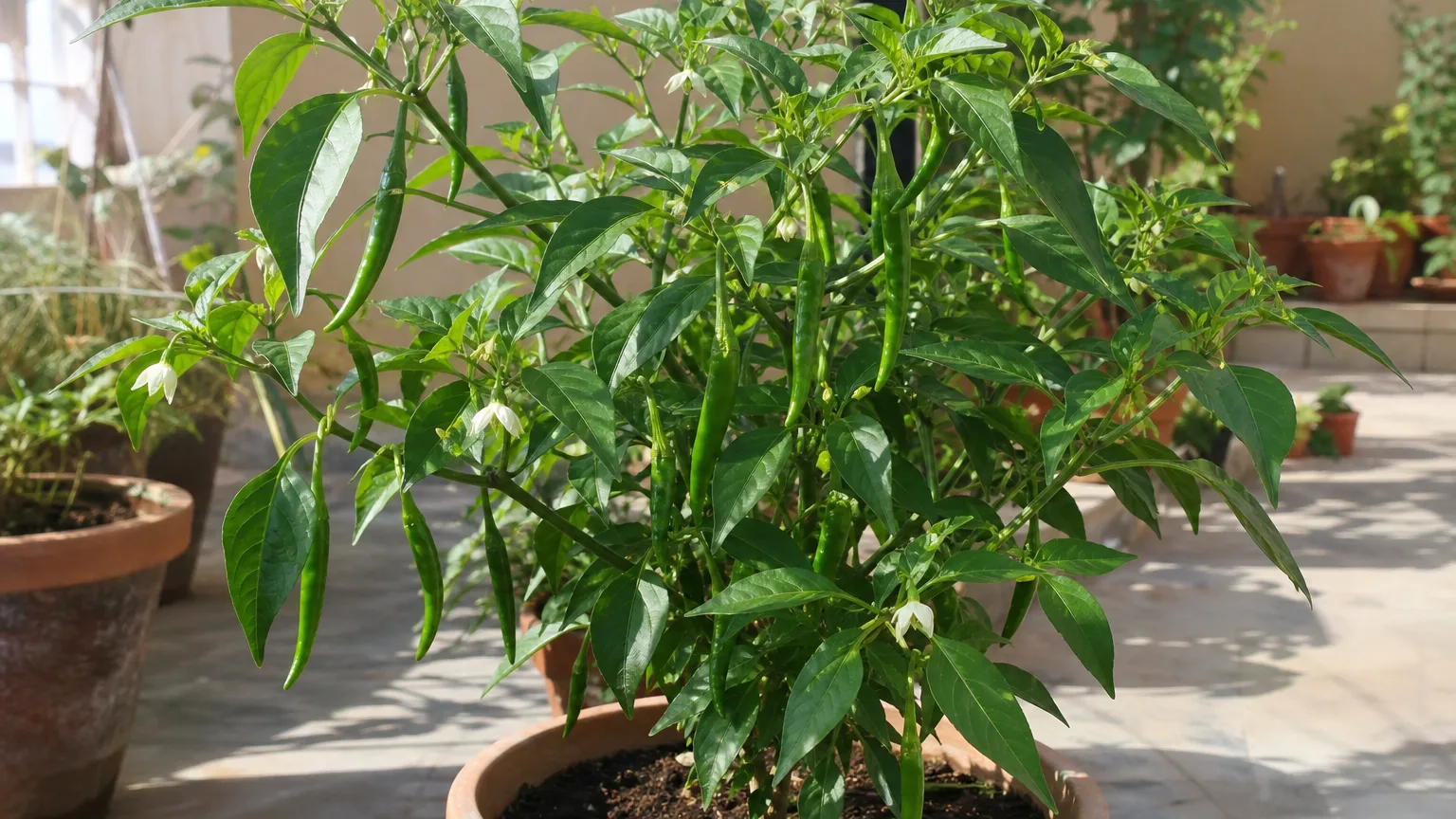
Green Chilli Pruning: Safe Cuts, Harvesting, and Shaping
Green Chilli Pruning: Safe Cuts, Harvesting, and Shaping
Quick answer: prune less than you harvest
First, remove one dead, snapped, or clearly diseased piece with clean, sharp scissors. Cut a damaged leaf at its petiole or a dead side shoot back to its junction with healthy tissue; do not begin by shortening every branch.
For a healthy Green Chilli (Capsicum annuum), the most useful repeated cut is usually the harvest cut. Pick firm fruits at the green stage you prefer, cutting the fruit stalk instead of yanking a brittle branch. Structural pruning is optional: a light pinch can shape a vigorous young plant, but routine topping is not required for the plant to flower and crop.
Decide whether the plant needs pruning
Stand back and inspect the whole plant before cutting. A naturally compact, well-branched chilli carrying flowers or fruit may need nothing beyond harvest and removal of damaged material. Compare its condition with the normal growth described in the Green Chilli overview rather than treating every side shoot as unwanted.
Look for:
- dead leaves that are dry throughout, not merely drooping at midday;
- snapped stems, split branch unions, or fruit stalks torn during harvest;
- spots, water-soaked tissue, mosaic-like mottling, or progressive wilt;
- lower leaves touching wet soil;
- crowded shoots that rub, block access, or make harvesting difficult;
- a stretched plant reaching for light rather than producing sturdy branches.
Pruning cannot correct low light, damaged roots, erratic watering, or a systemic infection. A stretched plant first needs its light conditions corrected; cutting it back while the same light problem continues only removes working leaves. Likewise, restore appropriate Green Chilli watering before asking a wilted plant to seal fresh wounds.
When to prune Green Chilli
Routine cleanup
Remove dead or broken material whenever it appears. For suspicious disease, work when foliage is dry, isolate the plant if practical, and identify the cause before making many cuts. Washington State University notes that some pepper mosaic viruses spread mechanically on tools and hands and advises pulling and destroying infected plants rather than trying to prune away a systemic infection (WSU Hortsense).
Optional shaping
Shape only a vigorous, established young plant that is producing healthy new leaves. NC State Extension describes pinching young chilli plants as a way to encourage a bushier appearance. That supports pinching as an option, not as a universal yield treatment.
Skip shaping when the plant is newly transplanted, dehydrated, heat-stressed, flowering heavily, or already carrying a useful crop. Do not combine a major trim with repotting or a sudden move into stronger sun.
End-of-season and overwintering cuts
In a frost-free climate or a genuinely warm, bright protected space, a healthy plant may be kept beyond one crop cycle. The Royal Horticultural Society describes C. annuum as a woody perennial that is commonly grown as an annual where cool months make survival difficult. Overwintering therefore depends on the environment; pruning does not make a cold, dim site suitable.
After the final harvest, remove damaged growth and shorten only shoots that must fit the protected space. Retain healthy nodes and some foliage instead of cutting an untested plant to bare sticks. Where cold, pests, or poor indoor light make survival unlikely, composting a healthy spent plant and starting fresh is more dependable than a severe rescue cut.
Prepare clean tools and protect yourself
Use bypass secateurs or sharp scissors that can cut a chilli stem without crushing it. Remove soil and sap first. Iowa State University Extension recommends wiping or dipping pruning equipment in ethanol or isopropyl alcohol; sanitize before starting, between plants, and again after cutting suspect tissue.
Dirty blades can move fungal, bacterial, and viral pathogens between plants, as summarized in the University of Arizona Cooperative Extension tool-sanitation guidance. Put diseased trimmings in the appropriate waste stream rather than among healthy cuttings, then clean the blades again.
Hot chilli fruit and residue can irritate skin and eyes. Wear gloves if the cultivar is pungent, keep your hands away from your face, and wash hands, blades, and handles after harvest.
Where to make each cut
Dead or damaged leaves
Follow the leaf stalk to where it joins the main stem and cut close to that junction without slicing the stem. If only the tip is cosmetically brown but most of the leaf is green, leave it; the green area is still useful canopy.
Broken or dead side shoots
Trace the shoot downward until the tissue is firm and normally coloured. Remove a wholly failed side shoot at its branch union without leaving a long snag. If damage extends into the main stem, stop and assess whether the plant can be supported; repeated cuts into collapsing tissue will not cure a stem or root disease.
A young tip for optional branching
Identify a soft growing tip above a healthy leaf pair or branching node. Pinch or snip only that tip and leave the node below it intact. Wait to see how the plant responds before touching another leader. Do not apply this to every branch of an unknown cultivar.
Ripe-enough green fruit
Support the fruit in one hand and cut its stalk with scissors, leaving a short stalk on the chilli. Do not twist the branch to free it. Regular picking fits the plant’s crop cycle, and Utah State University Extension confirms that peppers may be harvested firm and green before full colour.
How much foliage should remain?
There is no evidence-backed percentage that is safe for every Green Chilli cultivar, plant age, container size, or climate. Use the plant’s function as the limit: retain most healthy leaves, all sound fruit-bearing branches, and enough canopy to shade developing fruit.
That shade matters: exposed pepper fruit can develop sunscald in hot, dry weather, while good leaf cover reduces the problem. Avoid opening the centre simply to imitate tomato pruning, and do not strip leaves around fruit to “send energy” to the crop.
Formal pepper-pruning research does not justify a blanket home-garden rule. For example, a 2024 summer-pruning study tested defined treatments under its own cultivation conditions; such results cannot establish that topping every potted Green Chilli will increase yield. Cultivar, climate, training system, and the timing of each treatment all matter.
Aftercare and signs of recovery
Return the plant to stable care rather than trying to force instant regrowth. Keep the root zone evenly moist but not saturated, ensure drainage remains open, and avoid wetting fresh cuts. Do not fertilize simply because you pruned; follow the Green Chilli fertilizer guide and feed only when the plant is actively growing and actually due.
Successful recovery looks uneventful at first: retained leaves stay firm, cut surfaces dry, flowers and fruit do not suddenly abort, and buds later swell near intact nodes. A shaping pinch may produce more than one responding shoot, but the exact pattern depends on the cultivar.
Continued wilt, blackening that travels down a stem, soft tissue, or expanding spots are not normal pruning recovery. Stop cutting, isolate a suspect plant, and diagnose the underlying disease or root problem.
Mistakes that reduce the crop
- Topping every seedling by default. Pinching is optional, and compact cultivars may already branch adequately.
- Pruning a transplant immediately. Establish roots and stable growth before asking the plant to replace foliage.
- Removing the leafy cover around fruit. Exposed peppers are more vulnerable to sunscald.
- Treating virus symptoms as a local leaf problem. A systemic infection is not removed by trimming visible mottling.
- Pulling fruit from the plant. A clean stalk cut avoids tearing a productive branch.
- Taking cuttings from suspect growth. Use only healthy, pest-free material if you follow the Green Chilli propagation guide.
- Hard pruning for overwintering without suitable conditions. Warmth and strong light determine whether keeping the plant is realistic.
Related Green Chilli guides
- Green Chilli overview — identify normal growth and crop habit before cutting.
- Green Chilli light — correct stretching and weak growth before structural pruning.
- Green Chilli watering — stabilize moisture before and after a trim.
- Green Chilli fertilizer — feed active growth without using fertilizer as wound treatment.
- Green Chilli propagation — decide whether a clean, healthy cutting is worth keeping.
Pruning should leave Green Chilli easier to harvest and with most of its productive canopy intact. Clean up damage first, harvest with scissors, and use pinching or overwintering cuts only when the plant’s condition and growing environment justify them.