Green Chilli Light Needs for Pots and Balconies
Green Chilli Light Needs for Pots and Balconies
Green Chilli Light Needs for Pots and Balconies
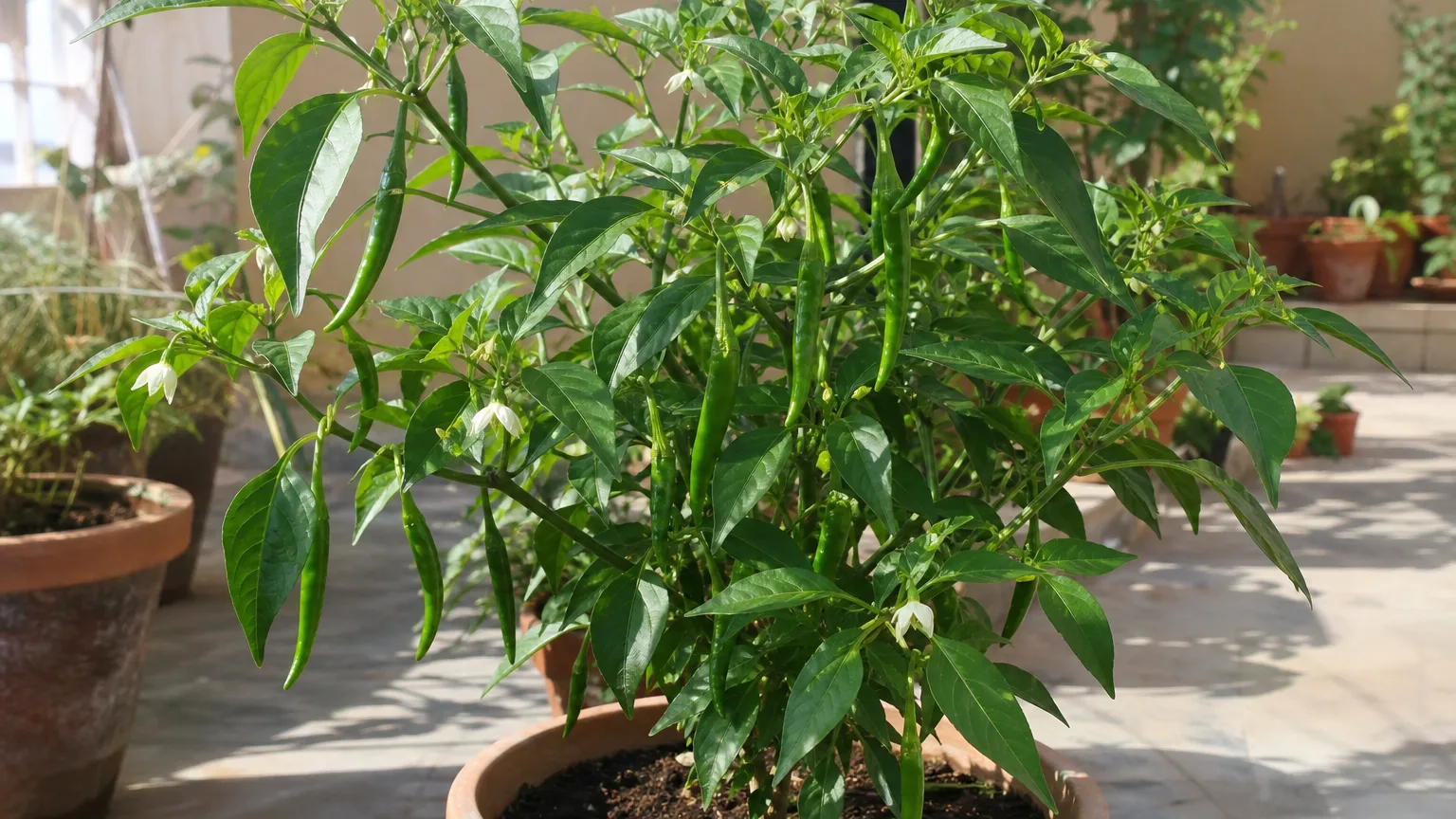
Green Chilli is a sun-grown edible crop, not a low-light kitchen plant. For a compact, branching Capsicum annuum that flowers and carries useful fruit, start with at least six hours of direct sunlight on the leaves, then judge the placement by growth, flower retention, and heat stress. NC State Extension classifies chilli pepper light as full sun, meaning six or more hours of direct sun each day.
That target is a starting point, not a promise that every west-facing balcony or rooftop is automatically suitable. Buildings, railings, shade cloth, glass, monsoon cloud, reflected heat, and the height of the sun all change what reaches the plant. The best spot gives strong direct light for much of the day without trapping enough heat to interrupt fruit set.
The quick answer: give Green Chilli direct sun
Put Green Chilli outdoors in the sunniest usable part of a garden, terrace, rooftop, or balcony. A site with morning sun continuing into midday is often easier to manage than an enclosed corner that receives only a short, hot late-afternoon blast. The Royal Horticultural Society says chillies need lots of sunshine to fruit well, and suggests a sheltered sunny patio, balcony, conservatory, or south-facing wall.
If your plant receives fewer than six hours because a neighbouring tower, awning, or balcony ceiling blocks the sky, it may stay alive but crop lightly. Move it toward a clearer edge if safe, use a wheeled stand to follow seasonal sun, or choose a compact cultivar and accept a smaller harvest. Do not try to replace missing light with extra fertilizer; lush weak growth is not a substitute for light-driven flowering.
Why fruiting Green Chilli needs strong light
Leaves use light to build the carbohydrates that support new branches, flowers, roots, and developing fruit. A Green Chilli may produce a few buds in mediocre light, but a useful crop asks more from the plant than leaf maintenance. UF/IFAS likewise places peppers in full sun and fertile, well-drained soil.
Light also shapes the canopy. Strong, appropriate exposure tends to produce shorter gaps between leaves, firmer stems, and better branching; weak light encourages stems to stretch toward the brightest opening. A well-leafed canopy matters later because exposed pepper fruit can suffer sunscald in hot, dry weather, while good leaf cover reduces that risk.
Best placement in a garden, terrace, or home
An open garden bed with long sun exposure is usually simplest, provided drainage and watering are sound. On a terrace or rooftop, place the pot where it receives direct sun but is not cooked by heat stored in dark flooring or boxed in by solid walls. Raise the container slightly so drainage holes stay clear and avoid pressing foliage against hot glass or metal.
Inside a home, even a bright window usually delivers less usable light than an open balcony because the roof, walls, glass, grills, and distance from the pane reduce intensity and duration. A compact chilli may grow beside an exceptionally sunny unobstructed window, but fruiting indoors is less reliable than outdoor culture. If no safe outdoor spot exists, treat artificial light as a production requirement rather than decoration.
Compare east, south, west, and obstructed balconies
An east-facing balcony often gives useful morning sun with lower afternoon heat load. It can work well when the plant receives several uninterrupted hours and bright open sky afterward. A south-facing exposure can provide long sun in much of India, but seasonal sun angle and overhead slabs still matter.
A west-facing balcony can deliver strong late light, yet walls, glass, and paving may also release stored heat around flowering time. Watch flower retention and leaf temperature rather than assuming more heat means better cropping. A north-facing or deeply recessed balcony is often the hardest: if direct sun never reaches the leaves, moving the pot a metre within the same dim space rarely fixes the limitation.
How much direct sun is enough?
Use six hours as the practical minimum for a fruiting plant, not as a magical cutoff. More direct sun can be productive when roots stay evenly moist and air moves freely. Less may still produce some fruit in a bright, warm climate, but the likely trade-offs are slower growth, fewer flowers, weaker branching, and a smaller crop.
Count the time when sun actually lands on the foliage. Do not count the hours between sunrise and sunset, or the hours when the room looks bright. Check the plant in the morning, near midday, and later in the afternoon on a clear day; this simple observation is more useful than choosing a spot from the compass direction alone.
Understand the limits of balcony light
Balconies create sharp local differences. The outer leaves may receive sun while the back of the canopy remains shaded by a solid railing. A roof slab may block high summer sun but admit lower winter rays, or the reverse depending on orientation. Nearby pale walls may add useful reflected light, while dark stone and metal add heat as well as brightness.
Rotate the container occasionally if one side consistently leans toward the opening, but do not use rotation to hide a fundamentally dim site. Secure the pot before moving it near an edge, and keep a fruit-heavy plant protected from gusts. The goal is an evenly lit, stable canopy, not the most exposed possible position.
Read the plant and the shadow, not the room
At midday, direct sun makes a clear, hard-edged shadow of the leaves. Bright open shade makes a softer shadow; a dim interior produces little useful shadow at all. This is a rough field check rather than a calibrated light measurement, but it helps distinguish direct exposure from a bright-looking room.
Then use new growth as evidence. Compact new nodes, fresh side branches, flowers that continue opening, and fruit that begins to swell suggest the light is doing useful work. Long pale stems leaning toward the opening, large thin leaves, and repeated buds that fail to develop justify a brighter placement after watering and temperature problems have been ruled out.
Full sun and extreme heat are different problems
Green Chilli wants sun, but its flowers have temperature limits. New Mexico State University reports that chile fruit set can stall in very hot conditions and that high night temperatures can trigger flower drop. Oklahoma State also notes that extreme summer heat can restrict pepper fruit set, although small pungent types may tolerate heat better than large bell peppers.
This distinction matters in Indian summers. A plant can need more total light over the day yet benefit from less heat load during an exceptional hot spell. If flowers drop while the plant has compact growth and abundant sun, investigate hot nights, a heat-trapping balcony, dry root swings, and poor airflow before concluding that the chilli needs still more exposure.
Use temporary shade only when conditions demand it
Do not permanently move a healthy fruiting chilli into deep shade because one afternoon is hot. First improve airflow, keep the root zone evenly moist, move the pot away from a heat-radiating wall, and water according to the Green Chilli watering guide. If severe heat continues and leaves or flowers show stress, temporary light shade during the harshest part of the afternoon can reduce heat load while preserving morning sun.
The RHS advises ventilation and shading in hot protected conditions because temperatures above its stated threshold can reduce chilli fruiting. Apply that principle conservatively on a balcony: use shade as a response to verified heat stress, not as a routine replacement for the full sun the crop needs.
Manage Green Chilli light through monsoon
Monsoon changes light, water, and disease pressure together. Several cloudy days reduce the energy available for growth, while wind-driven rain may saturate one pot and leave another under an overhang almost dry. Keep the plant in the brightest open position that remains safe, but protect the container from standing runoff and repeated waterlogging.
Do not compensate for grey weather by feeding heavily. Growth slows when light falls, so unused water and fertilizer can linger around the roots. Review the Green Chilli soil guide if the mix remains wet for long periods, and use the Green Chilli fertilizer guide for feeding decisions after active growth resumes.
After prolonged cloud, clear intense sun can return abruptly. Plants that stayed outdoors generally retain better sun tolerance than plants moved deep indoors, but still watch tender new leaves for bleaching or papery patches. Keep watering consistent and avoid combining sudden exposure changes with repotting or hard pruning.
Acclimate nursery plants without a rigid timetable
A nursery chilli may have been raised under shade cloth or held in a shop with filtered light. Moving it directly into harsh rooftop or west-balcony sun can scorch leaves even though the species ultimately belongs in full sun. The RHS recommends hardening chilli plants before outdoor conditions, which supports a gradual transition rather than a single abrupt move.
Begin with bright outdoor light and gentler direct sun, then increase exposure in stages as the plant remains firm and new leaves stay clean. Let weather and plant response set the pace: cloudy, humid conditions differ from dry summer wind, and a small soft transplant differs from an established woody plant. If fresh bleaching or crisp patches appear, step back to the last exposure that caused no new damage and resume more slowly.
Change one major stress at a time. Do not repot, prune hard, allow the root ball to dry, and increase direct sun together. If roots need more room, follow the Green Chilli repotting guide and let the plant re-establish before demanding its highest-light placement.
Seedlings and fruiting plants need different setups
Seedlings need bright light immediately after emergence, but their small root systems and tender leaves make sudden heat and drought more dangerous. Utah State says adequate light is essential for quality pepper transplants. Keep seedlings close to a strong light source, provide airflow, and avoid letting them stretch before gradually introducing outdoor sun.
A mature flowering plant needs a larger daily light total and enough canopy illumination to support fruit. It also carries more water demand and may be more vulnerable to a hot pot on concrete. Use the Green Chilli propagation guide for seed-starting details; this page focuses on established plants moving toward flowering and harvest.
Can grow lights replace outdoor sun?
They can, but a room bulb or distant decorative lamp is rarely enough for fruiting. Use a purpose-built full-spectrum horticultural fixture that covers the whole canopy, place it according to the manufacturer’s output and distance guidance, and run it on a timer. Increase intensity or duration gradually while watching leaf posture and heat around the fixture.
Artificial-light growing also needs airflow and pollination support. Gently moving flowering branches can help distribute pollen indoors, while stagnant enclosed air can compound heat and pest problems. If the plant stays tall, sparse, and flowerless despite long lamp hours, the useful light reaching the leaves is probably still inadequate; move the fixture within its safe rated range or use a stronger one.
Warning signs of too little light
Low-light Green Chilli usually becomes elongated rather than compact. Stems lean toward the opening, spaces between leaves lengthen, new leaves may be larger and thinner, and the lower canopy shades itself. Flowering can be delayed or sparse, and a plant that does bloom may carry fewer developing fruits.
First move the plant to a brighter site gradually; do not fertilize it into faster weak growth. Reassess watering because a dim plant uses water more slowly. If the newest growth remains compact after the move, the correction is working even though old stretched stems cannot shorten.
Warning signs of too much sun or heat
Sudden light injury appears mainly on the newly exposed side as pale, bleached, tan, or crisp patches. Fruit exposed after leaf loss can develop sunscald; Utah State describes it as overheating and drying where fruit receives direct sun in hot, dry weather. Existing damaged tissue will not turn green again, so judge the adjustment by healthy new leaves and protected new fruit.
Heat stress can look different: leaves may droop during the hottest period despite moist soil, flowers may drop, and tiny fruit may stop developing. Check the root zone before adding water. Improve airflow and reduce reflected heat first; add temporary afternoon shade only when strong sun and heat are clearly overwhelming an otherwise well-lit plant.
Common Green Chilli light mistakes
The most common mistake is calling a bright room “full sun” when no beam reaches the plant. The second is assuming that an hour of severe west sun replaces a longer, more usable daily exposure. A third is treating flower drop as proof of low light even when the real problem is extreme heat or irregular watering.
Other errors include moving a shop plant straight into harsh sun, leaving a pot against hot glass, shading throughout the season after one heatwave, and adding nitrogen to a leggy plant. Diagnose from the whole setup: direct-sun duration, new growth, temperature, airflow, root moisture, and recent changes.
When to use this page vs other Green Chilli guides
- Use this page for sun duration, balcony placement, heat-versus-light decisions, grow lights, and acclimation.
- Start with the Green Chilli overview when you need whole-plant context or cultivar clarification.
- Use the Green Chilli watering guide when droop, dry-down, flower drop, or hot-weather irrigation is the main concern.
- Use the Green Chilli soil guide when monsoon wetness, drainage, or slow pot dry-down limits growth.
- Use the Green Chilli fertilizer guide when growth is compact but pale or feeding and fruiting need review.
- Use the Green Chilli repotting guide when the container dries implausibly fast or roots fill the pot.
Related Green Chilli guides
- Green Chilli overview — identity, growth habit, and complete care
- Green Chilli watering — even moisture through flowering and fruiting
- Green Chilli soil — fertile drainage for pots and beds
- Green Chilli fertilizer — feeding without sacrificing fruit set
- Green Chilli repotting — container size, timing, and root handling
- Green Chilli propagation — seedling light and establishment
- Green Chilli pruning — shaping without removing productive canopy
Conclusion
Give Green Chilli at least six hours of direct sun as a practical starting point, then refine the placement from real evidence. Strong new branching, continuing flowers, and swelling fruit indicate useful light. Stretching and sparse flowering point toward too little; bleached sun-facing tissue, hot-wet droop, and flower loss during extreme heat call for acclimation, airflow, moisture checks, and sometimes temporary afternoon protection.
In India, the best light plan changes with the site and season. Preserve direct sun through monsoon cloud, prevent an enclosed summer balcony from becoming a heat trap, and move nursery plants toward stronger exposure in stages rather than by a rigid calendar. Green Chilli is flexible about containers, but not about the basic energy needed to flower and fruit.