Spider Mites on Green Chilli: Signs, Checks & Fixes
Quick answer
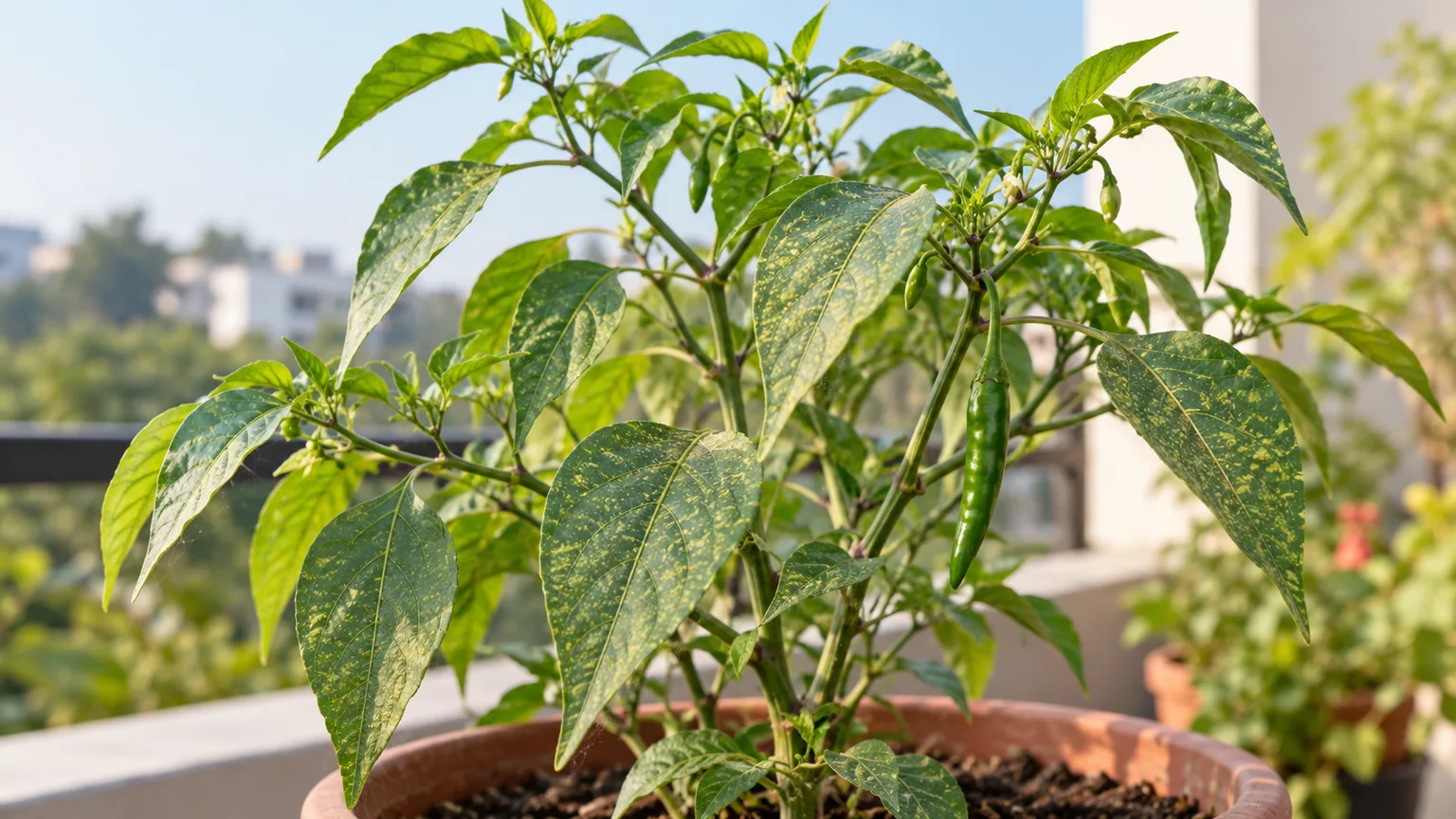
Pale stippling plus tiny moving specks on the undersides of Green Chilli leaves points to spider mites; fine webbing strengthens the diagnosis. First, rinse leaf undersides with a steady stream of water, then monitor new growth and nearby plants.
Spider Mites on Green Chilli: Signs, Checks & Fixes
This guide covers spider mites on Green Chilli. See also the general Spider Mites guide, watering, and light pages for this plant.
Spider Mites on Green Chilli: Signs, Checks & Fixes
Quick answer
Pale, closely spaced stippling on Green Chilli leaves plus tiny moving specks beneath them points to spider mites; fine webbing makes the diagnosis stronger. First, rinse the undersides of affected leaves with a steady stream of water, then check the plant and its neighbors again over the next few days.
Green Chilli is a fruiting Capsicum annuum crop commonly grown in a sunny pot, terrace, or garden. In a hot, dry spell, a container can dry quickly while the plant is carrying flowers and pods. Do not diagnose mites from curled or yellow leaves alone: confirm that live mites or their silk are present. For the general pest biology and control options, see the spider-mite guide; this page focuses on the checks that matter on a fruiting chilli. For the site’s full growing context, start with the Green Chilli overview.
What spider-mite damage looks like on a fruiting Green Chilli
The first clue is often a dusting of tiny pale dots across a leaf, rather than a large spot or a chewed edge. Check the lower and inner leaves, especially the underside and the junction where a leaf stalk meets a branch. Spider mites feed mostly on leaf undersides; damage can progress through pale stippling, bronzing, and leaf drop, while dense silk may appear when numbers are high.
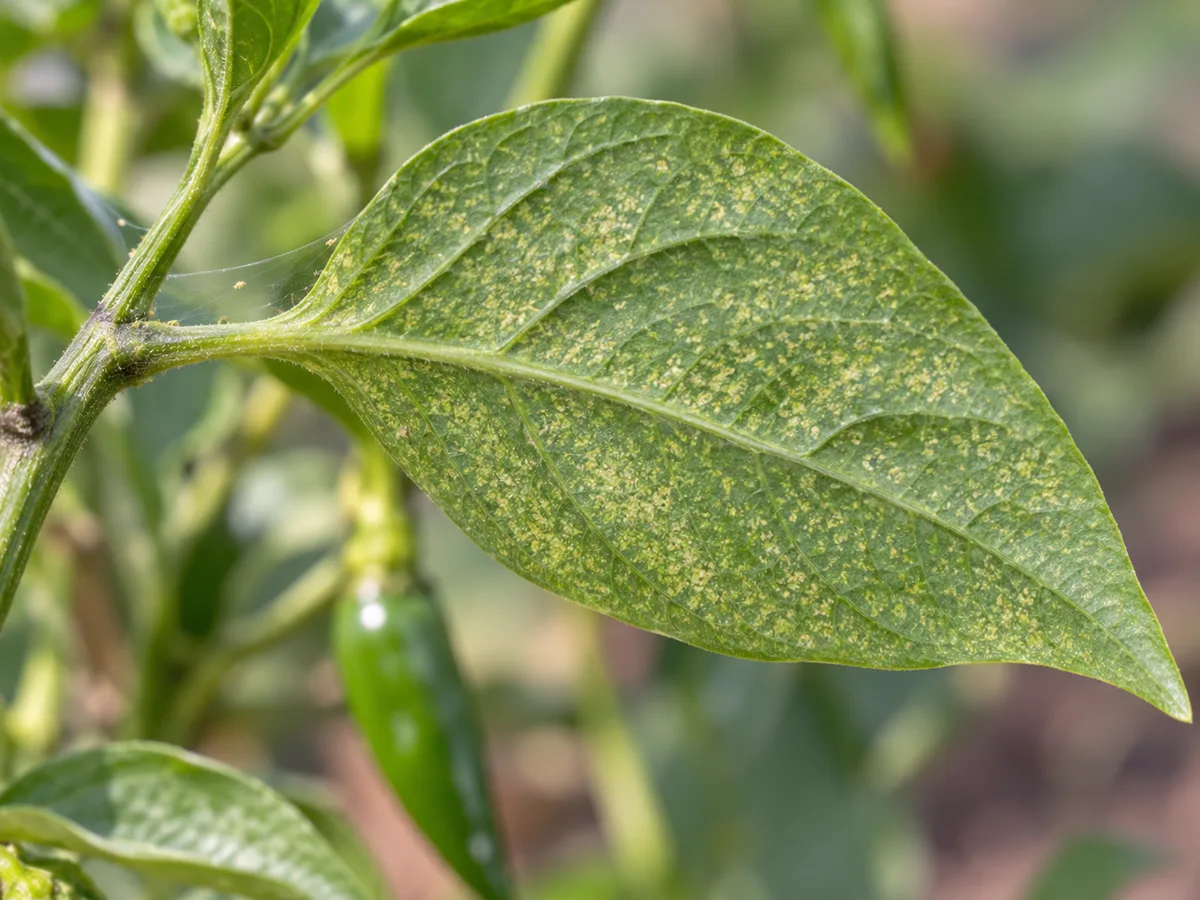
Fine stippling and silk on the underside of a chilli leaf are more useful clues than leaf curl alone.
Read the pattern across Green Chilli branches
Green Chilli makes a branching canopy with leaves, flowers, and young fruit close together. One spotted leaf cannot show whether mites are confined to a small patch or spreading. Check the undersides of several leaves on different branches: begin near the lower canopy, include leaves tucked inside the plant, and compare a damaged leaf with a nearby leaf that still looks clean. Also look around leaf-stalk junctions and along the newest side shoots, where crowded foliage can make a quick surface glance miss a colony. Spider mites commonly gather on leaf undersides, and a hand lens can reveal moving mites, eggs, or cast skins that are hard to distinguish against green tissue (UC IPM identification guidance).
If only one branch produces moving mites, treat that as a localized finding and inspect the rest before pruning or spraying the whole plant. If more than one branch has live mites or fresh stippling is appearing on previously clean leaves, assume the problem is active across the canopy. This simple map also gives you a useful baseline: later checks can focus on the same leaves and on the next leaves that unfold.
Use a hand lens if available. Mites look like moving pinpoints, while UF/IFAS’s white-paper test makes movement easier to see: hold a sheet under a suspect leaf, tap the leaf sharply, and watch for tiny specks that crawl across the paper. This is more reliable than judging the green leaf surface alone. A web alone is not enough if it is a large, loose strand from an ordinary spider; look for silk close to the leaf surface together with stippling or moving mites.
Why sunny Green Chilli crops can flare during dry weather
Spider mites favor hot, dry conditions, and their feeding is more damaging when a plant is already short of water. University of Minnesota Extension reports that hot, dry conditions can trigger spider-mite outbreaks, with feeding beginning on leaf undersides before stippling spreads across the canopy. This is relevant to Green Chilli because it is grown for flowers and pods in warm, bright conditions; a small pot on a sunlit balcony can lose moisture quickly in wind and heat.
Do not move a healthy chilli into deep shade as the first response. Instead, check the root-zone moisture and whether the pot has dried unusually fast. The Green Chilli watering guide explains how to keep a fruiting pot evenly moist without leaving it saturated; the light guide helps distinguish ordinary sun exposure from a sudden change that is stressing the plant.
How to confirm mites instead of another Green Chilli problem
Leaf curl, yellowing, and dry edges are not mite-specific. Spider mites become the likely cause when stippling is paired with live moving specks, fine silk, shed skins, or eggs on the underside. If the paper test shows no moving specks and you find no webbing after checking several affected leaves, keep the diagnosis open rather than spraying by appearance alone.
| What you see on Green Chilli | More useful next check |
|---|---|
| Fine stippling with moving specks on the paper | Inspect undersides and branch junctions for mites, eggs, and silk. |
| Curled, sticky new tips with visible pear-shaped clusters | Check for aphids; their colonies and honeydew are a different pattern. Compare with the Green Chilli aphids guide, then use the Green Chilli problems hub for other symptoms. |
| A few bleached patches only on the most exposed leaves, with no moving specks or silk | Review recent sun exposure and acclimation before treating for pests. |
| General droop while the pot is very light, without stippling or mites | Check whether the root ball has dried; this can occur alongside a separate mite problem. |
Do not repot just to treat mites. Check and rinse the leaf undersides first, then assess drainage only if the pot stays wet or the plant shows separate root-zone symptoms. The Green Chilli soil guide covers that different problem.
Confirm active mites on more than one leaf
Repeat the white-paper test on a leaf with fresh stippling and on one nearby leaf that looks healthier. A hand lens helps distinguish a plant-feeding mite from dust or a fleck of dried residue; if you cannot see a moving mite, keep the diagnosis provisional and look again rather than treating solely because an old leaf remains pale. UC IPM notes that visible injury can persist after mites have left, so old stippling is not by itself proof that a spray is needed. This matters on Green Chilli because heat, uneven moisture, and sun exposure can also leave older leaves marked even after the original stress has passed.
If moving mites show up on several branches, photograph or mark the affected areas and start with the rinse below. If the test is negative, compare the pattern with the lookalike rows and check the pot before changing light, fertilizer, or soil. Changing several conditions at once makes it harder to tell whether the pest diagnosis was right and can add stress while flowers or pods are developing. UC IPM notes that damage can persist after mites leave, so old stippling alone is not a reason to repeat a spray.
First fix: rinse the undersides of the affected leaves
Take the plant to a place where runoff will not splash onto other pots, or use a hose on an in-ground plant. Rinse the undersides of affected leaves with a steady stream that dislodges mites without shredding leaves, flowers, or tender branch tips. Work from the inner and lower canopy outward, then allow the foliage to dry before night. Better Homes & Gardens also recommends a thorough rinse of leaf undersides as a physical first step.
For a container-grown chilli, keep it away from plants whose foliage touches until you have confirmed the infestation is no longer active. Do not soak the pot simply to raise humidity, and do not treat a heat-wilted plant with oil or soap in direct sun. The water rinse is the first action; decide on any follow-up only after checking whether live mites remain.
Rinse a fruiting chilli without flooding the pot
Support a branch with one hand and direct the water at the leaf undersides with the other, moving through the canopy in sections rather than blasting the whole plant from above. Give extra attention to overlapping leaves and the inner branches, but ease the pressure around open flowers and tender tips so they are not torn off. If the plant is in a pot, tilt it slightly or cover the mix loosely while rinsing so runoff does not turn a moisture-retentive root zone into a saturated one; let the pot drain fully afterward. The goal is contact with leaf undersides, where colonies feed, not a longer watering session. Let foliage dry in moving air, keep the plant out of contact with neighboring pots, and do not combine the rinse with pruning, repotting, and a pesticide application on the same day.
If water alone does not control the outbreak
If moving mites and fresh stippling continue after rinsing, choose a contact product only if its label specifically allows use on edible peppers. Soap and oil products must contact the mites and need thorough coverage of leaf undersides; they can also burn foliage in hot conditions or on a water-stressed plant. Follow the product label for temperature limits, protective equipment, repeat timing, and the pre-harvest interval. Do not substitute dish detergent, rubbing alcohol, or an improvised oil spray for a labelled product. UC IPM warns that soaps and oils can injure foliage during heat or water stress; broad-spectrum insecticides can also disrupt mite predators and worsen outbreaks.
Spider-mite eggs and active stages do not all respond to one contact treatment. UF/IFAS notes that development can be rapid in warm conditions and that repeat applications may be needed; use the labelled interval rather than copying a fixed schedule from another crop or product. Keep flowers and harvestable pods in mind when choosing any treatment, and do not eat produce contrary to the label.
That follow-up is especially important during a hot Green Chilli season. For the twospotted spider mite, UF/IFAS describes eggs hatching in roughly three days and development from egg to adult taking about five to twenty days under favorable conditions near 80°F—a rapid development cycle whose timing changes with temperature and species. A rinse or labelled contact product can reduce exposed mites without proving that every egg or sheltered mite was reached. Recheck leaf undersides and repeat the paper test after treatment, then follow the product label for any repeat application. If no live mites return and new leaves stay clean, do not keep spraying old damage just because the marks remain.
Protect the Green Chilli canopy while it recovers
Remove only leaves that are mostly bronzed, heavily webbed, or drying. Carry the cut leaves straight to household waste instead of dropping them beside the pot. The pepper-specific temptation is to strip the whole lower canopy, but a fruiting plant still needs healthy leaves to keep growing and shading its pods. During cleanup, do not strip all foliage, as Get Busy Gardening’s pruning guidance also advises.
On a Green Chilli, keep enough healthy leaves on each major branch to support the plant while it is flowering and setting pods. Take off badly damaged leaves in small amounts and reassess before removing more; a bare branch has less healthy tissue available for ongoing growth, and exposed fruit loses some of its natural leaf cover. Do not cut back every branch just to make the plant easier to spray. If most of the canopy is already bronzed, webbed, and dropping, focus on keeping the remaining growing tips and root zone stable while monitoring for live mites. If the plant cannot produce clean new leaves or has lost nearly all useful foliage, replacing it may be more sensible than repeated treatments, especially near the end of the growing season.
Judge progress by fresh Green Chilli growth: new leaves should open without new stippling, and repeated paper checks should stop finding moving mites. Old speckled leaves will not become unmarked again because the feeding injury has already damaged those cells. In warm growing weather, the plant may replace some foliage; if the season is ending or the growing tip and most leaves are lost, replacing the crop may be more practical than repeated sprays.
Prevent another mite flare on a fruiting chilli
During hot, dry weather, inspect leaf undersides every few days, including the hidden leaves within the branching canopy. Check neighboring peppers and nearby susceptible plants at the same time; mites can persist on a neighboring host and move back after treatment. Give a pot enough water to prevent prolonged wilting, but let excess drain rather than keeping the root ball constantly saturated.
Keep the plant in its normal bright, airy position and avoid unnecessary nitrogen feeding while it is stressed. If the root zone and light are sound but you are unsure whether a recent feeding change affected the plant, consult the Green Chilli fertilizer guide before adding more. For symptoms that do not show mites, use the related guides below to choose the right plant-specific diagnosis.
For a container on a hot terrace, make moisture checks part of the pest check rather than watering on a fixed calendar. Green Chilli can need more frequent checks during hot, windy weather and while fruiting, but the mix should still drain freely; a dry-stressed plant is less tolerant of mite feeding, while a constantly wet root ball creates a separate root problem. Keep the plant in its usual sunny spot once it is acclimated instead of moving it into deep shade as a mite treatment. After a rinse, note the date and which branches were active, inspect nearby peppers, and compare the next round of growth. That record helps distinguish a controlled infestation from a fresh flare-up without relying on old leaf marks.
Related Green Chilli guides
- Green Chilli overview — use for the crop’s full sun, water, soil, and harvest context.
- Green Chilli watering — use when a pot dries rapidly or the plant wilts in hot weather.
- Green Chilli light — use when leaf injury follows a move into stronger sun.
- Green Chilli soil — use for poor drainage or a pot that stays wet.
- Green Chilli problems hub — use when the symptom pattern does not confirm spider mites.
Related tool
Use the Pest Identifier Tool to narrow causes for spider mites on this plant before changing multiple variables at once.