Leggy Growth on Kale: Causes, Checks & Fixes
Quick answer
Leggy kale is almost always seedlings stretching for light in too-warm indoor conditions. First step: move trays to your brightest, cooler spot at once — or hang a grow light 6 to 12 inches above them for 14 to 16 hours a day — then thin and grow on cool. Badly flopped stems rarely recover, but kale germinates fast, so re-sowing is often the quickest fix.
Leggy Growth on Kale: Causes, Checks & Fixes
This guide covers leggy growth on Kale. See also the general Leggy Growth guide, watering, and light pages for this plant.
Leggy Growth on Kale: Causes, Checks & Fixes
Quick answer
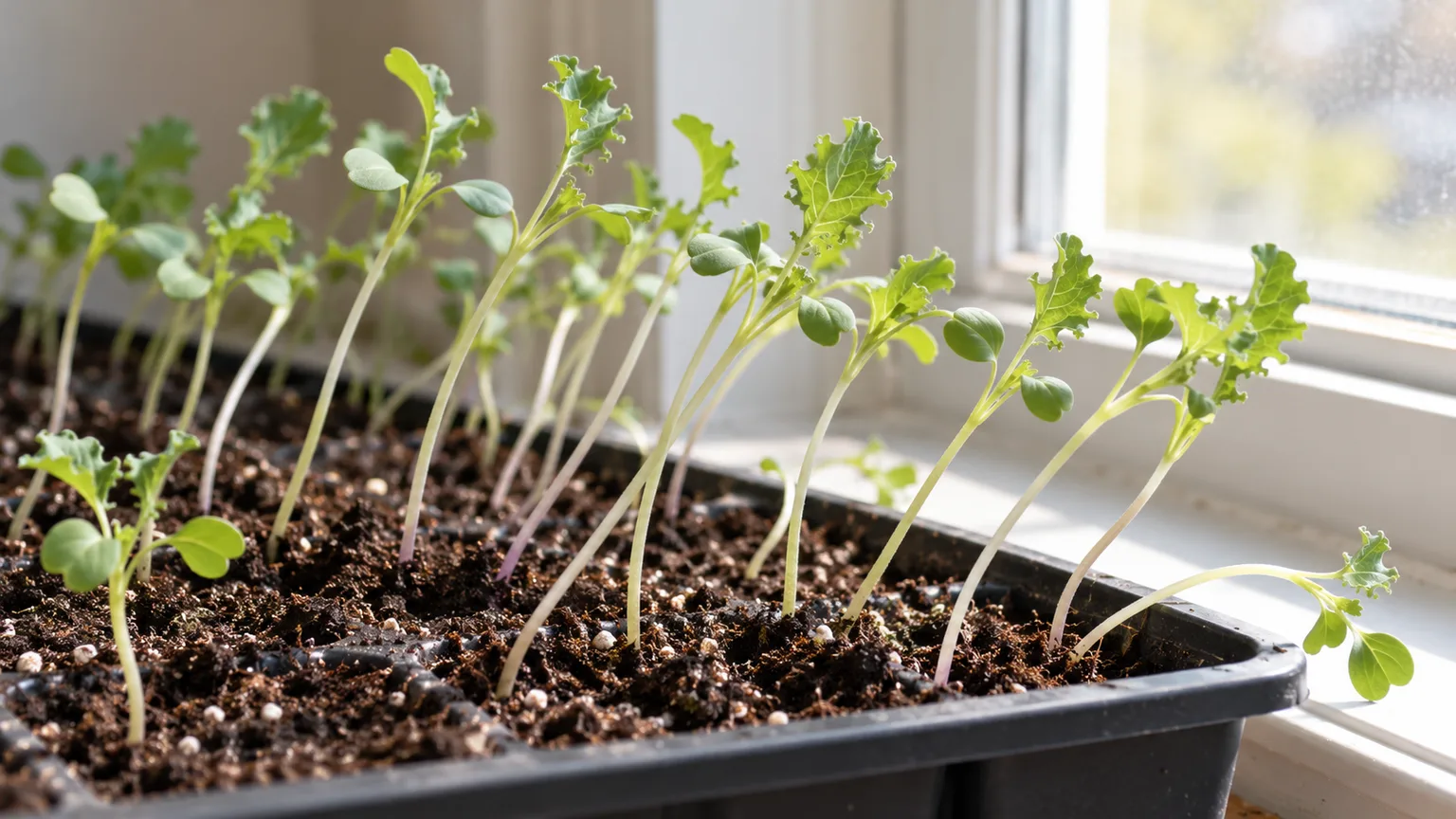
Leggy kale is almost always a seedling problem: fast-germinating kale stretches toward weak light while sitting in too much warmth. The classic scene is an October–November indoor tray on a warm windowsill — tall, pale stems leaning at the glass within days of emergence.
First fix: move the tray to your brightest, cooler spot immediately — or hang a grow light 6 to 12 inches above the seedlings for 14 to 16 hours a day. That single change stops the stretching; everything else (thinning, airflow, transplanting) comes after. For how this stretching works in general, see our leggy growth guide. On kale, the pattern usually shows up as pale stems with long gaps between the soil and the first leaves, while the growing tip still looks alive.
What leggy growth looks like on kale
On kale, legginess means long, thin, pale stems with small cotyledons or undersized first true leaves, often leaning strongly toward the nearest window. Seedlings may be unable to hold themselves upright, tall, thin, and pale as they crane toward the light. Because kale germinates quickly and grows fast — baby leaves in about 30 days — the stretch can go from slight to severe in under a week.
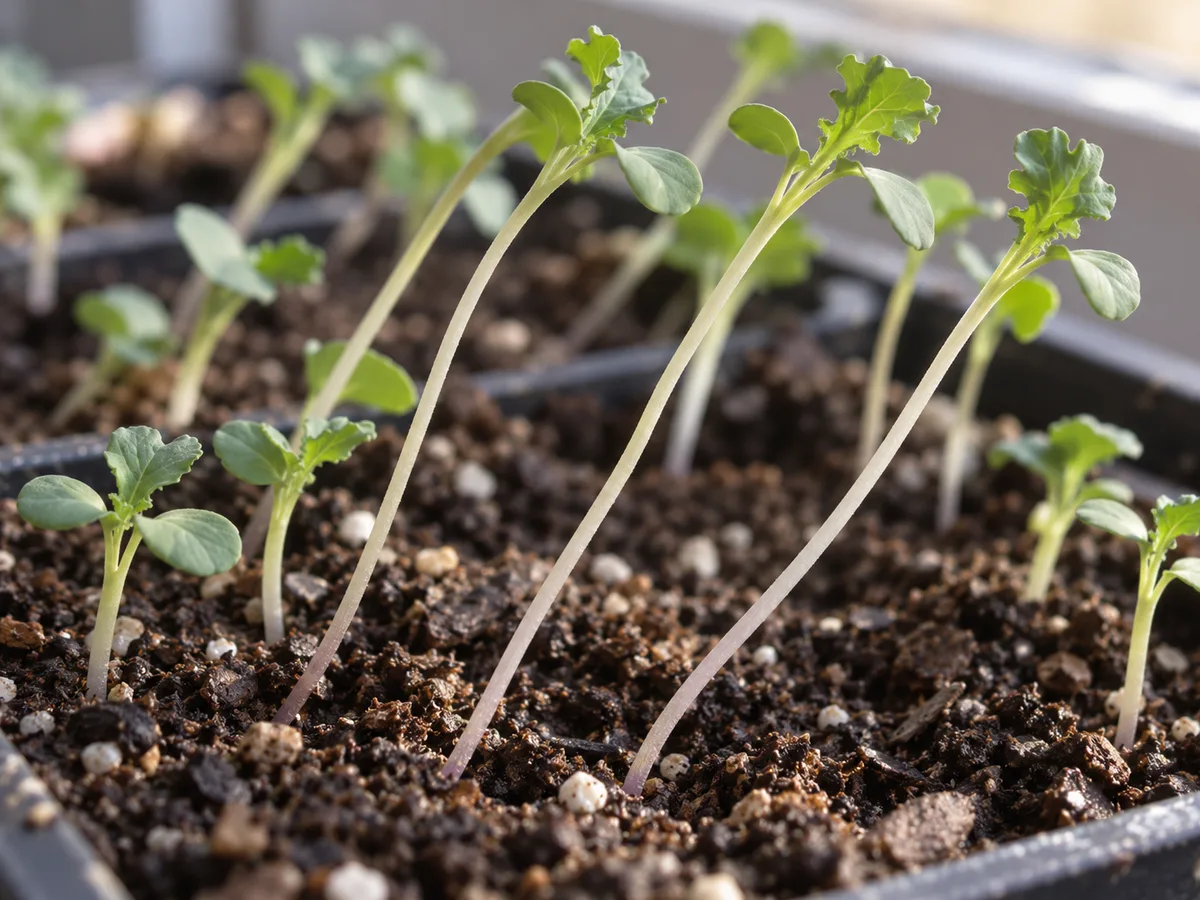
Stretched, pale stems with long gaps between soil and leaves; compare with the short sturdy seedlings in a well-lit tray.
Mature kale can also look leggy for different reasons: an overcrowded container where lower leaves were stripped and the bare stem keeps extending, or a plant entering its flowering (bolting) phase with a rapidly elongating central stalk. Those need different handling — see the lookalike section below — so confirm which stage your plant is at before acting.
Why kale seedlings stretch so readily
Three kale traits combine to make legginess common. First, kale is a cool-season crop that germinates readily in warmth but then wants cool air: professional grower guidance is to keep soil over 75°F (24°C) only until germination, then drop air temperature to about 60°F (16°C). Most indoor sowings break this rule — trays stay on the heat mat under a humidity dome on a warm sill, so seedlings elongate fast in dim late-season daylight.
Second, the underlying response is etiolation: in darkness or weak light, seedlings strongly elongate their stems while cotyledons stay closed and pale, and emergence into real light triggers the switch back to compact growth (etiolation response). A sunny-looking window still delivers light from one angle through filtered glass, which is often too little for a light-hungry brassica seedling.
Third, kale is usually sown densely and pricked out late. Crowded seedlings shade each other and compete upward, so a thickly sown tray stretches even under decent light. Sow thinly from the start — kale seed goes about a quarter to one half inch deep, and seedlings should be thinned to roughly 8 to 12 inches apart in beds (12–18 inches apart per professional spacing) rather than left to jostle.
Still indoor air adds a final push: without air movement, stems stay soft and weak, which is why a fan or daily gentle handling measurably thickens seedling stems (fan or gentle brushing).
How to confirm the cause
Work through these checks in order before changing anything:
- Stem test. Firm, pale-green stretched stems point to simple light hunger. Stems that are pinched, translucent, or thread-thin right at the soil line point to damping off — a fungal collapse, not legginess — and those seedlings will not recover.
- Light audit. Count real hours of direct sun on the tray, and measure any grow-light gap. Seedlings want roughly 12 to 16 hours of bright light daily; an LED hung too high is a classic cause, with 12 inches above seedlings a good reference height.
- Heat audit. Are trays still on a heat mat or under a dome days after sprouting? Seedlings left in that warmth develop thread-thin stems (off heating mats within a couple of days of sprouting).
- Density check. If you cannot see mix between seedlings, overcrowding is contributing — plan to thin regardless of light fixes.
- Stage check. Cotyledon-to-first-true-leaf stage responds best to rescue. Seedlings with several true leaves and woody, flopped stems are usually better replaced.
If watering or leaves look off too, cross-check the kale watering guide — but do not stack a watering overhaul on top of the light fix on the same day.
The first fix to try
Do one thing first: get the seedlings under strong light in cool air. Move the tray to your brightest spot (a south-facing windowsill is best) and get it off all heat; better still, hang a full-spectrum LED 6 to 12 inches above the tray on a timer for 14 to 16 hours a day. Keep the room cool — kale grows on best around 55–75°F (13–24°C), ideally 60–70°F (16–21°C) — rather than warm.
Turn a windowsill tray daily so stems stop bending one way (turn the tray daily), and raise the light as seedlings grow so the gap stays constant. Judge the fix by the next leaves: new growth should emerge shorter, greener, and sturdier within a week. Old stretched stem sections will not shrink back — recovery shows only in what grows next.
Step-by-step recovery
Once the light fix is in place, work through these in order:
- Thin promptly. Snip the weakest seedlings at the base so survivors have airflow and light. Crowded kale never thickens up, however good the lamp is.
- Add gentle movement. Brush your fingertips lightly across the seedling tops daily, or run a small fan nearby for a few hours a day. This simulates a breeze and triggers thicker stems — but watch moisture, since moving air dries trays faster.
- Water from below and ease off. Keep mix evenly moist but never soggy; kale’s shallow roots stall in waterlogged mix, and wet, dense soil invites the damping-off that finishes weakened stems. The kale soil guide covers a mix that drains yet holds moisture.
- Transplant at the right stage. Seedlings are typically ready to move on at 4 to 6 weeks. Firm-but-stretched seedlings can go slightly deeper — stem buried to just below the first true leaves — into a sterile seed-starting-style mix, since young brassica stems tolerate it. Discard any with pinched bases.
- Harden off before moving out. Indoor-grown kale scorches and wilts if planted straight outside. Follow a gradual hardening-off plan over about a week, then plant into full sun to partial shade — at least six hours of direct winter sun per the kale light guide.
Feed nothing extra during rescue. A stressed seedling cannot use fertilizer, and excess nutrients in dim light drive more weak elongation.
When re-sowing beats rescuing
Kale’s speed is your escape hatch. If more than half the tray has flopped, if stems are translucent at the base, or if seedlings have several pale true leaves on thread stems, start over. Fresh kale seed germinates in days under the corrected setup — strong light from day one, off the heat at emergence, sown thinly — and catches up to a nursed-along tray within two to three weeks.
Re-sowing is also the right call late in the window: a fresh tray sown at the proper October–November timing for the plains outperforms leggy September seedlings that never hardened properly. Keep one honest note: re-sow into fresh sterile mix, not the old tray, so any damping-off organisms do not greet the new batch.
Lookalike symptoms
| What you see | Likely cause | Where to go |
|---|---|---|
| Tall pale seedlings leaning to light | True legginess (this page) | Keep reading — light + cool fix above |
| Seedlings fine, but older leaves pale and growth stalled | Light too low overall, chronic | Not enough light on kale |
| Growth slow but compact, no stretching | Nutrition, root room, or season | Slow growth on kale |
| Tall central stalk with buds/flowers on a mature plant | Bolting, not seedling legginess | Harvest remaining leaves; sow a fresh cool-season crop |
| Seedlings collapse at soil line, stems pinched | Damping off | Discard affected seedlings; re-sow in fresh sterile mix |
| Wilting despite wet mix, soft stem base | Root trouble from overwatering | Wilting on kale and the kale overview |
Bolting deserves emphasis because it fools growers: sustained heat pushes mature kale to flower, and that rapidly elongating seed stalk looks “leggy.” No light fix reverses bolting — harvest what is usable and plan the next sowing for cool weather.
Mistakes to avoid
- Leaving trays on the propagator. The warmth that sprouts seeds stretches seedlings once they are up — move them off the heat as soon as most have emerged, growing on around 15–18°C for most crops.
- Hanging the grow light too high. Light intensity falls fast with distance; a lamp a metre above the tray is decoration. Keep it close and raise it as they grow.
- Fertilizing a stressed tray. Extra feed in dim light grows weaker stems, not stronger ones. Resume balanced feeding only after new growth looks sturdy — see the kale fertilizer guide.
- Burying rotten stems. Planting a pinched, discoloured stem deeper does not save it; it buries an infection. Only firm young stems qualify for deeper transplanting.
- Skipping hardening off. Seedlings rescued under lights still need a gradual outdoor transition or they stall at transplant. Review timing in the kale problems hub before moving day.
How to prevent it next time
Sow kale for light, not just for the calendar. Start trays where a grow light or the brightest sill is already waiting, and have the light on from the day of sowing — seedlings need light the moment they emerge, and every dim day adds stretch. Use a sterile seed-starting mix that stays loose and drains, since delicate roots need air as much as moisture.
Sow thinly, thin early, and pot on before roots circle — a seedling left too long in its cell stretches from both crowding and root restriction. In Indian plains, align sowing with the cool season (October into November) so trays grow on in naturally cool bright air; hill growers get a longer window but the same light rules. Outdoors, space to the seed packet’s mature dimensions — dwarf and full-size kales differ enormously — in fertile, moisture-retentive but free-draining soil enriched with compost, and harvest outer leaves while protecting the central bud so plants stay productive instead of bare-stemmed. For the full seasonal rhythm, see the kale overview.
Related kale guides
- Kale overview — season timing, cultivars, and container size; start here for planning the next sowing.
- Kale problems hub — route any new symptom to the right fix instead of guessing.
- Not enough light on kale — use when the whole plant is pale and stalled, not just stretched seedlings.
- Slow growth on kale — use when growth is compact but sluggish (feeding, pot size, season).
- Kale light guide — everyday light needs for established plants.
- Kale watering guide — even moisture without waterlogging for shallow roots.
- Kale soil guide — fertile loam mixes and pH 6.0–7.5.
- Kale fertilizer guide — feeding only after seedlings are sturdy and growing.
Related tool
Use the Plant Problem Diagnosis Tool to narrow causes for leggy growth on this plant before changing multiple variables at once.