Not Enough Light on Kale: Causes, Checks & Fixes
Quick answer
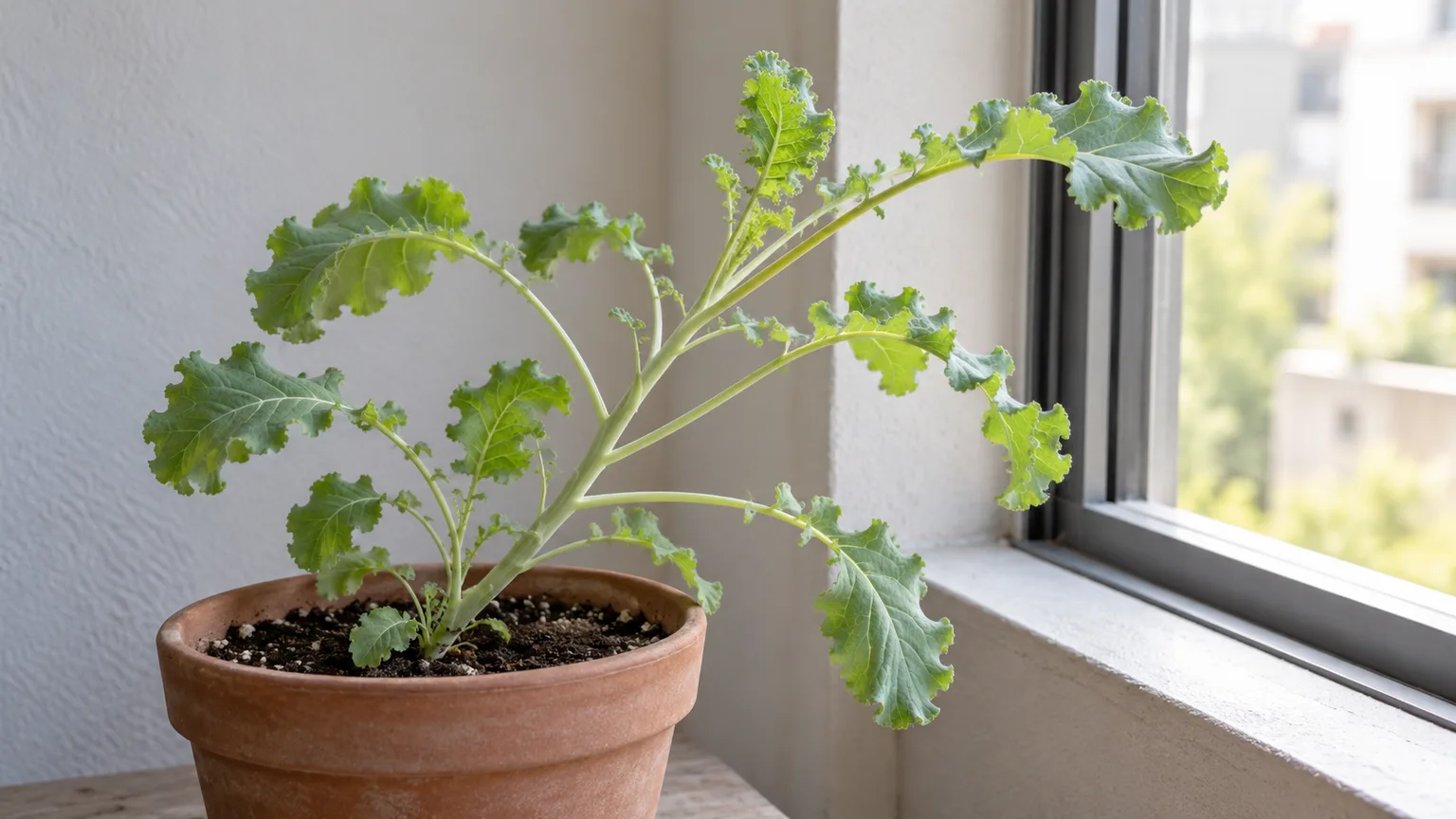
Not enough light on kale shows as pale, undersized leaves, wide gaps between leaf nodes, and regrowth that stalls after you pick outer leaves. First, move the pot to the brightest cool-season spot you have with at least six hours of direct sun, then judge the fix by the next flush of new leaves.
Not Enough Light on Kale: Causes, Checks & Fixes
This guide covers not enough light on Kale. See also the general Not Enough Light guide, watering, and light pages for this plant.
Not Enough Light on Kale: Causes, Checks & Fixes
Quick answer
Not enough light on kale (Brassica oleracea var. acephala) looks like pale, undersized leaves on thin stems, wide gaps between leaf nodes, and a plant that leans toward the brightest side. The signature complaint is harvest failure: you pick outer leaves and almost nothing grows back. Kale builds replacement leaves fastest in at least six hours of direct sun (NC State Extension) during its cool growing window, so dim placement starves the exact tissue you are trying to eat.
For how weak light slows indoor plants in general, see our not enough light guide. On kale, the pattern usually shows up as stalled cut-and-come-again regrowth plus stretch — not just a darker leaf color.
First fix: move the pot to your brightest cool-season spot for six or more hours of direct sun. Do not fertilize, repot, or spray anything first. Give the plant two weeks there, then read the newest leaves to confirm.
What not enough light looks like on kale
Healthy kale in winter sun holds a compact rosette or short stem with firm, deeply colored leaves and a vigorous central bud pushing new foliage. Light-starved kale breaks that picture in specific ways.
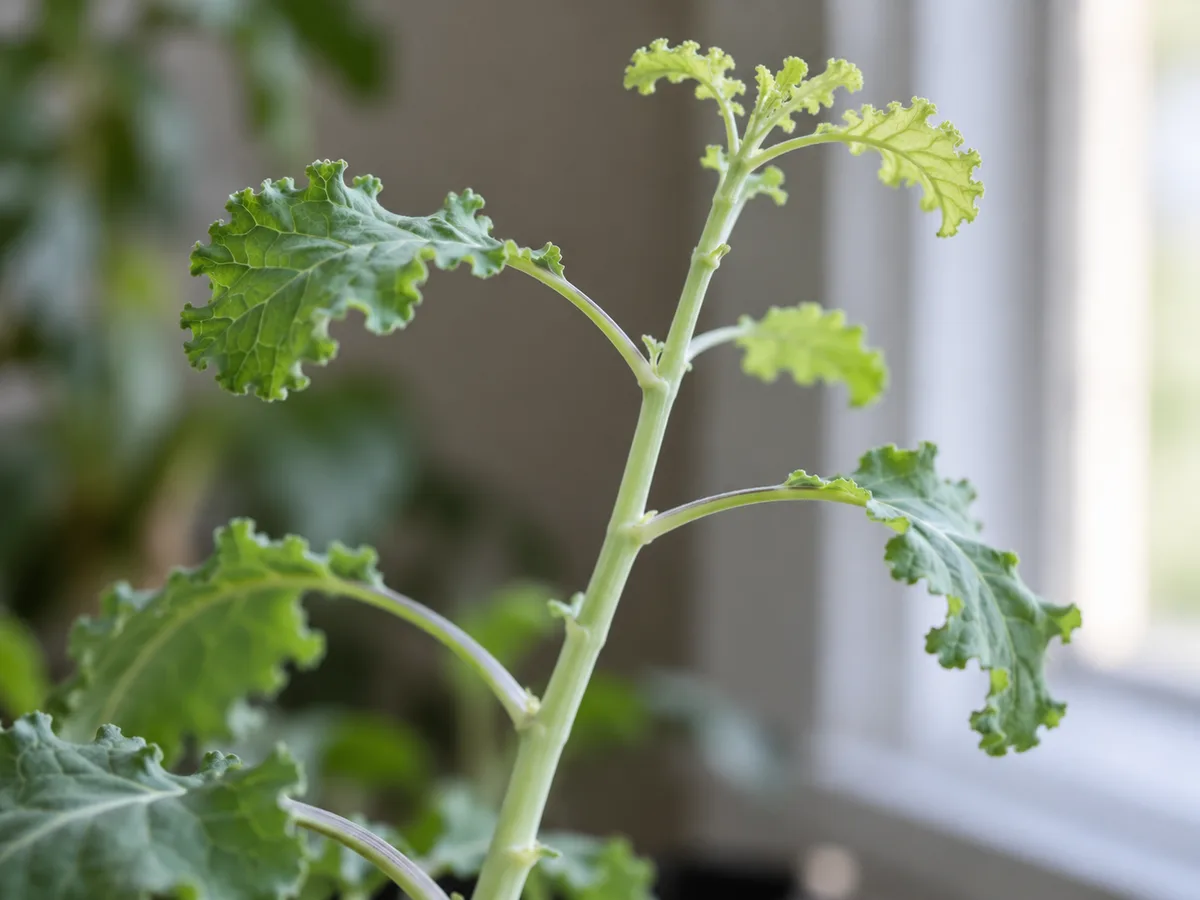
Pale, wide-spaced kale leaves in low light — compare new growth against older leaves on the same plant.
Typical signs include:
- Small, pale new leaves that never size up, sometimes yellowish-green instead of the cultivar’s normal deep green or purple
- Wide spacing between leaf nodes along an elongated, thin stem — the plant visibly reaching
- Lean toward the brightest side, especially on balconies with a wall on one side
- Regrowth stall: outer leaves picked, center bud slow or completely static for weeks
- Soft, floppy texture rather than crisp leaf substance, with lower leaves yellowing and dropping early
- Seedlings that topple: indoor-started trays with long white-ish hypocotyls bending toward the window
One caution: shaded kale dries its pot slowly because transpiration drops. Soil that stays damp for days in a dim corner is a light problem disguised as a watering problem — check the watering rhythm rather than pouring on schedule. Compare your plant’s silhouette with the kale overview to see what compact cool-season growth should look like.
Why kale goes short of light
Kale is a cool-season sun crop, not a shade vegetable
NC State lists Brassica oleracea as performing best in full sun — six or more hours of direct sunlight daily — while tolerating partial shade of roughly two to six hours. The RHS phrases the same tolerance from the gardener’s side: kale likes sun but will also cope in light shade. “Cope” is the operative word. In light shade the plant survives; in full winter sun it crops.
Gardener’s Path frames kale as a cool-weather crop whose sun needs shift with temperature: full sun for cool-season harvests, relief from harsh afternoon rays when heat builds. On Indian plains this maps directly onto the October-to-March season — generous winter sun first, afternoon protection only when late-season warmth arrives.
The three most common light traps for kale
A shaded balcony treated as full sun. Courtyard walls, neighboring blocks, and overhead awnings can cut direct sun to two or three hours even on an “outdoor” balcony. Kale limps along there — alive, but with baby-leaf output from a plant you expected to harvest for months.
Seedlings started weak indoors. Trays on a dim sill or under a weak desk lamp stretch within days of germination. Those elongated seedlings never develop the stocky stem that supports months of outer-leaf picking, and transplanting them into good sun later only partly compensates.
Crowded pots shading themselves. Three seedlings in a small pot race upward against each other, and the losers stretch in their siblings’ shadow. Because kale is harvested leaf by leaf, one crowded container reads as a light problem on the inner plants even when the balcony itself is bright.
Shade also invites secondary trouble: NC State notes that downy mildew can form where full sun is not provided, so persistently dim, humid corners pair light hunger with disease pressure.
How to confirm the cause
Work through these checks on a clear day before moving anything:
- Hand-shadow test at the pot. Hold your hand 30 cm above the soil at midday. A sharp, dark-edged shadow means direct sun; a faint shadow means bright indirect; no shadow means too dim for vigorous kale. Count sharp-shadow hours across the day — six or more is the productive range.
- Read the newest growth, not old scars. Are the youngest leaves smaller and paler than foliage from nursery days, with wider gaps between nodes? Old blemishes from a shaded nursery shipment are not diagnostic; the last two weeks of growth are.
- Check the harvest response. Pick one mature outer leaf. If the central bud pushes nothing new within ten to fourteen days in cool weather while soil and water are reasonable, light is the likely limiter.
- Look for lean. A stem bending hard toward one opening confirms the plant is actively foraging for photons.
- Rule out heat and calendar. A thickening central stalk with bitter flavor in warming spring weather is bolting, not light hunger — extra sun will not reverse it. See leggy growth on kale to separate stretch from a flower stalk.
If pale small leaves, wide internodes, window lean, and stalled regrowth appear together in cool weather, insufficient light is confirmed. You do not need to unpot for this diagnosis.
The first fix to try
Move the container to the brightest cool-season position available — an open terrace, an unobstructed south or west exposure, or an east spot that still collects six hours through midday. One move, then wait.
For indoor-started seedlings, the equivalent first fix is strong light immediately: a full-spectrum LED run about 12–14 hours daily with fixtures close enough that new leaves emerge compact. A dim windowsill alone rarely raises stocky brassica seedlings.
Acclimate gradually if the plant lived in deep shade for weeks — three to four days of morning sun before a full-sun terrace position — so pale leaves do not scorch on day one. Then leave the pot alone for two weeks and watch the center bud. Full placement strategy lives in the kale light guide.
Step-by-step recovery
Once the plant sits in better light, rebuild in this order:
- Watch new nodes first. Within two to four weeks in cool weather, the newest leaves should emerge deeper in color and closer together. That confirms the placement works; nothing else needs changing yet.
- Thin crowding. If several seedlings share one pot, keep the stockiest and snip the rest at the base rather than disturbing roots. Self-shading is a light problem you can fix with scissors.
- Resume outer-leaf harvests lightly. Pick only the largest usable outer leaves and always leave the central bud intact — this cut-and-come-again rhythm is what the overview prescribes, and it only works once light supports replacement growth. Stripping a weak plant stalls it further.
- Recheck watering cadence. Brighter sun dries containers faster; a pot that needed water weekly in shade may need checks every two to three days in winter sun. Water by the top 2–3 cm test in the watering guide, not by the old calendar.
- Feed only after growth restarts. Once new leaves emerge compact and green, a modest nitrogen feed per the fertilizer guide supports leaf production. Feeding a still-stalled plant in dim light pushes soft growth it cannot sustain.
Do not repot during light recovery unless roots are clearly failing — a bigger pot does not add photons, and oversized containers stay wet longer around a slow-drinking plant.
Recovery timeline
Existing pale leaves and stretched stem sections never revert — they stay thin and light-colored for the life of the leaf. Judge everything by foliage that emerges after the move.
| Phase | What to expect |
|---|---|
| Weeks 1–2 | Little visible change; soil dries faster, center bud firms up |
| Weeks 2–4 | New leaves emerge greener and closer together in cool weather |
| Weeks 4–8 | Outer-leaf picking resumes; regrowth keeps pace with harvests |
| Late winter onward | If warmth builds past the mid-20s °C, expect flavor and bolting pressure instead — a calendar limit, not a light failure |
Worsening signs: new leaves stay tiny and bleached after six weeks in verified six-hour sun, lower leaves yellow rapidly with wet soil, or stems soften at the base. Recheck drainage and the overwatering and root rot guides — wet roots mimic light hunger.
Lookalike symptoms to rule out
| Pattern | New growth | Soil / pot | Likely cause | Next step |
|---|---|---|---|---|
| Low light | Pale, small, wide-spaced, leaning | Slow to dry | Insufficient photons | Brighten placement → this guide |
| Heat bolting | Thick central stalk, bitter leaves | Normal | Warmth + long days | Harvest promptly, resow next cool window |
| Nitrogen hunger | Uniform pale older leaves, adequate sun | Normal dry-down | Feeding gap | Fertilizer after light is verified |
| Overwatering | Yellow lower leaves, wilt in wet mix | Heavy, sour | Wet roots | Overwatering |
| Pest drain | Chewed holes, sticky residue, clusters | Normal | Aphids / caterpillars | Inspect undersides; see aphids |
Pale leaves alone prove nothing — light, nitrogen, water, and season all bleach kale. The combination of stretch, lean, and stalled regrowth in cool weather is what makes light the verdict. When lower leaves yellow with wet soil rather than stretch, start with yellow leaves on kale instead.
Mistakes to avoid
- Fertilizing a dim plant back to health. Nutrients cannot replace photons; feeding stretched kale in shade grows weaker tissue, not stronger leaves.
- Jumping from deep shade to a blazing terrace in one afternoon. Pale leaves scorch easily — acclimate over several days.
- Chasing light with water. A slow-drying pot in shade needs less water, not more; drowning the roots while waiting for sun adds a second problem.
- Stripping the plant “to let light in.” Removing outer leaves from an already weak kale removes its remaining photosynthetic area. Harvest lightly or not at all until new growth proves the fix.
- Forcing a summer crop on a hot lowland balcony. Extra hours of May sun plus heat produce bitterness and bolting, not tender leaves. Accept the cool-season calendar in the propagation guide instead.
How to prevent it next season
Sow from October into November on the plains so seedlings meet strengthening winter sun from day one. Site containers where the hand-shadow test already passes — the RHS recommends a sunny spot such as a large pot on a sunny patio — and keep that position through peak harvest, adding afternoon shade only when late-season heat arrives.
Match the container to the cultivar: at least a 20–30 litre pot for one standard plant per the soil guide, thinned early so seedlings never shade each other. On dim balconies with under four hours of direct sun, grow kale as short-cycle baby leaf or microgreens on the brightest sill rather than expecting months of full-size harvests. When growth stalls the following year, re-run the shadow test before assuming the mix or feed is at fault.
When to use this page vs other kale guides
Use this page when new leaves are pale and stretched, the plant leans, and outer-leaf harvests do not regrow in cool weather. Switch guides when the pattern differs:
- Stretch with no pale color and a thickening center in warming weather → leggy growth and bolting timing
- Growth slow but compact and well-colored → slow growth
- Yellow lower leaves with heavy wet soil → overwatering or root rot
- Placement, shade cloth, and grow-light setup questions → kale light guide
Related kale guides
- Kale overview — cool-season identity, cultivars, and India sowing windows; start here for season fit.
- Kale light — window orientation, shadow test, shade cloth, and grow-light hours.
- Kale watering — dry-down checks that change with sun exposure.
- Kale soil — fertile mixes and pH 6.0–7.5 that support sun-driven leaf growth.
- Kale fertilizer — nitrogen timing once light is adequate.
- Kale propagation — sowing dates and seedling care for strong starts.
- Leggy growth — stretch morphology and pruning after light is fixed.
- Slow growth — when compact plants still stall.
- Yellow leaves — water and nutrient yellowing that mimics shade pallor.
Conclusion
Not enough light on kale is a placement problem with a placement cure: pale stretched leaves and stalled outer-leaf regrowth mean the plant needs six or more hours of direct cool-season sun, not fertilizer or a bigger pot. Move the container once, thin any crowding, and let the next flush of compact green growth confirm the fix — old stretched tissue never shortens, but a well-lit central bud restarts the cut-and-come-again harvests kale is grown for. When spring heat arrives, reassess: shade manages warmth, but no amount of sun makes kale a summer crop on a hot lowland terrace.
How we wrote and verified this guide: Recommendations were checked against NC State Extension, the Royal Horticultural Society, Iowa State Extension, and Gardener’s Path references cited inline. Author: sai-ananth. Reviewer: LeafyPixels Review Board. Methodology: plant problem guidance is reviewed against botanical references, extension resources, and LeafyPixels plant-care data before publication. Claims validation: claims-validator-v1 pass with inline external links documented below. Last reviewed: 2026-09-05.